Columbia political scientist Robert Jervis reminds us that at one time “there were significant links between theory and U.S. policy,” a point echoed by one of the most influential civilian academic strategic theorists, Harvard Nobel laureate Thomas Schelling, who points out that “there was a wholly unprecedented ‘demand’ for the results of theoretical work: scholars had an audience and scholars had access to classified information. Unlike any other country … the United States had a government permeable not only to academic ideas but by academic people.” Footnote 1 But now there is growing concern that the gap between scholars and policymakers has widened in recent years, particularly in the realm of national security affairs. Footnote 2 Harvard professor (and former high-level State Department, Defense Department, and Intelligence Community official) Joseph Nye penned a widely-discussed article in The Washington Post, in which he opined that “’the walls surrounding the ivory tower never seemed so high.’” Footnote 3 In the view of many on either side of the chasm, the bridge between the Ivory Tower and the Beltway has become an increasingly rickety one.
This development is puzzling: It flies, for example, in the face of a wide-spread and long-standing optimism about the compatibility of social-scientific rigor and policy relevance that traces its origin back to the Progressive Era and the dawn of modern American social science. Footnote 4 As historian Barry Karl remarks of Charles Merriam, one of the founders of the modern discipline of political science, he “was an American activist of his generation before he was a political scientist; it was his reason for becoming a political scientist. He saw no conflict between activism and science. Indeed, he saw science as the essential precondition of useful activism.” Footnote 5 Today, few of Merriam’s successors maintain his dual commitment to science and reform.
Moreover, while not all scholars and policymakers agree that the two sides of this yawning Beltway-Ivory Tower chasm have had, or could have, much useful to say to each other in the realm of national security affairs, Footnote 6 the majority do. According to the most recent Teaching and Research in International Politics (TRIP) survey—a regular poll of international relations scholars—most believe they should contribute to policy-making in some way. And yet, the majority also recognizes that the state-of-the-art methodologies of academic social science constitute precisely those approaches that policymakers find least helpful. Footnote 7 A recent related poll of senior national security decision-makers confirms that for the most part academic social science is not giving them what they want. Footnote 8 So despite this general optimism, and the best of intentions among both scholars and policymakers, “the relationship between the federal government and the social sciences generally and historically, while substantial in scope, has not been altogether harmonious.” Footnote 9
Stephen Van Evera first coined the phrase the “Cult of the Irrelevant” to refer to the tendency among many American social scientists to frame and orient their work around internal, disciplinary criteria and agendas, and to ignore the relevance of their scholarship for addressing broader societal concerns, government policy needs, or the concerns of people in the “real world” more generally. Lawrence Mead characterizes the same phenomena as the “the New Scholasticism,” Ian Shapiro refers to it as “the flight from reality,” and John Mearsheimer laments that the academy has become a “self-enclosed world.” Footnote 10 Their common concern is that a social science guided primarily by internally-oriented research agendas and assessed by self-generated metrics of excellence is not likely to encourage members of the guild to speak to broader audiences nor gauge scholarly excellence by broader relevance criteria of social or political import. Footnote 11 The problem, in a nutshell, is that scholars increasingly equate rigor with particular techniques (mathematics and models) and ignore broader criteria of relevance. Footnote 12
In what follows I expand upon this theme with an account of the changing relationship between political science and one of its key subfields—security studies. I show how disciplinary trends in political science have fostered an increasing insularity and thus to the marginalizing of security studies, which has historically pursued both scholarly rigor and real-world relevance. In my view, these developments have been harmful both to sound scholarship and effective public policy, and so I advocate a more engaged form of political science in which security studies and other policy-relevant sub-fields can prosper.
To be clear, I am not arguing that scholarship that is formal or quantitative is by definition irrelevant. Indeed, one can point to examples of both that are. When applied to economic issues, the discipline of economics has managed to be both highly “scientific” and, at times, quite relevant, though for both good and ill. Footnote 13 Likewise, there are examples of highly quantitative political science that policymakers have found useful. Footnote 14 Finally, there is much non-quantitative scholarship, particularly but not exclusively in the humanities, that is jargon-laden and otherwise inaccessible to a wider audience. Rather, what I am arguing is that when scholars appear to embrace these approaches for internal, disciplinary reasons rather than because they can help us answer substantively important questions, they are of at best “mixed” benefit to policymakers. Footnote 15
A number of political scientists have argued that security studies should vigorously embrace cutting-edge methodologies in order to be better integrated into the discipline of political science. Nuclear strategist Bernard Brodie once advocated making strategy into a “science,” and commended economics as the model for doing so. Footnote 16 More recently, Jeffrey Frieden and David Lake argue that “only when International Relations brings science to the discussion does it have anything of enduring value to offer, beyond informed opinion.” Footnote 17 But in doing so, they ignore that the sub-field pioneered cutting-edge social science methods early on, significantly contributed to their development, but soon discovered their limitations, well before the rest of the discipline. Footnote 18
These dangers are particularly evident in the field of security studies, and indeed they were acknowledged, long ago, by some of the early proponents of the effort to make it a “science.” In a letter to James Holland of the Army War College, Brodie later confessed that he was a “trifle uneasy” about his early call to make strategy a science modelled on the methods of economics: “I must tell you,” he wrote, “that I am not so disposed today as I was then to toss so many bouquets to the economists. It is not the substance of what I say in that paper that bothers me so much as the tone. I am concerned with the fact that the relevant political issues tend to be automatically de-emphasized by giving so much emphasis to the comparability of strategy with economics.” Footnote 19 More recently, Thomas Schelling admitted that he “was surprised and somewhat perplexed” when he received the Bank of Sweden Prize in Honor of Alfred Nobel in part for game theory, which he applied to national security policy issues in the 1950s and 1960s, given that by 2005 what he did “was not recognizable as game theory,” given subsequent technical developments in academic economics. Footnote 20
David Ricci characterizes as a “tragedy” that the discipline of political science’s initial effort to become more scientific so it could better guide policy has ironically made it less relevant to policymakers. Footnote 21 But why does it matter if academic political science has become increasingly irrelevant to the policy world? New York Times columnist Nicholas Kristof ignited a forest fire in the groves of academe when he lamented that the discipline, his “onetime love … seems to be trying, in terms of practical impact, to commit suicide.” Footnote 22 Following on the heels of the US Congress’s decision to restrict the National Science Foundation’s political science funding on the grounds, in former House Majority Leader Eric Cantor’s words, that “funds currently spent by the government on social science—including on politics of all things—would be better spent helping find cures to diseases,” it is not surprising that Kristof’s remarks singed the professoriate. Footnote 23 The subfield of international security studies can plausibly claim to save lives and so its marginalization is a self-inflicted wound at a time in which members of Congress demand greater relevance from the discipline.
I begin by documenting the decreasing policy relevance of political science. I then argue that this retreat from relevance has two primary sources. The first is the increasingly recognized tendency of academic disciplines, for reasons of professionalization and organizational interest, to become narrower and more internally focused. The second, less commonly discussed, is the responsiveness of the academy to the international security environment. War or intense international security rivalry more generally generate opportunities, incentives, and sometimes even imperatives for political scientists to transcend their disciplinary insularity, place a premium on relevance, and foster greater integration between academia and government. At such times there is optimism among social scientists about the compatibility of scientific rigor and concrete relevance. But there are also enduring tensions between those two values, which reemerge during times of peace and relative security. I trace this general pattern of the waxing and waning of policy relevance in the field of US security studies in the twentieth century and show that war and disciplinary dynamics account for it. I conclude by anticipating some likely objections and then offering some recommendations for how to reestablish the balance between rigor and relevance in political science.
The Declining Relevance of Political Science
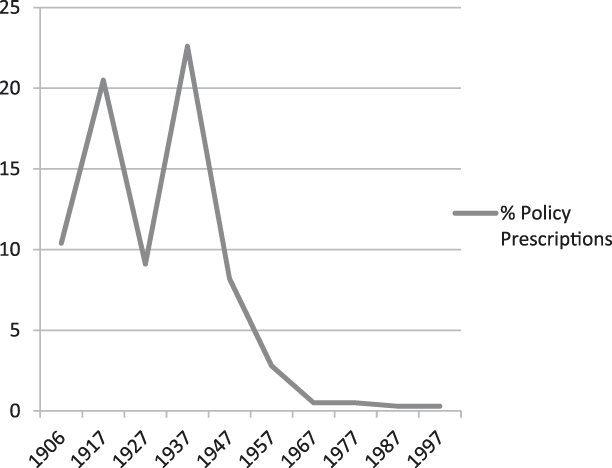
One important piece of evidence of the declining relevance of our discipline was furnished in Lee Sigelman’s Reference Sigelman2006 centennial American Political Science Review essay, “The Coevolution of American Political Science and the American Political Science Review.” His data (refer to figure 1) demonstrates that the policy relevance of articles published in the APSR, measured in terms of whether they offered “policy prescription,” has declined markedly in recent years. Footnote 24 This led him to conclude that “by the early 1960s, prescription had almost entirely vanished from the Review. If ‘speaking truth to power’ and contributing directly to public dialogue about the merits and demerits of various courses of action were still numbered among the functions of the profession, one would not have known it from leafing through its leading journal.” Footnote 25
Percentage of policy-relevant articles in APSR (1906–2006)
Source: Sigelman Reference Sigelman2006, 466, table 2, column 2 and 3. These judgments of whether an article offers a “policy prescription” are Sigelman’s.

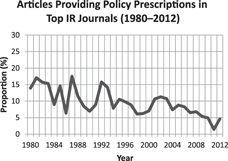
While one might dismiss Sigelman’s codings as idiosyncratic, there are reasons to be confident that they measure real trends. As the editor of the journal, he was intimately familiar with the trends within its pages. And his results track well with assessments of trends in other scholarly journals. Figure 2 shows the results of a similar analysis of leading international relations journals (including the APSR) from 1980 through 2011, which demonstrates the same decline as in the Sigelman data continuing through to the present.
Policy prescription used in top IR journals since 1980
Note: The Teaching and Research in International Politics journal coding project is described in Maliniak et al. Reference Maliniak, Oakes, Peterson and Tierney2011, 437-464. The data from which I generated these figures is available at http://www3.nd.edu/∼carnrank/.

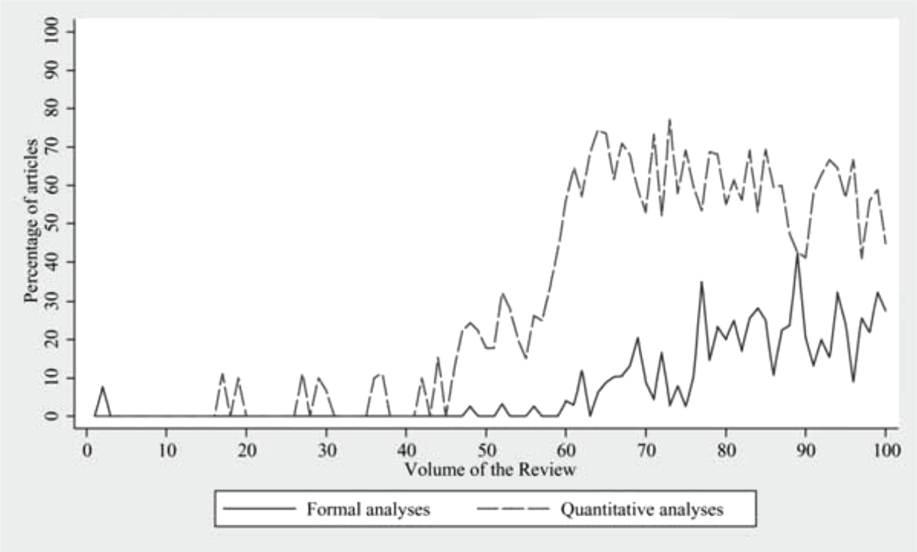
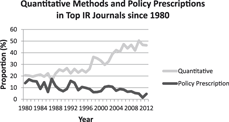
Accompanying these trends has been a movement among many political scientists to regard economics as the epitome of rigorous social science and hold up its methods as a model for their discipline. Footnote 26 This increasing dominance of political science by such “scientific” approaches coincided with its decreasing relevance to policy issues, as figures 1, 2, 3, and especially 4 make clear. Political scientists Andrew Bennett and John Ikenberry explain that “the increasing technical specialization of the profession has made it more difficult for policymakers and citizens to understand and make direct use of political science research.” Footnote 27 Some go further and argue that as the discipline has become even more wedded to these approaches, it has ceased to even try to be relevant to current policy concerns. Footnote 28 The problem is that many political scientists have internalized the notion that the hallmark of science is method (how you know something), rather than the substance of what is learned. Footnote 29 Why is this the case?
The dominance of “scientific” approaches to the study of politics
Source: Sigelman Reference Sigelman2006, 469, figure 4.

And the same trend recently in IR
Note: The Teaching and Research in International Politics journal coding project is described in Maliniak et al. Reference Maliniak, Oakes, Peterson and Tierney2011, 437-464. The data from which I generated these figures is available at http://www3.nd.edu/∼carnrank/.

The Waxing and Waning of Relevance in Political Science
Social science, at least as it has developed in the United States since the early twentieth century, has tried to balance two impulses: to be a rigorous science and a relevant social enterprise. But tension between “rigor” and “relevance” is inevitable. As Thomas Gieryn explains, there is “in science, an unyielding tension between basic and applied research, and between the empirical and theoretical aspects of inquiry.” Footnote 30 During wartime, the tensions between these two impulses have been muted, especially among those disciplines of direct relevance to the war effort; in peacetime, they reemerge and there are a variety of powerful institutional incentives within academe to resolve them in favor of a narrow definition of rigor that slights relevance.
War Builds the Bridges between the Ivory Tower and the Beltway . . .
The international security environment—among the most intense of external stimuli Footnote 31 —can overcome internal disciplinary tendencies during periods of war or heightened threat and foster cooperation between academia and government. Footnote 32 This logic follows from the substantial literature on war’s effect on domestic politics. Footnote 33 War solidifies relations between the government and other elements in society. Footnote 34 There are two specific mechanisms that lead to higher levels of wartime cooperation between government and academia. First, the need for wartime expertise leads policymakers to look to universities for natural and social science knowledge that could further the war effort. Second, a common sense of threat fosters a rally-around-the-flag effect and stimulates increased patriotic sentiment that affects even professors. Footnote 35 This sentiment tilts the balance of opinion within the disciplines in favor of a broader definition of rigor that does not exclude relevance. Footnote 36
. . . and Peace Weakens Them
Based upon this wartime experience, there is initially optimism among social scientists about the long-term compatibility of rigor and relevance. Footnote 37 But there are also tensions between those two objectives that peacetime allows to re-emerge. Left to their own devices, academic disciplines tend to resolve these tensions by becoming narrower and more internally focused. Footnote 38 While a variety of different factors play some role in the peacetime decline in policy relevance among social scientists, Footnote 39 I focus on the process of “normal science” and the impact of institutional dynamics—both vested interests and institutional self-image. Organizational interest explains why the social sciences tend to isolate themselves from the rest of society and the culture of “science” accounts for the particular way in which they do so. Footnote 40
The first logic for the decreasing relevance of social science flows from the dynamics of the scholarly enterprise itself. Given the limits of individual human cognition, it is often only through an intellectual division of labor that science can progress. Footnote 41 Philosopher of science Thomas Kuhn explains how growing specialization advances normal science: “By focusing attention upon a small range of relatively esoteric problems, the paradigm forces the scientist to investigate some part of nature in a detail and depth that would otherwise be unimaginable.” Footnote 42
However, this progress comes at the cost of the increasing isolation of the various specialties from each other and from society as a whole. In process similar to that through which Max Weber feared that modern rationalism would construct the “iron cage” of bureaucracy, the process of normal science has fostered an intellectual withdrawal from policy relevance among the social sciences. Footnote 43 Its hyper-fragmentation of knowledge now makes it difficult for even scholars in different disciplines to understand each other, much less policymakers and the general public. Footnote 44 The result is that many academics no longer deal with issues of interest to broader society. Footnote 45 In other words, the development of modern science itself makes it less directly applicable to concrete problems as it becomes more specialized. Footnote 46
Second, traditional theories of organizational behavior would attribute the decreasing relevance of academic social science to the fact that universities, like most other complex organizations, seek autonomy, the reduction of uncertainty, and more resources. Footnote 47 When these goals conflict, organizations almost always prefer the first. Disciplinary organizational interest can encourage scholars to separate themselves from non-specialists by using language and approaches that are inaccessible to the laity. Footnote 48 Many social science disciplines such as political science deal with issues that are not otherwise inherently difficult for educated laypersons to engage. To maintain their autonomy and claim to expertise they need to construct higher barriers to entry. Sophisticated social science methods (modeling, statistics, or abstruse jargon) offer an ideal barrier to entry for the non-professional because they take considerable investment in time and effort to learn. One does not have to be as cynical as George Bernard Shaw, who famously quipped that “‘all professions are conspiracies against the laity,’” to believe that the increasing withdrawal from relevance within the social sciences is also fostered by disciplinary vested interests. Footnote 49 A reinforcing set of organizational incentives are “sunk costs” and the resulting “law of the instrument” mentality, which lead many scholars who invest time and intellectual capital in learning these sophisticated techniques to try to amortize this investment by either choosing only questions amenable to them or forcing questions that are not into that template. Footnote 50 Eschewing policy engagement is also a way for social scientists to avoid unwonted political controversy. Footnote 51
Finally, a different, but complementary, organizational-culture explanation for the retreat from relevance in social science involves how academic disciplines define rigor and the incentives individual members of a discipline have to adopt similar approaches to each other. One of the hallmarks of science is its ability to measure causes and effects precisely, especially in mathematical terms, so the use of mathematics becomes the technique of choice. Footnote 52 It becomes ubiquitous because, as Harold Wilensky explains, “in modern societies, where science enjoys extraordinary prestige, occupations which shine with its light are in a good position to achieve professional authority.” Footnote 53 The result is that most of the professional incentives academics face today lead them write for each other and pursue disciplinary agendas, rather than write more accessibly and address issues of broader import. Footnote 54
One mechanism for the privileging of technique over relevance is the process of academic peer review, which fosters “homogenization of opinion.” Footnote 55 Through that process, moreover, even a small group of scholars committed to a narrow definition of rigor can have a disproportionate influence on the development of the discipline. Footnote 56 The initiation of peer review in the APSR in the early 1960s had this result. Footnote 57 Sigelman confirms that this process “makes it more likely that a given paper will be selected for publication because it passes muster among a narrow range of specialists rather than because it is considered to be of potentially great interest and importance to a broad range of readers. The end product may be a wide array of narrower articles—greater diversity at the price of even greater fragmentation.” Footnote 58
While the professionalization of a discipline and its increasing irrelevance to concrete policy issues is neither historically nor logically inevitable, there nonetheless seems to be an elective affinity between these two trends. Footnote 59 First, the increasing emphasis on quantitative research has led to narrower research questions that are often too abstruse or obscure to be relevant to policy. Footnote 60 Second, many proponents of the scientific study of politics believe that advocacy of particular policies is incompatible with scientific objectivity and so avoid it. Footnote 61 Third, many pressing policy questions are not readily amenable to the preferred methodological tools of social scientists. Footnote 62 For example, while statistics and survey research are useful to policy makers for gauging public opinion, the cutting-edge mathematical tools of Systems Analysis proved useless, if not counterproductive, as a basis for formulating higher-level US national security policy. Footnote 63 Finally, even when the results of these approaches are relevant to policy questions, they are often not presented in an accessible way for policymakers or the broader public. Footnote 64 In other words, there are good reasons for believing that the effort to make political science more “scientific” would tend to make it less policy relevant.
The Waxing and Waning of Security Studies in American Political Science
The history of the last century shows that academic political science has been more receptive to balancing methodological rigor with practical relevance in wartime than was the case in peacetime, particularly in subfields that could directly contribute to the war effort. Process evidence shows that once the war is over or the threat recedes, disciplinary dynamics once again exacerbate tensions between rigor and relevance, with the result that political scientists tend to favor a narrow definition of the former that excludes the latter.
Over the last century war has fostered closer ties between the US government national security community and the academy. Indeed, RAND consultant Warren Weaver explains that this “cooperation [between the two] has resulted only from the pressure and necessity of war.” Footnote 65 In times of war the willingness of American academics to contribute directly and indirectly to the war effort increases markedly. As the data in figure 1 confirms, the policy relevance of political scientists spiked during the First and Second World Wars and gradually declined during the Cold War.
In the face of what was widely recognized as a total war, the Wilson administration mobilized broad swathes of the university community to support the war effort. Academics snapped to attention and were among the First World War’s greatest boosters; many were eager to serve directly in government. Footnote 66 One motive was the Progressive Era “service ideal.” But self-interest was also a factor. As Richard Hofstadter notes, “the war itself, ironically, raised many [intellectuals] to heights of influence as no domestic issue could. Historians and writers were mobilized for propaganda, and experts of all kinds were recruited as advisers. Military Intelligence, Chemical Warfare, and the War Industries Board swarmed with academics, and Washington’s Cosmos Club was reported to be ‘little better than a faculty meeting of all the universities.’” Footnote 67 The most extensive effort to marshal academic talent for the war was the Inquiry, whose 150 scholars produced almost 2,000 reports, drafted nearly 1,200 maps, and some of whom traveled to Paris after the Armistice to serve as advisors to the American delegation during the post-war negotiations. Footnote 68
As with so many other aspects of American society, the mobilization of the country’s intellectual resources for the Second World War was even more extensive. World War II was revolutionary not only in terms of innovative new military technologies (especially the atomic bomb) but also the role of civilian experts played in fostering them and formulating the strategies for how to employ them. Footnote 69 Historian Barry Katz notes that the social sciences were called to the colors in a major way:
World War II has been called the physicists’ war in deference to the unprecedented recruitment of the scientific community to government service and the historic pooling of intellectual effort that followed … . It was also, however, the economists’ war—and the sociologists’, the historians’, the philosophers’ war—even if, viewed from the perspective of the human sciences, it ended less with a bang than a whimper. The social sciences and the humanities were called to arms in an intellectual mobilization that pressed into government service a community of academic scholars that was no less extraordinary than that of their scientific counterparts. Footnote 70
The area of the war effort to which scholars—particularly historians and area specialist social scientists—contributed the most was intelligence. As Harvard diplomatic historian William L. Langer recalls, “when General William J. Donovan in August 1941 organized what later became the Office of Strategic Services, his chief aim was to bring into government service scholars who, in addition to their specialized knowledge of foreign countries, were trained in particular disciplines and thoroughly grounded in the methods of assembling, selecting, evaluating, and presenting evidence.” Footnote 71 The locus for this was the “Research and Analysis Branch,” the O.S.S.’s analytical heart. As an intelligence organization it was remarkable for its ideological diversity, including some famous Marxists among its analysts such as Herbert Marcuse, Franz Neumann, and Otto Kirchheimer. Footnote 72 By the war’s end, the Research and Analysis Branch of the O.S.S. would employ nearly 700 people in Washington and around the world, most of whom were scholars drawn from social science fields like political science, economics, geography, psychology, and even archeology.
Building upon this wartime experience, the Department of Defense and the services promoted policy-relevant social science research early in the Cold War by establishing more permanent connections on university campuses. The post-war return of regional specialists to campus made it possible to do so through “area studies” research centers. Footnote 73 Soviet Studies would become the model for many of them. Footnote 74 The most prominent of which was Harvard’s Russian Research Center (RRC), established thanks to an Air Force grant to study the psychological effects on Russia of nuclear strikes as part of Air Force targeting. Footnote 75
The collapse of détente with the Soviet Union and the rekindling of the Cold War in the late 1970s and early 1980s ushered in what one scholar dubbed a “renaissance” in security studies: its “marriage” with social science promised to raise “its standing with in the academic world” after their post-Vietnam estrangement. Footnote 76 While the deteriorating international security environment was the key factor driving this renewed academic interest in policy-relevant scholarship on topics such as deterrence theory, nuclear strategy, general purpose forces, US grand strategy, and the interface between security studies and the disciplines of history and international relations, there was still concern among individuals such as Ford Foundation President McGeorge Bundy that “the field of international security was not deeply rooted in the academic world.” Footnote 77 To deepen those roots, he and other philanthropic leaders provided support for the establishment and growth of a number of centers devoted to brokering the nuptials of national security policy and social science.
Finally, Secretary of Defense Robert Gates’ 2008 Minerva Initiative is evidence of the dissatisfaction among policymakers with purely in-house research and analysis and also the desire to stimulate useful scholarly input into some of the most pressing post-Cold War security issues. It clearly indicated a commitment to rebuild the bridges between the Beltway and the Ivory Tower by funding policy-relevant social science research on issues such as the consequences of cultural and religious change; the ideologies of terrorist groups; military transformation in China, the national security consequences of environmental change; new theories of deterrence; and the dynamics of failing states. Footnote 78 In the wake of 9/11 and wars in Iraq and Afghanistan another new cohort of security scholars has emerged, committed to employing the cutting-edge tools of political science but also applying them to pressing policy problems such as the war on terrorism and nuclear proliferation. Footnote 79 Many of these individuals either came to academia after serving in Government or the military or would take time out of their scholarly careers to work directly in the policy world. Their apparent success has led to renewed optimism that a stable balance between rigor and relevance can finally be established. Footnote 80 Once again, war or intense international security competition opened a door to greater academic willingness to cooperate with government.
But the flip side of my argument is that we ought to see a decline in such cooperation in peacetime or when the international security competition becomes more benign. Richard Betts attributes to the intellectual impulse to make war’s study a “science” this peacetime waning of support for policy-relevant security studies. Footnote 81 This pattern was clearly evident in periods of peace over the last century.
With the end of the First World War and the country’s more general retreat into isolationism, the role for academics—or anyone else for that matter—in foreign and defense policymaking, shrank dramatically. Footnote 82 The “new science of politics movement” took hold in political science in the early 1920s and “for the first time there emerged a school of thought which argued that the discipline should abandon extra-scientific activities and concentrate on building the systematic body of knowledge implicit in the term ‘science.’” Footnote 83 Similarly, in the waning days of the war in Vietnam and the beginning of détente and the opening to China, there was a marked change in the attitudes on campuses about academics participating in national security policymaking. As historian David Engerman notes, there emerged “a new kind of interface among the policy, public, and academic spheres, one that was more individual and less institutional.” Footnote 84 Finally, it was growing post-Cold War calls by other political scientists to “abolish the subfield of security studies” entirely that prompted Betts to make the case that security studies should survive. Footnote 85
The rise and fall of Yale’s Institute for International Studies (IIS) illustrates how the peacetime waning of academic interest in security studies is caused by resurgent tensions between a narrow definition of rigor and broader relevance within political science. In the period between its establishment in 1935 and its collapse in the early 1950s and subsequent relocation to Princeton, IIS for the first time in American history assembled an impressive group of scholars of international affairs who produced some of the most influential national security scholarship of their era. Among those were Nicholas Spykman, Arnold Wolfers, Frederick Dunn, William T.R. Fox, Bernard Brodie, Percy Corbett, Klaus Knorr, Gabriel Almond, Harold Lasswell, and William Kaufmann. The Institute also founded the journal World Politics, which for a time was the leading journal in the field. Footnote 86 Both the Institute’s and World Politics’ eventual fate proves the rule about the tenuous peacetime standing of national security affairs in academe.
The story of IIS’s short career is comprehensively told in the archives of the Rockefeller Foundation, which was the Institute’s major benefactor during its roughly 15 year existence. Yale’s initial effort to secure Rockefeller Foundation support for a program in international law and international relations in 1931 did not pan out. Footnote 87 One factor that seemed to play a role in the Foundation’s lack of enthusiasm for the original Yale program was the perception that it, in the words of a later IIS document, “was generally non-scientific and was concerned more with the description of unique events than with revealing the common elements in classes of events.” Footnote 88 In short, rigor trumped relevance in the interwar period. Footnote 89
A subsequent Yale proposal that sought to balance a more systematic social-scientific approach with direct policy relevance met with success. And in May of 1941, on the eve of the US’s formal entry into the Second World War, Rockefeller approved an additional three year grant of $51,500 for the Institute. Footnote 90 By now, the Institute was beginning to bear fruit. IIS’s highest impact publication was Spykman’s book, The United States and the Balance of Power, which came out after Pearl Harbor in early 1942 to much critical acclaim. Footnote 91 Yale contributed disproportionately to the war effort, primarily through the service of its faculty in the O.S.S. Yale’s president Charles Seymour had previously served in the Inquiry, personifying the direct link between these two major efforts to bring scholars into government during war-time. Footnote 92
In 1943, the Institute took stock of its role, and that of other university-based research centers in doing policy-relevant scholarship. Dunn, who had taken over from Spykman as director, penned an optimistic 10-page memorandum on the topic. Footnote 93 But by January of 1944, he had become more pessimistic, observing that within universities “the conditions sometimes found inhibit rather than encourage creative activity” in this area. Footnote 94 Seymour’s successor as president, A. Whitney Griswold, was lukewarm in his support for the Institute, due not only to personality clashes but also academic institutional biases. Footnote 95 Recall that the core philosophy of the Institute’s work was, in Dunn’s words, “the development of a more disciplined type of policy analysis.” Footnote 96 But its approach cut against the grain of both the traditional scholarly approach to research (the Institute sponsored a lot of team projects as opposed to supporting the work of individual scholars) and it paid scant attention to traditional academic disciplinary boundaries. It was not just Griswold who had reservations about IIS; Yale’s political science department also launched a campaign to de-emphasize international relations in favor of “’domestic’ political science.” Footnote 97 By 1954, Yale had lost six of the core IIS members and its main activities—policy research and World Politics—to other institutions. Wolfers remained at Yale and tried to make the best of the situation. But even his optimistic gloss on these developments to Rockefeller conceded that policy-relevant research had been severely curtailed at Yale as a result. Footnote 98
With the support of a friendly foundation, many of the IIS principals decamped to Princeton and set up shop again, bringing World Politics with them. For a brief time, Princeton became the key link between the new RAND Corporation and those academics still interested in doing policy-relevant research. Footnote 99 But the Princeton Center for International Studies was hardly a model of successful integration of national security studies into the disciplinary departments either. Footnote 100 In short, disciplinary dynamics and other academic trends made the peacetime place of national security studies in the academy tenuous, even during the supposed Golden Age of such cooperation in the early Cold War. Such a pattern does not auger well for the long-term prospects of current efforts to marry cutting-edge methods with policy relevance.
Response to Objections
Before concluding, I want to anticipate four potential objections to my argument. First, the seeming success of the new cohort of younger security scholars committed to employing methodologically sophisticated social-science techniques for analyzing security-related issues could support the view that rigor and relevance are “not necessarily in opposition to one another.” Footnote 101 But there are theoretical and historical grounds for pessimism that they have finally achieved a stable balance between them. The inherent tensions between basic and applied research can be managed but never fully eliminated. And previous periods of optimism about maintaining the balance inevitably gave way to a narrow definition of rigor assuming pride of place. When that happens, and scholars appear to embrace these approaches for disciplinary reasons, rather than because they can help us answer substantively important questions, they are at best of “mixed” benefit to policymakers. Footnote 102 A cautionary tale is the sophisticated social science work of the CIA-sponsored Political Instability Task Force, which some members of the Intelligence Community found useful but which struck others as “very rigid and self-righteous” and regional experts “disputed its findings and did not think its output was credible.” Footnote 103
A second objection might be that I have overstated the problem by ignoring the proliferation of new publication venues such as blogs (The Monkey Cage, Political Violence @ A Glance, Duck of Minerva, and Daniel Drezner.com) and professional journals such as Perspective on Politics that provide space for scholars to present more broadly accessible scholarship. Footnote 104 While these developments are certainly encouraging and may ultimately foster greater scholarly relevance, it is by no means certain they will. For every Monkey Cage that gets picked up by the Washington Post, there are large numbers of other blogs that do little more than increase the “noise” to “signal” ratio. Footnote 105 And as members of one group blog recently discovered, the receptivity of traditional academic organizations to them remains limited. Footnote 106 We also lack systematic evidence of blogs’ impact upon the policy community. Finally, as anyone who has ever sat on a political science tenure committee will attest, publication in the “big three” disciplinary journals (The American Political Science Review, The American Journal of Political Science, or The Journal of Politics) still carries more cachet than in more accessible journals. As the TRIP journal survey project demonstrates, the trends in leading international relations journals are also moving away from relevance.
A third objection could be that I have mischaracterized the whole relevance problem to begin with. One critique might be that I have overlooked the division of labor that has emerged between those who want to do policy-relevant work and those who maintain a purely academic focus. Footnote 107 But as the late Donald Stokes puts it, “in academic research circles . . . the ideal of pure inquiry still burns brightly.” Footnote 108 A key component of our modern image of science is the increasingly rigidly distinction between “basic” and “applied” research: the former pursues knowledge for its own sake while the latter seeks solutions to specific problems. Footnote 109 Basic research is necessarily driven by its own internal agendas and criteria so as not to contaminate the process of science with normative or practical considerations. Footnote 110 As the social sciences increasingly emphasized their “scientific” character, they became more disengaged from practical affairs suggesting that the division of labor often gives way to the marginalization of relevance. Footnote 111
A different version of this argument might maintain that the pursuit of basic research produces applied knowledge via a “trickle down” process. Footnote 112 In this view, the progress of “pure” science naturally confers policy benefits in much the same way that some believe that economic growth increases the wealth of the poorest, even if wealth is quite unevenly distributed. Footnote 113 Confidence in this reinforces many scholars’ inclination not to worry about whether their work is directly relevant. Footnote 114 But this image of basic research proceeding on its own without reference to practical problems is a caricature of how, in fact, the two realms relate to each other in practice, in which concrete problems often spur theoretical advance. Footnote 115 Moreover, the Department of Defense, the largest supporter of basic research in the early Cold War era, undertook a study of the relationship between basic and applied research—Project Hindsight—and concluded that had it waited for the former to produce useful results, the US military would have had far inferior weaponry. Footnote 116 We should therefore not assume that we can focus on basic science and assume useful application would automatically result.
Finally, the notion that science and politics ought to be kept separate on moral grounds is widely shared among scholars across the political spectrum. One critique of policy relevance is that it compromises scholars’ ethical principles because policy is often immoral. Footnote 117 A related reservation is that policy engagement threatens scholars’ scientific integrity. Footnote 118 Some even fear that American social science is so deeply infused with residual policy agendas that even today’s “scientific” political science is corrupted by it. Footnote 119 While there is no doubt that scholarly engagement with policy poses some moral conundrums, critics ignore a different set of moral issues that arise when they eschew engagement with practical affairs. Efforts to resolve this tension by simply throwing up a Chinese Wall between our twin obligations to both science and the wider world inevitably slights one obligation in favor of the other. Footnote 120 Stephen Van Evera ties this ethical obligation back to the health of the discipline, arguing that a broader ethical self-reflection is essential for the health of the discipline because “social science operates largely beyond accountability to others. Institutions and professions that face weak accountability need inner ethical rudders that define their obligations in order to stay on course. Otherwise they risk straying into parasitic disutility. Social science is no exception.” Footnote 121
Conclusions
In sum, the easiest case to make is that today’s Ivory Tower/Beltway gap is detrimental for policymakers and society as a whole. Policymakers need academic expertise because they have to make decisions about issues and areas of the world in which they often do not have deep expertise. Footnote 122 They look to the academy for the raw data—whether quantitative or historical—that they use in decision-making. They also depend upon the social sciences for the theories they use to analyze and make sense of this data. Since policymakers implicitly use theory in analyzing situations and assessing the various alternatives they have, it makes sense for them to be stated explicitly and analyzed systematically, which is the comparative advantage of social scientists. Academics likewise have the time to develop greater depth of knowledge in issues and regions than most policymakers can. The institution of tenure allows them freedom to explore controversial issues and take unpopular stands, at least in theory. Finally, university-based scholars also have fewer vested interests in certain policies and programs than do policymakers, though that is not to deny that they have their own institutional biases. Footnote 123
To be clear, my argument is not that scholars would make better policy than bureaucrats and elected officials. Academics have their own biases and different agendas. Footnote 124 But their voices should be heard in policy debates for precisely that reason. Our system depends upon the successful functioning of the “marketplace of ideas” and the system of checks and balances in which individuals and groups with various strengths and weaknesses and off-setting biases, contribute to the larger policy debate, thereby compensating for each other. Footnote 125 One can point to instances—the war in Vietnam and the recent Iraq War—in which had the majority consensus of scholars in academia influenced policy, the country’s strategic interest would have been better served. Footnote 126
Less widely recognized, and perhaps more controversial given the prevailing sentiments in the Academy in favor of a sharp distinction between “science” and “policy,” is my contention that the gap is ultimately bad for the generation of new knowledge. But as Peter Ordeshook explains, “the practical application of theory and experiences feeds back on our awareness of theoretical inadequacies and on our identification of phenomena that warrant generalization and theoretical understanding.” Footnote 127 Moreover, as we have learned from the recent NSF controversy, even the most sophisticated social science will be judged in the final analysis by what it tells us about things that affect the lives of large numbers of people and which policymakers therefore seek to influence and control. Footnote 128
Finally, while academics spend a lot of time thinking about their ethical obligations to the norms of their disciplines and their relations with students and colleagues, they talk less about the proper relationship between science and policy. Tellingly, the ethical obligation of political science to society has been a recurrent theme in presidential addresses at the American Political Science Association, implying that from the perspective of eminent senior scholars, the discipline periodically needs to be reminded of it. Most recently, Harvard’s Robert Putnam declared in 2002 that “attending to the concerns of our fellow citizens is not just an optional add-on for the profession of political science, but an obligation as fundamental as our pursuit of scientific truth.” Footnote 129
There is a middle ground between policy advocacy, journalism, and Fleet Professorship on one side, and scientism, methodism, and the Cult of the Irrelevant on the other. One way to find it is through a commitment to problem- rather than method-driven research agendas. Footnote 130 The discipline should likewise embrace a broader definition of rigor that encourages finding the most reliable answers possible to questions the rest of society regards as important using methods appropriate to them. Footnote 131 The process of peer-review is invaluable in connecting the wisdom of crowds with an individual scholar’s research but we should consider broadening the pool of potential reviewers to include policymakers and other outside consumers as well. Think tanks once played an important role as “transmission belts” from the Ivory Tower to government, rather than simply as holding pens for out of work politicians, and at least some of them today should again take up that role. Finally, we should consider rewarding scholars and ranking departments based upon not only scholarly metrics but also in terms of whether they speak to broader concerns of society. Footnote 132 That is how the discipline of political science can contribute to better policymaking, produce better scholarship, and fulfill its ethical obligation to the rest of society. It is only within such an approach to political science that policy-relevant security studies can not only survive, but thrive.