Significant outcomes
-
∙ Lower educational levels may be associated with higher risk of delirium development in hospitalised elderly patients.
-
∙ Delirium was more frequent among male patients, those patients with lower education and with respiratory disease, after controlling for age and medication.
-
∙ These findings might point out in the negative correlation between education and delirium in elderly hospitalised patients, which is in line with some previous studies.
Limitations
-
∙ This is an one-site study, with the selection of a sample recruited from an intermediate care unit in the referred hospital (São João Hospital Centre). So, the generalisability of these findings will need to be confirmed in future studies.
-
∙ The sample presented low education. Thus, the restricted range of educational levels may have resulted in attenuated correlations of education with delirium.
Introduction
Delirium, an acute disorder of attention and cognition, is a common and serious complication among elderly hospitalised people, affecting as many as 50% of these patients (Reference Inouye, Westendorp and Saczynski1). It has been associated with negative outcomes, such as risk of death, institutionalisation and dementia (Reference Siddiqi, House and Holmes2–Reference Leentjens, Rundell and Rummans4). This syndrome is usually multifactorial, resulting on a complex interrelationship between the patient´s baseline vulnerability (predisposing factors) and exposure to noxious insults (precipitating factors) during hospitalisation (Reference Leentjens, Rundell and Rummans4,Reference Inouye and Charpentier5).
Taking this into consideration, the concept of reserve capacity can represent an important new conceptualisation to capture this vulnerability to delirium (Reference Jones, Yang, Zhang, Kiely, Marcantonio and Inouye6,Reference Jones, Manly, Glymour, Rentz, Jefferson and Stern7). This concept was proposed, as a theoretical framework, to explain individual differences in the relationship between neuropathology and cognitive performance (Reference Katzman, Terry and Deteresa8), in a range of clinical disorders, such as dementia (e.g. Reference Stern9–Reference Dekhtyar, Wang, Scott, Goodman, Koupil and Herlitz13) or brain injury (e.g. Reference Saczynski, Inouye and Kosar14–Reference Bigler and Stern16), and in cognitive ageing (Reference Staff, Murray, Deary and Whalley17).
Reserve capacity has been examined with respect to the brain and cognitive reserve (Reference Stern18). The first one is related to the structure and integrity of the brain and considers that there are individual differences (accounted for by structural features, such as head size) in the amount of damage that the brain can tolerate before reaching a critical threshold for clinical expression. Cognitive reserve refers to the efficiency with which an individual can use alternate neural networks or cognitive strategies to cope with the brain’s pathology. There are two distinct mechanisms underlying this concept: neural reserve (the brain’s capacity to cope with pathology by using pre-existing cognitive processes) and neural compensation (recruitment of compensatory networks) (Reference Stern9,Reference Stern18).
Differences in cognitive reserve have been explained as a result of mental stimulation that individuals are exposed to over a lifetime, including educational attainment, complex occupational performance, pre-morbid intelligence or participation in cognitive and stimulating leisure activities (Reference Stern11,Reference Valenzuela and Sachdev19,Reference Valenzuela and Sachdev20). In this context, some instruments have been developed to assess the participation in these activities, such as the Lifetime of Experiences Questionnaire (Reference Valenzuela and Sachdev21). Regarding the pre-morbid intelligence, this indicator has usually been assessed by literacy or vocabulary measures (e.g. National Adult Reading Test) (Reference Schmand, Smit, Geerlings and Lindeboom22,Reference Nelson23).
Among the markers of cognitive reserve, educational attainment is the most widely studied, and it is not uncommon to find research where education alone stands in for this concept (Reference Valenzuela and Sachdev19,Reference Valenzuela and Sachdev20).
The robust association between lower educational levels and higher prevalence of dementia suggests that education may be the most important protective factor for dementia (e.g. Reference Dekhtyar, Wang, Scott, Goodman, Koupil and Herlitz13, Reference Mortimer and Graves24–Reference Hugo and Ganguli26). In the context of delirium, studies that analyse the relationship between education and delirium are scarce (Reference Jones, Yang, Zhang, Kiely, Marcantonio and Inouye6). Among these works, some have reported that individuals with low levels of educational attainment are at greater risk of delirium than individuals with more education (Reference Jones, Yang, Zhang, Kiely, Marcantonio and Inouye6,Reference Pompei, Foreman, Rudberg, Inouye, Braund and Cassel27–Reference Yang, Inouye, Fearing, Kiely, Marcantonio and Jones29). Particularly, Pompei et al. (Reference Pompei, Foreman, Rudberg, Inouye, Braund and Cassel27) found that low educational levels and living alone were significant risk factors for delirium, whereas more education (beyond 12th grade) was a protective factor. Low educational level was also identified as a risk factor for acute confusional state in elderly patients following hip surgery (Reference Galanakis, Bickel, Gradinger, Von Gumppenberg and Förstl28). After these studies, Jones et al. (Reference Jones, Yang, Zhang, Kiely, Marcantonio and Inouye6) verified in two large prospective cohorts involving hospitalised elderly patients that a 5-year difference in educational attainment was associated with 1.6-fold decrease in the odds of delirium.
Nonetheless, some other studies have not found any association between education and the risk of delirium (Reference Fisher and Flowerdew30–Reference Saczynski, Inouye and Kosar34). More recently (Reference Saczynski, Inouye and Kosar34), a study examined the relation of brain and cognitive reserve markers (including education) to the risk of postoperative delirium in elderly patients without dementia, in whom the markers, except for vocabulary knowledge, failed to predict delirium.
In spite of these previous studies, it is important to consider that most of them have been carried out in populations with high levels of educational attainment [e.g. in Jones et al. (Reference Jones, Yang, Zhang, Kiely, Marcantonio and Inouye6), 61% had 7–12 years of education], and in surgical wards (Reference Pompei, Foreman, Rudberg, Inouye, Braund and Cassel27,Reference Galanakis, Bickel, Gradinger, Von Gumppenberg and Förstl28,Reference Fisher and Flowerdew30,Reference Leung, Sands, Mullen, Wang and Vaurio33,Reference Saczynski, Inouye and Kosar34).
In this context, carrying out the present work in a different setting, that is, in intermediate care units (IMCU), could complement the previous studies, aiming to analyse the relationship between educational attainment and delirium in severely ill elderly hospitalised patients. In this way, it is hypothesised that patients with lower education would be more likely to develop delirium during hospitalisation than patients with higher levels of education.
Materials and methods
Sample
This study was carried out with a sample of elderly patients recruited from an IMCU of the Intensive Care Medicine Service in the university hospital – São João Hospital Centre (CHSJ), in Porto, Portugal. Inclusion criteria were as follows: aged 65 years and over and admission for at least 48 h. Patients with a total score ≤11 on the Glasgow Coma Scale (Reference Teasdale and Jennett35), blindness/deafness, inability to communicate or to speak Portuguese were excluded.
Procedures
The European Portuguese Version of the Confusion Assessment Method (CAM) (Reference Inouye, Van Dyck, Alessi, Balkin, Siegal and Horwitz36,Reference Martins, Lourenço and Pinto-De-Sousa37) was used for delirium assessment. This instrument assesses the presence, severity and fluctuation of nine delirium features: acute onset and fluctuating course*, inattention*, disorganised thinking*, altered level of consciousness*, disorientation, memory impairment, perceptual disturbances, psychomotor agitation or retardation and altered sleep–wake cycle. It also includes a diagnostic algorithm, based on the four cardinal features of delirium (previously marked with an asterisk). A diagnosis of delirium requires the presence of features 1, 2, and either 3 or 4.
In the original study (Reference Inouye, Van Dyck, Alessi, Balkin, Siegal and Horwitz36), CAM demonstrated high levels of sensitivity (94%–100%) and specificity (90%–95%), when validated against the ratings of geriatric psychiatrists, and high inter-rater reliability (k=0.81–1.0). In the Portuguese validation study (Reference Martins, Lourenço and Pinto-De-Sousa37), the CAM had a moderate sensitivity (79%) and an excellent specificity (99%), using the Diagnostic and Statistical Manual of Mental Disorders, fourth edition (DSM-IV-TR), as reference standard (38), and also good convergent validity, as well as a high inter-rater reliability (k=0.65–1.00).
In the present study, the CAM was rated by a trained interviewer based on observations made during a clinical structured interview and a formal cognitive assessment, using the Mini Mental State Examination (Reference Folstein, Folstein and Mchugh39), a cognitive global measure, and the Digit Span Test (Reference Wechsler40), an attention and work memory measure. The patient’s family or caregivers and nurses, were also interviewed about the patient’s prior cognitive performance and any recent cognitive change.
Complete socio-demographic and clinical characteristics of patients and hospital-related data were also obtained through chart review.
The hospital ethics committee approved the present study. Informed consent was obtained from the patient or their closest family, if the patient was unable to decide for him/herself.
Data analysis
The statistical analyses were performed using the Statistical Package for the Social Sciences Version 21.0 for Windows software (SPSS). Patient characteristics are presented as raw frequencies and percentages for categorical variables and as median, minimum and maximum for continuous variables, as normality could not be assumed.
For analysis of differences between the two groups, with and without delirium (according CAM rating), the Mann–Whitney test for continuous variables, χ2 test for paired categorical variables and Fisher’s exact test for dichotomous variables were used at a significance level of 0.05.
A logistic regression analysis was conducted to test whether differences in the risk of delirium during hospitalisation were related to educational attainment, controlling for variables known to be risk factors for delirium (Reference Inouye, Westendorp and Saczynski1,Reference Saxena and Lawley41,42). The OR and its 95% CI were calculated. A p-value<0.05 was considered statistically significant. Education attainment was treated as a continuous variable, considering the total years of formal education that patients had.
Results
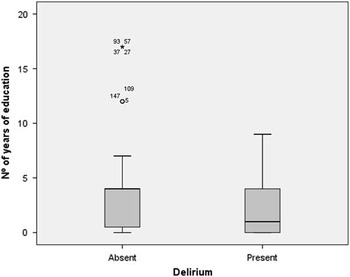
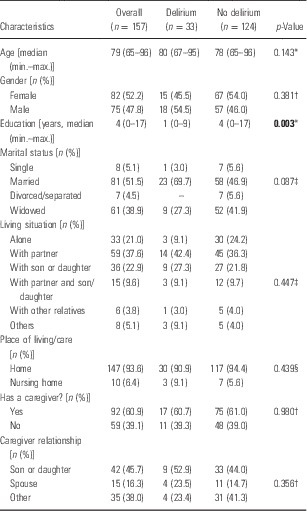
In the final sample (n=157), with a mean age of 78.85 (SD=7.61), the majority was female (52.2%), married (51.5%) and with low education level (0–3 years, 49%). Most of the patients lived with partner (37.6%) at home (93.6%) and had a caregiver (60.9%), in most of cases the son or daughter (45.7%). These socio-demographic characteristics did not differ significantly between the groups with and without delirium, classified by CAM, except for education (p=0.003), with the delirium group presenting the lowest value (Table 1). The median years of education among those who developed delirium was 1 (minimum 0 maximum 9), compared with 4 (minimum 0 maximum 17) years among those who did not (Fig. 1).
Number of years of education and delirium. The dots and stars represent outliers and extreme values in the data.

Demographic characteristics of sample

Bold values significant at p<0.05.
Max., maximum; min., minimum.
* Mann–Whitney test.
† χ2 independent test.
‡ χ2 exact test.
§ Fisher’s exact test.
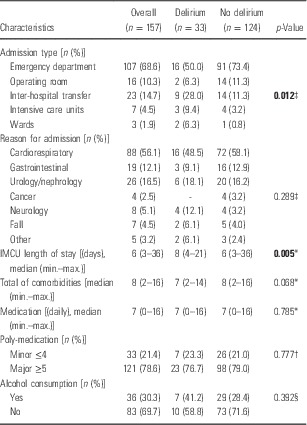
In relation to the clinical characteristics, the most common reason for admission was cardiorespiratory problems (56.1%). Concerning the admission type, the most frequent was emergency department (68.6%). The mean of length of stay in IMCU was 7.99 (SD=5.88) days. The average of the number of comorbidities was 7.86 (SD=3.40) and most of the patients (78.6%) presented poly-medication major (≥5 medication/day). In this sample, the majority (69.7%) did not consume alcohol (or did not report alcohol intake). According to the CAM, 21% of the patients had delirium. Comparing the two groups (with and without delirium), significant differences were only verified for admission type (p=0.012) and length of stay in the IMCU (p=0.005), with the delirium group presenting the highest duration of hospitalisation (Table 2).
Clinical characteristics of sample

Bold values significant at p<0.05.
IMCU, Intermediate Care Unit; max., maximum; min., minimum.
* Mann–Whitney test.
† χ2 independent test.
‡ χ2 exact test.
§ Fisher’s exact test.
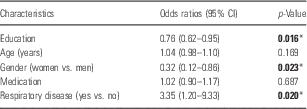
The Table 3 contains the results of the logistic regression model testing the linear effect of years of education as a predictor of delirium risk during hospitalisation. Through this analysis, it was possible to verify that delirium was more frequent among male patients (OR 0.32; 95% CI 0.12–0.86; p=0.023), as well as those patients with lower education (OR 0.76; 95% CI 0.62–0.95; p=0.016), and with respiratory disease (OR 3.35; 95% CI 1.20–9.33; p=0.020), after controlling for age and total number of medication.
Regression model of risk of delirium on educational attainment and control variables
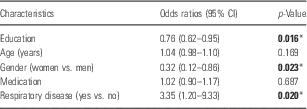
95% CI=95% confidence interval.
*p<0.05.
Discussion
The main results of the present study, found that delirium was more frequent among male patients, those with lower education and with previous respiratory disease.
Male gender is presented as a risk factor for delirium in previous review studies in mixed hospital settings (Reference Elie, Cole, Primeau and Bellavance43,Reference Noimark44). In Noimark’s review (Reference Noimark44), from eight studies analysed, six had reported an association between delirium and male gender, in accordance with the present results.
In agreement with prior studies (e.g. 45–47) the presence of chronic respiratory diseases was recognised as a predisposing risk factor for delirium in hospitalised patients, suggesting that they had some background brain vulnerability to delirium.
In relation to education, the findings of the present study might point to a negative correlation between education and delirium in elderly hospitalised patients, which is in line with some previous studies (Reference Jones, Yang, Zhang, Kiely, Marcantonio and Inouye6,Reference Pompei, Foreman, Rudberg, Inouye, Braund and Cassel27–Reference Yang, Inouye, Fearing, Kiely, Marcantonio and Jones29). Among these, two early prospective studies (Reference Pompei, Foreman, Rudberg, Inouye, Braund and Cassel27,Reference Galanakis, Bickel, Gradinger, Von Gumppenberg and Förstl28) have identified low educational level as a predictor for delirium, but only with a moderate to large effect size. In particular, Pompei et al. (Reference Pompei, Foreman, Rudberg, Inouye, Braund and Cassel27) found that elderly patients with delirium were less likely than those without delirium to have completed some education beyond the 12th grade (22% vs. 30%, p<0.05), and living alone was also identified as a risk factor. Likewise, Galanakis et al. (Reference Galanakis, Bickel, Gradinger, Von Gumppenberg and Förstl28) verified that elementary education only (OR 3.59; 95% CI 1.14–11.25; p=0.016), was a risk factor for delirium in elderly patients undergoing hip surgery.
In another study (Reference Jones, Yang, Zhang, Kiely, Marcantonio and Inouye6), with two large prospective cohorts of elderly hospitalised patients, a significant statistical difference in the mean years of education was found, with the delirium group presenting the lowest mean (9 vs. 11 years). In the present study, a significant difference regarding years of education was also found (1 vs. 4 years), in spite of the lower levels of educational attainment.
The association between education and delirium found in this work could be explained by the cognitive reserve concept. Accordingly, a higher educational attainment may enhance cognitive reserve by generating new or compensatory cognitive strategies (Reference Stern9,Reference Manly, Byrd, Touradji, Sanchez and Stern48) and it may increase brain reserve by promoting synaptic growth (Reference Katzman49). Considering this, lower education may lead to low cognitive reserve and increased vulnerability to stressor events that could precipitate delirium (Reference Jones, Fong and Metzger50,Reference Kolanowski, Fick, Clare, Therrien and Gill51). However, since education typically occurs in early lifetime, it is important to consider other forms of complex activities when assessing cognitive reserve (Reference Valenzuela and Sachdev21,Reference Kolanowski, Fick, Litaker, Clare, Leslie and Boustani52), such as occupational achievement, pre-morbid intelligence and cognitive activities (Reference Jones, Manly, Glymour, Rentz, Jefferson and Stern7,Reference Stern9). On the other hand, higher education can often lead to employment that involves high levels of intellectual and cognitive challenges, and can also lead to larger income, increased well-being, and to other factors that can shape lifestyle and promote involvement in physical, cognitive and social activities over a lifetime (Reference Jones, Manly, Glymour, Rentz, Jefferson and Stern7,Reference Kramer, Bherer, Colcombe, Dong and Greenough53). In this way, it is important to consider that all these factors can contribute to cognitive reserve. In this context, a more recent study (Reference Yang, Inouye, Fearing, Kiely, Marcantonio and Jones29), which evaluated the same cohorts as the Jones study (Reference Jones, Yang, Zhang, Kiely, Marcantonio and Inouye6), with hospitalised elderly patients, focussing on the role of activities in the delaying of clinical manifestations of delirium, found that not only education but also leisure activity participation (namely regular physical exercise) were protective against delirium. In addition, activity participation mediated the relationship between education and this syndrome.
It is also important to bear in mind some heterogeneity in the methodological issues between these previous studies and the present work, particularly regarding the setting and sample characteristics. The majority of these studies were carried out in surgical wards, focussing on the relationship between education and postoperative delirium. Despite the increased number of IMCUs in hospitals, there are few studies in the literature regarding delirium in this context, compared with the information on critically ill patient settings. In fact, the present study is the first one on the association between education and delirium in elderly patients recruited from IMCUs.
Moreover, most of these studies included highly educated samples, which is distinct from the current work, with lower educated patients. This may contribute to clarification of the role of only a few years of education in cognitive reserve, considering the scarce number of studies available on the present data.
The importance of assessment with standardised and referenced tools is also noteworthy. Thus, the inclusion of a standardised delirium assessment instrument is an undoubted strength of this study, particularly the recent European Portuguese Version of the CAM (Reference Martins, Lourenço and Pinto-De-Sousa37).
Nevertheless, this is a one-site study, with the selection of a sample recruited from an IMCU in the CHSJ hospital. So, the generalisability of these findings will need to be confirmed in future studies. Another limitation is related to the sample that presented low education. Thus, the restricted range of educational levels may have resulted in attenuated correlations of education with delirium.
In conclusion, lower educational levels may be associated with higher risk of delirium development in hospitalised elderly patients. These findings simply point out that the previously established hypothesis might be true in this population. Bearing this in mind, future studies are needed to clarify this association, as well as the role of other cognitive reserve markers, such as previous professional occupations, pre-morbid intelligence, cognitive, leisure and physical activities. This pinpoints the increasing interest in specific interventions that could promote cognitive reserve that can contribute to delirium prevention in elderly hospitalised patients.
Acknowledgements
The authors wish to thank clinical staff, patients and their families for the collaboration; also to Luís Filipe Azevedo and Emília Moreira for advice on statistical analysis. Authors’ Contribution: L.F. and M.R.S. participated in the definition and design of the study. S.M. and L.F. participated in the data collection and in the writing of the article. S.M., M.R.S. and L.F. contributed to the analyses and interpretation of the results, as well as to the critical revision of the article with J.A.P. All authors have approved the final manuscript.
Financial Support
The present work was supported by the Foundation for Science and Technology (SFRH/BD/63154/2009). The sponsor did not play any role in the design, methods, data collection and analyses, or in the preparation of the paper.
Conflicts of Interest
None.