Introduction
Irritable bowel syndrome (IBS) is a functional gastrointestinal disorder with a prevalence of around 11% (Lovell & Ford, Reference Lovell and Ford2012). It can be a debilitating condition that is associated with decreased quality of life and increased health care consumption (Talley et al. Reference Talley, Gabriel, Harmsen, Zinsmeister and Evans1995; Halder et al. Reference Halder, Locke, Talley, Fett, Zinsmeister and Melton2004). A number of psychological treatments have been shown to have beneficial effects on IBS symptoms (e.g. Lackner et al. Reference Lackner, Mesmer, Morley, Dowzer and Hamilton2004). However, the effects vary considerably among treatment studies and no single psychological approach has been shown to be superior in the treatment of IBS (Ford et al. Reference Ford, Quigley, Lacy, Lembo, Saito, Schiller, Soffer, Spiegel and Moayyedi2014). In recent years, interventions that explicitly target heightened anxiety and fear of IBS symptoms have been argued to be integral components of effective psychological treatments for IBS (Labus et al. Reference Labus, Mayer, Chang, Bolus and Naliboff2007; Wolitzky-Taylor et al. Reference Wolitzky-Taylor, Craske, Labus, Mayer and Naliboff2012). In particular, systematic exposure to IBS symptoms and IBS situations has been proposed to be an indispensable psychological intervention that can produce specific effects on IBS symptomatology (Ljótsson et al. Reference Ljótsson, Hesser, Andersson, Lindfors, Hursti, Rück, Lindefors, Andersson and Hedman2013). In line with this idea, a number of recent treatment studies have shown consistent and significant effects on IBS symptoms and quality of life following cognitive behavior treatment (CBT) programs that incorporate systematic exposure (Hunt et al. Reference Hunt, Moshier and Milonova2009; Craske et al. Reference Craske, Wolitzky-Taylor, Labus, Wu, Frese, Mayer and Naliboff2011; Ljótsson et al. Reference Ljótsson, Hedman, Andersson, Hesser, Lindfors, Hursti, Rydh, Ruck, Lindefors and Andersson2011a ).
Our research group has developed and evaluated a CBT program for IBS that is primarily based on exposure to IBS symptoms. The treatment is delivered via the internet in order to increase availability and reduce costs of delivery (see Andersson, Reference Andersson2009). In a series of randomized controlled trials, the treatment has produced reliable effects at post-treatment assessment with sustained effects at long-term follow-up (Ljótsson et al. Reference Ljótsson, Falk, Vesterlund, Hedman, Lindfors, Rück, Hursti, Andréewitch, Jansson, Lindefors and Andersson2010, Reference Ljótsson, Hedman, Andersson, Hesser, Lindfors, Hursti, Rydh, Ruck, Lindefors and Andersson2011a , Reference Ljótsson, Hedman, Lindfors, Hursti, Lindefors, Andersson and Rück b ). For example, Ljótsson et al. (Reference Ljótsson, Hedman, Andersson, Hesser, Lindfors, Hursti, Rydh, Ruck, Lindefors and Andersson2011a ) showed that the program was more effective in reducing IBS symptoms and improving quality of life than stress management treatment. While these findings do point to exposure as an effective treatment procedure for IBS, our program also incorporates other potentially effective psychological components besides exposure. This includes mindfulness training that has previously been shown to reduce symptom severity associated with IBS (Gaylord et al. Reference Gaylord, Palsson, Garland, Faurot, Coble, Mann, Frey, Leniek and Whitehead2011). The fact that the program includes other components precluded us from drawing a causal inference about the specific effect of systematic exposure.
In our most recently published randomized trial, the specific effect of exposure was tested in an add-on component study (Ljótsson et al. Reference Ljótsson, Hesser, Andersson, Lackner, El Alaoui, Falk, Aspvall, Fransson, Hammarlund, Lofstrom, Nowinski, Lindfors and Hedman2014). In this study, 309 patients with IBS were randomized to the full treatment protocol or to the same protocol without systematic exposure (but including psychoeducation, mindfulness training, and instructions to reduce avoidant and symptom control behaviors). All aspects were held equal with the only exception that patients randomized to the full protocol were also instructed to perform exposure exercises. Intention-to-treat (ITT) analysis showed that experimental condition (i.e. full treatment protocol) had an incremental effect on IBS symptoms compared with the control (i.e. protocol without exposure) post-treatment. The effects were maintained at a 6-month follow-up. While the between-group effect was statistically significant, the magnitude of the incremental effect of exposure on IBS symptoms was in the range of small to moderate.
However, the average causal effect (ACE) based on the full ITT sample is less informative if not all randomized patients receive the treatment (Angrist et al. Reference Angrist, Imbens and Rubin1996; Little & Yau, Reference Little and Yau1998). In other words, while ITT analysis provides an unbiased estimate of the causal effect of treatment assignment, even in the presence of non-compliance, it does not provide an accurate causal estimate of the treatment per se when not all receive (or comply with) the treatment. In addition, when compliance status is associated with missing data, ITT analysis can result in a biased ACE estimate (Frangakis & Rubin, Reference Frangakis and Rubin1999; Jo, Reference Jo2007; Jo et al. Reference Jo, Ginexi and Ialongo2010). In our trial, only 55% of the patients (n = 84) in the experimental condition completed all modules of the treatment that were prerequisites for accessing the isolated systematic exposure component. Thus, a substantial proportion of those randomly assigned to the experimental condition were not exposed to the particular psychological intervention that was tested in the trial (i.e. exposure) and hence aggregating across individuals who received the intervention and those who did not, as done in standard ITT analysis, may result in an inaccurate causal estimate of the effect of systematic exposure.
In the current study, we reanalyzed the data from our latest randomized controlled trial by taking into account compliance status in estimating the causal effect of systematic exposure. In the current study, we defined a complier as a participant who had been exposed to the treatment material as intended (see also Christensen et al. Reference Christensen, Griffiths and Farrer2009). The key problem involved in analyzing trials with non-compliance is that compliance status is an intermediate post-assignment variable that is not under experimental control (Angrist et al. Reference Angrist, Imbens and Rubin1996). The characteristics of individuals who are compliers are often different from the rest of the sample, and standard methods used to analyze trials with noncompliance, such as per-protocol and as-treated analyses, ignore this fact (Jo & Muthén, Reference Jo, Muthén, Marcoulides and Schumacker2001; Jo, Reference Jo2002b ). Such procedures break randomization and make the comparison statistically unfair, resulting in biased estimates of causal effects (Jo, Reference Jo2002b ). However, based on the potential outcomes framework for causal inferences (also known as the Rubin's causal model; Rubin, Reference Rubin1974; Holland, Reference Holland1986), analyses of the so-called complier average causal effect (CACE) have made it possible to obtain unbiased causal estimates in intervention studies with non-compliance under clear assumptions (Angrist et al. Reference Angrist, Imbens and Rubin1996; Imbens & Rubin, Reference Imbens and Rubin1997; Little & Yau, Reference Little and Yau1998; Jo & Muthén, Reference Jo, Muthén, Reise and Duan2003).
The current study estimated CACE in the latent variable modeling framework (Jo & Muthén, Reference Jo, Muthén, Marcoulides and Schumacker2001, Reference Jo, Muthén, Reise and Duan2003; Jo, Reference Jo2002b ). This allowed us to reanalyze our data from our latest trial in order to (1) examine the specific effect of exposure among those who actually received the exposure intervention (i.e. compliers), and (2) explore pre-treatment patient characteristics as predictors of both compliance status and outcome changes across and within different subsamples (i.e. non-compliers and compliers).
Methods
Study design and sample
Data for this study was obtained from a previously published randomized add-on component study. The procedures for recruitment, screening, measures and interventions are reported in full elsewhere (Ljótsson et al. Reference Ljótsson, Hesser, Andersson, Lackner, El Alaoui, Falk, Aspvall, Fransson, Hammarlund, Lofstrom, Nowinski, Lindfors and Hedman2014). The study was reported following the standard outlined by the CONSORT for a non-pharmacological randomized trial (Boutron et al. Reference Boutron, Moher, Altman, Schulz and Ravaud2008). A total of 309 participants were enrolled in this study and they were recruited through advertisements in newspapers and postings online. Inclusion criteria were a diagnosis of IBS given by a physician, fulfillment of Rome III criteria for IBS (Longstreth et al. Reference Longstreth, Thompson, Chey, Houghton, Mearin and Spiller2006), and age ⩾18 years. Exclusion criteria were presence of alarm symptoms that had not been examined by a physician (including blood in stool, persistent diarrhea, rapid weight loss, or recent change in bowel habits if older than 50 years of age) (Spiller et al. Reference Spiller, Aziz, Creed, Emmanuel, Houghton, Hungin, Jones, Kumar, Rubin, Trudgill and Whorwell2007), history of inflammatory bowel disease, lactose or gluten intolerance without proper dietary adjustments, severe alcohol dependence, severe depressive symptoms, suicidal ideation, and insufficient language or computer skills. The final sample (79.5% female) had a mean age of 42.4 (s.d. = 14.5) and an average duration of IBS of 15.9 years (s.d. = 12.4). At baseline, participants reported a mean score of IBS symptoms as measured with the Gastrointestinal Symptom Rating Scale –IBS version (GSRS-IBS) of 33.8 (s.d. = 10.6), and mean scores on depressive and anxiety symptoms as measured with the Hospital and Anxiety Depression Scale of 5.2 (s.d. = 3.9) and 8.1 (s.d. = 4.0), respectively. Once enrolled, patients were randomly allocated to the experimental condition (n = 153), i.e. the full treatment protocol with exposure, or the control condition (n = 156), i.e. the same protocol without exposure. (In the original publication these conditions were called ICBT and ICBT-WE, respectively).
Treatment and control condition
All eligible patients were offered the opportunity to participate in a psychological treatment delivered via the internet with guidance provided by a therapist via text messages (similar to email). In this treatment format, patients are encouraged to read self-help texts online and complete exercises and homework assignments prescribed in these texts. This constitutes the majority of the treatment, but each patient also has an assigned therapist who provides feedback and encouragement via text messages in a closed and password-protected web platform. The role of the therapist is to offer general support and to provide guidance on how to perform and evaluate the exercises prescribed by the treatment (i.e. the self-help texts). In this study, eleven therapists were involved, five of whom were advanced graduate psychology students and six of whom were clinical psychologists. Therapists were randomly assigned to patients in both conditions.
The two treatments (i.e. experimental condition and control condition) were identical in all respects with the only exception being that the experimental condition also included a treatment component with systematic exposure to IBS symptoms and situations. The treatment protocols are presented in full in the original publication. In short, both treatments were 10 weeks long and focused on changing psychological processes that may contribute to IBS symptom exacerbation and maintenance (fear of IBS symptoms and negative thoughts). In both conditions, patients worked with mindfulness exercises, values-based behavior change exercises, acceptance of IBS symptoms and negative thoughts. All patients were also presented with an identical psychological model of how IBS symptoms were maintained.
Treatments were divided into successive steps and systematic exposure was the last step in the experimental condition (step 4). Patients were encouraged to reach this final step in week 4, and thus prior to week 4 the experimental and control arms were identical (i.e. all patients had been exposed to the same treatment material). In this final step, patients in the experimental condition were presented with a rationale for performing gradual exposure exercises and were prompted to record avoidance, control or safety behaviors that could be targeted in subsequent exposure exercises. The exposure exercises included: (1) exposure to symptoms by engaging in activities that provoke symptoms (e.g. eating certain foods); (2) reduction of safety and control behaviors (e.g. repeated toilet visits, taking unprescribed medications); (3) exposure to situations where symptoms are unwanted (e.g. stressful situations); (4) scheduling of toilet visits; (5) gradual increase in time between onset of urgency and toilet visits.
Measures of IBS symptoms
Before randomization, all participants completed the primary outcome measure GSRS-IBS four consecutive times to obtain a reliable overall pre-treatment value of IBS symptoms. A mean baseline value of IBS symptoms was calculated by averaging across these measures (pre-treatment assessment). The same procedure was used for the post-treatment assessment. Once randomized, patients were then followed with 10 weekly measurements of GSRS-IBS over the active intervention phase. The GSRS-IBS consists of 13 items covering severity of gastrointestinal symptoms. The items are scored between 1 (no discomfort at all) and 7 (very severe discomfort), rendering a total score of between 13 and 91. The GSRS-IBS has demonstrated good psychometric properties, with an internal consistency (Chronbach's α) ranging between 0.74 and 0.85 (Wiklund et al. Reference Wiklund, Fullerton, Hawkey, Jones, Longstreth, Mayer, Peacock, Wilson and Naesdal2003).
CACE analysis
CACE estimation was based on latent trajectories over time in a growth mixture modeling framework (Jo & Muthén, Reference Jo, Muthén, Reise and Duan2003). In this framework, continuous latent variables are used to capture growth (and heterogeneity in growth) over time and a categorical latent variable is used to capture compliance status. Compliance status information is observed in the intervention group and latent (missing) in the control group. Thus, latent class membership (compliance status) is based on both known membership in the intervention and auxiliary information from covariates and growth trajectories included in the model. A participant was classified as a complier in the experimental condition if the individual was exposed to the particular content of the intervention (i.e. self-help texts about systematic exposure). This modeling strategy allowed us to examine the effect of treatment assignment on the slope among different subgroups (e.g. compliers, non-compliers). To incorporate trajectory information with growth modeling, the precision of CACE can be improved and statistical power to detect intervention effects can be increased (Jo & Muthén, Reference Jo, Muthén, Marcoulides and Schumacker2001, Reference Jo, Muthén, Reise and Duan2003). All analyses were carried out in Mplus v. 7.4 (Muthén & Muthén, Reference Muthén and Muthén2015) using full information maximum likelihood and the EM algorithm to handle missing data under ignorable missing data assumption (i.e. MAR) (Imbens & Rubin, Reference Imbens and Rubin1997; Little & Yau, Reference Little and Yau1998; Jo, Reference Jo2002b ; Jo & Muthén, Reference Jo, Muthén, Reise and Duan2003).
A piecewise growth model (Bollen & Curran, Reference Bollen and Curran2006) was fitted to GSRS-IBS symptom measures. This model allowed us to examine change and treatment effects in qualitatively distinct phases of the trial, before or after experimental manipulation. A mean difference between conditions was calculated post-treatment based on the model-implied mean differences at final assessment. A standardized mean difference effect size (d) was computed as the difference in outcomes post-treatment divided by the standard deviation pooled across the conditions at pre-treatment assessment (Feingold, Reference Feingold2009).
To examine if patient characteristics at baseline predicted compliance status, the categorical latent variable was regressed on a set of covariates using logistic regression analysis. We also examined associations between these covariates and growth parameters (intercept and slope in each phase). To examine the impact of violations on the exclusion restriction assumption – in this study, the assumption states that there is no effect of treatment assignment among non-compliers – we reran the growth mixture model assuming an additive effect of treatment assignment (Jo, Reference Jo2002a ). Further information about CACE estimation and details of fitted models are available in the online Technical Appendix. Throughout, statistical analyses were two-tailed and treated as statistically significant at the level of 0.05.
Results
Missing data, compliance and attrition
Of those enrolled and randomized to the experimental condition (n = 153), 95.4% (n = 146) completed the primary outcome GSRS-IBS post-treatment. Of those randomized to the control condition (n = 156), 93.6% (n = 146) completed the post-treatment measure. In the control condition, 17 participants (10.9%) reported that they wished to discontinue treatment in comparison with 15 participants (9.8%) in the experimental condition. Across conditions, the data were overall 75% complete for the weekly measurements of GSRS-IBS over the active treatment phase. The proportion of patients who received all steps was 60.3% in the control and 54.9% in the experimental condition. There were no statistically significant differences between conditions in the number of messages received by therapist, time spent by therapist on each patient per week, number of completed exercises by patients, and patient-rated treatment credibility (Ljótsson et al. Reference Ljótsson, Hesser, Andersson, Lackner, El Alaoui, Falk, Aspvall, Fransson, Hammarlund, Lofstrom, Nowinski, Lindfors and Hedman2014).
ITT analysis of treatment effect ignoring non-compliance
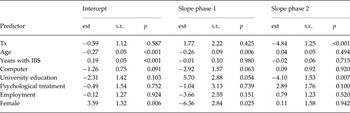
A piecewise growth model was fitted to the data with pre-treatment patient characteristics and treatment variable as covariates predicting random intercept and slope in phase 1 and phase 2. Age, university education, sex, employment, years with IBS, self-assessed computer skills (rated on 1–5 scale) and ongoing psychological treatment at pre-treatment assessment were included as covariates to increase the precision of the ACE (and to be able to compare results from the CACE analysis). The results from the piecewise growth model are presented in Table 1. The full intention-to-treat analysis showed that treatment assignment had a non-significant effect on the intercept and slope in the first phase (p > 0.4), but had a statistically significant effect on the slope in the second phase (p < 0.001). The estimated mean difference post-treatment was −4.24 (s.e. = 1.45), which corresponded to a standardized effect size of d = 0.44. These results favored the experimental condition over the control and showed that the experimental and control condition only differed following manipulation (i.e. after study week 4).
Results from ITT-analysis using a piecewise growth model with weekly measures of GSRS-IBS as dependent variables

Note. Intercept represented the pre-assessment; slope in phase 1 captured the growth rate between pre-assessment and study week 4, slope in phase two captured the growth rate between study week 5 and post-assessment. Tx = treatment variable (0.5 = experimental condition, −0.5 = control). Computer = self-rated computer skills (1–5 point scale). GSRS-IBS = Gastrointestinal Symptom Rating Scale –IBS version.
Age and sex were negatively associated with the slope in phase 1, indicating that older and female patients had a faster rate of symptom reduction during the first phase of treatment (before exposure was implemented). University education was negatively associated with the slope of phase 2 (i.e. during the exposure phase), indicating a faster rate of symptom reduction for patients with university education compared with those who had no such education. None of the other covariates were statistically significant predictors of the slope in phase 1 and 2 in the model (p > 0.05). Constraining the effect of treatment on initial status (intercept) and phase 1 to zero did not significantly alter the findings (see the online Technical Appendix).
CACE analysis of treatment effect taking non-compliance into account
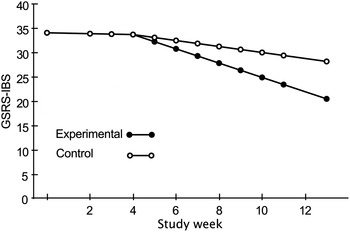
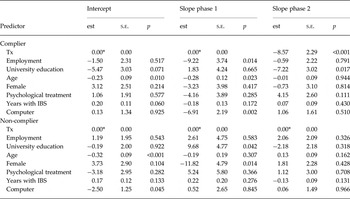
A total of 54.9% (n = 84) in the experimental condition reached the last step (step 4) and hence these patients were given access to the treatment module containing information about systematic exposure (i.e. compliers). To improve the precision of the CACE estimate and to explore associations between pre-treatment patient characteristics, compliance status and within-class variation in trajectories within each compliance class, the growth mixture model was run with the same covariates as the conventional growth model (i.e. ITT analysis). The results are presented in Table 2. The growth mixture model showed that treatment assignment was significantly related to the slope in the second phase among compliers (p < 0.001). The estimated mean difference post-treatment was −7.71 (s.e. = 2.06), which corresponded to a standardized effect size of d = 0.81. The treatment effect among the subsample of compliers is depicted in Fig. 1.
Complier average causal effect results from growth mixture modeling. Estimated means on Gastrointestinal Symptom Rating Scale – IBS as a function of condition among the subsample of patients who were classified as (potential) compliers.

Results from CACE-analysis using growth mixture model with weekly measures of GSRS -IBS as dependent variables

Note. Intercept represented the pre-assessment; slope in phase 1 captured the growth rate between pre-assessment and study week 4; slope in phase two captured the growth rate between study week 5 and post-assessment. The endpoint mean difference is obtained by multiplying the Tx estimate for Slope phase 2 by the time score factor loading at post-assessment (i.e. 0.9). Tx = treatment variable (0.5 = experimental condition, −0.5 = control). Computer = self-rated computer skills (1–5 point scale). GSRS-IBS = Gastrointestinal Symptom Rating Scale –IBS version. * = Constrained to zero based on study design or as per the exclusion restriction assumption.
In the subgroup of compliers, employment, age and self-rated computer skills were negatively associated with the slope in phase 1, indicating employment, higher age and higher self-rated computer skills were all associated with faster negative growth rates during this phase. Participants with university education had on average steeper negative growth rates than those without such an education during the exposure phase (phase 2) among compliers. Female patients had a steeper negative rate of growth than male patients during the first phase of the treatment (slope in phase 1), and patients with university education had a more positive growth rate than those without such an education among non-compliers. None of the examined covariates were associated with compliance status in the logistic regression analysis (all p’s > 0.2). Sensitivity analysis that relaxed the exclusion restriction assumption demonstrated that violations to this assumption did not bias the causal estimate in any substantial way (see the online Technical Appendix).
Discussion
The current study aimed to estimate the causal effect of systematic exposure for those who were classified as compliers in a previously published randomized component trial in IBS (i.e. CACE). We compared the results from the CACE analysis to those obtained in the standard ITT analysis. It was demonstrated that the causal effect estimate from the CACE analysis was considerably larger than that obtained in the ITT analysis (d = 0.81 v. d = 0.44). The results indicate that systematic exposure can produce an effect of substantial magnitude on IBS symptoms, provided that patients with IBS actually receive the intervention. Exposure has been proposed to be an integral component of effective psychological treatments in IBS by targeting potentially important maintaining factors, including increased anxiety and hypervigilance towards IBS symptoms and IBS-associated situations (Labus et al. Reference Labus, Mayer, Chang, Bolus and Naliboff2007; Wolitzky-Taylor et al. Reference Wolitzky-Taylor, Craske, Labus, Mayer and Naliboff2012; Ljótsson et al. Reference Ljótsson, Hesser, Andersson, Lindfors, Hursti, Rück, Lindefors, Andersson and Hedman2013). We have, for example, argued that the inconsistencies in outcomes from psychological treatment studies could in part be accounted for by the failure of some treatments to explicitly target these potential maintaining factors in IBS (Ljótsson et al. Reference Ljótsson, Hesser, Andersson, Lindfors, Hursti, Rück, Lindefors, Andersson and Hedman2013). Exposure has long been established as a powerful psychological intervention for treating anxiety disorders and phobias by explicitly targeting similar maintaining factors (e.g. Craske et al. Reference Craske, Treanor, Conway, Zbozinek and Vervliet2014). In line with this reasoning, repeated and systematic exposure to IBS symptoms and situations may over time lead to a reduction in fear of symptoms via extinction and habitation processes. A reduction in fear-responding and avoidance behavior may in turn reduce IBS symptoms and awareness of symptoms, thereby reversing a vicious cycle of vigilance and avoidance contributing to symptom exacerbation. In addition, exposure may increase overall tolerance to symptoms and ability to function with symptoms, and thus generate opportunities for the individual to pursue goals aligned with personal values (e.g. attending an important work meeting despite having symptoms). This could improve overall quality of life and reduce disability.
A growing number of studies have demonstrated that psychological treatments that include systematic exposure produce significant effects on IBS symptoms and quality of life (Hunt et al. Reference Hunt, Moshier and Milonova2009; Craske et al. Reference Craske, Wolitzky-Taylor, Labus, Wu, Frese, Mayer and Naliboff2011; Ljótsson et al. Reference Ljótsson, Hedman, Andersson, Hesser, Lindfors, Hursti, Rydh, Ruck, Lindefors and Andersson2011a ). However, all of these tested treatment protocols include other potentially effective psychological interventions besides exposure and no previous study has made efforts to isolate the exposure component in IBS treatments. By using a highly structured way of delivering interventions and making sure that all aspects besides the manipulated variable (i.e. systematic exposure) were held constant across conditions, our randomized component study provided us with a unique opportunity to test the specific, incremental effect of exposure. Our format of intervention delivery is also key aspect of estimating CACE in a reliable way. In internet-delivered interventions, it is possible to have a high degree of control over what a particular patient receives in terms of exercises and treatment components. This information is not readily accessible in face-to-face psychological treatment studies. That is, it is difficult, if not impossible, to know what a patient received without knowing if the intervention was delivered as intended by the therapist. In psychotherapy research this is often referred to as treatment integrity (or treatment fidelity) (Perepletchikova & Kazdin, Reference Perepletchikova and Kazdin2005). In our form of internet-delivered psychological intervention, the primary role of the therapist is to provide support and encouragement and the main part of treatment is the self-help texts provided to patients. In other words, treatment integrity in this context is evaluated as the degree to which treatment modules (self-help texts) describe the psychological principle or intervention as intended. This aspect simplifies the process of classifying participants into compliers and non-compliers.
Given that a substantial proportion of those who were randomly allocated to the full treatment protocol did not receive the exposure component, it was important to examine predictors of compliance. It is noteworthy that none of the examined pre-treatment covariates predicted compliance status. Thus, further work is needed to examine patient characteristics and treatment compliance. It is, of course, possible that we have missed key variables that distinguish compliers from non-compliers. For example, some patients with IBS may not find a psychological explanation of their symptoms adequate and because of this drop out from treatment. It is also possible that for this patient group further engagement with a psychological treatment, regardless of approach and type of intervention, may not result in improved outcomes. Illness representation has, for example, been found to be associated with IBS symptoms (Rutter & Rutter, Reference Rutter and Rutter2002, Reference Rutter and Rutter2007) and could potentially be an important factor. Adjunct interventions that target such factors that may prevent disengagement (e.g. illness representation, negative expectations) with treatment are potentially of value. Other treatment-related factors, such as monitoring of patient progress, increasing feedback and providing additional support for those in need, that have been discussed as means for improving adherence in internet-delivered treatments in general (Christensen et al. Reference Christensen, Griffiths and Farrer2009) could also be explored in greater detail. Still, little is known about the factors that can improve patient compliance in ICBT. Our results underline the importance of identifying the subgroup of patients early on who discontinue treatment prematurely and tailoring interventions for this subsample in order to improve compliance.
University education was the only predictor associated with better outcomes during the exposure phase among compliers. Some previous studies of internet-delivered treatments for other conditions, such as anxiety disorders, have found university education to be associated with increased adherence to treatment (i.e. number of treatment modules completed) (Hadjistavropoulos et al. Reference Hadjistavropoulos, Pugh, Hesser and Andersson2016). It is possible that the format of intervention delivery is more suitable for individuals with a higher level of education given that internet-delivered self-help interventions require patients to be able to read and comprehend text and communicate via text messages at a reasonable level. As most previous studies that have examined internet-delivered treatments for both somatic and psychiatric disorders have included a disproportionately high number of patients with higher education (e.g. Hesser et al. Reference Hesser, Gustafsson, Lunden, Henrikson, Fattahi, Johnsson, Westin, Carlbring, Maki-Torkko, Kaldo and Andersson2012; Hedman et al. Reference Hedman, Ljótsson, Kaldo, Hesser, El Alaoui, Kraepelien, Andersson, Rück, Svanborg, Andersson and Lindefors2014; El Alaoui et al. Reference El Alaoui, Hedman, Kaldo, Hesser, Kraepelien, Andersson, Rück, Andersson, Ljótsson and Lindefors2015), further research is needed to examine whether these positive treatment effects can also be obtained in more educationally diversified samples.
Limitations
Several limitations should be noted. While we had a high degree of control over what patients received in our study in terms of which treatment materials they were exposed to, we did not have detailed information about what patients did during treatment. Thus, patients might have received access to the last step of the exposure treatment without doing any exposure exercises. In such a situation, the CACE estimate is most likely underestimated, as the group of ‘compliers’ consists of both patients who did exposure exercises and those who did not. In other words, the results from our CACE analysis are restricted to recipients of treatment but ignore whether the patient actually followed the prescribed treatment. An alternative way of classifying compliers and non-compliers is to form groups based on the number of treatment activities completed in the exposure phase. In fact, we tracked and recorded the progress of the patient by the number of homework assignments handed in by the patient throughout the exposure phase, providing us with the opportunity to perform such an analysis. There are, however, two analytical problems with this approach. First, we do not have a clear idea of the cut-off point (i.e. how many exercises does a patient need to complete to be considered a complier). Second, classifying compliers by the number of exercises completed may create problems with the exclusion restriction assumption (Jo & Muthén, Reference Jo, Muthén, Reise and Duan2003). It is also possible to focus on different degrees of compliance. Indeed, we found a statistically significant, albeit small, correlation between number of exposure exercises completed and symptom severity post-assessment, suggesting that the degree to which patients comply with the exposure instructions is of importance (Ljótsson et al. Reference Ljótsson, Hesser, Andersson, Lackner, El Alaoui, Falk, Aspvall, Fransson, Hammarlund, Lofstrom, Nowinski, Lindfors and Hedman2014). More advanced methods for dealing with continuous compliance have been developed (Jin & Rubin, Reference Jin and Rubin2008), but more work is needed to clarify model assumptions.
The exclusion restriction assumption plays a critical role in the identification of CACE, and if this assumption is violated it can bias the causal effect estimate. We employed an alternative modeling strategy to test violations of the exclusion restriction assumption (Jo, Reference Jo2002a ). In this context, it is important to note that none of the covariates predicted compliance status so the sensitivity analysis should be interpreted with certain degree of caution due to possible confounds.
Missing data are another aspect that can bias results if not handled properly (Jo, Reference Jo2007; Jo et al. Reference Jo, Ginexi and Ialongo2010). Here, we assumed that the missing data mechanism was ignorable conditional on observed information in the model (i.e. MAR). Models have been developed with weaker missing data assumptions within the context of CACE estimation and these can be used to perform sensitivity analyses (Jo et al. Reference Jo, Ginexi and Ialongo2010). However, given the small amount of missing data post-treatment (i.e. missing data due to attrition was only 5.5%, n = 17), we relied on MAR to return correct estimates and standard errors.
Conclusions
Using the largest randomized component study in IBS to date, the current study demonstrated that standard ITT analysis underestimated the specific effect of exposure. The effect size obtained in the CACE analysis was almost twice the size of that obtained in the ITT analysis. No patient characteristics assessed pre-treatment were found to predict compliance status. Employment, age, and self-rated computer skills were linked to greater improvement during the initial phase of treatment (before exposure was implemented). University education was the only variable directly associated with outcomes during the exposure phase among compliers.
Further research should look more carefully into the issue of compliance in internet-delivered treatments in general and in particular examine ways to improve patient compliance in exposure therapy for IBS. In a wider context, our findings underline the significance of estimating both ACE and CACE in psychological treatment studies, as the result may differ substantially between ITT analysis and CACE analysis. Given the high degree of control over treatment content, the format of internet-delivered treatments offers a unique opportunity for examining CACE estimates for psychological treatments in a reliable way. Finally, we conclude that when patients with IBS engage in exposure exercises aiming to decrease preoccupation with their IBS symptoms, they gain significant symptom improvements that cannot be attributed to generic and specific effects of other psychological treatment components for IBS.
Supplementary material
The supplementary material for this article can be found at https://doi.org/10.1017/S0033291717001167.
Acknowledgements
We thank all the co-workers in our original trial and Dr B. Jo for helpful comments on the statistical analysis.
Declaration of Interest
None.
Ethical Standards
The authors assert that all procedures contributing to this work comply with the ethical standards of the relevant national and institutional committees on human experimentation and with the Helsinki Declaration of 1975, as revised in 2008.