


Introduction
Qualitative research is increasingly conducted with randomized controlled trials (RCTs) to provide insights into stakeholders’ perceptions and experiences, as well as contextual factors influencing the design and implementation of trials and interventions (Reference O’Cathain, Thomas, Drabble, Rudolph and Hewison1). In a recently published methodological guidance on patient-focused drug development, the US Food and Drug Administration (FDA) highlighted the important benefits of using qualitative research during the process of intervention development and evaluation, which included, among others, identifying clinical outcomes that are important to patients and explaining low trial recruitment rates (2). The increased attention that regulatory authorities are currently paying to these issues indicates that the criteria of efficient health technologies are moving away from solely focusing on evidence of effectiveness to considering the multiple stakeholders involved, their behaviors, and the complexity of the real world in which they live (Reference Drabble, O’Cathain, Hesse-Biber and Johnson3).
There have been extensive discussions about the potential uses of qualitative research with trials. These typically focus on how qualitative methods can contribute to the generation of evidence of effectiveness before, during, or after large-scale trials (Reference Boeije, Drabble and O’Cathain4). A 2013 mapping review conducted by O’Cathain et al. (Reference O’Cathain, Thomas, Drabble, Rudolph and Hewison1) identified twenty-two subcategories capturing the various ways that qualitative research can be used in conjunction with RCTs, including issues related to the intervention, the trial, outcomes, measures, and target conditions (Reference O’Cathain, Thomas, Drabble, Rudolph and Hewison1). Their results yielded an empirical foundation for previous debates, corroborating the idea that qualitative research has, in practice, been used in very diverse ways. Yet, the extent to which the potential value of qualitative research is currently realized remains poorly understood, largely due to how the findings of RCTs and associated qualitative research are presented in published literature. It is often unclear what follow-up work has arisen as a result of the qualitative findings, making it difficult to assess whether qualitative research has indeed fulfilled its promise (Reference O’Cathain, Thomas, Drabble, Rudolph and Hewison1). Since the use of qualitative methods in the context of RCTs has increased substantially over the last decade, it is worthwhile revisiting whether and how research practices may have shifted. This study maps the changing landscape a decade after O’Cathain et al.’s framework (Reference O’Cathain, Thomas, Drabble, Rudolph and Hewison1), which was based on publications from 2008 to 2010 (Reference Drabble, O’Cathain, Hesse-Biber and Johnson3;Reference Jansen, Foets and de Bont5).
Although an increasing number of qualitative studies have been conducted with clinical trials, their use remains uneven across different types of interventions. According to a systematic review of major trial registries, only around 5 percent of drug trials and 5 percent of device trials incorporated qualitative components (Reference Clement, Edwards, Rapport, Russell and Hutchings6). Similarly, a mapping review focusing only on RCTs estimated that these two categories of qualitative studies accounted for 27 percent altogether (Reference O’Cathain, Thomas and Drabble7). The limited use of qualitative methods in the context of drug and device trials might be attributed to the perception that these interventions are highly standardized and less influenced by contextual variation. Yet, the complexity of drugs and devices may take different forms. For example, patients’ perceptions and experiences of drugs or devices might influence their adherence to long-term use (Reference Kvarnström, Westerholm, Airaksinen and Liira8–Reference Ryan, Hesselgreaves and Wu10). Similarly, health professionals’ views toward a drug or device can shape patients’ treatment choices (Reference Sarradon-Eck, Bouchez, Auroy, Schuers and Darmon11–Reference Aladul, Fitzpatrick and Chapman13), create hesitations around trial recruitment (Reference Ritchie, Kelly, Moss, Paul and Shaw14), compromise protocol fidelity (Reference Lawton, Jenkins and Darbyshire15), or even affect post-market surveillance (Reference Gagliardi, Ducey and Lehoux16). This study sought to refine the understanding of when and where qualitative methods can be used in conjunction with RCTs involving drugs or devices, to assess the extent to which existing qualitative studies have fulfilled their intended contributions, and to empirically develop a set of guiding questions to assist the design of future qualitative research.
Methods
A systematic mapping review was conducted to characterize the uses and functions of qualitative research when conducted with contemporary RCTs. A protocol was developed before the study commencement; yet, given the nature of the review, this was not registered or published. The PRISMA Extension for Scoping Reviews (PRISMA-ScR) was used to guide the reporting of this review (Supplementary Table S1). As the primary goal of a mapping review is to describe the nature and characteristics of existing evidence (Reference Khalil and Tricco17) rather than synthesize identified studies, a critical appraisal is typically not recommended (Reference Grant and Booth18;Reference Peters, Marnie and Tricco19).
Search strategy and eligibility criteria
Using an updated version of the search strategy developed by O’Cathain et al. (Reference O’Cathain, Thomas, Drabble, Rudolph and Hewison1) (Supplementary Table S2), we systematically searched five major electronic databases (MEDLINE, EMBASE, CINAHL, PsycINFO, and ASSIA), as well as the National Institute for Health and Care Research (NIHR) Journals Library, to identify original qualitative research that: (a) was published in English between 1 January 2019 and 31 December 2020; and (b) was directly associated with a specific RCT (pilot or full) in the field of health (i.e., the publication had to include the trial name and/or explicitly state the existence of a trial, or function as a precursor assessing the feasibility of a subsequent RCT). For a study to be considered “qualitative,” it had to employ recognized methods of both qualitative data collection (e.g., in-depth interviews, focus groups, and participant observation) and qualitative data analysis (e.g., thematic analysis and interpretative phenomenological analysis), as well as to include participant quotes (or other raw data) to support authors’ claims. Mixed methods studies were also eligible for inclusion, provided that the qualitative component was discussed in sufficient detail. When a single study was reported across multiple publications, only the one judged to be the most comprehensive was included (e.g., an NIHR report was typically preferred over a journal article). This review chose not to include gray literature to minimize heterogeneity in methodological transparency and reporting completeness.
Screening and study selection
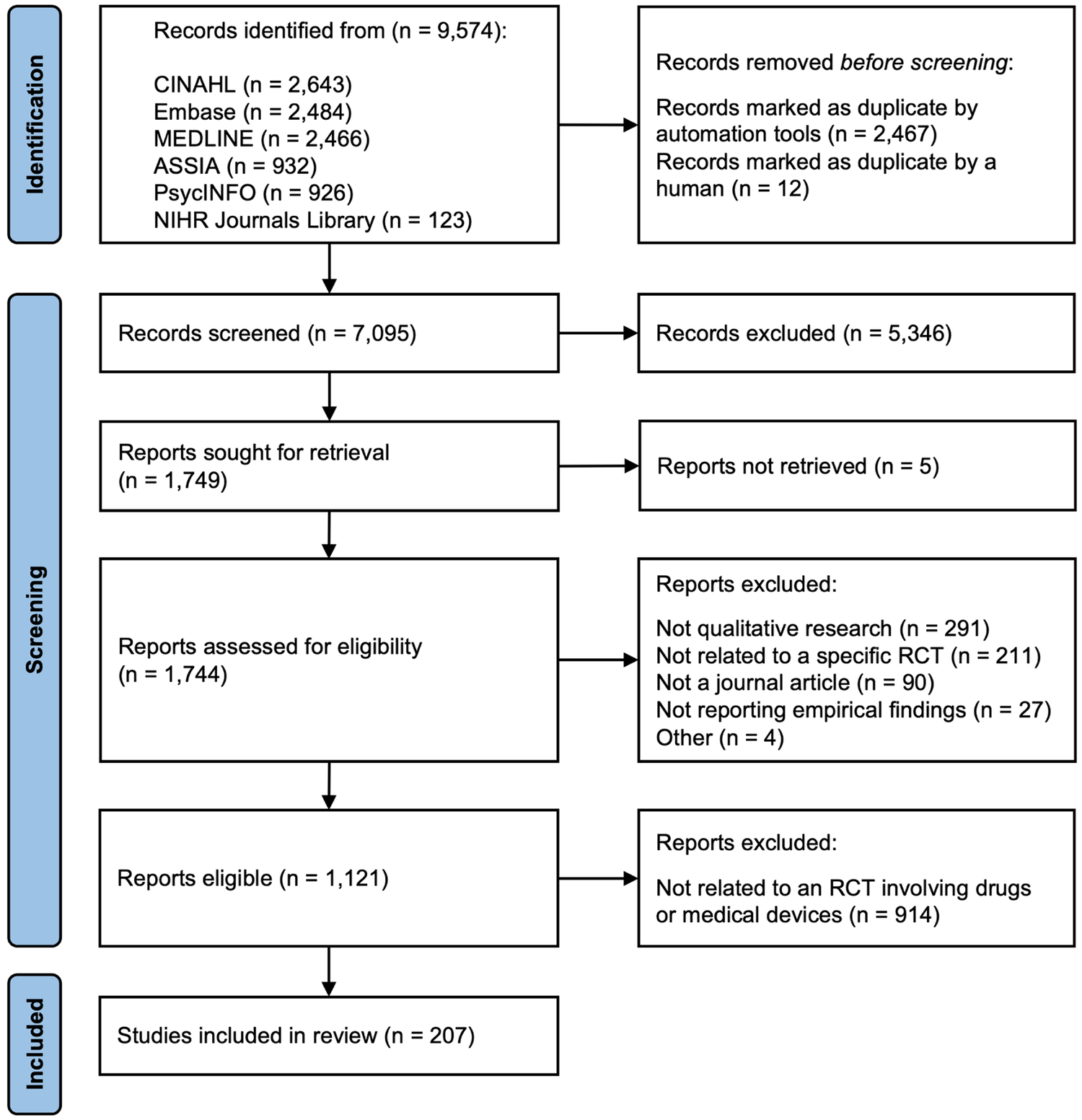
A total of 9,574 citations identified from the electronic search were uploaded into Covidence, and duplicates were removed. The titles and abstracts of all 7,095 unique citations were screened by the first author (YTH), with a randomly selected 50 percent independently screened by a second reviewer (BG). To increase consistency in screening decisions, both reviewers initially screened twenty-five citations and discussed their rationale for including or excluding. Disagreements on study selection were resolved through consensus or discussion with a third reviewer (EG). The same process was followed when screening potentially relevant full-text articles, but reasons for exclusion were recorded at this stage. Studies were primarily excluded either because they were not qualitative (n = 291) or because they did not relate to a specific RCT (n = 211) (Figure 1).
PRISMA flow diagram of study selection.

Figure 1. Long description
The flowchart is organized into three vertical phases labeled on the left: Identification, Screening, and Included.
1. Identification Phase:
- Top-left box: Records identified from (n = 9,574) including CINAHL (n = 2,643), Embase (n = 2,484), MEDLINE (n = 2,466), ASSIA (n = 932), PsycINFO (n = 926), and NIHR Journals Library (n = 123).
- Top-right box (exclusion): Records removed before screening: Records marked as duplicate by automation tools (n = 2,467) and Records marked as duplicate by a human (n = 12).
2. Screening Phase:
- Second box down: Records screened (n = 7,095). An arrow points right to Records excluded (n = 5,346).
- Third box down: Reports sought for retrieval (n = 1,749). An arrow points right to Reports not retrieved (n = 5).
- Fourth box down: Reports assessed for eligibility (n = 1,744). An arrow points right to Reports excluded: Not qualitative research (n = 291), Not related to a specific RCT (n = 211), Not a journal article (n = 90), Not reporting empirical findings (n = 27), and Other (n = 4).
- Fifth box down: Reports eligible (n = 1,121). An arrow points right to Reports excluded: Not related to an RCT involving drugs or medical devices (n = 914).
3. Included Phase:
- Final bottom box: Studies included in review (n = 207).
Due to the large number of studies meeting our inclusion criteria (n = 1,121), we decided to focus exclusively on qualitative research conducted in the context of RCTs involving: (a) a drug (medicine or vaccine); (b) a conventional medical device; or (c) a digital device, as defined by the Medicines and Healthcare products Regulatory Agency (20). Post-hoc modifications to the inclusion and exclusion criteria are common in scoping/mapping reviews, given that study selection is not a strictly linear process (as is the case, for instance, with systematic reviews of effectiveness), but rather an iterative one (Reference Gottlieb, Haas, Daniel and Chan21). As the name suggests, mapping reviews seek to map the existing literature on a broad topic and, as the reviewers’ familiarity with the existing evidence landscape grows, decisions related to the scope of the review might be revisited. In our case, this involved restricting our scope to RCTs of drugs and medical devices, given that extensive qualitative research has already been conducted alongside RCTs of social and psychological interventions, whereas the implementation nuances and subjective experiences of using drugs and medical devices remain largely unexplored. A subset of 10 percent of eligible studies was double-checked by second reviewers (EG and SG), and there was full agreement on further exclusions. This left us with 207 papers for further review and analysis (20).
Data extraction and analysis
We began by extracting the key characteristics of each study into an Excel spreadsheet. These included, for instance, information such as the journal of publication, data collection and analysis methods, timing of qualitative research (i.e., before, during, or after the trial), and therapeutic area of the intervention, according to the International Classification of Diseases (ICD-10) (22). The discussion and conclusion sections of all included studies were then scrutinized to understand the extent to which the potential value of using qualitative methods in the context of an RCT was empirically demonstrated. Similar to O’Cathain et al. (Reference O’Cathain, Thomas, Drabble, Rudolph and Hewison1), we did not focus on the value that the qualitative findings had in their own right, that is, the general contributions to knowledge that they made, but rather on instances where they had enhanced the research endeavor (e.g., by identifying ways to optimize trial recruitment and retention). As such, we also sought to discern what kind of follow-up actions (if any) were taken in response to the qualitative results.
Employing an approach similar to framework synthesis (Reference Brunton, Oliver and Thomas23), we used O’Cathain et al.’s (Reference O’Cathain, Thomas, Drabble, Rudolph and Hewison1) framework as a “scaffold” for the initial data extraction. Each “example” of the contribution made by the qualitative research was derived through immersion in the included studies, particularly through repeated reading of their results and discussion sections. The representative cases, corresponding to the twenty-two subcategories identified by O’Cathain et al. (Reference O’Cathain, Thomas, Drabble, Rudolph and Hewison1), were read multiple times and served as “typical” cases for determining the appropriate subcategory for each example. Examples were categorized into the subcategory where the typical case and example were most similar. There were a few distinct examples that could not fit in the original framework; these were categorized into new subcategories (e.g., a new subcategory, called “private life influenced by the intervention,” was created for the example “glucose monitoring reduced conflict between pediatric diabetics and their parents” (Reference Boucher, Aum and Crocket24)). By merging existing subcategories and adding new ones, the original framework was iteratively adjusted and refined, resulting in a revised candidate framework, which covered a range of functions that qualitative research can serve in the context of contemporary trials. Twenty percent of the included studies were randomly selected and double-checked by a second reviewer (EG or SG), who read the full texts and independently extracted data, identified examples, and developed their own candidate subcategories. These new subcategories were then compared with the preliminary candidate subcategories developed by the first author. Disagreements were discussed internally within the research team, leading to the refinement of the category descriptions and final categorizations. This process aims to increase the consistency of the analysis and to ensure that the framework is not dependent on a single perspective. Thinking backwards, the example about glucose monitoring might address the question “what impact did the monitoring device have on parent–child relationship?”. This question, however, can be abstracted further to “what impact did the intervention have on interpersonal relationships and family life?”. We identified one such question for each example derived and compiled a list of issues that can be addressed by using qualitative research with clinical trials.
The entire research process was resource-demanding, lasting about 33 months from the initial testing of the search strategy to the completion of analysis and reporting.
Results
Characteristics of included studies
Of the 1,121 studies that met our inclusion criteria, 207 (18.5 percent) studies conducted in conjunction with RCTs involving drugs or medical devices were included in the final analysis. Among these, 91 were published in 2019 and 116 in 2020. The included studies were published across 120 academic journals. Sixty-five out of the 207 studies (31.4 percent) were conducted at the pretrial stage and were described as feasibility, pilot, or early-stage studies. However, based on the information reported in individual studies, most of the remaining 142 studies did not report start or end dates, making it difficult to determine whether the qualitative research was conducted during or after the trial. Identified qualitative studies were associated with 211 RCTs (as eight qualitative studies were related to more than one RCT, and eleven RCTs were each associated with multiple qualitative studies), and of which 191 trials (related to 189 qualitative studies) reported their registration year. Of these, 182 trials were registered between 2010 and 2020.
The 211 identified RCTs were conducted across fifty-nine countries around the world. However, the associated qualitative research was carried out in thirty-nine of these, with a significant number (n = 17) in countries classified as high-income economies according to the World Bank criteria (25). The countries where RCTs were conducted without a qualitative research component were mostly located in Central and Eastern Europe (n = 9), Asia (n = 3), and South America (n = 3). Although a total of thirty-seven qualitative studies were conducted in the context of large, international, multicenter trials, eighteen of these investigations were limited to a single country.
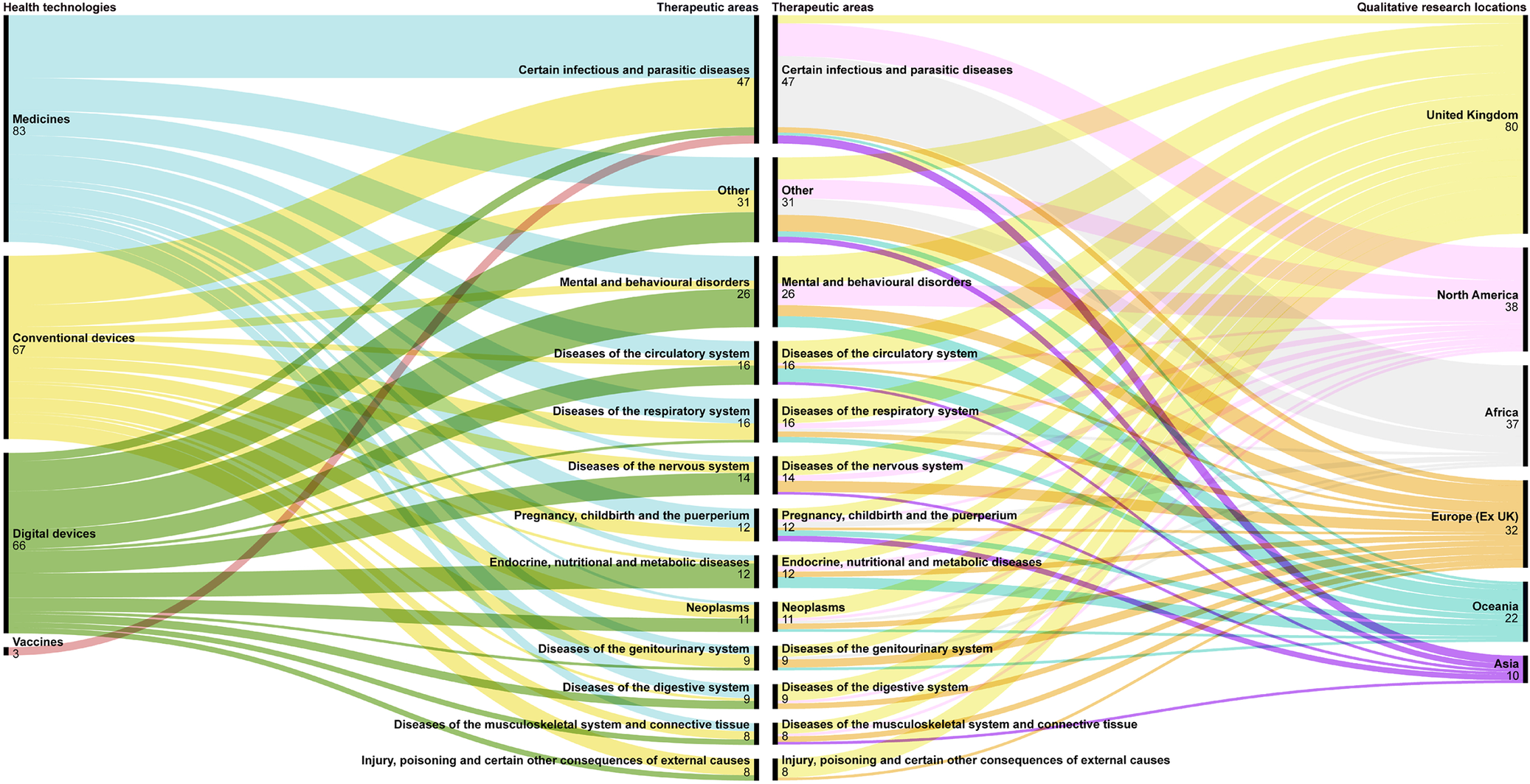
Figure 2 displays the distribution of qualitative studies across health technologies under study (i.e., medicines, vaccines, conventional medical devices, and digital devices), therapeutic areas that they targeted, and the locations of qualitative research. Eleven studies were counted more than once, as they included respondents from various locations. Wider lines represent a larger number of relevant studies. As shown on the left side of the diagram, studies were in relatively even distribution across RCTs of various health technologies (excluding vaccines). Notably, studies referring to digital devices (green lines) covered almost all therapeutic areas (except pregnancy and childbirth), although most of them primarily addressed psychiatric, circulatory, and neurological disorders. The lines on the right side of the diagram illustrate how qualitative studies in each region focused on similar therapeutic areas or differed from one another. For instance, infectious diseases were the focus of most studies undertaken in Africa, North America, and Asia. By comparison, studies conducted in the United Kingdom and Oceania were mostly related to mental health disorders and circulatory system diseases, respectively. Qualitative research with RCTs conducted in Europe demonstrated substantial breadth. Across all individually defined therapeutic areas, neurological and psychiatric disorders were the most frequently addressed. Although the aggregated “other” was the largest single line, it represents a consolidation of numerous conditions.
Distribution of qualitative studies across health technologies, therapeutic areas, and the locations of qualitative research.

Figure 2. Long description
The diagram consists of two connected flow charts.
Left Panel: Health technologies to Therapeutic areas.
The left axis lists four categories: Medicines 83, Conventional devices 67, Digital devices 66, and Vaccines 3.
Flow lines connect these to the central axis of Therapeutic areas, which includes:
* Certain infectious and parasitic diseases 47
* Other 31
* Mental and behavioural disorders 26
* Diseases of the circulatory system 16
* Diseases of the respiratory system 16
* Diseases of the nervous system 14
* Pregnancy, childbirth and the puerperium 12
* Endocrine, nutritional and metabolic diseases 12
* Neoplasms 11
* Diseases of the genitourinary system 9
* Diseases of the digestive system 9
* Diseases of the musculoskeletal system and connective tissue 8
* Injury, poisoning and certain other consequences of external causes 8
Right Panel: Therapeutic areas to Qualitative research locations.
The central axis of Therapeutic areas flows into the rightmost axis of Qualitative research locations:
* United Kingdom 80
* North America 38
* Africa 37
* Europe Ex UK 32
* Oceania 22
* Asia 10
Wider flow lines represent a larger number of studies. The United Kingdom is the most frequently represented location for qualitative research overall.
The articulated value and potential contributions of qualitative research
Forty-six out of the 207 studies (22.2 percent) explicitly articulated the value of qualitative research to the specific trial and/or intervention by reporting follow-up actions that were implemented in response to the qualitative findings. Of these forty-six studies, twenty-seven were conducted at the pretrial stage. The values most frequently reported by researchers were: explaining trial findings (n = 22), including explanations of why the use of specific interventions is low (Reference Ball, Newton and Rohricht26); ensuring that interventions meet the needs of key stakeholders (n = 14), by suggesting improvements and identifying potential issues (Reference Asklund, Samuelsson, Hamberg, Umefjord and Sjöström27); and making a trial feasible and viable (n = 13), for example, through improved trial design and conduct based on the qualitative findings (Reference Denison, Carruthers and Hudson28); Other values of the qualitative research, as mentioned by the original authors, included: increasing trial recruitment rates (n = 4) (Reference Sherratt, Beasant, Crawley, Hall and Young29); improving participant informed consent (n = 4) (Reference Weckesser, Farmer and Dam30); and making trials more sensitive and considerate toward people (n = 4) (e.g., by refining presentation strategies and improving communication experiences for both participants and recruiters (Reference Sherratt, Beasant, Crawley, Hall and Young29)).
A total of 776 examples of the contribution made by employing qualitative research with RCTs were identified, then divided into twenty-seven subcategories according to their functions. Table 1 presents one representative example from each subcategory to illustrate a given function. Around two-thirds of the examples focused on the intervention content and delivery, whereas a very limited number of examples were classified into the categories of outcomes and measures of process and outcome. However, it is worth noting that the pretrial examples made a significant contribution to both categories. As precursors to full-scale RCTs, the pretrial examples were also frequently related to assessing the feasibility and acceptability of the trial in practice.
The uses of qualitative research in the context of RCTs involving drugs and devices

Table 1. Long description
The table is organized into six columns: Category, Subcategory, Description, Frequency in 776 examples (%), Frequency in 243 pre-trial examples (%), and Example.Frequencies below are reported first for all 776 examples and then for the 243 pre-trial examples.
1. Intervention content and delivery: Total frequency 493 (63.5%); pre-trial frequency 150 (61.7%). Subcategories include:
* Intervention development and adjustment: 39 (5.0%); pre-trial 14 (5.8%).
* Models, mechanisms, and underlying theory development: 25 (3.2%); pre-trial 7 (2.9%).
* Perceived value and benefits of intervention: 109 (14.0%); pre-trial 32 (13.2%).
* Acceptability of intervention in principle: 5 (<1%); pre-trial 4 (1.6%).
* Feasibility and acceptability of intervention in practice: 151 (19.5%); pre-trial 50 (20.6%).
* Compliance with intervention: 43 (5.5%); pre-trial 12 (4.9%).
* Implementation of the intervention in the real world: 64 (8.2%); pre-trial 16 (6.6%).
* Perceptions and treatment choices between different interventions: 43 (5.5%); pre-trial 13 (5.3%).
* Private life influenced by the intervention: 14 (1.8%); pre-trial 2 (<1%).
2. Trial design, conduct, and processes: Total frequency 192 (24.7%); pre-trial frequency 63 (25.9%). Subcategories include:
* Recruitment and retention: 48 (6.2%); pre-trial 15 (6.2%).
* Engagement and performance of health professionals in trial: 24 (3.1%); pre-trial 7 (2.9%).
* Preparation and training: 19 (2.4%); pre-trial 5 (2.1%).
* Feasibility and acceptability of the trial in principle: 5 (<1%); pre-trial 5 (2.1%).
* Feasibility and acceptability of the trial in practice: 48 (6.2%); pre-trial 19 (7.8%).
* Acceptability of post-research care arrangements: 4 (<1%); pre-trial 1 (<1%).
* Ethical conduct: 20 (2.6%); pre-trial 6 (2.5%).
* Adaptation of trial conduct to local context: 2 (<1%); pre-trial 0.
* Impact of trial on staff, researchers, or participants: 17 (2.2%); pre-trial 4 (1.6%).
* Role of trial components other than interventions: 5 (<1%); pre-trial 1 (<1%).
3. Outcomes: Total frequency 14 (1.8%); pre-trial frequency 8 (3.3%). Subcategories include:
* Breadth of outcomes: 8 (1.0%); pre-trial 6 (2.5%).
* Variation in outcomes: 4 (<1%); pre-trial 1 (<1%).
* Results dissemination: 2 (<1%); pre-trial 1 (<1%).
4. Measures of process and outcome: Total frequency 13 (1.7%); pre-trial frequency 8 (3.3%). Subcategories include:
* Accuracy of measures: 11 (1.4%); pre-trial 6 (2.5%).
* Development of outcome measures: 2 (<1%); pre-trial 2 (<1%).
5. Target condition: Total frequency 64 (8.2%); pre-trial frequency 14 (5.8%). Subcategories include:
* Experience of the disease, behavior, or beliefs: 34 (4.4%); pre-trial 10 (4.1%).
* Experience of the body, behavior, or beliefs: 4 (<1%); pre-trial 0.
* Awareness, help seeking, or expectation: 26 (3.4%); pre-trial 4 (1.6%).
a Original category.
b Modified category.
c Newly added category.
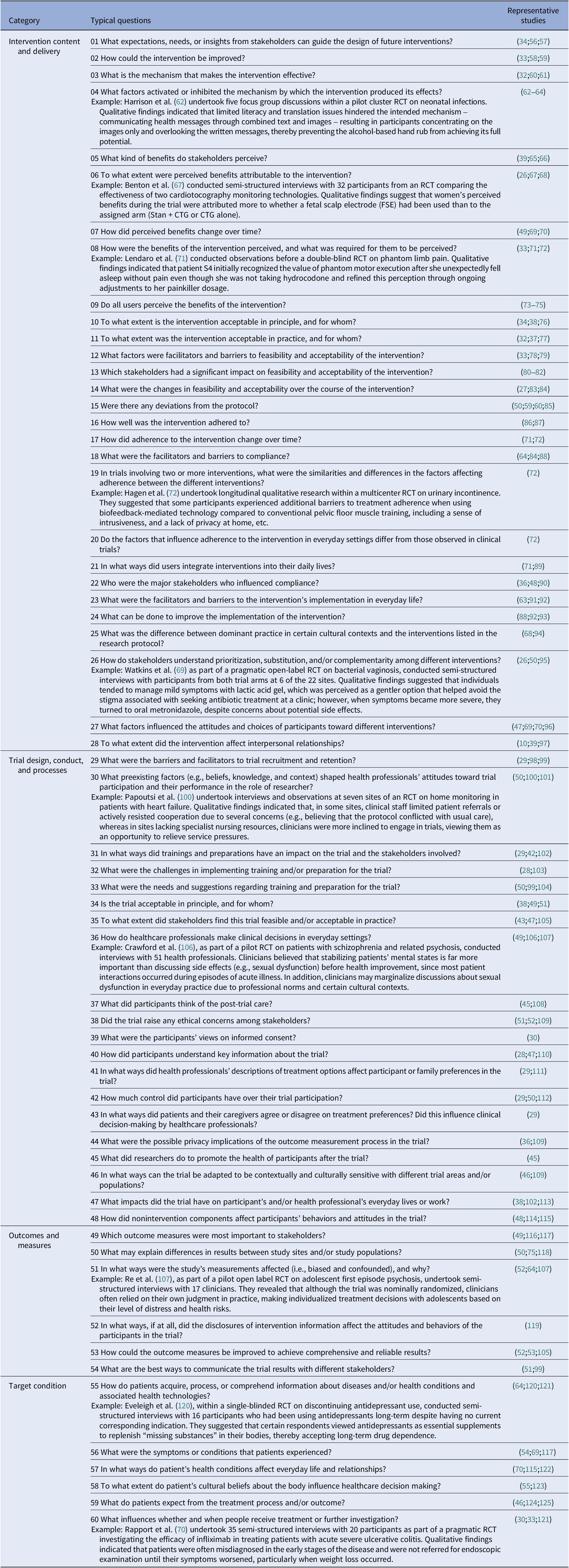
Drawing on all identified examples, sixty research questions that could be addressed by qualitative studies with RCTs were extrapolated (Table 2). The questions cover a wide range of topics, including designing and developing the intervention, validating its effectiveness, implementing the intervention in the real world, and understanding the preferences among different interventions for various stakeholders (e.g., healthcare providers, patients, and policymakers), as well as the key factors influencing their decision making. These questions illustrate the nuanced complexities of drugs and devices in controlled trials and the real world. For example, consider the benefits of an intervention: in addition to understanding which benefits can be perceived by stakeholders (question 5), it is also crucial to consider whether these perceived benefits are attributable to the intervention itself or to ancillary components or procedures associated with its delivery (question 6). Additionally, questions about how perceptions of benefits evolve over time (question 7) and how different people perceive benefits (question 9) highlight the temporal and individual variability in the trial context. It is equally important to recognize the knowledge gap between the objective existence of benefits and users’ perception of them, which highlights the necessity to understand the complex process by which users gradually become aware of, interpret, and internally construct the belief that their physical or mental conditions have improved as a result of the drug or device (question 8).
Examples of questions that can be addressed by using qualitative research in trials

Table 2. Long description
The table is organized into three columns: Category, Typical questions, and Representative studies.
1. Intervention content and delivery (Questions 01 to 28): Focuses on stakeholder expectations, mechanisms of effectiveness, perceived benefits, acceptability, feasibility, adherence, and implementation in everyday life. Notable examples include Harrison et al. on neonatal infections and Lendaro et al. on phantom limb pain.
2. Trial design, conduct, and processes (Questions 29 to 48): Addresses barriers to recruitment, health professionals’ attitudes, training needs, ethical concerns, informed consent, and cultural sensitivity. An example includes Papoutsi et al. on home monitoring for heart failure patients.
3. Outcomes and measures (Questions 49 to 54): Explores which measures are important to stakeholders, differences between study sites, potential biases, and communication of results. Re et al. is cited regarding clinician judgment in adolescent psychosis trials.
4. Target condition (Questions 55 to 60): Examines how patients comprehend health conditions, the impact of symptoms on daily life, cultural beliefs, and factors influencing when people seek treatment. Examples include Eveleigh et al. on antidepressant use and Rapport et al. on ulcerative colitis.
Discussion
This review identified a significant increase in the number of qualitative studies conducted with RCTs, rising from 296 articles published over 33 months (2008–2010) (Reference O’Cathain, Thomas, Drabble, Rudolph and Hewison1) to 1,121 over 24 months a decade later (2019–2020). For qualitative studies specifically focusing on drug and device trials, the number of publications rose from ~80 articles (Reference O’Cathain, Thomas and Drabble7) to 207 over the same respective periods. There are considerable similarities between the characteristics of the included studies in this review and those in O’Cathain et al.’s review (Reference O’Cathain, Thomas, Drabble, Rudolph and Hewison1). Around one-third of the qualitative studies that we identified were also conducted at the pretrial stage. Moreover, examples focusing on the intervention content and delivery, and on trial design and conduct, constituted the largest and second-largest categories, respectively. Nevertheless, the distribution of examples in different categorizations also implied that the functionality and potential value of qualitative research in terms of trial outcomes, measures, ethics, and stakeholder beliefs and behaviors might be under-utilized and not fully explored. Six out of the twelve potential values of using qualitative research to the generation of effectiveness evidence posited in O’Cathain et al.’s framework (Reference O’Cathain, Thomas, Drabble, Rudolph and Hewison1) were corroborated by identifying specific follow-up actions resulting from the qualitative findings. Our framework, revised for studies involving drugs and devices, indicates that the contribution of qualitative research in clinical trials goes beyond the trial itself.
This review identified emerging subcategories about the application of qualitative research conducted with RCTs. In comparison to previous subcategories influenced by the concept of process evaluation (Reference Drabble, O’Cathain, Hesse-Biber and Johnson3), the newer categories not only place a greater emphasis on human beings (rather than materials or data) and their subjectivity, but also highlight the importance of issues after the research process, such as the dissemination of results (Reference Sandelowski and Leeman126) and the acceptability of post-trial healthcare arrangements. Through the perspective of health professionals, patients, carers, and society, the newly added subcategories recognized how the complexity of human perceptions, emotions, and behaviors could influence the conduct of trials and interventions, for example, the training process and staff performance in the trial, resonating the argument of how subjective and social processes provides crucial value in ensuring scientific evidence is translated into practice (Reference Britten127). The subcategory “completion of outcome measures,” identified only once in the original review, did not recur in our review and was therefore not retained in our categorization. This may reflect that, in drug and device trials, issues related to the completion of outcome measures are less likely to be the focus of qualitative investigations.
The current study contributes to the understanding of the appropriate timing for qualitative research in drug or device trials. Several temporal frameworks have cited the benefits of selecting appropriate outcomes and measures as a rationale for conducting qualitative research at the pretrial stage (Reference Maher and Neale128). While the previous review has suggested a different conclusion (Reference O’Cathain, Thomas, Drabble, Rudolph and Hewison1), the current research is consistent with this assumption, as qualitative studies conducted at the pretrial stage included a higher proportion of examples in the categories of outcome (3.3 percent vs. 1.8 percent) and measures of process and outcome (3.3 percent vs. 1.7 percent) compared with all included studies. Our analysis also shows that qualitative studies aimed at guiding intervention design and development were more often conducted alongside large-scale trials. This is different from what a previous review found (Reference O’Cathain, Thomas, Drabble, Rudolph and Hewison1), which primarily focused on complex interventions and found that such work was more commonly conducted during the pretrial stage. This difference may reflect the distinct research and development pathways of drugs and devices, which tend to prioritize safety and efficacy over contextual adaptation and subjective experience in the early phases.
There has been considerable discussion regarding the importance and challenges of reporting on the impact of qualitative research on trials (Reference Boeije, Drabble and O’Cathain4;Reference Rapport, Storey and Porter129). Despite this, most of the included studies did not explicitly articulate how the application of qualitative research had changed or influenced specific trials and/or interventions, such as improving external validity, and so forth One explanation is that some investigations (especially those without an embedded qualitative component) failed to integrate qualitative and quantitative data (e.g., whether qualitative findings would be used to explain effectiveness results depended on research timeline and available funding support) (Reference Cooper, O’Cathain and Hind130). The reasons for such omissions may be related to time constraints, perceptions of the credibility of the qualitative evidence, or resistance to changing established trial practice or ways of thinking (Reference Drabble, O’Cathain, Hesse-Biber and Johnson3). Another barrier is the concern that discussing qualitative findings within the research team poses potential risks associated with the conduct of the trial (e.g., disclosing the limited acceptability of the intervention among stakeholders might affect staff motivation in patient recruitment) (Reference Cooper, O’Cathain and Hind130). It has been argued that these risks can be mitigated by establishing a committee for reviewing process evaluation data and addressing significant ethical and acceptability concerns before they become critical (Reference Riley, Hawe and Shiell131). In addition to factors embedded during trial design and conduct, it is essential to indicate the challenges in inferring the causal relationships between some qualitative insights and subsequent outcomes (e.g., an increase in recruitment rates) (Reference Sherratt, Beasant, Crawley, Hall and Young29). Moreover, values that necessitate prolonged observation and deliberate evaluation to be accurately perceived or measured, such as enhancing the transferability of results to real-world settings, may be challenging to recognize in the short term, or at least before the implementation of full-scale interventions. Rather than stating that this study quantitatively confirms half of the potential values proposed in the earlier framework (Reference O’Cathain, Thomas, Drabble, Rudolph and Hewison1), we prefer to emphasize that our findings corroborate those values that are less constrained by measurement limitations.
Existing research (Reference Bouchard and Tulloch132;Reference Davis, Minckas and Bond133) indicates that qualitative studies conducted with trials appear less frequently in high-impact medical journals, which may reflect ongoing challenges to the visibility of qualitative research. Further evidence of the secondary status of qualitative research is the fact that included studies seldom explicitly state the start and end dates for the collection and analysis of qualitative data (Reference O’Cathain, Thomas, Drabble, Rudolph and Hewison1;Reference Drabble, O’Cathain, Hesse-Biber and Johnson3). There was evidence that some qualitative studies were conducted long after trials had started (Reference Russell, Berney and Stansfeld134), while some were completed much earlier than the trials (Reference Cooper, O’Cathain and Hind130), which may prevent qualitative research from delivering its full value. Perhaps a more important question is how the timing of qualitative research in clinical studies is determined and by whom (Reference Powell, Hoare and Modi135).
While a similar number of qualitative studies in this review were conducted in high-income countries as well as low- and middle-income countries, the latter are underrepresented compared to their significantly greater share of the global population (Reference Clement, Edwards, Rapport, Russell and Hutchings6). The structural marginalization of participants’ nuanced needs and preferences may be costly, particularly when these are shaped by differences in geography, economics, social, and cultural contexts that often reflect real-world conditions in which drugs and devices would ultimately be implemented. It can hinder researchers from fully comprehending the uncertainties associated with complex interventions and evaluations, as well as prevent them from developing and refining sustainable and contextually flexible intervention components before scaling up the intervention (Reference Skivington, Matthews and Simpson136).
Strengths and limitations
A key strength of this study is that it relied on a large number of published qualitative studies, which were conducted alongside actual RCTs involving drugs and medical devices. This focus makes our findings highly applicable to the design, evaluation, and implementation of most life science interventions and provides field-specific categorizations of the value of using qualitative research. Additionally, a list of representative questions was developed to illustrate how qualitative methods could be employed to address diverse research aims under various circumstances. This could prove a useful resource for a variety of audiences (e.g., trial investigators and sponsors, journal editors and peer reviewers, research ethics reviewers, and funders), especially those less familiar with collecting and analyzing nonnumerical data.
While an existing framework guided the categorization of examples, we acknowledge that our subjectivity might have influenced how the examples were interpreted. Although efforts were made to align examples with appropriate subcategories, we recognize that other researchers might have categorized the selected examples differently based on their perspectives or experiences. Besides, a lack of clarity in reporting when qualitative studies were conducted alongside RCTs may have limited a more nuanced understanding of the context in which these values were generated. We are also aware that the exclusion of gray literature and non-English publications may limit the global representativeness and completeness of the findings. This study represents a methodological snapshot of recent research practices and may not fully capture how qualitative research is conducted alongside trials involving more recently emerging technologies, given its temporal coverage from 2019 to 2020. Although the overall categorization of the values of qualitative research is less likely to have changed substantially, the relative frequency of certain subcategories within this framework may vary across time.
Conclusions
The number of qualitative studies conducted with RCTs has significantly increased compared to a decade ago, and trials involving drugs and devices are no exception. Although qualitative research has been more commonly used to optimize trial design and conduct, as well as to improve the development and implementation of interventions, its considerable potential in understanding outcomes, enhancing the validity of measures, and understanding experiences and behaviors related to conditions continues to be underutilized. Furthermore, strengthening qualitative research in geographic regions and therapeutic areas with limited qualitative inquiry may enhance the contextual relevance and impact of trials and their associated interventions. While qualitative methods have traditionally been associated with complex interventions, this review – focusing on trials of drugs and medical devices – contributes to expanding the relevance of using qualitative research with trials across a broader range of intervention types. The illustrative list of questions proposed by this mapping review can assist investigators, intervention developers, and regulators in identifying where and how qualitative methods can be meaningfully applied at different stages of the trial process, thereby maximizing opportunities for the value they might bring.
Supplementary material
The supplementary material for this article can be found at http://doi.org/10.1017/S0266462326103936.
Data availability statement
All data relevant to this study are included in the article or uploaded as Supplementary Material.
Acknowledgments
The authors would like to thank Professor Alicia O’Cathain for her thoughtful comments on an earlier version of this manuscript.
Author contribution
E.G. and Y.-T.H. conceived and designed the study. Y.-T.H., B.G., and E.G. updated the original search strategy. Y.-T.H. performed the literature searches and data screening. B.G., E.G., and S.G. contributed as second reviewers. Y.-T.H. carried out the data extraction and analysis, with guidance and input from E.G. and S.G. Y.-T.H. wrote the first draft of the manuscript, which E.G. and S.G. critically revised. All authors have read, edited, and approved the final version of the manuscript.
Funding statement
This research received no specific grant from any funding agency in the public, commercial, or not-for-profit sectors.
Competing interests
The authors declare that they have no competing interests.



 Open access

