Introduction
Blood-sucking mosquitoes (Diptera: Culicidae) are a serious biting nuisance and vectors of diseases causing high morbidity and mortality, such as malaria, encephalomyelitis and filariasis (Service, Reference Service, Lane and Crosskey1995; WHO, 2002). Since pathogen acquisition implies the taking of at least one blood meal, disease transmission usually requires the completion of one or more oviposition cycles before the vector can transfer the pathogen to a host in a subsequent bite (Klowden, Reference Klowden1990; Klowden & Briegel, Reference Klowden and Briegel1994; Gu et al., Reference Gu, Regens, Beier and Novak2006). The oviposition strategy may also be intimately associated with the life-span of the adult female; therefore, the study of oviposition behaviour and its implications on the adult biting populations are of primary importance in the context of disease incubation and transmission by vector species (Bentley & Day, Reference Bentley and Day1989). The dependence of mosquitoes on aquatic habitats for immature development provides a logical starting point for the modelling of mosquito-borne disease systems (Shaman et al., Reference Shaman, Stieglitz, Stark, Le Blancq and Cane2002).
Oviposition strategies can be classified into four broad categories (Bentley & Day, Reference Bentley and Day1989; Silver, Reference Silver2008): (A) those that deposit individual eggs on the water surface, usually while hovering above the water without touching it (e.g. Anopheles, Toxorhynchites); (B) those that attach their eggs to vegetation, often below the water surface (e.g. Mansonia, Aedeomyia); (C) those that lay eggs individually at or above the water line on a substrate that is subject to intermittent flooding (e.g. Ochlerotatus, Psorophora); and (D) those that lay floating egg-rafts on the water surface (e.g. Culex, Coquillettidia). Each of these strategies could be associated with different environmental conditions, which are heterogeneous in space and time. The distribution of the aquatic stages of mosquito species is considered to be a consequence of the pre-oviposition behaviour of their females (Clements, Reference Clements1999), which is related to environmental factors, such as rainfall, relative humidity, temperature and wind speed, involving visual, olfactory and tactile responses (Bentley & Day, Reference Bentley and Day1989).
Mosquito-transmitted diseases raise public concern about the relationship between wetlands and mosquitoes. Temporary pools within wetlands offer optimal breeding sites for mosquitoes because they are characterized by standing water and absence of fish (i.e. predators of immature mosquitoes), thereby enhancing habitat suitability for many mosquito species (Rubbo et al., Reference Rubbo, Lanterman, Falco and Daniels2011). Developing strategies for mosquito control needs to consider the protection of wetlands because they provide many environmental and socio-economic functions, services and products (Society of Wetland Scientists, 2009). Although wetland benefits are currently highly considered (Willot, Reference Willot2004), wetland loss and degradation have been substantial throughout the world over the past two centuries, given that human activities have historically reduced their number and total area (Schäfer, Reference Schäfer2004). The Delta of the Paraná River is one of the main wetland systems in South America, providing different kinds of resources, such as fishing, forestry, transport and tourism, as well as an important source of freshwater (Kandus et al., Reference Kandus, Quintana and Bó2006). As many other delta areas (see Dale & Knight, Reference Dale and Knight2008), it has been traditionally associated with mosquito annoyance. In a recent survey in the Paraná Lower Delta (Cardo et al., Reference Cardo, Vezzani and Carbajo2011a), 19 culicid species have been recorded in temporary habitats.
Mosquito population density and individual survival probability are affected by a suite of environmental conditions, such as broad-scale variability in precipitation, humidity, temperature, tidal patterns, topography and land use (de Little et al., Reference de Little, Bowman, Whelan, Brook and Bradshaw2009). Knowledge regarding relations between environmental factors and mosquito assemblages is highly relevant for the study of current processes, future changes and effective control measures (Beketov et al., Reference Beketov, Yurchenko, Belevich and Liess2010). We aimed to identify which aspects of environmental variation (grouped in five categories, namely temperature, precipitation, tidal regime, land use and microenvironment) best predict the occurrence of mosquito immatures with different oviposition strategies in temporary pools and, based on these associations, make management and control recommendations for the area. For that, we first modelled the availability of temporary pools as a function of environmental factors. Then, we tested the association between such factors and the occurrence of species grouped according to the two most frequent oviposition strategies, i.e. ‘floodwater’ and ‘raft-laying’ mosquitoes. We expected a different set of environmental factors to drive each oviposition strategy, in particular floodwater mosquitoes to be positively associated with precipitation due to suitable habitat creation and negatively related to high tides, because of unsuitable oviposition surface and a flushing effect of immatures. As regards raft-laying species, we expected them to be positively associated with both water sources (precipitation and tides, in the latter suitable habitat formation outweighing the washing effect) and negatively related to temperature due to higher habitat stability caused by reduced evaporation.
Materials and methods
Study area
The Lower Delta of the Paraná River is a wetland macromosaic extending over northern Buenos Aires and southern Entre Ríos provinces, Argentina (Kandus et al., Reference Kandus, Quintana and Bó2006). It is located at the end of the Paraná River and in the upper portion of the de la Plata estuary, covering approximately 2700km2 and prograding towards the estuary through the continuous development of new bars and islands. These are formed by the accretion of silts transported and deposited by the Paraná River in the de la Plata River, eventually developing into saucer-shaped islands with perimetrical levees and a flooded central portion. The region is temperate with mean annual temperature of 16.7 °C (min. 6 °C, max. 30 °C) and accumulated annual rainfall values of 1073mm. The hydrologic regime is the result of the combined effects of the Paraná River flow and lunar tides, and wind patterns affecting the de la Plata River estuary. Semi-diurnal tidal amplitude is normally about 1m. Floods are due to south-southeastern winds that can raise water levels up to 2.5m over the average, and may last between several hours and a few days (Kandus & Malvárez, Reference Kandus and Malvárez2004).
Sampling design and data collection
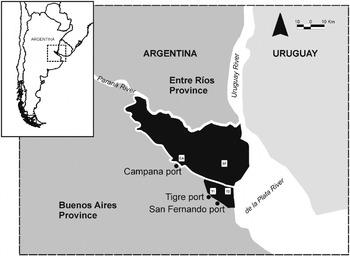
Four sites in the Paraná Lower Delta were monthly visited along a one-year period (Dec. 09–Nov. 10). Site selection was based on previous results (Cardo et al., Reference Cardo, Vezzani and Carbajo2011a) in an attempt to capture the landscape heterogeneity detected by satellite imagery and ground proofing. All sites were located in Buenos Aires Province; sites T1 (S 34.3718°, W 58.6549°; 25ha) and T2 (S 34.3754°, W 58.5538°; 10ha) were situated in the municipality of Tigre, site SF (S 34.2402°, W 58.5347°; 12ha) in San Fernando and site CA (S 34.1750°, W 58.8643°; 166ha) in Campana (fig. 1).
Location of the four sites surveyed (white squares) in the Buenos Aires Lower Delta of the Paraná River (black shading). T1 and T2 shows surveyed sites in Tigre Municipality, SF shows the site in San Fernando and CA, the site in Campana. Upper left: position of the study area (dotted square) in southern South America.

Most vegetation in natural habitats has distinct boundaries, with thin ecotones (Kandus et al., Reference Kandus, Karszenbaum and Frulla1999). Four main land uses, detected by satellite imagery and ground proofing, were identified as follows: domestic areas, Salicaceae plantations, secondary forests and Scirpus giganteus Kunth marshes (Baigún et al., Reference Baigún, Puig, Minotti, Kandus, Quintana, Vicari, Bo, Oldani and Nestler2008). Three random points were designated in each land use of each site sampled, assuming that temporary pools are randomly distributed within them. The temporary pool nearest to each random point was searched for, up to a 25m-radius around each point. Each point and its nearest pool (when present) were georeferenced with a Global Positioning System (Garmin eTrex Legend HCx).
For each pool, shading and turbidity conditions, and the presence of emergent vegetation and organic matter were recorded. Each pool was subsequently inspected for immature mosquitoes with the aid of a fine-mesh strainer and a white tray. Time sampling effort was standardized between one minute for pools of 1m2 and 20min for 100m2 or greater. Larvae were preserved in 70% ethanol, and pupae were transported alive to the laboratory for rearing. Larvae and adults emerged from collected pupae were identified using dichotomical keys (Darsie, Reference Darsie1985; Forattini, Reference Forattini2002; Rossi et al., Reference Rossi, Mariluis, Schnack and Spinelli2002) and specific descriptions (Senise & Sallum, Reference Senise and Sallum2008; Laurito et al., Reference Laurito, Almirón and Rossi2011).
Data analysis
Response variables
We collected and identified a total of 1044 immatures, belonging to 15 mosquito species. Six species corresponded to oviposition strategy C (268 immatures) and seven to strategy D (690). Floodwater mosquitoes included Ochlerotatus albifasciatus (Macquart), Ochlerotatus crinifer (Theobald), Ochlerotatus scapularis (Rondani), Ochlerotatus serratus (Theobald), Psorophora albigenu (Peryassu) and Psorophora ferox (Von Humboldt). Raft-laying mosquitoes were Culex lahillei Bachmann & Casal, Culex maxi Dyar, Culex pipiens L., Culex tatoi Casal & García, Uranotaenia apicalis Theobald, Uranotaenia nataliae Lynch Arribálzaga and a species complex composed of at least two species (Cx. dolosus Lynch Arribálzaga and Cx. eduardoi Casal & García) according to Senise & Sallum (Reference Senise and Sallum2008). The remaining two species collected, Culex (Melanoconion) intrincatus Brèthes and Aedeomyia squamipennis (Lynch Arribálzaga), have oviposition requirements fitting strategy B (Petersen & Linley, Reference Petersen and Linley1995; Clements, Reference Clements1999) and were excluded from further analysis due to low total number of samples (17 samples, 86 immatures collected).
Analysis of co-occurrence of mosquito species from both oviposition strategies was performed in two ways. First, with G statistic with one degree of freedom (df) and William´s correction for sample size <200 (Zar, Reference Zar1999). Second, with C8 coefficient of interspecific association, which is based on presence-absence data and ranges from −1 to +1, indicating maximum negative and positive associations, respectively (Hurlbert, Reference Hurlbert1969). Both analyses gave no signs of association (G = 2.27, P > 0.05; C8 = 0.37). Therefore, both species subsets were considered independent and modelled separately. In view of these results, response variables were defined as follows: I- presence (1) or absence (0) of a temporary pool within a 25m-radius around each random point; II- presence (1) or absence (0) of floodwater mosquitoes in surveyed pools; and III- presence (1) or absence (0) of raft-laying mosquitoes in surveyed pools.
Environmental variables
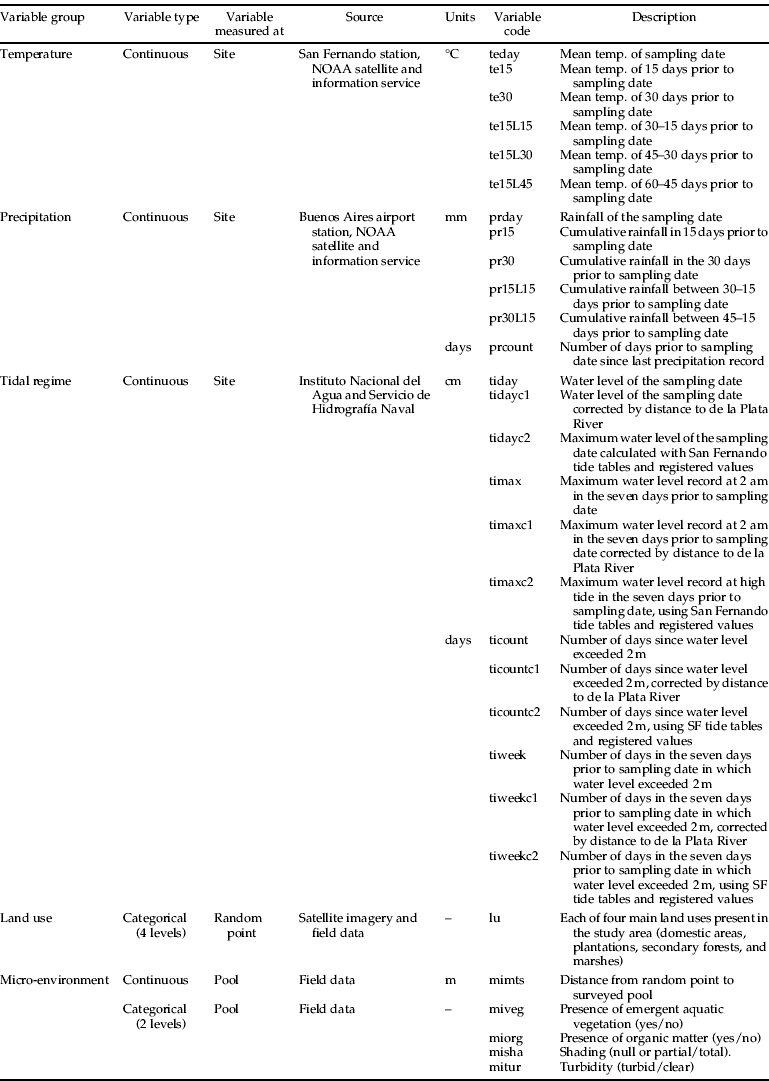
Environmental conditions were characterized through 30 variables classified into five main groups: temperature, precipitation, tidal regime, land use and microenvironment (table 1). All continuous variables (xi) were centred and squared. Temperature and precipitation data were obtained from San Fernando and Buenos Aires airport stations, respectively (NOAA Satellite and Information Service, 2011). In the calculation of temperature and precipitation variables, different time lags (15, 30 or 45 days) were applied to account for potential effects of environmental variables on the bionomics of immatures and adults. As regards tidal regime, two sources of information were available, namely daily water level records at 2 am at San Fernando, Tigre, and Campana ports (provided by the Instituto Nacional del Agua) and tide tables for San Fernando port (Servicio de Hidrografía Naval, 2009, 2010). Both sources were combined to obtain 12 variables (see table 1 for details), including two different corrections (c1 and c2) to account for the distance to the de la Plata River, which affects tide amplitude due to the influence of oceanic tides and south-southeastern winds. Based on field observations, a water level record above 2m was considered to produce flooding inside the islands. Land use was mapped in advance at the laboratory, and microenvironmental variables were recorded in situ for each sampled pool.
Explanatory variables included in generalized linear models for temporary pool availability, occurrence of floodwater mosquitoes, and occurrence of raft-laying mosquitoes in the Paraná Lower Delta, Argentina.

Temporal variograms
To discard any temporal autocorrelation among monthly-spaced samples, we built variograms (Cressie, Reference Cressie1993) in S-plus 6.1, taking into account increasing lags up to half of the maximum distance between pairs (six months). The stability of the variograms for all response variables suggested that any potential temporal autocorrelation did not depend on the lag between samples, i.e. samples taken consecutively were not more correlated than samples taken five months apart. Based on these results, we may affirm that even though samples taken monthly may not have been completely independent, the degree of correlation did not depend on the temporal separation among samples, so we treated all samples as valid replicates and run models without considering the temporal correlation.
Even though the seasonality was not explicit in the modelling, it was implicitly considered by including explanatory variables with a temporal component, i.e. temperature variables.
Statistical modelling
The quantification of the species-environment relationship through models may be regarded as hypotheses as to how environmental factors control the distribution of species and communities (Guisan & Zimmermann, Reference Guisan and Zimmermann2000). Generalized linear models (GLMs) are mathematical extensions of linear models based on an assumed relationship (called a link function) between the mean of the response variable and a linear combination of the explanatory variables. Inference tests for the selection of predictors that explain a significant portion of the variance (or deviance in the case of maximum likelihood estimation techniques) are mainly χ2 tests (Cantoni & Hastie, Reference Cantoni and Hastie2002). GLMs are more flexible than ordinary regression models for analysing ecological relationships due to their ability to handle non-linear data structures (Guisan et al., Reference Guisan, Edwards and Hastie2002). Generalized linear mixed models (GLMM) are an extension of GLM containing random effects in addition to the usual fixed effects. GLMM allow the treatment of data with errors that do not conform to a normal distribution and control for correlations that arise from grouped observations (Paterson & Lello, Reference Paterson and Lello2003) because of repeated measures in time or due to spatially related data.
Three GLMs were performed, one for each of the response variables previously defined. All models were fitted using a maximum likelihood method (McCullagh & Nelder, Reference McCullagh and Nelder1989), assuming a binomial distribution of errors and applying the logistic function as a link between the response variable and the linear predictor. The goodness-of-fit was evaluated in terms of the Akaike's information criterion (AIC: Akaike, Reference Akaike1974); the model that yielded the lowest AIC was selected from all possible models (Zuur et al., Reference Zuur, Ieno, Walker, Saveliev and Smith2009). Models with ΔAIC ≤ 2 were considered equivalent.
Initially, preliminary univariate GLMs were run for each explanatory variable, either categorical or continuous. In the latter case, they were also run for the squared variable (xi2) and for the sum of both (xi + xi2). Significant variables in the univariate analysis were selected for further modelling. To find a set of explanatory variables without collinearity, we calculated the variance inflation factors (VIFs) adjusted by the df as VIF1/(2 × df) (Davis et al., Reference Davis, Hyde, Bangdiwala, Nelson, Moolgavkar and Prentice1986). We removed the variable with the highest VIF value, recalculated the VIF values and repeated this process until all values were smaller than 5 (Zuur et al., Reference Zuur, Ieno, Walker, Saveliev and Smith2009). With this procedure, we obtained a full model without redundancy among explanatory variables.
To account for potential spatial dependence among samples, three groupings were tested as random factors in the full models using GLMM. These groups were (i) each site (i = 4); (ii) each site during each sampling period (j = 12) (ij, 48 groups for model I and 42 for models II and III); and (iii) each land use (k = 4) in each site during each sampling period (kij, 108 groups for model I and 96 for models II and III). The number of groups was sometimes lower than the maximum because not all land uses were present in all sampling sites and not all land uses presented temporary pools in all months. We chose the GLMM with any of the random factors detailed above if its AIC value was lower than a GLM with the same fixed factors and if the bootstrap P-value for the random term was significant at P < 0.05.
Once the proper random structure (if any) was selected, we performed an automatic stepwise backward procedure to select those explanatory variables significantly associated with each of the response variables. Variables in the final models were selected using changes in AIC and scaled deviance. Among selected variables, we tried all possible two-way interactions. Finally, to simplify the models, the levels in a factor that were not significantly different were merged together (Nicholls, Reference Nicholls1989). This procedure was stopped when the merging implied a significant increase in AIC.
For binomial models, output variables (predicted values) lie between 0 and 1, and presence for all models was initially accepted at a threshold probability of 0.5 (i.e. a fixed cut-off of P = 0.5). Afterwards, we tried all possible cut-off points from P = 0.01 to P = 0.99 to select an alternative P (labelled acp, after ‘adjusted cut-off point’) that maximized the classification effectiveness of the model. This was evaluated applying a 10-fold cross-validation using the Kappa index (K) to assess improvement of classification of the model over chance (Fielding & Bell, Reference Fielding and Bell1997). The Kappa index overcomes the problem of unequal number of presences and absences (Titus & Mosher, Reference Titus and Mosher1984). We reported the mean K value of ten rounds of cross-validations along with its corresponding SD and followed Landis & Koch (Reference Landis and Koch1977) ranges of agreement: poor K < 0; slight 0 ≤ K≤0.2; fair 0.2 < K≤0.4; moderate 0.4 < K≤0.6; substantial 0.6 < K≤0.8; and almost perfect 0.8 < K≤1. We performed this both for cut-off = 0.5 – labelled K(0.5) and SD(0.5), respectively – and for acp – K(acp) and SD(acp). All analyses were performed using the open-source software R 2.10.1 (R Development Core Team, 2009) with glmmML and Design packages.
Results
Out of 269 randomly-thrown points, 46.5% (125) presented a temporary pool within a 25-m radius. Pools of varying sizes were encountered; 27 of them ranged from 1 to 10m2, while the remainder 98 were bigger than 10m2. Floodwater and raft-laying mosquitoes occurred in 22.4% (28/125) and 48.8% (61/125) of the pools sampled, respectively.
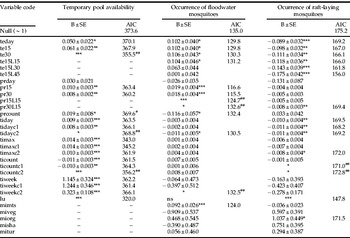
There was a high degree of correlation among explanatory variables within each group. Also, most temperature and precipitation variables were correlated, as well as some temperature and tide variables. On the contrary, no correlation occurred between precipitation and tide variables. Univariate GLMs showed that variables from all groups were significantly associated with each of the response variables (table 2). In particular, all variables from the tide group were significantly associated with temporary pool availability, whereas the same applied to the temperature group in relation to raft-laying mosquito presence.
Univariate statistics of the explanatory variables used to model temporary pool availability, the occurrence of floodwater mosquitoes and the occurrence of raft-laying mosquitoes in the Paraná Lower Delta, Argentina. Generalized linear models parameter (B) and standard errors (SE) are given for continuous variables and categorical variables with only two states. For continuous variables, best fit among the variable, its square and the sum of both is reported. For significant univariate fits, AIC values are reported. For land use, a χ2 test on the deviance with three degrees of freedom (df) for pool availability and two df for mosquito occurrence (domestic areas and plantations were pooled due to low sampling number in plantations) is informed.

*** Significant at P < 0.001; ** P < 0.01; * P < 0.05, Z-test results (B/SE with 267 df for pool availability and 123 df for either mosquito strategy) except for ##.
# Best fit is the squared variable.
## Best fit is the sum of the variable and its square. In this case, no parameter estimators are provided and significance is the result of the anova test comparing each model with the null model.
– These variables were not tested for temporary pool availability.
ns, not significant.
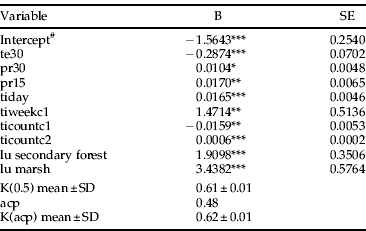
Considering all non-correlated significant explanatory variables together in the multivariate analysis, pool availability was best modelled as a function of eight environmental variables (table 3): one of temperature, two of precipitation, four of tide, and land use. Pool occurrence was negatively associated with mean monthly temperature (te30) and number of days since water level exceeded 2m (ticountc1), and positively related to the cumulative precipitation 15 and 30 days prior to sampling (pr15 and pr30), and to higher water levels at two time lags (the sampling day, tiday, and the week prior to the sampling day, tiweekc1). As regards land use, the probability of occurrence of pools was lowest in domestic areas and plantations, intermediate in secondary forests, and highest in marshes.
Generalized linear model parameter (B) and standard error (SE) for each variable included in the selected model for temporary pool availability in the Paraná Lower Delta, Argentina. Significance is the result of B/SE with 259 df.
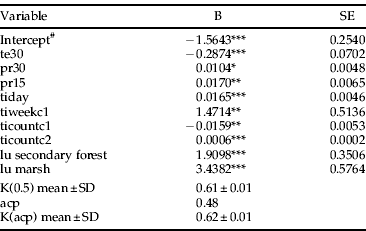
*** Significant at P < 0.001; ** P < 0.01; * P < 0.05.
# Corresponds to domestic areas and plantations.
K(0.5), Kappa index value considering predicted values >0.5 as species presence; SD, standard deviation; acp, adjusted cut-off point; K(acp), Kappa index value considering predicted values >acp as species presence.
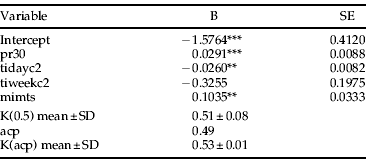
The best model for floodwater mosquito occurrence included two explanatory variables of tide, one of precipitation, and the distance to randomly-thrown points (mimts) (table 4). On average, lower tidal records (tiweekc2 and tidayc2), higher monthly cumulative precipitation (pr30) and more mimts had higher probability of occurrence of mosquitoes with this oviposition strategy.
Generalized linear model parameter (B) and standard error (SE) for each variable included in the selected model for occurrence of floodwater mosquitoes in temporary pools in the Paraná Lower Delta, Argentina. Significance is the result of B/SE with 120 df.
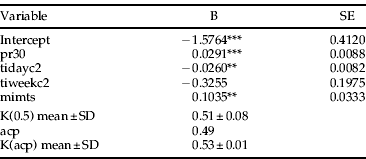
*** Significant at P < 0.001; ** P < 0.01.
K(0.5), Kappa index value considering predicted values >0.5 as species presence; SD, standard deviation; acp, adjusted cut-off point; K(acp), Kappa index value considering predicted values >acp as species presence.
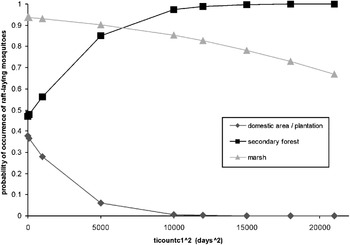
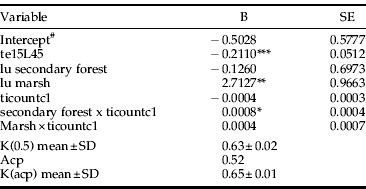
The best model for raft-laying mosquito occurrence included three explanatory variables, one of temperature, one of tide, and land use, along with a significant interaction between the latter two (table 5). High probability of occurrence of mosquitoes with this oviposition strategy was associated with lower mean temperature 45 days prior to the sampling date (te15L45). The time elapsed since water level exceeded 2m (ticountc1) was associated with lower probability of mosquito presence in domestic areas, plantations and marshes, and with higher probability of presence in secondary forests (fig. 2).
Predicted probability of occurrence of raft-laying mosquitoes as a function of the power of the number of days since water level exceeded a pre-selected threshold of 2m (ticountc12) in the Paraná Lower Delta, Argentina ( , domestic area/plantation;
 , Secondary Forest;
 , Marsh).

Generalized linear model parameter (B) and standard error (SE) for each variable included in the selected model for occurrence of raft-laying mosquitoes in temporary pools in the Paraná Lower Delta, Argentina. Significance is the result of B/SE with 118 df.
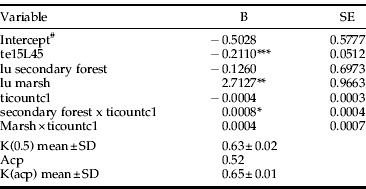
*** Significant at P < 0.001; ** P < 0.01; * P < 0.05.
# Corresponds to domestic areas and plantations.
K(0.5), Kappa index value considering predicted values >0.5 as species presence; SD, standard deviation; acp, adjusted cut-off point; K(acp), Kappa index value considering predicted values >acp as species presence.
As the inclusion of a random component did not significantly improve any of the models, the three fixed factor models were preferred. All models presented mean K(acp) values between 0.53 and 0.65, corresponding to ‘moderate’ and ‘substantial’ ranges of agreement.
Discussion
Oviposition is probably the most important event in the life history of mosquitoes, shaping both their individual fitness and vectorial capacity (Chaves & Kitron, Reference Chaves and Kitron2011). Therefore, mosquito species can be highly selective of oviposition sites according to environmental and hydrologic conditions (Society of Wetland Scientists, 2009). In the temperate wetland under study, the environmental factors related to mosquito presence differed between the two oviposition strategies considered. Precipitation and tidal regime were relevant for floodwater mosquitoes, while temperature, tide and land use did so for raft-laying mosquitoes. We identified four main issues to be considered in the interpretation of these results. First, we evaluated the extent and quality of available surface created by both water sources in relation to the requirements of each oviposition strategy. Floodwater mosquitoes typically breed in ephemeral pools (Clements, Reference Clements1999). In temperate Argentina, the species of Ochlerotatus and Psorophora studied are multivoltine and the number of generations produced depend on the frequency of flooding of eggs and hatching success (Maciá et al., Reference Maciá, García and Campos1995; Fontanarrosa et al., Reference Fontanarrosa, Marinone, Fischer, Orellano and Schweigmann2000; Campos et al., Reference Campos, Fernández and Sy2004). Raft-laying mosquitoes exploit a wider variety of ground water bodies as breeding habitats. Within temporary pools, they are typically found in larger and more stable pools than floodwater mosquitoes (Clements, Reference Clements1999). In tidal systems, the extension of the flooded area is directly related to rainfall volume and tide height and inversely related to the time elapsed since the last rain or flooding event, due to evaporation and infiltration (Gleiser & Gorla, Reference Gleiser and Gorla1997). Precipitation creates circumscribed small pools mixed with dry and muddy areas in a patchy distribution. These small ephemeral pools are more suitable for floodwater mosquitoes. High tides, on the contrary, produce extended flooded grounds, which may however resemble precipitation-formed pools when water retreats and they start drying. This extensive flooded area would be favourable for raft-laying mosquitoes.
Second, high tides (but not precipitation) may sweep larvae and egg-rafts, but not singly-laid eggs of floodwater mosquitoes, because they are embedded in mud or in crevices in the soil. It has been shown that excessive rain flushes larvae of Aedes sierrensis (Ludlow) from natural and artificial containers (Washburn & Anderson, Reference Washburn and Anderson1993). However, not all species may be equally affected. In container habitats, Koenraadt & Harrington (Reference Koenraadt and Harrington2008) have demonstrated that excessive rain flushes differentially the immature stages of Aedes aegypti (L.) and Cx. pipiens, and that the strength of the alarm response varies with water temperature. The explanation given by the authors is that increased larval activity at higher temperatures provokes larvae to spend more time at the surface and, consequently, increases their likelihood of being flushed. If similar behaviours could be extended to raft-laying mosquitoes in ground water habitats, we would be able to explain why larvae were more frequently found during the colder months, matching the negative association with temperature variables.
Third, it should be acknowledged that water from both sources has not only physical differences as regards its dynamics but also chemical differences, which were not included in the present research. Mosquito richness and abundance may be determined by microenvironmental variables such as oxygen and pH (Berti et al., Reference Berti, Gutiérrez and Zimmerman2004), bacterial concentration and dissolved organic carbon (Leisnham et al., Reference Leisnham, Slaney, Lester and Weinstein2005), and dissolved nutrients (Mercer et al., Reference Mercer, Sheeley and Brown2005), all of which may differ between pools composed by water from rain or rivers. Future studies should focus on the identification and quantification of such chemical differences and whether they affect the occurrence of different species.
Fourth and last, the interaction with predators should not be disregarded. Species that colonize temporary pools probably take advantage of the abundant resources offered by such pools and the reduced predation pressure as compared to more permanent pools (Williams, Reference Williams1997). The avoidance of oviposition sites with high abundance of predators has been suggested by several authors for different mosquito species (reviewed by Blaustein et al., Reference Blaustein, Blaustein and Chase2005). Pools with a precipitation origin are most probably predator-free at least in a first stage. Flooding by high tide connects temporary pools with other aquatic habitats, which may favour the contact between mosquitoes and predators occupying semipermanent and permanent habitats. Even though our sampling techniques were not specifically designed to collect predators (particularly those with benthic habits), we recorded some predatory morphs, most frequently Coleoptera, Hemiptera, Odonata and Ephemeroptera larvae, and tadpoles. Forty pools were predator-free, while in the remainder 85 pools one or more (up to five) predatory morphs were present. While immatures from strategy C were encountered equally in pools with and without predators, mosquitoes with strategy D were more frequently collected in pools with predators, reinforcing the idea of raft-laying species being associated with more long-lasting pools of tidal origin.
Considering the previous issues, we may try to understand oviposition and immature presence patterns for each strategy. Precipitation is favourable for floodwater mosquitoes, by stimulating the hatching of eggs already deposited in the soil and also by creating suitable habitat for new oviposition cycles. Although high tides may also stimulate the hatching of available eggs, the short time lags of the tide variables included in the model (flooding on the sampling day and on the seven days prior to sampling) probably prevented those recently hatched eggs to reach the third larval stage in order for that pool to be recorded as positive. Also, the extensive flooding precludes new ovipositions in the short term and may wash larvae to adjacent streams when it recedes. These associations are in accordance with the positive correlation of floodwater mosquitoes with distance to randomly-thrown points, given that extended flooded ground is logically related to shorter distance to random points than circumscribed small pools. So, this variable could be interpreted as an indicator of low temporary pool availability, given that the distance required to find a pool will be larger as fewer pools are present.
As regards raft-laying mosquitoes, their association with hide tide varied for different land uses. Flooding certainly increases oviposition surface considerably, but may also produce a washing effect of egg-rafts or larvae already present. The dynamic of the land use ‘marsh’ appears fairly independent of the time elapsed since inundation, being the probability of finding mosquitoes consistently high (94–67% for 0–145 days after high tide). This is probably because, due to its position in the centre and bottom of the island, it is highly capable of retaining water and there is no water runoff to adjacent streams that could sweep egg-rafts or larvae. The steep fall of raft-laying immature probability in domestic areas and plantations could be related to low water holding capacity; domestic areas are located on rivers and streams' levees, while in plantations drained soils are maintained by man-made drainage channels and polders (Kandus et al., Reference Kandus, Karszenbaum and Frulla1999). A favourable microclimate for adult mosquitoes given by the protective effect of canopy is presumably produced in secondary forests and plantations, but the scarce amount of water makes the latter land use unsuitable for immatures. On the contrary, this microclimate plus retained water makes secondary forests especially suitable for mosquito breeding farther apart in time from inundation, avoiding the potential washing effect. Developed tree canopies not only provide shade that can reduce evaporation, but may also decrease sub-canopy wind speed and increase humidity near the ground (Linthicum et al., Reference Linthicum, Anyamba, Tucker, Kelley, Meyers and Peters1999). Moreover, due to higher structural complexity and the number of plants species present, secondary forests usually present higher richness of birds and mammals (Bó & Quintana, Reference Bó, Quintana, Matteucci, Solbrig, Morello and Halffter1999). This would provide extra feeding sources for adult mosquitoes in this land use.
Also, raft-laying mosquitoes were negatively associated with temperature. Even though the mean temperature 45–60 days before sampling fitted best and was included in the final model, all temperature variables (with and without lags) were negatively associated, as shown in the univariate analysis. This result reflects the seasonality of the species grouped within this oviposition strategy, mainly of the complex Cx. dolosus/eduardoi, which was present in 88.5% (54/61) of all samples. The apparently counterintuitive association between these species and cold temperatures may be due to a number of reasons. As mentioned above, colder temperatures may be associated with lower larval activity, less time spent at the surface and consequently less washing effect. Alternatively, higher mosquito richness during the warmer months may produce an interspecific competitive interaction which effect is released in winter, enabling these species to occupy more pools. Asymmetry of competitive interactions in temporary pools has been previously demonstrated for Culex, suggesting that local competitive exclusion is possible for these species (Juliano, Reference Juliano2009). Floodwater mosquitoes have drought-resistant eggs (Clements, Reference Clements1992) and, therefore, are able to go through the winter in this stage. On the contrary, the eggs of raft-laying mosquitoes are sensible to desiccation, so they survive the winter as larvae. A word of caution should be said on the distinction between immature samplings and adult abundance, because common perception of mosquito presence is usually based on biting activity and this need not correlate with immature presence in temporary pools.
To our knowledge, there are no published studies dealing with environmental factors related to the immature presence of mosquito species grouped according to their oviposition strategy so as to make a formal comparison of our results. Field surveys and experiments relating mosquito oviposition patterns to environmental factors have mainly focused on the genus Culex, not only because they are important disease vectors but, in practice, because their egg-rafts are easy to identify and collect (Rubbo et al., Reference Rubbo, Lanterman, Falco and Daniels2011). In New Zealand, more rafts were oviposited by Culex pervigilans (Bergroth) mosquitoes when temperature was higher and humidity and pressure were lower (Zuharah & Lester, Reference Zuharah and Lester2010). The oviposition dynamics of Culex quinquefasciatus Say in USA was also primarily dictated by relative humidity and disrupted by heavy rainfall events, due to the dilution of limiting resources (Chaves & Kitron, Reference Chaves and Kitron2011). Also in the USA, saltmarsh mosquitoes of the genus Aedes were modelled accurately using meteorological and tide variables (Kokkinn et al., Reference Kokkinn, Duval and Williams2009). As regards the methodological approach, GLMs have been applied to the ecological characterization of both mosquito assemblages and individual species. For instance, mosquito larval presence was associated with lower elevations, greater wetness, short distances to water, and land use in western Kenya (Bian & Li, Reference Bian and Li2006). In a tidally influenced swamp in Australia, Aedes vigilax (Skuse) larval densities were positively related to maximum tide height and high tide frequency, whereas Culex annulirostris (Skuse) larval densities were positively related to elevation and rainfall (de Little et al., Reference de Little, Bowman, Whelan, Brook and Bradshaw2009). A previous study in our area modelled the occurrence of Oc. crinifer and Cx. dolosus s.l. (which can be regarded as representatives of strategies C and D, respectively) in ground-water habitats as a function of land use, anthropic intervention and seasonality (Cardo et al., Reference Cardo, Vezzani and Carbajo2011b). In that occasion, both species exhibited significant seasonal trends coherent with the results presented here, and positive association with land uses as follows: Oc. crinifer with secondary forests (we did not obtain a significant land use association here), and Cx. dolosus s.l. with secondary forests and marshes (as expected by the pattern observed in fig. 2).
Finally, we attempt to draw some guidelines for mosquito management and control in the Paraná Lower Delta. As raft-laying mosquitoes were significantly associated with lower temperatures, periods in which little adult activity is recorded, we believe that action measures should be directed mainly toward floodwater mosquitoes. Moreover, three species of the latter strategy (Oc. crinifer, Ps. ferox and Oc. serratus) were previously recorded as the most anthropophilic species in the study area, accounting for 90% of all captured specimens using human bait (Loetti et al., Reference Loetti, Burroni and Vezzani2007), while raft-laying species represented only 0.6% of all captures. As human-biting mosquitoes are not only a nuisance but key in terms of vectorial capacity and disease transmission, this reinforces the idea of intervening against floodwater mosquitoes. Generating a tidal in- and outflow could be a good measure against floodwater mosquitoes in all land uses and raft-laying mosquitoes in secondary forests, due to larval flushing and predator entry. Such regulated water flow could be done by ditching and polding, both of which are current practices to control water level in plantations (Kandus et al., Reference Kandus, Karszenbaum and Frulla1999). It is true that, in domestic areas and plantations, this would also create an increased oviposition surface for raft-laying mosquitoes, which could shorten the time of the gonotrophic cycle, thereby increasing the number of larvae and adults and, most importantly, the biting frequency (Gu et al., 2006). Draining marshes could be an option against raft-laying species; however, habitat alteration could be major, and decreased water levels could favour the breeding of floodwater species. The complexity of this wetland system requires any control measure to be carefully evaluated in advance, taking into account the different actors and foreseeing potential cascade reactions.
Mosquitoes are a major component of wetland communities and, therefore, presumably play an important role in the processes involved in and services produced by these highly productive systems. However, the need to control mosquito populations, as a serious nuisance and vectors of diseases to humans and animals, is unequivocal (Willot, Reference Willot2004). We identified which variables describing climatic features, tidal regime and land use best predicted the occurrence of floodwater and raft-laying mosquitoes and the availability of their main breeding habitat in the Paraná Lower Delta, and made recommendations on mosquito management and control based on these results. Considerations regarding mosquitoes life history (e.g. that old females may oviposit in suboptimal habitats) and the influence of biotic interactions within pools (Blaustein et al., Reference Blaustein, Blaustein and Chase2005; Blaustein & Chase, Reference Blaustein and Chase2007; Rubbo et al., Reference Rubbo, Lanterman, Falco and Daniels2011) should be integrated in future studies towards a more comprehensive approach.
Acknowledgements
We thank Gabriel and Liliana, the authorities of Estación Experimental Agropecuaria Delta del Paraná-INTA, Automovil Club Argentino and Felicaria camp of San Fernando Municipality for allowing us to work at the study sites and also Interisleña S.A. for transportation discounts. This study was supported by Consejo Nacional de Investigaciones Científicas y Técnicas (CONICET) (PIP 112-200801-00743) and University of Buenos Aires (UBACYT X608). MVC is a fellow of CONICET, and DV and AEC are members of the Research Career of CONICET.