Introduction
Maintaining seed quality and viability of stored orthodox crop seeds over time can be challenging in any location but is especially so in the humid tropics and subtropics of the developing world (Delouche et al., Reference Delouche, Matthes, Dougherty and Boyd1973; Ellis, Reference Ellis1991; Rao et al., Reference Rao, Hanson, Dulloo, Ghosh, Nowell and Larinde2006). Warm year-round temperatures, high rates of relative humidity, fluctuating relative humidity, and year-round pest pressures are all problematic for long-term storage of seeds. Even where seeds are saved, stored, and planted on short annual cycles, significant losses in seed quality are not uncommon. Storing seeds longer than 1 year becomes a considerable challenge where resources are scarce but offers the potential to greatly expand planting options, improve food security, and increase resilience for developing world farmers.
Community seed banks, in particular, have great potential for improving access to diverse seeds and building the resilience of smallholder farmers and communities (Vernooy et al., Reference Vernooy, Sthapit, Otieno, Shrestha and Gupta2017). Farmer access to seeds of local landraces and neglected crops protects local sources of food and income and preserves genetic diversity. Unfortunately, even large and well-established seed banks face challenges storing seeds over long periods. Research by Gomez-Campo (Reference Gomez-Campo2006) posits that this inability to store seeds over long periods (30–50 years) is due primarily to inadequate storage containers and underscores the importance of appropriate seed storage technologies for community-based seed banks that do not have access to climate-controlled storage infrastructure.
Research has shown that even in today’s agricultural environment, in which seeds in most places can be purchased from a variety of vendors, many farmers still save and exchange seeds within their own communities. Coomes et al. (Reference Coomes, McGuire, Garine, Caillon, McKey, Demeulenaere, Jarvis, Aistara, Barnaud, Clouvel, Emperaire, Loufi, Martin, Massol, Pautasso, Violon and Wencelius2015) have shown that in many developing countries, commercial or ‘formal’ seed systems may only account for as high as 10% of what farmers actually plant, indicating that the majority of seeds in these locations are derived through informal seed systems. Louwaars et al. (Reference Louwaars, deBoef and Edeme2013) suggest that, even for staple grain crops in sub-Saharan Africa, formal seed systems may only supply as much as 20% of what farmers are planting. The quality of seeds passing through informal seed systems can benefit from accessible and affordable storage technologies.
Despite successful seed saving for many generations, there remain high rates of loss in seed quality of traditionally saved seeds and losses that can be reduced with technologies that mitigate against causes of seed decay in storage environments (Croft et al., Reference Croft, Bicksler, Manson and Burnette2012). The deterioration of seeds over time varies between crops (Probert et al., Reference Probert, Daws and Hay2009) and is compounded by environmental factors of moisture, oxygen, and temperature (Ellis, Reference Ellis1991; Harrington, Reference Harrington and Kozlowski1972). Seed viability can be extended by drying seeds prior to storage, which slows respiration and prevents premature germination or rotting of seeds, and then by maintaining low moisture, temperature, and oxygen in storage (Rao et al., Reference Rao, Hanson, Dulloo, Ghosh, Nowell and Larinde2006; Groot et al., Reference Groot, de Groot, Kodde and van Treuren2015). Many technologies for storing seeds under proper conditions remain out of reach to those in resource-poor communities, especially where electricity is unavailable, unaffordable, or intermittent.
Vacuum sealing has been touted as a successful approach for its ability to reduce the exposure of seeds to humidity and oxygen. Croft et al. (Reference Croft, Bicksler, Manson and Burnette2012) in northern Thailand found that the viability of vacuum-sealed seeds exposed to ambient outdoor conditions was superior to that of nonsealed seeds in the refrigerator. As vacuum sealing removes ambient humid air inside of storage containers, it also removes oxygen, thereby mitigating against various stored grain and seed pests. Research in Thailand showed that electric vacuum sealing significantly reduced populations of cowpea bruchid (Callosobruchus maculatus) in stored lablab seeds (Lablab purpureus) compared to nonsealed seeds (Lawrence et al., Reference Lawrence, Bicksler and Duncan2017). Groot et al. (Reference Groot, de Groot, Kodde and van Treuren2015) confirmed that the presence of oxygen accelerates the deterioration of dry seeds and recommended storing seeds with reduced or no oxygen.
Though vacuum sealing has proven effective, its adoption by smaller seed banks has been limited due to the prohibitive cost and availability of vacuum sealing technology. One alternative is hermetic sealing. Laminated aluminum foil packets are appropriate for hermetic sealing of smaller quantities of seeds. Working with laminated foil, Ellis and Hong (Reference Ellis and Hong2007) found hermetic sealing to be most effective with dry seeds. Laminated foil containers can be opened and then resealed with a hot iron. The most convenient irons to use for this require electricity.
Another approach to storing seeds without costly infrastructure and electricity is the placement of desiccants in seed storage vessels. A variety of desiccant materials can be used to absorb moisture from humid air trapped inside containers, such as in jars, bottles, and barrels. Commonly used local materials include silica, bentonite, zeolite, and activated charcoal, which are often placed with seeds in containers for storage (Ashok Shakuntal and Gowda, Reference Ashok Shakuntal and Gowda2017; Ellis and Hong, Reference Ellis and Hong2007; Hay et al., Reference Hay, Thavong, Taridno and Timple2012; Nethra et al., Reference Nethra, Rani, Gowda, Prasad and Narayanaswamy2016; Nyarko et al., Reference Nyarko, Bayor, Craigon and Suleimana2006). Zeolite Drying Beads® were shown to be effective at rapidly drying down rice seeds (Hay et al., Reference Hay, Thavong, Taridno and Timple2012). This technology shows great promise but requires an understanding of initial seed moisture content and accurate bead-to-seed ratio calculations (Hay and Timple, Reference Hay and Timple2013) to avoid injuring seeds by drying them down too much (Hay et al., Reference Hay, Thavong, Taridno and Timple2012; Vertucci and Roos, Reference Vertucci and Roos1990).
Studies with desiccants have mostly focused on their use for drying harvested seeds in preparation for storage (Hay et al., Reference Hay, Thavong, Taridno and Timple2012; Hay and Timple, Reference Hay and Timple2013; Nassari et al., Reference Nassari, Keshavulu, Rao, Chandra Shekar Reddy and Raheem2014). In areas of the tropics with limited resources, however, there is also the need for low-cost, accessible approaches for keeping dry seeds from rehydrating and deteriorating when placed in structures with high ambient humidity and in containers that may not be perfectly sealed. Here, we explore the use of desiccants and vacuum for maintaining the storage life of initially viable, dry seeds. We hypothesized that, starting with initially dry seeds, it is possible to maintain seed quality over time, for multiple crops, with very inexpensive technologies found in many areas of the developing world.
Materials and Methods
Site descriptions
This study took place between July 11, 2017 and July 16, 2018 at two locations. Sites were located at the ECHO Asia Impact Center in Chiang Mai, Thailand (18o 47’N, 99o 0’E) (referred to as ‘Thailand’ throughout) and the ECHO Global Farm in North Fort Myers, Florida, USA (26o 43’N, 81o 47’W) (referred to as ‘Florida’ throughout). Sites are classified according to the Koppen classification system as ‘Tropical Savanna’ (Thailand) and ‘Humid Subtropical’ (Florida), respectively. Both sites exist to research and demonstrate technologies for sustainable agriculture development in resource-constrained settings.
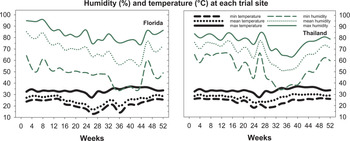
All treatment containers were stored in cardboard boxes, which were kept outside in ambient temperature and humidity conditions under the shelter of screened-in porches. The inference space of this experiment was not on mitigating the effects of temperature on stored seeds, but rather on comparing the effects of accessible seed storage techniques/suites on seed moisture content and seed viability in ambient conditions in the tropics and subtropics that approximate the context of many smallholdings in the developing world. Temperature (°C) and relative humidity (%) (Figure 1) were measured using Onset® Hobo® Temp/RH data loggers set to record readings at 1-h intervals over the course of the study.
Minimum (min), mean, and maximum (max) air temperature (thick lines) and relative humidity (thin lines) surrounding seeds were kept for 52 weeks in an outdoor shelter at each of two sites (Florida and Thailand). Data are biweekly averages of daily readings from a data logger at each site.

Experimental design
This study was designed to compare the effects of a range of locally available storage technology suites (involving desiccants and vacuum) to a control (paper bags) on seed viability. The dependent variables tested included two indicators of seed viability: seed moisture content (% on a wet weight basis) and seed germination (%). Treatments were arranged in a randomized complete block design (RCBD) with four replications at each of the two sites (Florida and Thailand). Main effects included seed type, seed storage treatment, and sampling time. Seed types included okra (Abelmoschus esculentus (L.) Moench), sorghum (Sorghum bicolor (L.) Moench), and velvet bean (Mucuna pruriens (L.) DC), selected for their differences in size and crop classification, categorized as a vegetable, grain, and pulse, respectively. Seeds of all three crops are considered orthodox and can be stored long term under dry conditions (Ellis, Reference Ellis1991). Okra and velvet bean seeds were grown and saved in Florida at the ECHO Global Seed Bank, while the sorghum seeds were purchased from a commercial US-based seed company. Seeds from the same seed lots were used at both sites for consistency, and transported via air from Florida to Thailand to minimize time and exposure after shipping. Seeds remained sealed and airtight between shipment and the start of the experiment. Prior to treatment, seed moisture content was 6, 9, and 12% for okra, sorghum, and velvet bean, respectively. Seed treatments were blocked within the screened-in porch itself and exposed to ambient conditions.
Seeds were stored over the course of 12 months (52 weeks), and sampled at 0 (baseline), 1, 3, 6, 9, and 12 months after treatment establishment. Experimental units of seeds were placed in respective containers, treated at the onset of the experiment, and tested at respective sampling times. An experimental unit at each site consisted of 60 g of seeds per container, with each container assigned to 1 of 5 storage treatments, 1 of 3 seed types, 1 of 5 sampling times, and 1 of 4 replicates, for a total of 600 experimental units across two locations (300 experimental units per location).
Treatments
Seed storage treatment suites included: (1) seeds stored under vacuum sealing using an electric vacuum sealing machine with polyethylene bags; (2) seeds stored under vacuum sealing using a modified bicycle pump vacuum sealer with glass jars; (3) seeds stored with zeolite Drying Beads® desiccant in glass jars; (4) seeds stored with calcium oxide desiccant in glass jars; and (5) a control of seeds stored in paper bags.
Seed storage treatment 1 consisted of seeds stored under vacuum, using an electric 0.080 MPa vacuum pressure, DZ-320A Vacuum Packing Machine, Hongzhan, China; 4-kg capacity; 530 USD; and purchased in Chiang Mai, Thailand. Seeds were vacuum-sealed in clear polyethylene vacuum storage bags purchased at the Chiang Mai Plastics store. Information on film thickness and density was not available; however, this technology combination (above-mentioned sealer and polyethylene bags) was used to keep results relevant to locally available materials used exclusively for vacuum sealing, mainly in the food processing industry but also in local seed banks. The same machine sealer and vacuum bags were used in previous research on seed storage (Croft et al., Reference Croft, Bicksler, Manson and Burnette2012; Lawrence et al., Reference Lawrence, Bicksler and Duncan2017).
Treatment 2 seeds were stored using a low-cost ‘modified bicycle pump vacuum sealing device’ (Bicksler, Reference Bicksler2015). This device uses a standard manual bicycle pump, altered with a reversed valve to remove rather than push air. It achieves a modest vacuum pressure of 53 kPa and works by pulling air through a small hole – with a simple tape gasket over the hole – in the lid of a jar or similar container (Motis, Reference Motis2019). A modified bicycle vacuum sealing device can be assembled in Thailand for an equivalent of approximately 15 USD, or even less with used instead of new components. Treatment 2 seeds were placed in 118 ml (4 oz) glass jars, with plastisol lining on the inside of the metal lids, prior to removal of air with a modified bicycle pump. The tape gasket was then hermetically sealed with rubber cement glue around the edges.
Treatment 3 seeds were hermetically sealed in 207 ml (7 oz) jars, with similar lids as treatment 2 jars, along with zeolite Drying Beads® at a ratio (by weight) of 2:1 seeds to beads. Manufacturer (Rhino Research, Phichit, Thailand) guidelines recommend tailoring the seed-to-bead ratio to each crop; however, to avoid introducing ratio as a confounding factor in the study, we kept the seed-to-bead ratio constant across the three crops. The 2:1 ratio of seeds to beads used in this research was the same as that found by Nassari et al. (Reference Nassari, Keshavulu, Rao, Chandra Shekar Reddy and Raheem2014) to be effective for drying tomato seeds. Within each jar receiving zeolite, the beads were placed in a small breathable paper bag on top of the seeds, ensuring that there was no direct contact between desiccant and seeds. The beads cost 8–15 USD per kg (FFIL, 2017).
Treatment 4 seeds were hermetically sealed in 207 ml (7 oz) jars along with powdered calcium oxide, locally available in many parts of the tropics and often sold as ‘quicklime’ for the equivalent of 2 or less USD per kg. Calcium oxide removes moisture by reacting with water to form calcium hydroxide (Powers and Calvo, Reference Powers, Calvo and Ahvenainen2003). It was added to seeds at the same seed-to-desiccant ratio (2:1 by weight) as zeolite beads. Within each jar assigned to treatment 4, calcium oxide was placed in a small breathable paper bag on top of the seeds.
Treatment 5 served as a control of nontreated seeds. These seeds were stored in small paper bags (2 mm) that were simply folded over and stapled closed.
Data collection
At each site, air temperature and relative humidity were recorded hourly with an Onset® Hobo® Data Logger (UX100–003) placed adjacent to the seeds. During each sampling period, one batch of seeds (60 experimental units) at each site was removed for measuring the dependent variables as explained below. For jars and bags under vacuum sealing treatments, vacuum pressure was measured in cm Hg (converted to kPa) before unsealing. This was done using a simple pressure gauge attached to a hypodermic needle that was either pushed directly into treatment 1 bags or pushed through the tape gasket and pinhole in the lids of treatment 2 jars. No jars were resealed and placed back into the study, as data for each sampling month were taken from a different batch.
Upon unsealing of containers, a subsample of seeds was then randomly removed from the middle of each jar for measurement of dependent variables. Seed viability was measured by determining seed germination (%) using a simple Petri dish method, with 50 seeds (Rao et al., Reference Rao, Hanson, Dulloo, Ghosh, Nowell and Larinde2006) with four replicates placed into germination cabinets (Seedburo® Model 548 [Florida]; a custom-built analog of the Seedburo® Model 548 cabinet [Thailand] used by Croft et al., Reference Croft, Bicksler, Manson and Burnette2012 and Lawrence et al., Reference Lawrence, Bicksler and Duncan2017) that maintained the same average temperature (29 ± 2 °C) and humidity (60 ± 5%) at both sites. Germination cabinets were maintained at 28 ± 5 °C using a thermostat. Replications of Petri dishes were blocked within the germination cabinet utilizing a RCBD in order to statistically account for temperature variation within the cabinets. Germinated seeds were removed every 2 days for up to 14 days. A second 5-g subsample of seeds was also removed from each container to measure seed moisture content (%), using a DSH-50-1 Precision Halogen Moisture Meter. The same device was also used for measuring moisture percentage of desiccants removed from treatments that included zeolite Drying Beads® and calcium oxide, using a 5-g sample of the desiccant to compare moisture absorbance. For month 0, seeds were subjected to the same measurements for dependent variables to provide a baseline measurement of seed germination percentage and seed moisture content before seeds were appropriated to different treatment regimes.
Data analysis
Hourly logger readings of ambient conditions were used to calculate daily minimum, mean, and maximum values for air temperature and relative humidity. Biweekly averages of resulting daily values were then plotted over time for each site (Figure 1). For all sampling periods, remaining data were subjected to analysis of variance (ANOVA), using the mixed procedure of SAS (SAS Institute Inc., Cary, NC), to measure main and interacting effects of site, crop, treatment, and sampling time. For all dependent variables, degrees of freedom were adjusted using the Satterthwaite correction, and normality of the raw data and residuals was evaluated using the UNIVARIATE procedure of SAS. Homogeneity of variance for the two sites was ascertained using Levene’s Test of Homogeneity of Variance. Due to homogeneity of variances and ANOVA, sites were combined to maintain degrees of freedom and limit inference space primarily to the interaction of crop, treatment, and sampling time. Interactions of sampling time with treatment and crop were described with symbol-based line drawings created with SigmaPlot (version 14.5). Due to a significant interaction on germination percentage of treatment/crop combinations, site, and time, the effect of site on germination percentage was explored within the sampling of greatest interest, month 12.
Results
Ambient humidity and temperature
Ambient relative humidity ranged from a minimum percentage of 34 (at both sites) to a maximum percentage of 84 (Thailand) or 96 (Florida) (Figure 1). Minimum, mean, and maximum humidity values between the 30th and 40th weeks were lower than at the start of the trial, with declines more pronounced at the Thailand than Florida site. Air temperature ranged from 13 to 36 °C at the Florida site and 18–37 °C at the Thailand site. Temperatures at both sites were consistently lowest between weeks 24 and 26.
Seed moisture
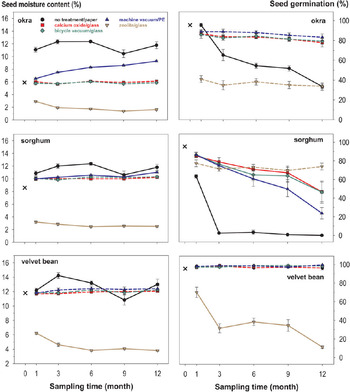
Seed moisture content across sites was influenced by interacting factors of crop, treatment, and time (Figure 2; Table 1). Okra seed moisture content was 6% initially (month 0). Between months 1 and 12, nontreated okra seed moisture fluctuated over time (p < 0.001), with the highest (13%) and lowest (10%) levels occurring in months 3 and 9, respectively. Over the duration of the trial, okra seeds had lower seed moisture content with, than without, drying treatments. With machine vacuum sealing, okra seed moisture content increased slowly over time (p < 0.001), reaching a level of 9% by month 12. Calcium oxide and bicycle vacuum sealing, however, kept okra seed moisture content constant (time response p > 0.05), close to the baseline level of 6%. Okra seeds were driest with zeolite, with a moisture content that declined (p < 0.001) from about 3% at month 1 to a lowest level of 2% by month 9.
Interaction of crop, treatment, and time on seed moisture content and seed germination (%) across sites. For each crop, a ‘month 0’ (July 2017) reference point (X) is shown for the mean of 4 pretreatment baseline values per site (Florida and Thailand), followed by means (of 4 values per treatment per site) with no treatment (circles), calcium oxide (squares), vacuum sealing (of glass jars with a modified bicycle pump [diamonds] and polyethylene [PE] bags with a machine sealer [upward triangles]), bicycle vacuum sealing (diamonds), and zeolite (downward triangles) at each sampling time. Responses to time, of measured variables for crop × treatment combinations, were nonsignificant (dashed lines) or significant (solid lines) at p ≤ 0.05 (see Table 1 for levels of significance). Error bars are ± 1 standard error of the mean.

Level of significance for significant responses to time of seed moisture (%), germination (%), vacuum pressure, and desiccant moisture for technology suites (crop × treatment/container) combinations across sites

ZEffects are significant at p ≤ 0.05 (*), 0.01 (**), or 0.001 (***).
YPE refers to the polyethylene bags used in conjunction with electric machine vacuum sealing.
Moisture content of nontreated sorghum seeds changed similarly over time as that of okra, with a maximum of 13% seed moisture content reached between months 3 and 6. Between 1 and 12 months, sorghum seed moisture content with calcium oxide and the two vacuum sealing treatments stayed slightly above the initial value of 9%. Relative to the 9% baseline value, zeolite reduced and kept sorghum seed moisture content lower than any other treatment, with values that declined (p < 0.05) from 3% in month 1 to about 2% by month 12.
Seed moisture content of velvet bean, with no treatment, reached a maximum of 14% by month 3, changing (p < 0.001) similarly over time as nontreated okra and sorghum. With calcium oxide and the two vacuum sealing treatments, the seed moisture content of velvet bean was unaffected by time (p > 0.05), staying close to the initial level of 12%. With zeolite, however, the moisture content of velvet bean seeds declined (p < 0.001) from 6% at month 1 to a low of 4% at month 6.
Seed germination percentage
Interacting effects of crop, treatment, and time influenced seed germination across sites (Figure 2 and Table 1). Okra seeds initially germinated at a rate above 90%. With no treatment, okra seed germination declined rapidly over time (p < 0.001). By month 12, only 30% of sampled, nontreated okra seeds germinated. Between months 1 and 12, okra seed germination percentage with calcium oxide and vacuum sealing treatments remained constant (p > 0.05) at approximately 80%. With zeolite, okra seed germination percentage dropped from over 90% at month 0 to less than 40% by month 1; subsequent germination was unaffected by time (p > 0.05), remaining constant between 30 and 40%.
Sorghum seed germination started at a baseline level of 90%. With no treatment, sorghum seed germination declined rapidly with time (p < 0.001) from 60% at month 1 to nearly 0% by month 3. Calcium oxide and the two vacuum treatments reduced (p < 0.01 or < 0.001) sorghum seed germination percentage over time; however, the rate of decline was slowest and similar with calcium oxide and bicycle pump vacuum sealing. With zeolite, sorghum germination percentage was unaffected (p > 0.05) by drying below 4% moisture, averaging close to 75% between months 1 and 12.
Velvet bean seed germination at month 0 was nearly 100%. With no treatment, calcium oxide, and the two vacuum treatments, velvet bean seed germination percentage during subsequent samplings did not change with time (p > 0.05) or decline below the initial value. However, with zeolite, velvet bean seed germination percentage declined over time (p < 0.001), falling to < 20% by month 12.
Seed germination was further affected by site for month 12, as shown in Table 2. The effect of site on seed germination with crop × treatment combinations was only significant for sorghum seeds, which germinated better in Florida than Thailand with calcium oxide, bicycle vacuum, and zeolite.
Interaction of crop, technology suite (treatment/container), and site for month 12 germination percentage of okra, sorghum, and velvet bean seeds

ZSite effects are nonsignificant (NS) or significant at p < 0.05 (*), 0.01 (**), or 0.001 (***).
Vacuum pressure
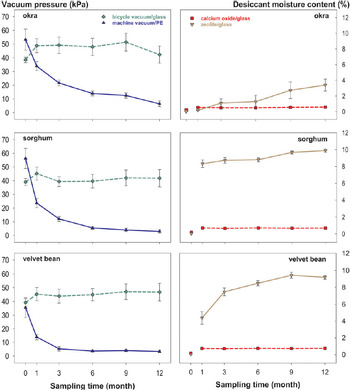
Vacuum pressure and desiccant moisture content were influenced by interacting factors of crop, treatment, and time (Figure 3; Table 1). Initial (month 0) vacuum pressure in seed containers (polyethylene bags and glass jars for machine and bicycle vacuum sealing, respectively) was highest with machine-sealed okra and sorghum seeds (53–56 kPa). Thereafter, for each crop, vacuum pressure with machine sealing declined over time (p < 0.001) while remaining constant (p > 0.05) with the modified bicycle pump. For each crop, loss of vacuum with machine sealing occurred most rapidly during the first month; by month 3, values dropped to less than 25 kPa, well below pressures (39–52 kPa) maintained with bicycle pump vacuum sealing.
Interaction of crop, treatment, and time on vacuum pressure and desiccant moisture content across sites. For each crop, means with vacuum sealing (of glass jars with a modified bicycle pump [diamonds] and polyethylene [PE] bags with a machine sealer [upward triangles]) and desiccants (calcium oxide [squares] and zeolite [downward triangles]) are shown for each sampling time. Each mean is the average of 4 values per treatment per site, except for ‘month 0’ desiccant moisture means (each of these is an average of 4 pretreatment values shown as a baseline reference point). Responses to time, of measured variables for crop × treatment combinations, were nonsignificant (dashed lines) or significant (solid lines) at p ≤ 0.05 (see Table 1 for levels of significance). Error bars are ± 1 standard error of the mean.

Desiccant moisture content
Moisture content of calcium oxide did not change with time (p > 0.05), staying below 2% over the course of the study. Moisture content of zeolite, however, increased over time (p < 0.001) for each crop. In jars of okra seeds, zeolite moisture content reached nearly 4% by month 12. Zeolite accumulated moisture more quickly in jars of sorghum and velvet bean seeds than in jars of okra seeds. At the month 1 sampling, the moisture content of zeolite in sorghum and velvet bean treatments had already reached 9 and 5%, respectively. At month 12, zeolite moisture content was between 9 and 10% in jars of sorghum and velvet bean seeds.
Discussion
Changes in moisture content of nontreated seeds over time were consistent with seasonal changes in ambient humidity at both sites (Figure 1). For example, the downturn in nontreated seed moisture content from months 3 to 9 (Figure 2) coincided with a decline in relative humidity during the dry season, at both sites, over the same period of time (Figure 1). Because the control seeds were stored in breathable paper envelopes, which are not airtight, the seed moisture content of nontreated seeds would be expected to equilibrate with ambient relative humidity (Ellis and Hong, Reference Ellis and Hong2007; Vertucci and Roos, Reference Vertucci and Roos1990). This is one of the big constraints facing local producers, community seed banks, and other seed banking entities in the humid tropics and subtropics, which limits storage life and viability of stored seeds due to fluctuating moisture content (Delouche et al., Reference Delouche, Matthes, Dougherty and Boyd1973; Guzzon et al., Reference Guzzon, Bello, Bradford, Mérida Guzman and Costich2020).
These findings showed that, at minimum, the desiccant and vacuum technologies tested in this trial reduced fluctuations in seed moisture content that otherwise occurred in seeds kept in paper envelopes exposed to ambient conditions. Of the two vacuum technologies, only vacuum drawn on glass with a modified bicycle pump prevented increases in seed moisture from months 1 to 12 for all three crops; moisture content with bicycle vacuum, averaged over months 1 to 12, differed from starting moisture content by −0.1, +1.6, and +0.2% for okra, sorghum, and velvet bean, respectively (Figure 2). Although calcium oxide and bicycle pump vacuum sealing stabilized seed moisture content over the duration of the trial, these treatments did not reduce months 1–12 moisture contents below their initial values. Thus, even with technologies that exclude humidity and stabilize seed moisture, it is still important to dry seeds to a low moisture content before putting them into storage. Here is where utilizing zeolite beads for drying seeds before airtight storage may be a very important contributor; the failure of calcium oxide to lower seed moisture below initial values in this experiment indicates that, of the two desiccants, zeolite would be the most effective option for drying seeds prior to hermetic storage.
Exposure of seeds to high humidity, and the resulting increase in seed moisture content, would be expected to reduce seed germination percentage. This was the case for germination percentages of nontreated okra and sorghum seeds; however, the germination percentage of nontreated velvet bean seeds remained high throughout the 12-month trial, indicating that some orthodox seeds have greater resilience to high seed moisture contents and humid storage environments than others. Moreover, the effect of site on month 12 sorghum but not okra and velvet bean germination percentages (Table 2) suggests that germination of some orthodox seeds is more consistent than others across variations in storage conditions (Figure 1), highlighting the necessity for contextually relevant options.
Results also suggest that seeds vary in their drying requirements and desiccation tolerance. With vacuum sealing and calcium oxide, moisture content of sorghum seeds stayed between 10 and 11% from months 1 to 12. At those moisture levels, sorghum germination percentage declined over time with vacuum sealing and calcium oxide (Figure 2). With the same treatments, however, the germination percentage of velvet bean seeds remained stable over time, even with seed moisture levels near 12%. At ambient temperatures, therefore, results stress the importance of low seed moisture for storing sorghum seeds. Unlike okra and velvet bean, sorghum tolerated drying – with zeolite – to a moisture content of less than 4%, an observation consistent with results of a 16-year study in which good sorghum germination was maintained with seeds at a moisture content of 4% (Bass and Stanwood, Reference Bass and Stanwood1978).
Moisture contents of < 5% have been described as ultradry (Guanghua, Reference Guanghua1994). Zeolite achieved ultradry seed moisture status, doing so across crops (Figure 2) and absorbing more moisture than calcium oxide powder in seeds of all three crops (Figure 3). Absorption of moisture by zeolite was mirrored by seed moisture reduction over time – with zeolite – for all three seed types (Figure 2) and was similarly observed by Hay et al. (Reference Hay, Thavong, Taridno and Timple2012) with zeolite and rice seeds (Oryza sativa). Faster moisture accumulation by zeolite in jars of sorghum and velvet bean seeds than in jars of okra seeds was consistent with higher starting levels of seed moisture in sorghum (8%) and velvet bean (12%) than okra (6%) jars (Figure 2).
Factors related to low germination percentage of ultradry seeds include hardseededness (Ellis et al., Reference Ellis, Nasehzadeh, Hanson and Woldemariam2018), water imbibition damage upon rehydration (Ashok Shakuntal and Gowda, Reference Ashok Shakuntal and Gowda2017), and deterioration associated with overdrying (Vertucci and Roos, Reference Vertucci and Roos1990). Data from our study were insufficient to determine why okra and velvet bean seeds stored with zeolite germinated poorly. Visual observations suggest damage associated with overdrying and/or rapid water imbibition of ultradry seeds. During the germination procedure, velvet bean seeds quickly swelled and rotted, while okra seeds produced a short, distorted plumule with no further growth.
The manufacturer of zeolite Drying Beads® recommends proper ratios of beads to seeds and removal of the desiccant after initial drying of freshly harvested seeds. Their website (www.dryingbeads.org) explains how to calculate the bead quantity to achieve a target level of moisture for seeds of various crops. In this research, the desiccants were kept with dry seeds in storage, a practice that prevents rehydration of seeds under humid conditions. Hay et al. (Reference Hay, Thavong, Taridno and Timple2012) kept zeolite beads with rice seeds during initial drying after harvest, and during subsequent storage of the dried rice seeds for 371 days. With initial drying at 30 °C for at least 2 weeks, the germination of rice seeds stored with zeolite for 371 days equaled or exceeded 95%. In their research, rice seed moisture content did not decline below 7%, whereas zeolite beads in our research dried seeds to levels below 5%. These observations suggest that seed moisture levels and desiccation tolerance should inform decisions on how a desiccant is used. Results of this study suggest that, at a 2:1 ratio of seed to desiccant weight, and with the desiccant kept with dry seeds in storage, ultralow seed moisture is less likely to be reached with calcium oxide than zeolite beads. Furthermore, as used in this experiment, the 2:1 ratio of seeds to zeolite beads was too high for okra and velvet bean. These findings have implications for seeds sensitive to ultralow moisture.
Loss of vacuum pressure in the polyethylene bags with machine sealing across seed types indicated that the vacuum-sealed bags allowed outside ambient air to diffuse inwards to the seeds. Polyethylene has a reasonably low water vapor transmission rate, but a relatively high oxygen transmission rate. Its permeability to water vapor and gases varies with the thickness and density of the film used, whereas glass completely blocks the movement of air across media (Walters, Reference Walters2007; Mullan and McDowell, Reference Mullan, McDowell, Coles and Kirwan2011). Results demonstrated that the jars used in this trial were sealed well, a requirement for keeping seeds dry in containers (Gomez-Campo, Reference Gomez-Campo2006; Walters, Reference Walters2007). Our findings, therefore, show the benefit of airtight, glass containers in maintaining vacuum pressure over time.
Neither of the vacuum sealing technology suites used in the study fully evacuated the air around the seeds. A gauge pressure of 50 kPa (as observed initially for okra [Figure 3]), for example, corresponds to 50% vacuum and, therefore, only a 50% reduction in oxygen relative to that of 0 kPa (0% vacuum). Nevertheless, the same machine sealer and bags as used in this research proved more effective than permeable envelopes (Croft et al., Reference Croft, Bicksler, Manson and Burnette2012) or nonvacuum polyethylene (Lawrence et al., Reference Lawrence, Bicksler and Duncan2017) in maintaining the viability of seeds over time. Theirs and our findings, coupled with the deleterious effect of oxygen on dry seeds (Ellis and Hong, Reference Ellis and Hong2007; Groot et al., Reference Groot, de Groot, Kodde and van Treuren2015), indicate that even modest reductions of oxygen can slow the deterioration of stored seeds.
Conclusion
These novel results demonstrate that seed germination percentages can be maintained with low-cost technology suites, even under conditions of high and variable temperatures and humidity, which are often encountered in the tropics and subtropics. These findings, therefore, have important implications for individuals and seed banks in these areas with limited resources. The effectiveness of the bicycle pump vacuum sealing treatment with glass jars, for example, showed that anyone (e.g. individuals, community seed banks, seed bank managers) can practice vacuum sealing without expensive, manufactured vacuum sealing machines or electricity. The modified bicycle vacuum pump may be the cheapest (15 USD or less) seed storage innovation available to seed saving entities at this time.
Findings showed that calcium oxide and zeolite Drying Beads® in airtight containers can be used as alternatives to more conventional and costly dehumidifiers to keep seeds dry. Zeolite beads open up the possibility of ultradry storage for extending the viability of seeds that tolerate ultradry conditions, such as some grasses. It was shown, for the first time, that zeolite can lower the moisture content of sorghum seeds below 4% without adversely affecting germination over a 12-month period of storage under ambient conditions in a tropical/subtropical environment. Zeolite beads cost 6–13 USD more per kg than calcium oxide; however, as pointed out by Ashok Shakuntal and Gowda (Reference Ashok Shakuntal and Gowda2017), they can be reused, spreading the cost over many years, but reuse requires access to an electric heat source. Reuse of calcium oxide powder is also difficult, requiring a temperature of 600 °C to convert calcium hydroxide back to calcium oxide (Powers and Calvo, Reference Powers, Calvo and Ahvenainen2003).
Findings also have implications for future research. The usefulness of modest vacuum with low-cost vacuum-sealing devices should be further explored by studying the impact on seed quality of hermetic sealing with varying percentages of air removal. Furthermore, the desiccant/glass jar treatments should be compared to glass jars alone, which would indicate whether moisture stabilization over storage time can be achieved without the desiccant. Additionally, the development and study of low-cost methods to stabilize or reduce temperature, coupled with novel ways to exclude humidity and oxygen, could further advance and optimize seed storage treatments for resource-constrained settings. Moreover, as most desiccants require a heat source for regeneration, future research could help ascertain if nonelectric sources (e.g. fire) could be used to regenerate desiccants in resource-constrained settings.
These findings should be a welcome addition to the growing toolkit of low-cost, easily accessible seed storage options that are being developed for smallholders, community seed banks, and NGO seed banks in order to improve their seed storage and viability. Effective and easily accessible seed storage technologies can help contribute to the preservation of agro-biodiversity, increase self-sufficiency, and promote global food and nutrition security.
Acknowledgements
The authors would like to extend their gratitude to all those that helped make this research happen, through the development and implementation of these experiments, to ongoing data collection, and the publication process. They would like to acknowledge Ken Thompson, Taylor Cantril, International Cooperation Cambodia, Rick Burnette, Ryan Biel, Emma Bailey, Sarah Bateman, and Emily Burke for their help and hard work.
Declaration on Conflict of Interest
None.
Financial support
This work was made possible by the generous support of ECHO Inc. and its donors.