1. Introduction
Theadvent of transformer language models (Vaswani et al. Reference Vaswani, Shazeer, Parmar, Uszkoreit, Jones, Gomez, Kaiser and Polosukhin2017) has greatly improved the performance of natural language processing (NLP) tasks such as text generation, which is an essential component in many downstream NLP applications. The use of transformer models like GPT-2 (Radford et al. Reference Radford, Wu, Child, Luan, Amodei and Sutskever2019) and GPT-3 (Brown et al. Reference Brown, Mann, Ryder, Subbiah, Kaplan, Dhariwal, Neelakantan, Shyam, Sastry, Askell, Agarwal, Herbert-Voss, Krueger, Henighan, Child, Ramesh, Ziegler, Wu, Winter, Hesse, Chen, Sigler, Litwin, Gray, Chess, Clark, Berner, McCandlish, Radford, Sutskever and Amodei2020) to generate and continue text primed with an arbitrary input prompt has led to coherent and realistic texts. More strongly grounded applications such as translation, image captioning, and summarization that have input/outputs are less problematic in text generation with current decoding algorithms (Li et al. Reference Li, Roller, Kulikov, Welleck, Boureau, Cho and Weston2020). However, in open-ended tasks (e.g., dialog generation or language modeling (LM)), failures such as repetitive text, unnatural topic switching, and contradictions are often observed (Holtzman et al. Reference Holtzman, Buys, Du, Forbes and Choi2020). Exploring new ways to confront these weaknesses is an active area of research in natural language processing. In this paper, we address the problem of topical language generation (TLG) which plays a key role in generating long, coherent, and realistic texts. The results can also be used to improve the downstream open-ended text generation tasks such as dialog generation or predictive response suggestion (Kannan et al. Reference Kannan, Kurach, Ravi, Kaufmann, Tomkins, Miklos, Corrado, Lukacs, Ganea, Young and Ramavajjala2016).
Despite the fact that pre-trained LMs store a vast amount of knowledge about the world (Petroni et al. Reference Petroni, Rocktäschel, Lewis, Bakhtin, Wu, Miller and Riedel2019), the real potential of them has not been harnessed yet for controlled text generation. This means that even though there is currently a lot of knowledge about the world in our pre-trained LMs, we are still unable to control the topical attributes of generated texts. Controlling the text generation to incorporate knowledge about specific topics usually requires major changes to the LM architecture, loss function, or retraining the whole models with annotated data.
Language modeling calculates the probability distribution P(x) of a sequence of tokens x for a given input text. On the other hand, TLG which is a type of controlled language generation can be formulated as modeling
 $P(x|t)$
where t is a specific topic. Different approaches for this problem have been proposed that usually involve expensive retraining or creating annotated datasets on restricted controlled attributes. This paper addresses the following research question:
“How to combine the knowledge from topic models such as Latent Dirichlet Allocation (LDA) and Latent Semantic Indexing (LSI) to control the language generation by pre-trained causal language models (e.g., GPT, GPT-2) and steer them towards specific topics?”
Our approach does not require any retraining or fine-tuning of the original model, but at the same time, it is flexible and fast. In our approach, pre-trained topic models (such as LDA or LSI) can be used or trained to enable the final TLG in a fully unsupervised manner. We publicly released all the codes, models, and data that have been used in this paper.Footnote a
The problem with most existing models is that they do not take into account the distributional properties of words for a topic. Statistical topic modeling techniques, especially LDA and LSI, have proven to be successful for data mining and uncovering hidden semantic structures from a given corpus of text. The main motivation to use topic models is that they analyze and return the distributional properties of the words based on the themes that run through them. In other words, just like language models that are trained on large text datasets, topic models find the topical properties of words after training on a relatively large text corpus. Topic models are more accurate and robust compared to word lists that have been used extensively in the literature. Moreover, extraction of word-topic distributions makes the integration with language model vocabularies easier. Also, topic modeling does not require any prior annotation or labeling of the data. This makes it a particularly good candidate for controlled text generation with more flexibility and less cost. It is worth mentioning that the topic coherence of the generated text by the proposed model has increased due to the fact that unlike other methods that focus on words or hidden variables to represent topics, every word in the vocabulary gets the correct attention from the topic model.
Our main contributions are as follows:
-
• Introduction of TLG which consists of generating text conditioned on a specific chosen topic.
-
• Demonstrating that the base TLG model follows the Bayesian conditional principle and introducing parameters that control the strength at which the model generates on-topic tokens.
-
• Generation of text with the same topical distribution of the given document. In other words, we show that we can replicate the topical properties of a given document in the generated text.
-
• Comparing TLG with existing state-of-the-art language generation models and showing that our model outperforms them on coherency, fluency, token diversity, and speed measurements without any extra costly training.
The rest of the paper is outlined as follows: first, we review the related works on the conditional language modeling; then in the proposed approach, we go over a background on the current state-of-the-art language modeling techniques and then propose our approach on topical-aware language modeling. We prove the proposed equation mathematically using the Bayes’ rule. Then, we review the two most used topic modeling techniques: LDA and LSI show how we use them in conjunction with the proposed method to generate topical texts. In Section 5, we demonstrate two different approaches to regulate the TLG. We also propose the simulating document topic generation as another application of TLG. Experiments consist of demonstrating different aspects of TLG. We show the results of the method with different topics, comparing it with SOTA models, and show how the parameters change the output, the results of document topic simulation, fine-tuning, and a graphical user interface for using the method in practice. Finally, in the discussion section, we demonstrate how the entropy and KL divergence in the TLG are different compared to the base LM. We also study the different variants of TLG that we introduce and their differences.
2. Related works
In this section, the methods for controlled text generation in NLP are described. We categorize the methods into Generative Adversarial Network (GAN) and VAE methods and conditional training and decoding algorithms.
Controlling image features such as style and color using encoder-decoder, GAN, and VAE architectures is the main motivation for researchers in NLP to apply the same rules to text inputs. Researchers mostly use Recurrent Neural Networks (RNN) and adjust the encoder-decoder structure to control the features of the generated text, in the same manner that has been used with images. Unfortunately, because text data are discrete and therefore not differentiable, these methods have not been less successful with text inputs.
The progress in language modeling with new transformer models shift the research to keep the architecture intact while trying to change either dataset, decoding algorithm, or in some cases tweaking small parts of the architecture to achieve better results in controlled language generation. The main reason for this change was the astonishing capabilities of ever larger transformer models to write long and coherent texts. Changing the dataset usually leads to conditional training methods, and changing the decoding helps to generate more realistic and diverse texts from the language model. Another motivation for using transformers is that because the language modeling task has been defined as a conditional probability on previous tokens, we can still use the same rule without introducing new hidden variables that are hard to incorporate and interpret.
2.1 GAN and VAE methods
GAN models are unsupervised machine learning methods that have been successfully used in image processing to generate new data with the same statistics as the training set. Controlled text generation involves some feature extraction that manipulate the GAN process. Unlike image processing, the text data in NLP tasks are discrete. Unfortunately, applying GANs for discrete outputs is problematic because the generator should be differentiable (Goodfellow Reference Goodfellow2016). There are a few ways to tackle this problem like using reinforcement learning or changing the generator to produce continuous outputs. In Yu et al. (Reference Yu, Zhang, Wang and Yu2017), they bypassed the problem by directly performing the gradient policy update. They used the reinforcement learning reward that comes from the GAN discriminator. In LeakGAN (Guo et al. Reference Guo, Lu, Cai, Zhang, Yu and Wang2018), the problem of long text generation has been solved by leaking the reward signal on high-level extracted features and then passing the signal to the generative network. The generator incorporates such informative signals into all generation steps through an additional MANAGER module, which takes the extracted features of the current generated words and outputs a latent vector to guide the WORKER module for the next-word generation.
Other methods involve using continuous hidden variables that control the desired features like style, topic, sentiment, and content. In Bowman et al. (Reference Bowman, Vilnis, Vinyals, Dai, Jozefowicz and Bengio2015), Hu et al. (Reference Hu, Yang, Liang, Salakhutdinov and Xing2017), Malandrakis et al. (Reference Malandrakis, Shen, Goyal, Gao, Sethi and Metallinou2019a), VAE has been used to train hidden variables that can control some aspects of the generated text. For example, in Dethlefs and Cuayáhuitl (Reference Dethlefs and Cuayáhuitl2015) the authors address the problem of language generation in situated tasks that involve human instructions. The model is trained from human-human corpus data and learns particularly to balance the trade-off between efficiency and detail in giving instruction. Both methods are much more flexible compared to traditional rule-based methods because they model the language as probability distributions, and this brings more diversity in token generation. But, there are two main problems with GAN and VAE methods: first, training GAN and VAE with text inputs is very unstable which means it is difficult to find the right parameters for the model to converge. Likewise, even with the right parameters, the quality of the generated text is not very good. Second, it is hard to interpret the hidden variables that control the generated text. In some cases, one can find some interpretable features, but in general, we do not have a good intuition about how the hidden variables control the features of the generated text. By contrast, in our proposed approach we do not rely on hidden variables, the training is stable, and most of the topics that are extracted from the topic modeling are interpretable.
2.2 Conditional training
In conditional language models, the desired feature is explicitly present in the dataset or training process. In CTRL (conditional transformer language model) (Keskar et al. Reference Keskar, McCann, Varshney, Xiong and Socher2019), the authors used control codes along with the input text that governs the style, content, and task-specific behaviors. They trained their 1.63 billion-parameter transformer model on 140 GB of text. Other methods of controlled text generation address the problems of repetition, overuse of frequent words, and logical consistency of the generated text. In Welleck et al. (Reference Welleck, Kulikov, Roller, Dinan, Cho and Weston2020), Li et al. (Reference Li, Roller, Kulikov, Welleck, Boureau, Cho and Weston2020), an unlikelihood training has been introduced that pushes down the probability of undesired tokens that cause the aforementioned problems. In Stahlberg, Cross, and Stoyanov (Reference Stahlberg, Cross and Stoyanov2018), a method that involves the fusion of language modeling and translation models was employed to improve the fluency of the generated texts. Unlike GAN and VAE methods, the conditional training is stable and has higher quality. However, the issue with conditional training methods is that we have to create datasets that contain the features we want. Even though the quality of the generated texts in conditional training is high, it takes a lot of efforts to create a dataset and train it from scratch leading to large models that are restricted to the codes in the dataset. Fine-tuning large language models also suffers from the same limitation, even though fine-tuning in general is relatively less costly than training from scratch. In comparison, our method does not change the base language model and training is limited to the training of the topic modeling, which is very inexpensive.
2.3 Style transfer
Another active area of controlled text generation is style transfer. Language style transfer concerns the problem of migrating the content of a source sentence to a target style by separating the semantic content of what is said from the stylistic dimension of how it is said (Prabhumoye et al. Reference Prabhumoye, Tsvetkov, Salakhutdinov and Black2018). Text styles can be defined in terms of sentiment (positive/negative/neutral), formality (formal/informal), tense (past/present/future), or any other style (Li et al. Reference Li, Jia, He and Liang2018).
In Mueller, Gifford, and Jaakkola (Reference Mueller, Gifford and Jaakkola2017), a recurrent VAE is proposed that maps the input sentences to a continuous latent space which then revises the latent representation of the sentence in a certain direction guided by a classifier. In this approach, the decoder imitates the favored sentiment. Due to the lack of parallel datasets, some researchers (Xu et al. Reference Xu, Sun, Zeng, Ren, Zhang, Wang and Li2018) have tried to neutralize the input sentence using either neural networks or retrieval-based methods to create a neutral version of the input and then add the style to it. State-of-the-art models (Zhao et al. Reference Zhao, Bi, Cai, Liu, Tu and Shi2018) use GAN to disentangle the content from the style and then transfer the latent representation of the content to the desired style with a decoder. The use of GAN in style transfer was introduced in Hu et al. (Reference Hu, Yang, Liang, Salakhutdinov and Xing2017) and has been extensively used in other works (Fu et al. Reference Fu, Tan, Peng, Zhao and Yan2018; Zhang, Ding, and Soricut Reference Zhang, Ding and Soricut2018; Singh and Palod Reference Singh and Palod2018). Style transfer methods are restricted to a predefined set of control codes, and due to this restriction, their applications are specific. Unlike these methods that rely on predefined control codes, our approach can get all sorts of topic information from another source and incorporate them in a general framework.
2.4 Decoding algorithms
These methods modify the basic decoding algorithms without changing the language model architecture or the training process to control the generated text by the model. Early attempts for decoding like greedy decoding or beam search result in degenerate texts with repetition, meaning that high-frequency tokens appear too often and low-frequency tokens are drawn rarely. In Holtzman et al. (Reference Holtzman, Buys, Du, Forbes and Choi2020), the nucleus sampling was introduced that allows for diversity in the token distribution of the generated text. The resulting text better demonstrates the quality of the human text, yielding enhanced diversity without sacrificing fluency and coherence.
In Ghazvininejad et al. (Reference Ghazvininejad, Shi, Priyadarshi and Knight2017), Holtzman et al. (Reference Holtzman, Buys, Forbes, Bosselut, Golub and Choi2018), a weighted decoding algorithm based on the fusion of a log probability with a set of manual scoring functions has been used. The score functions feature some positive aspects of the generated text like reducing repetition, increasing text diversity, topical words, and sentiment. While our approach has some similarities with this method, we do not use hand-crafted functions for extracting features. Instead, we rely on trained features from another successful model.
As demonstrated in See et al. (Reference See, Roller, Kiela and Weston2019), manual weighted decoding is more specific but it comes with sacrificing the fluency. Recent research by Malandrakis et al. (Reference Malandrakis, Shen, Goyal, Gao, Sethi and Metallinou2019b) combines the state-of-the-art pre-trained language models with one or more simple attribute classifiers that guide text generation without any further training of the language model. Their predefined bag-of-words (BoW) for TLG limits the use of new topics and also does not consider the exact influence of all the words in the vocabulary for topics. In their method, they change the gradient of the last layer and push the base language model gradient to generate desired tokens more often. This approach is a “plug and play” method which means there is no need to retrain the language model but it is still very slow.
The most relevant work to ours is Baheti et al. (Reference Baheti, Ritter, Li and Dolan2018); in this work, the constraint of topics in source and target texts is applied by adding a term to the log probability that helps to capture the similarity of the topics in the source and target texts. They pointed out that the topics extracted from LDA do not work well in practice, because it gives equal probability to topics and syntax words. Instead in their approach, they use the HMM-LDA probability that corresponds to the topic component of the model. Also in Xing et al. (Reference Xing, Wu, Wu, Liu, Huang, Zhou and Ma2017) and Lau, Baldwin, and Cohn (Reference Lau, Baldwin and Cohn2017), LDA has been used for training and the LDA weights were applied in the attention mechanism.
Also, in Dziri et al. (Reference Dziri, Kamalloo, Mathewson and Zaiane2018) the concept of topic modeling, particularly LDA, has been used in the attention mechanism of the encoder. They used the same probability distribution of topic in the decoder and added it as an extra term to the basic word probability. The encoder-decoder model is the seq2seq model that has been used in this work. The quality of RNN-GRU in text generation and the problems with parallelizing the training makes them deprecated for modern NLP tasks. Like these methods, we also use LDA as the source of our topic information, though we consider LSI, which opens the door for other topic models that fit the formulation as well. However, unlike these methods, our model does not need to incorporate them during training. We show that by choosing the right parameters we can control the influence of the topics without sacrificing fluency.
3. Proposed approach
3.1 Language modeling and decoding
The applications of language generation in NLP can be divided into two main categories: directed language generation and open-ended language generation. Directed language generation involves transforming input to output such as machine translation, summarization. These approaches need some semantic alignment between the inputs and the outputs. On the other hand, open-ended language generation has much more freedom in the generation process because it does not need to be aligned with any output. The open-ended language generation has applications in conditional story generation, dialog systems, and predictive response generation. Even though there is more flexibility in choosing the next tokens compared to directed language generation, controlling the top-level features of the generated text is a desirable property that needs to be addressed and still is a challenging problem.
Given a sequence of m tokens
 $x_1, .., x_m$
as the context, the problem of open-ended language generation can be formulated as finding the continuation
 $x_{m+1}, ..., x_{m+n}$
with n tokens. In other words, if we consider the whole context plus continuation as follows:
 \begin{equation} x_1, .., x_m, x_{m+1}, .., x_{m+n}\end{equation}
The language modeling probability can be decomposed using the chain rule as:
 \begin{equation} P(x_{1:m+n}) = \prod_{i=1}^{m+n} P(x_i|x_{i})\end{equation}
The language modeling probability can be used with a decoding strategy to generate the next token for language generation. Finding the optimal continuation can be formulated as:
 \begin{equation} \hat{x}_{m+1:n} = \underset{x_{m+1:n}}{\operatorname{argmax}} \: P(x_{m+1:n}|x_{1:m})\end{equation}
Solving Equation (3) is not tractable so practical decoding strategies use approximations to generate the next tokens. The most famous and widely used decoding strategies are greedy decoding and beam search methods. Greedy decoding selects the highest probability token at each time step, while the beam search keeps a set of hypotheses and then updates the tokens in the hypotheses as it goes through and decodes more tokens. These approaches are well suited for directed language generation, but they suffer from repetition, genericness, and degenerate continuations (Holtzman et al. Reference Holtzman, Buys, Du, Forbes and Choi2020). Both of these approaches are deterministic in the sense that they do not involve any random selection in their algorithms.
On the other hand, stochastic decoding methods sample from a model-dependent distribution q (Welleck et al. Reference Welleck, Kulikov, Roller, Dinan, Cho and Weston2020):
 \begin{equation} x_i \sim q(x_i|x_{i}, p)\end{equation}
The simplest stochastic sampling consists of sampling from top-k probabilities, the use of constant k is problematic because in some contexts the probability distribution of the next token is flat which means there are plenty of reasonable next tokens to select from but in some other contexts the distribution is concentrated in a small number of tokens. To solve this problem, Holtzman et al. (Reference Holtzman, Buys, Du, Forbes and Choi2020) proposed nucleus sampling. In this method, a subset of vocabulary is defined which is the smallest set
 $V^{(p)}$
such that:
 \begin{equation} \sum_{x \in V^{(p)}} P(x|x_{i}) \geq p\end{equation}
Then, the resulting distribution which is based on the new vocabulary should be re-scaled to form a probability distribution. Under nucleus sampling, the number of plausible next tokens changes dynamically with the context and generated tokens. In this work, we use nucleus sampling as the base decoding technique and propose a new method to take into account topical knowledge about the tokens.
3.2 Topical language modeling
Given a list of K topics
 $t = \{1...K\}$
, to control the outputs of the language model to follow a certain topic, at each generation step, we have to model the following probability distribution:
 \begin{equation} P(x_{1:m+n}|t_j) = \prod_{i=1}^{m+n} P(x_i|x_{i}, t_j)\end{equation}
Compared to Equation (2), the only difference is that it is conditioned on the topic
 $t_j$
. To create the right-hand side of Equation (6), we change the last layer of the network that creates the logits.
Here, we adopt the GPT transformer architecture. Because of its auto-regressive property, at any given time step i, the embeddings of input tokens
 ${x_1, .., x_i}$
can be stacked into a matrix
 $\mathbf{X}_{1..i}$
and then fed into the network as follows to give the probability of the next token given all of the previous tokens:
 \begin{equation} \mathbf{h}_0 = \mathbf{X}_{1..i}\mathbf{W}_e + \mathbf{W}_p\end{equation}
 \begin{equation} \mathbf{h}_l = \text{TranformerBlock}(\mathbf{h}_{l-1}) \quad l \in [1,n]\end{equation}
 \begin{equation} S(x_i|x_{i}) = \mathbf{h}_n \mathbf{W}^{T}_e\end{equation}
 \begin{equation} P(x_i|x_{i}) = \frac{\text{exp}(S(x_i|x_{i}))}{\sum_{z}\text{exp}(S(z|x_{i}))}\end{equation}
where
 $\mathbf{W}_e$
is the token embedding matrix and
 $\mathbf{W}_p$
is the positional embedding matrix. Here, we have n layers. The first layer is fed with
 $\mathbf{h_0}$
and the final layer outputs
 $\mathbf{h_n}$
. The logit S is obtained by passing
 $\mathbf{h_n}$
through a feed-forward linear layer. In the original implementation, the logit S has been used for the final probability distribution over the vocabulary. The TransformerBlock is the transformer architecture (Vaswani et al. Reference Vaswani, Shazeer, Parmar, Uszkoreit, Jones, Gomez, Kaiser and Polosukhin2017) that takes a hidden state and outputs another hidden state with the same shape. More specifically, the TransformerBlock consists of the following functions that goes from
 $\mathbf{h}_{l}$
to
 $\mathbf{h}_{l+1}$
:
 \begin{equation} \overline{\mathbf{h}}_{l} = \text{LayerNorm}(\mathbf{h}_{l})\end{equation}
 \begin{equation} \mathbf{H}_l = \text{MultiHead}(\overline{\mathbf{h}}_{l}) + \mathbf{h}_l\end{equation}
 \begin{equation} \overline{\mathbf{H}}_l = \text{LayerNorm}(\mathbf{H}_{l})\end{equation}
 \begin{equation} \mathbf{h}_{l+1} = \text{FeedForward}(\overline{\mathbf{H}}_l)+\mathbf{H}_l\end{equation}
LayerNorm and FeedForward are the usual layers used in modern neural networks. MultiHead function is the multi-head attention module that is defined as follows:
 \begin{equation} \text{MultiHead}(\mathbf{X}) = \it{Concat}(\mathbf{z}_1, ..., \mathbf{z}_k)\mathbf{W}_0\end{equation}
 \begin{equation} \mathbf{z}_i = \text{Attention}(\mathbf{X}\mathbf{W}_{i}^Q, \mathbf{X}\mathbf{W}_{i}^K, \mathbf{X}\mathbf{W}_{i}^V)\end{equation}
 \begin{align} \text{Attention}(\mathbf{Q}, \mathbf{K}, \mathbf{V})= \mathbf{D}^{-1}\mathbf{A}\mathbf{V},\quad \mathbf{A} = \it{tril}(\it{exp}(\mathbf{Q}\mathbf{K}^T/\sqrt{d})), \quad \mathbf{D} = \it{diag}(\mathbf{A}\mathbf{1}_L)\\[-3pt] \nonumber\end{align}
where
 $Concat(.)$
is the concatenation function,
 $tril(.)$
returns the lower-triangular part of the argument matrix including the diagonal, and, the
 $diag(.)$
is a diagonal matrix with the input vector as the diagonal. Also,
 $\mathbf{1}_L$
is the all-ones vector of length L and
 $exp(.)$
is applied element-wise. All the matrices
 $\mathbf{W}_{i}^Q$
,
 $\mathbf{W}_{i}^K$
,
 $\mathbf{W}_{i}^V,$
and
 $\mathbf{W}_{0}$
are trainable parameters.
We can use the Bayes rule on
 $P(x_i|x_{i}, t_j)$
to obtain:
 \begin{equation} P(x_i|x_{i}, t_j) = \frac{P(x_i|x_{i}) P(t_j|x_i, x_{i})}{\sum_{z} P(z|x_{i}) P(t_j|z, x_{i})}\end{equation}
Because in topic modeling, documents are treated as bag-of-words we can also assume that the probability of the topic for each token is independent of the previously generated tokens. Based on this assumption, we have:
 \begin{equation} P(t_j|x_i, x_{<i}) = P(t_j|x_i)\end{equation}
Now, assuming that we have
 $P(t_j|x_i)$
, then using Equation (10) we can prove that the conditional topical language model can be written as:
 \begin{equation} P(x_i|x_{<i}, t_j) = \frac{\text{exp}(S(x_i|x_{<i})+\text{log}P(t_j|x_i))}{\sum_{z} \text{exp}(S(z|x_{<i})+\text{log}P(t_j|z))}\end{equation}
3.2.1 Proof
Starting with Equation (18) with topic independence assumption of Equation (19), we can write:
 \begin{equation}P(x_i|x_{<i}, t_j) = \frac{P(x_i|x_{<i}) P(t_j|x_i)}{\sum_{y} P(y|x_{<i}) P(t_j|y)}\end{equation}
Now, using the Equation (10), we can rewrite the Equation (21) to:
 \begin{equation} P(x_i|x_{<i}, t_j) = \frac{ \frac{\text{exp}(S(x_i|x_{<i}))}{\sum_{z} \text{exp}(S(z|x_{<i}))} P(t_j|x_i)}{\sum_{y} \frac{\text{exp}(S(y|x_{<i})}{\sum_{z} \text{exp}(S(z|x_{<i}))}P(t_j|y))}\end{equation}
which can be simplified to the following:
 \begin{equation} P(x_i|x_{<i}, t_j) = \frac{\text{exp}(S(x_i|x_{<i}))P(t_j|x_i)}{\sum_{y} \text{exp}(S(y|x_{<i}))P(t_j|y)}\end{equation}
and finally if we take
 $P(t_j|x_i)$
and
 $P(t_j|y)$
into the exponential function, it gives us Equation (21).
The question of how to obtain
 $P(t_j|x_i)$
still remains. In the next section, we show how to extract topical probabilities from the topic modeling techniques.
3.3 Topic modeling
Topic modeling algorithms automatically extract topics from a collection of textual data. They are based on statistical unsupervised models that discover the themes running through documents. We use two main algorithms in topic modeling.
LDA Generative Process.

1- LDA: The basic idea behind LDA is that in a collection of documents, every document has multiple topics and each topic has a probability distribution. Moreover, each topic has a distribution over vocabulary. For example, a document can be on the topics of “Football,” “News” and “America” and the topic of “Football” can contain words including “NFL,” “Football,” “teams” with a higher probability compared to other words.
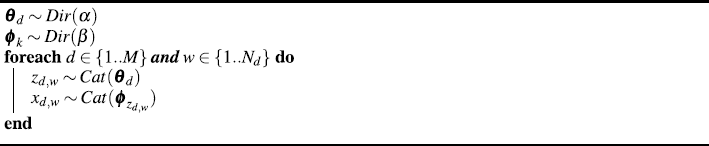
Given a collection of M documents with vocabulary V, we can fix the number of topics to be K. The LDA can be thought of as a generative process in which each token is generated through Algorithm 1.
In Algorithm 1,
 $\mathbf{{\phi}}_k \in \Delta^{|V|-1}$
is a simplex that specifies the probability distribution of topic k.
 $\mathbf{\theta}_d \in \Delta^{K-1}$
is another simplex that determines the probability distribution of document d over K topics. First, we draw samples from Dirichlet distribution with parameter α for θd and samples from Dirichlet distribution with parameter β for φk. Both parameters α and β are hyperparameters that need to be fixed. Then for each document and token index, we first sample topic index zd,w from categorical distribution with parameter θd. Then, we sample token xd,w from the categorical distribution with parameter φzd,w.
The probabilities of topics per documents and topic for tokens can be summarized in matrix forms, θM×K and φK×|V|, respectively. These parameters should be learned through Gibbs sampling or variational inference methods (Blei, Ng, and Jordan Reference Blei, Ng and Jordan2003). After the learning, we have the distributions of topics for each token, and hence, we can write:
 \begin{equation} P(t_j|x_i)= \phi(j, i)\end{equation}
We incorporate P(tj|xj) in our proposed topical language model.
2- LSI: LSI is the application of singular value decomposition method (Deerwester et al. Reference Deerwester, Dumais, Furnas, Landauer and Harshman1990) to word-document matrix, with rows and columns representing the words and documents, respectively. Here we use tokens instead of words to have consistency with the language models. Let X|V|×M be the token-document matrix such that
 $X_{i,j}$
is the occurrence of token i in document j, then singular value decomposition can be used to find the low rank approximation:
 \begin{equation} \hat{\mathbf{X}}_{|V| \times M} = \mathbf{U}_{|V| \times M} {\boldsymbol\Sigma}_{M \times M} \mathbf{V}^{T}_{M \times M}\end{equation}
After the decomposition,
 $\mathbf{U}$
still has the same number of rows as tokens but has fewer columns that represents latent space that is usually interpreted as “topics.” So, normalizing
 $\mathbf{U}$
gives us the scores of each token per topic. We can use this score for the probability of topic j for each token i in the vocabulary:
 \begin{equation} P(t_j|x_i) = \frac{\mathbf{U}^T[j, :]}{\left\lVert{\mathbf{U}^T[j, :]}\right\rVert}[i]\end{equation}
In Equation (26),
 $\mathbf{U}^T[j, :]$
means
 $j\textrm{th}$
row of the matrix
 $\mathbf{U}$
.
4. Controllable generation methods
The conditional topical language model in Equation (20) gives us a token generation that is conditioned on a specific topic but we cannot control the amount of the influence. Besides, using the prior distribution on topics leads to a sub-optimal token generation that hurts the fluency (Baheti et al. Reference Baheti, Ritter, Li and Dolan2018). In this section, we address this issue and change the base Equation (20) for a better text generation process:
1- Adding topical parameter and logit threshold: adding the term
 $\text{log}(P(t_j|x_i))$
directly to the actual logit from the model can deteriorate the fluency of generated text in some cases. We propose two methods to alleviate this problem. We introduce a new parameter
 $\gamma$
to control the influence of topical distribution:
 \begin{equation} P(x_i|x_{<i}, t_j) = \text{softmax}(S(x_i|x_{<i})+\gamma\: \text{log}(P(t_j|x_i)))\end{equation}
Higher values of
 $\gamma$
result in more on-topic text generation because the final probability will be dominated more by
 $\text{log}(P(t_j|x_i))$
than the logit from the base language modeling.
The other approach is to cut the log probabilities of the topic with a threshold. The lower values of S correspond to tokens that the model gives very low probabilities, and we do not want to change them because it introduces unwanted tokens and diminishes the fluency. In Equation (28), we only keep
 $\text{log}(P(t_j|x_i))$
for all the values of S that are larger than threshold.
 \begin{equation} \operatorname{logprob}(i)=\left\{\begin{array}{ll}\log \left(P\left(t_{j} \mid x_{i}\right)\right) & \text {S}\left(x_{i} \mid x_{<i}\right)>threshold \\ \\[-7pt] 0 & \text{otherwise}\end{array}\right.\end{equation}
and logprob used in the following equation:
 \begin{equation} P(x_i|x_{<i}, t_j) = \text{softmax}(S(x_i|x_{<i})+\gamma\: \operatorname{logprob}(i))\end{equation}
lower values of threshold correlates with more on-topic text generation because we change more tokens from the original model by
 $\text{log}(P(t_j|x_i))$
.
2 - Using
 $\alpha$
-entmax instead of softmax: The problem with the softmax function is that it gives non-zero probabilities to a lot of unnecessary and implausible tokens. The softmax function is dense because it is proportional to exp function and can never give exactly zero probabilities at the output. We use
 $\alpha$
-entmax instead to create more sparse probabilities that are less prone to degenerate text.
 $\alpha$
-entmax is defined as (Correia, Niculae, and Martins Reference Correia, Niculae and Martins2019):
 \begin{equation} \alpha {-}\text{entmax}(\mathbf{z}):=\underset{p \in \Delta^{|V|-1}}{\operatorname{argmax}} \{\mathbf{p}^T\mathbf{z} + H_{\alpha}^T(\mathbf{p})\}\end{equation}
where
 $\Delta^{|V|-1}:=\{p \in \textrm{I\!R}^{|V|-1}, \sum_{i}{p_i=1}\}$
is the probability simplex, and for
 $\alpha \geq 1$
,
 $H_{\alpha}^T(\mathbf{p})$
is the Tsallis entropy which defines the family of entropies (Tsallis Reference Tsallis1988) as follows:
 \begin{equation} H_{\alpha}^T(\mathbf{p}) = \begin{cases*} \frac{1}{\alpha (\alpha-1)} \sum_j(p_j-p_j^\alpha) \quad& $ \alpha \neq 1 $ \\ \\[-7pt] -\sum_j p_j \text{log}p_j & $ \alpha =1 $ end{equation}
 $\alpha$
-entmax is the generalized form of the softmax function. In particular, for
 $\alpha=1$
it exactly reduces to the softmax function, and as
 $\alpha$
increases, the sparsity in the output probabilities continuously increases. Here we are specifically interested in
 $\alpha=2$
which results in sparsemax (Martins and Astudillo Reference Martins and Astudillo2016):
 \begin{equation}\text{sparsemax}(\mathbf{z})=\underset{\mathbf{p} \in \Delta^{|V|-1}}{\operatorname{argmin}}\|\mathbf{p}-\mathbf{z}\|^{2}\end{equation}
Unlike the softmax function, sparsemax can assign zero probabilities.
3- Adding temperature and repetition penalty parameters: We need to make some changes to the base nucleus sampling to control the base distribution flatness and prevent it from generating repetitive words. We denote the final logit after the above changes as
 $u_i$
. Given a temperature T, repetition penalty r, and the list of generated tokens g, the final probability distribution for sampling is:
 \begin{equation} P(x_i|x_{<i}, t_j) = \text{softmax}(u_i/(T.R_{g}(x_i)))\end{equation}
where
 $R_{g}(x_i)$
is defined as below:
 \begin{equation} {R_g}({x_i}) = \left\{ {\begin{array}{*{20}{c}}
r \hfill & {{x_i} \in g} \hfill \\
1 \hfill & {{x_i} \notin g} \hfill \\ \end{equation}
In Equation (33), when
 $T \rightarrow 0$
, the sampling reduces to greedy sampling, while if
 $T \rightarrow \infty$
the distribution becomes flatter and more random. The penalized sampling discourages drawing already generated tokens. Following Keskar et al. (Reference Keskar, McCann, Varshney, Xiong and Socher2019), we set
 $r=1.2$
which results in a good balance between fluency and lack of repetition.
5. Simulating document topic generation
An obvious observation from topic models is that many real documents are on more than one topic. For example, a paper about bioinformatics can be on the topics of genetics, neuroscience, and computer science. Given the trained parameters, we can modify the generative process of LDA, which is based on BoW assumption to create multi-topic document generation using a specific input document. In other words, we can simulate the topical behavior of an input document using the proposed topical language model.
Simulating Document Topic Generation.

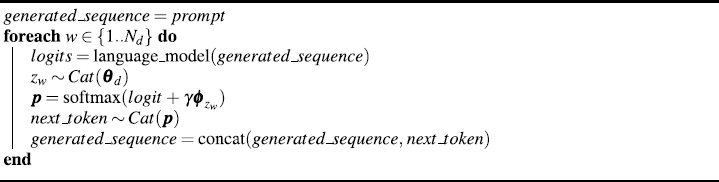
Algorithm 2 redirects the generation process towards topics in the given document as follows: the algorithm starts with a prompt text and given an input document it iterates
 $N_d$
times, in which
 $N_d$
is the length of the input document. In each iteration, it calculates the logits from the base language model and also draws a topic from the topic distribution of the given document
 $\boldsymbol{\theta}_d$
. Then, the probability distribution of tokens for the selected topic and logits from the base language model will be combined. This gives us the final probability of tokens that we can draw the next tokens from. Finally, we concatenate the chosen next token to the input to feed it back to the base language model.
6. Experiments
We conducted several experiments to evaluate the controlled natural language generation in different aspects. In Section 6.1, we show the ability of the model in generating coherent outputs for different topics. In Section 6.2, we compare our model with state-of-the-art language generation models and show that our model outperforms them.
6.1 Topical text generation with different topics
One of the biggest benefits of TLG is that it can be used with different language models without any retraining or fine-tuning of the base model; however, to generate topical texts we need to have topics extracted from a text corpus. For training the topic models, we used Alexa Topical-chat dataset (Gopalakrishnan et al. Reference Gopalakrishnan, Hedayatnia, Chen, Gottardi, Kwatra, Venkatesh, Gabriel, Hakkani-Tür and AI2019). This dataset contains conversations and a knowledge base in a wide variety of topics from politics and music to sports. We do not use the tags for topics in the dataset but extract them automatically with our LDA and LSI topic models. This unsupervised approach gives us the flexibility to work with any raw text corpus.
In preprocessing, we first tokenized the dataset using Byte Pair Encoding (BPE) tokenizer (Gage Reference Gage1994). Then, we filter out the very rare and very frequent tokens because they affect the topic modeling negatively. Very frequent words are usually stop words and rare words are usually not very informative. We empirically set the initial number of topics to 8 and the batch size to 200 documents. The final results are not very sensitive to these parameters, and as long as the topics are intuitively separable, the TLG works fine. The LDA model is trained by Online Variational Bayes (VB) technique which is based on online stochastic optimization with a natural gradient step (Hoffman, Bach, and Blei Reference Hoffman, Bach and Blei2010). The training continues by feeding new documents until the topics converge or until the number of iterations which is set to 600 is reached.
We adopt the results from parameter search based on topic coherence score which will be discussed in Section 6.4. We set the prior probability on documents to be a symmetric Dirichlet distribution with
 $\alpha=0.1$
. The prior probability of word distribution can be learned from data using maximum likelihood estimation (Huang Reference Huang2005).
For training the LSI model, we use the same dataset and preprocessing as LDA. We use stochastic singular value decomposition on a sparse input (Halko, Martinsson, and Tropp Reference Halko, Martinsson and Tropp2011) to extract the matrix
 $\mathbf{U}$
in Equation (26).
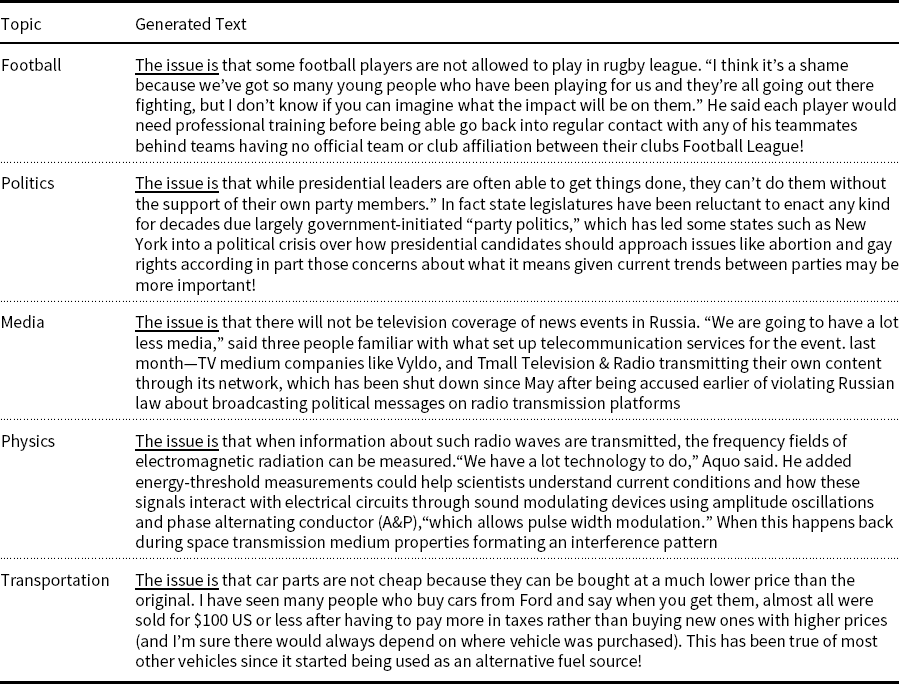
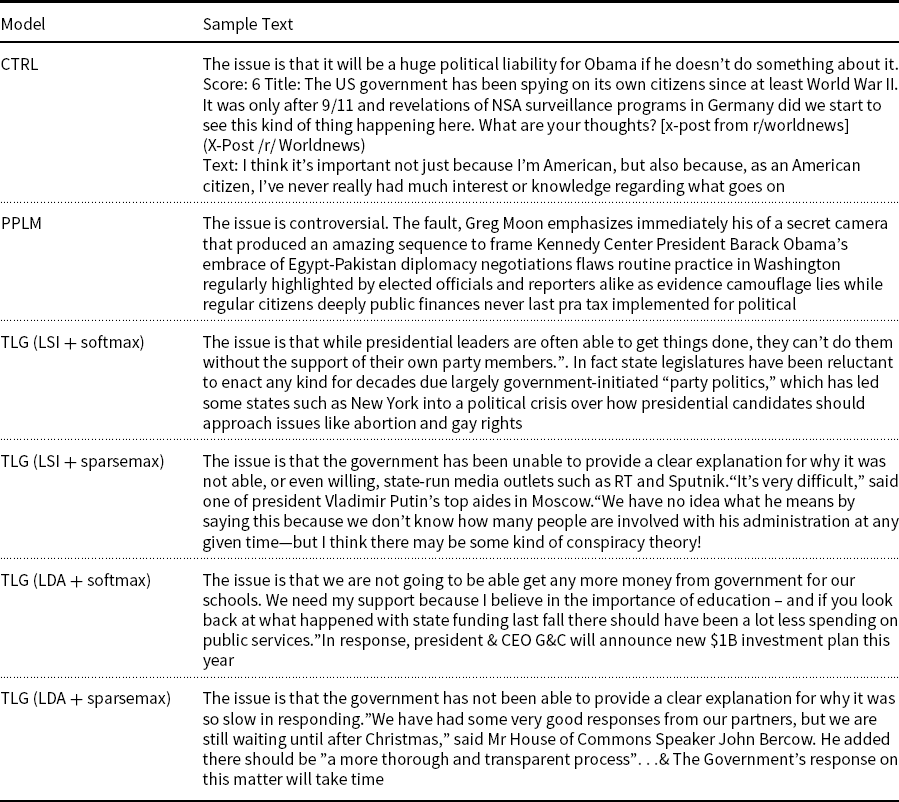
In this experiment, a fixed neutral prompt has been used to make sure the model is not conditioned on the few initial tokens. The results in Table 1 show that after selecting a topic from the topic modeling output, the model can create long, coherent, and fluent text continuation without manually injecting extra knowledge from other resources or through training on labeled datasets. The LSI with softmax function is illustrated in Table 1, the LSI with softmax function has been used. To avoid cherry-picking, the first output with a fixed seed from TLG has been selected.
TLG with a fixed prompt (The issue is) that is conditioned on different topics

6.2 Comparison of text generation with other models
To evaluate and compare TLG with other methods, we use topic coherence and n-gram diversity metrics. Topic coherence (Röder, Both, and Hinneburg Reference Röder, Both and Hinneburg2015) can be measured in many different ways. More formally, if the model generates the set of words
 $W=\{w_1, w_2, ..., w_n\},$
each word should be compared to any other word in the generated sequence. The set S is defined as:
 \begin{equation} S = \{(w', w^*) | w' = {w_i}; w_{i} \in W; w^* = W\}\end{equation}
the coherence is the mean value of cosine similarity between the word2vec (Mikolov et al. Reference Mikolov, Sutskever, Chen, Corrado and Dean2013) vectors of all the pairs in S:
 \begin{equation}C=\frac{1}{|S|} \sum_{\left(w^{\prime}, w^{*}\right) \in S}\frac{\mathbf{V}_{w^{\prime}}.\mathbf{V}_{w *}}{||\mathbf{V}_{w^{\prime}}||||\mathbf{V}_{w *}||}\end{equation}
But the topic coherence alone is not enough because if the model degenerates and produces repetitive tokens then the topic coherence will increase. We also have to make sure that the model creates diverse n-grams. We report Dist-1, Dist-2, and Dist-3 as the number of unique 1, 2, and 3-grams across all the samples generated for a given topic with different prompts. This score is a very good indicator of the diversity of samples generated by the models.
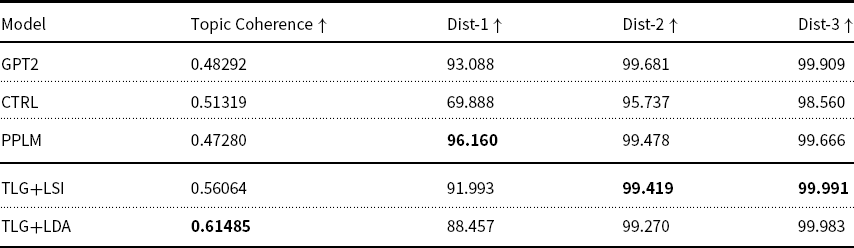
Table 2 shows that TLG models have superior capability in generating both coherent texts while keeping the token diversity very high.
Comparing TLG with other models on topic coherency and Dist-1,2,3 which is an indicator of token diversity. All the experiments have less than 1e-5 variance

One of the main restrictions on most approaches is the limitation on the number of topics/conditions that the model can work on. Even though our model is free from those restrictions, we have to limit our comparisons on the predefined topics of other approaches. Here, we compare the methods on the topic of “politics” which is available in all the models.
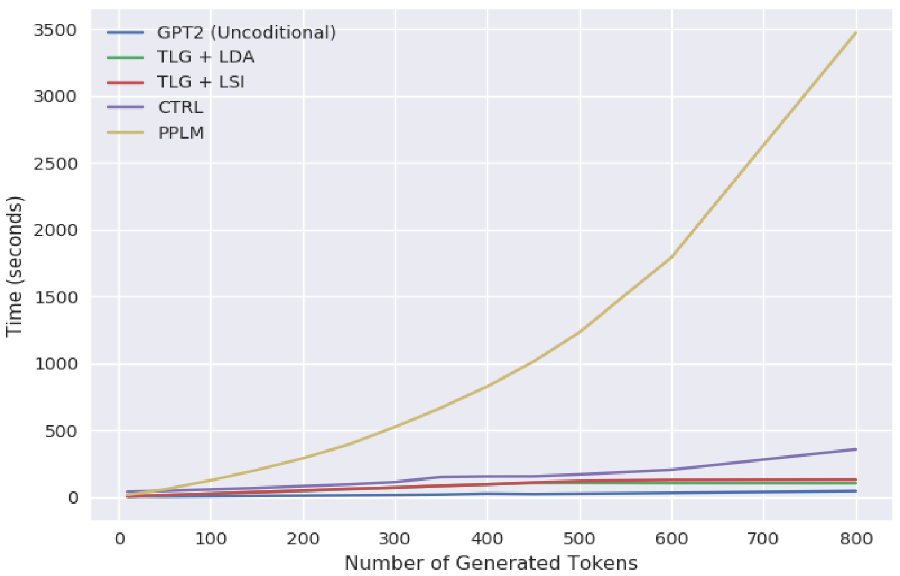
In Table 3, the result of comparison of our model to the baseline CTRL (Keskar et al. Reference Keskar, McCann, Varshney, Xiong and Socher2019) and PPLM (Malandrakis et al. Reference Malandrakis, Shen, Goyal, Gao, Sethi and Metallinou2019b) has been demonstrated. CTRL is a conditional language model with specific control codes. Although it outputs high-quality text continuation, it does not have the flexibility for any other topic outside its predefined codes and one has to retrain the network on a dataset with a new control code that represents that topic. This model is also very large and contains 1.63 billion parameters that makes it hard to be used in real applications. The text generated by CTRL also contains meta-information such as “title, text, Score, etc” that was trained from the original labeled text and it diminishes the quality of the generated text. PPLM is a plug-and-play language model which means it does not need retraining of the base model; however because of its nature on perturbing the gradient of the base model, the text generation process of PPLM is extremely slow. Figure 1 shows that PPLM is slower compared to other models. PPLM also suffers from the text degeneration problem by repeating itself on some tokens. In PPLM, topics are represented as predefined BoW which gives more flexibility compared to CTRL but still leaves the creation of new topics a difficult task for users. Also, as a model for topics BoW is overly simple because it gives the same weight to all the tokens in the bag. It ignores all other tokens that are not in the BoW and leaves the topic extraction as a manual task for annotators.
Comparing the results of text generation for different models

On the other hand, TLG does not need any retraining and it works with base models of different sizes. TLG gets the topics from a topic modeling algorithm once, then it can be used or shared with others just like the base language model itself. In Section 3, we also compare the results of TLG with different topic models that are combined with both softmax and sparsemax function. Both functions result in quality outputs. In Section 7, we discuss the differences between them in more detail.
6.3 Document topic simulation
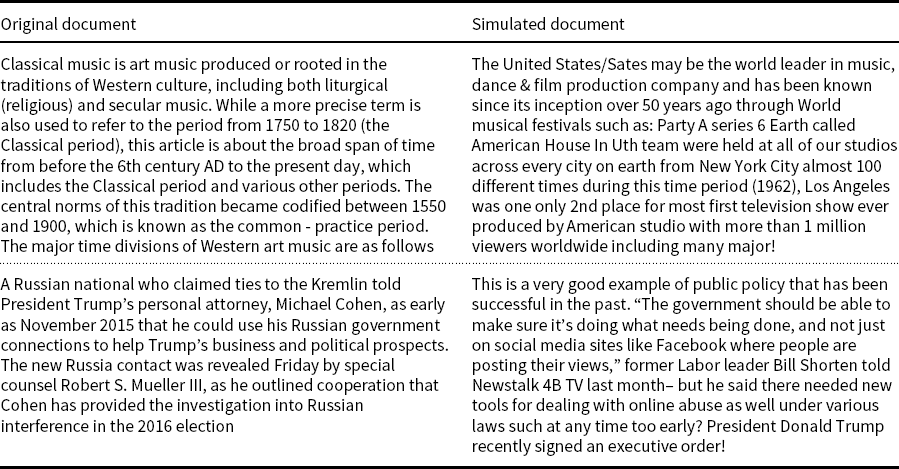
One of the novel features of our approach is the ability to generate text not only with one specific topic but also generate documents with the same topical distribution as the given document. In Table 4, two samples from the document topic simulation have been shown. The left column shows real samples without any modification from the Alexa Topical dataset. After processing and extracting the topic distribution of each document on the left column, we employ the Algorithm 2 to generate similar documents with respect to topical distribution that has been shown on the right column. One interesting observation is that the generated documents do not have one topic anymore. For example, the original document on the top left has distribution over topics of Music and America, the same pattern can be observed on the generated text on the top right column. The down left document is around the topics of Politics and Communication which is replicated on down right generated text from the algorithm. It should be noted that the samples from the dataset are those samples that were considered to have the mentioned topics even though they may not contain the exact topic title words. For example, the sample from the dataset on top left does not have the word America but still considered to be from the topic America. In general, the quality of document simulation, which has multi-modal topical distribution, is lower than the base TLG model. This is probably due to the more complex relationship between topics in the original text that Algorithm 2 captures using only random sampling.
Samples of document topic simulation. Original documents come from Alexa Topical dataset and corresponding simulated documents follow the same topical behaviors of the given document

As the number of generated tokens by the model increases, the time needed to decode them also increases. TLG methods are the fastest and PPLM is the slowest controlled language generation.

To show how much two documents are similar, we use sentence-bert (Reimers and Gurevych Reference Reimers and Gurevych2019) which is based on the BERT model to create embeddings for sentences that can be used for similarity purposes. To evaluate the document topic simulation, we calculate the similarity between 1000 samples from Alexa dataset as the given document and the output of the document topic simulation for each one of those documents. In the next experiment, we calculate the same samples from Alexa dataset but with outputs from GPT-2. In both experiments, we use the same prompt. The first experiment gives an average of 44.625% cosine similarity compared to the second experiment which is 11.015% similarity. This shows that the document topic simulation creates very similar texts to the original retrieved document from the dataset.
6.4 Effects of hyperparamters on TLG
In our proposed approach, we can use
 $\gamma$
and threshold as knob parameters to control the amount of topic influence on the language generation process. More specifically, based on Equation (27) higher values of gamma will result in more on topic results. Also, lower values of the threshold are correlated with more on topic language generation. In the limit, if we set
 $\gamma=0$
and
 $threshold=0$
TLG reduces to the original language model without any topic. But our experiments have shown that changing
 $\gamma$
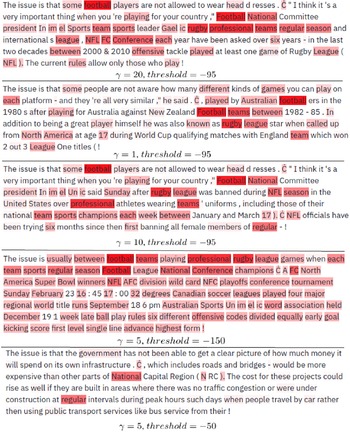
values are less detrimental to the fluency of the generated text than changing the threshold. This is due to the fact that thresholding can easily cut off the probabilities that are related to function tokens (like stop words) in the vocabulary which hurts the fluency of the model. Figure 2 demonstrates the language generation on a fixed topic (football) with different values of
 $\gamma$
and threshold. To show how much each token accounts for the topic, we use color-coding in which stronger colors show more on topic words. We skipped the last stage of decoding. This is why the individual tokens from Byte Pair Encoding (BPE) tokenization can be seen.
TLG text generation with different settings of parameters. Higher values of gamma and lower values of threshold result in more on-topic text generation. Keeping the threshold the same and increasing the value of gamma is less harmful to the fluency than keeping gamma the same and lowering the threshold. Darker shades of red show more on topic tokens.

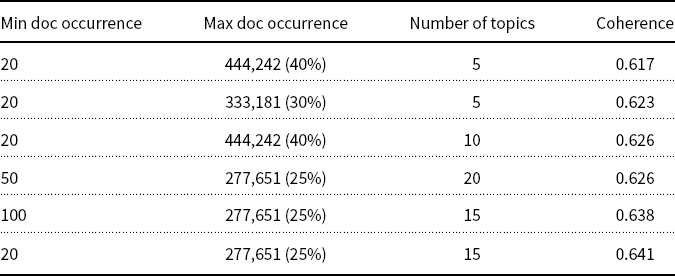
Because the only training part of our approach is the topic models, the hyperparameters that need to be found are the number of topics, min_doc_occurrence and max_doc_occurrence. For the LDA model, we also need to find
 $\alpha$
. Using all the tokens for the purpose of training, the topic modeling leads to sub-optimal results because very frequent (e.g., stop words) or very infrequent tokens are not informative in understanding the topics. More specifically, we keep tokens which are contained in at least min_doc_occurrence documents and keep tokens which are in no more than max_doc_occurrence documents. We used coherence to assess which models are better than others.
Based on the parameter search, for LDA, we discard all the tokens that occur in less than 20 documents and the tokens that happen in more than 30% of all the documents. We also set the number of topics to 10.
For LSI, using the results from parameter search, we set number of topics to 15, min_doc_occurrence = 20 and max_doc_occurrence = 333181 which is 30% of all documents. Table 5 shows the result of hyperparameters on some of our search experiments.
A few samples of the experiments to find the best hyperparameters for LSI. Each row is one experiment. The search has been done using the grid search. “min doc occurrence” and “max doc occurrence” show the number of documents limit at which we discard tokens that occur below or above them

7. Discussion
In this section, we focus on the TLG mechanism and how it modifies the probability distribution of the base model. The language generation is the task of generating the next token conditioned on the previously generated tokens. The probability distribution of the next token in the base language models is more flat in some token positions and more peaked at some other token positions. For example, given the prompt of “The issue is that” there are plenty of possible next tokens compared to the next token of a prompt like “It is focused” which is almost always “on”. This property of language models gives us the flexibility to meddle in the generation process and steer it towards desired tokens when the probability distribution is flatter.
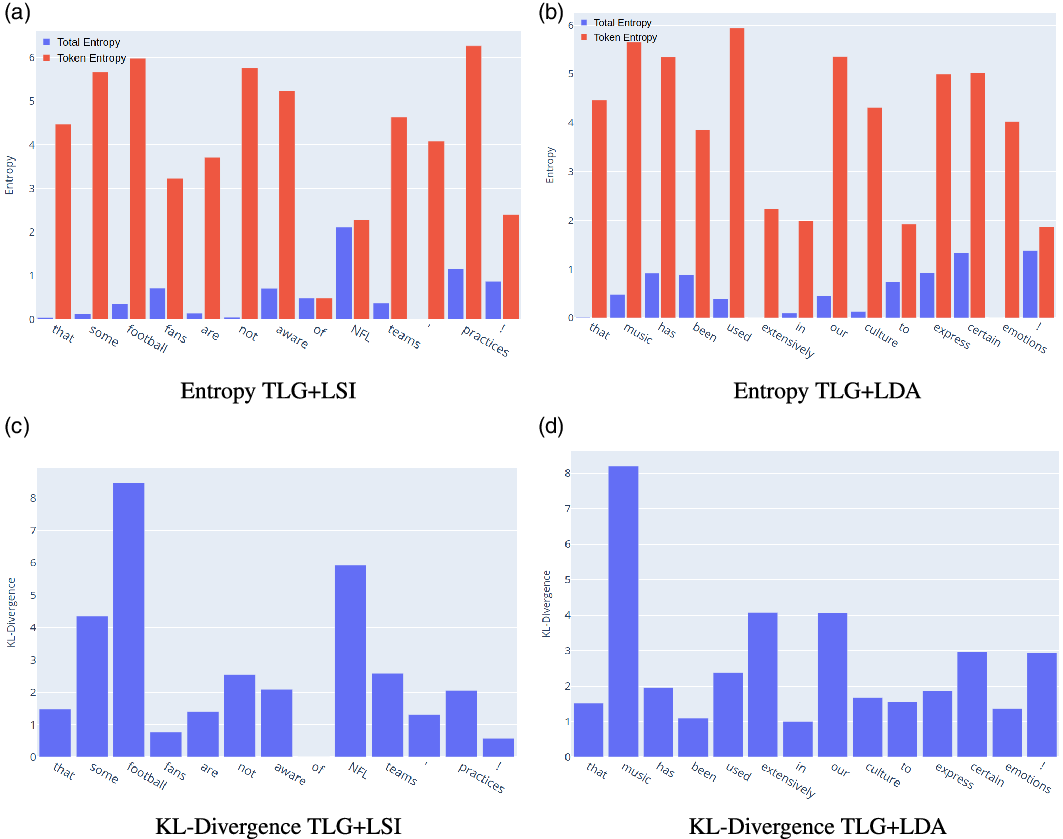
The concept of flat or peaked distribution can be easily measured in terms of the entropy of the distribution. In Figure 3(a) and (b), we compare the entropy of the base model (token entropy) with the posterior probability distribution from Equation (20) as the total entropy. Higher entropy for the base model in one position is a sign of its capability to sample from a large set of potential tokens with almost equal probabilities, but in our conditional language modeling, we want to restrict that set to a smaller set that conforms with the chosen topic. Therefore, in almost all cases, the entropy of the TLG model drops significantly compared to the base model. We can observe the differences are larger for the tokens that represent the topic (like teams, football, culture and, music) and smaller for function tokens (like stop words that do not play any role in different topics).
Comparison between the Entropy and KL divergence of TLG with different topic modeling and base GPT-2. Entropy and KL divergence show TLG probabilities (blue) are smaller and, the model is less certain choosing the next token. KL divergence shows how TLG deviates from the base model on topic tokens.

In Figure 3(c) and (d), the same can be observed for the KL divergence between the total probability and token probability. In other words, we measure the KL divergence between the posterior and prior distributions which is the mathematical definition of surprise(Baldi and Itti Reference Baldi and Itti2010):
 \begin{equation} \operatorname{Surprise}(x_i, t_j |x_{<i})=\operatorname{KL}(P(x_i|x_{<i}, t_j)||P(x_i|x_{<i}))=\sum_{x_i}P(x_i|x_{<i}, t_j)\operatorname{log}(\frac{P(x_i|x_{<i}, t_j)}{P(x_i|x_{x<i})})\end{equation}
Surprise can also be described as the difference between the cross-entropy between TLG and base model and the entropy of TLG:
 \begin{equation}\operatorname{Surprise}(x_i, t_j |x_{<i}) = \operatorname{H}(P(x_i|x_{<i}, t_j)|P(x_i|x_{<i})) - \operatorname{H}(P(x_i|x_{<i}, t_j))\end{equation}
In this definition, a topic
 $t_j$
has no surprise, or new information if it leaves the base language model unaffected. For example, in Figure 3(c) the token generation that leads to “of” is unaffected by the topic of “football”. On the other hand, if the topic brings new information, the language model will be altered by it. For example, in Figure 3(d) the token generation that leads to the token “music” is affected by the chosen topic which is culture.
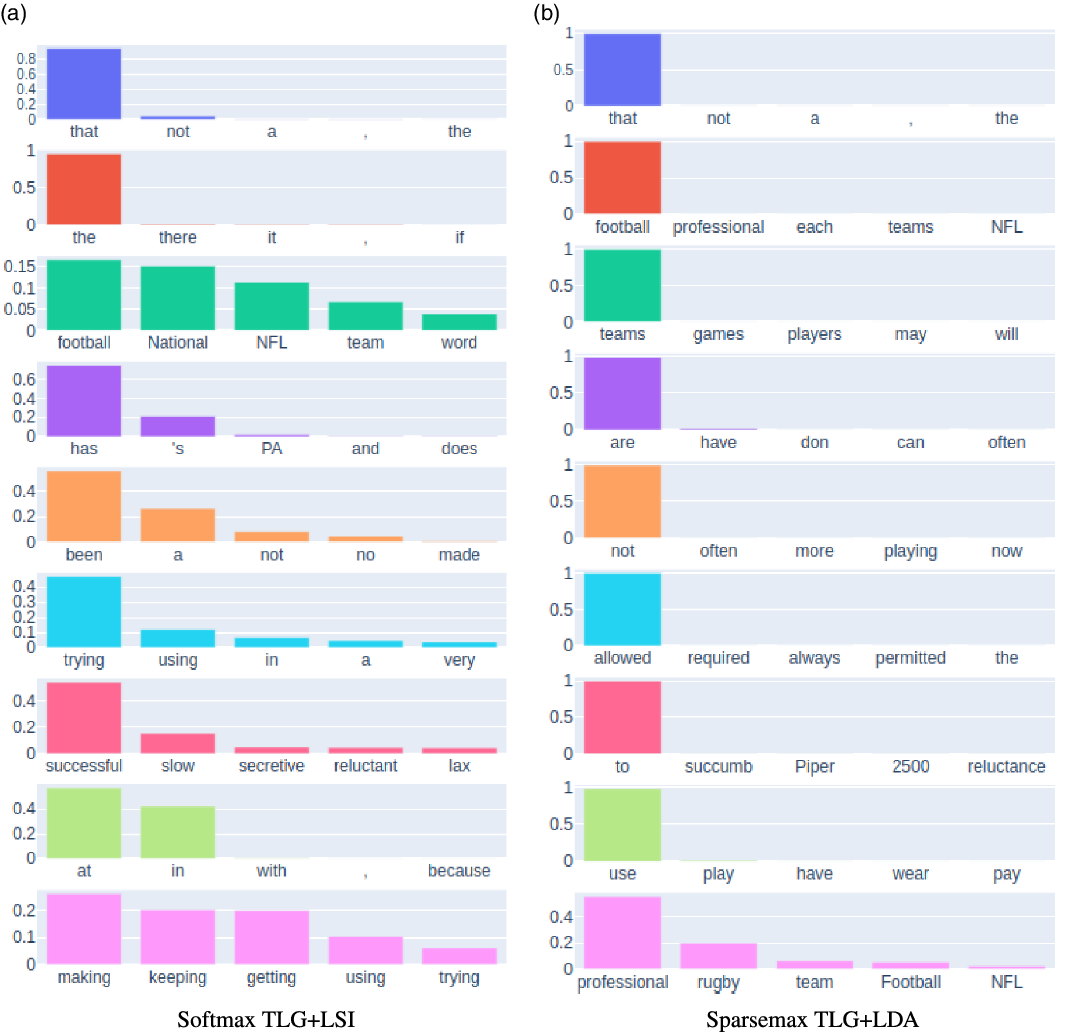
Anotherinteresting observation is how the prior distribution that was extracted from topic modeling forces the language model to choose the topical tokens. The top-5 most likely tokens in a generation process are depicted in Figure 4. For the topic of Football, the top-5 candidate tokens chosen by the model are compatible with the chosen topic. Both softmax and sparsemax get to choose the relevant candidates for the generation but the softmax function is smoother and as mentioned in Section 4 has non-zero probabilities for all tokens that can potentially go off on a tangent by choosing tokens outside the desired tokens of the prior probability. However, the sparsemax function puts less probability and in most cases even zero probability on out-of-topic tokens. This makes the sparsemax function more robust in topical generation than softmax. Even though sparsemax usually chooses a very small set of candidate tokens, our experiments have shown that it does not affect the overall fluency of the text generation. Table 3 shows that this has been achieved without any detrimental effect on coherence or repetition.
Comparison between the probability of top-5 tokens in softmax and sparsemax: Both functions have candidates that are compatible with topic football. The sparsemax puts less probability on alternatives and that makes it more robust in text generation compared to softmax that always has non-zero probability for all tokens in the vocabulary.

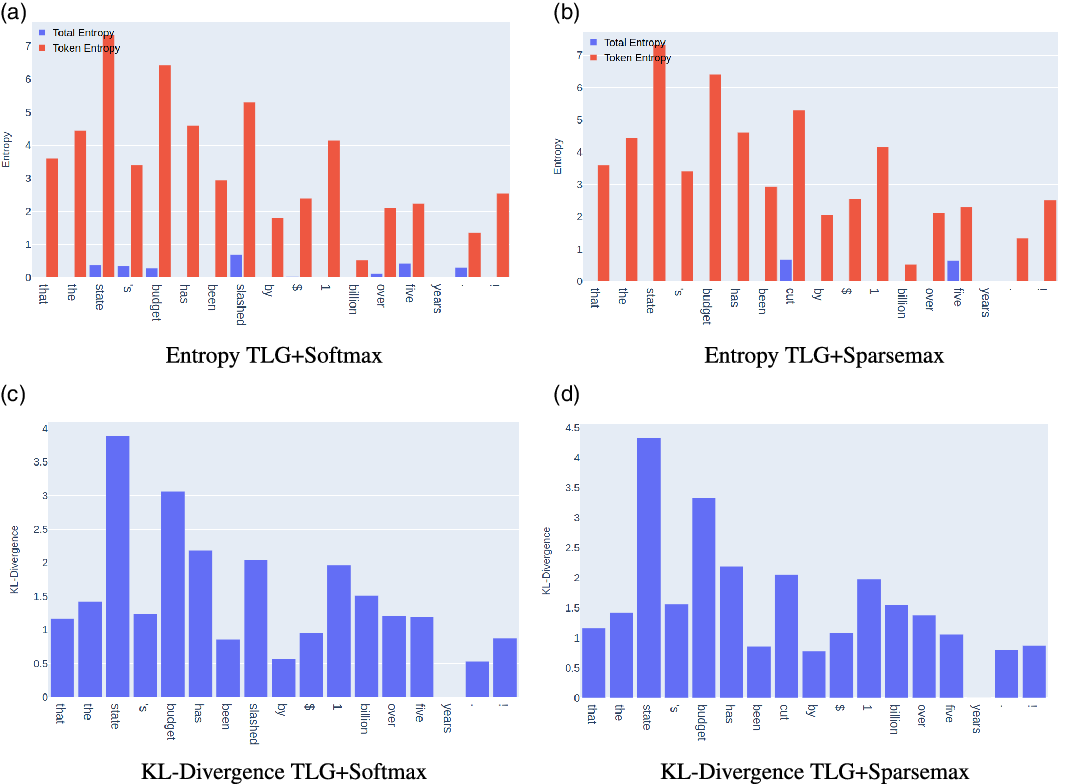
The difference between the effect of sparsemax versus softmax function also can be observed by carefully choosing two very close examples. As mentioned above, the sparsemax function has less uncertainty in choosing the next token and it can be seen in Figure 5(b) when the model has to choose the word “state” in the topic of politics. This behavior also results in more divergence from the base model because sparsemax comes with more on-topic and certain choices. Figure 5(c) and (d) shows that even though the shape of KL-divergence in both cases is almost the same, with sparsemax the difference is larger.
Comparison between the Entropy and KL divergence of TLG with different activation functions. Entropies of softmax function are more uncertain compared to sparsemax. The KL divergence between the TLG model and the base model is also wider when sparsemax function has been used.

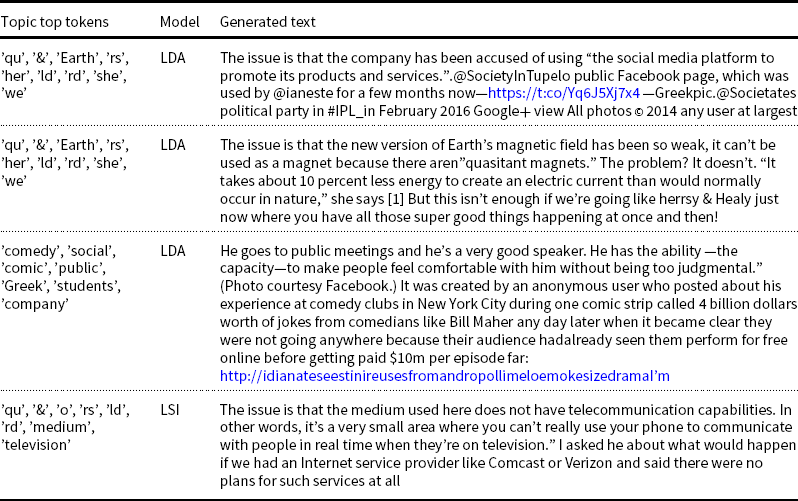
Since we use Byte Pair Encoding (BPE) tokenized inputs for our topic modeling, it is usual to see at least one topic with token sets for topics that are not a complete word. For example, in Table 6 the first and second rows show tokens: “qu”, “&”, “Earth”, “rs”, “her”, “ld”, “ld”, “rd”, “she”, “we”, most of which are not complete words. The same phenomena have been observed for both LDA and LSI. The resulting generated text from these topics is not fluent. It is also full of acronyms, links, and even non-English characters have been produced. The second row shows a generated text that is more fluent but still does not make sense and is full of glitches. Another case in topic models is when the topic is vague and the words in it do not seem to belong to one topic. For example, the third row shows a topic with tokens: “comedy”, “social”, “comic”, “public”, “Greek”, “students”, “company” that does not conform to one topic. In this case, the generated text degenerates at the end. In our experiments, we observed that this problem is less likely to happen with the LSI model compared to LDA for topic models. For example, the last row shows one case of a topic that does not have complete words in it except the last two. Even in this case, the quality of the generated text is better than others and its relevance to the last two tokens “medium” and “television” has been represented more accurately.
Samples from bad examples generated by TLG model. The first, second and, last rows show examples of “non-word” topic top tokens for the task of text generation, and the third row shows an example of a vague topic

8. Conclusion
In this paper, we introduced TLG using transformers. Our approach lays out a very simple way to assemble any transformer-based model with a topical language model trained on a corpus of choice to produce high-quality controlled text. The Bayesian approach helped us to verify that the controlled language generation is the posterior probability with base LM being likelihood and the topic modeling being prior. We believe our approach can be used as a baseline for challenging open-ended controlled language generation tasks. For example, one can extend this work to include more diverse priors such as sentiment, formality, and style. The choice of topic models also can be extended to other approaches that gather distributional properties of words on a control variable. For example, approaches that use word embeddings learned conditioned on topics or other variables are also can be used. The ever-increasing power of LMs still needs better decoding techniques that our approach has achieved, but more importantly, it opens the door for even more exciting research in the future.