Soil animals are important regulators of nutrient cycling and soil fertility (Lavelle & Spain Reference LAVELLE and SPAIN2001). Though typically quite numerous, many soil animals are characterized by their small size and cryptic lifestyle that hamper detailed studies of their ecology. Nevertheless, the development of modern instrumental methods, in particular stable isotope analysis (SIA) have led to significant advances in the understanding of the trophic structure of soil animal communities (Illig et al. Reference ILLIG, LANGEL, NORTON, SCHEU and MARAUN2005, Maraun et al. Reference MARAUN, ERDMANN, FISCHER, POLLIERER, NORTON, SCHNEIDER and SCHEU2011, Semenyuk et al. Reference SEMENYUK, TIUNOV and GOLOVATCH2011). Bulk SIA requires a specific weight of each sample. In most laboratories, a minimum weight of about 50 μg is required for a reliable determination of the isotopic composition of nitrogen (δ15N values) in an individual sample of animal tissues. Collembolans, mites and other micro-arthropods, but also many macrofauna species (e.g. Ptiliidae beetles), have a very low body mass and are difficult to collect in the quantities required for SIA. Moreover, diet-switch experiments have demonstrated that tissue turnover of C and N in collembolans varies from 4–5% d−1 to 10–15% d−1 (Larsen et al. Reference LARSEN, VENTURA, DAMGAARD, HOBBIE and KROGH2009, Potapov et al. Reference POTAPOV, SEMENINA, KURAKOV and TIUNOV2013). Thus, a short extraction time not exceeding 3–4 d is preferred if the target organisms are likely to continue feeding during extraction. In field conditions, these animals may feed on certain resources, for instance algae, which strongly differ in the isotopic composition from the litter and litter-colonizing microflora (Maraun et al. Reference MARAUN, ERDMANN, FISCHER, POLLIERER, NORTON, SCHNEIDER and SCHEU2011).
Soil animals are usually collected using various modifications of Kempson extractors or Tullgren funnels. These devices require an equipped laboratory and are not designed for mass extraction of animals from large samples of soil or litter. Winkler extractors could be a suitable alternative for such purposes. Though Winkler extractors have relatively low efficiency in comparison to high-gradient extractors (Sakchoowong et al. Reference SAKCHOOWONG, NOMURA, OGATA and CHANPAISAENG2007, Shaw & Ozanne Reference SHAW and OZANNE2011), they are widely used in comparative ecological and biodiversity studies (Delsinne & Arias-Penna Reference DELSINNE and ARIAS-PENNA2012, Krell et al. Reference KRELL, CHUNG, DEBOISEA, EGGLETON, GIUSTIA, INWARDA and KRELL-WESTERWALBESLOH2005).
Due to the large amount of material, reduced ventilation, and lack of heating, the substratum in Winkler extractors dries out more slowly than in other extractors, and extraction may thus require a longer time. The problem is exacerbated in humid tropical climates where the desiccation of litter is even slower and the inner substrate layers may remain wet for 3–4 wk (unpubl. data).
In order to accelerate the desiccation of litter and shorten the extraction time, we equipped the Winkler extractors with heating plates. The heating plates are available and cheap (used, for example, for heating terraria), and each Winkler extractor can be easily equipped with them if there is access to electricity. The aim of this study was to assess the effectiveness of this modified Winkler apparatus when working in a humid tropical climate.
The experiment was performed at Cat Tien National Park, southern Vietnam (11°21′–11°48′N; 107°10′–107°34′E). The park lies at the foot of the central Vietnamese highlands, about 130 km north-east of Ho Chi Minh City. The climate is tropical monsoon with two distinct seasons: a rainy season from May to November and a dry season from December to March. The mean annual temperature is close to 26.4°C, with rather small seasonal fluctuations. The mean annual rainfall is about 2518 mm, the rainiest months being August and September (Deshcherevskaya et al. Reference DESHCHEREVSKAYA, AVILOV, DINH BA DUY and KURBATOVA2013). The soils are mostly loamy, black ferrallitic, formed on basalt bedrock. The vegetation includes over 150 tree species, of which Lythraceae associated with Dipterocarpaceae, Fabaceae and Datiscaceae often dominate the upper storey and canopy (Blanc et al. Reference BLANC, MAURY-LECHON and PASCAL2000). Most of the upper-canopy trees are deciduous.
Samples were collected in November 2012 at two study sites. The first study site was a multi-species forest plantation (Lagerstroemia speciosa (L.) Pers., Dipterocarpus alatus Roxb., Hopea odorata Roxb. and other species) established in 1997 near Ta Lai Village. The second site was a lowland tropical forest with Lagerstroemia calyculata Kurz associated with dipterocarp species dominating the upper storey. At each study site, litter was collected from eight randomly selected 1-m2 plots. The litter was sifted through a wire mesh screen (10 mm) using a custom-made sifter. Litter from each site (hereafter referred to as plantation litter and forest litter) was thoroughly homogenized in a large bowl, divided into equal parts by volume, and loaded into four Winkler extractors (produced by Dr Ondrej Šauša, Entomological Instruments and Literature, Bratislava, Slovakia). Each Winkler extractor contained four mesh bags (24 × 32 cm, mesh size 5 mm). Four out of the eight Winkler extractors were equipped with 20 × 20 сm, 4-W heating plates (Heat Wave terrarium substrate heater, Rolf C. Hagen Inc., Montreal, Canada) placed in the middle of each mesh bag. Powering of one heater-equipped Winkler apparatus would require about 0.1 m2 of modern solar panels. The temperature of the litter inside the mesh bags was measured several times during extraction using an infra-red digital thermometer. During extraction, the temperature averaged 37.5°C and 29.2°C, respectively, in the Winkler extractors with and without heating plates.
The extractors were left suspended for 10 d in a well-ventilated room at ambient temperature and humidity. The collecting bottles were emptied and refilled with fresh ethanol solution on days 2, 4, 6, 8 and 10. The extracted animals were counted and stored in 75% ethanol. On day 10, the litter was removed from each Winkler apparatus, dried at 80ºС over 5 d, and weighed. The abundance of animals was calculated based on the number of individual organisms per 100 g of dry litter. A post hoc LSD test was used to compare means. Calculations were performed in Statistica 7.0 (StatSoft, Tulsa, USA).
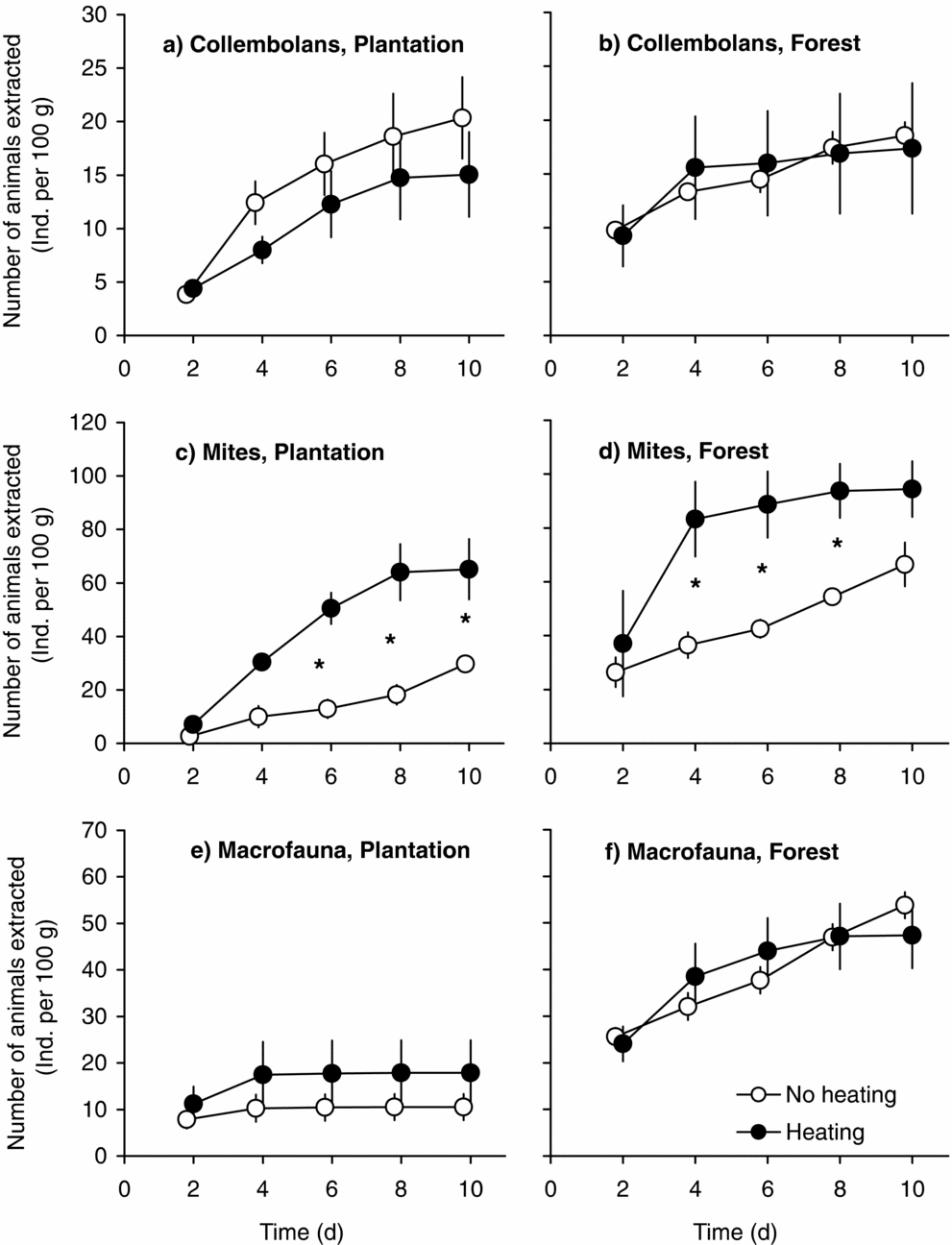
After 10 d of extraction, the remaining moisture content in the litter ranged from 5% to 14% and from 2% to 4% in unheated and heated extractors, respectively. The total number of extracted mites and macro-invertebrates depended strongly on the study site, but a similar number of collembolans was extracted from plantation and forest litter (Figure 1).
Specimen accumulation curves for litter-dwelling collembolans (a, b), mites (c, d) and macro-invertebrates (e, f) extracted using conventional and heater-equipped Winkler apparatus. Litter was collected in a mature forest and in a young forest plantation in Cat Tien National Park, southern Vietnam. Whiskers show 1 SE. Asterisks indicate significant differences between Winkler extractors with and without heating (P < 0.05; post hoc LSD test).

Heating did not affect the extraction efficiency of collembolans (Figure 1a, b). Collembolans are relatively sensitive to moisture. Nevertheless, surface-dwelling (atmobiotic) forms are more resistant to high temperatures and desiccation. Atmobiotic collembolans form up to 60% of the total density of collembolans in mature forests at Cat Tien National Park (Anichkin et al. Reference ANICHKIN, BELYAEVA, DOVGOBROD, SHVEENKOVA and TIUNOV2007), and might be even more abundant in the young forest plantation with an undeveloped single-storey canopy. Continuous breeding or hatching also cannot be excluded.
In contrast, heating doubled the number of mites extracted from the litter. A significant difference in the total number of mites extracted from heated and unheated extractors was apparent on days 6 and 8 (Figure 1c, d). More importantly, in heated extractors, the specimen accumulation curve approached the asymptote. This indicates that most mites were extracted during the first 4 d. Heating did not affect the proportion of Oribatida, Mesostigmata and Prostigmata extracted from forest litter (on average, 70%, 23% and 7%, respectively, of the total number of mites extracted). In plantation litter, the proportion of Oribatida extracted was slightly higher where heating was applied (92% and 85% of the total number of mites in heated and unheated extractors, respectively).
The number of macro-invertebrates extracted from the forest litter increased continuously during the extraction period where no heating was applied (Figure 1f). In heated extractors, the specimen accumulation curve approached the asymptote on days 4 or 6 of extraction. Only a small number of macro-invertebrates were extracted from plantation litter, most of which were extracted during the first 2 d both in heated and unheated extractors (Figure 1e).
To conclude, this study demonstrates that the application of heating plates accelerates the extraction process while still yielding large quantities of organisms. Heating was generally more effective in forest rather than plantation litter. In all three groups of soil animals extracted from forest litter, specimen accumulation curves approached asymptote at day 4 if heating was applied. Thus, by using heating plates, extraction time can be reduced to 3–4 d. The short extraction time allows the animals to preserve their original isotopic signature and might increase the precision of SIA-based reconstruction of soil food webs in tropical habitats.
ACKNOWLEDGEMENTS
This study was supported by the Russian Foundation for Basic Research (Projects 14-04-01824 and 14-04-31183 mol_а).