1. Introduction
“It is a conventional wisdom,” it has been observed, “that monarchy has become a political anomaly.”Footnote 1 To be sure, the number of jurisdictions with a royal head of state are now far and few between, in Asia as well as in other parts of the world. India, for example, abolished more than 500 monarchies in the 1940s with the creation of its union in 1947. Yet, there are countries that have bucked the trend of transition to fully electoral democracy under republican government, retaining, or even in some cases reintroducing, their monarchies.Footnote 2 What is more, the Asian monarchies that have so far withstood the test of time are not simply ornamental, but carry significant societal and even legal-political meaning. This reality is the impetus for the present article as well as the Special Issue to which it belongs and which it seeks to frame. Monarchies may have become a rare breed, but rarity should not be confused with inconspicuousness. Our aim in this article is to present a roadmap of sorts for examining the phenomenon of monarchy in Asia, which we conceive as a pluralist institution in a twofold manner. On the one hand, many monarchies discharge a wide range of roles and responsibilities that may range from the symbolic to the religious to the legal-political. These varied functions, we submit, can be usefully captured under the notion of constitutional guardianship, and call for intersectional analysis. On the other hand, it is common for monarchies to have metamorphosed from being purely endogenous institutions to becoming ones embedded in a scheme of limited, constitutional government under the influence of ideas from elsewhere. The result of this, we suggest, is that monarchies should be viewed as a form of legal métissage—that is, a braiding of local and extraneous ideas, practices, and rules. This article is accordingly primarily conceptual and methodological in outlook. We do not intend to offer detailed empirical observations on the functioning of Asian monarchies, which can be found in the other contributions to the Special Issue, but rather to provide illustrations demonstrating how these institutions can be profitably studied.
The discussion below begins with a brief consideration of the various forms that monarchies can assume, alongside an exploration of the factors that may account for their survival. This will be followed by an examination of the idea of royal constitutional guardianship and its manifestations. Emphasis will be placed on three matters: first, the reality of constitutional interpretation of legal and political rules by monarchs;Footnote 3 second, their role in upholding the Constitution and promoting constitutional identity; and third, the impact of crisis and transition on the functioning of these monarchies.
The focus then turns to the concept of legal métissage and an explication of how notions of modern constitutional governance continue to co-exist with indigenous, and older, governance traditions contained in various ways within monarchical regimes. The methodological implications of this view are also discussed. We submit that legal métissage is an apt way of describing the Asian monarchies as they currently are, and that interrogating their multifaceted nature requires a pluralist and interdisciplinary methodological approach that consciously goes beyond court-centricity.Footnote 4 In this sense, a law-and-society approach is far more likely to reveal the nature of these monarchies than a strictly legal-doctrinal approach, although some of the latter is needed in order to fully appreciate the significance of the former.
2. The endurance of royal power
A remarkable feature of Asian monarchies is the survival into the modern world of several monarchies that were previously absolute, but are now (except for that of Brunei) “constitutional.” The late nineteenth and twentieth centuries saw the abolition of traditional monarchies in China, Korea, Vietnam, Burma, India, Indonesia, and elsewhere, while others were converted into “constitutional” monarchies. These developments were due to revolution, colonialism, the push for modernization, or a combination of these. Apart from Japan, those Asian monarchies that have survived are the focus of the other articles in this Special Issue.
Monarchies come, of course, in various shapes and sizes. A distinction is usually drawn between two archetypes, as just alluded to: absolute and constitutional monarchy—terms that we wish to interrogate in the paragraphs that follow. In the former case, the exercise of royal power is not subject to any formal limits. There is no written law or well-established constitutional practice that formally circumscribes monarchs’ powers or their room for manoeuvre in political matters. In this model, the political and legal powers of the monarch are unchecked by other state institutions, which operate under the ultimate control and command of the monarch, in line with the political theory of absolutism. The people are cast as subjects of the monarch (rather than as citizens constituting the body politic itself, to which national sovereignty is assigned and that possess a pouvoir constituent), so that even a written Constitution is issued by or in the name of the monarch. Absolute monarchies are often associated with the ancient notion of divine kingship,Footnote 5 implying that the ability to rule is derived from being God’s representative, or the shadow of God, on Earth. In contrast, a constitutional monarchy is one in which royal powers are limited and the royal officeholder must operate within the parameters set out in a constitutional document or by unwritten norms considered as binding in every sense except legally, and so equivalent to those contained in a written Constitution. In a constitutional monarchy, the monarch is subject to the power of other state institutions, such as an elected government and a legislature, and it is these that tend to wield real governmental authority and take the lead in fashioning new laws and policies.
When looking at the way monarchies, more particularly those in Asia, operate, however, the distinction between absolute and constitutional monarchies may not be as stark or convincing as the above classic rendering suggests.Footnote 6 To start with, there may be non-binding informal constraints that absolute monarchs are expected to pay heed to, for instance in the form of seeking the views of local chiefs, a privy council, or other royal advisers, before making major decisions. They may thus not possess unbridled power, but rather operate under conditions in which they are free of formal legal constraints. At the same time, it can be convincingly suggested that the constitutional monarchy should be conceived as covering a range of arrangements rather than as a single template for a particular type of constitutional government. It encompasses, on the one hand, the purely ceremonial or symbolic constitutional monarchy in which the crowned head “reigns but does not rule,” as Bagehot’s famous epithet has it.Footnote 7 When such a constitutional monarchy prevails, governmental authority vests in essence exclusively in the elected branches of the state, and the royal ruler is entirely subjected to the Constitution and is therefore rule-of-law-bounded. The contrast with the absolute monarchy here is obvious and significant. On the other hand, however, there is the breed of the quasi-constitutional monarchy: formally defined as fully constitutional or virtually so, but with monarchs capable of exerting “a large measure of political influence” such that they ought to be reckoned with as a meaningful constitutional actor alongside other state institutions.Footnote 8 These monarchs may be legally empowered to exercise some discretionary constitutional powers; and, as the Asian case-studies reveal, they may also enjoy extensive informal powers lying outside the formal constitutional order that otherwise circumscribes their autonomy and ability to shape a country’s public life. In a related vein, political scientists have cautioned against assuming that constitutional monarchies are necessarily democratic, as far as the relationship between the electorate and the government is concerned.Footnote 9 As Stepan, Linz, and Minoves have pointed out, there may be a power-sharing arrangement in place between the monarchy and Parliament, in which the support of both is needed for the formation and termination of government, or the exercise of law-making powers. In sum, the various abilities of monarchies to affect national affairs may be best conceived in shades of grey, with due recognition of the extent of informal constraints and informal competences that they can wield as a matter of sociopolitical reality.
Applying these classifications and criteria to the extant Asian monarchies, we can classify Brunei as an absolute monarchy; Bhutan, Malaysia, and Thailand as quasi-constitutional monarchies; and Cambodia as a fully constitutional (or ceremonial) monarchy.Footnote 10 Of course, such categorizations may be fluid over time, and—differently from what Stepan et al. seem to presuppose—they may not necessarily develop in a linear fashion, with the inexorable advent of democracy at the expense of monarchical power.Footnote 11 This much is also apparent from a close reading of the accompanying articles in this Special Issue.
At this point, it is fitting to consider briefly the factors that may account for the endurance of monarchies in the face of modernizing democratic or liberal pursuits, generally and in Asia specifically.Footnote 12 One contributory aspect is that many monarchies have a long historical pedigree, thus providing a patina of home-grown legitimacy for a phenomenon that “has always been there.”Footnote 13 It has been suggested further that a monarchical system provides a measure of political stability, including when it is compared to republican government, as was already recognized by many of Europe’s leading early-modern political thinkers such as Spinoza, Hume, and Montesquieu.Footnote 14 In modern Asia, we see this issue of stability evidenced in Thailand and Malaysia, for instance. For students of democracy, there can also be considerable appeal in the existence of an office that is structurally neutral, in the sense of standing above ordinary party politics.Footnote 15 The incumbent of such an officeFootnote 16 could perform an important role in breaking a gridlock to keep the political system on track—a task that may be particularly important under conditions of growing polarization or during times of transition. We return to this point below. Many of Asia’s monarchs perform such functions, thus connecting them to prevailing local ideas of legality and constitutionalism. At the same time, they are often deeply related to tradition and religion, as we shall later see in greater detail. Monarchs are here looked to as symbols of national unity, and may even be attributed quasi-divine qualities or be explicitly charged to act as keepers of the country’s official faith.Footnote 17 To the extent that societies remain steeped in religious beliefs and practices, the monarchy may accordingly be viewed as a (semi) sacred institution that should be held in high regard, if not outrightly revered.Footnote 18
Other factors that may be of relevance include the importance of the individual personality of the ruler and their reputation among the citizenry: the late King Bhumibol Adulyadej of Thailand (King Rama IX) or Cambodia’s late King Norodom Sihanouk, for instance, enjoyed considerable personal popularity during their lifetimes.Footnote 19 Similarly, a turnaround in the fortunes of the Malaysian monarchies is attributed partly to the improved individual conduct of the Rulers.Footnote 20 Such high standing among the people can provide monarchies with a veritable groundswell of social legitimacy that may inoculate the monarchy from challenges to its existence.
Mention should further be made of supporting legal frameworks that may be in place to protect the monarchy and its reputation. This includes most notably lese majeste and sedition laws. Such laws proscribe any form of defamation, threat, or insult directed at the monarch (and may include other members of the royal family). In a recent judgment of the Thai Constitutional Court, Article 112 of the Criminal Code, which provides for the offence of lese majeste, was referred to as justification for ruling unlawful protests aimed at reform of the monarchy.Footnote 21 Sedition cases have also been brought to protect the reputation of the Malaysian Rulers.Footnote 22 Finally, some monarchies have intimate social and historical linkages with the military that can extend to relationships of patronage. The crowned head may be named in the Constitution as the commander of the armed forces and, while the military have sentiments of loyalty vis-à-vis the monarchy, the royal right to reign—if not rule—is backed up with the might of the sword. In Thailand, for instance, military coups are carried out in the name of the king.Footnote 23
In sum, there is no single key to the continued endurance of monarchies in Asia; rather, their survival and legitimacy are made possible because of a complex interplay of socio-legal and political factors. These factors focus attention on the precise role and responsibilities associated with the monarchy, which is the subject of the next section.
3. Reflections on royal constitutional guardianship
We suggest that it can be profitable to use the notion of constitutional guardianship to anchor conceptually the examination of the various roles that monarchs perform and the responsibilities entrusted to, or claimed by, them. Before considering three aspects on which studies of monarchical institutions should particularly focus, let us say a few words about the notion of guardianship as such.
Guardianship as a term of art in governance can be traced back to Plato, who contended that a just society should be led politically by a special group of guardians, also referred to as the philosopher-kings.Footnote 24 This elite group of individuals should be tasked with ruling the city and entrusted with responsibility for defending the polity from internal as well as external threats. Plato’s assumption was that the craft of leadership ought to be assigned to these guardians as they would be led by the pursuit of the common good, and not be tempted to pursue ulterior motives, mainly on account of having received an education that should instil a deep respect for morality and reinforce their innate proclivity towards philosophical thinking. Ideas about non-partisan, righteous guardians that would chart the way for the rest of society have long retained their influence, and traces thereof can arguably be found in the traditional notions of divine kingship and absolute monarchy mentioned earlier. In more modern times, the language of guardianship has famously been used by legal theorists Carl Schmitt and Hans Kelsen.Footnote 25
Schmitt advocated the head of state as best suited for the task of ultimately preserving the Constitution, basing himself on the nineteenth-century doctrine of a pouvoir neutre (neutral power). What mattered most, he argued, was for the constitutional guardian to be independent and non-aligned to political factions or interests, so that they can act as a balance against the other state powers. These attributes are realized for the head of state, on account of the hereditary nature of the position (in the case of monarchies), or else on account of their direct electoral mandate, long term of office, and protection against easy removal. Moreover, there are some factors that make the monarch, quite apart from constitutional or democratic legitimacy, an ideal candidate for the post of constitutional guardian. First, the competences associated with the head of state (notably appointing the head of government and other major officials, assenting to statutes, and dissolving Parliament) lend themselves well to such a role. Second, the monarch symbolizes the people as a whole and the territory they inhabit.
In contrast, Kelsen preferred the creation of a separate constitutional court as ultimately responsible for upholding the Constitution, appealing to the notion of judicial independence.Footnote 26 His claim has proved particularly persuasive, as the rapid proliferation of judicial review and constitutional courts around the globe, including in Asia, attests.Footnote 27 Of the jurisdictions covered in this Special Issue, Thailand and Cambodia have adopted this mechanism. Apart from constitutional courts, ordinary apex courts of general jurisdiction (as in the other countries featured) have also stressed their function in upholding the Constitution in their case-law. Indeed, scholarship suggests that references to guardianship have become relatively common in the self-perception of judicial institutions, as far as their role in adjudicating constitutional claims is concerned.Footnote 28 At the same time, the responsibilities of courts vis-à-vis the Constitution are neither exclusive nor necessarily always final. Other state institutions too can be expected to, and do, uphold the Constitution and its underlying values.Footnote 29 While attention is often focused on parliaments and increasingly on governments,Footnote 30 heads of state—including those of the crowned variety—may similarly perform a valuable function in ensuring the proper functioning of the constitutional order, as fervently defended by Schmitt.
We suggest that the choice of guardianship terminology is especially apposite when considering what exactly is often expected of, or done by, monarchs. Inherent in a legal reading of this notion is the exercise of powers for the benefit of another. Regardless of the type of monarchy in place, the crowned head is commonly conceived of as a benevolent pater nationalis, who should champion the collective wellbeing of the state and its inhabitants.Footnote 31 The assumption of a fiduciary relationship of sorts between the citizenry and the monarch is for instance neatly explicated in the Bhutanese Constitution, according to which the monarch “shall protect and uphold this Constitution in the best interest and for the welfare of the people of Bhutan” (emphasis added),Footnote 32 while the Cambodian document speaks of the king taking on the role of “supreme arbiter to ensure the regular execution of public powers.”Footnote 33 We draw attention also here to the notion of the “right to uphold” the Constitution, expounded by Kumarasingham.Footnote 34 This captures the idea that the reserve powers of heads of state in Westminster-type parliamentary systems include an ultimate right to protect the Constitution from abuse by political actors. For instance, Malaysia’s King in 2020, in rejecting advice to proclaim an emergency, forestalled a situation, at least temporarily, that would have rendered the government unaccountable to Parliament.Footnote 35 Similarly, Thailand’s King Bhumibol intervened ostensibly in the public interest to spur the courts towards invalidation of a flawed general election in 2006.Footnote 36 We acknowledge that monarchs may not always discharge such responsibilities wisely, legitimately, in a desirable manner, or even at all, but this should not detract from the suitability of legal guardianship as a lens to analyze the exercise of monarchical power. Indeed, from a law-and-society perspective, it appears to be a powerful notion in the minds of the populace, whether or not borne out from analysis of constitutional texts. The guardianship concept duly emphasizes the relational quality of the monarchy as institution—in its capacity as a possible final backstop in state management exercises and/or as a non-partisan, national symbol of unity—which is often instrumental to its social legitimacy and hence endurance.Footnote 37 Two central aspects of constitutional guardianship by monarchies are first their involvement in the process of giving meaning to constitutional provisions, notably those relating to royal powers, that make their impact felt within the legal-political sphere (Section 3.1); and second, their role in manifesting and preserving the constitutional identity of the state (Section 3.2). The occurrence of a crisis or transition emerges also as a significant variable in shaping the need for and scope of royal constitutional guardianship (Section 3.3).
3.1 Constitutional interpretation and legal-political guardianship
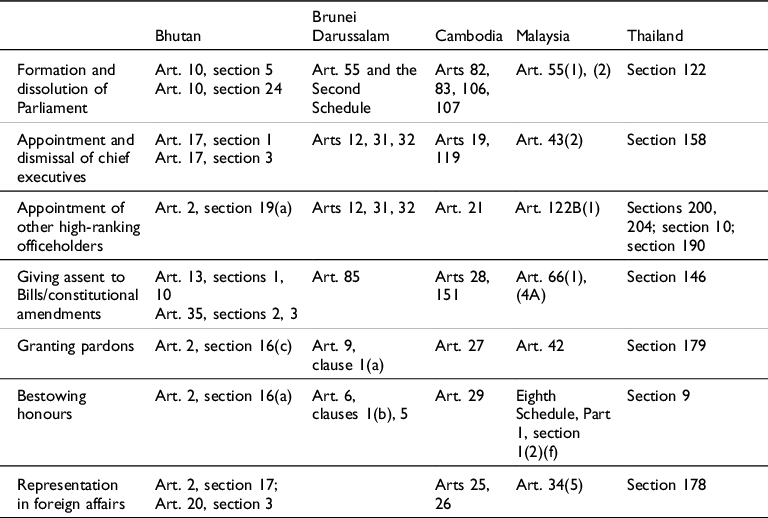
The role of the monarch can encompass several different functions that may affect the functioning of the legal-political order. Asia’s crowned heads may have a part to play in the formation or dissolution of Parliament; the hiring and firing of chief executives, and hence the making or unmaking of governments; the appointment of other high-ranking officeholders; the exercise of law-making powers, notably by giving royal assent to laws, sometimes including those purporting to amend the Constitution; the conduct of foreign affairs and maintaining good relations with other jurisdictions; and the granting of pardons and bestowal of awards or honours. The royal powers associated with these functions can be of different strengths and allow for varying degrees of monarchical autonomy, including interpretative discretion. Simply put, the greater the leeway granted to, or claimed by, the crowned head, the greater their potential to act as a serious guardian of (or, admittedly also, a threat to) the existing legal-political order, and as a counterweight to (or source of political authority distinct from) the other branches of state. Table 1 provides a comparative overview of the constitutional powers available to Asia’s contemporary crowned heads (ceremonial functions have been excluded as these are the subject of the next subsection).
Constitutional powers of Asia’s monarchs

In quintessentially ceremonial monarchies, the crowned head, even acting formally, does not act entirely of their own accord in the exercise of the above functions. Cambodia offers a good example, where the Constitution declares in Article 7 that the king “reigns but does not govern,” which means that his acts are subject to the countersignature of the government. Otherwise, as in Westminster-type systems, government advice will have to be proffered before the monarch can act. In such instances, whether the relevant criteria for, say, the dissolution of Parliament or the grant of a royal pardon, have been met, will thus primarily entail the exercise of interpretative responsibility on the part of the democratically accountable executive rather than the monarch. In other instances, for example the appointment of senior public servants or heads of independent state agencies, the prior issuance of a recommendation by another state institution or body as to the proposed course of action is required. The principal interpretative challenge here concerns the force of such a recommendation in circumscribing the ability of the monarch to act according to their own will. Thus, for example, Malaysia provides salient and controversial instances of the Yang di-Pertuan Agong (king) rejecting government advice, offering opinions on the political process, and inventing rules for ascertaining majority parliamentary support.Footnote 38
Conversely, the Constitution may confer powers that envisage, in some areas of activity, autonomous decision-making on the part of the crowned head. We can find several examples in Asia’s quasi-constitutional or absolute monarchical systems. In Bhutan, the Druk Gyalpo can refuse to give his assent to a Bill and return it “with amendments or objections” to be deliberated in a joint sitting of Parliament.Footnote 39 The relevant provision suggests that the monarch can take on an active guardianship role, as he is unencumbered in the nature of the concerns that can be levelled against the draft legislation, while he is simultaneously given the space to act as a co-legislator. Similar provisions can be found in Thailand and (before 1993) in Malaysia.
The room for manoeuvre for monarchs, and their ability to shape law-making or political processes based on their understanding of the meaning of the relevant authorizing constitutional provisions, may at times thus appear to be quite substantial. Yet even when presented with (significant) discretionary powers, there can be a collaborative or dialogic interpretative dynamic at play. On the one hand, there usually exists a royal council of advisers that the monarch can decide to solicit input from, even though he may not be formally required to heed the interpretative guidance thus provided. The composition and operation of such councils ought accordingly to feature in any analysis of royal constitutional guardianship, across all types of monarchy.Footnote 40 On the other hand, the monarch’s reading of his own competence will have implications for the competence of other state institutions, notably those of the executive or legislature; and this may induce either of those to put forward a contrary interpretation of the remit of the power at stake. Whether such eventuality occurs, and which of the conflicting readings prevails, may depend less on the text of the provision than on the relative political authority of the monarch vis-à-vis the legislature and the executive. The same holds true regarding a classic “who guards the guards?” issue that may arise: what is the check on royal power in cases where the monarch adopts too expansive a view of their powers? The answer here will not necessarily always depend on judicial or legal opinions, as the formal authority of courts to decide interpretative questions is, in practice, often limited when it comes to disputes between the monarchy and the other branches of government in the Asian jurisdictions. Negotiating such disputes will, again, be done with reference principally to political (and perhaps also social) perceptions regarding the strength of a right to contradict the monarch and the latter’s response to pushback.Footnote 41
This leads us to another observation. So far, we have referred to various types of constitutional provisions. However, the country studies presented in this Special Issue highlight that in Asia the role and responsibilities of the monarchies are usually not fully encapsulated in the codified Constitution or even in other legal instruments. Instead, it is also necessary to look at what Palmer has helpfully called the “complete constitution,” viz. “the structures, processes, principles, rules, conventions and even culture that constitute the generic ways in which public power is exercised” alongside the constitutional text itself.Footnote 42 In this regard, it should also be borne in mind that few constitutional provisions pertaining to the monarchy have conventionally been the subject of judicial pronouncement, be it because those with standing do not think it necessary or prudent to bring any interpretational issue involving the monarchy before the courts, or because the courts would typically hold such an issue to be non-justiciable, and better resolved within the political realm. The implication is that any study of monarchical powers and their interpretation ought to decentre courts and case-law ought to be de-centred in favour of a focus on other interpretative sources and sites, including those able to informally influence or constrain monarchical conduct.Footnote 43
Many monarchs are further able to wield prerogative powers with political connotations that, at least traditionally, have not been enshrined in the Constitution or statute,Footnote 44 while the content of those that have been formally regulated by law may be adjusted by political practice in their actual application. One clear example of this is the manner in which Malaysian prime ministers were appointed in 2020 and 2021.Footnote 45 One difficulty in this regard is that if prerogative powers have not been codified in the constitutional text, legal-doctrinal analysis may not be sufficient to ascertain the existence, scope, or the extent of legitimate exercise of such powers.Footnote 46 There is therefore a concomitant need to broaden the sources and methods relied on to arrive at either empirically or normatively defensible answers that duly grapple with the full suite of powers wielded by Asian monarchs.
All this confirms that political realities and social expectations must be systematically considered to obtain a holistic appreciation of the space for, and exercise of, actual legal-political monarchical power at any given time in Asian jurisdictions with an enthroned head of state. When societies and political elites accept, or even expect, that monarchs serve as real constitutional custodians of the legal-political order, the result may be an enlarged scope for the royal exercise of executive authority, ranging from intervening in megapolitical cases that involve “matters of outright and utmost political significance” that may “define and divide whole polities”Footnote 47 to sharing views on the meaning of constitutional (including unwritten) rules regulating inter-branch relationships. This enlarged scope of royal power is especially likely in states where democratization remains a work in progress, which is arguably the case for most if not all Asian monarchies.Footnote 48 A good example is occasions on which monarchs have made pronouncements on critical political issues. In Thailand in 2006, the King made a speech designed to kick-start judicial invalidation of a general election.Footnote 49 In Malaysia in 2016, the Conference of Rulers made a statement encouraging the speedy conclusion of the probe into the “1MDB” corruption scandal.Footnote 50
Finally, we should be alive to the fact that it might not always be possible, or even sensible, for monarchs to act as constitutional guardians vis-à-vis the political domain in the same visible manner that would be appropriate for the other branches of government. A monarch’s engagement with delicate or controversial matters (including those that implicate their own position within the constitutional order) may not always be out in the open, and they may also have recourse to techniques to side-step constitutional questions. By way of example, it has been observed that when potentially controversial legislation is due to be promulgated, the Cambodian King Norodom Sihamoni is absent from the territory and hence unable to grant his royal imprimatur to the law in question.Footnote 51 In Malaysia, one of the Rulers grew a beard, declaring that he would not shave until his chief minister left office.Footnote 52 Such instances are perhaps more appropriately seen as a kind of social symbolic indicator of monarchical displeasure about legal-political events that may nevertheless be equally, if not more, powerful than the formal exercise of constitutional powers. Any serious study of monarchical functions with a legal-political dimension must accordingly also take account of this “constitution behind the veil.”Footnote 53
3.2 Manifesting and preserving constitutional identity
Another theme that is pertinent to understanding the functioning of Asia’s monarchies is that of guardianship of constitutional identity. The monarchy is seen as expressive of such identity, in legal as well as extra-legal terms, which hence ought to be protected, while also looked to as the guardian of constitutional identity. No single meaning is ascribed to this concept in the literature, and a broad distinction can be maintained between a formal, “thinner” sense of constitutional identity and a social, “thicker” understanding.Footnote 54 The former is focused on the existence, quality, and provisions of the Constitution,Footnote 55 and may extend to the dynamics at play between different features of this document as well as those between the document and the society it purports to regulate.Footnote 56 The latter emphasizes the collective identity of the people as the subjects of a Constitution or that of the nation as such, while also interrogating the relationship between this form of constitutional identity and other forms of collective identity (e.g. ethnic, cultural, ideological, or religious).Footnote 57 When it comes to royal guardianship in Asia, both dimensions of constitutional identity—document-centric as well as people-centric—are relevant.
To start with, it is typical for Asian monarchies to be addressed in the Constitution, and for this to be done in a manner that presents the institution as of considerable importance to the nature of the polity. For example, the second article of the Constitution of Bhutan posits that the Druk Gyalpo is the “symbol of unity of the Kingdom and of the people of Bhutan.” The Thai document is even literally granted by the King to the people rather than proclaimed directly in their name.Footnote 58 Constitutions may also cast the monarch as a protector of a set of foundational norms or principles or ascribe to this institution the role of defender of the realm. The Cambodian Constitution offers a good illustration. The monarch is stated to be “the guarantor of national independence, the sovereignty and territorial integrity of the Kingdom of Cambodia and the guarantor of the rights and freedoms of all citizens and of international treaties.”Footnote 59 Furthermore, the monarchical form of government is often explicitly enshrined in the Constitution, and may even be declared to be unamendable, as is the case for instance in Thailand, with its “democratic regime with the King as head of state,” and Cambodia.Footnote 60 In these Constitutions, the text signals that the monarchy is an integral and fundamental element of the national constitutional settlement; that its demise should accordingly be prevented (hence for instance also the elaborate rules on succession found in many Constitutions);Footnote 61 and that if such occurred, it would result in a radically different regime and self-understanding of the countries concerned.Footnote 62
In much of Asia, constitutional identity as taking its cue from the people or the nation as a real or “imagined community”Footnote 63 is steeped in strong religious-cultural beliefs. These belief patterns may help validate the monarchical regime on spiritual or traditional grounds. In particular, in several jurisdictions, the throne is explicitly recognized or regarded socially as sacrosanct, and accordingly inviolate. Accordingly, the boundaries are blurred between constitutional and religious or other ideological identity, and there is added another dimension to monarchical guardianship, viz. that of extra-constitutional values. As an aside, it should be recognized that this kind of guardianship can have ethno-religious-nationalist, and hence, exclusionary, consequences.
In turn, to the extent that deep veneration for the monarchy also rests on religious, traditional, or other identities, there will be concomitant expectations of how monarchs, as supreme guardians, ought to conduct themselves. Thus, the Sultan in Brunei and the King in Malaysia are constitutionally ordained as heads of Islam, which is declared in both cases to be the country’s state religion. As such, they are also supposed to conduct themselves in line with Islamic religious doctrine, which extends to the manner in which royal power and prerogatives are exercised. The power that the monarch enjoys from religious belief may also encompass the regulation of religious practice. For example, in Malaysia, the Rulers are heads of Islam—a jealously guarded power and one of few areas in which they can exercise legal discretion.Footnote 64 Similarly, there is a strong concordance between the Thai, Cambodian, and Bhutanese monarchies and Buddhist values, with the crowned heads looked to as Dhammarajas, or virtuous kings.Footnote 65 In both Buddhist and Islamic monarchies, the personal conduct of the monarch is seen to be of great importance.Footnote 66
There is also a powerful symbolic quality to the monarch’s role as guardian of constitutional identity, which seems to be prevalent across all forms of monarchical regime and all jurisdictions. The significance, or weight, of that symbolism may vary across spatial and temporal dimensions, however. In Europe’s classic monarchical settings, the monarch’s role as a symbol—of the people, their culture, the nation, or of religion—does not appear to matter as greatly in practice as it did in the past.Footnote 67 In comparison, that role continues to be of critical importance in the Asian monarchies with which we are concerned here, to the extent that it would be warranted to speak of “Symbolism” with a capital “S.” This is in part because the symbolism associated with constitutional identity may support and carry over into the performance of the other guardianship functions mentioned earlier. To return to the earlier Cambodian example, there is a sense that it matters to political and societal actors when the king is not available to sign a Bill into law and this power is exercised by an elected state official instead. Across Asia, it is further noticeable that the monarchy is surrounded by an extraordinary degree of protocol. A recent book on monarchical traditions in the Malaysian state of Perak discusses protocol and custom surrounding the monarchy over almost 1,000 pages, and covers every conceivable issue from language used in addressing the Sultan to the mode of firing a cannon on significant royal occasions.Footnote 68
We accordingly suggest that engaging with Symbolism as a term of art may be a powerful analytical tool in studying constitutional identity guardianship. In this regard, there are several variables that can usefully be considered. These variables would include the amount and type of symbolic capital that the monarch as a person and the monarchy as institution are imbued with. It should extend to the relationship between both types of capital; at times, the institution and the incumbent may become almost inextricably intertwined, such that the flows of their respective symbolic capital become a virtuous—or vicious—cycle. Such is particularly likely to happen during long royal reigns, as in Thailand, when the monarchy qua institution and the late King Bhumibol (also known as Rama IX), who was on the throne during seven decades, were largely synonymous. A good understanding of symbolic capital also directs attention to the sources of such capital, including the competences that have been attributed to or associated with the monarchy as a matter of law or practice. This covers both those functions that are clearly part of identity guardianship, but may also extend to the exercise of the legal-political competences discussed in the preceding section, notably as far as these can be viewed as part of the “constitution behind the veil.” Next, the forms of Symbolism matter, and here we can think of rituals of power—like ascension to the throne or the taking of oaths of loyalty in support of the monarchy when assuming public officeFootnote 69 —or other rites and spectacles (e.g. the opening of the parliamentary year, marking the country’s national day or other public holiday celebrationsFootnote 70 ). Taking a cue from the work of cultural anthropologists, it would further be illuminating to reflect on the objects, dress, and language used on such occasions and the extent to which these invoke or evoke symbolic authority on the part of the monarchy. Finally, just like the notion of guardianship itself, symbolic capital is ultimately about relationships, so any study thereof should also take account of the intended audiences for the display or use of such capital. These audiences and their interrelationships may in part be determined by the Constitution or another law, which may determine the setting and prescribe the presence of certain groups of elites or other individuals, while the relevant social context must be reckoned with too: who understands the expressions of symbolic capital, and to what extent is there a unified or shared sense of their meaning?
3.3 Crisis and transition as significant variables in understanding royal guardianship
Moments of crisis and transition, like nothing else, reveal or establish constitutional fundamentals. Adopting the lens of royal guardianship, core issues that warrant examination are the role of the monarchy in the face of a crisis, and its behaviour, including societal expectations about the position that the monarchy ought to adopt. Governments might be tempted to restrict the monarch’s powers on such occasions, with a view to elevating their own powers and standing. Alternatively, the monarchy could decide to concede restrictions of its formal powers, as arguably happened in Cambodia, in order to survive. A potentially relevant factor here is the degree to which the extra-legal environment is volatile, because of inherent ethnic, religious, linguistic cleavages, or due to exogenous factors. What matters here is whether the monarchy can stand above such cleavages and credibly present itself as a symbol of unity, such that royal authority is itself a tool in the handling of crisis.
When taking seriously the salience of crisis, two forms must be distinguished: those that directly implicate the institution of the monarchy or the position of the monarch, and those that are faced by political system, and do not, as such, directly involve the monarchy. Let us briefly survey some examples from across Asia. We can note first that, in Japan’s constitution-making episode of 1945–47, a critical aspect was the retention of the monarchy, in spite of its alleged association with and symbolic support for the outrages of wartime. The thinking was clearly that in this stage of fundamental transition to a liberal-democratic order, the monarchy was an essential anchor for support, legitimacy, and confidence in the new constitutional order.Footnote 71 A similar situation occurred in Cambodia in 1993, where the monarchy, despite its chequered history, was restored in an attempt to provide a symbol of unity, again in period of fundamental change. In both these cases, however, the monarchy was not the focus of change, but rather one of the instruments for achieving change. In both cases, the endurance and popularity of the institution moreover testifies to the success of the strategy invoked.Footnote 72
The 2008 transition to constitutional democracy in Bhutan belongs to both categories. The voluntary surrender of absolute powers on the part of the Druk Gyalpo directly affected the position of the monarchy in the political firmament, while also indirectly affecting its ability to manage a new role both for itself and for the other state institutions to effectively manage the changeover in regime. Bhutan appears to have done quite well in accomplishing its pro-democratic evolution, while the monarchy has succeeded in remaining a sociopolitical pillar of strength, widely respected and effective in navigating external crises, such as the Covid pandemic.Footnote 73
The recent government crises in Malaysia have not concerned the monarchy as such, but have implicated it due to a clear demand for the exercise of royal power to resolve successive political crises in 2018, 2020, and 2021. The Rulers’ management thereof has carried popular legitimacy, despite arguably going beyond their hitherto conceived role.Footnote 74 The Malaysian experience might indicate that crisis could offer an opportunity for the monarchy to extend its powers even as far as those enjoyed in pre-modern times. In contrast, the Thai monarchy is directly implicated in the protests of 2020–22 that sought to recalibrate the country’s national identity, particularly by advocating a reformed, and circumscribed, role for royal power. The outcome of this crisis, which might even be considered existential in nature, remains in doubt.Footnote 75
Taken together, the picture that emerges is one of Asian monarchies adapting and responding to the need for change, including when they are themselves affected by such a need, although Thailand remains somewhat of an outlier in this respect. Their ability to negotiate calls for transition may also go some way towards explaining the survival of the monarchies, as discussed earlier. Looking at such moments of crisis, we suggest, may place in sharp relief the status and expectations of royal constitutional guardianship, and times of national predicament may accordingly be an incisive vantage point for understanding the contemporary as well as future role and status of the monarchy.
4. Monarchies as legal métissage
Having set out how constitutional guardianship is manifested by and through royal power, this section turns to consider the genesis and identity of the monarchy itself. At the outset, it should be observed that Asian monarchies are endogenously created cultural products, notwithstanding the infusion of exogenous religious ideas and beliefs, such as Buddhism or Islam. At the same time, they have for the most part (Brunei excepted) been deeply affected by the notion of a constitutional monarchy, which can be seen to be an ideological transfer from Europe. This is not to say that traditional monarchies were not subject to constraints, but we recognize here that the specific method of imposing constraints by means of a written Constitution is one that was not developed in Asia but introduced through colonialism or a process of modernization or self-strengthening at a critical juncture in the past, such as the Meiji restoration, the Siamese revolution of 1932, or the more recent democratic reforms in Bhutan.
Looking at how the global revolutionary turn played out in Asia, with the choice for monarchies between their abolition or their (partial) constitutionalization, what seems to have taken place is a transfer of conceptual thinking, or of an idea rather than a law,Footnote 76 which also involved an attempt to engineer cultural change. The impetus for accepting “modern”—in practice: Western—forms of limited governance, including constitutional monarchy, is often linked to colonization, or its corollary, fear of external control.Footnote 77 Deposing an absolute monarchy necessarily requires a Constitution to establish limits on royal power (unless a republican revolution overthrows the monarchy entirely, as in China and Vietnam, for example).Footnote 78 However, the important point for present purposes is that the adoption of a written Constitution did not necessarily entail the adoption of a liberal-democratic regime. In the cases of Japan and Siam (present-day Thailand), for example, the transfer of power was not to the people as such, but to an elite of army officers and their intellectual supporters. This revolutionary government embraced the ideas of limited government, the written Constitution, and the trias politica, in place of an absolute monarchy, but not under a liberal-democratic dispensation. Indeed, as we have seen earlier, in the case of governance regimes, legal texts—notably the Constitution—do not tend to offer an exhaustive or very precise definition or regulation of legal and political powers, especially those relating to the monarchy, where much is left to the imagination. This situation in turn created considerable space for local acculturation or the continued relevance of extant sociocultural norms. Customary norms and structures could, and do, continue in force. In contemporary Thailand, for example, the King exercises the constituent power in bestowing a new Constitution (see e.g. the Preambles of the Constitutions of 1997, 2007, and 2017).Footnote 79 Here we may contrast the social contract theory that prevails in the European equivalents, in which popular sovereignty is emphasized, to such exercises. In some other cases, the transfer of European ideas of limited governance was disguised by adherence to indirect royal rule, as with the nine Malay monarchies, thus preserving and even enhancing the indigenous institution at precisely the moment of transfer of potentially opposing ideas in order to maintain the legitimacy of change. The combination of the European-derived Westminster model alongside pre-existing local culture, with its own perceptions and modes for discussion of the monarchy, has produced what can be called an “Eastminster.”Footnote 80
We submit that the concordance of structures of modern constitutional governance with enduring indigenous, and older, royalist traditions is appropriately rendered by the notion of legal métissage, in preference to the notion of a legal transplant. Métissage is derived from the French language, where it is used to describe the fruitful blending of breeds that belong to the same species to create a breed with intermediate characteristics. Legally, it has been used to denote hybridity, often in the context mixing of civil and common law, or in the making of a hybrid global constitutional tradition that draws on principles from diverse sources.Footnote 81 Core features include a braiding of different (conceptual) traditions as well as the diverse sources that constitute those traditions. Thus in métissage neither the indigenous nor the foreign elements are “mixed out,” but rather are blended or braided together, presenting an outcome that valorizes both constituent parts of the resulting institution. As such, it goes well beyond characterizations such as “successful legal transplant,”Footnote 82 which assumes merely the success of one element, albeit adapted in some way to the local system. Furthermore, legal transplants tend to pay attention only to the applicability of foreign law at the moment of transfer, or possibly extending to its immediate afterlife. In the case of Asia’s monarchies, however, there is a keen need to draw attention to the status quo ante, something that métissage is intended to do.
Indeed, the notion of legal métissage helps convey the idea that Asian monarchies have existed for a long time, often predating the colonial era. As such, this notion fits well with emerging contemporary debates about the need to decolonize constitutional law and related methodologies, recognizing the need to study and accept “on their own terms” the continuing relevance in many respects of indigenous forms of governance.Footnote 83 Their long genesis and endurance mean that there are indigenous monarchical structures (which are the product of and responsive to local sociocultural settings) that overlay, and push back against, the classic European idea of the monarchy as more functional or purely ceremonial in nature.Footnote 84 It should also be recalled that the notion of “ceremony” is qualitatively different in Asia, where power may be expressed via ceremony and symbolic acts instead of ceremony and symbolism being a substitute for power. The braiding of ideas involves indigenous institutions that are subtly different from each other, with different political histories and profiles, as well as different linkages with religion; yet, what they have in common is that they are perceived as expressions of national constitutional identity and tradition. The “European” and indigenous monarchical structures can be profitably compared and contrasted, we argue, by using the concept of legal métissage.
Interrogating the phenomenon of métissage brings with it several methodological implications. There is, first, as alluded to, an important temporal aspect: the focus should be on looking at the origins of relevant indigenous and foreign concepts, and how these have affected society and been affected by society. This calls for longitudinal studies to uncover the fate of such concepts as they have evolved over time, placing a premium on engagement with historical sources, all the more so considering that there often is an invocation of a distant past or mythical kind of history for monarchies. Next, legal métissage can involve multiple layers of braiding. Asia’s monarchies are a blend of ideas and sources from Europe (notably England and Prussia), but also from other regions (Japan, China, India, and even the Arab world). Beyond legal texts and concepts, symbols and socioreligious practices from elsewhere may be braided into, and shape, the role and image of the monarchy. This has implications for what counts as data as well as the manner of its collection and analysis. It is axiomatic that the plurality of braided materials calls for the use of disciplines beyond the law and beyond legal methods such as case-law analysis and statutory/constitutional interpretation. Alongside history, cultural anthropology and religious studies hold out the promise of significantly enriching accounts of the lived reality of monarchies between the local and the foreign. Finally, métissage requires us to take seriously the indigenous context and local legal culture. Matters pertaining to the monarchy and royal constitutional guardianship, and hence opportunities for braiding, are more likely to be mediated by context, such as social norms, rather than settled in the text or “interpreted” by judicial bodies. There is thus a dynamic imperative of legal-constitutional translation at the sociocultural level, giving rise to complex relationships between textual and social understandings of the monarchy’s role: these may involve parallel co-existing tracks, gradual alignment, or enduring divergence. Appreciating the various forces and drivers at play calls for an intimate familiarity with the local culture through immersion, and efforts to engage in constitutional ethnography à la Scheppele.Footnote 85
5. Conclusion
In this article, we have emphasized the need to examine Asian monarchies through both constitutional analysis as well as a careful study of their surrounding society and culture. We believe this approach both to explain, and to be justified by, the empirical accounts provided in the accompanying case-studies, which, taken together, make clear that the study of monarchies requires more than a legal-doctrinal approach to do justice to their multifaceted and multi-functional nature. Indeed, we have argued that in Asia monarchy plays a role in upholding constitutional values and identity in terms of the real Constitution as a sociocultural product, not necessarily the textual Constitution as the product of lawyers and statespersons. We have further argued that legal métissage correctly represents the Asian monarchies insofar as it indicates the type, scope, and significance of monarchical constitutional guardianship. Through the use of this notion, we can better understand the roles played by both imported foreign ideas of constitutional monarchy alongside strongly surviving indigenous ideas and traditions of monarchy. Employing legal métissage as the lens for research into monarchies may well be taxing for legally trained scholars, but it holds out the promise of an accurate rendering of monarchies in all their vibrancy and their proper couleur locale.
Acknowledgements
We would like to thank the contributors to this Special Issue for their comments on an earlier draft of this Article as well as for their participation in the Special Issue, and Noémi Chaw for excellent research assistance.