


Introduction
A clinical feature of bipolar disorder (BD) is the excessive involvement in activities that have a high potential for adverse consequences (APA, 2013). These may include excessive spending, shoplifting, sexual indiscretions and aggression (Martino et al., Reference Martino, Strejilevich, Torralva and Manes2011; Reinharth et al., Reference Reinharth, Braga and Serper2017), which can have a negative impact upon social relationships (Owen et al., Reference Owen, Gooding, Dempsey and Jones2017), physical risks (Khalsa et al., Reference Khalsa, Salvatore, Hennen, Baethge, Tohen and Baldessarini2008) and has been used as evidence of decision-making impairment in BD (Adida et al., Reference Adida, Jollant, Clark, Besnier, Guillaume, Kaladjian and Courtet2011).
Decision-making is complex, with emotional and cognitive factors impacting the decisions we make (Milkman et al., Reference Milkman, Chugh and Bazerman2009). For individuals with BD, fluctuating mood increases this complexity (Inder et al., Reference Inder, Crowe, Joyce, Moor, Carter and Luty2010), leading individuals to perceive information differently resulting in different decisions across their mood states (Adida et al., Reference Adida, Jollant, Clark, Besnier, Guillaume, Kaladjian and Courtet2011). Thus, Alexander et al. (Reference Alexander, Oliver, Burdine, Tang and Dunlop2017) questioned which aspects of decision-making are phase-dependent (only present in mania or depression) and which aspects are trait-dependent (persisting even during periods of euthymia), concluding that low levels of vigilant decision-making and lack of adaptive coping style are consistent across phases and may be a trait component of the condition.
There are other factors related with decision-making in BD, such as impulsivity, reduced working memory, significant disinhibition, poor judgement or a lack of consideration for long-term consequences. However, the results of investigations regarding the role of these factors have been inconclusive (Burdick et al., Reference Burdick, Braga, Gopin and Malhotra2014; Cáceda et al., Reference Cáceda, Nemeroff and Harvey2014; Reinharth et al., Reference Reinharth, Braga and Serper2017; Yechiam et al., Reference Yechiam, Hayden, Bodkins, O’Donnell and Hetrick2008).
A recent study has offered a more comprehensive framework (Sicilia et al., Reference Sicilia, Lukacs, Jones and Perez Algorta2019), suggesting that risk-taking in BD could be driven by a reasoned (but sometimes faulty) process rather than impulsivity. This model shows how memories and analytical thinking, contrary to intuitive thinking, can facilitate risk-taking behaviours.
Although there appears to be agreement about general decision-making difficulties within the manic and depressive phases of BD (Murphy et al., Reference Murphy, Rubinsztein, Michael, Rogers, Robbins, Paykel and Sahakian2001; Reinharth et al., Reference Reinharth, Braga and Serper2017), there is disagreement regarding decision-making difficulties during euthymia (Adida et al., Reference Adida, Jollant, Clark, Besnier, Guillaume, Kaladjian and Courtet2011; Martino et al., Reference Martino, Strejilevich, Torralva and Manes2011; Olley et al., Reference Olley, Malhi, Mitchell, Batchelor, Lagopoulos and Austin2005). Olley et al. (Reference Olley, Malhi, Mitchell, Batchelor, Lagopoulos and Austin2005) explored subtle impairments during euthymia that would impact decision-making and highlighted deficits in executive functioning. In addition, Adida et al. (Reference Adida, Jollant, Clark, Besnier, Guillaume, Kaladjian and Courtet2011) report impaired decision-making in euthymia that was consistent across mania and depressive phases. Therefore, the authors suggested that a decision-making impairment should be considered a trait abnormality in BD. In contrast, a systematic review of 20 studies suggested that decision-making abilities are preserved during euthymia in BD (Samame et al., Reference Samame, Martino and Strejilevich2012).
As risk has different meanings for different individuals and within different contexts, risk-taking is defined as any decision that has the potential for negative consequences (Holmes et al., Reference Holmes, Bearden, Barguil, Fonseca, Monkul, Nery and Glahn2009). For example, some individuals may consider the risk of self-harm or suicide daily and therefore that is an everyday risk for that person. Alternatively, it may be speeding or going to social events that can carry a risk of negative consequences for them.
Exploring decision making and risk-taking in BD during euthymia – the mood state where people with BD spent approximately half of their time (Joffe et al., Reference Joffe, MacQueen, Marriott and Young2004) – can offer an opportunity to understand their experience of risk without the constraints imposed by the experience of mood episodes. It is estimated that around 40 to 70% of people with BD regain full functioning in occupation and social domains during euthymia (Akers et al., Reference Akers, Lobban, Hilton, Panagaki and Jones2019; MacQueen et al., Reference MacQueen, Young and Joffe2001).
Thus in this study, using a qualitative method we sought to explore how individuals in the euthymic phase of BD consider risk-taking in everyday decisions and the impact this may have on their lives.
Method
Epistemological approach
To conduct the study, we used a critical-realist epistemological stance (Pilgrim, Reference Pilgrim2013) to understand how individuals experience their BD. Exploring risk-taking in this way may help to understand the underlying experiences of the participants within the different contexts they occur (Willig, Reference Willig2019).
Design
We used interpretative phenomenological analysis (IPA) (Smith et al., Reference Smith, Flowers and Larkin2009) and semi-structured interviews (see Supplementary material) to provide a consistent framework for exploring key aspects of the topic whilst giving the flexibility to explore prominent issues that were brought up in the conversation (Galletta, Reference Galletta2013).
A service user researcher was approached to review the design of the study, in particular to review the language used. It was agreed that the term euthymia might be unfamiliar to participants, and we agreed on a definition that would be used in the study materials. This was: ‘The euthymic phase refers to a reduction/absence of manic or depression symptoms. It also means that you are currently living your usual lifestyle’.
Recruitment
Following ethical approval by the Faculty of Health and Medicine Research Ethics Committee (FHMREC), Lancaster University, in agreement with Ethical Principles of Psychologist and Code of Conduct, the study was advertised by Spectrum Connect, a network connecting people with an interest in BD. Adult individuals who self-reported having a diagnosis of BD and were currently in a euthymic phase were invited to register their interest with the researcher. If verbal or written consent was given, then a telephone screening interview was scheduled.
We used the Mini-International Neuropsychiatric Interview (MINI) (Sheehan et al., Reference Sheehan, Lecrubier, Sheehan, Janavs, Weiller and Keskiner1997) as the telephone standardized screening interview to ensure that participants met the criteria for a BD diagnosis and were in euthymic mood. As mood states can change quickly, interviews were scheduled within 2 weeks of the screening interview.
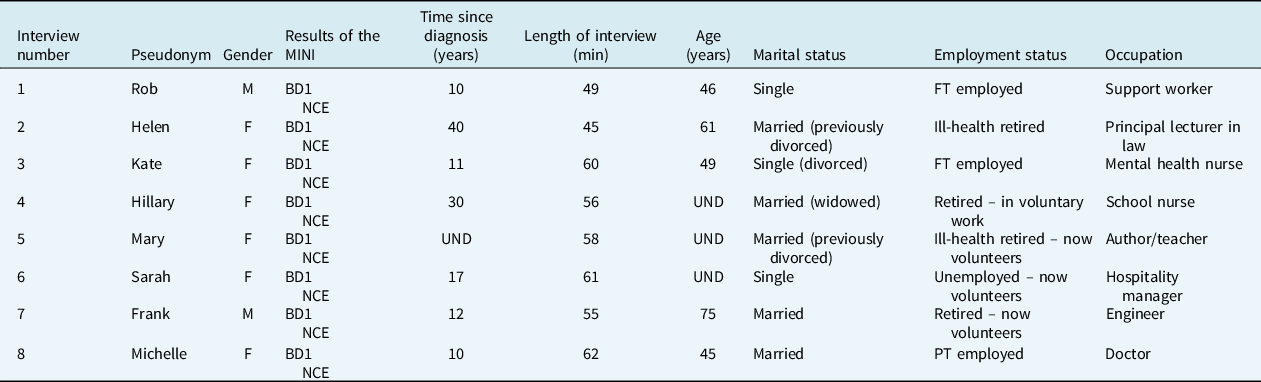
Participants were recruited on a first-come, first-served basis. Sixteen people responded to the initial advertisement, and 10 participants volunteered for the screening interview. One participant was deemed to have been in a depressive phase. One other participant withdrew close to their interview day. In total, eight participants were interviewed (Table 1).
Participant characteristics

DD1, bipolar 1 disorder; NCE, no current episode; UND, undisclosed.
Data collection
All participants were from the UK and were interviewed between November 2018 and January 2019 by the first author. Participants’ age range was 45 to 75 years; six were females. All met criteria for bipolar I disorder (Table 1).
Participants were offered face-to-face, telephone or skype interviews, with all eight opting for a face-to-face interview. Interviews were conducted in locations convenient for the participant, including public libraries, community centres or their own homes.
On the interview day, the researcher checked on the participant’s mood state by asking about low and elevated mood over the past 2 weeks. Written consent was obtained and the interview was then conducted. The interviews started by asking for the person’s own definition of risk and the definition of risk of relevant others (family, friends). Then, we asked about everyday examples of risk-taking behaviours during euthymic phases. This was followed by questions about the consequences of their decisions and how other people may perceive their risk-taking behaviour (see full details in Supplementary material).
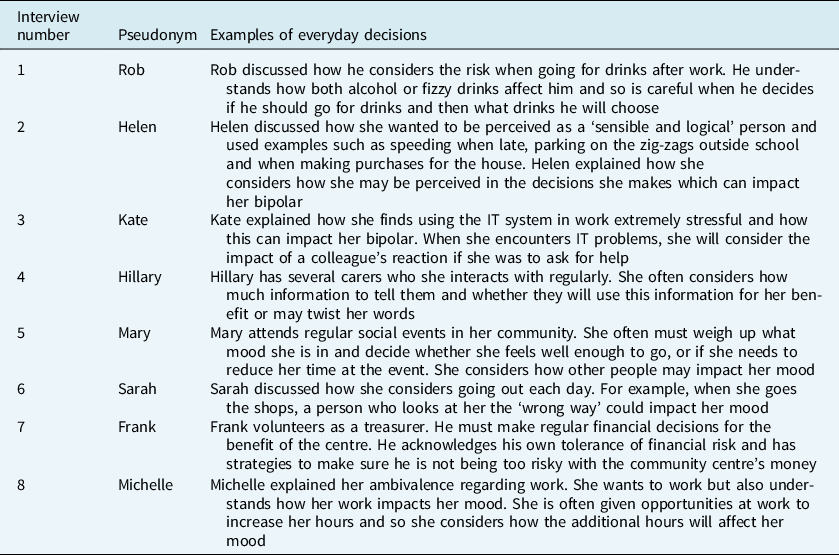
We present examples of an everyday decision that involved an element of risk in Table 2.
Participant examples of everyday decisions

Interviews were recorded digitally and transcribed verbatim. We replaced personally identifiable data with pseudonyms. The interviews lasted between 45 and 62 minutes.
Data analysis
The analysis was conducted by the first author following the procedure for IPA outlined by Smith and Osborn (Reference Smith, Osborn and Smith2015). This was done on a transcript by transcript basis which began with the first author immersing himself in the data by reading the transcript several times. He then made first-level annotations, commenting on phenomena of interest, including semantic content, metaphors and other linguistic features, as part of the preliminary coding phase. The second level of annotations reduced the initial comments to create emerging themes. The emerging themes hypothesized underlying psychological processes that may be occurring, allowing theoretical connections across the interview but grounded in the specific experience of the participant. The emerging themes were then clustered into a set of subordinate themes. This process was repeated for each interview to ensure the themes stayed closely linked to the participant’s account. After all the interviews had been analysed, the subordinate themes from each interview were collated to develop superordinate themes for the whole data set (Smith et al., Reference Smith, Flowers and Larkin2009; Smith and Shinebourne, Reference Smith and Shinebourne2012).
Trustworthiness of the analysis was ensured by consensus via supervision (Goodell et al., Reference Goodell, Stage and Cooke2016) with clinical psychologist supervisor with vast credentials using this methodology and research supervisor. Interpretations were checked by supervisors asking IPA informed critical questions such as: what is the participant trying to achieve here? Do I have a sense of something going on here that maybe the participants themselves are less aware of? (Smith and Osborn, Reference Smith, Osborn and Smith2015). With the aim of reducing bias, a reflective journal was used during the process of data collection and analysis (Lobban et al., Reference Lobban, Taylor, Murray and Jones2012).
Results
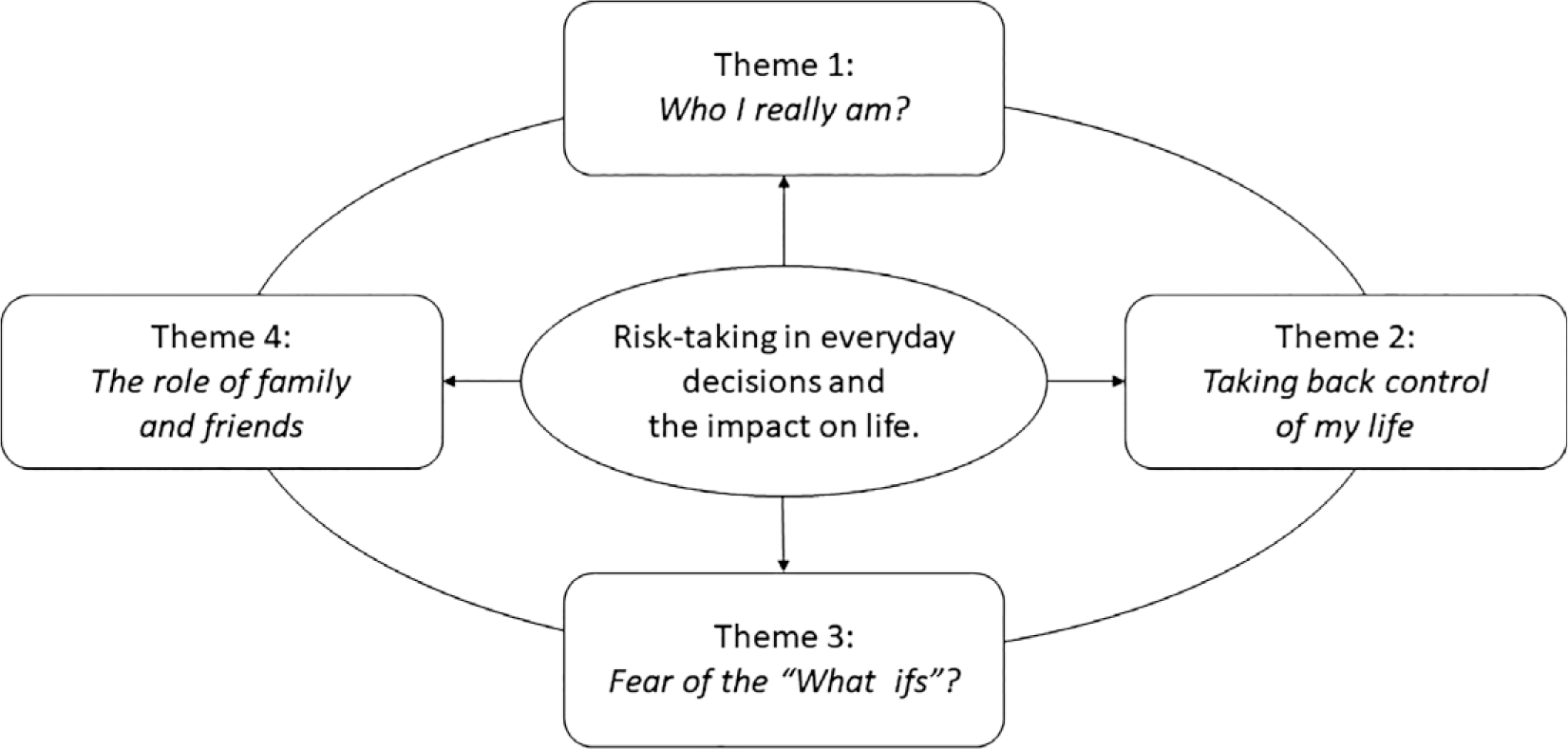
The analysis of the interviews resulted in four themes regarding how individuals with BD consider risk in everyday decisions and the impact on individual experiences: Who I really am; Taking back control of my life; Fear of the ‘what ifs’; and The role of family and friends (Fig. 1).
Themes obtained from analysis of how individuals with bipolar disorder diagnosis consider risk in everyday decisions, and the impact on individual experiences.

Who I really am
Identity and personal values appeared to play an important role when participants considered risk during periods of euthymia, when risk-taking choices were more aligned to their real self and expressed the person they were. In contrast, during periods of mania or depression, participants described not feeling their true selves and because of the risky actions they took, they were given identities by others that they did not want or appreciate. For example, Kate was perceived to be ‘the performer’ by her peers, and Mary was seen as ‘the drama-queen’ by her sister. Similarly, other participants described being confused over what were BD symptoms and what was their personality.
Having quick fluctuations in mood meant that participants were often worried about their ability to assess risk and make their decision as they thought they may be misjudging the situation. Their confidence was often reduced, further hindering their risk decision-making process:
If I could just be, clear cut and come up with these decisions straight away instead of thinking ‘I should do that’, ‘I would be better off doing that’ or ‘should I do that, no I will do that’. I am arguing with myself all the time. [Sarah]
In contrast, participants felt that their risk-taking choice during their euthymic phase reflected their true self, a period when they were able to think clearly, weigh up the pros and cons and take the time to assess the risk involved in the decisions that they were making. They performed risk assessment, by considering whether the consequences would reflect their identity, if the risk gave a sense of purpose in life, and if the risk were aligned with their personal values:
We have always managed a spiritual and moral life between us. We go to mass of a Sunday and through the week with confession there and it is all therapeutic. It causes you to think about what you are doing, why you are doing it and what was wrong and all the rest of it. [Frank]
Some described themselves to not be a risk-taker, identifying as sensible, logical and careful. Others enjoyed taking risks as they perceived it to be exciting and interesting, although they were still able to balance what risks were worth taking: ‘If you are going to learn something or it makes you feel alive, exciting, vibrant, stimulate you then I would probably say do it.’ [Kate]
Participants also talked about being reflective during euthymia. They were able to think about the behaviours they had displayed during episodes of mania and depression, reflect on them, and apply their learning during the euthymic phase. Their reflections enabled them to consider the risks that reflected their identity. Participants were able to ‘mindfully push’ themselves to make risky decisions that would be best for them, even considering the impact the decision may have on their mood. It was during manic or depression periods when their reflective capabilities appeared to stop:
It all depends on what mood I am in that moment. If I am tired or restless or something like that then I’ll just have coke and that, but if I’m off work the next day or whatever and I’m drinking, I don’t overdo it cos of my medication, I just enjoy it. [Rob]
Finally, perfectionism appeared to have an impact when making risky decisions during periods of euthymia. There was an additional consequence of making what they felt were wrong choices and how they were then perceived by other people. Always striving to make correct choices had the positive effect that participants tended to create contingency plans for the negative consequences of risky decisions. However, this perfectionist thinking also led to a tendency to overthink every decision. Unfortunately for some, even during euthymia, the perfectionist identity meant that assessing risk became challenging. With much to consider, the potential rewards versus the potential costs meant that they found it difficult to come to a conclusion: ‘I don’t want the consequences of it being wrong. It is all down to perfectionism. I find it difficult about the thought that if I don’t get a positive response it is because of something I have done.’ [Michelle]
Taking back control of my life
Participants described the importance of feeling they were taking back control of their life when they assessed the risks and made autonomous decisions that were in their best interests. Similarly to the first theme, participants reported a sense of loss of control over their lives after being diagnosed and then again each time symptoms escalated. All shared stories of how their BD had caused much distress and impacted on their lives, so when their symptoms escalated, they appeared during the interviews less confident with themselves in their decision-making ability when considering risk: ‘Unfortunately, everything I learn when I am well doesn’t play out when I am unwell, at all!’ [Helen]
Yet, when in euthymia, participants wanted to keep a balance and would make decisions to keep control of their moods. Even with incomplete information, participants took control over their decisions and made choices that best meets their needs:
When I am about to take risk behaviour, I tend to watch for a while to find out what other opinions are on the go and when I see where they are coming from, I find that I then calculate what I have to do. [Hillary]
A positive aspect of risk-taking during euthymia, mainly observed in male participants, was that participants were not prevented from living life to the full. After taking risks and having positive outcomes the participants were empowered to live autonomous lives and to achieve their wider goals. For example, taking the risk to travel the world helped Rob to develop the self-confidence to live independently when he returned home. At times, participants may have been feeling controlled by BD but their risk-taking during euthymia could satisfy the urges whilst not putting their life in jeopardy such as in situations involving economic or sexual risks: ‘if you satisfy the urge […] you calm down, hormone balance returns and you are not bothered by it anymore’. [Frank]
At times other people tried to control their decisions as they were concerned that the participant’s mood may be escalating. In an attempt to keep control over their decisions, participants had to justify their considerations of the risks involved, providing evidence or thinking carefully before they responded. Participants described how they were aware of and showed consideration to the other person’s interpretation. However, ultimately, even after input from family and friends, they recognized it as their own decision whether to take the risk or not.
I felt the need to justify and well ‘I have got it for ID plus why not?’. If I am capable of driving and taking lessons, that’s up to me. He had no right to tell me I can’t afford it. [Rob]
Another way to gain control over their lives was through work. Continuing to work, voluntary or paid, provided them with a sense of purpose and achievement. Although, within work, they described the risk of taking on too much responsibility which could lead to arousal of mood.
During their euthymic phase, participants described themselves as being better positioned to weigh up the risks of taking on more responsibility and the impact that the extra responsibility may have. Furthermore, they could assess the risks and adapt their behaviour so that the severity of the risk would reduce. For example, Mary explained that if she wanted to go to a work event but was worried it may trigger her manic symptoms then she may reduce the time she spent at the event:
I would probably have the presence of mind and the positivity to ask my husband ‘do you think this is a good idea?’ and to have a conversation with him. Probably agree and I can manage, or we could go an hour later and come home an hour earlier to sort of balance everything out. [Mary]
Fear of the ‘what ifs?’
Participants feared the ‘what ifs?’: what if they make the wrong decision? What if there are consequences for myself? What if it impacts my family or other people? What if I am perceived to be something I am not? The most prominent what if was ‘What if it triggers an episode and I end up being admitted into hospital?’: ‘I tend to think of risk assessment, so you try and put your black hat on and think “what could go wrong in this situation?”’ [Mary]
Before taking a risk, participants described having to wait until the time was right. The right time was identified through a gut feeling, thinking about the correct response, or collecting enough evidence to justify their choice. Making sure the time was right was a challenge as they feared slight changes in mood or minor altercations which could lead to severe consequences. Sometimes this fear would prevent them making a decision. However, avoiding the decision could itself trigger a mood change and so the risk of this occurring also had to be considered. Balancing fear and avoidance provided a challenge even during euthymia. For example, Sarah found it difficult to decide whether to go to the shops or not as she feared meeting somebody that would trigger an episode: ‘Something as small as that could trigger a slight episode, not a major one, a slight one in that I could be feeling alright and then quite poorly the next.’
Several participants reported not taking risks because they worried about the impact on their family if they did. They were unwilling to take risks that may create financial, occupational or relational stress. Participants were able to hold in mind future consequences, and the regret that they may feel if a risky decision did not work out: ‘You see, the reason I don’t normally when I am well is that I know that it puts myself and my family at risk.’ [Helen]
Again, the biggest fear participants had when making decisions was if the consequence triggered an episode, and they ended up in a psychiatric hospital; something described as the worst part of their life – the ‘gates to hell’:
Police took me in on a 136, they saved my life, he could’ve killed me. Tried all different medications and it resulted in electric shock treatment. So I had four treatments, the fourth one made me manic. They had to give me medication to bring me back down again. I was in hospital for 11 months. [Sarah]
The need to stay mentally well meant that in some situations risky choices had to be made; not taking a risk, was, paradoxically, riskier for their mental wellbeing. For example, Kate explained a dilemma she had been involved in. She was aware that staying where she was had a heightened risk of triggering her BD symptoms; however, there were risks to her physical safety if she was to leave. Kate prioritized her mental health over her physical health due to a fear of ‘what if it makes me ill again?’:
I just think “I have just got to stay well”. I know that is ironic because I am probably doing something risky but I just think “I need to sleep, I have got to sleep, I don’t feel comfortable with this person or where I am, I have to get home”. [Kate]
The role of family and friends
Participants described initiating discussions regarding risk with family and friends because it was important to hear their perspective. At times they also valued family and friends initiating these discussions and identifying risks that they had not considered themselves. However, at times these interactions were perceived as being unsupportive.
When family and friends supported the participant’s risk-taking decisions this was perceived as extremely positive. They described considering risk as a team effort. A supportive role for their family and friends was to politely suggest when they noticed subtle mood changes or if they believed the participant was taking on too much responsibility. This was to protect the participant from making choices that may have negative consequences. For example, Mary explained how arguments with her husband occurred when she became irritable. Mary had learnt to read her husband’s indirect ways of acknowledging her irritability:
I can also test my husband reactions to me quite easily. If I say “we could do with doing some housework, it looks a bit of a mess” he will hear my tone of voice and say “ok, let’s have a coffee and do it together in half an hour, is that ok?” and then that gives me an indication that he has picked up on some kind of irritability. [Mary]
Another positive form of support was in empowering participants to make decisions. During euthymia, participants were able to take advice from family and friends and think rationally about it, making the decision that would be best for them. Empowering the participants did not necessarily mean going along with what was suggested. For example, Michelle explained how her friends would often encourage her to take risks as they believed that she was a competent person. Michelle found this encouraging but she was also aware of her limitations and could balance the risks involved:
My friends probably the best sort of support. They are very good. I mean sometimes they can be overly supportive like I had an opportunity to do a three-day course and they said “you know you can” and massively boosting my confidence. But in fact, I know three days would be too much for me as tiredness tends to set me off. [Michelle]
At times, the support offered when considering risk was perceived to be unhelpful. The added pressure to make correct decisions, prompted by a desire not to disappoint their family and friends, could lead them to misjudging risk, sometimes making decisions which increased their risk. Participants also described feeling undermined by family and friends when they put contingency plans in place for them, as they perceived that they did not have confidence in their decision-making ability: ‘[it felt] patronising really, because I feel that I know myself better than she does. She has a sense of embarrassment.’ [Sarah]
Discussion
This study is the first to qualitatively explore how individuals with BD consider risk in everyday decisions and the impact this may have on their individual decision making. We identified four themes: identity (‘Who I really am’), control (‘Taking back control of my life’), fear (‘Fear of the “what ifs”’), and their supporting network (‘The role of family and friends’).
Living with the mood instability of BD can often leave individuals with confusion over their identity, for example because of the changing sense of self and ways of behaving as a consequence of experiencing mood episodes (Dias et al., Reference Dias, Brissos, Frey and Kapczinski2008). It can become difficult for people with BD to differentiate between what is their BD symptoms and what is their ‘real self’ (Folstad and Mansell, Reference Folstad and Mansell2019; Inder et al., Reference Inder, Crowe, Moor, Luty, Carter and Joyce2008). How individuals embrace the identity that BD can bring, could be influencing their decisions around risk. For example, for people who want to identify as sensible and logical, it may be that rejecting the BD identity and being risk-averse during euthymia feels appropriate. In contrast, those embracing the identity of BD could be more willing to take risks because that is what is expected by others and themselves from someone with BD. The risks participants took during periods of euthymia were seen to reflect the person that they are or want to be perceived as. Therefore, exploring the impact of BD on identity and personal values should be an important process to consider in further research projects. For example, expanding the work of Folstad and Mansell (Reference Folstad and Mansell2019) about people’s desires to live with or without their bipolar disorder in a hypothetical case of having a button to turn their BD off forever.
After having considered participants’ comments, aligning risky decisions to identity and personal values could also be an expression of control over their BD. Taking back control over their lives was deemed to be important and so adaptive strategies were utilized (possibly including taking risks). Assessing risk and making individualized choices kept control over their BD and could be perceived as empowering (Morton et al., Reference Morton, Michalak, Hole, Buzwell and Murray2018). Empowerment in euthymia could encourage more calculated and individualized risks being taken so that they could live a fulfilling life. However, if a risky choice did have negative consequences, then a sense of loss of control could be experienced which has been described as one of the most distressing aspect for those with BD (Warwick et al., Reference Warwick, Mansell, Porter and Tai2019). This distress could derive from a desire for stability in their lives that lacking control over their moods interferes with (Folstad and Mansell, Reference Folstad and Mansell2019). The need for stability, and thus control, was commonly manifested by participants, and this control was achieved by balancing their decisions relative to the assessed risk. During euthymia, a clarity of mind enabled a more balanced assessment of risk. Future studies should evaluate the moderating effect of empowerment in the relationship between decision-making and risk-taking during euthymia.
The study findings shed light on self-reflection capabilities that may be present during euthymia that may be reduced during mania or depression, a finding contradicting Van Camp et al. (Reference Van Camp, van den Ameele, Sabbe and Oldenburg2018), who suggest that reduced self-reflection is a trait that is consistent throughout all mood phases of BD.
The importance of an individual’s supporting network was also observed in this study. Family and friends were relied on for support even when their support was perceived to be unhelpful, highlighting the importance of effective communication in order to understand how BD can impact both the individual and their close friends and family (Owen et al., Reference Owen, Gooding, Dempsey and Jones2017).
Limitations
Participants were primarily female, all aged over 45 years and had at least 10 years’ experience of BD since diagnosis, limiting the generalizability of findings to males and younger groups. Another limitation was the diagnosis of the participants, as all met the criteria for bipolar I, had a relatively highly level of functioning, and were recruited from a single mood research centre. Finally, the definition of risk was narrow and focused on the negative aspects of risk. It is acknowledged that there are positive aspects of taking risks (Folstad and Mansell, Reference Folstad and Mansell2019; Robertson and Collinson, Reference Robertson and Collinson2011). This study focused on the negative aspects of risk as they could have severe consequences that impact an individual’s social, occupational and daily functioning.
Further research
The study highlights the need for more research regarding risk and decision-making for individuals with BD. With the different perspectives on the debate about decision-making impairments, hearing the personal experiences of risk-taking can add knowledge. Furthermore, exploring gender and age differences in the consideration of risk in decisions could help individuals and clinicians be more informed for each individual depending on their position in life. To better characterize the sample at study entry, other scales such as the Perceived Control of Internal States Scales (Pallant, Reference Pallant2000) could be added to future similar protocols.
Cognitive insight and more specifically self-reflection and self-certainty were a surprising element in this study. Further research could explore how individuals with BD reflect on their life experiences and how these impact future decisions involving the risk of negative consequences. It could also explore how confident they are when making such decisions and what impacts their confidence.
Finally, our findings can inform the development of intervention studies for individuals during euthimia that address aspects of the four themes, such as testing modules on how to deal with fears, build and maintain support networks, and how to enhance feeling of control in life.
Clinical implication
It has been suggested that advances in therapy will depend on an improved understanding of the factors responsible for the development and maintenance of BD symptoms (Palmier-Claus et al., Reference Palmier-Claus, Dodd, Tai, Emsley and Mansell2016). When individuals with BD consider the risks in their decisions it may be that these four themes may have an impact on decision-making and as such it may be helpful to consider and explore the four themes during therapy.
There are several therapeutic approaches for BD (Meyer and Hautzinger, Reference Meyer and Hautzinger2012), with manualized cognitive behavioural therapy (CBT) and family therapy being two options recommended by NICE (NICE, 2014). To further improve effectiveness of CBT for BD, authors have suggested an individualized, formulation-driven CBT (Jones et al., Reference Jones, Smith, Mulligan, Lobban, Law and Dunn2015) or psychotherapy that targets specific aspects of BD (Miziou et al., Reference Miziou, Tsitsipa, Moysidou, Karavelas, Dimelis, Polyzoidou and Fountoulakis2015). The four themes could help to conceptualize the specific difficulty of considering risk for individuals in BD in a formulation-based approach. Discussing and exploring a person’s identity, sense of control, fear and supportive network could enhance a CBT informed formulation.
The supporting network theme highlights the helpfulness that a supportive family member or friend can have in the consideration of risky decision-making and may suggest that a family therapy element is incorporated within all therapeutic modalities. Family therapy approaches to BD have often worked on educating family members to the understandings of BD so that they can be better equipped to offer their support (Fredman et al., Reference Fredman, Baucom, Boeding and Miklowitz2015). Discussing the impact of risk with family members may facilitate action by facilitating an understanding of helpful support and when it is appropriate for the family member to be involved. Finally, these themes can be particularly important to integrate into post-discharge recommendations of out-patient providers.
Conclusion
This study highlights factors that impact an individual with BD’s consideration of risk. During euthymia, the risks that individuals take are more aligned to their identity and personal values. Control over their life is sought by managing BD symptoms and balancing the risks taken. However, fear has an impact as individuals often believe that a wrong decision could trigger a mood state that requires hospitalization. This can result in an avoidance of taking risks. Finally, the importance of a supporting network is expressed as they can provide another perspective and alternative solutions to risk-taking decisions.
Supplementary material
To view supplementary material for this article, please visit: https://doi.org/10.1017/S1352465820000946
Acknowledgements
None.
Financial support
This research received no specific grant from any funding agency, commercial or not-for-profit sectors.
Conflicts of interest
None.




Comments
No Comments have been published for this article.