Introduction
The European Union (EU) considers climate change a major issue in its environmental policy. Europe continues to struggle in fields including the loss of biodiversity, the use of resources, the consequences of climate change and environmental hazards to human health and well-being. Compared to other regions, it regularly uses more resources and has a more significant impact on environmental degradation (European Environment Agency 2023). The shift to a ‘green economy’ calls for a focus on biodiversity loss, resource depletion and climate change effects; in this regard, the decarbonization of the main systems – energy, transportation and housing, among others – is sought (European Environment Agency 2015). This change intends to produce more resilient and efficient systems that fit the wider requirements of the ecosystems concerned, therefore guaranteeing that every sector is integrated to promote social as well as environmental well-being.
The EU has taken a leading role in global climate change and sustainable development discussions through its commitment to environmental sustainability, highlighted by the European Green Deal (EGD), which aims to make Europe the first climate-neutral continent by 2050. Introduced in 2020, the EGD sets an ambitious goal of achieving a ‘zero-carbon economy’ – an economic model in which greenhouse gas emissions are eliminated or fully offset – by 2050 at the core of its strategy. This framework drives the transition to clean energy, enforces rigorous rules on emissions and encourages resource efficiency (Sikora Reference Sikora2021). Becoming a climate-neutral continent and improving climate and environmental resilience call for major lifestyle, manufacturing and consumption pattern changes, as well as a move away from fossil fuel reliance (Silva & Antunes Reference Silva, Antunes and Foundation2021). Therefore, determining the factors that might influence this objective is absolutely crucial.
Extant research underscores the importance of examining these factors in depth. Emissions reduction strategies, renewable energy adoption and decarbonization policies within the EGD context have been well researched (Simionescu et al. Reference Simionescu, Păuna and Diaconescu2020, Włodarczyk et al. Reference Włodarczyk, Firoiu, Ionescu, Ghiocel, Szturo and Markowski2021, Igliński et al. Reference Igliński, Pietrzak, Kiełkowska, Skrzatek, Gajdos and Zyadin2022, Miłek et al. Reference Miłek, Nowak and Latosińska2022). However, socio-economic determinants of EGD progress have received comparatively less attention and are often examined in fragmented or country-specific studies. For instance, Zheleva and Markov (Reference Zheleva and Markov2024) analyse the socio-economic challenges of transitioning to a low-carbon economy in Bulgaria’s coal-producing regions, while Dmochowska-Dudek and Wójcik (Reference Dmochowska-Dudek and Wójcik2022) assess the resilience of Polish lignite-producing regions amid coal phase-out policies. Adamowicz (Reference Adamowicz2022) links green economy concepts to broader development trajectories, while Ziętara and Mirkowska (Reference Ziętara and Mirkowska2021) highlight the role of green urban spaces in fostering economic inclusion and community health within the EGD framework.
A complementary body of literature explores the normative underpinnings of a just transition in the EU context. Sabato and Vanhille (Reference Sabato and Vanhille2024) argue that the EU’s emerging just-transition framework lacks the integration, coherence and enforcement capacity needed to protect vulnerable communities. Grossi and Rayner (Reference Grossi, Rayner, Vanhercke, Sabato and Spasova2024) also criticize the Green Deal Industrial Plan for ignoring social inclusion and labour market tensions, arguing that decarbonization without sufficient welfare alignment endangers current socio-economic disparities. Although these papers provide insightful analyses on the justice aspect of climate policy, they are mostly normative or geographically constrained.
Recent studies have attempted to evaluate EGD performance through structured cross-country assessment frameworks. For example, Tutak and Brodny (Reference Tutak and Brodny2024) construct a European Green Deal Index (EGDI) using a hybrid weighting approach to benchmark the EU-27 countries, whereas Ozdemir et al. (Reference Ozdemir, Demirel, Zaralı and Çelik2024) assess the EGD performance of 25 EU Member States through a multi-criteria evaluation framework. Karadağ et al. (Reference Karadag, Gul, Yucesan, Ortiz-Barrios, Ishizaka and Khan2025), on the other hand, apply a multi-attribute decision-making model to measure Türkiye’s alignment with EGD objectives. While these studies contribute important methodological advances in tracking EGD-related progress, they neither explore the indirect effects of socio-economic structures on environmental outcomes nor integrate econometric tools to establish causal inferences. Our study addresses this gap by proposing a two-stage hybrid framework that links structural socio-economic conditions to emissions and, in turn, to overall EGD performance across European countries.
Understanding performance variation in the EGD context also requires clarity on what climate neutrality entails at a systemic level. At the heart of this transformation lies the concept of net-zero emissions, which refers to reducing carbon emissions to a minimal level and offsetting the remainder through natural or technological carbon-removal mechanisms (UN 2024). Achieving this goal depends on a fundamental reconfiguration of economic and social systems, guided by policies that address not only emissions but also broader development pathways (Ossewaarde & Ossewaarde-Lowtoo Reference Ossewaarde and Ossewaarde-Lowtoo2020, Furfari & Mund Reference Furfari and Mund2021).
Empirical research has emphasized the role of structural socio-economic conditions in shaping sustainability outcomes. Studies show that investments in research and development (R&D; Danish et al. Reference Danish, Hassan and Iqbal2020, Ma et al. Reference Ma, Tariq, Mahmood and Khan2022), access to education (Eyuboglu & Uzar Reference Eyuboglu and Uzar2021, Sarwar et al. Reference Sarwar, Streimikiene, Waheed and Mighri2021), urbanization dynamics (Poumanyvong & Kaneko Reference Poumanyvong and Kaneko2010, Abdullah Reference Abdullah and Abdullah2021, European Commission 2022) and regulatory quality (Maloney & McCormick Reference Maloney, McCormick, Berck and Helfand2017, Hafezi & Zolfagharinia Reference Hafezi and Zolfagharinia2018) are all instrumental in promoting environmental quality and sustainable behaviour. These dimensions form the basis of the socio-economic structure incorporated into our GDPI framework. Yet, while greenhouse gas emissions have been widely studied as a determinant of EGD success (Rybak et al. Reference Rybak, Rybak, Joostberens and Kolev2022), their interaction with structural socio-economic conditions remains underexplored. A narrow focus on emissions reduction – without attention being given to institutional capacity, human capital or social equity – risks reinforcing pre-existing inequalities, especially given the EU’s diverse levels of fossil fuel dependency (SDSN Europe Reference SDSN2023). Although the European Commission has adopted the Just Transition Mechanism (JTM) to promote fairness during this transition (European Commission 2023), its focus remains largely operational, and broader socio-economic modifiers of emissions trajectories are still insufficiently integrated into policy design (Filipović et al. Reference Filipović, Lior and Radovanović2022). The EGD seeks to boost the EU economy through green technologies and sustainability-orientated reforms while ensuring a just and inclusive transition. However, achieving climate neutrality within a relatively short timeframe and with constrained natural resources demands not only technological innovation but also a comprehensive understanding of local socio-economic dynamics (Paroussos et al. Reference Paroussos, Fragkiadakis and Fragkos2020, Furfari & Mund Reference Furfari and Mund2021, Doskočil Reference Doskočil2022). To ensure that sustainability policies do not inadvertently disadvantage vulnerable populations, policymakers must integrate a wider socio-economic framework into environmental decision-making and performance evaluation.
This study aims to provide a more comprehensive understanding of the ‘just transition’ process by identifying emissions as a transmission channel through which socio-economic dynamics affect climate policy outcomes. The EGD, while ambitious in its environmental scope, must embed socio-economic dimensions more centrally to fulfil its ‘just transition’ mandate (Grossi & Rayner Reference Grossi, Rayner, Vanhercke, Sabato and Spasova2024, Sabato & Vanhille Reference Sabato and Vanhille2024). Given this recent strand of research, we raise the question of the roles of technology, population demographics, human capital and governance in the EGD process. Are the implications for 2050 net-zero emissions consistent even when the impacts of these dynamics are omitted?
We hypothesize that models ignoring the role of socio-economic factors will be inaccurate; consequently, policies based on these results would probably fall short of the intended targets of achieving carbon-neutral status and ensuring socio-economic equity. We thus employ a two-stage hybrid framework that combines a multi-criteria decision-making (MCDM) procedure to construct a Green Deal Performance Index (GDPI) with panel data regression techniques to estimate the indirect impacts of socio-economic factors on emissions. The GDPI is designed to offer a comprehensive measure of each country’s alignment with the core environmental and social goals set out in the EGD. The significance of the GDPI lies in its ability to translate diverse sustainability dimensions into a single performance score, enabling cross-country comparison and policy benchmarking. Unlike conventional single-variable indicators, the GDPI captures the multi-dimensional nature of the EGD, offering insights into how effectively a country is transitioning towards a climate-neutral and socially inclusive economy. Thus, this index serves as the foundation for our analysis of how socio-economic structures condition environmental performance across EU countries.
Various MCDM techniques have been explored, each with distinct purposes, advantages and limitations (Khedrigharibvand et al. Reference Khedrigharibvand, Azadi, Teklemariam, Houshyar, De Maeyer and Witlox2019, Aktas & Demirel Reference Aktas and Demirel2021). In the first step, the Criteria Importance Through Intercriteria Correlation (CRITIC) method is applied to objectively determine the weights of evaluation criteria. CRITIC reduces subjectivity by assessing both the contrast intensity and the level of conflict among criteria, thereby capturing the inherent information content and mutual independence of the indicators (Diakoulaki et al. Reference Diakoulaki, Mavrotas and Papayannakis1995). Subsequently, the Technique for Order of Preference by Similarity to Ideal Solution (TOPSIS) is employed to rank the alternatives based on their relative proximity to an ideal solution, thereby enabling performance assessment (Hung & Chen Reference Hung and Chen2009). TOPSIS evaluates each alternative by calculating its geometric distance from both the ideal and anti-ideal solutions, facilitating a comprehensive and intuitive ranking system (Hwang & Yoon Reference Hwang, Yoon, Beckman and Künzi1981). Compared to more subjective weighting schemes (e.g., Analytical Hierarchy Process, Best–Worst Method) or methods that do not allow for direct performance benchmarking, the combination of CRITIC and TOPSIS provides a robust framework for assessing multi-dimensional performance. In the second step, the 2SLS (Two-Stage Least Squares) procedure ensures unbiased coefficient estimates in the presence of endogeneity by using instrumental variables.
We merge environmental sciences with social and economic disciplines to address gaps in the literature related to justice and sustainability. By emphasizing the importance of equitable and inclusive policymaking, this study contributes to informing a just transition. Specifically, it provides a quantitative insight into the concept of a just transition, which has largely been treated normatively in the prior literature. In doing so, the research highlights the potential risks of overlooking socio-economic dynamics when developing policies and strategies aimed at achieving carbon neutrality. By bringing these considerations to light, the study enriches public discourse and policy development processes, ensuring a more comprehensive and grounded approach to meeting the objectives of the EGD and promoting social justice. Scientifically, the study contributes to advancing interdisciplinary modelling frameworks that integrate structural socio-economic factors into environmental performance analysis, thereby refining how sustainability outcomes are assessed at the macro level.
Accordingly, the main objective of this study is to examine whether and how socio-economic structures shape the environmental outcomes targeted by the EGD. Our central hypothesis is that neglecting these structures leads to biased estimations of EGD performance and misguided policy strategies. Through a novel two-stage empirical design, we aim to test this hypothesis by (1) constructing a robust, multi-dimensional index of EGD performance and (2) estimating the indirect effects of key socio-economic indicators on emissions.
Methodology
This study employs both the MCDM and panel data regression techniques. This combination is widely applied in different study fields (Atmaca & Karadaş Reference Atmaca and Karadaş2020, Çam et al. Reference Çam, Karataş and Lopcu2022, Delcea et al. Reference Delcea, Nica, Georgescu, Chiriță and Ciurea2024) and helps model sustainable transitions and their distributional impacts, highlighting the importance of well-being, environmental values and behaviour.
GDPI calculation
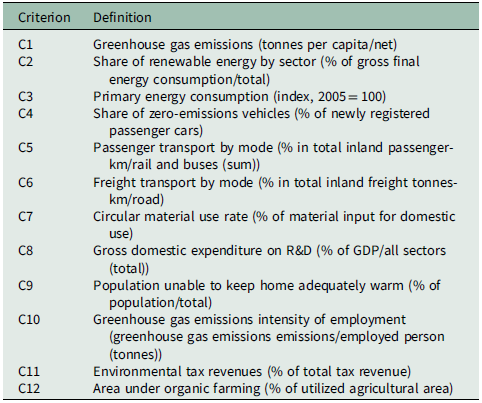
The GDPI in this study is constructed considering the various indicators released by the official Eurostat dataset developed for monitoring EGD progress, and it is categorized under three overarching policy themes: (1) reducing environmental harm; (2) enabling the transition; and (3) protecting well-being. Due to data availability constraints, the GDPI aggregates 12 out of 27 EGD indicators, selected based on their completeness across countries and years. It is important to note that only 23 indicators are available at the country level; therefore, for consistency throughout the study, we refer to 12 out of these 23 indicators. Table 1 provides definitions for each criterion.
Criteria definitions.

GDP = gross domestic product; R&D = research and development.
The inclusion of these indicators allows the GDPI to capture both environmental performance and the socio-economic aspects embedded within its 12 component indicators, reflecting each country’s overall sustainability alignment with the EGD. This design ensures that the GDPI provides a balanced, policy-relevant and empirically feasible measure of each country’s alignment with the EGD’s multidimensional objectives.
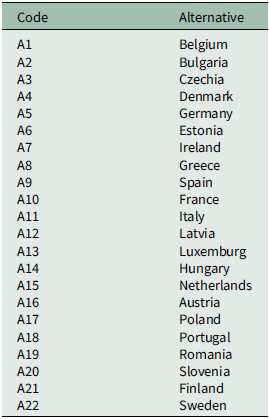
Among the criteria (Table 1), C1, C3, C6, C9 and C10 were categorized as cost criteria, whereas C2, C4, C5, C7, C8, C11 and C12 were considered as benefit criteria. The cost criteria negatively affected EGD performance, whereas the benefit criteria had positive effects. The selected 12 EGD criteria were then weighted using the CRITIC method. The TOPSIS method was then implemented to define the performance ranking of alternatives. The TOPSIS numeric scale ranged between 0 and 1, where a score closer to 0 indicated lower EGD performance, while a score closer to 1 indicated higher EGD performance. Based on data availability, only 22 EU countries were included in the sample. Table 2 lists the 22 EU countries included in the analysis as alternatives.
European Union countries included in the analysis as alternatives.

Notice that this combination was selected based on its suitability for constructing composite indices in policy-driven, multi-dimensional settings such as the EGD. The CRITIC method enabled data-driven weight assignment by considering both variability and correlation among indicators, which is particularly important when working with diverse sustainability metrics that differ in scale and significance. TOPSIS complemented this by providing a clear and interpretable ranking based on each country’s relative distance from an ideal performance profile. The CRITIC–TOPSIS combination ensured methodological transparency and policy relevance, reducing the need for the sensitivity analysis typically required in models involving subjective inputs or multi-method configurations.
The CRITIC technique of Diakoulaki et al. (Reference Diakoulaki, Mavrotas and Papayannakis1995) involved five steps. First, a set of m possible options, denoted as A i (i = 1, 2, …, m), and n evaluation criteria, denoted as C j (j = 1, 2, …, n), were considered. In step 1, the decision matrix X was created to indicate how different alternatives perform in relation to the criteria as in Equation 1:
 $$X = {[{x_{ij}}]_{mxn}} = \left[\!\!\!\!\!\!\matrix{& {x_{11}}& {x_{12}} \cdots & {x_{1n}} \cr& {x_{21}} & {x_{22}} \cdots & {x_{2n}} \cr & \vdots& \vdots & \vdots \cr& {x_{m1}} & {x_{m2}} & {x_{mn}}}\right] \\ \left( {i=1,2, \ldots, {\rm{\;}}m; \ j=1,2, \ldots, n} \right)$$
where x ij displays the ith alternative’s performance value on the jth criterion.
In step 2, the decision matrix X was normalized for maximizing and minimizing criteria, respectively, as per Equation 2:
 $${r_{ij}} = {{{{x_{ij}} - \min \left( {{x_{ij}}} \right)}}\over{{max\left( {{x_{ij}}} \right)} - {\rm{min}}\left( {{x_{ij}}} \right)}}\;\;\;\left( {i=1,2, \ldots, \;m; \; j=1,2, \ldots, n} \right)$$
 $$\!{r_{ij}} = {{{{\rm{max}}\left( {{x_{ij}}} \right) - {x_{ij}}}}\over{{max\left( {{x_{ij}}} \right) }- min\left( {{x_{ij}}} \right)}}\;\;\;\left( {i=1,2, \ldots, \;m;j=1,2, \ldots, n} \right)$$
where the ith alternative’s normalized performance value on the jth criterion was presented as r ij .
In step 3, a correlation coefficient matrix was constructed, the correlations between pairs of criteria being calculated to measure the degree of relationship between the criteria as in Equation 3:
 $${\rho _{jk}} = {{{\mathop \sum \nolimits_{i=1}^m \left( {{x_{ij}} - {{\bar x}_j}} \right)\left( {{x_{ik}} - {{\bar x}_k}} \right)}}\over{{\sqrt {\mathop \sum \nolimits_{i=1}^m {{\left( {{x_{ij}} - {{\bar x}_j}} \right)}^2}\mathop \sum \nolimits_{i=1}^n {{\left( {{x_{ik}} - {{\bar x}_k}} \right)}^2}} }}}$$
In step 4, how much information, C j , was released by the jth criterion was determined as in Equation 4:
 $${C_j} = {\sigma _j}.\mathop \sum \limits_{k=1}^n 1 - {\rho _{jk}}$$
where the ρ
jk
values represented the correlation between any criterion j and criterion k; a criterion had a higher C
j
value if it had more information and was more related to other criteria. The
 ${\sigma _j}$
value, which represents the standard deviation of each criterion in Equation 4, was calculated as in Equation 5:
 $${\sigma _j} = \sqrt {{{{\mathop \sum \nolimits_{i=1}^m {{\left( {{x_{ij}} - {{\bar x}_j}} \right)}^2}}}\over{{m - 1}}}} $$
In step 5, objective weights of the jth criterion (w j ) were obtained according to Equation 6:
 $${w_j} = {{{{C_j}}}\over{{\mathop \sum \nolimits_{k=1}^n {C_k}}}}$$
The TOPSIS method involved five steps. In step 1, the decision matrix was formed and normalized according to Equation 7:
 $${r_{ij}} = {\rm{\;}}{a_{ij}}/\sqrt {\mathop \sum \limits_{i = 1}^m a_{ij}^2{\rm{\;}}} {\rm{\;\;\;\;\;\;}}\left( {i = 1,2, \ldots, {\rm{\;}}m; \; j = 1,2, \ldots, n} \right)$$
In step 2, the weighted normalized decision matrix was obtained according to Equation 8:
 $${v_{ij}} = {\rm{\;}}{w_j}{\rm{*\;}}{r_{ij}}$$
The positive and negative ideal solutions (A +, A –) were found in step 3 using the weighted standard decision matrix obtained in the previous step:
 $${A^ + } = \;\left( {v_1^ +, \;v_2^ +, \;v_3^ +, \; \ldots, v_n^ + } \right)$$
 $${A^ + } = \;\left\{ {\left( {ma{x_j}{v_{ij}}{\rm{|}}j \in J} \right),\left( {mi{n_j}{v_{ij}}{\rm{|}}j \in J^\prime} \right)} \right\}$$
 $${A^ - } = \;\left( {v_1^ -, \;v_2^ -, \;v_3^ -, \; \ldots, v_n^ - } \right)$$
 $${A^ - } = \;\left\{ {\left( {mi{n_j}{v_i}{\rm{|}}j \in J} \right),\left( {ma{x_j}{v_{ij}}{\rm{|}}j \in J^\prime} \right)} \right\}$$
where J stands for benefit criteria and J’ for cost criteria.
In step 4, the distances from positive (D i +) and negative (D i –) ideal solutions were calculated according to Equation 9:
 $$D_i^ + = \;\sqrt {\mathop \sum \limits_{j=1}^n {{\left( {{v_{ij}} - v_i^ + } \right)}^2}} $$
 $$D_i^ - = \;\sqrt {\mathop \sum \limits_{j=1}^n {{\left( {{v_{ij}} - v_i^ - } \right)}^2}} $$
The relative closeness to the positive ideal solution was obtained in step 5 using Equation 10:
 $$C_i^{\rm{*}} = {{{D_i^ - }}\over{{D_i^ + + D_i^ - }}}{\rm{\;\;\;\;}}0 \le C_i^{\rm{*}} \le 1$$
The performance graphs of 22 alternatives over the period 2010–2020 are presented in Appendix S1. Figure 1 provides a concise summary of the steps involved in conducting the EGD performance index.
Steps followed in constructing the European Green Deal (EGD) performance index. CRITIC = Criteria Importance Through Intercriteria Correlation; TOPSIS = Technique for Order of Preference by Similarity to Ideal Solution.

Regression
To address the potential endogeneity concerns in our model due to omitted variables, simultaneity or measurement errors, leading traditional regression estimates to be biased and inconsistent, we employed the 2SLS estimation technique. The first stage in the reduced form of the procedure was as in Equation 11:
 $$lnco{2_{it}} = {\beta _0} + {\beta _1}r{d_{it}} + {\beta _2}ur{b_{it}} + {\beta _3}ed{u_{it}} + {\beta _4}re{q_{it}} + {\varepsilon _{it}}$$
where rd, urb, edu and req represented instrument variables and CO2 was the endogenous variable that represented the transmission mechanism. The second stage (structural form) of the procedure was described as in Equation 12:
 $$GDP{I_{it}} = {\alpha _0} + {\alpha _1}{\widehat {lnco2}_{it}} + {\nu _{it}}$$
where
 ${\widehat {co2}_{it}}$
represents the predicted values of the endogenous variable obtained from Equation 11. For comparison purposes, we also utilized the fixed effects regression with standard errors proposed by Driscoll and Kraay (Reference Driscoll and Kraay1998) to estimate the impacts of carbon emissions when the role of socio-economic factors was ignored.
Data
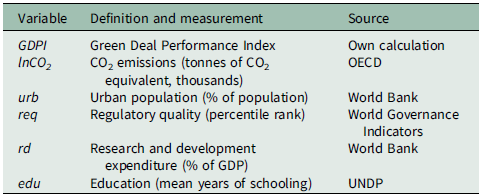
We used annual observations for the period 2010–2020, with a focus on 22 EU Member States (Table 2). While the EGD was officially introduced in 2019, our analysis does not constitute a retrospective evaluation of EGD policy implementation. Instead, it assesses structural performance over a broader time horizon based on indicators that were later formalized within the EGD framework, capturing the evolution of socio-economic and environmental conditions in the years leading up to and surrounding its launch. Note that Croatia, Lithuania, Malta, the Republic of Cyprus and Slovakia were excluded from the analysis due to insufficient data availability. Variable definitions and data sources for all variables are presented in Table 3.
Variable definitions and data sources.

Note: CO2 is converted into natural logarithms.
GDP = gross domestic product; OECD = Organisation for Economic Co-operation and Development; UNDP = United Nations Development Programme.
Descriptive statistics (Table 4) show that the variable that had the lowest standard deviation was the GDPI, indicating a homogeneous sample selection in terms of EGD performance.

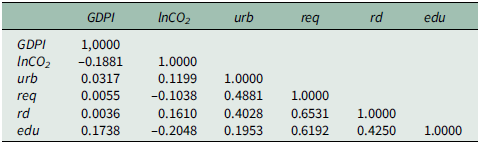
The correlation matrix (Table 5) indicates that the majority of the correlations were positive, with the exception of the carbon emissions variable. The regulatory quality variable shows the highest correlation with the technology and education variables. In general, the correlation matrix did not provide any indication of a probable multicollinearity problem.

Results
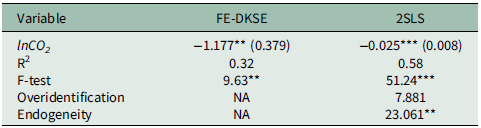
The 2SLS and FE-DKSE (Fixed Effects with Driscoll–Kraay Standard Errors) procedures indicate that a 1% increase in carbon emissions is associated with a 0.00025-unit decrease in the GDPI, while a 1% increase in carbon emissions decreases the GDPI by 0.01177 units given the estimation results obtained from the FE-DKSE procedure (Table 6). The negative impact obtained from the 2SLS estimator was around 47-times greater in magnitude than those obtained from the FE-DKSE procedure, emphasizing the role of socio-economic factors in explaining their indirect impacts on GDPI through the emissions mechanism. The smaller estimated coefficient from the 2SLS estimator, which was very close to zero effect, indicated that the EU might achieve 2050 net-zero emissions only when the importance of the socio-economic factors is fully recognized for comprehensive and inclusive policy frameworks in ensuring a just transition. Overall, these findings underscore the necessity of integrating socio-economic dimensions into environmental policymaking, following a comprehensive and inclusive approach, to ensure environmental sustainability across the EU.
Regression results. Regressions include a constant. Standard errors are in parentheses. First-stage results are not reported.

***, ** and * indicate significance at 1%, 5% and 10%, respectively.
Instruments: req, rd, edu, urb and country dummies.
2SLS = Two-Stage Least Squares; FE-DKSE = Fixed Effects with Driscoll–Kraay Standard Errors.
Discussion
We reinforce the critical role of socio-economic factors in shaping EGD performance because, in our modelling, carbon emissions exert a significantly reduced negative impact on EGD performance index when socio-economic factors are considered. Specifically, the magnitude of this effect is nearly 47-times larger in the absence of socio-economic considerations, emphasizing the necessity of integrating broader structural dynamics into climate policy discussions. This highlights the multidimensional nature of the EGD transition (Filipović et al. Reference Filipović, Lior and Radovanović2022, Paleari Reference Paleari2022, Hereu-Morales et al. Reference Hereu-Morales, Segarra and Valderrama2024), supporting the argument that policies focused exclusively on emissions reductions without accounting for socio-economic determinants may lead to suboptimal outcomes.
Our finding that the socio-economic variables serve as critical transmission mechanisms through which emissions affect EGD performance aligns with studies that stress the role of governance quality in fostering effective environmental policies (Maloney & McCormick Reference Maloney, McCormick, Berck and Helfand2017, Hafezi & Zolfagharinia Reference Hafezi and Zolfagharinia2018) and research highlighting the importance of human capital in driving sustainability transitions (Eyuboglu & Uzar Reference Eyuboglu and Uzar2021, Sarwar et al. Reference Sarwar, Streimikiene, Waheed and Mighri2021).
Moreover, our findings highlight the need for an inclusive, just transition framework, which has been a common topic in policy debates but is still overlooked in empirical assessments (Filipović et al. Reference Filipović, Lior and Radovanović2022, Sandri et al. Reference Sandri, Hussein, Alshyab and Sagatowski2023). The JTM has been developed to mitigate the socio-economic disparities stemming from the shift to a carbon-neutral economy (European Commission 2023), yet our findings indicate that its role in shaping EGD performance is not fully captured in conventional modelling approaches. We therefore aim to fill this gap by showing how socio-economic determinants mediate the nexus between emissions and EGD performance.
Compared to earlier research that built indices to track EGD performance, including Tutak and Brodny (Reference Tutak and Brodny2024), Ozdemir et al. (Reference Ozdemir, Demirel, Zaralı and Çelik2024) and Karadag et al. (Reference Karadag, Gul, Yucesan, Ortiz-Barrios, Ishizaka and Khan2025), our work presents a notable methodological improvement by explicitly modelling the indirect influence of socio-economic structures on EGD results via a transmission channel through carbon emissions. Unlike these earlier contributions, which offer descriptive rankings or static assessments, we incorporate a causal econometric framework that considers endogeneity and reveals how structural factors such R&D capacity, education, urbanization and regulatory quality influence emission dynamics and, therefore, condition sustainability results.
Beyond describing coefficient magnitudes, a comparative interpretation of the two estimation approaches is crucial. The FE-DKSE estimator, which does not control for endogeneity, attributes a larger negative impact of carbon emissions on the GDPI. In contrast, the 2SLS estimator reveals a much smaller coefficient once the indirect role of socio-economic factors is taken into account through instrumented emissions. This discrepancy reflects the omitted variable bias present in the FE-DKSE approach, where emissions may capture the effects of correlated, unobserved socio-economic conditions. The instrumental variable framework corrects for this bias by isolating the variation in emissions that is exogenous to socio-economic dynamics, thereby yielding a more conservative and arguably more accurate estimate of emissions’ direct effects on EGD performance.
When it comes to linking empirical findings to implications, the results also highlight a crucial methodological insight: omitting socio-economic factors in policy assessments may lead to misleading conclusions regarding the feasibility of achieving net-zero emissions by 2050. Previous critiques of EGD policy frameworks have also cautioned against an overly technocratic approach that neglects societal and economic dimensions (Ossewaarde & Ossewaarde-Lowtoo Reference Ossewaarde and Ossewaarde-Lowtoo2020, Furfari & Mund Reference Furfari and Mund2021). By integrating these factors, our study provides a more comprehensive perspective on the conditions under which the EU can successfully transition to climate neutrality while ensuring economic and social equity. Therefore, our findings support the broader scholarly consensus on the importance of human capital and governance quality in sustainability transitions while demonstrating empirically how these factors function as mediators rather than mere background conditions.
This study is not without limitations. First, it focuses on four key socio-economic factors. While the results are compelling, future research could explore additional modifiers, particularly those shaped by country-specific or sample-dependent characteristics. Second, the study employs a transmission mechanism approach linking socio-economic factors to EGD performance through emissions. While suitable for our analytical framework, it may be useful to examine the time-varying dynamics of these relationships in future work, given the evolving nature of both environmental and socio-economic contexts. Third, although our dataset spans 2010–2020 to capture structural patterns, part of the variation may reflect pre-EGD dynamics, potentially influencing the interpretation of temporal effects. Fourth, the analysis does not account for regional heterogeneity across EU Member States; using heterogeneous panel time series estimators could offer more tailored policy insights. Fifth, our GDPI construction was limited to 12 out of 23 available indicators due to data availability, which may omit certain relevant dimensions of EGD performance. Finally, country-specific unobserved heterogeneity and structural breaks – particularly the COVID-19 shock near the end of the period – may introduce additional noise into the estimates. Despite these limitations, the study offers critical insights into the indirect role of socio-economic structures in shaping the EGD’s implementation and outcomes.
We highlight four implications of our findings. Firstly, governments should actively foster innovation through strategic investments in R&D and technology, as these socio-economic factors have been empirically demonstrated to significantly moderate the negative impacts of carbon emissions on EGD performance. Secondly, because an educated populace is more equipped to appreciate, support and contribute to green initiatives, governments should prioritize curricula that emphasize sustainability, environmental science and the socio-economic impacts of carbon emissions. By cultivating a knowledgeable citizenry, nations can facilitate a grassroots push towards greener lifestyles and business practices. Thirdly, establishing robust and high-quality regulatory frameworks is crucial. Given that regulatory quality significantly moderates the negative impacts of carbon emissions on EGD performance, policymakers should prioritize improving regulatory effectiveness, transparency and accountability mechanisms to better enforce environmental compliance and support sustainable business practices. Strengthening regulatory quality will help ensure that emissions reduction targets effectively contribute to achieving the goals outlined in the EGD. Fourthly, governments should adopt policies that manage the socio-economic dynamics of urban growth in ways that are conducive to sustainability. These policies could include targeted investments in sustainable urban infrastructure as well as strategies promoting energy-efficient urban planning.
Our empirical results offer crucial policy implications for estimation procedures as well. The stark split between the 2SLS and FE-DKSE results reveals the importance of selecting an appropriate methodology when evaluating policy impacts. The 2SLS results, by capturing indirect effects, shed light on more profound and perhaps previously unrecognized relationships between socio-economic factors and the GPDI. In addition, projections without a transmission framework are likely to incorrectly estimate the impacts of emission reductions on the GDPI, which, in turn, will lead to excessive policy burden. Furthermore, policies aiming at climate neutrality may fall short of their intended targets. Overall, the results of this study can also be considered as an instrument for comparison purposes.
While the EGD’s goals are commendable, a nuanced understanding of the intertwined carbon-emitting modifiers and their impacts is crucial. Only with a comprehensive, multi-faceted approach can the EU hope to realize its vision for a greener, more sustainable future by 2050.
Conclusion
This study investigates the link between carbon emissions and EGD performance, emphasizing the critical role that socio-economic factors play in shaping environmental outcomes. Using CRITIC and TOPSIS methodologies to construct an EGD performance index, our empirical findings from the 2SLS estimator reveal that neglecting socio-economic factors substantially inflates the negative impacts of carbon emissions – c. 47-times higher – on EGD performance. Thus, addressing socio-economic factors is essential for accurately assessing climate policy impacts. Our results offer a clear implication: achieving the EU’s 2050 net-zero emissions target hinges significantly on recognizing and integrating socio-economic dynamics into policy frameworks. A narrow focus solely on emissions reduction without considering these factors risks missing intended sustainability targets. Hence, policymakers should adopt a comprehensive approach to ensure a just and sustainable transition.
The integrated framework developed in this study can also serve as a practical tool for evaluating regional EGD alignment across diverse economic contexts. Its adaptability makes it useful for guiding transition strategies in EU candidate countries, sub-national regions or sectors undergoing decarbonization reforms.
Supplementary material
To view supplementary material for this article, please visit https://doi.org/10.1017/S0376892925100106.
Acknowledgements
We are grateful to Editor Emeritus Professor Nick Polunin for his exceptional editorial guidance and to the three anonymous reviewers for their insightful and constructive comments.
Financial support
None.
Competing interests
The authors declare none.
Ethical standards
Not applicable.