Introduction
The discovery of heterosis in maize was a milestone achievement in the history of plant breeding (Hochholdinger and Baldauf, Reference Hochholdinger and Baldauf2018), fundamentally altering the trajectory of commercial maize cultivation. The pioneering efforts of Shull, East, and Jones in the early 20th century laid the groundwork for the inbred-hybrid system (Frascaroli et al., Reference Frascaroli, Canè, Landi, Pea, Gianfranceschi, Villa, Morgante and Pè2007; Hallauer et al., Reference Hallauer, Carena and Miranda Filho2010; Schnable and Springer, Reference Schnable and Springer2013; Berlan, Reference Berlan2018; Xiao et al., Reference Xiao, Jiang, Cheng, Wang, Yan, Zhang, Qiao, Ma, Luo, Li, Liu, Yang, Song, Meng, Warburton, Zhao, Wang and Yan2021), which remains vital to modern maize breeding even today. Over time, research has established that heterosis is predominantly driven by non-additive gene action, with additive effects playing a complementary role in hybrid vigour (Labroo et al., Reference Labroo, Studer and Rutkoski2021). Molecular investigations have further enriched our understanding of heterosis by examining the interplay of differential gene expression at key developmental stages and epigenetic modifications (Hochholdinger and Hoecker, Reference Hochholdinger and Hoecker2007; Chen, Reference Chen2013; Goulet et al., Reference Goulet, Roda and Hopkins2017; Fu et al., Reference Fu, Ma, Zhu, Liu, Ma, Li, Liao, Liu, Gu, Wang and Wang2023), highlighting the complexity of heterosis through interactions at genetic, epigenetic, and molecular levels.
For breeders, heterotic groups are indispensable, as they ensure the success of hybrid programs (Fan et al., Reference Fan, Tan, Chen and Yang2003; Reif et al., Reference Reif, Melchinger, Xia, Warburton, Hoisington, Vasal, Srinivasan, Bohn and Frisch2003a; Yao et al., Reference Yao, Luo, Wang, Huang, Duan, Xu, Chen, Tan and Pan2009; Adeyemo et al., Reference Adeyemo, Menkir, Gedil and Omidiji2011; Wu et al., Reference Wu, San Vicente, Huang, Dhliwayo, Costich, Semagn, Sudha, Olsen, Prasanna, Zhang and Babu2016; Leng et al., Reference Leng, Lv, Li, Xiang, Xia, Wei, Rong and Lan2019; Li et al., Reference Li, Guan, Jing, Li, Wang, Li, Liu, Zhang, Liu, Xie, Zhao, Wang, Liu, Zhang, Hu, Li, Li, Sun, Wang, Shi, Song, Jiao, Ross-Ibarra, Li, Wang and Wang2022). Defined as sets of inbred lines that exhibit superior hybrid performance when crossed with lines outside their group (Melchinger and Gumber, Reference Melchinger, Gumber, Lamkey and Staub1998), heterotic groups form the basis for parental selection. Historical successes such as the Northern Flint × Southern Dent hybrids which have dominated commercial maize production in the US (Tracy and Chandler, Reference Tracy and Chandler2006; Troyer, Reference Troyer2006), Flint × Southern Dent hybrids in Europe (Soengas et al., Reference Soengas, Ordás, Malvar, Revilla and Ordás2006; Gouesnard et al., Reference Gouesnard, Negro, Laffray, Glaubitz, Melchinger, Revilla, Moreno-Gonzalez, Madur, Combes, Tollon-Cordet and Laborde2017), and the development of key heterotic groups in China (Leng et al., Reference Leng, Lv, Li, Xiang, Xia, Wei, Rong and Lan2019), highlight the value of structured grouping systems.
While genetic divergence is a prerequisite for heterosis, divergence beyond a critical threshold can lead to unfavourable performance (Troyer, Reference Troyer2006; Makumbi et al., Reference Makumbi, Betrán, Bänziger and Ribaut2011). Therefore, optimizing genetic distance between parental lines is critical. Traditionally, specific combining ability (SCA) has been used to identify ideal heterotic combinations. More recently, methods such as HSGCA (Heterotic Group's Specific and General Combining Ability) and HGCAMT (Heterotic Grouping based on GCA of Multiple Traits), which consider both general combining ability and multiple trait data to improve grouping accuracy have been introduced (Fan et al., Reference Fan, Zhang, Yao, Chen, Tan, Xu, Han, Luo and Kang2009; Badu-Apraku et al., Reference Badu-Apraku, Oyekunle, Fakorede, Vroh, Akinwale and Aderounmu2013). Furthermore, molecular markers are increasingly being used to assess genetic relatedness among inbred lines, helping to refine heterotic grouping decisions (Reif et al., Reference Reif, Melchinger, Xia, Warburton, Hoisington, Vasal, Beck, Bohn and Frisch2003b; Leng et al., Reference Leng, Lv, Li, Xiang, Xia, Wei, Rong and Lan2019).
The North Eastern Hill Region (NEHR) of India, a recognized secondary center of maize diversity, offers immense potential for heterosis breeding. The genetic diversity of maize landraces in this region, preserved by local tribal communities as part of their cultural heritage (Prasanna and Sharma, Reference Prasanna and Sharma2005; Singh et al., Reference Singh, Das, Roy, Tripathi and Sinha2018), however remains largely underutilized. Previous studies, including molecular investigations, have revealed significant population structuring within this germplasm (Singode and Prasanna, Reference Singode and Prasanna2010; Naveenkumar et al., Reference Naveenkumar, Sen, Vashum and Sanjenbam2020). These studies have indicated that inbreds derived from NEHR landraces show promise as a valuable resource for breeding programs.
The present study builds on the earlier findings of Naveenkumar et al. (Reference Naveenkumar, Sen, Vashum and Sanjenbam2020) by focusing on the formal establishment of heterotic groups for NEHR-derived inbreds. Combining conventional combining ability analyses with molecular studies, the research aimed to classify inbreds into heterotic groups and validate their potential through a full diallel experiment. The objective of this integrated approach was to develop a framework for effectively utilizing indigenous genetic diversity in hybrid maize breeding.
Materials and methods
Plant material and agronomy
A total of 116 yellow endosperm maize inbreds from the NEHR selected based on seed colour, higher yield, and uniformity were used. These inbreds advanced through eight generations were testcrossed with two testers, LM-13 and LM-14, obtained in 2019 from Punjab Agricultural University, Ludhiana via AICRP on Maize. Progenies from eighty of the 116 lines produced 160 testcrosses. The top crosses were developed in kharif 2019 and evaluated over two cropping seasons of kharif 2020 and spring 2021 using a 33 × 5 (blocks) alpha lattice design with two replications. For heterosis studies, F1s developed by crossing five inbreds of each heterotic group in a full diallel fashion in kharif 2021 were evaluated in spring 2022 in a randomised complete block design with two replications.
Plants were spaced 60 × 30 cm, and data from all plants in each row were analysed. Standard agronomic practices were followed. The phenological, morphological and ear/kernel traits were recorded according to the standard descriptors set by the Protection of Plant Varieties and Farmers' Rights Authority, New Delhi (Anonymous, 2007). These included days to 50% tasselling (DT), days to 50% silking (DS), Anthesis Silking Interval (ASI), plant height (PH) and ear height (EH). Ear and kernel parameters studied were ear weight with husk (EWWH), ear weight without husk (EWWOH), ear length (EL), ear diameter (ED), number of grain rows (NGR), 100-grain weight (SI) and total grain weight (TGW).
Heterotic grouping studies
Four approaches used for heterotic grouping were SCA, HSGCA, HGCAMT, and SSR_GD. In the SCA method inbreds were grouped with testers if the F1 progenies recorded negative trait values (Vasal et al., Reference Vasal, Srinivasan, Pandey, Cordova, Han and Gonzalez Ceniceros1992). The HSGCA method considered both SCA and GCA effects when assigning inbreds (Fan et al., Reference Fan, Zhang, Yao, Chen, Tan, Xu, Han, Luo and Kang2009). The HGCAMT method (Badu-Apraku et al., Reference Badu-Apraku, Oyekunle, Fakorede, Vroh, Akinwale and Aderounmu2013) grouped inbreds based on significant GCA effects for multiple traits, using BLUP values for six yield-related traits: ASI, EWWH, EL, ED, NGR, and TGW.
For genetic analysis, 34 non trait specific polymorphic SSR markers (Woodhouse et al., Reference Woodhouse, Cannon, Portwood, Harper, Gardiner, Schaeffer and Andorf2021) were used to assess the genetic distance. A phylogenetic tree was generated using the dissimilarity index in DARwin software (Perrier and Jacquemoud-Collet, Reference Perrier and Jacquemoud-Collet2006). Ward's minimum distance method was used to assign inbreds to clusters, which were visualized on a dendrogram, and the inbreds were grouped with the respective testers based on their proximity.
Statistical analysis
Best Linear Unbiased Predictors (BLUPs) were estimated using pooled data with CIMMYT's META-R (Alvarado et al., Reference Alvarado, Rodríguez, Pacheco, Burgueño, Crossa, Vargas, Pérez-Rodríguez and Lopez-Cruz2020) software. These values were used to calculate GCA and SCA effects following Fan et al. (Reference Fan, Zhang, Yao, Chen, Tan, Xu, Han, Luo and Kang2009). ANOVA for evaluation studies was performed using the Residual Maximum Likelihood (REML) method with the ‘gamem’ function from the ‘metan’ package (Olivoto and Lúcio, Reference Olivoto and Lúcio2020) in Carmer (Reference Carmer1976) suggested using relaxed significance levels for evaluating cultivars in field trials, and Bernardo (Reference Bernardo2020) highlighted the balance between Type I and Type II errors when significance levels are too strict. Therefore, in addition to the usual 0.05 and 0.01% significance levels, a 0.1% level was also considered, particularly for heterosis studies.
Breeding efficiency of heterotic grouping studies
To evaluate the effectiveness of the heterotic grouping methods, the number of high-yielding intra- and inter-group crosses for total grain weight was identified. The mean grain yield of the 160 test crosses was divided into three yield groups: YG-I, YG-II, and YG-III. The number of intra- and inter-group crosses within each yield group was then determined based on the different grouping methods. These data were used to calculate the efficiency of heterotic grouping following the method by Fan et al. (Reference Fan, Zhang, Yao, Chen, Tan, Xu, Han, Luo and Kang2009), with slight modifications as described by Badu-Apraku et al. (Reference Badu-Apraku, Fakorede, Talabi, Oyekunle, Akaogu, Akinwale, Annor, Melaku, Fasanmade and Aderounmu2016).
Validation studies
Five inbred lines from each of two heterotic groups were selected and crossed in both directions in a full diallel fashion. The parental lines and F1 hybrids were evaluated in the following season. ANOVA and combining ability analysis were performed according to Griffing's (Reference Griffing1956) Method I and Model I, using the ‘DiallelAnalysisR’ (Yaseen et al., Reference Yaseen, Eskridge and Barbosa2021) package in R environment (R Core Team, 2020). The genetic variance components, gene action, and average GCA of both parents involved in a cross were calculated. Heterosis for total grain weight (TGW) was analysed as per Springer and Stupar (Reference Springer and Stupar2007), with significance tested following Wynne et al. (Reference Wynne, Emery and Rice1970). Boxplots were generated using XLSTAT. Associations among TGW, combining ability estimates (FGCA for female parent GCA, MGCA for male parent GCA, and Average GCA), and heterosis indices (BPH and SCA effects) were calculated using Pearson's correlation.
Results
ANOVA and combining ability findings
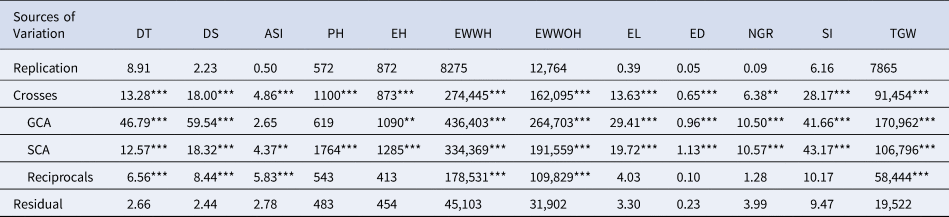
The pooled ANOVA (Table 1) indicated that both genotype and genotype × environment (G × E) interactions were highly significant for the key yield and yield attributing traits under study. Therefore, BLUP values were calculated to estimate combining ability. The general (online Supplementary Table S1) and specific (online Supplementary Table S2) combining ability analyses identified several promising lines and combinations for ear- and kernel-related traits with early maturity. Forty-seven lines showed positive GCA values for total grain weight, with top performers including YL-178, YL-17, YL-218, YL-27, YL-237, YL-256, YL-21, YL-246, YL-191, and YL-277. Additionally, seventy-nine test crosses exhibited positive SCA values for grain weight and related traits. The crosses H-14-164, H-13-245, H-14-255, and H-13-193 were the top performers and recorded negative SCA values for flowering traits, thus favouring early maturity.
Pooled ANOVA mean squares for the 12 yield and yield-related traits in 160 maize test crosses evaluated over two seasons using the REML procedure

DT, days to 50% tasselling; DS, days to 50% silking; ASI, anthesis silking interval; PH, plant height (cm); EH, ear height (cm); EWWH, ear weight with husk (g); EWWOH, ear weight without husk (g); EL, ear length (cm); ED, ear diameter (cm); NGR, number of grain rows; SI, 100 grain weight (g); TGW, total grain weight (g).
*: α ≤ 0.10; ** : α ≤ 0.05; ***: α ≤ 0.01.
Heterotic grouping
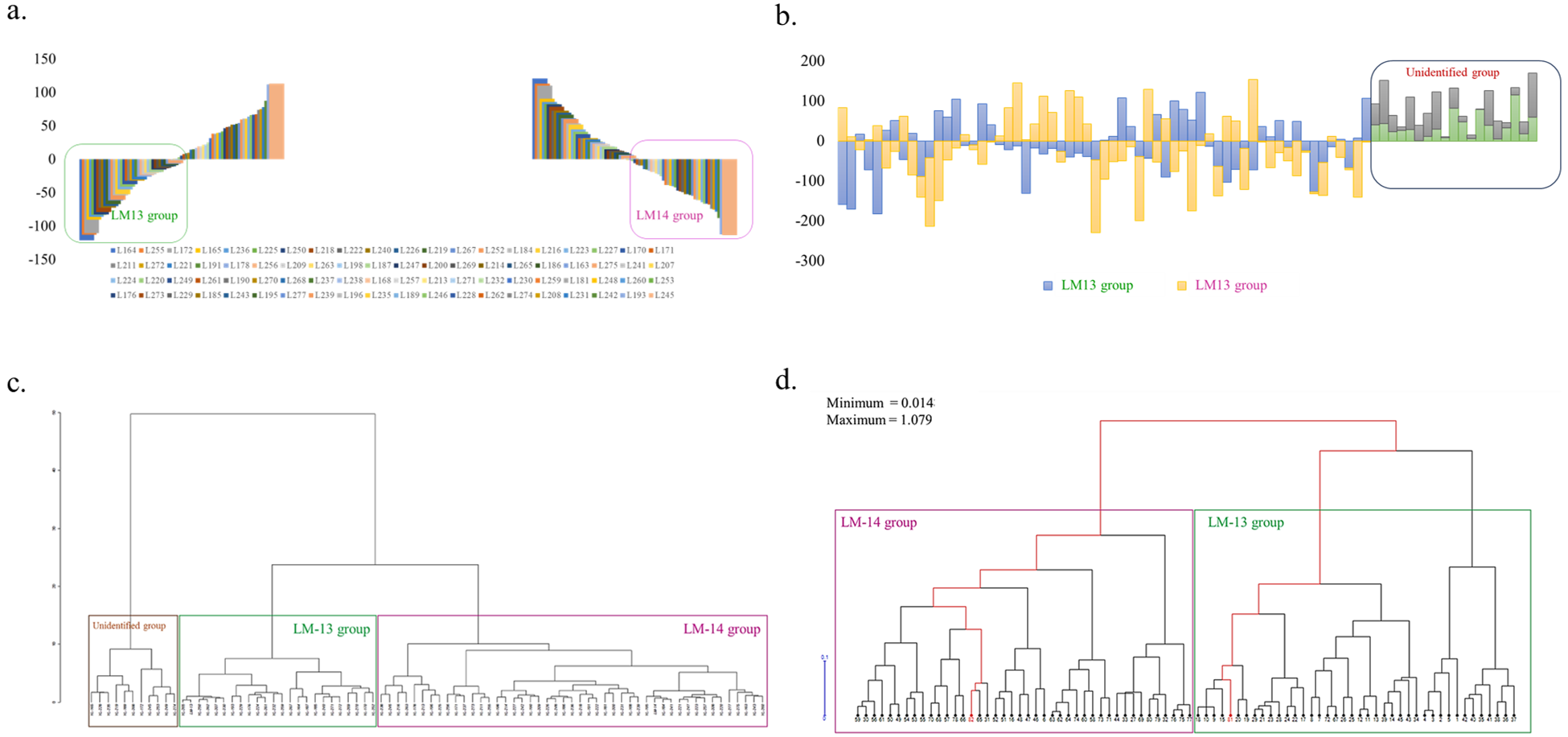
Although all the yield traits were examined, total grain weight was the primary focus due to its dependence on multiple components, including ear length, ear diameter, and kernel characteristics (Fan et al., Reference Fan, Chen, Tan, Xu, Zhang, Luo, Huang and Kang2008; Flint-Garcia et al., Reference Flint-Garcia, Buckler, Tiffin, Ersoz and Springer2009; Shojaei et al., Reference Shojaei, Mostafavi, Khosroshahli, Reza Bihamta and Ramshini2020; Rahimi Jahangirlou et al., Reference Rahimi Jahangirlou, Akbari, Alahdadi, Soufizadeh, Kumar and Parsons2021; Ma et al., Reference Ma, Wang, Han, Zhou, Xu, Qu, Wang, Ma, Yuan, Wang, Ding and Qian2022; Azrai et al., Reference Azrai, Aqil, Efendi, Andayani, Makkulawu, Iriany, Yasin, Zainuddin, Sitaresmi and Suwarno2023). For the SCA method, female parental lines with negative SCA effects were assigned to the same heterotic group as the male line (LM-13 or LM-14). This placed 39 inbreds in the LM-13 group and 41 inbreds in the LM-14 group (Fig. 1a). In the HSGCA method, both SCA effects of testcrosses and GCA effects of female lines were considered when grouping the inbreds. Female lines with negative HSGCA values for both testers were grouped with the tester that recorded the higher negative values. The female lines with positive HSGCA values were categorised into a third, ‘unidentified’ category. Using this method, 27 inbreds were classified in the LM-13 group, 34 in the LM-14 group, while 19 inbreds remained unclassified.
Heterotic grouping of the eighty maize inbred lines into their respective tester groups using the (a) SCA method, (b) HSGCA method, (c) HGCAMT method, and (d) SSR_GD based hierarchical clustering method.

For the HGCAMT method, inbreds were grouped based on their clustering pattern relative to the testers in a dendrogram. In all 23 inbreds grouped with LM-13, 46 with LM-14, and 11 inbreds could not be classified in either tester group (Fig. 1c). SSR-based grouping (SSR_GD) revealed genetic distances ranging from 0.014 to 1.079, with the greatest distance between testers LM-13 and LM-14. Inbreds clustering with the respective testers were grouped accordingly. In all 39 inbreds clustered along with LM-13 in the LM-13 heterotic group while 41 inbreds grouped into LM-14 tester group. Within the LM-13 tester group, genetic distances ranged from a minimum of 0.12 to a maximum of 0.96. Similarly, for the LM-14 tester group, the genetic distances ranged from 0.09 to 0.66 (Fig. 1d).
Breeding efficiencies of heterotic grouping methods
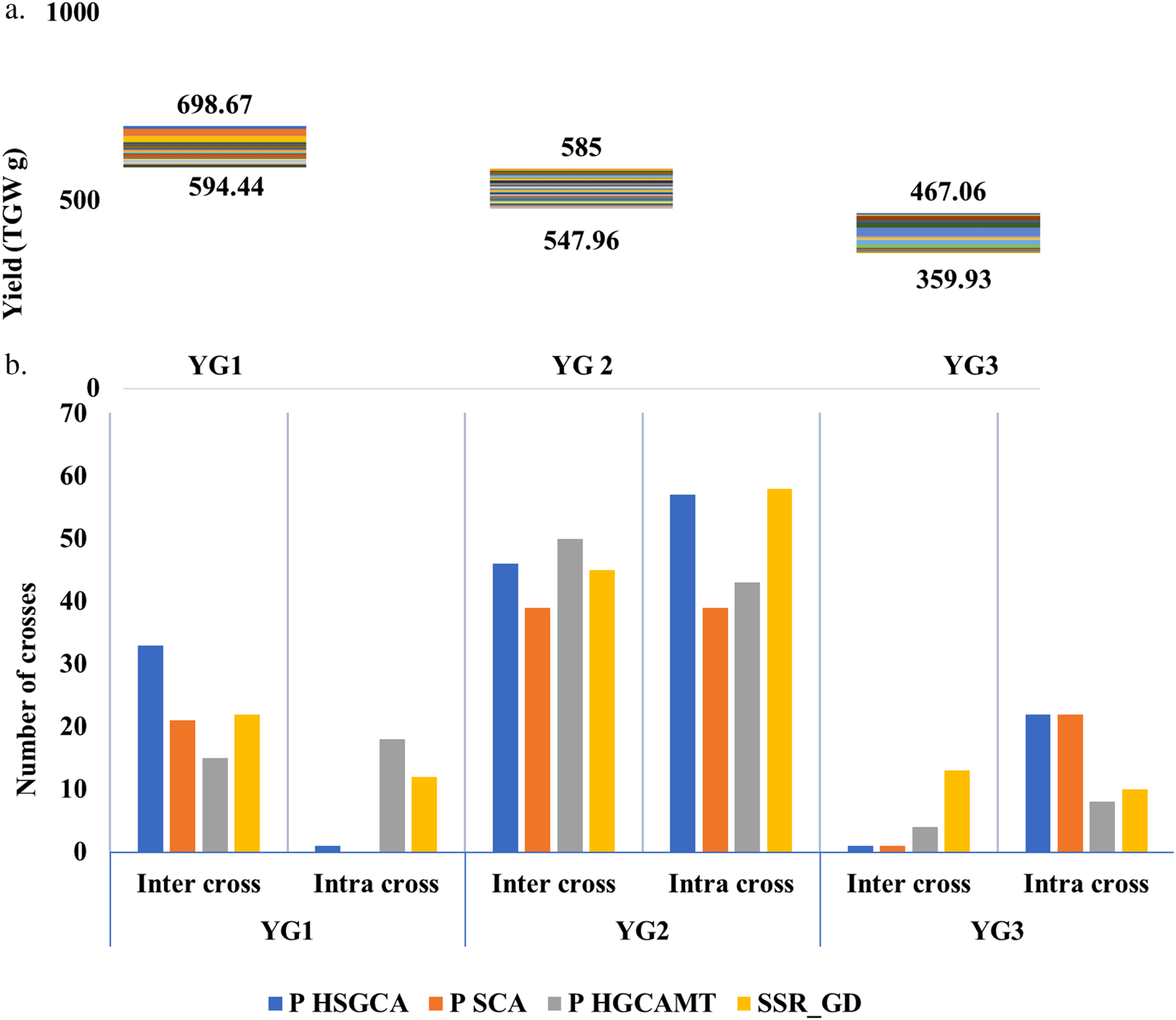
Based on their grain yield performance, the 160 testcross progenies were grouped (Fig. 2a) into three yield classes: YG-I (698.67–586.89 g), YG-II (585–547.96 g), and YG-III (467.06–347.61 g). On comparison, YG-I recorded a higher number of inter-group crosses, while YG-III had more intra-group crosses (Fig. 2b). Additionally, all except four of the female parental lines in the YG-I topcrosses recorded positive GCA values, which were significantly correlated with high yield (online Supplementary Fig. S1).
(a) The three yield groups YG-I, YG-II and YG-III determined for total grain weight (TGW) from the160 testcrosses studied. (b) The number of inter and intra crosses assigned to each yield group (YG) for the four different heterotic grouping methods.

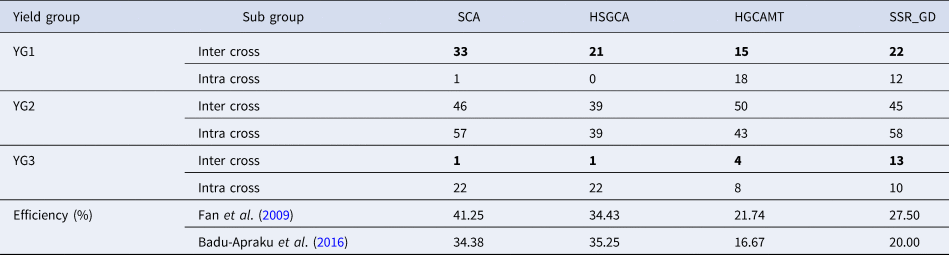
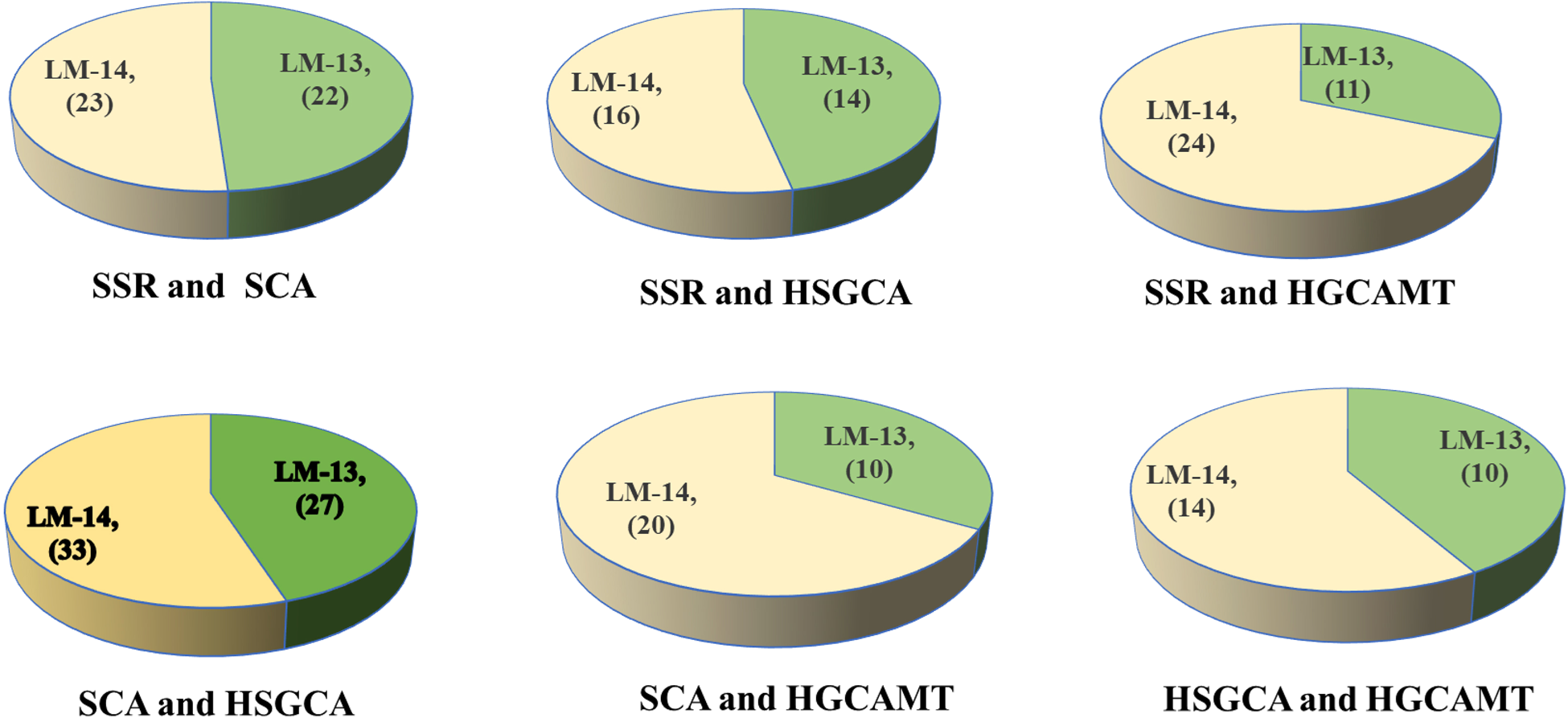
The hybrid performance-based SCA and HSGCA methods focusing on grain yield recorded higher breeding efficiencies of 41.25 and 34.43% respectively (Table 2). In comparison, the breeding efficiency for the clustering methods SSR_GD (27.50%) and HGCAMT (21.74%) were notably lower. When comparing shared inbreds across the different heterotic grouping methods, taken two at a time, the SCA and HSGCA methods proved more effective in consistently assigning larger number of inbreds to specific tester groups compared to other methods (Fig. 3). The final tester groups were, therefore, determined using the inbreds common to both the SCA and HSGCA methods. A total of 27 inbreds were assigned to LM-13 while 33 inbreds grouped into LM-14.
Breeding efficiencies of the 80 maize inbreds evaluated using four heterotic grouping methods

Pie charts indicating the proportion of shared inbreds for the diverse heterotic grouping methods studied. Figures in parentheses specify the count of inbreds common to the LM-13 and LM-14 tester groups. The highlighted combination of SCA and HSGCA methods have the highest number of inbreds in common for the respective tester groups.

Validation of heterotic grouping
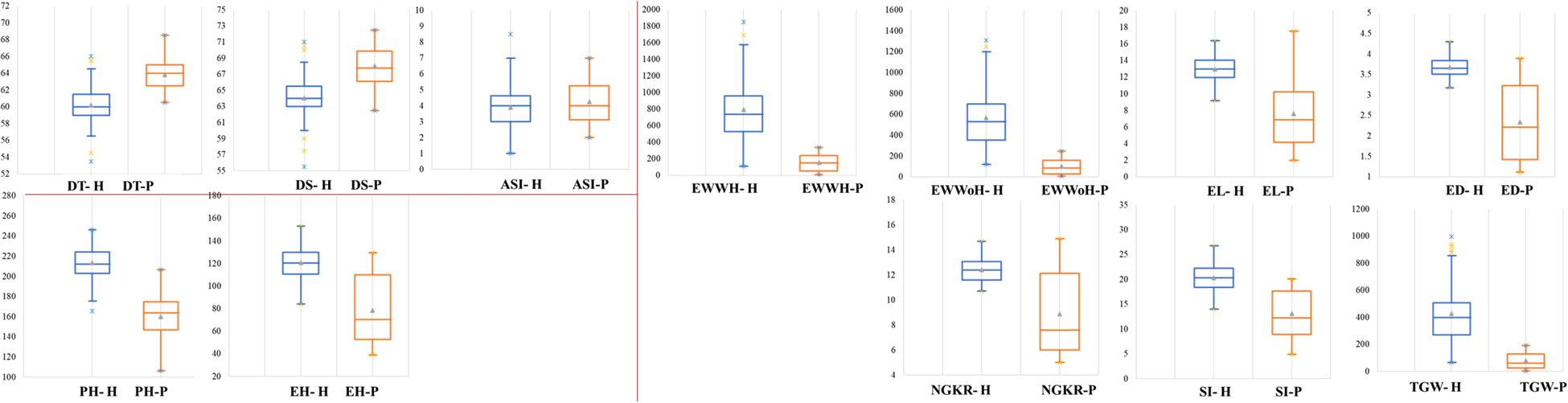
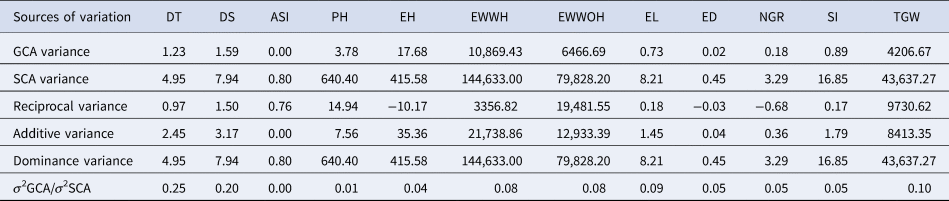
Nine of the 10 inbreds crossed successfully, generating 72 F1 progenies, which were evaluated with their parents in the following season using a randomized block design. Since the general ANOVA (online Supplementary Table S3) indicated significant hybrid means, combining ability studies based on Griffing's Method I and Model I were done to study the gene action (Table 3). The GCA, SCA, and reciprocal variances were significant for majority of the traits studied. A σ 2GCA/σ 2SCA ratio less than 1 for these traits, implied a preponderance of dominance gene action. Significant reciprocal variance implied that yield traits differed when the line was used as a seed or pollen parent (Table 4). The performance of the F1 hybrids indicated positive heterosis for ear traits and negative heterosis for the phenological traits (Fig. 4).
Mean squares for the 12 yield and yield-related traits in 72 maize hybrids analysed using Griffing's (Reference Griffing1956) Method I, Model I

DT, days to 50% tasselling; DS, days to 50% silking; ASI, anthesis silking interval; PH, plant height (cm); EH, ear height (cm); EWWH, ear weight with husk (g); EWWOH, ear weight without husk (g); EL, ear length (cm); ED, ear diameter (cm); NGR, number of grain rows; SI, 100 grain weight (g); TGW, total grain weight (g).
** : α ≤ 0.05 ***: α ≤ 0.01.
Box plots illustrating the performance of the F1 hybrids compared to their parents, highlighting the magnitude and distribution of heterosis for the phenological, morphological, and ear/kernel traits analysed.

Combining ability variances and gene action for the 12 yield and yield-related traits in the 72 maize hybrids studied

DT, days to 50% tasselling; DS, days to 50% silking; ASI, anthesis silking interval; PH, plant height (cm); EH, ear height (cm); EWWH, ear weight with husk (g); EWWOH, ear weight without husk (g); EL, ear length (cm); ED, ear diameter (cm); NGR, number of grain rows; SI, 100 grain weight (g); TGW, total grain weight (g).
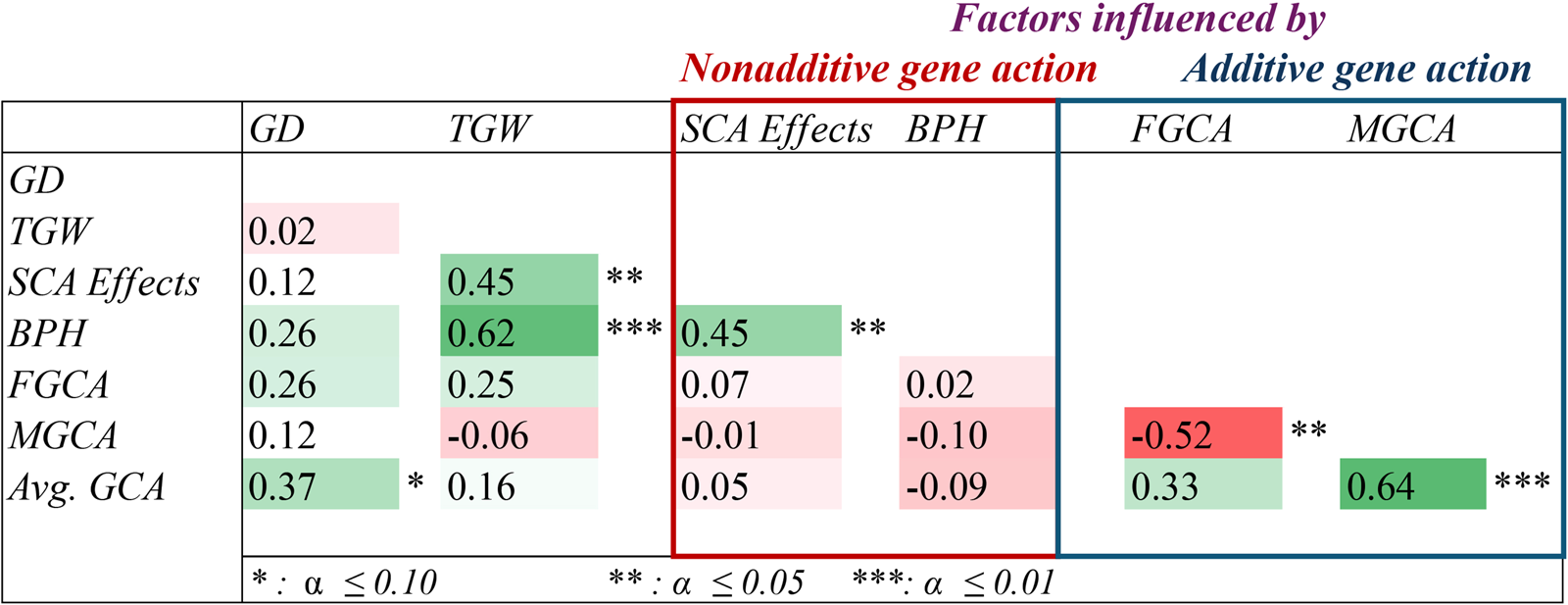
To understand the association of additive/non additive components with high yield, we analysed the correlation between TGW, its related combining ability estimates, and heterosis indices for the top 20 performers (Fig. 5). Pearson's correlation revealed significant positive associations between TGW with BPH, and SCA effects. The BPH for 19 of the twenty hybrids ranged between 75 and 384% with the exception of one combination with a BPH of 1648% arising from the significant difference between the F1 (997 g) and the better parent (57 g) (online Supplementary Table S4). A high BPH demonstrates a strong heterosis due to significant yield advantages over the better parent.
A density gradient (green to red) representation showing the association between genetic distance (GD_SSR), total grain weight (TGW), specific combining ability (SCA) effects, better parent heterosis (BPH), female general combining ability (FGCA) effects, male general combining ability (MGCA) effects and average GCA effects. Asterisks denote the level of significance.

The correlation (0.37) between average GCA and genetic distance (α = 0.10) suggested a moderate association, with hybrids from more genetically distant parents potentially exhibiting higher GCA. The genetic distance between the parental combinations for the top 20 performers ranged from 0.07 to 0.39, with an average of 0.31. The negative correlation between MGCA and FGCA (−0.52) indicated an inverse association between the male and female combining abilities of the respective parental lines. Additionally, the high positive correlation (0.64) between MGCA and average GCA indicated that the male effects contributed substantially to general combining ability.
Discussion
Since hybrid performance plateaus over time, integrating new genetic resources into breeding programs is essential. The unique genetic reservoir of maize landraces from the Himalayan foothills of India (Sharma et al., Reference Sharma, Prasanna and Ramesh2010; Singode and Prasanna, Reference Singode and Prasanna2010; Sanjenbam et al., Reference Sanjenbam, Sen, Tyagi and Chand2018) shaped by primitive popcorn varieties, introduced hybrids, and advanced races (Singh, Reference Singh1977; Prasanna, Reference Prasanna2012; Prakash et al., Reference Prakash, Zunjare, Muthusamy, Chand, Kamboj, Bhat and Hossain2019), offers untapped potential for breeding. However, the absence of well-defined heterotic groups for the region has limited hybrid development efforts. This study aimed to bridge this gap by developing heterotic groups and validating their efficacy using a genetic approach.
Building on the framework of Naveenkumar et al. (Reference Naveenkumar, Sen, Vashum and Sanjenbam2020) for germplasm improvement through population structuring, this study focused on hybrid development through heterotic grouping. Testcrosses using two standard testers LM-13 and LM-14, known for effectively differentiating tropical inbreds based on combining ability (Karjagi et al., Reference Karjagi, Phagna, Neelam, Sekhar, Singh and Yathish2023) were developed and evaluated over two seasons to account for G × E interactions. BLUP values were used to increase the reliability of combining ability estimates (Piepho et al., Reference Piepho, Möhring, Melchinger and Büchse2008; Bernardo, Reference Bernardo2014; Molenaar et al., Reference Molenaar, Boehm and Piepho2018). The analysis results indicated a strong genetic basis for yield-related traits driven by additive and dominance gene action.
Heterotic grouping methods were subsequently applied incorporating combining ability analysis from multiple perspectives as well as molecular analysis. Among the methods tested, SCA and HSGCA were the most effective for grouping the inbreds, with both methods consistently assigning high-yielding hybrids to intergroup categories and low-yielding crosses to intragroup categories (Fan et al., Reference Fan, Zhang, Yao, Chen, Tan, Xu, Han, Luo and Kang2009; Akinwale et al., Reference Akinwale, Badu-Apraku, Fakorede and Vroh-Bi2014; Amegbor et al., Reference Amegbor, Badu-Apraku and Annor2016; Oyetunde et al., Reference Oyetunde, Badu-Apraku, Ariyo and Alake2020; Olayiwola et al., Reference Olayiwola, Ajala, Ariyo, Ojo and Gedil2021). Previous studies have also identified the SCA and HSGCA methods as the superior grouping methods due to their ability to effectively capture interallelic complementation (Hochholdinger and Baldauf, Reference Hochholdinger and Baldauf2018; Xiao et al., Reference Xiao, Jiang, Cheng, Wang, Yan, Zhang, Qiao, Ma, Luo, Li, Liu, Yang, Song, Meng, Warburton, Zhao, Wang and Yan2021). The final tester groups for our studies were formed based on the overlapping inbreds identified by these methods.
The grouping studies also highlighted the importance of parental GCA effects, which displayed a strong correlation with grain yield, underlining the role of parental additive gene action in hybrid performance. In the case of molecular studies, while SSR markers have been widely utilized for population structuring and for grouping inbreds into heterotic groups (Reif et al., Reference Reif, Melchinger, Xia, Warburton, Hoisington, Vasal, Beck, Bohn and Frisch2003b; Aguiar et al., Reference Aguiar, Schuster, Amaral Júnior, Scapim and Vieira2008), in this study, the SSR_GD analysis primarily served to validate the genetic distance between testers LM-13 and LM-14. This confirmation while highlighting the suitability of the testers in the grouping studies, had limited direct utility for heterotic grouping, as seen from the breeding efficiency test.
Validation of the heterotic grouping through diallel analysis (Habiba et al., Reference Habiba, El-Diasty and Aly2022; Amegbor et al., Reference Amegbor, van Biljon, Shargie, Tarekegne and Labuschagne2023) revealed that while dominance variance and gene action predominantly influenced the hybrid performance, additive variance also played a significant role. As stated by Falconer and Mackay (Reference Falconer and Mackay2009), additive variance can also arise in the presence of non-additive gene action. The significant reciprocal differences observed for traits such as flowering days and grain weight underline the importance of cross direction in influencing trait expression and highlight the critical role of parental selection – a key principle in heterotic grouping.
Association studies linking grain yield to heterosis indices BPH and SCA effects further confirmed the role of non-additive gene action in hybrid vigour, consistent with the findings of Li et al. (Reference Li, Zhou, Lu, Jiang, Li, Li, Wang, Chen, Li, Würschum, Reif, Xu, Li and Liu2021). Both studies highlight the role of nonadditive interaction as the major contributor to heterosis of maize grain yield. Our studies also revealed a moderate positive correlation between GCA and genetic distance, suggesting that hybrids derived from parents with intermediate genetic divergence achieved optimal performance (Datta et al., Reference Datta, Mukherjee, Das and Barua2004; Wu et al., Reference Wu, Liu, Zhang and Gu2021). Additionally, a significant negative correlation between male and female GCA effects highlighted the importance of contrasting parental GCA contributions for enhanced heterosis.
These findings align with Patil et al. (Reference Patil, Kachapur and Nair2021), who reported improved heterosis in hybrids involving inbreds from contrasting GCA groups and provides a predictive framework for selecting parental combinations that optimize hybrid vigour. While the earlier work by Naveenkumar et al. (Reference Naveenkumar, Sen, Vashum and Sanjenbam2020) had focused on subgrouping inbreds to define the germplasm for heterotic grouping, the current study advances the field by establishing functional heterotic groups specifically for developing high-yielding single-cross hybrids.
In northeastern India, where maize serves primarily as a poultry feed, targeted breeding programs that exploit heterosis hold substantial promise. The development of improved hybrids tailored to local agro-climatic conditions offers a dual advantage – providing poultry farmers with a cost-effective and reliable feed source while enhancing their profitability. Furthermore, by leveraging the unique genetic diversity of local germplasm, breeders can create hybrids better adapted to the region's challenging hilly terrain and smallholder farming systems. Such advancements have the potential to foster economic resilience, ensure feed security, and promote agricultural sustainability in the region.
Conclusion
To the best of our knowledge, this study is the first to confirm the heterotic potential of inbreds from the maize germplasm of the North East Hill Region (NEHR). Drawing on the findings of Naveenkumar et al. (Reference Naveenkumar, Sen, Vashum and Sanjenbam2020), which focused on foundational genetic characterization and divergence studies, the present research builds on these insights to establish functional heterotic groups and validates their utility in developing high-yielding hybrids. Leveraging indigenous genetic diversity mitigates the risk of genetic erosion in breeding programmes while benefitting smallholding farmers, particularly in regions practising shifting cultivation, thus supporting the economic well-being of agricultural communities. Additionally, incorporating farmer preferences through a participatory breeding approach can further enhance the relevance of these hybrids, contributing to food security and livelihoods in NEHR.
Supplementary material
The supplementary material for this article can be found at https://doi.org/10.1017/S1479262124000704.
Acknowledgements
Acknowledgements are first and foremost due to the local farmers of NEHR of India who willingly shared their germplasm with us for our study. We express our heartfelt gratitude to AICRP (Maize), India, Dr Sujay Rakshit, Former Director, ICAR-Indian Institute of Maize Research and Dr Jasbir Singh Chawla, Principal Maize Breeder, Punjab Agricultural University Ludhiana for providing us with the necessary testers. The invaluable inputs from Dr Wricha Tyagi, Professor, School of Crop Improvement, College of Post Graduate Studies in Agricultural Sciences received from time to time is also duly acknowledged. The financial assistance received from ICAR-SRF(PGS) during the first author's doctoral program is also gratefully acknowledged.
Author contributions
Duddukur Rajasekhar: D. R. was involved in phenotyping over five cropping seasons, genotyping, statistical analysis of data and assisted with the writing of the manuscript. Naveenkumar KL: Major part of the experimental material was developed and advanced by N. KL along with other team members. Samudra Kalita: S. K. was involved in phenotyping and data collection of the experimental material. Harshavardhan Tatiparthi: H. T. was involved in phenotyping and data collection of the experimental material. Mayank Rai: M. R. was involved in procuring the testers in his capacity as then in-charge AICRP Maize, Barapani and was involved in giving direction to the research as part of the advisory committee of the first author. Devyani Sen: D. S. was involved in conceptualization of the program, overall supervision, analysis, writing, review and editing of the manuscript.
Competing interests
The authors declare no conflict of interest.