Introduction
Nilaparvata lugens Stahl, the rice brown planthopper (BPH), was a relatively minor rice pest prior to the Green Revolution and the associated increase in pesticide use in rice. At that time, it came to be considered the number one threat to rice production in many parts of Asia (International Rice Research Institute, 1980). Nilaparvata lugens kills rice plants by feeding intensively on them and transferring a viral disease. It is now widely accepted that indigenous enemies in Asian rice areas are the key to BPH management. In most cases, the numerous predators, egg and nymphal parasites, pathogens and nematodes can maintain BPH populations below damaging densities (Kenmore et al., Reference Kenmore, Carino, Perez, Dyck and Gutierrez1984).
Host plant resistance was widely developed, with the aim of reducing resurgence of BPH populations, but has been successful only to the extent that new varieties have been continuously introduced. This is because host plant resistance breaks down due to the high selection for viruliferous strains of BPH. Breakdown happens more quickly when pesticide applications continue at high levels (Gallagher et al., Reference Gallagher, Kenmore, Sogawa, Denno and Perfect1994).
In the 1980s, it was recognized that the over-use of insecticides was the root cause of outbreaks. Biological control, complemented by host plant resistance, is now seen as the basis of management of BPH (Way & Heong, Reference Way and Heong1994). IPM programmes emphasize that the routine use of insecticides should be avoided (Gallagher et al., Reference Gallagher, Kenmore, Sogawa, Denno and Perfect1994; Matteson et al., Reference Matteson, Gallagher, Kenmore, Denno and Perfect1994). Wide-scale observations of low populations of BPH in farmers' fields, even with BPH-susceptible rice, suggest that more emphasis be put on biological control (Way & Heong, Reference Way and Heong1994; Schoenly et al., Reference Schoenly, Cohen, Heong, Arida, Barrion, Litsinger, Polis and Winemiller1996).
The dominant predators in irrigated rice during the first 35 days after transplanting (DAT) are the lycosid Pardosa pseudoannulata and the linyphiid Atypena formosana (Sahu et al., Reference Sahu, Singh and Kumar1996; Sigsgaard et al., Reference Sigsgaard, Villareal, Gapud, Rajotte, Hong and Sastroutomo1999). Both spiders are considered important predators of BPH (Kiritani & Kakiya, Reference Kiritani and Kakiya1975; Kenmore et al., Reference Kenmore, Carino, Perez, Dyck and Gutierrez1984; Shepard et al., Reference Shepard, Barrion and Litsinger1987; Barrion et al., Reference Barrion, Aquino and Heong1994; Ooi & Shepard, Reference Ooi, Shepard and Heinrichs1994; Inthavong et al., Reference Inthavong, Inthavong, Sengsaulivong, Schiller, Rapusas, Barrion and Heong1998; Sigsgaard & Villareal, Reference Sigsgaard and Villareal1999). Both occur throughout the year (Barrion & Litsinger, Reference Barrion and Litsinger1984; Shepard et al., Reference Shepard, Barrion and Litsinger1987; Rubia et al., Reference Rubia, Almazan and Heong1990), and their field densities co-vary with hopper densities (Reddy & Heong, Reference Reddy and Heong1991). Later in the cropping season, predatory bugs become the dominant predators. One of these is Cyrtorhinus lividipennis, an important predator of BPH eggs and young nymphs (Heong et al., Reference Heong, Bleih and Lazaro1990; Heong et al., Reference Heong, Aquino and Barrion1991). Cyrthorinus lividipennis numbers in the field are closely linked to BPH populations (Hinckley, Reference Hinkley1965; Kuno & Dyck, Reference Kuno and Dyck1985; Heong et al., Reference Heong, Bleih and Lazaro1990).
The dominance of the two spider species in early rice calls for a better understanding of their control of BPH, as well as their interaction and how it may affect the resulting predation. Due to the difference in size, A. formosana principally preys upon smaller instars of BPH, while the larger P. pseudoannulata can prey upon all BPH instars, larger spiderlings and adults being effective predators of late instar nymphs and adults.
Though its major contribution to pest control is normally later than that of the spiders, typically after 40 DAT, it is not uncommon for C. lividipennis to occur in fairly high numbers around 20 DAT. Thus, in 1999, this species was already nearing A. formosana densities by 28 DAT, which makes it relevant to assess the effect of the three species combined on BPH populations. Predation by more than one species of predator may have synergistic, additive or antagonistic effects on a prey population. Synergy occurs when predation by two predators results in more prey killed than the sum of what each predator individually removes. Synergy may be expected, for example, when predators do not compete for the same instar or do not prey in the same part of the rice hill. Since the smaller of the two spiders, A. formosana, preys primarily on small BPH while P. pseudoannulata can handle larger instars and adults, synergy may be expected. An additive effect is when predation by two predators is equal to the sum of prey removed by each individual predator alone. Factors that may lead to less than additive interactions include competition for prey and intraguild predation. Due to the size difference, P. pseudoannulata could be a predator of A. formosana. Such intraguild predation was documented for P. pseudoannulata with C. lividipennnis (Heong et al., Reference Heong, Bleih and Rubia1989). Several studies show positive effects on biocontrol with increased predator biodiversity (Cardinale et al., Reference Cardinale, Harvey, Gross and Ives2003; Snyder et al., Reference Snyder, Snyder, Finke and Straub2006).
Materials and methods
Plants
Ten-day-old rice seedlings of the BPH-susceptible cv. TN1 were transplanted in clay pots (13 cm in diameter) at 3–5 seedlings per hill. The plants were grown in screened cages for 35 days, and had reached the tillering stage, before being used in the experiments. This will correspond to 20 DAT of rice grown in the field, which is normally 25 days old at transplanting.
Cages and set-up
First experiment with adult spiders
Cages (37×48 cm base and 61 cm height) were made of plastic Mylar film with the top covered with fine white nylon mesh. The bottoms of the Mylar cages were plastic trays into which the Mylar film was then fitted and glued. Each cage had a window measuring 18×23 cm in the front. The window was covered with cut sliding Mylar film. Five potted rice hills were placed in each cage and arranged in a metal tray filled with water to exclude predaceous ants. The cages were set up in a glasshouse with an average temperature (±SE) of 29.6±0.4°C, ranging from 23–40°C, and an average RH of 77.4±1.0%, ranging from 61–91%. The distance between the five potted rice hills, 25 cm, was similar to that used in farmers' fields.
Second experiment with spiderlings
In the experiment with spiderlings, the cage heights were increased to 100 cm and had windows measuring 20×16 cm on each side of the cage covered with fine nylon mesh, but, otherwise, the cages were similar. The cages were set up in a greenhouse under similar conditions as in the first experiment, with an average temperature (±SE) of 29.6±0.4°C, ranging from 23.5–36°C, and an average RH of 77.5±1.1%, ranging from 58–92%.
Arthropods
Adult P. pseudoannulata and A. formosana
Adult P. pseudoannulata and A. formosana were captured in a rice field at the International Rice Research Institute in Los Baños and in farmers' fields in Pila, Laguna, Philippines. Spiders were separated according to sex and kept in culture tubes (150 mm long, 18 cm in diameter) until they were introduced into the cages. To ensure adequate humidity, each tube contained a small wad of moist cotton and was plugged with moist cotton wool wrapped with fine mesh. Spiders were collected one or two days ahead of the experiment and were given excess diet. P. pseudoannulata was fed 60 5th instar BPH nymphs daily, and A. formosana was fed 20 2nd instar BPH daily.
Atypena formosana female length was 2.5±0.1 mm and weight was 1.5±0.1 mg. Pardosa pseudoannulata were 10.4±0.2 mm long and weighed 65.6±2.8 mg. Females were allocated among cages to obtain an even-sized distribution within and between cages.
Immature P. pseudoannulata and A. formosana
Immature 4th to 6th instar P. pseudoannulata were collected and kept as above. After collection, they were fed an excess diet of BPH 5th instar nymphs and adult Drosophila melanogaster (Meigen) for 10 days. By the onset of the experiment, P. pseudoannulata spiderlings were 5th to 6th instar and weighed (±SE) 64.2±1.3 mg (range 32.7–98.5 mg, n=96). Spiderlings were allocated among cages to obtain an even-sized distribution within and between cages.
A lab culture with gravid females was established to assure a good supply of A. formosana for the experiment. Females readily laid egg sacs in the test tubes; thereafter, females were removed. Tubes with eggs of A. formosana were kept moist until the eggs hatched. Newly dispersed spiderlings were transferred to culture cages and kept until they reached 5th instar, the last instar before becoming adults.
A mixture of half field- and half laboratory-reared A. formosana were used in the experiment. Before the experiment, both field-collected and lab-reared 5th instar spiderlings were kept in test tubes for 3 days and fed daily with an excess diet of 2nd instar BPH nymphs, Collembola (Entomobryidae), and adult D. melanogaster (Meigen). Only A. formosana females were used in the experiment. In the last instar, sexes can easily be distinguished. By the onset of the experiment, A. formosana was represented by a mixture of 5th instar females and newly moulted young, unmated females. Sizes of field-collected and laboratory-reared A. formosana were equivalent (mean±SE female length in both, 2.5±0.1 mm, and weight 1.5±0.1 mg).
C. lividipennis
Young, gravid, adult females of C. lividipennis were collected from a stock culture maintained at IRRI, using the rearing method described by Manti (Manti, Reference Manti1990). The stock culture at IRRI was established from field-collected C. lividipennis and regularly renewed with new field collections.
BPH
Gravid, brachypterous BPH females were obtained from a stock culture maintained at IRRI, using the standard rearing method described by Heinrichs et al. (Reference Heinrichs, Medrano and Rapusas1985). The stock culture at IRRI was established from field-collected BPH and regularly renewed with new field collections.
Treatments
Two cage experiments were set up to assess the contribution to BPH control by P. pseudoannulata and A. formosana individually and in combination. Densities of potted rice hills were similar to those in farmers' fields. The age of the rice plants by the onset of the experiments was comparable to 20 DAT in the field.
Initial densities of BPH and spiders were chosen so that they corresponded with field data from the Philippines (Kenmore et al., Reference Kenmore, Carino, Perez, Dyck and Gutierrez1984; Heong et al., Reference Heong, Aquino and Barrion1992). At 20 DAT, Heong et al. (Reference Heong, Aquino and Barrion1992) found similar densities of A. formosana and P. pseudoannulata of c. four individuals per 0.25 m2. However, densities of this small, rather inconspicuous, spider may have been underestimated (Green, Reference Green1999); so a higher ratio was used in this study, following densities found at IRRI in 1999 by 28 DAT (3.2 P. pseudoannulata m−2 and 5.4 A. formosana) (Sigsgaard, unpublished data) and in agreement with ratios of A. formosana and P. pseudoannulata at 20 DAT, a ratio of 3:2 (Sahu et al., Reference Sahu, Singh and Kumar1996). A treatment with both spiders and C. lividipennis was included to simulate the situation later in the cropping season when this species becomes more numerous, typically after 40 DAT, although in 1999 this species was already nearing A. formosana densities by 28 DAT. While the experiment with adult spiders allowed for an assessment of predation that included spider reproduction, the experiment with immatures allowed for an assessment of effects with a fixed number of spiders.
One day prior to predator infestation, ten newly gravid BPH were introduced into each cage, allowed to settle and to lay eggs on the host plants. The next day, A. formosana, P. pseudoannulata and C. lividipennis were introduced to the cages. In the experiment with adult spiders, spider males were included for continuous fertilization of females. In the experiment with immature and unmated spiders, predator introduction was split, C. lividipennis was introduced as above, spiders were introduced with a 5 day delay allowing C. lividipennis to establish better than in the first experiment; so, in this experiment, BPH had been in the cage for 6 days before spiders were introduced.
Five treatments with eight replicates (cages) were used in both experiments. In addition, the experiment with adult spiders included a sixth treatment with C. lividipennis with five replicates. Treatments were:
(i) control of ten gravid BPH females;
(ii) as in (i), with seven field-collected A. formosana females and two males;
(iii) as in (i) with four field-collected P. pseudoannulata females and two males;
(iv) as in (i) with seven A. formosana females and two males, four P. pseudoannulata females and two males;
(v) as in (i) with seven A. formosana females and two males, four P. pseudoannulata females and two males and ten C. lividipennis females; and
(vi) as in (i) with ten C. lividipennis females (five replicates).
In the experiment with immature and unmated spiders, treatments were:
(i) control of ten gravid BPH females;
(ii) as in (i) with seven A. formosana newly adult unmated females (a mixture of field-collected and lab-reared);
(iii) as in (i) with four field-collected 6th–7th instar P. pseudoannulata;
(iv) as (i) with seven A. formosana newly adult unmated females and four 6th–7th instar P. pseudoannulata; and
(v) as in (i) with seven A. formosana newly adult unmated females, four 6th–7th instar P. pseudoannulata and ten C. lividipennis females.
Throughout the experiments, water level was kept at 2–3 cm from the base of the rice plants to avoid submergence of BPH eggs. Rice hills were replaced with new TN1 hills of equal size, based on hopperburn damage. One to two hills were replaced in each control cage and one hill in each treatment cage, except for the ‘treatment with all three predators’ cage, in which no replacement was needed. The plant material of the rice hills to be replaced was cut off and left in the cage for approximately two days, placed on an upturned clay pot next to the new hill, to allow easy movement of arthropods from plant material to the new hill. In the experiment with adult spiders, cages were visually examined for predators and prey weekly for five consecutive weeks, except for the ‘treatment with only C. lividipennis’ experiment, which was ended after four weeks. In the experiment with immatures, cages were examined for three consecutive weeks, and the counts of the originally introduced BPH were pooled with the hatched nymphs after the first week. At the end of experiments, the cages were emptied with a blower-vac (Domingo & Schoenly, Reference Domingo and Schoenly1998) to assess the total number of arthropods, except for the ‘treatment with C. lividipennis’ cage.
Data analysis
Data were analyzed for normality and homogeneity of variances and, if necessary, transformed. If requirements for a parametric analysis could not be met, a nonparametric analysis was used. Repeated measurement ANOVA (PROC MIXED) was used to analyze development in BPH and predator numbers over time (Diggle et al., Reference Diggle, Liang and Zeger1994). Individual treatments were compared using differences of least square means (t-test, P<0.05). Data from the conclusion of the experiments, where cages were emptied with the blower-vac, were analyzed with a one-way ANOVA (PROC ANOVA) (SAS Institute, 1999). Individual treatments were compared using t-tests (P<0.05).
Results
Experiment with adult spiders
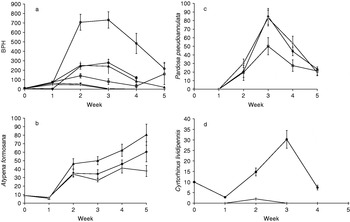
Initially, numbers of BPH increased in all treatments, most so in the control. By the third week, the BPH population was beginning to decline because the rice plants were reaching a less favourable age for BPH (fig. 1a). At this point in time, BPH numbers were about a third of those in the control in A. formosana and C. lividipennis treatments; about a tenth in the P. pseudoannulata treatment; and, in the treatment with both spiders as well as the one with all three predators, BPH numbers were a fifth of those in the P. pseudoannulata treatment.
Visually observed numbers (±SE) of BPH and spiders in experiment with adult spiders (a) BPH; (b) Atypena formosana in the treatments with A. formosana, A. formosana and P. pseudoannulata and all three predators; (c) Pardosa pseudoannulata in the treatments with P. pseudoannulata, A. formosana and P. pseudoannulata and all three predators; (d) Cyrthorinus lividipennis in the treatment with C. lividipennis and all three predators (o, control; △, A. formosana; □, P. pseudoannulata; ◊, A. formosana and P. pseudoannulata; +, A. formosana, P. pseudoannulata and C. lividipennis).

A mixed linear model showed a highly significant effect of week×treatment (F29,152=58.21, P<0.0001) on the number of BPH. An analysis of differences of least square means revealed significantly fewer BPH in the A. formosana treatment than in the control from the second week onwards (second week: t=2.19, P=0.029; third week: t=3.21, P=0.003; fourth week: t=4.31, P<0.0001; fifth week: t=5.79, P<0.001; all df=152). The P. pseudoannulata treatment was superior to the A. formosana treatment in reducing the number of BPH in the third and fourth week (t=2.77, P=0.0002; t=4.01, P<0.0001, respectively; both df=152). The A. formosana-P. pseudoannulata treatment was superior to both of the single spider treatments in controlling BPH (compared with the P. pseudoannulata treatment: second week: t=2.10, P=0.031; third week: t=4.95, P<0.0001; fourth week: t=3.55, P=0.0005; fifth week: t=4.71, P<0.0001). Fewest BPH were found in the mixed treatment, but numbers were not significantly different from the A. formosana-P. pseudoannulata treatment.
The C. lividipennis and the A. formosana treatments were similar in their effect upon the BPH population, except in the fourth week, where BPH numbers were lower in the A. formosana treatment (t=2.46, P=0.002, df=215).
Atypena formosana numbers were highest in the treatment where A. formosana was the only predator present. Numbers (log-transformed) were significantly affected by treatment×week (F17,71=53.7, P<0.0001), with more A. formosana in the A. formosana treatment than in the A. formosana-P. pseudoannulata treatment as well as in the treatment with all three predators in the third, fourth and fifth weeks (t=−2.73, P=0.007; t=−2.01, P=0.04; t=−2.30, P=0.020, respectively; and t=3.90, P=0.0002; t=2.68, P=0.009; t=4.89, P<0.0001, respectively; all df=108).
Pardosa pseudoannulata numbers were higher in treatments where A. formosana and C. lividipennis were included. The number of P. pseudoannulata (log-transformed) peaked after three weeks (almost exclusively 1st–5th instar spiderlings) (fig. 1c). Numbers were significantly affected by treatment×week (F17,58.6=17.3, P<0.0001), with significantly more P. pseudoannulata in the treatment with both spider species than in the P. pseudoannulata treatment in the second, third and fourth week (t=1.99, P=0.049; t=2.45, P=0.016; t=2.28, P=0.025, respectively; all df=96.7); and in the treatment with all predators in the third and fourth week (t=−2.36, P=0.019; t=−2.68, P=0.009, respectively; both df=96.7). The treatment with all predators had more P. pseudoannulata than the treatment with two spider species in the second week (t=2.16, P=0.033, df=96.7) (fig. 1c). In the treatment with all predators, C. lividipennis was not observed except after three weeks when two immature C. lividipennis were observed.
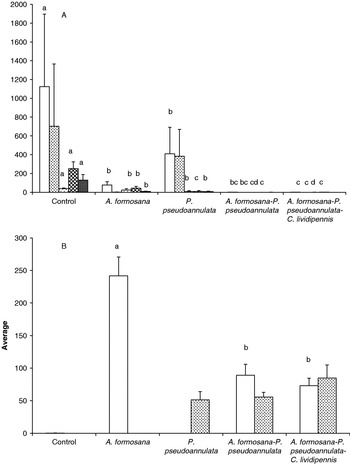
After the final visual count, the cages were carefully emptied with a blower-vac to obtain near-total numbers of arthropods (fig. 2). Results confirm findings from the final visual count. In addition, the effect on age groups was analyzed. The effect of treatment on the total number of BPH (log-transformed) was highly significant (F4,35=13.0, P<0.0001) (fig. 2), which was highest in the control and intermediate in the treatments with A. formosana and P. pseudoannulata, which were not significantly different. Least BPH were found in the A. formosana-P. pseudoannulata treatment and the treatment with all three predators. In the final counts, these two treatments were not significantly different. An analysis of the effect of treatment on age groups (all log-transformed) of BPH showed a highly significant effect for adults (F4,35=20.9, P<0.0001), medium-sized nymphs (F4,35=12.51, P<0.0001) and large nymphs (F4,35=32.3, P<0.0001). All treatments had significantly fewer BPH adults, medium and large nymphs than the control (t-test at the 5% level). Single spider treatments were not significantly different from each other, except for a significantly higher number of large BPH nymphs in the A. formosana treatment than in the P. pseudoannulata treatment. Small BPH nymphs were more numerous in the control and single spider treatments, especially in the P. pseudoannulata treatment (fig. 2); but the effect of treatment on the number of small BPH nymphs was not significant (F4,35=1.3, P<0.28), which was probably due to a large variation among replicates (cages). However, a contrast-analysis, comparing the two single spider treatments with the treatment with both spider species, found that the treatment with both spider species more effectively reduced numbers of small BPH nymphs (F1,35=5.22, P=0.028).
Mean numbers (±SE) by the conclusion of the experiment with adult spiders of (A) BPH across instars (white) and small, medium-sized and large BPH nymphs and of adult BPH (increasing shades of grey); and (B) A. formosana (white) and P. pseudoannulata (light grey). Letters above columns indicate significant (P<0.05) differences among treatments.

In the three treatments that included A. formosana, its numbers were significantly influenced by treatment (F2,21=17.0, P<0.0001), with significantly fewer A. formosana in the treatments with both spider species and all three predators than in the treatment with only A. formosana. The same was true when analyzed for adults, small and large spiderlings separately. Final numbers of P. pseudoannulata were not significantly different among treatments (F2,21=0.75, P=0.49). A contrast test showed that the proportion of males (arcsine transformed) was near significantly lower in the P. pseudoannulata treatment than in the two other treatments (F1,21=4.1, P=0.056). No C. lividipennis were recovered with the blower-vac.
The blower-vac data revealed that Microvelia sp., mosquito larvae and collembola could be found in the cages. Most likely, these species entered in low numbers, perhaps with the irrigation water, and multiplied within the cages. An average of 23±14 collembola could be found in the cages, and the number was not significantly affected by treatments. Microvelia and mosquito larvae were, on the other hand, affected by treatment (Proc GLM on log-transformed numbers, F4,35=13.1, P<0.0001; F4,35=10.9, P<0.0001, respectively). Most Microvelia were found in the control, fewer in the A. formosana treatment and fewest in the P. pseudoannulata and mixed treatments (control: 156±28; A. formosana: 56±15; P. pseudoannulata: 7±15; both spiders and all three predators: 2±1; ls-means P<0.05). Likewise, most mosquito larvae were found in control, intermediate numbers in single spider treatments (though not significantly less with A. formosana), and fewest in mixed treatments (control: 28±14; A. formosana: 15±40; P. pseudoannulata: 15±54; both spiders and all three predators: 2±1; ls-means P<0.05).
A comparison of BPH and predator numbers found with the blower-vac and the final visual count showed that the visual count had underestimated BPH total numbers by an average of 68±20%, A. formosana total numbers by 50±8% and P. pseudoannulata total numbers by 69±12%. For larger individuals the difference was less. For example, only 17% of the adult BPH had not been seen by visual sampling.
Differences in observed BPH numbers after two weeks, adjusted for underestimation of approximately 68% by visual counts, offer the possibility of estimating the daily consumption of BPH before the decline in plant quality begins to limit BPH numbers. Disregarding any predation by the predators' offspring and any sex differences in consumption, as well as intraguild predation yields, an average of 5.3 BPH was eaten daily by each of the nine A. formosana adults; an average of 9.9 BPH was eaten daily by each of the six P. pseudoannulata adults; and an average of 4.6 BPH was eaten daily per spider (15 spiders) in the A. formosana-P. pseudoannulata treatment and the treatment with all three predators. Finally C. lividipennis removed an average of 4.9 BPH per mirid.
Experiment with immature spiderlings
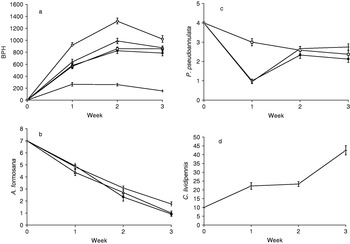
In the experiment with immature spiderlings, numbers of BPH initially increased in all treatments, especially so in the control but least in the treatment with all predators. After one week, the BPH population began to decrease in the treatment with all three predators. In this experiment, spiders were introduced with a delay to favour the establishment of C. lividipennis. By the third week, the BPH population was declining in all treatments (fig. 3a).
Visually observed numbers of BPH, spiders and C. lividipennis numbers in experiment with immature and unmated spiders. Mean number (±SE) of (a) BPH; (b) Atypena formosana in the treatments with A. formosana, A. formosana and P. pseudoannulata and all three predators; (c) Pardosa pseudoannulata in the treatments with P. pseudoannulata, A. formosana and P. pseudoannulata and all three predators; and (d) C. lividipennis in the treatment with all three predators (o, control; △, A. formosana; □, P. pseudoannulata; ◊, A. formosana and P. pseudoannulata; +, A. formosana, P. pseudoannulata and C. lividipennis).

The mixed linear model on log-transformed BPH numbers showed a highly significant effect of week×treatment (F15,75=5854.1, P<0.0001).
The A. formosana treatment had significantly fewer BPH than the control in the first and second week (t=4.11, P<0.0001; t=3.22, P=0.002, respectively; both df=75) but not in the third week. The P. pseudoannulata treatment was not significantly different from the A. formosana treatment. The A. formosana - P. pseudoannulata treatment was not significantly different from the P. pseudoannulata treatment and only had nearly significantly less BPH than the A. formosana treatment in the second week (t=−1.96, P=0.053). The treatment with all three predators had highly significantly fewer BPH than all other treatments throughout the experiment (for example, for the first week: t=8.82, P<0.0001, df=75).
In the three treatments with A. formosana, its population declined over the course of the experiment, probably through ageing of the unmated females (fig. 3b). There was a significant effect of treatment×week on A. formosana numbers (square-root transformed) (F11,47=148.0, P<0.0001). A comparison of least square means revealed that the numbers of A. formosana in the A. formosana and the A. formosana-P. pseudoannulata treatments were not significantly different. In the second and third weeks, more A. formosana were found in the treatment with all three predators than in the A. formosana-P. pseudoannulata treatment (t=−2.84, P=0.005; t=−9.01, P<0.0001, respectively; both df=73.1). In the third week, there were significantly more A. formosana in the treatment with all three predators than in the A. formosana treatment (t=−3.46, P=0.0009, df=77.1).
A slight decrease was also observed in P. pseudoannulata numbers (fig. 3c). An extraordinarily low number of P. pseudoannulata after one week in the A. formosana-P. pseudoannulata treatment and the treatment with all three predators may possibly be attributed to less efficient sampling, since the following week's and final count of P. pseudoannulata (following the blower-vac emptying) revealed no significant differences among treatments. Perhaps a different distribution of P. pseudoannulata, in cages where other predators were present, could have affected the counts. The effect of treatment×week was highly significant (F11,40.5=123.6, P<0.0001), although there were only significant differences in P. pseudoannulata numbers between treatments in three cases. There were significantly more P. pseudoannulata in the P. pseudoannulata treatment than in the A. formosana-P. pseudoannulata treatment and the treatment with all three predators in the first week (t=−10.62 and 10.88, both P<0.0001, df=79.6), and there were significantly more P. pseudoannulata in the treatment with all three predators than in the A. formosana-P. pseudoannulata treatment in the third week (t=−3.05, P=0.003, df=79.6). Numbers of C. lividipennis increased throughout the experiment since gravid females were used (fig. 3c).
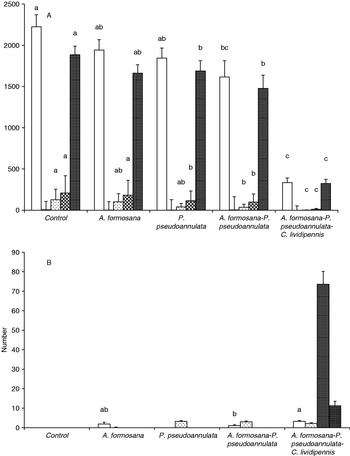
The total number of arthropods collected with the blower-vac at the end of the experiment confirmed findings from visual observations. The overall effect of treatment on the total number of BPH (log-transformed) was highly significant (F4,35=69.6, P<0.0001). Most BPH were found in the control, least in the treatment with all predators, and intermediate numbers in the treatments with A. formosana, P. pseudoannulata and both spider species (fig. 4a). A comparison of treatments (t-test, P>0.05) across age groups showed that the least BPH remained in the two mixed treatments and intermediate numbers remained in the single spider treatments. Most BPH remained in the control, but not significantly more than in the single spider treatments (fig. 4a). The effect of treatment, when tested separately on BPH age groups (all log-transformed), was significant for adult BPH (F4,35=67.1, P<0.0001), medium-instar BPH nymphs (F4,35=14.6, P<0.0001) and late instar nymphs (F4,35=14.2, P<0.0001), but not for early instar nymphs, of which there were few (F4,35=1.4, P=0.25). However, significantly less medium and large instar BPH were found in the P. pseudoannulata treatment than in the A. formosana treatment and the control.
Mean numbers (±SE) by the conclusion of the experiment with unmated and immature spiders of (A) BPH across instars (white), small, medium-sized and large BPH nymphs and adult BPH (increasing shades of grey); and (B) A. formosana (white), P. pseudoannulata (light grey) and C. lividipennis adults (medium grey) and nymphs (dark grey) by the conclusion of the experiment with unmated and immature spiders.

There was a significant effect of treatment on the number of A. formosana (square-root transformed) (F2,21=3.9, P=0.036). Significantly fewer remained in the A. formosana-P. pseudoannulata treatment than in the treatment with all three predators (t-test, P<0.05), while the A. formosana treatment was intermediate and not significantly different from the other two treatments (fig. 4b). P. pseudoannulata spiderlings had not yet reached adulthood; and, in contrast to A. formosana, their numbers (square-root transformed) were not significantly different among treatments (F2,21=0.26, P=0.78). Finally, the number of C. lividipennis had increased to an average of 84.9±8.8 nymphs and adults per cage (fig. 4b) by the conclusion of the experiment, double the number found in visual observations (42.5±2.6). In the first experiment, a comparable average of 30.2±4.2 C. lividipennis were observed after three weeks. In this experiment, numbers of collembola, Microvelia sp. and mosquito larvae were negligible and were not recorded separately.
An estimation of daily consumption rates during the first two weeks of the experiment, similar to the one done for the experiment with adult spiders, yields feeding rates equivalent to those found for adult spiders, with an average of 4.9 BPH eaten per day by each of the seven A. formosana, 12.1 BPH eaten per day by each of the four P. pseudoannulata spiderlings, 4.7 eaten per spider per day in the A. formosana-P. pseudoannulata treatment (11 spiders) and 5.3 eaten per predator per day in the treatment with all three predators (11 spiders and ten C. lividipennis).
Discussion
Reduction of BPH by individual predator species
Both spider species significantly reduced planthopper populations. Pardosa pseudoannulata adults and large spiderlings are capable of handling adult BPH, which may explain early good control of BPH in the P. pseudoannulata treatment, compared to the A. formosana treatment. The smaller A. formosana, being more suited for control of young BPH, displayed delayed control compared to P. pseudoannulata in both experiments, although in the experiment with immature spiders the two single spider treatments were not significantly different. Final absolute samplings (blower-vac count) were in agreement with visual observations and showed that later BPH instars and adults were better controlled by P. pseudoannulata, whereas A. formosana was superior at controlling young nymphs. The effect of C. lividipennis was comparable to that of A. formosana. While C. lividipennis has long been recognized as being an important predator of BPH, this experiment stresses the role of the less well-studied A. formosana in early BPH control.
Immature vs. mature spiders
The delayed introduction of spiders, and the fact that immature or unmated female spider were used, meant that BPH densities in all treatments, except the one with C. lividipennis, were higher in the experiment with immature spiders than in the experiment with adult spiders.
The numbers of C. lividipennis increased during the experiment with immature spiders (fig. 3c), and the effect of C. lividipennis on the BPH population was evident. In this experiment, the mirid had had time to reproduce and to reduce the population of BPH somewhat by the time spiders were introduced. The A. formosana population declined over the course of the experiment in all three treatments where it was included, probably through ageing of the unmated females (fig. 3b). A slight decrease was also observed in P. pseudoannulata numbers (fig. 3c), although final numbers were not significantly different among treatments. A low after one week in mixed treatments may reflect a different distribution of P. pseudoannulata in cages with other predators leading to reduced visibility. P. pseudoannulata adjust their distribution to conditions (Heong and Rubia, Reference Heong and Rubia1990), thus reducing the risk of encounter and cannibalism.
Reduction of BPH by more predator species
In both experiments, the two spider species combined were more effective in controlling BPH than single spider treatments. In the experiments, realistic early season field densities of BPH and the two spider species were used, thus the result shows that A. formosana is an important early season predator alone, as well as when P. pseudoannulata is present. In the first experiment, mirids (C. lividipennis) were soon depleted and the treatment did not significantly differ from that with both spider species; however, in the second experiment, BPH suppression with all three predators was significantly superior to the treatment with both spider species. While A. formosana was more effective in controlling young BPH nymphs, P. pseudoannulata exerted better control of later BPH instars and adults. Thus, in mixed treatments, all instars of BPH remained low; while in the P. pseudoannulata treatment, numbers of A. formosana and C. lividipennis were negatively affected by the presence of P. pseudoannulata. Antagonistic interactions could be competition for prey or intraguild predation. Competition for prey cannot be excluded, especially during the latter part of the first experiment where less BPH remained. However, interference between predators of the same species can also cause predators to decrease their rates of prey consumption (Clark et al., Reference Clark, Wolcott, Wolcott and Hines1999; Griffin & Byers, Reference Griffin and Byers2006).
Intraguild predation
The fact that more P. pseudoannulata were found in the treatment with both spider species than in the P. pseudoannulata treatment shows that P. pseudoannulata benefited from the presence of A. formosana, confirming that A. formosana serves as intraguild prey for P. pseudoannulata.
In the first experiment, C. lividipennis was seriously restricted by the presence of spiders. Pardosa pseudoannulata prefer adult BPH over adult C. lividipennis at densities of 10:60 but with decreasing preference at increasing proportions of BPH (Heong and Rubia, Reference Heong and Rubia1989). This ‘inverse switch’ in preference may be due to P. pseudoannulata actively optimizing its diet, as seen in another wolf spider (Greenstone, Reference Greenstone1979). Since the dietary quality of BPH is intermediate and not significantly different from prey mixtures, optimization cannot be excluded (Sigsgaard et al., Reference Sigsgaard, Toft and Villareal2001). In addition, it has been shown that a Pardosa sp. would ingest more nitrogen and biomass and grow faster on intraguild prey (Matusumura et al., Reference Matsumura, Trafelet-Smith, Gratton, Finke, Fagan and Denno2004). Thus, it is plausible that the absence of C. lividipennis in the first experiment was at least partly due to P. pseudoannulata predation. Perhaps the delayed role of C. lividipennis in a field situation may be due to spider predation, perhaps later alleviated as the crop grows, thus improving chances for C. lividipennis escaping spider predation.
A tendency was observed in the first experiment for higher numbers of A. formosana to occur in the mixed treatment than in the treatment with both spiders. In the second experiment, this was significant. Intraguild predation by P. pseudoannulata on A. formosana may be relieved in the presence of C. lividipennis. In addition, C. lividipennis may serve as prey for A. formosana, but this will require a separate analysis to be tested.
In the first experiment with adult spiders, mixed treatments led to almost absolute elimination of BPH by the end of the experiment, providing incentives for intraguild predation and cannibalism. Cannibalism, which is well documented for P. pseudoannulata (Iida, Reference Iida2003) is supported by the near significantly fewer P. pseudoannulata males in the P. pseudoannulata treatment. Food shortage may also explain the decrease observed in P. pseudoannulata numbers the last weeks of the experiment. A similar drop was not observed in A. formosana numbers. Spiders probably fed on the incidental arthropods since their numbers were lower in treatments with predators.
A biological control perspective
The relative scarcity in the literature of positive interactions among predators might be due to negative interactions being more common (Polis et al., Reference Polis, Myers and Holt1989; Matsumura et al., Reference Matsumura, Trafelet-Smith, Gratton, Finke, Fagan and Denno2004). However, seen from a biological control perspective, the presence of more predators can be an advantage for the control of BPH in rice. Alone, A. formosana and C. lividipennis are less efficient predators than P. pseudoannulata, but they can contribute to BPH control and are more efficient predators of young instars. In years where P. pseudoannulata is less numerous, A. formosana and C. lividipennis can still provide important control of planthoppers. Their dietary value as prey for P. pseudoannulata has not been studied separately; but better survival and more offspring of P. pseudoannulata were observed, suggesting a contribution towards higher fitness of P. pseudoannulata, which in turn can have long-term positive consequences for its ability to control BPH (Toft & Wise, Reference Toft and Wise1999; Sigsgaard et al., Reference Sigsgaard, Toft and Villareal2001). Several other studies have shown positive effects on biocontrol with increased predator biodiversity (Cardinale et al., Reference Cardinale, Harvey, Gross and Ives2003; Snyder et al., Reference Snyder, Snyder, Finke and Straub2006). The positive effect on biocontrol may be a result of P. pseudoannulata intraguild predation. In a further example, a study of predatory crabs demonstrated that when predator combinations with the potential for intraguild predation were examined, predator interference increased and predator redundancy decreased (Griffin & Byers, Reference Griffin and Byers2006). However, with an additional intraguild predator together with a wolf spider, prey reduction may be lessened as observed in a salt-marsh microcosm (Finke & Denno, Reference Finke and Denno2005). Also, positive interactions of rice predators in BPH control was not observed with three-predator combinations of C. lividipennis, P. pseudoannulata, the coccinellid Micraspis crocea (Mulsant) and the cricket Metioche vittaticollis (Stål) in a 24 h cage experiment (Wilby et al., Reference Wilby, Villareal, Lan, Heong and Thomas2005). This could be a consequence of the chosen predator combinations. Moreover, the short duration of the experiment restricted results attainable on predator interactions to interactions between adults. A positive effect of the same predator combinations on the rice leaffolder, Marasmia patnalis Bradley, was attributed to greater morphological differences in prey instars permitting better resource partitioning among predator species (Wilby et al., Reference Wilby, Villareal, Lan, Heong and Thomas2005). This finding suggests that positive interactions will be more common when more prey is available; and is, thus, in agreement with findings showing that, where both predator, herbivore and plant diversity can influence biocontrol, a positive effect of increased predator biodiversity may be most likely (Aquilino et al., Reference Aquilino, Cardinale and Ives2005). While control of a single herbivore species is not always improved by increased diversity of natural enemies, the diversity will ensure a better overall defence against a variety of pests, as shown for a spider community in apple (Marc & Canard, Reference Marc and Canard1997). In unsprayed rice, BPH populations are normally low, supporting the finding that more predators improve biological control of BPH.
Acknowledgements
Special thanks to Prof. Dr Michael Way, UK, Dr K.L. Heong, IRRI, the Philippines and Prof. J. Weiner, KVL, for commenting on an earlier draft of this paper. Also, thanks to two anonymous referees for comments that have further improved the paper. Invaluable practical assistance was given by BSc. Sylvia Villareal and technical, as well as field, staff at IRRI. The research was financially supported by DANIDA and assistance and facilities were provided by IRRI.