Introduction
Over 5 million older adults in the United States live with Alzheimer’s disease (AD) and related dementias (Matthews et al., Reference Matthews, Xu, Gaglioti, Holt, Croft, Mack and McGuire2019). One major goal is to discover noninvasive in vivo brain imaging biomarkers related to early dementia risk factors decades before major impairment (Braak et al., Reference Braak, Thal, Ghebremedhin and Del Tredici2011). One early risk factor is subjective cognitive decline, defined as reporting worsening cognition (Jessen et al., Reference Jessen, Amariglio, van Boxtel, Breteler, Ceccaldi, Chetelat, Dubois, Dufouil, Ellis, Van Der Flier and Glodzik2014). In the AD pathway, subjective cognitive decline is thought to occur before objective cognitive impairment (Jessen et al., Reference Jessen, Amariglio, van Boxtel, Breteler, Ceccaldi, Chetelat, Dubois, Dufouil, Ellis, Van Der Flier and Glodzik2014; Rabin et al., Reference Rabin, Smart, Crane, Amariglio, Berman, Boada, Buckley, Chételat, Dubois, Ellis, Gifford, Jefferson, Jessen, Katz, Lipton, Luck, Maruff, Mielke, Molinuevo and Sikkes2015). Aligned with this idea, subjective cognitive decline in cognitively unimpaired older adults relates to a 2–4-fold increased risk of converting to mild cognitive impairment and dementia (Snitz et al., Reference Snitz, Wang, Cloonan, Jacobsen, Chang, Hughes, Kamboh and Ganguli2018; van Harten et al., Reference van Harten, Mielke, Swenson-Dravis, Hagen, Edwards, Roberts, Geda, Knopman and Petersen2018). Subjective cognitive decline is also linked to higher levels of amyloid and tau (Buckley et al., Reference Buckley, Hanseeuw, Schultz, Vannini, Aghjayan, Properzi and Sperling2017; Miebach et al., Reference Miebach, Wolfsgruber, Polcher, Peters, Menne, Luther, Incesoy, Priller, Spruth, Altenstein and Buerger2019; Snitz et al., Reference Snitz, Weissfeld, Cohen, Lopez, Nebes, Aizenstein, McDade, Price, Mathis and Klunk2015). As such, neuroimaging biomarkers related to subjective cognitive decline may help find who is at risk for AD pathology in a noninvasive manner.
Magnetic resonance imaging (MRI) studies have detected slightly smaller medial temporal, parietal, hippocampal, and prefrontal gray matter volumes in people with subjective cognitive decline compared to peers without (Jessen et al., Reference Jessen, Feyen, Freymann, Tepest, Maier, Heun, Schild and Scheef2006; Saykin et al., Reference Saykin, Wishart, Rabin, Santulli, Flashman, West and Mamourian2006). Such differences are consistent with areas affected in later AD stages (Csernansky et al., Reference Csernansky, Wang, Swank, Miller, Gado, Mckeel and Morris2005; Morris et al., Reference Morris, Roe, Grant, Head, Storandt, Goate, Fagan, Holtzman and Mintun2009). However, there is a need to go beyond examining allocortical and neocortical brain regions as substantial atrophy due to AD pathology may not occur until later in the disease. Neuroimaging of the brainstem, and the locus coeruleus (LC) in particular, is one promising target as it shows abnormal tau long before tau and amyloid pathology spread into the cortex (Braak et al., Reference Braak, Thal, Ghebremedhin and Del Tredici2011). Neuroimaging of the LC may help explain subjective cognitive decline related to AD pathology.
The LC is located in the dorsal pons and is critical for higher order cognitive processing, arousal, and attention through tonic and phasic release of norepinephrine/noradrenaline throughout the brain (Aston-Jones & Bloom, 2005; Aston-Jones & Bloom, Reference Aston-Jones and Bloom1981). Tonic norepinephrine/noradrenaline release from the LC keeps the brain in “readied” exploratory states of attention essential for bottom-up information processing, while phasic norepinephrine/noradrenaline releases aid the strategic use of attention for purposeful tasks, i.e., attentional control (Aston-Jones & Bloom, 2005). Injured LC neurons release tonic norepinephrine/noradrenaline, which may disrupt cognitive function by offsetting phasic norepinephrine/noradrenaline releases and increasing distractibility (Chiodo et al., Reference Chiodo, Acheson, Zigmond and Stricker1983). As a possible driver of early AD symptoms, people may report subjective cognitive decline as they face attentional difficulties due to LC damage. Studies show that LC damage occurs often due to early tau pathology as early as midlife (Braak et al., Reference Braak, Thal, Ghebremedhin and Del Tredici2011).
Autopsy studies describe the LC as one of the first structures to show abnormal tau, even before the appearance of amyloid in the cortex (Braak et al., Reference Braak, Thal, Ghebremedhin and Del Tredici2011). Accumulation of abnormal tau may damage the LC leading to the persistent release of tonic norepinephrine/noradrenaline (Janitzky, Reference Janitzky2020), which may contribute to subjective cognitive decline in early AD stages. Furthermore, AD’s effects in the LC appear region specific. Abnormal tau mostly accumulates and damages the rostral-middle region of the LC, which is responsible for delivering norepinephrine/noradrenaline to the hippocampus and areas of the neocortex (Betts et al., Reference Betts, Cardenas-Blanco, Kanowski, Jessen and Duzel2017; Betts et al., Reference Betts, Kirilina, Otaduy, Ivanov, Acosta-Cabronero, Callaghan and Hämmerer2019; German et al., Reference German, Manaye, White, Woodward, McIntire, Smith, Kalaria and Mann1992; Theofilas et al., Reference Theofilas, Ehrenberg, Dunlop, Di Lorenzo Alho, Nguy, Leite and Grinberg2017). Deterioration of the rostral-middle LC due to abnormal tau has also been linked to cognitive decline (Hämmerer et al., Reference Hämmerer, Callaghan, Hopkins, Kosciessa, Betts, Cardenas-Blanco and Dolan2018; Dahl et al., Reference Dahl, Mather, Duzel, Bodammer, Lindenberger, Kuhn and Werkle-Bergner2019). By comparison, the caudal LC, which has most projections linked to the spinal cord, is less affected by AD pathology and its integrity has been unrelated to objective cognitive performance (Elman et al., Reference Elman, Puckett, Beck, Fennema-Notestine, Cross, Dale, Eglit, Eyler, Gillespie, Granholm, Gustavson and Kremen2021). As such, the rostral-middle LC may be more linked to subjective cognitive decline than the caudal region. Recent technology now allows us to investigate this link.
Brainstem regions are notoriously difficult to image in vivo, as their deep, small structures are not visible on commonly used structural MRI sequences. However, researchers have noticed that the LC shows hyperintensity compared to surrounding regions on certain imaging protocols. Although reasons for hyperintensity are still under investigation (Watanabe et al., Reference Watanabe, Tan, Wang, Martinez-Hernandez and Frahm2019; Priovoulos et al., Reference Priovoulos, van Boxel, Jacobs, Poser, Uludag, Verhey and Ivanov2020), LC signal intensity can shine light onto its structural integrity. Researchers have used LC-sensitive MRI sequences to compare signal intensity from the LC region to surrounding brainstem structures, known as an LC contrast to noise ratio (LCCNR). LCCNR has been shown to not only relate to LC neuronal count shown in post-mortem autopsies but also has been linked to episodic memory performance in older adults (Hämmerer et al., Reference Hämmerer, Callaghan, Hopkins, Kosciessa, Betts, Cardenas-Blanco and Dolan2018; Dahl et al., Reference Dahl, Mather, Duzel, Bodammer, Lindenberger, Kuhn and Werkle-Bergner2019; Elman et al., Reference Elman, Puckett, Beck, Fennema-Notestine, Cross, Dale, Eglit, Eyler, Gillespie, Granholm, Gustavson and Kremen2021) and tau accumulation (Jacobs et al., Reference Jacobs, Becker, Kwong, Engels-Domínguez, Prokopiou, Papp, Properzi, Hampton, d’Oleire Uquillas, Sanchez, Rentz and Sanchez2021). Using this in vivo assessment of LC integrity, our study aimed to provide the first in vivo examination of the LC and subjective cognitive decline.
Our study had a central hypothesis and two exploratory aims. Our central hypothesis was that lower rostral-middle LC integrity would be associated with greater overall subjective cognitive decline. This association is expected due to the demonstrated associations between rostral-middle LC integrity and objective cognitive performance (Hämmerer et al., Reference Hämmerer, Callaghan, Hopkins, Kosciessa, Betts, Cardenas-Blanco and Dolan2018; Dahl et al., Reference Dahl, Mather, Duzel, Bodammer, Lindenberger, Kuhn and Werkle-Bergner2019; Elman et al., Reference Elman, Puckett, Beck, Fennema-Notestine, Cross, Dale, Eglit, Eyler, Gillespie, Granholm, Gustavson and Kremen2021) assuming subjective cognitive decline is an indirect measure of actual declines in cognitive function. Subjective cognitive decline may also capture subtle problems in higher order cognitive processing, arousal, and attention when objective testing is normal, as suggested by studies showing disruption of neural networks (Smart et al., Reference Smart, Segalowitz, Mulligan and MacDonald2014; Tu et al., Reference Tu, Lo, Huang, Huang, Deng and Hsu2018) and lowered alertness to stimuli (Esmaeili et al., Reference Esmaeili, Nejati, Shati, Vatan, Chehrehnegar and Foroughan2021). We did not hypothesize relationships between caudal LC region and subjective cognitive decline, although this was investigated to assess regional specificity of effects. For our first exploratory aim, we examined associations of LC integrity across individual subscales of subjective cognitive decline, including decline in subjective memory, executive function, language, and visuospatial ability. Our second exploratory aim assessed whether any significant associations between LC integrity and subjective cognitive decline were attenuated after controlling for objective cognitive performance, captured as current levels of performance or decline from about 12 years prior. This aim helped us directly test our assumption that associations between LC integrity and subjective cognitive decline primarily reflect LC-related decline in objective cognitive performance. In supplemental analyses, we assessed associations with hippocampal volume as a comparison region affected much in later stages of AD pathology as compared to the LC (Braak et al., Reference Braak, Thal, Ghebremedhin and Del Tredici2011). Findings clarify the role of the LC in subjective cognitive decline experienced in early old age.
Methods
Participants
Participants were from the Wave 3 of the Vietnam Era Twin Study of Aging (VETSA) project when LC imaging was added to the protocol (Kremen et al., Reference Kremen, Franz and Lyons2013; Kremen, Franz, & Lyons, Reference Kremen, Franz and Lyons2019; Kremen et al., Reference Kremen, Thompson-Brenner, Leung, Grant, Franz, Eisen and Lyons2006). VETSA is a longitudinal aging project designed to investigate behavioral genetics of cognitive and brain aging. VETSA participants were from a random sample recruited from the Vietnam Era Twin Registry (VETR), a national registry of male-male adult twin pairs who served during the Vietnam War era (1965–1975), who also participated in the Harvard Drug Study (Tsuang et al., Reference Tsuang, Bar, Harley and Lyons2001). Nearly 80% did not report combat exposure. VETSA participants are comparable to community-dwelling men in the United States on demographics and lifestyle factors as well (Schoeneborn & Heyman, Reference Schoeneborn and Heyman2009). More details of this project have been reported elsewhere (Kremen et al., Reference Kremen, Franz and Lyons2013; Kremen et al., Reference Kremen, Franz and Lyons2019) and data remain available for external access (http://www.vetsatwins.org/for-researchers/).
Wave 3 of VETSA occurred from 2016 to 2019, when the average age was 68 years. Of the sample, 487 met standard MRI inclusion criteria (e.g., no metal in the body). Of these, 442 had LC and cortical imaging data. From this, we removed people with MRI-based cerebral abnormalities (encephalomalacia, meningioma, large infarct, etc.; n = 6) or who had low LC imaging quality due to excessive head motion in the scanner (n = 4) as assessed by visual inspection. We also excluded people with a self-reported history of stroke (n = 18), seizures (n = 5), HIV (n = 2), schizophrenia (n = 1), and alcohol dependency (n = 24). One more person was removed for having no data on subjective cognitive decline (n = 1). In the final sample for this analysis (n = 381), participants were an average of 67.58 years of age (SD = 2.62, range = 62.96 to 71.00), 88% Non-Hispanic White (n = 336), and had an average education of 13.98 years (SD = 2.07). No participants were diagnosed with dementia, but 57 participants had MCI (15%) as defined below.
All procedures were approved by the Institutional Review Board at the University of California San Diego and Boston University, and all participants gave written informed consent for the study. Procedures were in accordance with the Helsinki Declaration.
LC MRI acquisition and processing
Our analyses use MRI data from Wave 3 of VETSA. Description of our MRI imaging for the LC has been published in detail (Elman et al., Reference Elman, Panizzon, Hagler, Eyler, Granholm, Fennema-Notestine, Lyons, McEvoy, Franz, Dale and Kremen2017). Neuroimaging was conducted using two GE 3T Discover 750x scanners (GE Healthcare, Waukesha, WI, USA) equipped with eight-channel phased-array head coils. Imaging of the LC was completed using oblique axial FSE-T1-weighted images (TR = 600 ms; TE = 14 ms; flip angle = 90°; matrix = 512 × 320; FOV = 220 mm; pixel size 0.42 × 0.68 mm; 10 slices; slice thickness = 2.5 mm; interslice gap = 1 mm, acquisition time = 4 min and 44 s, online averaging).
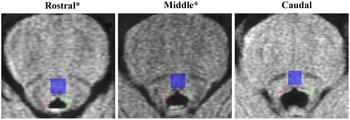
LC-related hyperintensity was visible on three slices or four slices (about half of the participants each), with the three slices showing the most visible LC-related hyperintensity being used. Each image was marked by two out of four experienced raters using a modified version of the Clewett et al. method (Clewett et al., Reference Clewett, Lee, Greening, Ponzio, Margalit and Mather2016). Signal intensities were derived from manually marked regions of interest (ROI) on three slices corresponding to the LC rostral-middle, middle, and caudal portions (shown in Figure 1). The middle slice was selected by taking the slice 7 mm below the inferior edge of the inferior colliculus. Two 3 mm2 voxel crosses were manually placed over the left and right sides of the middle LC region centered on the voxel of highest signal within the area of LC-related hyperintense signal. We controlled for overall signal intensity variability by taking the contrast-to-noise ratio of signal in the LC compared to a reference region. The reference region was marked with a 10mm2 ROI over the pontine tegmentum (PT) – located 6 voxels anterior to the central voxel of the LC ROI. The same processes were followed to then mark one slice superior (i.e., rostral LC) and one slice inferior (i.e., caudal LC) relative to the middle slice. Left and right LC values were averaged together on each slice. Next, an LC contrast to noise ratio (LCCNR) was calculated to get a single value of LC signal intensity (where higher scores indicate better integrity) for each slice with the following equation:
 $${\rm{L}}{{\rm{C}}_{\rm{CNR}}} = \underline {({\rm{LC}}} {\,_{\underline {{\rm{intensity}}} }}\underline { - {\rm{PT}}} {\,_{\underline {{\rm{intensity}}} }})$$
 $${\rm{P}}{{\rm{T}}_{{\rm{intensity}}}}$$
Summary of the manual marking method of the LC. Note. The middle slice is selected 7 mm below the inferior colliculus. Left and right portions of the locus coeruleus (LC) are marked on the rostral, middle, and caudal slices with a 3mm2 cross. Signal intensity is averaged from left and right regions to calculate rostral, middle, and caudal LC intensity. As a reference region, we placed a 10 mm2 square placed over the pontine tegmentum (PT). The same marking rules were used to calculate signal intensity for the rostral, middle, and caudal slice of the PT. A contrast to noise (CNR) is created for each region using LC signal intensity subtracted by PT signal intensity and divided by PT signal intensity for each region. *For this study, we averaged rostral and middle LC CNR as both regions show similar age and disease-related effects. The caudal LC CNR was used as an exploratory aim and comparison region.

For this study, signals from the rostral and middle slices were averaged to create a rostral-middle LCCNR as they both show more prominent changes due to aging and AD (Betts et al., Reference Betts, Kirilina, Otaduy, Ivanov, Acosta-Cabronero, Callaghan and Hämmerer2019; German et al., Reference German, Manaye, White, Woodward, McIntire, Smith, Kalaria and Mann1992). Caudal LCCNR was defined as the contrast-to-noise ratio in the most caudal slice. Regarding reliability, four raters showed 95% inter-rater reliability across the entire data set (calculated from the results of a mixed model; Wald’s Z = 15.14, p < .001). LCCNR was standardized (z-scored) for ease of interpretability.
Hippocampal volume
Hippocampal volume was estimated using atlas-based volumetric segmentation (Fischl et al., Reference Fischl, Salat, Busa, Albert, Dieterich, Haselgrove and Dale2002; Fischl et al., Reference Fischl, Salat, van der Kouwe, Makris, Segonne, Quinn and Dale2004) performed using FreeSurfer version 6.0 (http://surfer.nmr.mgh.harvard.edu). Details provided in the Supplemental Material.
Subjective cognitive decline
At Wave 3, subjective cognitive decline was measured using the participant- and informant-rated versions of the Everyday Scale of Cognition (ECOG). This scale has been previously validated (Farias et al., Reference Farias, Mungas, Reed, Cahn-Weiner, Jagust, Baynes and Decarli2008) and higher scores correspond to an elevated risk of MCI and dementia pathology (Shokouhi et al., 2019; van Harten et al., 2018). Domains of everyday cognition are queried through four subscales: Memory (8 items), Executive Function (15 items), Language (9 items), and Visuospatial Abilities (7 items). For each item, participants and their informants separately rated current behavioral functioning with that of 10 years earlier. They rated items on a 4-point Likert-type scale: 1 = better or no change, 2 = questionable/occasionally worse, 3 = consistently a little worse, and 4 = consistently much worse. A total score was calculated by averaging the scores across all items of the ECOG, which can be thought to capture changes in global cognitive function. This has been done previously (Farias et al., Reference Farias, Mungas, Reed, Cahn-Weiner, Jagust, Baynes and Decarli2008) and seemed appropriate as subscales were highly intercorrelated (range from .35 to .68, see Table S1 in the Supplementary Material). The ECOG and its subscales demonstrated high reliability across participant and informant ECOG scales (αs range from .81 to .86).
MCI Classification
MCI classification followed the Jak-Bondi approach, which defined MCI as performing > 1.5 SDs worse on 2 or more tasks within a cognitive domain after adjusting for age and education (Bondi et al., Reference Bondi, Houston, Eyler and Brown2005; Jak et al., Reference Jak, Panizzon, Spoon, Fennema-Notestine, Franz, Thompson, Jacobson, Xian, Eyler, Vuoksimaa, Toomey and Vuoksimaa2015). These were preadjusted for practice effects, age, education, and young adult cognitive ability as described in the Supplemental Material.
Covariates
Covariates included age (years), young adult cognitive ability (Armed Forces Qualification Test; Lyons et al., Reference Lyons, York, Franz, Grant, Eaves, Jacobson, Warner Schaie, Panizzon, Boake, Xian, Toomey, Eisen and Kremen2009; Lyons et al., Reference Lyons, Panizzon, Liu, McKenzie, Bluestone, Grant, Franz, Vuoksimaa, Toomey, Jacobson and Reynolds2017), education (years), objective cognitive function (factor scores of episodic memory, executive function, fluency, and visuospatial ability), objective cognitive decline (change in factor scores from Wave 1), depressive symptoms (CESD; Radloff, Reference Radloff2016), and number of physical morbidities. Covariates are described in detail in the Supplemental Material.
Statistical analysis
Descriptive statistics for major variables of interest and sample characteristics are shown in Table 1. Variables were assessed for normality before analyses using a cutoff of > |2| on metrics of skewness and kurtosis. Rostral-middle and caudal LCCNR were within acceptable bounds and did not require transformation. ECOG scores, however, showed a negative skew (between 2.25 and 4.25) and were hyper-kurtotic (range from 2.21 to 24.59), which normalized after a logarithmic transformation (skewness and kurtosis < |2|). Distributions of the major variables are provided in Figure S1 in the Supplementary Material.
Demographics of sample (n = 381)

a ECOG overall average and subscales were later log-transformed for normality in analyses but shown untransformed in this table for clarity.
Notes. CESD = Center for Epidemiological Studies Depression scale; ECOG = Everyday Cognition scale. Race was coded as Non-Hispanic White and non-White. The variable of physical morbidities was a summed index from a medical interview of the presence of heart attack, heart failure, peripheral vascular disease, thrombolysis, hypertension, angina, diabetes, bronchitis, asthma, cancer, osteoarthritis, rheumatoid arthritis, and cirrhosis. ECOG asked participants and informants to rate changes in behaviors in the last ten years.
For our first analyses, we performed Spearman-rank correlations between major variables in our study, including LC integrity, participant and informant ECOG subscales, and current objective cognitive performance at Wave 3, shown in Table 2. The purpose of these initial analyses was to understand the correlation of the LCCNR with outcomes before covariate adjustment, examine the relationship between participant and informant ratings, and examine how much ECOG ratings related to current objective cognitive performance in respective domains.
Correlations between locus Coeruleus integrity, subjective cognitive decline, and objective cognitive performance (n = 381)

Note. ECOG = Everyday Cognition Scale. Correlations are derived from spearman-tau correlations between each ECOG domain shown in the row with its objective performance counterpart. Specifically, correlations for subjective cognitive decline, subjective memory decline, subjective executive function decline, subjective language decline, subjective visuospatial decline are analyzed with objective factors scores of global cognition, memory, executive function, verbal fluency, and visuospatial function, respectively. ECOG cognition scores are the average of all ECOG items.
For main analyses, mixed models were fitted in SPSS software Version 26 (MIXED; IBM Corp., 2016) to test associations between LCCNR and ECOG scales. In mixed models shown in Table 3 as Models 1a to 2, predictor variables included rostral-middle or caudal LCCNR and covariates of interest (age, objective cognitive scores, depressive symptoms, and physical morbidities). In our primary models, we adjusted for young-adult cognitive ability as a possible confounder of the relationship between LC integrity and subjective cognitive decline. Young-adult cognitive ability is a more precise measure than years of education, however, results did not change when controlling for years of education instead (see Table S3 in the Supplementary Material). Separate mixed models were run with each participant and informant-rated ECog scale as the outcome. Rostral-middle and caudal LCCNR were placed as predictors in the same model with low multicollinearity (r = .41, p < .001) (ECOG score ∼ β 0 + β 1(rostral-middle LCCNR)t + β 2(caudal LCCNR)t + [covariates] + eit; t = observations nested within twin). Mixed models assumed a Gaussian distribution and adjusted for family (being in the same twin pair). For these models, we interpret the standardized betas with 95% confidence intervals. A repeated measures model additionally nesting rostral-middle and caudal LC values within participant was used to examine whether one LCCNR region was more predictive than another (LCCNR ∼ β 0 + β 1(region type [rostral-middle or caudal])it + β 2(ECOG score) + β 3(region type × ECOG score)it + [covariates] + eit; i = observations nested within individual; t = observations nested within twin). As a complementary analysis, we look at these results when adjusting for current objective cognitive performance (Table 4, Models 1b to 2b). As a complementary analysis, we examined associations when adjusting for objective cognitive decline in a subsample of participants who also completed tests at Wave 1 (Table 5, Models 1c to 2c). For supplemental analyses, we examined associations looking at hippocampal volume as a predictor of ECOG scores.
Associations between the Locus Coeruleus and Subjective Cognitive Decline (n = 381)

a p-values for effects outside of the hypothesized relationship with rostral-middle LC have been corrected for multiple testing using FDR.
Notes. CNR = contrast-to-noise ratio; LC = Locus Coeruleus. Each column represents an ECOG subscale regressed on predictors shown in the rows. Rows under “Participant-Rated Decline” show effects when predicting respective ECOG subscales using participant ratings; rows under the “Informant-Rated Decline” show effects when predicting respective ECOG subscales using informant ratings. Models were assessed in a general estimating equation accounting for related observations between twins in the same pair. Models were adjusted for age, depressive symptoms measured by the Center of Epidemiological Studies – Depression Scale (CESD), and physical morbidities.
Associations between the Locus Coeruleus and Subjective Cognitive Decline after Adjusting for Objective Cognitive Performance (n = 381)

a p-values for effects outside of the hypothesized relationship with rostral-middle LC have been corrected for multiple testing using FDR.
Notes. CNR = contrast-to-noise ratio; LC = Locus Coeruleus. Each column represents an ECOG subscale regressed on predictors shown in the rows. Rows under “Participant-Rated Decline” show effects when predicting respective ECOG subscales using participant ratings; rows under the “Informant-Rated Decline” show effects when predicting respective ECOG subscales using informant ratings. Models were assessed in a general estimating equation accounting for related observation between twins in the same pair. Models were adjusted for age, depressive symptoms measured by the Center of Epidemiological Studies – Depression Scale (CESD), and physical morbidities. For objective cognitive performance as a covariate, models with subjective cognitive decline, subjective memory decline, subjective executive function decline, subjective language decline, subjective visuospatial decline are analyzed with factors scores of global cognition, memory, executive function, verbal fluency, and visuospatial ability, respectively.
Associations between the Locus Coeruleus and Subjective Cognitive Decline after Adjusting for Objective Cognitive Decline (n = 287)

a p-values for effects outside of the hypothesized relationship with rostral-middle LC have been corrected for multiple testing using FDR.
Notes. CNR = contrast-to-noise ratio; LC = Locus Coeruleus. Each column represents an ECOG domain regressed on predictors shown in the rows. Rows under “Participant-Rated Decline” show effects when predicting respective ECOG subscales using participant ratings; rows under the “Informant-Rated Decline” show effects when predicting respective ECOG subscales using informant ratings. Models were assessed in a general estimating equation accounting for related observations between twins in the same pair. For objective cognitive decline as a covariate, models with subjective cognitive decline, subjective memory decline, subjective executive function decline, subjective language decline, subjective visuospatial decline are analyzed with declines in objective factors scores of global cognition, memory, executive function, verbal fluency, and visuospatial ability from Wave 1 to Wave 3, respectively.
Finally, we conducted sensitivity analyses excluding people with MCI in the main analyses (mixed models) to provide results generalizable to people not cognitively impaired. Statistical significance was determined with an α at .05. FDR multiple testing correction was applied for all analyses outside the main hypothesis that rostral-middle LC integrity would be related to ECOG scores. Given what is known about rostral-middle versus caudal LC, we did not expect a significant association between subjective decline and caudal LC.
Results
Descriptives and bivariate correlations
As shown in Table 1, most people and their informants reported subjective cognitive decline in the range from “better to no change (1)” to “questionably/occasionally worse (2)” with mean scores ranging from 1.35 to 1.61. Regarding bivariate correlations shown in Table 2, lower rostral-middle LCCNR was related to worse participant-rated ECOG scores (r’s range from -.15 to -.10, ps < .05) while the caudal LC was not related to any participant-rated ECOG score (ps > .05). Lower rostral-middle LCCNR was related to the worse informant-rated ECOG score of subjective visuospatial ability (r = –.13, p = .009) while the caudal LCCNR was not related to any informant-rated ECOG score (ps > .05). Lower rostral-middle LCCNR and higher ECOG scores were related to worse objective cognitive function as shown in Table 2. Rostral-middle LCCNR, caudal LCCNR, and most ECOG scores were not associated with objective cognitive decline as shown in Supplementary Table S2.
Relationship of LCCNR with participant-rated decline
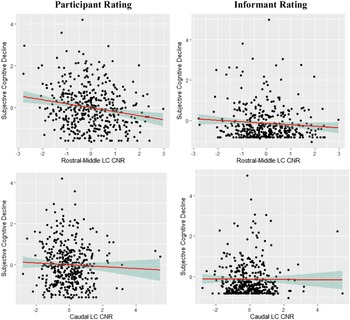
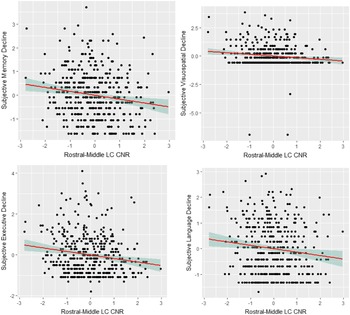
Lower rostral-middle LCCNR was related to greater decline in participant-rated subjective cognition (β = –.18, 95% CI [–.29, –.07], p = .001, see Figure 2). For our first exploratory analyses, we examined associations between LCCNR and ECOG subscales. As shown in Table 3 Model 1a, lower rostral-middle LCCNR related to greater decline in subjective memory (β = –.15, 95% CI [–.26, –.04], p = .007), subjective executive function (β = –.16, 95% CI [–.27, –.05], p = .005), subjective language (β = –.14, 95% CI [–.25, –.03], p = .012), and subjective visuospatial ability (β = –.15, 95% CI [–.26, –.04], p = .010). Associations are visualized in Figure 2. Shown in Table 3, no significant associations appeared when looking at the caudal LCCNR as a predictor (ps > .05). Nonsignificant association of caudal LCCNR is illustrated in Figure 2. To test differences in effect size, we ran a repeated measures model nesting LCCNR within participant testing an interaction of participant-rated subjective cognitive decline with region type. Overall, the interaction term was significant (p < .011), showing that the association of subjective cognitive decline and LCCNR was more significant for rostral-middle LCCNR (β = –.12, 95% CI [–.21 to –.03], p = .011) than caudal LCCNR (β = –.05; 95%CI [95%CI: –.14 to .03]; p = .217).
Scatterplots of the associations of rostral-middle and caudal locus coeruleus integrity and participant-rated and informant-rated subjective cognitive decline. Note. Associations are adjusted for age, young-adult cognitive ability, depressive symptoms, and morbidities. Participant-rated and informant-rated subjective cognitive decline was log transformed from its original scale. CNR = contrast to noise ratio; LC = locus coeruleus. All variables are standardized to z-scores.

Scatterplots of the associations of rostral-middle locus coeruleus integrity and participant-rated ECog subscales. Note. Associations are adjusted for age, young-adult cognitive ability, depressive symptoms, and morbidities. ECog subscales were log transformed from its original scale. CNR = contrast to noise ratio; LC = locus coeruleus. All variables are standardized to z-scores.

For our complementary analyses, we adjusted for objective cognitive performance and objective cognitive decline. Significant findings remained when adjusting for objective cognitive performance (βs range from –.16 to –.12, ps < .05, see Table 4) or objective cognitive decline (βs range from –.19 to –.13, ps < .05, see Table 5).
Relationship of LCCNR with informant-rated decline
Rostral-middle and caudal LCCNR were unrelated to decline in informant-rated subjective cognition and other ECOG subscales (ps > .05, see Table 3). Nonsignificant associations of rostral-middle and caudal LCCNR with informant-rated subjective cognitive decline are illustrated in Figure 2.
Sensitivity analyses excluding participants with MCI
As shown in Table S4 in the Supplementary Material, the pattern of associations between LCCNR and participant-rated ECOG scales was similar when excluding people with MCI. Lower rostral-middle LCCNR was related to greater decline in participant-rated subjective cognition (β = –.16, 95% CI [–.27, –.04], p = .007), subjective executive function (β = –.14, 95% CI [–.26, –.03, p = .018]), subjective language (β = –.12, 95% CI [–.24, –.004, p = .043]), and subjective visuospatial ability (β = –.14, 95% CI [–.24, –.03], p = .013). The association between lower rostral-middle LCCNR and greater subjective memory decline was now marginal with a similar effect size (β = –.23, 95% CI [–.27, .0001], p = .050). Neither rostral-middle nor caudal LCCNR were significantly associated with informant-rated subjective cognitive decline or ECOG subscales when excluding people with MCI (ps > .05).
Supplemental analyses looking at hippocampal volume
Rostral and caudal LCCNR were unrelated to hippocampal volume (p = .957). As shown in Table S3 in the Supplementary Material, there were no significant effects of hippocampal volume on subjective cognitive decline or ECOG subscales after adjusting for age, young-adult cognitive ability, depressive symptoms, and physical morbidities in mixed models (ps > .05).
Discussion
Subjective cognitive decline is one of the earliest symptoms of AD (Snitz et al., 2018; van Harten et al., 2018). We found an inverse relationship between rostral-middle LC integrity, a brain stem region affected early in AD pathology, and participant-rated subjective cognitive decline. Below we integrate these findings into existing research on recent studies of the LCCNR, discuss possible explanatory factors, and summarize implications for AD risk research.
In this study, we used an in vivo measure of LC integrity to explore associations with subjective cognitive decline, one of the earliest presenting AD symptoms (Jessen et al., Reference Jessen, Amariglio, van Boxtel, Breteler, Ceccaldi, Chetelat, Dubois, Dufouil, Ellis, Van Der Flier and Glodzik2014). Our work builds on recent studies linking LC integrity to related AD risk factors including depression and objective cognitive performance (Dahl et al., Reference Dahl, Mather, Duzel, Bodammer, Lindenberger, Kuhn and Werkle-Bergner2019; Elman et al., Reference Elman, Puckett, Beck, Fennema-Notestine, Cross, Dale, Eglit, Eyler, Gillespie, Granholm, Gustavson and Kremen2021; Guinea-Izquierdo et al., Reference Guinea-Izquierdo, Giménez, Martínez-Zalacaín, Del Cerro, Canal-Noguer, Blasco, Gascón, Reñé, Rico, Aguilera and Camins2021), but we are unaware of any studies linking LC integrity to subjective cognitive decline. A previous study found that people with late-life major depression had lower LCCNR compared to healthy controls (Guinea-Izquierdo et al., Reference Guinea-Izquierdo, Giménez, Martínez-Zalacaín, Del Cerro, Canal-Noguer, Blasco, Gascón, Reñé, Rico, Aguilera and Camins2021). In our sample, subjective cognitive decline remained related to LCCNR even after adjusting for depressive symptoms, which suggests that subjective cognitive decline captures something unique. In our second exploratory aim, we sought to determine if this was due to capturing LC-related differences in cognitive performance. Recent work has shown that people with higher rostral-middle LCCNR have better episodic memory and verbal fluency than people with lower rostral-middle LC integrity (Dahl et al., Reference Dahl, Mather, Duzel, Bodammer, Lindenberger, Kuhn and Werkle-Bergner2019; Elman et al., Reference Elman, Puckett, Beck, Fennema-Notestine, Cross, Dale, Eglit, Eyler, Gillespie, Granholm, Gustavson and Kremen2021). Counter to our expectations, however, associations remained after accounting for current objective cognitive performance and objective cognitive decline. Reasons for reporting LC-related subjective cognitive decline could involve the need for compensatory cognitive effort or the LC’s contribution to personality.
The Adaptive Gain Model postulates that the LC is a key neural substrate of higher order cognitive processing, arousal, and attention through its tonic and phasic release of norepinephrine/noradrenaline throughout the cortex (Aston-Jones & Cohen, Reference Aston-Jones and Cohen2005). Greater ratings of subjective cognitive decline may arise as people exert greater cognitive effort to complete tasks in the face of dysregulation of higher order cognitive processing, arousal, and attention. Engagement of cognitive effort would explain why objective cognitive function did not fully explain the relationship between rostral-middle LC integrity and subjective cognitive decline. Engagement of cognitive effort may also explain why rostral-middle LC integrity was related to participant-rated subjective cognitive decline rather than informant-rated subjective cognitive decline. If people with lower rostral-middle LC integrity engage in greater cognitive effort for compensation, then a portion of difficulties in higher order cognitive processing and attention would go undetected by neuropsychological testing or informant observation at first. This is supported by research showing that cognitive decline is first noted by the participant before informants before MCI diagnosis (5 versus 2 years before; Caselli et al., Reference Caselli, Chen, Locke, Lee, Roontiva, Bandy, Fleisher and Reiman2014). As a note, researchers typically consider informant ratings to be more accurate in capturing objective cognitive decline than participant ratings, especially after MCI (Rabin et al., Reference Rabin, Smart and Amariglio2017). However, this boundary is not always so sharp as evidenced by considerable reversion of MCI to cognitively normal on follow-up (18% of cases; Canevelli et al., Reference Canevelli, Grande, Lacorte, Quarchioni, Cesari, Mariani, Bruno and Vanacore2016) and higher participant ratings of subjective cognitive decline than controls in people with MCI (Jessen et al., Reference Jessen, Wolfsgruber, Kleineindam, Spottke, Altenstein, Bartels, Berger, Brosseron, Daamen, Dichgans, Dobisch and Düzel2022). Furthermore, participant and informant ratings are weakly related to objective cognitive decline in people with and without MCI (Gustavson et al., Reference Gustavson, Reynolds, Hohman, Jefferson, Elman, Panizzon and Franz2022; Ryu et al., Reference Ryu, Lee, Kim and Lee2016), emphasizing the larger role of other factors.
In support of the role of compensatory cognitive effort, studies have linked the LC system to objectively measured cognitive effort and MCI risk. Activity of the LC system has been related to pupil dilation, an objective measure of cognitive effort (e.g., Alnæs et al., Reference Alnæs, Sneve, Espeseth, Endestad, van de Pavert and Laeng2014; Joshi et al., Reference Joshi, Li, Kalwani and Gold2016). We showed this recently in our sample as well. A subsample of VETSA participants completed functional imaging of the LC system as well as pupil dilation during a memory task at Wave 2. Overall, participants who had lower network efficiency in the LC system had greater pupil dilation, suggesting the need for greater cognitive effort (Elman et al., Reference Elman, Panizzon, Hagler, Eyler, Granholm, Fennema-Notestine, Lyons, McEvoy, Franz, Dale and Kremen2017). Furthermore, lower LC network efficiency and greater cognitive effort related to increased MCI risk (Granholm et al., Reference Granholm, Panizzon, Elman, Jak, Hauger, Bondi and Kremen2017). Although further study is needed, these studies suggest that participant-rated subjective cognitive decline may arise from lower rostral LC integrity that requires the engagement of cognitive effort for compensation.
It is also possible that the relationship between rostral-middle LC integrity and subjective cognitive decline is not due to changes in later life due to aging or AD pathology, but instead related to long-standing differences in personality. Previous studies have shown that subjective cognitive decline is less related to objective cognitive performance (rs ∼ .10) (Crumley, Stetler, & Horhota, Reference Crumley, Stetler and Horhota2014) and much more related to trait levels of neuroticism (rs > .40) (Merema et al., 2013, Reference Merema, Speelman, Foster and Kaczmarek2013; Bell, Hill, & Stavrinos, Reference Bell, Hill and Stavrinos2020) and is stable over time (Johansson, Björk, & Thorvaldsson, Reference Johansson, Björk and Thorvaldsson2020). We also found in the VETSA sample that subjective cognitive decline corresponded more with levels of concurrent depressive symptoms than objective cognitive decline (Gustavson et al., Reference Gustavson, Reynolds, Hohman, Jefferson, Elman, Panizzon and Franz2022). The LC system may play an important role in neuroticism, explaining why lower rostral-middle LC is related to subjective cognitive decline over and beyond objective cognitive decline. Neuroticism is defined as the tendency to experience negative emotions due to greater physiological arousal and stress reactivity (Eysenck, Reference Eysenck1983; Costa & McCrae, Reference Costa and McCrae1992). As mentioned, the LC regulates arousal through norepinephrine/noradrenaline release to the anterior cingulate cortex, prefrontal cortex, hippocampus, amygdala, and thalamus (Samuels & Szabadi, Reference Samuels and Szabadi2008). People with weaker rostral-middle LC structures may be more arousable leading to higher levels of trait neuroticism resulting in greater subjective cognitive decline. A significant role of neuroticism may also explain lower LC integrity found in major depressive disorder as well (Guinea-Izquierdo et al., Reference Guinea-Izquierdo, Giménez, Martínez-Zalacaín, Del Cerro, Canal-Noguer, Blasco, Gascón, Reñé, Rico, Aguilera and Camins2021). Studies incorporating measures of personality and personality-related patterns of physiological arousal would help clarify this possibility. The role of the LC may be important in explaining why neuroticism and related outcomes like depressive symptoms and subjective cognitive decline are predictive of increased AD risk (Ownby et al., Reference Ownby, Crocco, Acevedo, John and Loewenstein2006; Terracciano et al., Reference Terracciano, Aschwanden, Passamonti, Toschi, Stephan, Luchetti and Sutin2021).
In supplemental analyses, we found that hippocampal volume was not predictive of participant- or informant-rated subjective cognitive decline. Rostral-middle LC integrity remained associated with participant-rated subjective cognitive decline in these analyses. Tau appears in the hippocampus at later stages of spreading compared to the LC (Braak et al., Reference Braak, Thal, Ghebremedhin and Del Tredici2011), so therefore tau in the hippocampus may not be involved in the early stage of subjective cognitive decline. Additional analyses will be needed to assess how relationships change as AD progresses. Hippocampal volume may be more predictive of subjective cognitive decline in later AD stages, and informant ratings may become more reliable as self-awareness decreases (Rabin et al., Reference Rabin, Smart and Amariglio2017).
Findings from this study should be considered alongside limitations. First, subjective cognitive decline and the LC were only assessed at a single timepoint, leaving temporal links unclear. VETSA is currently conducting a fourth wave of data collection which will provide prospective measures of subjective cognitive decline, cognitive function, and LC imaging; and these data will allow us to examine temporal relationships. Second, our measures were also unable to specify pathology. Damage to the LC could have been due to AD or other disease processes. Third, our measure of the LC was also based on manual marking in subject space. This approach avoids inaccuracies introduced by registration and interpolation and shows high inter-rater reliability (Elman et al., Reference Elman, Panizzon, Hagler, Eyler, Granholm, Fennema-Notestine, Lyons, McEvoy, Franz, Dale and Kremen2017). The location of our slices can be compared to other studies based on the location of the middle and rostral slices relative to the inferior colliculus (e.g., the middle slices in 7 mm below the inferior edge of the inferior colliculus). However, automated protocols for LC assessment are a key goal of ongoing research to provide further standardization across studies (Dünnwald et al., Reference Dünnwald, Ernst, Düzel, Tönnies, Betts and Oeltze-Jafra2021). Another limitation of our LC measure is that the caudal LC is more diffuse in structure and is more difficult to visualize in acquisitions such as the one used here (Tona et al., Reference Tona, Keuken, de Rover, Lakke, Forstmann, Nieuwenhuis and van Osch2017). Therefore, we are likely not capturing the caudal-most extent of the LC. However, the pattern of results seen here do still suggest a rostral-caudal gradient of effects. Fourth, our cognitive factor scores did not demonstrate strong invariance, which is expected due to developmental change in means and variances (Haberstumpf et al., Reference Haberstumpf, Forster, Leinweber, Rauskolb, Hewig, Sendtner, Lauer, Polak, Deckert and Herrmann2022; Pentz et al., Reference Pentz and Chou1994, Tyrell et al., Reference Tyrell, Yates, Widaman, Reynolds and Fabricius2019), but could possibly be due to some measurement bias. Fourth, our sample was entirely male and largely white, non-Hispanic, making generalizations to women and other racial/ethnic groups uncertain. Nevertheless, men represent a group at high risk for MCI (Petersen et al., Reference Petersen, Roberts, Knopman, Geda, Cha, Pankratz, Boeve, Tangalos and Rocca2010), from which our findings can be extended.
In conclusion, lower rostral-middle LC integrity was significantly associated with greater participant-rated subjective cognitive decline, even after adjusting for other possible explanatory factors. As a goal for further study and translation, findings might differentiate which individuals with subjective cognitive decline are more likely to develop AD. Individuals with subjective cognitive decline might have trouble with higher order cognitive processing, arousal, and attention due to lower LC integrity, which may reflect early AD tau deposition in this region (Wilson et al., Reference Wilson, Nag, Boyle, Hizel, Yu, Buchman, Schneider and Bennett2013; Jacobs et al., Reference Jacobs, Becker, Kwong, Engels-Domínguez, Prokopiou, Papp, Properzi, Hampton, d’Oleire Uquillas, Sanchez, Rentz and Sanchez2021). Longitudinal studies with amyloid and tau biomarker collection will be worthwhile in examining this hypothesis further. Regardless, the LC appears a crucial factor in explaining why some individuals rate higher subjective cognitive decline than their peers, even in the absence of cognitive impairment.
Supplementary material
The supplementary material for this article can be found at https://doi.org/10.1017/S1355617722000881
Acknowledgments
The content is the responsibility of the authors and does not necessarily represent official views of the NIA, NIH, or VA. The U.S. Department of Veterans Affairs, Department of Defense; National Personnel Records Center, National Archives and Records Administration; National Opinion Research Center; National Research Council, National Academy of Sciences; and the Institute for Survey Research, Temple University provided invaluable assistance in the creation of the VET Registry. The Cooperative Studies Program of the U.S. Department of Veterans Affairs provided financial support for development and maintenance of the Vietnam Era Twin Registry. We would also like to acknowledge the continued cooperation and participation of the members of the VET Registry and their families.
Funding statement
This work was supported by the National Institute on Aging at the National Institutes of Health grant numbers R01s AG050595 (WSK MJL CEF), AG022381 (WSK), AG037985, AG062483, and P01 AG055367, and K01AG063805.
Conflict of Interest
The authors declare the absence of known competing financial or personal relationships that could have influenced the work reported in this paper. Ethics of Human Subjects Participation Study procedures were completed in accordance with the Declaration of Helsinki and was approved by the Institutional Review Board at the University of California, San Diego.