INTRODUCTION
This article discusses the acquisition of gender agreement in Russian, focusing on four exceptional noun classes where there is a mismatch between morphology and semantics, such as e.g. papa ‘daddy’ (semantically masculine with feminine morphology). We adopt the acquisition model of Westergaard (Reference Westergaard2008; Reference Westergaard2009a), which assumes the existence of micro-cues in children's I-language grammars, reflecting recent findings showing that, in cases where there is variation in the input, children have an early sensitivity to fine syntactic distinctions. This means that children from a very early age are able to focus on linguistically relevant subcategories that distinguish particular micro-cues. Within this model, the objective of this article is to explain a discrepancy in children's use of semantic agreement across various subclasses of nouns in Russian.
The subcategories of Russian nouns considered in this article are the following: papa-type nouns (papa ‘daddy’), double gender nouns (plaksa ‘cry-baby’), hybrids (vrač ‘doctor’), and female names in -ok/-ik (Lenok, from Lena). These involve cases where there is a lack of correspondence between the morphology of the noun itself and the agreement on targets that it appears with (e.g. adjectives and verbs in the past tense). Consider, e.g., moj-Ø Mpap-a ‘my daddy’ vs. moj-a Fmam-a ‘my mommy’: both nouns have morphology typical of feminine nouns (-a), yet they take different agreement forms on the determiner (masculine or feminine), corresponding to the biological sex of the referent.
The data discussed come from elicited production experiments with two different age groups of monolingual Russian children and some adults. The conclusion that we draw is that, in a language where semantic agreement is only important for very specific classes of nouns, children are conservative learners, using detailed input information to make specific inferences concerning the gender of different noun classes. To the extent that children make generalizations, this appears to take place only within a particular class or subcategory of nouns.
THE GENDER SYSTEM OF RUSSIAN
Russian has three genders: masculine, feminine and neuter. The gender distinctions are made on the basis of agreement, reflecting the features of a noun on a target (e.g. an adjective or a verb) by means of inflection. In examples (1a–c), the three nouns occur with distinct sets of agreement. In the glosses, the gender of the noun is marked in parentheses, and the gender of the agreeing item is marked without parentheses. In words such as mal′čik in (1a) the symbol ′ transliterates the Russian soft sign, which indicates palatalization of the preceding consonant.
- (1)
a. Strann-yj mal′čik-Ø ležal-Ø na skamejke.
strangeM boy(M) liePST.M on bench
‘A strange boy was lying on the bench.’
b. Strann-aja devočk-a ležal-a na skamejke.
strangeF girl(F) liePST.F on bench
‘A strange girl was lying on the bench.’
c. Strann-oe pis′m-o ležal-o na skamejke.
strangeN letter(N) liePST.N on bench
‘A strange letter was lying on the bench.’
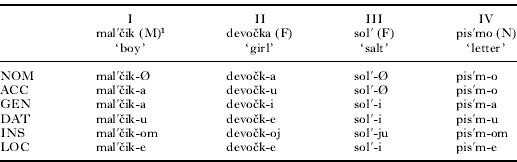
Both semantic and morphological factors exert an influence on gender agreement. For the majority of nouns, gender can be predicted on the basis of morphological form, i.e. the paradigm of inflectional affixes. Russian nouns may be divided into four inflectional paradigms (called declension classes, cf. Corbett, Reference Corbett1982; Reference Corbett1991), based on four different sets of inflectional affixes (case forms). Nouns in declension I are masculine, nouns in declensions II and III are feminine, and nouns in declension IV are neuter. Table 1 is based on Corbett (Reference Corbett1991: 36) and provides an overview of the correlation between declensional class and gender. The nouns are shown only in the singular, as there are generally no gender distinctions in the plural (p. 175).
Declension–gender correlations in Russian
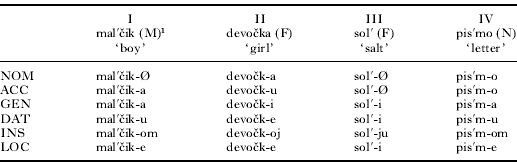
1 Note that inanimate nouns in declension I have a zero ending in the accusative singular, e.g. dom-Ø ‘house’.
The noun classes examined in this study belong to declensions I and II, where the majority of nouns are masculine and feminine respectively. Like other nouns in class I, hybrids (e.g. fotograf ‘photographer’) and female names in -ok/-ik (e.g. Lenok/Dusik) end in a non-palatalized (hard) consonant and have a zero ending (-Ø) in the nominative singular. Papa-type nouns and double gender nouns (also called common gender nouns), e.g. plaksa ‘cry-baby’, belong to declension II and end in -a in the nominative singular. In the experiments, the nouns were presented to the children in the nominative singular, which is considered to be the basic form of a Russian noun and which unambiguously signals whether a noun belongs to declensional class I or II. This is to say that, upon hearing the test nouns in the nominative singular, children could immediately establish their declension class and make predictions about their gender. However, the latter can be done successfully only when the semantics of these nouns is also taken into account. In this article we have chosen to use the term ‘morphological’ rather than ‘phonological’ when discussing gender properties, even though the test items were introduced as single forms (Nominative Singular) and not paradigms. This has been done for convenience, since it allows us to make a more direct comparison with Corbett's gender assignment theory, where morphology (i.e. declensional paradigm) is argued to play a role in gender assignment (Corbett Reference Corbett1991: 34–36).
The semantic factor involves a male vs. female distinction and is only relevant for nouns denoting human beings and certain animals. For the majority of nouns referring to humans there is also a strong correlation between gender agreement and declension class, cf. examples (1a–b). It is thus not straightforward to determine what plays a decisive role for gender assignment in such cases – semantics or morphology. Semantics thus has a more limited scope than morphology in the gender system of Russian and becomes important only in noun classes where the two factors do not overlap.
The first relevant class is papa-type nouns, such as papa ‘daddy’, deduška ‘granddad’, djadja ‘uncle/man’, junoša ‘youth’, and mužčina ‘man’.Footnote 1 As pointed out above, these nouns have morphology typical of feminine nouns, yet they denote males. In this case, semantics wins over morphology and these nouns take masculine agreement, shown in (2). In this example and in the rest of the article we will mark the declensional class of a noun in parentheses and not its gender (as was done for illustration in (1) above), since the gender of hybrids and double gender nouns is based on the referent's biological sex and not the noun itself.
(2) naš-Ø pap-a prišel-Ø
ourM daddy(II) comePST.M
‘Our daddy came.’
In contrast to papa-type nouns, hybrids and double gender nouns can refer to an individual of either sex. Examples are vrač ‘doctor’ and plaksa ‘cry-baby’. Originally hybrids referred only to male individuals and were masculine only, but in the course of the twentieth century their grammatical status changed and in the present-day language both masculine and feminine agreement are possible when the referent is female. This means that hybrids have become more similar to double gender nouns, for which the semantic information is expressed by the referent rather than by the noun itself (cf. Švedova, Reference Švedova1980; Lopatin, Miloslavskij & Šeljakin, Reference Lopatin, Miloslavskij and Šeljakin1989). Double gender nouns characterize the referent by some personal (often negative) trait or behaviour; thus these nouns refer to specific individuals.
The fact that hybrids and double gender nouns may refer to an individual of either sex is directly reflected in agreement. Importantly, the form of the noun itself remains the same, as shown in (3)–(4). This creates two situations: one in which the semantic and morphological properties overlap, as in (3b) for double gender nouns referring to a female and (4a) for hybrids referring to a male individual, and another in which these properties are in conflict. As double gender nouns have morphology typical of feminine nouns (declension II), the mismatch occurs when they refer to males, as in (3a). In the case of hybrids, on the other hand, which have morphology typical of masculine nouns (declension I), the mismatch occurs when the referent is a female, illustrated in (4b). Furthermore, there is another mismatch in (4a) when the reference is to a female individual: in this case there is correspondence between the declension class and agreement (both masculine), but not between the linguistic expression and the biological sex of the referent.
- (3)
a. naš-Ø plaksa (male referent)
ourM cry-baby(II)
b. naš-a plaksa (female referent)
ourF cry-baby(II)
- (4)
a. naš-Ø vrač (male or female referent)
ourM doctor(I)
b. naš-a vrač (female referent)
ourF doctor(I)
There is an important distinction between hybrids and double gender nouns, as the sex criterion is an obligatory factor for the latter type of noun, but not the former.Footnote 2 Crucially, the examples in (3a, b) demonstrate that, in the case of double gender nouns, gender agreement has a strictly semantic justification. This means that double gender nouns always take agreement forms that are based on semantics. This is slightly different in the case of hybrids. While only masculine agreement is allowed when the referent of a hybrid noun is a male (cf. (4b)), semantic agreement is to some extent optional when the referent is a female (cf. (4a)). In this case, agreement variation may also be observed within syntactic phrases, illustrated in (5), where the determiner has masculine and the verb feminine agreement. This is referred to as inconsistent agreement by Corbett (Reference Corbett1991).
(5) naš-Ø vrač prišl-a (female referent)
ourM doctor(I) comePST.F
‘Our doctor came.’
The choice of agreement in structures like (5) is constrained by the type of agreement target, in that semantic agreement is more likely the further it is away from the noun itself (cf. the Agreement Hierarchy in Corbett, Reference Corbett1991: 226). Hence, in example (5), semantic agreement appears on the verbal predicate, while the demonstrative pronoun in attributive position bears syntactic agreement. According to a questionnaire survey by Panov (Reference Panov1968), cited in Corbett (Reference Corbett1991: 231, 251), approximately 50% of the participants preferred semantic (feminine) agreement on the verb, but only about 20% showed this preference with an adjective in attributive position. The survey data were also broken down according to age, education, profession and area of longest stay, which also appeared to affect the speakers' agreement choices. In each of these categories, semantic agreement was preferred more often in predicative than in attributive use. In our study we have therefore decided to elicit verbal agreement with hybrids, double gender nouns and female names in -ok/-ik in order to increase the likelihood of semantic agreement with these noun types.
The last type of nouns considered in this article has not received much attention in the literature. This is a class denoting female names in -ok/-ik, e.g. Lenok and Dusik, derived by the diminutive suffixes -ok and -ik from female names like Lena and Dusja. These suffixes are the result of a phonologically conditioned alternation: -ok occurs when the preceding sound is hard and -ik when it is soft. Full names like Lena belong to declension II, but when the diminutive suffixes -ok/-ik are attached, they switch to the inflectional paradigm of declension I. Unlike hybrids and double gender nouns, female names in -ok/-ik denote females only, yet both semantic and morphological criteria may have an effect on the agreement pattern chosen. These nouns therefore display optionality similar to that of hybrids (cf. Crockett, Reference Crockett1976), shown in (6).
- (6)
a. Pomniš, Svetik byl-Øtak-ojmalen′k-ij.
remember Svetik(I) bePST.M suchM littleM
b. Pomniš, Svetik byl-atak-ajamalen′k-aja.
remember Svetik(I) bePST.F suchF littleF
‘Remember, Svetik was so little!’
Finally, just like hybrids referring to females, these female names in -ok/-ik may exhibit inconsistent agreement. In (7) the feminine (semantic) form is found on the verbal predicate byval-a ‘was’, while the attributive adjective ljubim-yj ‘beloved’ is masculine, matching the form of the noun Svetik (from Iomdin, Reference Iomdin1990:128).
(7) A vot director ni razu ne podumal, čto Svetik ix
but director not once not thought that Svetik(I) their
ljubim-yj dal′še Irkutska ne byval-a.
belovedM farther Irkutsk not bePST.F
‘But the director never thought that their beloved Svetik had not been farther than Irkutsk.’
PREVIOUS RESEARCH
Several gender assignment theories postulate a dominance of semantic factors in the gender system of Russian. Corbett (Reference Corbett1991: 40) proposes that speakers of Russian need two sets of gender assignment rules: semantic and morphological.
(8) Semantic assignment rules in Russian:
a. Sex-differentiable nouns denoting males are masculine.
b. Sex-differentiable nouns denoting females are feminine.
(9) Morphological assignment rules in Russian:
a. Nouns in declensional class I are masculine.
b. Nouns in declensional class II and III are feminine.
c. Nouns in declensional class IV are neuter.
Corbett postulates a hierarchy where the semantic rules in (8) take precedence over the morphological rules in (9); this is referred to as the ‘semantic hierarchy’. Although Corbett does not investigate any child data, he refers to acquisition and predicts that a learner should first decide whether a noun denotes a human being, and if so, whether the referent of the noun is male or female. In case a noun does not denote a human being, the learner should establish which declensional class it belongs to in order to infer its gender. Thus, from the perspective of the semantic hierarchy, a learner would not need to look down to the morphological component in order to establish the gender of nouns such as papa ‘daddy’.
However, in acquisition studies of other languages, it has been found that formal (morphological and/or phonological) criteria play a dominant role in gender assignment at an early age (e.g. Henzl, Reference Henzl1975; Karmiloff-Smith, Reference Karmiloff-Smith1979; Levy, Reference Levy1983; Berman, Reference Berman and Slobin1985; Mills, Reference Mills1986; Chini, Reference Chini, Giacalone Ramat and Vedovelli1994; Müller, Reference Müller, Unterbeck and Rissanen2000; Kupisch, Müller & Cantone, Reference Kupisch, Müller and Cantone2002; Kuchenbrandt, Reference Kuchenbrandt, Cohen, McAlister, Rolstad and MacSwan2005; Reference Kuchenbrandt2008). Based on child data from French, German, Czech, Hebrew, Spanish and Italian, it has been argued that two-year-olds formulate language-specific rules on the basis of formal information. Importantly, young children have been found to make errors which reveal that morphology or phonology often wins over semantics in cases where these factors make conflicting gender predictions (e.g. Karmiloff-Smith, Reference Karmiloff-Smith1979).
Errors due to overgeneralization of formal features over semantic ones have also been found in the speech of Russian children (Gvozdev, Reference Gvozdev1961; Popova, Reference Popova, Ferguson and Slobin1973), illustrated in (10a–b). According to Gvozdev (Reference Gvozdev1961), this overgeneralization tendency stabilizes around age 2 ; 4, while these errors disappear by age 3 ; 0. However, it should be noted that no exceptional classes of nouns in Russian have received specific attention in previous acquisition literature.
- (10)
a. moj-a pap-a. (Zhenya 2 ; 3·20)
myF daddy(II)
‘My daddy.’
Target structure: Moj-ØM papa(II). (from Gvozdev, Reference Gvozdev1961:104)
b. dedušk-a sidel-a na lošadke. (no age reference)
granddad(II) sitPST.F on horse
‘Granddad sat on a horse.’
Target structure: Dedušk-a(II) sidelM na lošadke. (from Popova, Reference Popova, Ferguson and Slobin1973: 273)
Thus, previous acquisition literature has claimed that children's language organization changes from formal to non-formal, in the following way: the child starts out by making a formal grammatical analysis of the gender system. In the course of development, formal generalizations are replaced by rules made on the basis of semantic properties of nouns. This development from formal to non-formal is the opposite of what would be predicted by the semantic hierarchy approach. In the next section, we take a closer look at the specific predictions that follow from these two approaches to gender acquisition for the four classes of Russian nouns where there is a conflict between semantics and morphology.
PREDICTIONS
According to Corbett's (Reference Corbett1991) semantic hierarchy, Russian children are initially expected to pay attention to the semantic category of a noun and only later acquire the significance of morphological factors involved in gender assignment. More specifically, we predict the following course of acquisition:
• Papa-type nouns (only masculine in the target language): children will immediately realize that these nouns are masculine only and never make mistakes.
• Female names in -ok, -ik (masculine or feminine in the target language): children will start out using feminine agreement only and then gradually produce more masculine agreement.
• Hybrid nouns (e.g. vrač ‘doctor’): children will start out using masculine agreement with male referents and feminine agreement with female referents, and gradually use more masculine agreement with the latter.
• Double gender nouns (e.g. plaksa ‘cry-baby’): children will use masculine agreement for nouns with male referents and feminine agreement with female referents and never make mistakes.
If, on the other hand, children start out with a preference for formal (i.e. morphological/phonological) factors in gender assignment, we predict a somewhat different development:
• Papa-type nouns (only masculine in the target language): children will start out producing feminine agreement and only gradually realize that these nouns take masculine.
• Female names in -ok, -ik (masculine or feminine in the target language): children will start out using masculine agreement and then gradually produce more feminine agreement.
• Hybrid nouns (e.g. vrač ‘doctor’): children will start out using masculine agreement only and then gradually use more feminine agreement with hybrids referring to females.
• Double gender nouns (e.g. plaksa ‘cry-baby’): children will start out with feminine agreement only and gradually use more masculine agreement with double gender nouns with male referents.
Assuming the latter development, where semantics gradually takes over for morphology, another important question arises: Is the dominance of semantics established for all nouns simultaneously in the child grammar? In other words, when children acquire the grammatical function of natural gender, do they apply semantic rules across all subclasses of nouns at the same time and to the same extent? From the point of view of the semantic hierarchy, one would expect children who have realized the dominance of semantics for one subcategory of nouns to do so uniformly and simultaneously for all nouns.
In the next section we introduce a cue-based approach to language acquisition and formulate the micro-cues that are relevant for the acquisition of gender in Russian.
CUES AND MICRO-CUES IN LANGUAGE ACQUISITION
According to Lightfoot's (Reference Lightfoot1999; Reference Lightfoot2006) cue-based approach to language acquisition, a cue is a piece of structure that is produced in a child's I-language grammar as a result of exposure to the primary linguistic data. This means that cues are not surface strings, but the child's internalized analysis of the input. In Lightfoot's work, the formulation of cues corresponds to major parameters, e.g. the head parameter (OV vs. VO) or the verb-second parameter (V2). Examples are provided in (11)–(12).
(11) Cue for OV syntax: VP[DP V]
(12) Cue for V2 syntax: CP[XP CV...]
In recent work, Westergaard (Reference Westergaard2008; Reference Westergaard2009a; Reference Westergaard2009b) has pointed out that languages vary considerably with respect to word order. For V2, she has shown that the variation is dependent on several linguistically relevant factors (e.g. clause type, type of verb involved, class of initial element, or information value of the subject), and she has argued that this cannot be the result of a major parameter but must be learned from input. This variation means that children face a much greater challenge in the acquisition process than to set parameter values. In order to produce target-consistent word order, children must pay attention to a high number of fine distinctions in the input. Westergaard (Reference Westergaard2008; Reference Westergaard2009a; Reference Westergaard2009c) shows that children have the right word orders in place as soon as relevant constructions appear in the child data, and there is generally no overgeneralization from one context to another. She therefore concludes that children are sensitive to fine distinctions in syntax and information structure from early on. As a result of this, Lightfoot's cues are reformulated as micro-cues, where the relevant linguistic context is part of the cue (see Westergaard, Reference Westergaard2008; Reference Westergaard2009a; Lightfoot & Westergaard, Reference Lightfoot and Westergaard2007). Micro-cues thus typically contain a lot more specific information than the cues in (11)–(12).
In Westergaard (Reference Westergaard2009b) it is also argued that, to the extent that (Norwegian and English) children make word order mistakes, they typically ‘undergeneralize’ instead of overgeneralize; that is, they use V2 or subject–auxiliary inversion in fewer contexts than what is required in the adult language (e.g. with be but not auxiliaries in English). This means that children at an early stage may have smaller micro-cues than adults, making even finer distinctions than the target language. Thus, the micro-cue analysis may not only explain early target-consistent word order in cases where there is considerable linguistic detail to be acquired; it may also be used to account for the common claim found in much acquisition literature that children are conservative learners, typically making errors of omission rather than errors of commission (see Snyder, Reference Snyder2007, for a recent discussion).
Nevertheless, children also make generalizations in the acquisition process, extending a rule to other contexts and lexical items than the ones directly experienced in the input. But these kinds of generalizations are typically only transferred within a small class or subcategory of a word class, and not to, e.g., all verbs or all nouns. Thus, the micro-cue model asserts that these minor categories are present in children's grammars, enabling them to make fine distinctions in syntax and morphology from early on. This makes the model different from constructivist approaches to language acquisition, which argue for an item-based or frame-based learning process (e.g. Tomasello, Reference Tomasello2003).
So far, the micro-cue model has only been used to account for the acquisition of word order, but we would like to use this approach to explain children's acquisition of gender assignment in Russian, another area where attention to fine distinctions in the input is crucial. In the following we formulate the micro-cues that are necessary to acquire target-consistent gender agreement in Russian.
The exceptional subclasses of nouns discussed in this article belong to declensions I and II (see above). The well-behaved nouns in these declension classes are subject to general (morphological) gender cues, which may be formulated as in (13)–(14). The cue in (13) applies to nouns of declensional type I and triggers the assignment of masculine agreement. Exceptions are hybrids referring to females and female names in -ik/-ok that can also be assigned feminine (see below). The cue in (14) applies to nouns of declensional type II and triggers feminine agreement. Here the exceptions are papa-type nouns and double gender nouns (e.g. plaksa ‘cry-baby’) referring to males.
(13) Morphological cue for masculine gender: [N-ø V-ø]
(14) Morphological cue for feminine gender: [N-a V-a]
The structures in (13) and (14) illustrate the relationship between the morphological properties of a noun and the corresponding properties of a verb (verbal agreement is used here for convenience). These structures trigger the acquisition of two distinct grammatical classes based on morphological properties. But since semantics plays a crucial role for the exceptional nouns, a more fine-grained distinction must be made. We propose that each subclass of nouns should be represented by separate cues, micro-cues, provided in (15)–(18).
(15) Micro-cue for papa-type nouns: [[+male]N-a V-ø]
(16) Micro-cue for double gender nouns referring to males: [(+male)N-a V-ø]
(17) Micro-cue for hybrids referring to females: [(−male)N-ø V-a]
(18) Micro-cue for female names: [[−male]N-ø V-a]
In addition to the morphological and semantic properties of a subcategory of nouns, the representations in (15)–(18) indicate whether semantics is part of the noun's lexical entry or not. We use square brackets for nouns that have biological sex as part of their lexical entry, e.g. papa ‘daddy’. Round brackets, on the other hand, indicate that gender is assigned via identification with a human referent, e.g. plaksa ‘cry-baby’. In (15)–(18) there is correspondence between the suffix on the agreement target and the semantic properties of the noun. Moreover, there is an important difference between (15)–(16) on the one hand and (17)–(18) on the other, in that the former cues are categorical, while the latter two are in competition with the more general cue in (13), which is based on morphology alone.
The semantic gender cues formulated in (15)–(18) are thus more specific than the semantic rules proposed by Corbett, as they take into consideration various kinds of information relevant for a particular grammatical class. We propose that in order to detect these cues, children need to pay attention to the relevant subtype of noun separately. From the point of view of the micro-cue approach, children should be sensitive to the notion of class rather than to category. Furthermore, to the extent that children make generalizations, this should only take place within a particular class or subcategory. This resonates with findings from English child language, e.g. Roeper (Reference Roeper1999; Reference Roeper, Gülzow and Gagarina2007), where it was found that, when inversion is learned for a particular subtype of verbs (auxiliaries), it is never overgeneralized to the whole verbal category. Westergaard's (Reference Westergaard2008; Reference Westergaard2009a) findings from Norwegian are also relevant here. According to the micro-cue approach, it may thus be predicted that the course of gender acquisition will vary across different subclasses of nouns.
Nevertheless, delays in the acquisition of semantic agreement may be expected with those subclasses of nouns where there is considerable inconsistency or variation in the adult grammar, i.e. with hybrid nouns (vrač ‘doctor’) and female names in -ik/-ok. In other words, in addition to the lack of correspondence between semantics and morphology, hybrids and female names in -ik/-ok should present an extra problem for children, due to the fact that the agreement evidence in the input is not categorical.
We may also expect a delay in the acquisition of gender agreement with double gender nouns such as plaksa ‘cry-baby’, since the sex distinction is not part of the lexical entry of these nouns. This means that semantic agreement for individual nouns must be established on every occurrence of a noun in concrete discourse situations. This kind of knowledge can only be acquired if there is consistent and sufficient evidence in the input. Furthermore, the actual input experience may differ across individual children depending on their own sex and the sex of their siblings or friends, in that some may experience one noun to occur only with feminine agreement, another noun only with masculine, and others with both.
METHOD
Participants
Twenty-five typically developing children (14 F, 11 M) were recruited from a daycare centre Detskij Mir in Ivanovo, Russia (Rodina, Reference Rodina2008). The children were aged 2 ; 6–4 ; 0 with a mean age of 3 ; 7. An additional twelve children (8 F, 4 M) aged 5 ; 1–6 ; 5 (mean age 5 ; 7) were tested on two of the four tasks (Tasks 2 and 3; see below), as were twenty-one primary caregivers (sixteen mothers, one father, three grandmothers and one older sister).
Materials
Task 1
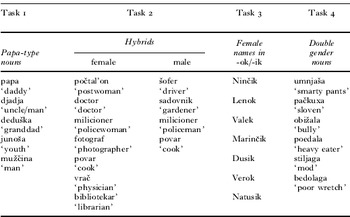
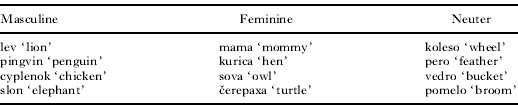
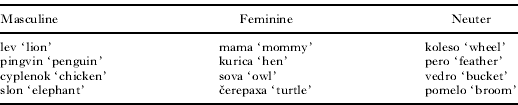
Task 1 tested the children's knowledge of semantic masculine agreement with papa-type nouns. The experiment was designed to elicit adjectival agreement (e.g. sinij papa ‘blue daddy’ or papa sinij ‘daddy is blue’) and verbal predicate agreement (e.g. papa upal-Ø ‘daddy fell down’) with five masculine nouns: papa ‘daddy’, deduška ‘granddad’, djadja ‘uncle/man’, mužčina ‘man’ and junoša ‘youth’ (the complete list of test items for all four tasks is provided in Table A1 in the ‘Appendix’). Other masculine, feminine and neuter nouns whose gender was easily derivable from their formal properties were used as fillers (see Table A2 in the ‘Appendix’).
The experiment was introduced as a game where cardboard characters of different colours were used to represent each noun. Each character appeared in five colours: blue, yellow, red, green and purple; hence there were five fathers, five grandfathers, etc. Every test item was introduced in a separate experiment together with three fillers: masculine, feminine and neuter. Thus, there were five experiments performed on five different days. The characters representing each noun were placed into small paper bags, which were put on the table together with some small objects, e.g. a book, a cup, etc. The experimenter (the first author), manipulating a puppet called Elmo, explained to the child that Elmo was a silly puppet who could not remember the names of colours and who refused to listen to adults. The child was then asked to help Elmo learn the colour terms. Next, the experimenter took the characters out of the bags and put them in different places, e.g. under the book. The child had to tell Elmo what colour character was where, e.g. sinij papa pod knigoj ‘blue daddy is under the book’. The experimenter used the following lead-in statement: Posmotri, vot papa. A po cvetu papa? ‘Here is a daddy. And what colour is daddy?’ The character was then placed on the table and the experimenter asked: Skaži Elmo, gde teper′ papa. ‘Tell Elmo where daddy is now’. If the child forgot to use the colour term, s/he was reminded that it was important to name the colour of each character; otherwise Elmo would get mixed up. If the child used the wrong colour adjective, s/he was never corrected.
Verbal predicate agreement was elicited in the same sessions as adjectival agreement, and the children's responses were again addressed to Elmo. The verb used was ‘to fall’ in the past tense, which has the following forms: upal (masculine), upala (feminine) and upalo (neuter). In this part of the task a child saw a character who had fallen into a cup or on a book, etc., and a target response was e.g. papa upal v čašku ‘daddy fell down into the cup’. Verbal predicate agreement was elicited with each test item but only with one verb, and this part of the test therefore yielded a lower number of relevant responses.
Task 2
Task 2 tested children's knowledge of semantic agreement with hybrid nouns referring to females. The experiment was introduced as a storybook reading task. The characters were male and female individuals of different professions, the former being the test items and the latter fillers. There were seven test items (počtal′on ‘postwoman’, doktor ‘doctor’, milicioner ‘policewoman’, fotograf ‘photographer’, povar ‘cook’, vrač ‘physician’ and bibliotekar′ ‘librarian’) and four fillers (šofer ‘driver’, sadovnik ‘gardener’, milicioner ‘policeman’ and povar ‘cook’). The experimenter introduced the characters in the story and then asked the child to say what the main character did. In every story the sex of the character was made salient in the drawing as well as in the oral presentation of the task. Consider for example the lead-in statement for the story about a postwoman in (19).
(19) experimenter: Posmotri, vot zdes′ Maša, a vot zdes′ počtal′on. A počtal′on v etoj istorii teten′ka. Vidiš, u počtal′ona bol′šaja sumka s pis′mami i podarok. A čto bylo dal′še? Čto *sdelali počtal′on?
‘Look, here is Maša and here is počtal′on. And počtal′on is a woman in this story. Look, počtal′on has a big bag and a present. What do you think happened then? What did počtal′on do?’
target response: Počtal′on dal/dala Maše podarok. ‘Počtal′on gave Maša a present.’
In addition to the question What happened?, which is rather general, we used a more specific elicitation question, such as Čto * sdelalipočtal′on? lit. ‘what didPL postman/woman?’ Note, however, that this question is ungrammatical, since the verb has the plural form. This allowed the experimenter to avoid producing a structure that would reveal the target agreement pattern to the child, i.e. Čto sdelalM.SGpočtal′on? or Čto sdelalaF.SGpočtal′on? This technique was inspired by Popova (Reference Popova, Ferguson and Slobin1973), who used the same question form in her experimental design. This strategy was also used in Task 4 on double gender nouns (see below) and turned out to be successful, as the children were in general not affected by the ungrammatical plural agreement in the lead-in question. In fact, there were only five plural verb forms produced by the children (one child made three errors in Task 2 and Task 4 and two other children made one error each in Task 2), constituting only 0·4% (5/1170) of the total number of verb forms produced in these tasks.
Task 3
Task 3 tested children's knowledge of semantic agreement with female names in -ok/-ik. This task had a very similar procedure to the one in Task 2. The experimenter and the child read seven stories, one story per test item (see Table A1 in the ‘Appendix’). Each story contained several colour pictures where the main characters were girls. The experimenter introduced the characters in the story first and asked the child to say what the main character did.
Task 4
Task 4 tested children's knowledge of semantic agreement with double gender nouns. This was a picture description task and had a procedure similar to that used in Task 2. There were six stories about boys, representing six test items, and four stories with female characters that were used as fillers. Four of the test items in this experiment were derived from real words with suffixes typical of this noun type, such as -xa and -ša (e.g. pačkuxa ‘sloven’ from the verb pačkat' ‘to make dirty’). Other derived nouns were obižala ‘bully’, poedala ‘heavy eater’ and umnjaša ‘smarty pants’. Thus, these nouns were not novel but presumably unfamiliar to the children. In addition, two existing but infrequent nouns were used in the task, stiljaga ‘mod’ and bedolaga ‘poor wretch’. This was done to avoid any personal associations that the children might have that could interfere with the test conditions. In the discussion of this noun class above it was pointed out that double gender nouns characterize individuals by some personal trait and describe specific individuals. It is thus possible that a child who is often called sloven will associate this noun with himself or herself or some other messy person in the child's environment, and the child may thus have certain agreement preferences with this particular noun. Using unfamiliar nouns in this task helped to avoid this problem.
RESULTS
Papa-type nouns
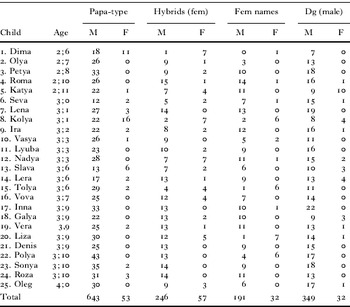
The overall results of the experiment presented in Table 2 show that target-like masculine agreement is used with papa-type nouns at a rate of 92·4% (643/696) while non-target-like feminine constitutes 7·6% (53/696). The errors were made by eleven children, who produced both types of agreement for this noun class (see Table A3 in the ‘Appendix’ for the results of individual children). Note that both adjectival and past tense verb agreement results are collapsed in Table 2, since the samples for the two agreement types differ greatly and are therefore difficult to compare (540 vs. 156 respectively).
The accuracy rates of semantic agreement for papa-type nouns across two age groups, twenty-five children

Examples of the children's responses with papa-type nouns are given in (20). Verbal predicate agreement where both target-deviant (upala) and target-consistent (perevernulsja) verb forms occur in the same utterance is shown in (20a). In (20b) the target-deviant feminine form of the adjective is used with the noun deduška ‘granddad’.
- (20)
a. oj dajadja upala u menja i perevernulsja (Kolya 3 ; 1)
oops uncle/man(II) fallPST.F at IGEN and flip overPST.M
‘Oops, my uncle/man fell and flipped over.’
Target structure: dajadja upalPST.M u menja i perevernulsja PST.M
b. deduška oranževaja na tareločke (Vera 3 ; 9)
granddad(II) orangeF on plate
‘The orange granddad is on the plate.’
Target structure: deduška oranževyjM na tareločke
Although there are relatively few errors, Table 2 reveals the children's sensitivity to the morphological/phonological form of these nouns. This goes against the semantic hierarchy approach, which predicted that children should immediately realize that these nouns were masculine only and never make mistakes. On the other hand, agreement errors with this noun class were predicted by the ‘morphology-first’ approach, which suggests that children should start out producing feminine agreement and only gradually realize that these nouns take masculine agreement. Since the age of the youngest children in our study was 2 ; 6, nothing can be said about the initial stage of their agreement production. As shown in Table 2, the rate of target-like masculine agreement was very high for the youngest children, 90·8% (139/153). This means that we only see a slight development across the two age groups, which suggests that children very early realize that papa-type nouns are masculine.
Female names in -ok/-ik
The overall results presented in Table 3 show that young children use masculine agreement with this noun class considerably more often than feminine, 85·7% (191/223). On the individual level (see Table A3 in the ‘Appendix’), nine out of twenty-five children used both agreement forms, while the majority of the children (fifteen) used only masculine (note that the data from the youngest child contains only one utterance). Children's preference for masculine agreement, which corresponds to the morphological properties of these nouns, is the opposite of what was predicted by the semantic hierarchy approach, namely that children start out using feminine only and gradually produce more masculine agreement. Given that the rate of semantic feminine agreement was very low in the production of the two- and three-year-olds, it can be concluded that the children initially assign gender to these nouns based on formal criteria, as predicted by the ‘morphology-first’ approach. Examples of the children's responses with female names are provided in (21).
- (21)
a. Lenok narjadilsja (Seva 3 ; 0)
Lenok(I) dressPST.M up
‘Lenok dressed up.’
b. a Ninčik nadela plat′je (Kolya 3 ; 1)
and Ninčik(I) putPST.F on dress
‘And Ninčik put on a dress.’
Agreement production for female names in -ok/-ik, twenty-five young children, twenty-one caregivers, and twelve older children

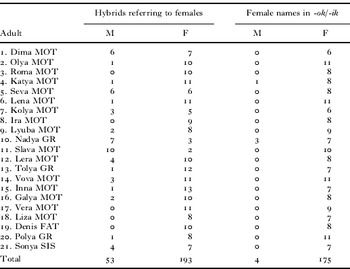
Data from the children's caregivers were obtained to compare child and adult agreement preferences in the same experimental conditions. Unlike their children, the caregivers have a clear preference for semantic agreement with female names in -ok/-ik, using it at a rate of 97·8% (175/179), i.e. almost categorically. Syntactic masculine agreement occurs in only 2·2% (4/179) of the utterances and only in the speech of two out of twenty-one speakers. Results for individual adult speakers are provided in Table A4 in the ‘Appendix’.
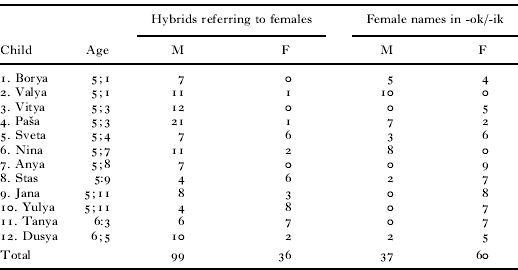
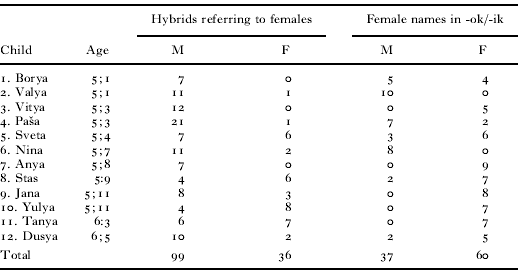
Table 3 also illustrates the overall results obtained from twelve older children. It is clear that these children are different from the younger children and use semantic feminine agreement more frequently than syntactic masculine (61·9%, 60/97). We can thus conclude that children's agreement preferences with this noun class change with age. On the individual level, two out of twelve children used only masculine agreement, five used only feminine, and five used both (see Table A5 in the ‘Appendix’). It should also be noted that older children seemed to be aware of the effect of the referent's biological sex, since several children hesitated and corrected themselves in the course of the experiment, illustrated in (22).
(22) prosnulsja … prosnulas′ (Dusya 6 ; 5)
wake PST.M up wake PST.F up
‘(Valek) woke up.’
Hybrid nouns
The overall results presented in Table 4 show that masculine agreement was used predominantly both when the referent of a hybrid noun is a male (control cases) and when it is a female: 96·9% (251/259) and 81·2% (246/303), respectively. In other words, the children preferred agreement corresponding to the morphological form of these nouns. At the same time the use of feminine agreement suggests that the children make a distinction between the two cases. Overall there were only eight occurrences (3·1%) of erroneous feminine agreement with hybrids referring to males in the speech of three children (see Table A3 in the ‘Appendix’). This shows that children's production is near-categorical and thus target-consistent in cases where the noun has a male referent.
Overall results for hybrids, twenty-five children aged 2 ; 6–4 ; 0

In cases where the noun had a female referent, on the other hand, feminine agreement constituted 18·8% (57/303) of the responses. This occurred on a par with masculine agreement in the speech of eighteen children, while the remaining seven children used only masculine. This result goes against the semantic hierarchy approach, which predicts that children should start out using masculine agreement for hybrids with male referents and feminine with female referents, and gradually use more masculine agreement with the latter. On the contrary, as predicted by the ‘morphology-first’ approach, the children seemed to start out using masculine agreement for all hybrids. Examples of children's responses with hybrids referring to females are given in (23).
- (23)
a. doctor polečil (Kolya 3 ; 1)
doctor(I) curePST.M
‘Doctor (female) cured him.’
b. bibliotekar′ knižku položila (Kolya 3 ; 1)
librarian(I) bookACC putPST.F
‘Librarian (female) put the book.’
The results of the caregivers' agreement production with hybrids referring to females are displayed in Table 5, where it is immediately clear that they prefer semantic feminine agreement, using it at a rate of 78·5% (193/246). Caregivers' agreement pattern with hybrids referring to females is thus similar to their production of female names in -ok/-ik, which occurred with semantic agreement 97·8% (175/179) of the time. However, in the case of hybrids, the caregivers are not categorical with respect to their agreement choice: sixteen speakers use both feminine and masculine, and only five speakers produce feminine agreement only (see Table A4 in the ‘Appendix’).
Agreement production for hybrids referring to females, twenty-one caregivers and twelve older children

As also shown in Table 5, five- and six-year-olds use syntactic masculine agreement more often than semantic feminine with these nouns, 73·3% (99/135). On the individual level, nine out of twelve children use both feminine and masculine and three use only masculine (see Table A5 in the ‘Appendix’). The results for older children suggest that they are more reluctant to use semantic agreement with hybrids referring to females than with female names in -ok/-ik, where it occurred at a rate of 61·9% (60/97). Nevertheless, this result indicates that children use gradually more feminine agreement with hybrids referring to females.
Double gender nouns
Children's agreement production with double gender nouns is presented in Table 6 and reveals that masculine and feminine forms are in complementary distribution: masculine agreement was used at a rate of 91·6% (349/381) and feminine was used at a rate of 87·4% (194/222).
Overall results for double gender nouns, twenty-five children aged 2 ; 6–4 ; 0

Thus, there is little evidence for the ‘morphology-first’ hypothesis here, which predicted that children would start out with feminine agreement for all double gender nouns and gradually use more masculine agreement with male referents. The high accuracy rates reported in Table 6 suggest that, already at a rather early stage, children's agreement production is guided by the semantic male–female distinction. The children were also found to use masculine and feminine for the same noun, as for example in (24a–b), where target-consistent feminine forms of the verbs are used with the made-up noun pačkuxa ‘sloven’ referring to a girl, while a target-consistent masculine form occurs when this noun refers to a boy.
- (24)
a. a pačkuxa zalezla vot sjuda na lužu i
and sloven(II) climbPST.F here on puddle and
ispačkalas′ (Vera 3 ; 9)
get dirtyPST.F
‘The sloven (girl) got into the puddle and got dirty.’
b. ispačkalsja (Vera 3 ; 9)
get dirtyPST.M
‘(Sloven (boy)) got dirty.’
These results support the semantic hierarchy approach. The results in Table 6 show that children's agreement production is not error-free. In the case of a male referent, erroneous feminine agreement constituted 8·4% (32/381) and in the case of a female referent, erroneous masculine constituted 12·6% (28/222). In the former case semantics and morphology are in conflict and the errors are not surprising given children's sensitivity to formal features of nouns, as discussed above. Yet, it is rather unexpected that children make errors in cases where there is a female referent, since in this case semantic and morphological gender features overlap. In fact, the children made more mistakes with female than with male referents. Note that this problem did not arise in the case of hybrids referring to males, where target-like masculine agreement was used 96·9% (cf. Table 4).
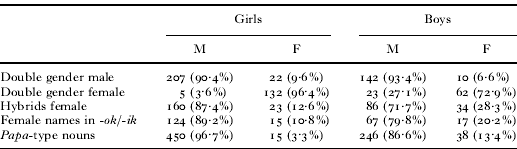
However, further analysis of the children's errors reveals that the majority of them (23/28) were made by seven boys (see Table A3 in the ‘Appendix’), one of them (Vasya 3 ; 3) being responsible for almost half of the errors. This child produced exclusively masculine agreement with double gender nouns, irrespective of the referent's sex. The girls, on the other hand, made only five errors (5/28), which were produced by three girls. In order to investigate whether a child's own biological sex may have played a role here, we divided all results into the boys' and girls' production data in Table 7.
Agreement production for girls and boys across noun classes, twenty-five children aged 2 ; 6–4 ; 0
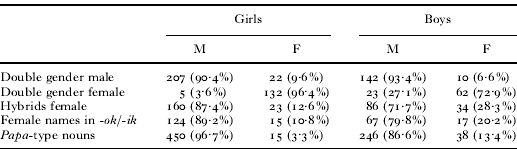
As we see in Table 7, the proportion of correct responses for male and female referents is rather balanced and was equally good in the girls' production: 90·4% (207/229) vs. 96·4% (132/137). At the same time, accuracy was considerably lower for female than for male referents in the boys' speech: 72·9% (62/85) vs. 93·4% (142/152). We think that this is an interesting finding, but it is difficult to find a satisfactory explanation. One possible explanation is that the boys' agreement production is conditioned by their own sex rather than the sex of the referent presented in the picture. However, the results from other tests presented in Table 7 for girls and boys separately cast doubt on this explanation. Boys made considerably more errors than girls with papa-type nouns (13·4% vs. 3·3%) and used masculine forms less than girls for hybrids referring to females and female names in -ok/-ik (i.e. 28·3% and 20·2% vs. 12·6% and 10·8%). This can be taken as counter-evidence to the idea that boys' production could be conditioned by their own sex. Another possible account might therefore be that that these differences are simply to be attributed to boys paying less attention than the girls to the test, as found in Macnamara's (Reference Macnamara1982) study of proper names vs. common nouns. Unfortunately, these explanations remain speculations.
DISCUSSION
The results of the experimentation reported in this article constitute a challenge for Corbett's semantic hierarchy: first and foremost, the children in our study appear to be affected to some extent by the morphological properties of a noun, as indicated by non-target-consistent agreement produced occasionally with papa-type nouns and double gender nouns referring to males (e.g. plaksa ‘cry-baby’). At the same time, the children were highly sensitive to the semantic and morphosyntactic gender characteristics of a noun and were able to distinguish one subclass from another from early on. Most importantly, children did not use semantic agreement across the board. While they were clearly able to use semantic agreement with papa-type nouns and double gender nouns referring to males, they appeared to be rather conservative in using semantic agreement with hybrids referring to females and female names in -ok/-ik. This is illustrated in Figure 1, where the cases illustrating a lack of correspondence between morphology and semantics are highlighted; the others are shown for comparison.
Semantic agreement across different noun classes. Overall results from twenty-five children aged 2 ; 6–4 ; 0.

We would therefore like to argue that our results provide evidence for the micro-cue approach. Our main finding supporting this idea is that children are sensitive to minor distinctions in the semantics and morphology of different subclasses of nouns and distinguish between all four of them. First, with papa-type nouns and double gender nouns such as plaksa ‘cry-baby’, non-target-consistent feminine agreement occurs in roughly 10% of all experimental contexts, revealing children's awareness of the morphological properties of these nouns. But the children also make a distinction between these two subclasses of nouns, as they applied different agreement strategies with them. Specifically, while target-consistent masculine agreement was used for papa-type nouns, two different agreement forms – masculine and feminine – were used as complementary variants for double gender nouns referring to males and females, respectively. Their choice of agreement with unfamiliar and non-existing (made-up) double gender nouns also had referential justification in the majority of cases, i.e. masculine was used productively and predominantly when the referent was a male and feminine when it was a female. This means that the same lexical item may be used with two different genders (cf. examples (24a–b) above).
Second, the different proportions of semantic agreement illustrated in Figure 1 allow us to conclude that children distinguish between papa-type nouns and double gender nouns on the one hand and hybrids and female names in -ok/-ik on the other. In the case of the former nouns, the children reveal an early awareness of semantic agreement as the only grammatical alternative in the language. At the same time, in the case of hybrids referring to females and female names in -ok/-ik, the children did not restrict themselves to semantic agreement, as they used agreement corresponding to the morphological properties of the noun to a considerable extent. Although we have not investigated the exact input to these children, it seems clear that they behave very differently from their caregivers, who displayed a clear preference for semantic agreement in these contexts.
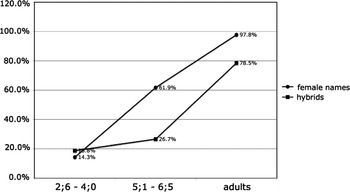
Third, the differences between younger and older children suggest that the children make a further distinction between hybrids referring to females and female names in -ok/-ik. This is illustrated in Figure 2. In the late preschool years, semantic agreement gains dominance rapidly with female names in -ok/-ik, but remains a less preferred alternative with hybrids referring to females. This fact also seems to be reflected in the speech of caregivers, who were shown to use semantic agreement near-categorically with female names in -ok/-ik, but variably and less frequently with hybrids referring to females. It can be hypothesized that the actual input for female names in -ok/-ik is more consistent than the input for hybrids, and thus children may improve faster with female names. This could also be connected to the fact that female names apply to females only, while hybrids may apply to both males and females.
Semantic agreement produced by twenty-five younger children (age 2 ; 6–4 ; 0), twelve older children (age 5 ; 1–6 ; 5), and twenty-one adults: overall results for hybrids referring to females and female names in -ok/-ik.

Given this evidence, we would like to argue that children focus on the relevant noun class or agreement type separately, and only generalize within the particular domain in question. Their differentiated use of semantic agreement for the four exceptional subclasses of Russian nouns can thus be argued to be an indication that gender is acquired for each subcategory individually. In terms of the model of micro-cues, we thus propose that, in the course of gender acquisition, the children operate with very specific micro-cues, presented in (15)–(18) above and repeated here for convenience.
(15′) Micro-cue for papa-type nouns: [[+male]N-a V-ø]
(16′) Micro-cue for double gender nouns referring to males: [(+male)N-a V-ø]
(17′) Micro-cue for hybrids referring to females: [(−male)N-ø V-a]
(18′) Micro-cue for female names: [[−male]N-ø V-a]
These micro-cues involve morphological, semantic and syntactic information about particular noun classes. In addition, the formal representation of the cues reflects that, for two of the subclasses, papa-type nouns and female names in -ok/-ik, gender is a permanent property of a noun, while for the other two, double gender nouns and hybrids, gender is dependent on the referent. These micro-cues are thus much more specific than the rules proposed by Corbett, which involve semantic information only and as such have a very broad application. Hence, Corbett's rules fail to account for the fact that, in the course of gender acquisition, children appear to be sensitive to fine distinctions in the syntax, semantics and morphology of different nouns and apply this knowledge ‘locally’ to each subclass separately.
From the point of view of the micro-cue approach, it was predicted that the course of gender acquisition would be different for different subclasses of nouns and also that children's production should be more or less target-consistent from early on. We might then ask why children make mistakes at all. To answer this question we refer to the frequency and consistency of the input. In other words, some micro-cues may be more difficult to discover than others. Specifically, we hypothesized that there would be a delay in the acquisition of semantic agreement with hybrid nouns referring to females and female names in -ik/-ok as well as double gender nouns. The results of our study show that the predicted delay is attested with the two former noun classes, but that there is no such delay in the case of double gender nouns. We suggest that the explanation for this should be sought in the nature of the triggering experience, more specifically in the quality and quantity of the input that expresses the specific micro-cues.
The structures that express the semantic cues in the input are qualitatively different. With respect to papa-type nouns and double gender nouns, the child's triggering experience is consistent in that only semantic agreement is available, masculine agreement with papa-type nouns and either masculine or feminine with double gender nouns depending on the referent. In the case of hybrids referring to females and female names in -ik/-ok, on the other hand, semantic agreement is subject to variation. That is, there are different frequencies of occurrence across individual nouns, speakers and style, as well as agreement target. This means that both masculine and feminine forms may occur with reference to a female in the primary linguistic data. Hence the child who is on the lookout for semantic cues may find such information indeterminate. In other words, unlike a consistent agreement pattern, an inconsistent agreement pattern may fail to provide sufficient evidence at an early stage. Therefore, in the absence of consistency, the child must have extensive experience before s/he can extend the acquired knowledge of semantic agreement to this domain.
As mentioned above, we have not carried out an investigation of any child-directed speech and do not know what the exact percentages are of masculine and feminine agreement in the children's input. Nevertheless, given the optionality that exists in the adult grammar, there is a considerable likelihood that the children are exposed to variable input in these cases. Along the lines of Roeper (Reference Roeper, Gülzow and Gagarina2007: 33), who proposes that children use “incremental knowledge acquiring a list of contexts”, we argue that, in order to produce target-consistent semantic agreement with hybrids referring to females and female names in -ik/-ok, the child must receive ample evidence for this from the input. In the absence of consistency and sufficient evidence for semantic agreement (due to variation in the adult language), the children initially prefer to rely on morphology and thus predominantly use syntactic (masculine) agreement with these nouns.
Finally, the argument for consistency may also account for the developmental difference between female names in -ok/-ik and hybrids referring to females. In the former case, the semantic rule appears to be acquired faster, cf. Figure 2. Caregivers' production of semantic (feminine) agreement with female names in -ok/-ik was near-categorical, i.e. 97·8%, while for hybrids referring to females it was used at a somewhat lower rate of 78·5%. For the younger children there was not much difference between the two noun types (14·4% vs. 18·8%), while the difference between the two was considerable in the preferences of the older children (61·9% vs. 26·7%). This indicates that the semantic cue may be represented with greater consistency for female names than for hybrids, which is presumably also related to the fact that the former category applies only to females. Hence, in the case of female names, sufficient evidence for the establishment of semantic agreement may be obtained earlier than in the case of hybrids.
SUMMARY
The study has shown that the children are sensitive to both morphology and semantics from early on. Importantly, the children distinguish between the four subclasses of nouns with respect to the proportions of semantic agreement produced with different referents. These results are used to argue for a model of micro-cues, according to which children do not pay attention to major rules or massively overgeneralize gender agreement in the acquisition process. Instead, children are argued to be sensitive to fine distinction in semantics, morphology and syntax, enabling them to recognize different subclasses of nouns.
APPENDIX
List of nouns used in the experimentation

List of fillers used in the experiment with papa-type nouns
Individual agreement production for papa-type nouns, hybrids referring to females, female names in -ok/-ik and double gender (Dg) nouns referring to males, twenty-five children aged 2 ; 6–4 ; 0

Caregivers' individual agreement production for hybrids referring to females and female names in -ok/-ik (twenty-one adult speakers)

Individual agreement production for hybrids referring to females and female names in -ok/-ik, twelve children aged 5 ; 1–6 ; 5