In the welfare state literature, social class features prominently. The working class is, in some accounts, viewed as a primary motor of welfare state expansion; while some instead zero-in on the middle class as the main class of interest when understanding welfare state politics (e.g. Stephens, Reference Stephens1979; Korpi, Reference Korpi1989; Meltzer and Richard, Reference Meltzer and Richard1981; Korpi and Palme, Reference Korpi and Palme1998; Moene and Wallerstein, Reference Moene and Wallerstein2001; Iversen and Soskice, Reference Iversen and Soskice2006). Other scholars have argued that class does not (any longer) play any role, presumably because welfare states have created a convergence of preferences within the citizenry. In this scenario, welfare state politics will often be driven by the re-election concerns of political elites rather than the preferences of different social classes (Pierson, Reference Pierson1994; Reference Pierson1996).
In our view, the first question to ask, when considering social class and welfare state politics, is whether people belonging to various classes actually hold distinct opinions about the welfare state. More precisely, we want to know if citizens’ class markers are politically relevant. That is, do citizens self-ascribing to, say, the ‘middle class’ hold different opinions about the welfare state than citizens self-ascribing to other class groupings? What is more, we would like to know if the correlation between self-ascribed class and opinions varies across countries. Class consciousness may differ from one country to the next for a number of reasons, such as the historical strength of the labour movement or the organisation of the welfare state, potentially making self-ascribed class status more important for opinions in some places.
Past research has been limited in its ability to explore these issues since no existing international survey has, to our knowledge, combined different measures of self-ascribed class with questions assessing respondents’ general relationship to the welfare state. Instead, existing surveys have tended to look at more specific attitudes toward the welfare state, relating to questions around social expenditure, redistribution, social programmes, or government responsibility toward in-need groups. While valuable, these sorts of questions do not allow us to comprehend how individuals understand and relate to the welfare state as a whole – an important exception, given assumptions about the relevance of social class in certain strands of the welfare state literature.
To address this limitation, we fielded a 10-country survey with nationally representative samples and a total of more than 12 000 respondents. Through an analysis of these data, we reach somewhat sobering conclusions for the welfare state literature: self-ascribed class is a surprisingly poor predictor of general attitudes toward the welfare state, both at the national level and across welfare state types. Our findings suggest that class identities are not tied up with stances toward the welfare state in the manner implied by much of the existing research, and that researchers would do better to focus on household income instead – though even it is not a perfect measure of welfare state preferences. We end by outlining potential explanations for these findings and highlighting wider implications for research on the contemporary welfare state.
Setting the stage
Welfare state scholars are divided on the importance of social class for social policy developments. For some researchers, social class – and, in particular, the working class – is essential to understanding how the welfare state emerged and persists (e.g. Stephens, Reference Stephens1979; Korpi, Reference Korpi1989; Svallfors, Reference Svallfors2004). The most prominent such example comes from research based on the Power Resource Theory, which argues that generous welfare states normally emerged when a coalition was formed between the working class, on the one hand, and the middle class, on the other. Such coalition formation could happen either between the parties representing these classes in parliament, as in Scandinavia (Esping-Andersen, Reference Esping-Andersen1985; Korpi and Palme, Reference Korpi and Palme1998), or within parties, as happened in many Continental European countries (van Kersbergen, Reference Van Kersbergen1995; van Kersbergen and Manow, Reference Van Kersbergen and Manow2009). And, while the end of the twentieth century may have been marked by a decline in class consciousness, rather than suggesting that the concept now lacks importance, research in this vein instead highlights a shift in the balance of class power (see Taylor-Gooby, Reference Taylor-Gooby1997).
Other authors see (objective) income levels, not (subjective) social class membership, as the essential driver underlying welfare state preferences. The median-voter model of Meltzer and Richard (Reference Meltzer and Richard1981) has inspired much work in this tradition. While this literature is theoretically focused on the median voter, it most often concentrates on the importance of the middle-income group instead. The common denominator of this research is that, due to the vote-seeking behaviour of political elites, it is the middle-income group that ultimately sets policy – but disagreement exists about what the middle-income group wants to achieve with this power. The traditional assumption of the Meltzer-Richard model – that its preference is to increase redistribution until median and mean income is identical except for a small margin covering transaction costs – has been hotly debated (e.g. Kenworthy and McCall, Reference Kenworthy and McCall2008; Finseraas, Reference Finseraas2009; Jæger, Reference Jæger2013; Schmidt-Catran, Reference Schmidt-Catran2016; Sumino, Reference Sumino2014).
If class membership were solely a matter of income, the distinction between these two strands of literature would be trivial; indeed, both approaches assume an antagonistic relationship between (vertically-demarcated) groups vying for redistribution and social programme access (see Rehm, Reference Rehm2016). In the real world, however, an individual's objectively-defined place in the income distribution may be discordant with their subjectively-defined social class (cf. Savage et al., Reference Savage, Devine, Cunningham, Taylor, Li, Hjellbrekke, Le Roux, Friedman and Miles2013). Such tensions may be particularly pronounced with a fuzzy concept like the ‘middle class’, where even academics disagree about the proper definition; given the general prominence of ‘middle class’ self-identification in Western societies, it appears highly plausible that the meaning of social class markers differs dramatically between scholars and citizens.
As a consequence, assumptions about the relationship between class and the welfare state may well be disconnected from the real-world significance of class identity. Such a reading is backed up by research criticising the political relevance of class distinctions on public opinion – often highlighting the importance of cross-class coalitions driven by overlapping insurance preferences (e.g. Oesch, Reference Oesch2006; Beramendi et al., Reference Beramendi, Häusermann, Kitschelt and Kriesi2015; Rehm, Reference Rehm2016). Building on earlier work by Erikson and Goldthorpe (Reference Erikson and Goldthorpe1992), these authors suggest that (horizontal) occupational differences, not (vertical) class markers, are what really matter. Kitschelt and Rehm (Reference Kitschelt and Rehm2014), for example, argue that work experiences are essential for opinion formation and that class markers will have an impact only insofar as they reflect occupationally homogenous groups. Given the dramatic increase in the range of middle-class occupational groups over the last 50 years, this leads them to conclude that ‘the conventional notion of the “middle class” is ill-conceived and probably useless for many theoretical problems in political science’ (2014: 1690).
Indeed, scholars have highlighted a wide variety of factors that might shape citizen preferences vis-à-vis the welfare state. Analyses in this vein abound. An individual's attitudes might, for example, be:
• shaped by the ways in which social programmes do (or do not) offer benefits to them personally (Pierson, Reference Pierson1994; Reference Pierson1996);
• driven by a desire to maximise a mix between insurance and redistribution – suggesting that insurance preferences, driven by variation in risk aversion, will be key (Moene and Wallerstein, Reference Moene and Wallerstein2001; Rehm, Reference Rehm2011; Reference Rehm2016); and/or
• affected by concerns about the relative distance from the middle-income group to the low- and high-income groups in society (Lupu and Pontusson, Reference Lupu and Pontusson2011; Kevins et al., Reference Kevins, Horn, Jensen and van Kersbergen2018).
Iversen and Soskice (Reference Iversen and Soskice2006), in turn, model when and how the middle-income group enters into parliamentary coalitions with either the low- or high-income group, providing an analytical framework that integrates the median voter and class coalition literatures.
These debates have profound political implications. If individuals in different self-ascribed class groups do not hold distinct opinions, the political relevance of the concept diminishes considerably. Social group formation and mobilisation require some form of distinction between groups (Tajfel, Reference Tajfel1974); as such, if class groups lack distinct opinions, it is less obvious that they can constitute a relevant political force vis-à-vis the welfare state. Real-world campaign practices provide mixed evidence on the matter. While direct appeals to the working class are increasingly rare, the middle class has featured prominently in contemporary political campaigning: in recent American elections, for instance, the ‘squeezed’ or ‘disappearing’ middle class has been wooed by both Republican and Democratic candidates. Yet the fact that candidates run campaigns to win middle-class votes might just as well signal that the concept is an empty vessel that candidates fill with their own rhetoric: that Republicans and Democrats can provide such radically different policy solutions to the problem of the disappearing middle class (from draconian tax cuts to expanded government involvement) might suggest that this is indeed the case.
We therefore set out to investigate whether social class is a politically meaningful category, such that it is associated with distinct stances toward the welfare state. At the same time, we must also consider the extent to which this relationship varies across countries and welfare state types. While welfare states are most commonly thought to primarily derive the bulk of their support from the working class, many scholars have argued that encompassing, or universalist, welfare states tend to generate considerable support within the middle class (Korpi and Palme, Reference Korpi and Palme1998; Rothstein, Reference Rothstein1998; Larsen, Reference Larsen2008). This is both because the middle class stands to gain directly from universalist welfare programmes and because the perceived distance between the middle class and the poor is typically smaller under universalism, militating against views of the poor as undeserving outsiders. If that is true, believing oneself to be middle class should have less of an impact on attitudes toward the welfare state in the Scandinavian universalist systems than elsewhere.
Research design and data
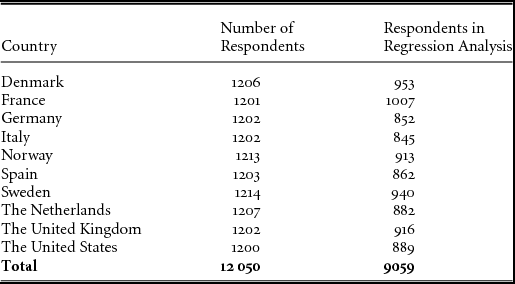
To investigate these questions, we fielded an original survey in ten countries, namely Denmark, France, Germany, Italy, the Netherlands, Norway, Spain, Sweden, the United Kingdom, and the United States. Overall, the survey was completed by 12 500 individuals, with at least 1200 respondents per country. After excluding respondents with missing data for any of our key variables and controls, we are left with 9059 data points in our main regression analysis, with the number of respondents per country ranging from 845 in Italy to 1007 in France (Appendix Table 1 lists the number of respondents per country in both the sample as a whole and in the regression analysis carried out below).
All surveys were conducted by YouGov, a commercial polling company that constructs its samples via online panels. Respondents were quota-sampled to achieve representativeness on the basis of education, age, gender and geographical region (defined by the European Union's NUTS 2 region classification scheme) – in other words, the standard set of variables with regard to which survey fielders typically aim to ensure representativeness. As a result of this process, YouGov survey data have been shown to exhibit essentially identical coefficient estimates and total survey error when compared to data collected via traditional mail and telephone surveys (Ansolabehere and Schaffner, Reference Ansolabehere and Schaffner2014). Note also that YouGov provides corresponding design weights for each of the country samples, which we incorporate when constructing all figures and carrying out our analysis below (though we also confirm that weighting does not substantially alter any of the findings).
Given our focus on welfare state attitudes, our choice of cases was based on a desire to examine countries across the range of Western welfare types (see Esping-Andersen, Reference Esping-Andersen1990; Ferrera, Reference Ferrera1996). This allows us to examine attitudes at both the country- and regime-level. In particular, Denmark, Norway and Sweden represent the Scandinavian universalist model; France, Germany and the Netherlands represent the conservative model of Continental Europe; Italy and Spain represent the Southern European model; and the UK and the US represent the liberal, residual model typically found in the Anglo-Saxon countries. The basic intuition here is that different welfare state types likely engender very different class allegiances (Korpi and Palme, Reference Korpi and Palme1998; Rothstein, Reference Rothstein1998; Larsen, Reference Larsen2008). They might, for example, provide a variety of benefits across the class spectrum (as in Scandinavia), concentrate generous benefits among the relatively better-off (as in Continental and Southern Europe), or target most benefits toward the poorest in society (as in the Anglo-Saxon countries). As a consequence, the impact of class on stances toward the welfare state might differ considerably across the regime types.
The analysis below centres around two sets of questions: those meant to assess a respondent's objective and self-perceived position in society and those that address his or her attitude toward the welfare state. While the former set of questions allows us to explore the extent to which class identity reflects positional considerations, the latter questions assess the expected attitudinal consequences of those positions.
To assess objective and self-perceived positions in society, we rely primarily on a standard set of items (found also in general surveys such as the International Social Survey Programme). First and foremost, we ask respondents for their self-identified class status – our key independent variable – using the question:
Most people see themselves as belonging to a particular class. Which class you would say you belong to?
1. Working class
2. Lower middle class
3. Middle class
4. Upper middle class
5. Upper class
This set of class marker options has the benefit of disaggregating the middle-class into subgroups that reflect real-life practices.
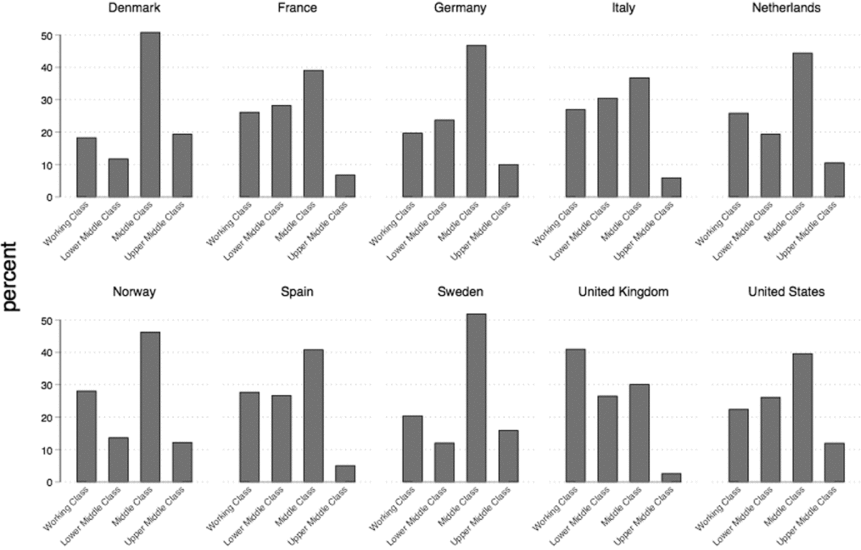
Figure 1 provides an overview of the distribution of class identity across our various country samples. Crucially, we note that respondents do not simply all identify as ‘middle class’. Although a plurality of individuals in almost all countries places itself within that category, a sizeable proportion of respondents identifies otherwise. Around 20 to 30 per cent typically categorise themselves as working class (except in the UK, where the working class, at 40 per cent, is the largest group). The size of the lower-middle class ranges widely from just over 10 per cent in Denmark to over 30 per cent in Italy. The upper-middle class, in turn, is rather smaller, with proportions ranging from three per cent in the UK to 20 per cent in Denmark. Given that less than one per cent of respondents identified as upper class, we opt to exclude the category from our analysis below.
Distribution of class identity across country samples

We then consider this class placement data alongside responses to three additional sets of positional questions. In order to compare the effect of social class with that of objective economic position, we use data on respondent's household income, grouped into eleven income brackets. Because the variable is part of YouGov's pre-collected background data, response rates are relatively high in comparison to standard surveys such as the International Social Survey Programme (ISSP) or the European Social Survey (ESS), though we still lose about one-tenth of our sample.
Given that class markers are clearly connected with much more than simple economic position, we also consider two questions intended to reveal respondents’ perceived position in society. The first of these asks respondents to place themselves on a decile spectrum, with the question:
In our society there are groups that tend to be towards the top and groups which tend to be towards the bottom. Below is a scale that runs from top to bottom. Where would you put yourself on this scale?
1. Bottom
2. _
3. _
4. _
5. _
6. _
7. _
8. _
9. _
10. Top
Note that the question wording here (taken from the ISSP) is purposefully broad, with the goal of having respondents reflect not simply upon their perceived economic position but also their position in society more generally. The second question, in turn, is an original survey item designed to assess whether a respondent feels closer to those at the bottom or the top of society. To that end, respondents were presented with the statement ‘In general I have much more in common with poor people than with the rich’ and then asked to record their agreement along a five-point scale (‘Disagree strongly’ (1), ‘Disagree’ (2), ‘Neither agree nor disagree’ (3), ‘Agree’ (4), and ‘Agree strongly’ (5)).
Traditional measures of welfare state attitudes normally either ask respondents about preferences for government redistribution or whether government should spend more or less on certain social programmes. Yet none of these standard items actually relate to the respondent's own relationship with and beliefs about the welfare state. Rather, they concern aggregated outcomes (i.e. redistribution) and specific social policies, and these may or may not be derived from attitudes about the welfare state as such. Put differently, correlating self-identified class position with preferences for redistribution and social spending will generate estimates that may be difficult to interpret when our interest is the welfare state per se. Indeed, this is particularly a problem as research mounts on the widely varying redistributive effect of social spending across different welfare states; in some, social spending is by and large directed at those with the lowest incomes, while the reverse is true in other places (e.g. Jensen and van Kersbergen, Reference Jensen and van Kersbergen2017: 97).
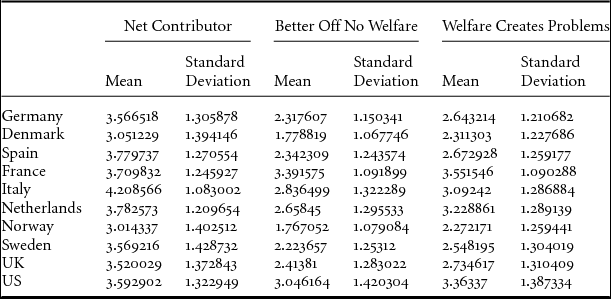
For these reasons, our analysis is based on three novel survey items investigating beliefs about one's general relationship to the welfare state, all of which employ the aforementioned set of responses ranging from ‘Disagree strongly’ (1) to ‘Agree strongly’ (5). The first of these questions is intended to determine whether or not respondents consider themselves to be net contributors to the state. We thus solicited their opinion on the statement ‘Overall, I pay more in taxes than I get back from state’. With a decidedly more neutral tone than our other key survey items, this question provides insight into how respondents perceive their fiscal relationship to the state. In much starker terms, the second survey item presents respondents with the hypothetical statement ‘I would ultimately be better off if the welfare state didn't exist’; the goal here is to draw out particularly harsh critics of the welfare state – whether that criticism is driven by perceived class status or other considerations. Finally, we also asked respondents for their agreement with the statement ‘The welfare state creates more problems than it solves’. Once again, our intention is to assess respondents’ global assessments of the welfare state; in this instance, by asking them to reflect on the balance between the asserted positive and negative consequences that are frequent fixtures in political debate. Further details on responses to these questions are laid out in Appendix Table 2, which presents the (weighted) means and standard deviations of each survey item across all of the countries in our sample.
Despite variation in their tone and focus, our three key survey items have a Cronbach's alpha of 0.77 and are highly correlated. This suggests that each question is capturing part of an underlying attitude that we might label ‘welfare state scepticism’. This does not, of course, imply that the three questions provide an encompassing overview of citizens’ attitudes toward the welfare state; rather, each assesses a component of one's general relationship to the welfare state, whether in terms of the individual's personal gains and losses or the societal benefits and drawbacks of social programmes. If welfare states cater differently to different classes across our 10 countries (and assuming people both notice and care), this should come out directly when we study the correlation between self-identified class position and these welfare state attitudes.
In examining the relationship between responses to the questions and self-identified class, we employ the standard set of baseline controls (see, for example, Iversen and Soskice, Reference Iversen and Soskice2006; Finseraas, Reference Finseraas2009; Rehm, Reference Rehm2011):
• a binary gender variable (with males coded as 1), reflecting research that suggests women are generally expected to be more supportive of the welfare state (e.g. Svallfors, Reference Svallfors1997);
• age, as well as its squared value (to allow for non-linear effects);
• education, with respondents sorted into one of three categories (coded 1 for those with less than secondary education, 2 for those having completed secondary education, and 3 for those with a post-secondary degree or diploma);
• trade union membership, as members are typically more supportive of the welfare state (e.g. Cusack et al., Reference Cusack, Iversen and Rehm2006);
• a binary religious attendance variable (coded 1 for those who have attended a religious ceremony (excluding special occasions) over the past month), since religiosity may shape welfare attitudes (e.g. Scheve and Stasavage, Reference Scheve and Stasavage2006);
• employment status, with dummy variables for the unemployed and the retired; and
• a binary variable denoting if a respondent's main source of income is government benefits.
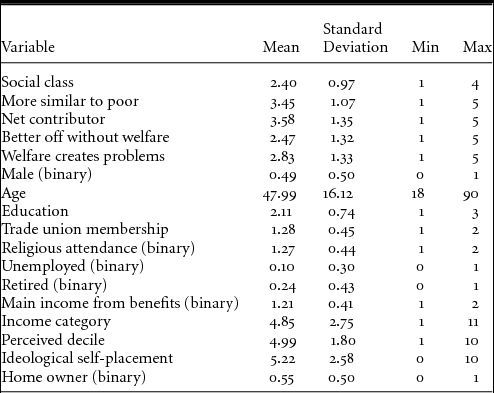
In constructing our analysis using a standard set of baseline controls, our intention is to set up the simplest test for class membership, as we avoid potentially crowding out the effect of the variable. We nevertheless confirm that our findings remain robust if we also include measures such as home ownership (see Ansell, Reference Ansell2014) and left-right ideological self-placement. Appendix Table 3 provides an overview of the mean, standard deviation, and minimum and maximum values of all variables used in this paper.
Analysis
Our investigation proceeds in two stages. Before turning to analyse attitudes toward the welfare state, we first establish that self-identified class status is not entirely disconnected from related social and economic considerations in the minds of respondents; in other words, we want to know whether class status has meaning that is related to the sorts of considerations that should be connected to the welfare state attitudes we examine. Doing so also helps validate our newly collected survey data by documenting that our findings regarding welfare attitudes (to be reported in the second step of the analysis) are not simply a by-product of anomalous data.
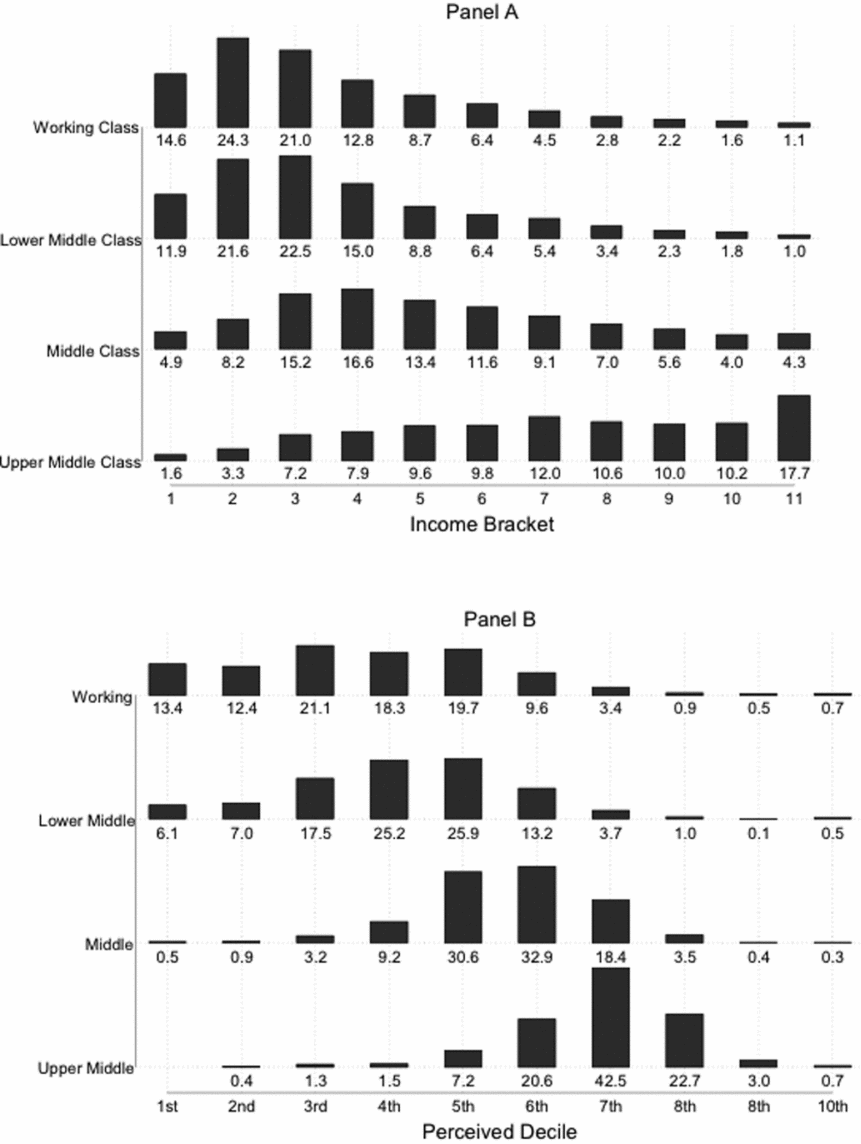
To that end, Figure 2 illustrates the percentage of a given class that falls into each of the income brackets (in the top panel) and self-perceived deciles (in the bottom panel) across the sample as a whole. Looking first at the relationship between class and household income brackets, we note that although there are always at least a few individuals from every income category within each of the classes, the pattern broadly reflects a general link between class and income. As one moves from the working class across the class spectrum to the upper-middle class, we find a growing percentage of individuals in the higher income brackets. That said, the difference between the working class and the lower-middle class is negligible, and members of the upper-middle class in particular are spread widely across the income range.
Distribution of class identity by income bracket and perceived decile

Looking beyond objective economic position, the bottom panel of Figure 2 turns our attention to the respondents’ self-perceived positions in their societies. Here we find a much closer relationship with class identity, even when we compare the distribution of answers for working and lower-middle class respondents. The modal response increases as we move across the class spectrum – from the working class (at the 3rd decile) to the lower-middle (5th), middle (6th), and upper-middle (7th) class groups – and (weighted) mean responses increase steadily (at 3.7, 4.2, 5.6, and 6.8 respectively). While respondents from each class grouping do not of course cluster into a single perceived decile, most can nevertheless be found spread across two to three adjacent decile groups.
Finally, examining perceived proximity to the poor versus the rich offers another way to assess whether class identification is tied to one's (perceived) position in society. Yet since a variety of individual-level characteristics may shape responses to this question (as well as those below), the remainder of the paper will present results from multivariate analysis. In particular, logistic regressions (incorporating design weights) were run (1) independently for each country in the sample, (2) pooling together countries based on their welfare state type, and (3) on the sample as a whole. In the latter two instances, the analysis also includes country dummies to control for country-level heterogeneity. In each iteration of the analysis, we seek to explain agreement with a given statement (with agree and strongly agree coded as 1), controlling for the various factors laid out in the previous section. The result is a set of 15 regressions per question. All findings are therefore illustrated via plots of marginal effect sizes,Footnote 1 with full regression tables relegated to an online Appendix.
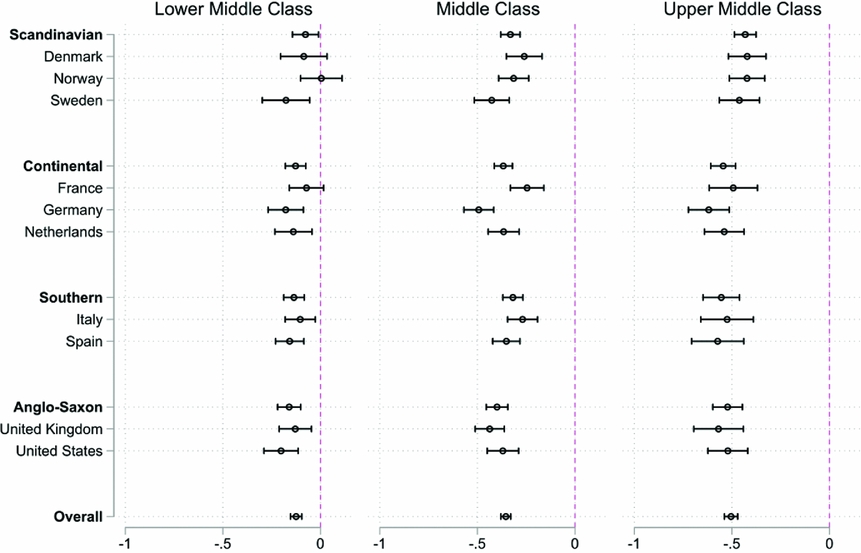
Figure 3 presents the first variant of this analysis, regarding agreement with the statement ‘In general I have much more in common with poor people than with the rich’. The figure illustrates the marginal effect (on probability of agreement) of a given class status relative to the working class. The size of the marginal effects is reported on the horizontal axis and with 95 per cent confidence intervals displayed as the bars around each marginal effect estimate. In this setup, if the 95 per cent confidence intervals overlap with the vertical zero line, the effect is statistically insignificant. Results confirm the connection between self-ascribed class and societal position: the probability of agreeing with the statement decreases progressively (relative to working-class respondents) as one moves up the class hierarchy, with relatively large marginal effect sizes. Indeed, despite a few exceptions in Scandinavia and France vis-à-vis the lower-middle class, this relationship is consistent across countries, welfare-state regimes, and the sample as a whole.Footnote 2
Marginal effect of class identity (relative to the working class) on ‘more similar to poor’

All in all, there is little doubt that people are on average perfectly capable of situating themselves in the class hierarchy. Those with lower incomes and a perception that they have more in common with the poor tend to self-identify as a lower class than those with a higher income and less in common with the poor. These findings corroborate other studies using measures such as occupation (e.g. Curtis, Reference Curtis2016), and lead us to confirm that class clearly has a social and economic meaning for our respondents. The core question of our paper remains, however: do these self-identified class positions also reflect distinct stances toward the welfare state?
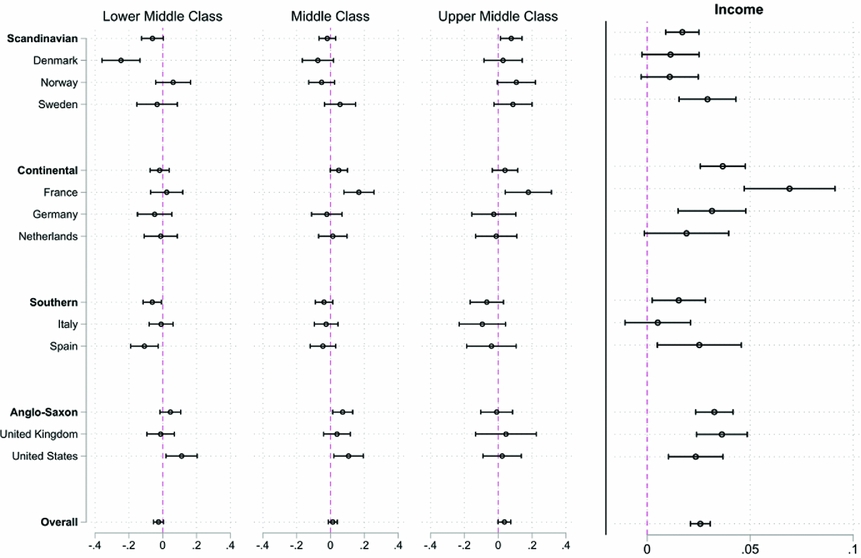
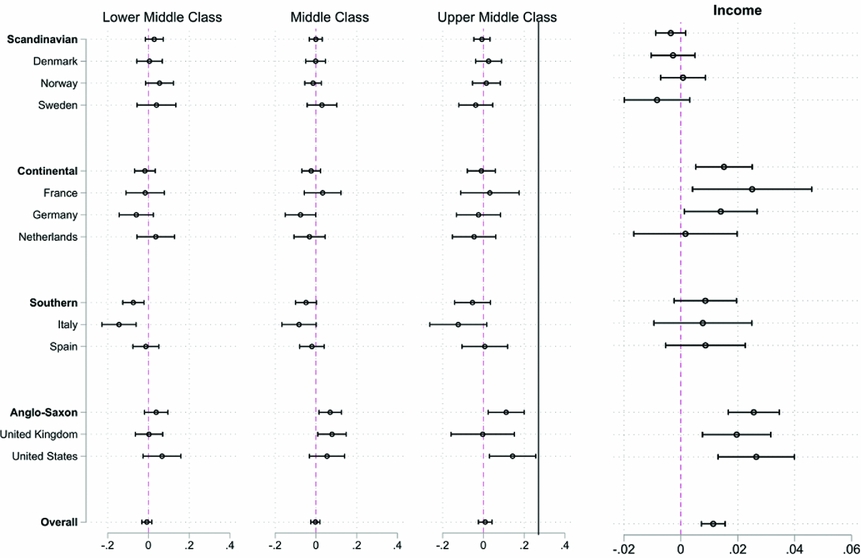
Our first attempt to respond to this question is laid out in Figure 4, which is focused on agreement with the statement ‘Overall, I pay more in taxes than I get back from the state.’ We thus begin by examining what factors shape an individual's self-identification as a net contributor or net recipient. Here the presentation replicates that found in Figure 3 – illustrating the effect of a given class marker relative to the working class – but we also add an additional panel (on the right) demonstrating the effect of moving up one income bracket. (Recall that there are 11 brackets in total.)
Marginal effect of class identity (relative to the working class) and income on ‘net contributor’

If social position matters, responses to this statement would be the most obvious place to find it, out of our three key dependent variables. Yet as Figure 4 makes clear, there is little evidence (outside of the French case) to suggest that social class affects agreement with this statement. Nor is this because of a lack of variation: the split among respondents on this question is more or less even, with a small majority (58 per cent) asserting that they are net contributors. Indeed, as the right-most panel in the figure demonstrates, household income does a much better job of explaining responses to these questions: while a few individual countries do not quite reach statistical significance, only Italian respondents clearly diverge from the general trend, and income reaches significance for the welfare state types as well as the overall sample. Taking the sample as a whole, moving across the interquartile range of income categories (from the third to the ninth bracket) entails an increased likelihood of agreeing to the level of just over 15 per cent. In France – the only country for which there was consistent evidence of a class effect – the impact of moving from the working class to the upper-middle class (at 18 per cent) is surpassed even by an increase of three income brackets (at 21 per cent).
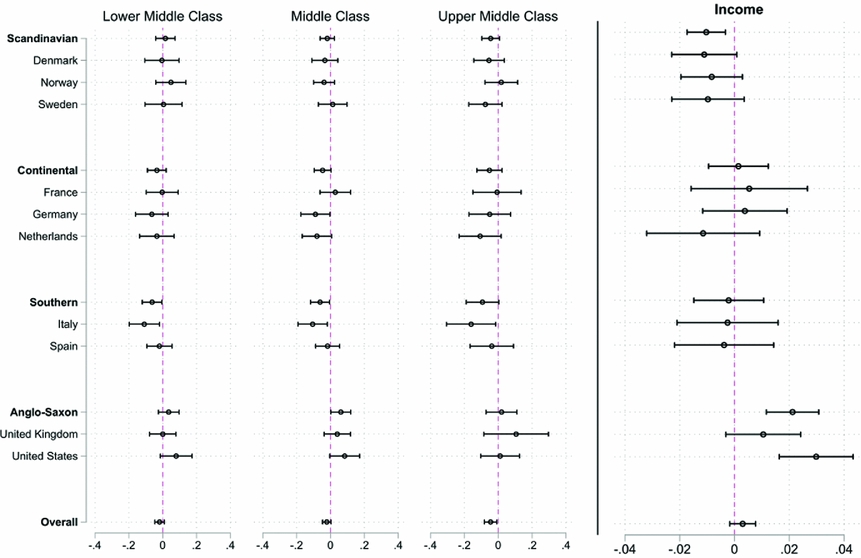
Figure 5, in turn, repeats the above exercise, but focuses on agreement with the claim ‘I would ultimately be better off if the welfare state didn't exist’. This statement presumably captures the respondents’ overall assessment of the welfare state. Assuming an even modestly redistributive welfare state – and given the results above which link class to position in the societal hierarchy – one might expect class to be a major determinant of responses. Yet, as the figure indicates, results are noteworthy in that there is strikingly little evidence of an effect of class status on responses to the statement. The effect sizes of the various class markers are almost never statistically significant and, in the few instances that they are, they remain small and sensitive to small changes to model specification. Recall also that the list of controls employed is relatively limited – adding a control for ideology, for example, erases even the small effect that is at times present in the Anglo-Saxon welfare states.
Marginal effect of class identity (relative to the working class) and income on ‘better off without welfare’

In a certain sense, given that a focus on insurance preferences would suggest broad agreement with the idea that one is better off with a welfare state than without one, these non-findings are perhaps not as shocking as one might initially think. Yet as the figure also illustrates, there is evidence that income matters – though the effect here varies greatly by welfare state type. In the Anglo-Saxon and Continental welfare states (save for the Netherlands), higher income is consistently associated with a greater probability of agreeing that one would be better off if the welfare state did not exist. In the Scandinavian and Southern European welfare states, by contrast, we find no evidence of such an effect. While in the case of Scandinavia this divergence may be explained by the broader popular base of universalist welfare states, it is interesting to note that the Southern European welfare states do not fall in line with their corporatist Continental neighbours. Whether this distinction reflects temporary factors (such as the impact of recent economic crises) or more long-term ones (such as the increased focus on benefits for welfare state insiders) would however require further research.
Finally, Figure 6 illustrates the marginal effect of class status on agreement with the statement ‘The welfare state creates more problems than it solves’, reflecting potential concerns about the welfare state's negative externalities. Here once more, one would predict, a priori, that responses would be closely related to class identification, albeit perhaps with different gradient across welfare state types – but results again belie expectations. Evidence of a relationship between class and agreement is scarce. What is more, in the few instances in which small statistically significant effects are present, they are often in the opposite direction than one would expect. For example, upper-middle class respondents seem, in the sample as a whole, to be marginally less likely than working class respondents to think that welfare creates more problems than it solves. Yet these results are not robust to changes to the set of included countries nor, often, to the introduction of additional common control variables. Indeed, even income does not help us to understand responses to this question: the only evidence of an effect here is found in the Anglo-Saxon welfare states, and is entirely driven by the United States.
Marginal effect of class identity (relative to the working class) and income on ‘welfare creates problems’

Overall, then, we find that while class self-identification does appear to be tied to one's actual and perceived position in society, it is nevertheless an extremely poor predictor of attitudes toward the welfare state. This is an especially striking finding given that several of our survey questions are expressly focused on welfare state attitudes that should (in theory at least) be driven by positional considerations – namely, believing oneself to be a net contributor to the welfare state, and feeling that one would be better off if the welfare state did not exist. The broad lack of evidence of a class-based effect suggests that, although class may have social and economic meaning for individuals, we should not take for granted that it will have corresponding political meanings as well.
Conclusion
Class actors often play an important role in accounts of the origin and persistence of welfare states, particularly in work connected to the Power Resource Theory (e.g. Stephens, Reference Stephens1979; Korpi, Reference Korpi1989). Yet do social classes constitute distinct groups in terms of attitudes toward the welfare state? Based on a unique survey covering more than 12 000 respondents in 10 countries, our answer is a resounding ‘no’. Indeed, none of the class groups we explored here really stood out in terms of their stances toward the welfare state. Self-identified working-class respondents were just as likely to think negatively about the welfare state as self-identified middle or even upper-middle class individuals. There is, by contrast, more evidence to suggest that income level matters for attitudes toward the welfare state; but even its impact varies considerably, depending on both the question asked of respondents and the country in which they live.
Our findings thus align with previous research suggesting that class markers (e.g. Oesch, Reference Oesch2006; Beramendi et al., Reference Beramendi, Häusermann, Kitschelt and Kriesi2015) and, in some instances, even income groups (Soroka and Wlezien, Reference Soroka and Wlezien2008) may be less relevant than often assumed in the literature. Yet, crucially, self-identified class position is nonetheless tied to individual-level characteristics that should presumably shape one's general stance toward the welfare state: it correlates strongly with income and affinity with the poor. Self-identified class positions, in other words, clearly have a social and economic meaning – they just lack any corresponding effect on attitudes towards the welfare state.
Why might this be the case? While this is an obvious avenue for future research, two potential answers seem obvious. On the one hand, the simplest response is that class positions simply never mattered that much for attitudes toward the welfare state, and that other individual-level characteristics – such as risk aversion and occupation – are what really matter (Erikson and Goldthorpe, Reference Erikson and Goldthorpe1992; Kitschelt and Rehm, Reference Kitschelt and Rehm2014). Similarly, it could also be that, while social class was important during the expansionary phase of the welfare state (Stephens, Reference Stephens1979; Korpi, Reference Korpi1989), its relevance may have diminished considerably since the 1970s (e.g. Pierson, Reference Pierson1994; Reference Pierson1996). Insofar as governments seek to reform the welfare state while avoiding electoral backlash, the relevant societal groups should be either benefit recipients for whom losses will be concentrated (e.g. retirees with pension reform) or citizens clustered around the median income group.
For related reasons, part of the explanation for our findings may lie with parties rather than individuals: in a study of the United Kingdom, Evans and Tilley (Reference Evans and Tilley2017) suggest that the decline of class voting can be best explained not by a breakdown of class, but rather by party de-alignment – with parties moving towards the centre in a hunt for the fabled middle-class voters. From this perspective, people may be just as likely as ever to feel a sense of class belonging, but parties no longer represent classes very well. Indeed, research suggests the popularity of the welfare state has pushed centre-right parties to give up many of their most fiscally conservative positions, not least on areas such as health care and old-age pensions (Jordan, Reference Jordan2011; Jensen, Reference Jensen2014). In a similar fashion, social democratic and other centre-left parties have adopted some of the policy positions previously associated with the right, including budget discipline and marketisation of public services (Green-Pedersen, Reference Green-Pedersen2002; Klitgaard, Reference Klitgaard2007; Gingrich, Reference Gingrich2011). Welfare attitudes may therefore not correlate well with self-identified class position because the political system is less structured around these attitudes than in the past. Future research, in short, needs to pay close attention to the possibility that the policy preferences of classes and welfare state politics may well be endogenous to each other. As a consequence, research exploring how political parties understand class markers and their potential political relevance would be especially valuable. Is class really a relevant concept for office-seeking political elites, or are appeals to the middle class simply a (relatively content-free) holdover from a time when class actually mattered?
Acknowledgements
This paper benefited from helpful feedback provided by Christoph Arndt, Young-hwan Byun, Ursula Dallinger, Fabian Engler, Christian Albrekt Larsen, Noam Lupu, Thomas Lux, Steffen Mau, Jonas Pontusson, Mads Thau, Reimut Zohlnhöfer, and three anonymous reviewers. This research was made possible by generous financial support from Aarhus University Research Foundation's AU IDEAS Programme. Anthony Kevins also received financial support from a Marie Skłodowska-Curie Individual Fellowship.
Supplementary material
To view supplementary material for this article, please visit https://doi.org/10.1017/S0047279418000247
Appendices
Number of respondents per country

Descriptive Statistics of Dependent Variables, by Country

Weighted descriptive statistics of all variables