1. Introduction
The Romance languages utilize several series of pronouns with different properties and degrees of structural deficiency which have long been the subject of research. Ever since the path-breaking work by Meyer-Lübke in 1894 it has been known that clitics display a kind of deficiency which gives rise to various restrictions not exhibited by strong pronouns. This different behavior prompted researchers to assume two classes of pronouns; see Meyer-Lübke (Reference Meyer-Lübke1894), among others. In the present paper we will take a closer look at analyses of pronouns within the generative tradition (for analyses within optimality theory see, among others, Tesar and Smolensky, Reference Tesar and Smolensky1998. and Dekkers, van der Leeuw and van der Weijer, Reference Dekkers, van der Leeuw and van der Weijer2000).
Approaches within generative theory diverge on the question whether pronouns have a different categorial status (external syntax) or a different internal structure (internal syntax). External syntax means that the different pronouns project differently, i.e., they do not appear uniformly with a D(eterminer)-layer. Clitics are considered to be syntactically deficient in this approach, i.e., they do not project the D-layer. Internal syntax means that pronouns appear as elements of the functional category D, but differ in their internal structure, in particular it has been suggested that clitics are D-heads and strong pronouns DPs.
New studies present and discuss these approaches and argue that the notion of a pronoun is not a primitive (Raposo, Reference Raposo, Schwegler, Tranel and Uribe-Etxebarria1998; Cardinaletti and Starke, Reference Cardinaletti, Starke and van Riemsdijk1999, Reference Cardinaletti, Starke, Powers and Hamann2000; Déchaine and Wiltschko, Reference Déchaine and Wiltschko2002). We will show that the acquisition facts are not compatible with these approaches and will introduce a new proposal which combines the advantages of these approaches and can make correct predictions for monolingual and bilingual language acquisition.
The differences in deficiency are of both theoretical (e.g., representation and sentence positions of these functional categories) and empirical (e.g., language acquisition and change) interest. For the domain of empirical research in language development, it can be observed that the different pronoun types are acquired by normal monolingual and bilingual children at particular moments of the developmental process. Many researchers have observed an asymmetry between subject clitics and (reflexive and non-reflexive) object clitics, the former being acquired earlier than the latter. Research on early child French has shown that object clitics are omitted until the age of approximately 2;4 (Hamann, Rizzi and Frauenfelder, Reference Hamann, Rizzi, Frauenfelder and Clahsen1996; Jakubowicz, Müller, Ok-Kyung, Riemer and Rigaut, Reference Jakubowicz, Müller, Ok-Kyung, Riemer, Rigaut, Springfellow, Cahana-Amitay, Hughes and Zukowski1996; Jakubowicz, Müller, Riemer and Rigaut, Reference Jakubowicz, Müller, Riemer, Rigaut, Hughes, Hughes and Greenhill1997; Jakubowicz and Rigaut, Reference Jakubowicz and Rigaut2000; Hamann, Reference Hamann2002, among others). Both the delay of object clitics and the subject–object asymmetry between the different types of clitics are robust across individual learners and acquisition types (L1, 2L1, early child L2, and SLI; see Müller, Crysmann and Kaiser, Reference Müller, Crysmann and Kaiser1996; Müller and Hulk, Reference Müller, Hulk, Howell, Fish and Keith-Lucas2000, Reference Müller and Hulk2001; Müller, Reference Müller, Paradis and Prévost2004 for 2L1; Grondin and White, Reference Grondin and White1996; White, Reference White and Clahsen1996 for early child L2; Jakubowicz, Nash, Rigaut and Gérard, Reference Jakubowicz, Nash, Rigaut and Gérard1998; Hamann, Cronel-Ohayon, Dubé, Frauenfelder, Rizzi, Starke and Zesiger, Reference Hamann, Cronel-Ohayon, Dubé, Frauenfelder, Rizzi, Starke and Zesiger2003; Paradis, Crago and Genesee, Reference Paradis, Crago, Genesee, Beachley, Brown and Conlin2003 for SLI). Object clitics have been proposed as a clinical marker for SLI (Paradis et al., Reference Paradis, Crago, Genesee, Beachley, Brown and Conlin2003). However, this research focuses only on the acquisition of clitics (with the exception of Meisel, Reference Meisel and Meisel1990). The present study will look at the different clitic pronouns in relation to their strong counterparts. Any theory of pronominal clitics will have to account for the acquisition of strong pronouns as well. For example: if only clitics are investigated, an asymmetry between subject and object clitics could be explained in terms of their different derivational properties. One may find evidence to support the assumption that subject clitics are directly merged in their syntactic surface position, whereas objects clitics must move to their final position. Appealing to different derivations of subject and object clitics becomes implausible when one realizes that strong subject pronouns are acquired on a par with subject clitics and before or after object clitics, under the standard assumption that strong subject pronouns move to their surface position (as object clitics do). Therefore, we believe that a unified approach which considers strong and clitic pronouns may contribute to a better understanding of a phenomenon which is situated at the heart of the study of Romance and of its normal and delayed acquisition.
The observed robust order of acquisition of particular types of pronouns in bilingual children is crucial for the development of a theory of bilingual language acquisition. Until the mid 1990s, researchers claimed that cross-linguistic influence and very early language separation are mutually exclusive in the bilingual individual. This is so because both are assumed to be valid for whole language systems (like German, Italian), not for subsystems of the language (finite verb placement in Italian and German, subject omissions in Italian and German). If, however, it is plausible to think about language as a competence system which includes different subsystems, the view that separation and cross-linguistic influence can co-exist is indeed plausible. The hypothesis that two languages can be acquired separately and, nevertheless, influence each other was significantly supported by Gawlitzek-Maiwald and Tracy (Reference Gawlitzek-Maiwald and Tracy1996). In the wake of this seminal work, researchers have argued that there exist vulnerable grammatical phenomena, i.e., domains for which cross-linguistic influence is likely to occur in the bilingual child. Hulk and Müller (Reference Hulk and Müller2000) formulate also conditions under which cross-linguistic influence affects bilingual first language acquisition. The interesting conclusion is that cross-linguistic influence seems to be determined only by linguistic characteristics of the grammatical phenomenon in question; language dominance (i.e., the situation when one language develops more quickly than the other one) or language preference (the situation when the readiness to speak a language is higher for one of the two languages) does not play any role for cross-linguistic influence. Of course, the idea about vulnerable grammatical phenomena is only attractive once there exist also robust domains which are acquired by bilingual children without recourse to the other language. The realization of pronouns is such a domain in which bilingual children do not differ from monolingual children.
The present article investigates the acquisition of the pronominal systems by French and Italian monolingual children as well as by bilingual German–French and German–Italian children, showing a stable asymmetry: object and reflexive clitics are acquired later than nominative clitics and strong subject and object pronouns. In the following, we briefly present the pronominal systems of the two languages.
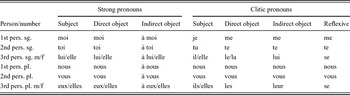
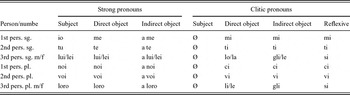
French and Italian have two series of pronouns, clitic and strong personal pronouns for all grammatical functions as can be seen in Tables 1 and 2.
French pronouns.

Italian pronouns.

Both languages, French and Italian, have non-reflexive and reflexive object clitics, represented as LE/LO and SE/SI, respectively, in Tables 1 and 2. In addition, both languages utilize partitive and locative clitics, namely en/ne (partitive) and y/ci (locative). There are also differences between the systems: French exhibits subject clitics which will be represented in what follows as IL.Footnote 1 Furthermore, Italian employs the dative pronoun loro with an intermediate status between strong and clitic (see Cardinaletti, Reference Cardinaletti1991).Footnote 2
The article is organized as follows: section 2 presents acquisition data from monolingual French and Italian children as well as from German–French and German–Italian bilingual children, collected in several longitudinal and cross-sectional studies. These are preceded by a brief survey of the realization of the target system by monolingual adults. Section 3 outlines the different approaches in the literature. Furthermore, we compare clitics to strong pronouns and show that clitics indeed form a homogeneous syntactic class, thus justifying their identical external syntax. We present quantitative and qualitative differences among the types of clitics (IL, LE/LO, SE/SI), which make it necessary to distinguish between them on the level of internal syntax. We argue that reflexive clitics are heads, object clitics are “deficient arguments” and subject clitics display the complete internal structure of noun phrases. We then formulate predictions for the acquisition of subject and reflexive/non-reflexive object clitics, particularly regarding the order of their acquisition, in monolingual and bilingual language acquisition, which explain the findings in section 2. Section 4 discusses the results and section 5 presents our conclusions.
2. Acquisition data
In the following we present acquisition data which show that both the delay of object clitics and the subject–object asymmetry between the different types of clitics are robust across individual learners and acquisition types. In contrast to other studies of monolingual and bilingual children, we will compare the acquisition of clitics with that of strong pronouns and discuss the consequences of the developmental path for a syntactic analysis of clitics and strong pronouns in Romance. This led us to investigate only the Romance languages in the bilingual children, and not their German pronouns since German does employ genuine clitics and thus does not allow us to draw conclusions on the acquisition order of the different pronoun types. Furthermore, we can also predict the absence of cross-linguistic influence which will be shown below, on the basis of the criteria by Müller and Hulk (Reference Müller, Hulk, Howell, Fish and Keith-Lucas2000, Reference Müller and Hulk2001): according to them, a certain overlap of the relevant domain in the two languages is required in order to create ambiguity leading the children to make possibly target-deviant conclusions about the use of pronouns (in this case). Due to the absence of genuine clitics in German, such an overlap does not exist.
In order to be able to determine quantitatively what was expected by the children, we analyzed a corpus of spontaneous interactions by French and Italian monolingual adults with children (i.e., input data for language acquisition).We compared the different possible realizations of the subject and the object position in the two languages and ascertained numerous quantitative and qualitative differences.
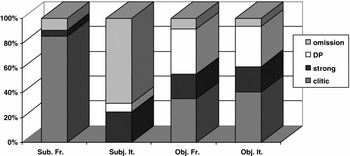
The two languages resemble each other in their realizations of the object position. Figure 1 shows that object clitics amount to about 40% of object realizations in the two languages.Footnote 3 Notice further that DPs are quite frequent in object position in both languages (ca. 35–40%). If we compare subjects and objects, Figure 1 can be interpreted as demonstrating that the presence of subject clitics in French (ca. 85%) and the absence of a phonetically realized element in subject position in Italian are systematic syntactic properties of the two languages. In what follows we will refer to Figure 1 as the target frequencies of the different types of pronouns. In section 3.3. we will present examples for object omissions and interpret the quantitative differences between subject and object clitics in the two languages as reflecting qualitative differences of the target systems.
Realization of subject and object position in French and Italian.

2.1 The monolingual children
Longitudinal studies
Two monolingual children were analyzed: Grégoire (French) and Martina (Italian). The longitudinal data of both children are taken from the CHILDES database (see MacWhinney and Snow, Reference MacWhinney and Snow1985). Table 3 gives a survey of their age in years;months,days, the (word-based) MLUw value, and the standard deviation (from MLUw).Footnote 4
The monolingual French and Italian children.

Cross-section studies
In addition to the longitudinal monolingual studies introduced in the preceding subsection, further studies on pronoun acquisition by monolingual French and Italian children are relevant for the present study and enlarge the monolingual database. These studies will be briefly presented below.
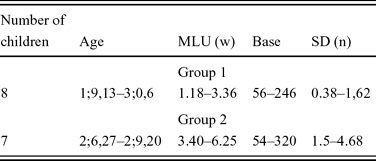
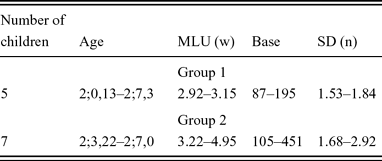
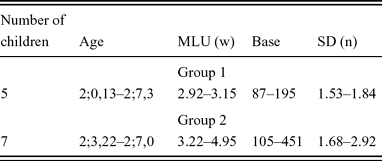
Jakubowicz et al. (Reference Jakubowicz, Müller, Ok-Kyung, Riemer, Rigaut, Springfellow, Cahana-Amitay, Hughes and Zukowski1996, Reference Jakubowicz, Müller, Riemer, Rigaut, Hughes, Hughes and Greenhill1997) conducted an elicited production task with monolingual German and French children between the ages 2 and 3. In addition to this test, each session also contained about 30 minutes of recordings of spontaneous speech on which the following analysis is exclusively based. Tiedemann (Reference Tiedemann1999) conducted the same test with monolingual Italian children.Footnote 5Tables 4 and 5 provide a summary of the number of children, their age in years;months, days, the (word-based) MLUw value, and the standard deviation. Two groups of children were set up: in group 1, children had a mean MLUw of ≤ 3 and (almost) lacked structures related to the adult C-system (which include subordinate clauses introduced by a lexical complementizer). Group 2 children had a mean MLUw > 3 and used the relevant structures productively.
Monolingual Italian children in elicited production task.
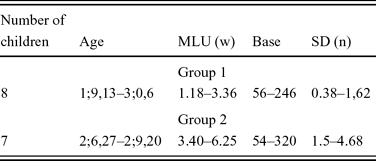
Monolingual French children in elicited production task.
2.2 The bilingual children
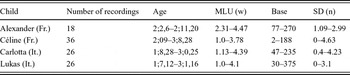
For the purpose of the present article, we analyzed two German–French and two German–Italian bilingual children, all of them recorded in the research project “Bilingualism in Early Childhood: Comparing German/Italian and German/French”.Footnote 6 All of these bilingual children are being raised in Hamburg; their parents follow the strategy of “one parent – one language” (see Ronjat, Reference Ronjat1913). Except for Céline, the mothers are native speakers of French or Italian and the fathers are German. Céline's mother is German and her father is French. Table 6 shows the number of chosen recordings and the age span in years;months,days as well as the range for the MLUw, base (number of utterances) and standard deviation (SD) of the four children in their Romance language.
The bilingual German–French and German–Italian children.

2.3 Analysis
The following analysis of the data focuses on the use of different types of pronouns in the acquisition of French and Italian. In particular, the order of acquisition of strong and clitic pronouns in subject and object position is investigated, as well as that of reflexive and non-reflexive object clitics and subject (nominative) clitics. Both the onset of acquisition and development towards the target are studied, where development is considered successful or target-like when the adult norm is reached.Footnote 7 We will refer to the adult data represented in Figure 1 (cf. section 2). The figures showing occurrences of subject and object pronouns are based on percentages.Footnote 8 Information about DP use (la fille, la ragazza “the girl”) is added, allowing the reader to compare it with pronoun use and to infer the omission rates.Footnote 9
Pronouns in monolingual longitudinal studies
Subject and object pronouns
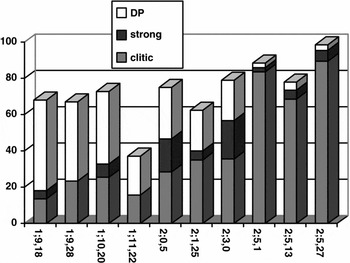
This section compares the use of strong and clitic pronouns in subject and object position in the acquisition of French and Italian by the monolingual children. Figure 2 shows for the monolingual French child Grégoire that he produces both strong and clitic subject pronouns from the first recording onwards, reaching the adult rate of 80% of subject clitics at age 2;5,1.
Clitic versus strong subject pronouns in Grégoire.

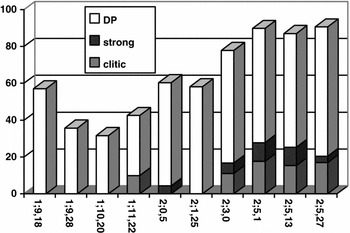
In the object position, Grégoire uses clitics rather intermittently (maximally to 20%, only half of the percentage of the French adults in Figure 1) and only regularly, i.e., in every recording session, from 2;3 onwards. The same holds for strong object pronouns, as Figure 3 shows. The few occurrences of strong pronouns appear one recording session later than the first clitics, i.e., within a time span of 13 days, which can be considered to be simultaneously.
Clitic versus strong object pronouns in Grégoire.

Comparing both positions, both strong and clitic object pronouns appear clearly later than strong and clitic subject pronouns, and objects are mainly realized as DP.
The Italian monolingual child Martina uses strong subject pronouns from the first recording on. They increase from less than five in the first recordings up to a maximum of about 30 at the age of 2;4,13. Although it is not possible to represent these rare occurrences in a percentage-based graph, we would like to add this information since the rare use of strong pronouns is caused by the null subject property of Italian and reflects adult use.
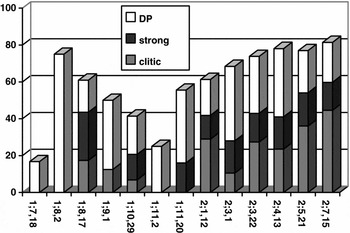
In object position, Martina initially uses clitic pronouns at a rate of less than 20%, i.e., only at half the rate of the Italian adults in Figure 1. The number of object clitics increases during development, reaching the adult rate of 40% in the last recording as Figure 4 shows. Both strong and clitic object pronouns are employed at this time, but strong pronouns appear later in object position (not in the first two recordings) than in subject position. Strong object pronouns are used regularly (i.e., in every recording) from 1;11,20 on to a maximum rate of 20% (as the adults' rate). In the beginning, a large number of objects are realized as DP, as in Grégoire.
Clitic versus strong object pronouns in Martina.

The comparison between the use of strong and clitic pronouns in subject and object position by monolingual children clearly shows that subject clitics and strong subject pronouns start to be used at the same time. Subject clitics appear before object clitics. In object position, however, pronouns are in general acquired later than in subject position. Once objects are pronominalized, strong pronouns and object clitics appear simultaneously.
While the observations above emphasize the onset of acquisition, we can also state that both monolingual children reached the adult rates of clitic use in both subject (French) and object (French and Italian) position.
Reflexives
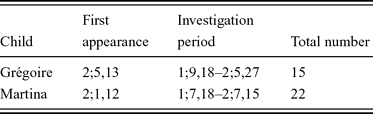
In the following, the first appearances and total number of reflexive object clitics are presented and compared with the onset of both subject and non-reflexive object clitics. Notice, however, that reflexive verbs appear rarely in the spontaneous data. Table 7 shows that Grégoire, the French child, uses reflexive clitics very late, only in the last two recordings, unlike subject clitics, which appear already in the first recording. Also, Martina does not use reflexive clitics from the beginning of the investigation period.
First appearance and total use of reflexive object clitics in the monolingual longitudinal studies.
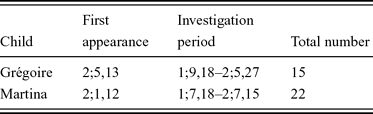
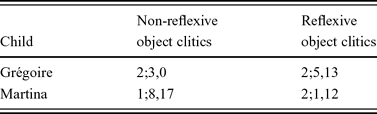
Table 8 compares the first appearances of reflexive and non-reflexive object clitics.
First appearances of reflexive and non-reflexive object clitics.
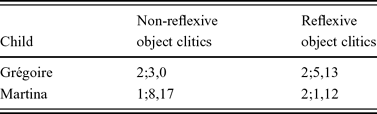
Summarizing, the results for the reflexive object clitics show that the monolingual French child acquires reflexive clitics later than subject clitics. With respect to non-reflexive object clitics, the comparison of the moments of acquisition indicates that both monolingual children use non-reflexive object clitics before reflexives.Footnote 10
Pronouns in the cross-section studies
Subject and object pronouns
This section compares the onset and development of strong and clitic pronouns in subject and object position in the spontaneous production part of the cross-section studies introduced in 2.1. Figure 5 shows that in French, both groups of children use subject clitics to a much higher degree (F1 50%, F2 more than 80%) than strong subject pronouns (less than 10%). The second French group (F2) thus almost reaches the adult rates for both subject clitics and strong subject pronouns. The Italian children use strong pronouns approximately 20% of the time, which corresponds to the Italian adult rate.
Clitic versus strong subject pronouns in French and Italian.

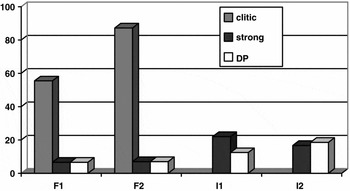
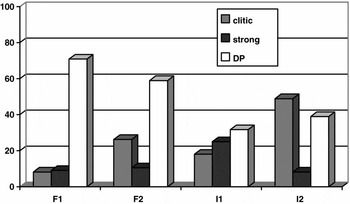
In object position, a completely different picture emerges: Figure 6 shows that the first groups of French and Italian children (F1 and I1) use slightly more strong object pronouns (F1 10%, I1 22%) than clitics (F1 9%, I1 18%), while the second groups (F2 and I2) produce clearly more clitics than strong pronouns; in French, however, with ca. 20 percentage points less than in subject position and far less than adults (40%), which means that the second groups of French and Italian children had not yet reached the target norm. The Italian children use more object clitics (ca. 42%) than the French children. This rate is also higher than that of DP objects while in both French groups and the first Italian group the highest rate of realized objects consists of DP's as in the longitudinal data from Grégoire and Martina (cf. also Müller, Schmitz, Cantone and Kupisch, Reference Müller, Schmitz, Cantone, Kupisch, Torrens and Escobar2006, who find parallel developments in their cross-sectional study).
Clitic versus strong object pronouns in French and Italian.

With regard to strong object pronouns we observed that French children of both groups (F1 and F2) use them rather rarely (ca. 10%), while the Italian children of the first group (I1) produce them ca. 22% of the time. In group I2, this rate decreases to ca. 10% (mostly in favor of object clitics). Both French and Italian adults, however, use strong objects around 20% of the time. This rate is not reached by either of the second groups (F2 and I2).
These results can be summarized as follows: strong subject pronouns and subject clitics are acquired at the same time as strong object pronouns. The developmental process of acquisition of object clitics clearly takes place after the acquisition of subject clitics. The adult norm for subject clitics is almost reached by F2 children, while the adult rate for object clitics is still far from having been reached. These observations show that although the acquisition process towards the target norm of strong object pronouns starts very early, it still overlaps with that of object clitics.
Reflexives
Following the same procedure as in the cross-section studies, we compare the onset of use of reflexive object clitics with that of subject and non-reflexive object clitics.
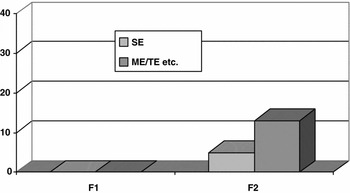
The analysis of the reflexive pronouns in French monolingual children is based on the results taken from Jakubowicz and Rigaut (Reference Jakubowicz and Rigaut2000), an expanded version of the investigation in Jakubowicz et al. (Reference Jakubowicz, Müller, Ok-Kyung, Riemer, Rigaut, Springfellow, Cahana-Amitay, Hughes and Zukowski1996, Reference Jakubowicz, Müller, Riemer, Rigaut, Hughes, Hughes and Greenhill1997) with new data from the original and several new children. The criteria for group division (MLUw, C-system and finite verb production) correspond to the criteria applied in the present study. Spontaneous interaction and elicited production are clearly separated. In contrast to Jakubowicz and Rigaut (Reference Jakubowicz and Rigaut2000), only accusative reflexive pronouns in spontaneous production are counted here. Figure 7 shows that reflexives were only used by the second French group while both subject and non-reflexive object clitics were also used by the first French group (see Figures 5 and 6).
Reflexives in French monolingual children.

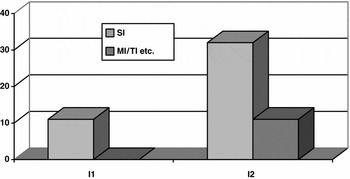
The analysis of reflexive pronouns in Italian is based on the study of Tiedemann (Reference Tiedemann1999). Figure 8 shows that reflexive pronouns are acquired earlier in Italian than in French, the reflexive si being used already by the group 1 children.
Reflexives in Italian monolingual children.

The results for the ongoing acquisition of reflexives can be summarized as follows: the acquisition of subject clitics takes place before the acquisition of reflexive object clitics, as the French study clearly shows. The order of acquisition of non-reflexive and reflexive object clitics seems to depend on the language: French group 1 children exhibited a very low percentage of non-reflexive object clitics (ca. 10%) and they did not use reflexives at all. Italian children in group 1 used more non-reflexive object clitics (18%) than their French peers, and they also produced reflexive object clitics (ca. 10%). The children of the second French group (F2) produced reflexives at a rate of ca. 15% while the Italian children in the second group (I2) already produced reflexives at a rate of ca. 40%.
We may thus conclude that reflexive object clitics pattern like non-reflexive object clitics in both languages and that Italian children have less difficulty producing these types of pronouns as compared to French children.
Pronouns in bilingual longitudinal studies
Subject and object pronouns
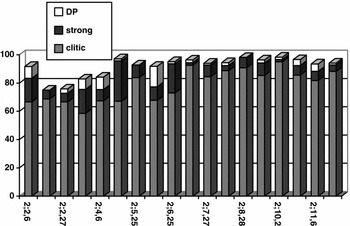
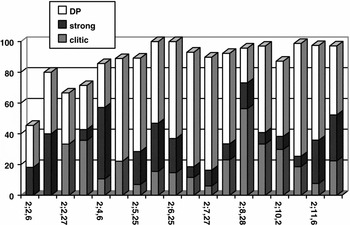
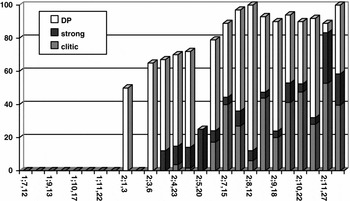
This section compares the use of strong and clitic pronouns in subject and object position in French and Italian by the bilingual children. Starting with the German–French bilingual child Alexander, we can observe in Figure 9 that he uses strong subject pronouns and subject clitics simultaneously from the first recording onwards. By the age of 2;6 he quantitatively approaches the target system's use of subject clitics (a rate of more than 80%, cf. Figure 1), thus discovering the near-obligatoriness of subject clitics. Until then, clitics are used at a rate of ca. 80%. Strong subject pronouns are also used in every recording, but to a very low average degree of less than 10%, which corresponds to the adult use.
Clitic vs. strong subject pronouns in Alexander.

Figure 10 shows that Alexander does not use object clitics in the first two recordings but only strong pronouns. Object clitics are produced from 2;2,27 onwards, but to varying degrees of far below the adult rate (e.g., 10% at 2;7,27) and also exceeding the adult rate (e.g., 50% at age 2;8,28). A consistent use corresponding to the adult rate of 40% cannot be observed during the investigation period. The onset of use of object clitics, however, clearly takes place after that of strong object pronouns. Overall, Alexander prefers to realize objects as DP's like the monolingual children (cf. subsections above).
Clitic vs. strong object pronouns in Alexander.

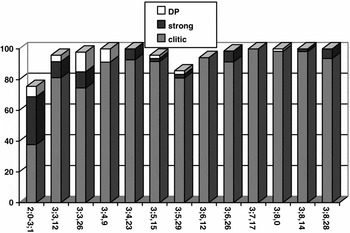
Figure 11 shows that the other bilingual German–French child, Céline, behaves similarly with respect to subjects: from the first recordings onwards, she produces both strong and clitic subject pronouns (even in the period from 2;0 to 3;1 where she speaks much less French than Alexander).Footnote 11 Interestingly, she starts to use subject clitics at the 80% level from 3;3,12 onwards, i.e., much later than Alexander as far as each child's respective age in concerned. Notice however that their MLUw is comparable: Alexander has reached an MLUw of 3.5, Céline an MLUw of 3.4 when they use nominative clitics at the 80% level, i.e., at almost the adult rate. Unlike Alexander, Céline does not use strong subject pronouns in every recording and to a lesser degree than the adults, but the onset of production occurs at the same time as the onset of production of subject clitics, as was the case with Alexander and the monolingual children.
Clitic vs. strong subject pronouns in Céline.

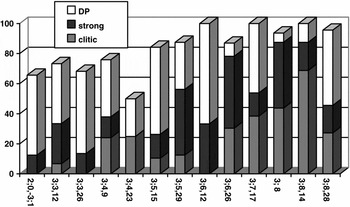
By contrast, Céline uses no clitic pronouns in object position until 3;3,12. Like Alexander, she already uses strong pronouns in the object position during the very first recordings. The adult 40% level for object clitics is reached only at 3;7,17 for the first time, as Figure 12 shows. Apart from one recording (3;4,23), Céline uses strong object pronouns in every recording with rates of up to 40%, reaching the 20% adult level only from 3;8,14.
Clitic vs. strong object pronouns in Céline.

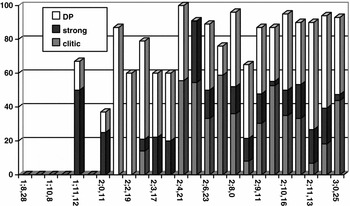
We now turn to the German–Italian bilingual children. The bilingual German–Italian child Carlotta shows an increasing use of strong subject pronouns from 2;0 onwards. Although we cannot represent the overall rare use of strong subject pronouns (due to the null subject property, as with Martina) the onset of the use of strong subject pronouns is relevant since it corresponds to the onset of regular use of strong object pronouns (2;0,11) as Figure 13 shows. In the object position, Carlotta also uses only strong pronouns until 2;3,2 which is the onset of using object clitics. But a regular use, i.e., in every recording, takes place only from 2;4,21 on. Then Carlotta produces them, like the bilingual German–French child Alexander, to highly varying rates, both below the adult rate (ca. 10% at e.g., 2;11,13) and up to ca. 60% (e.g., at 2;4,21), then exceeding the adult rate of ca. 40% object clitics. An adult-like use of ca. 40% is reached in the last recording (3;0,25). Like the German–French child Céline, Carlotta does not use strong subject pronouns in every recording. If they are used, however, they mostly appear at a rate of ca. 20%, which corresponds to the adult rate.
Clitic vs. strong object pronouns in Carlotta.

Lukas, the second bilingual German–Italian child, behaves similarly: in the subject position he uses strong pronouns from 2;2 onwards (to a varying rate). Compared with the object position, Figure 14 shows that Lukas first uses only strong object pronouns (from 2;4,9 onwards) and starts to use clitic pronouns slightly later (at 2;4,23). The onset of the use of strong pronouns in both subject and object position thus clearly precedes that of the object clitics. Like Carlotta (and the German–French child Alexander), Lukas uses object clitics to a varying degree (up to 50%, then exceeding the adult rate of ca. 40% object clitics). The adult rate is met only in the last recording (3;1;16). Lukas uses strong object pronouns in every recording from 2;4 on, but mostly to a rate of 10% and less. Not until the last recording does their use correspond to the adult rate of 20%.
Clitic vs. strong object pronouns in Lukas.

We can summarize the results of this section as follows: strong subject pronouns and subject clitics are acquired at the same time as strong object pronouns. Subject clitics are acquired clearly before object clitics. Strong object pronouns are acquired before object clitics.
Reflexives
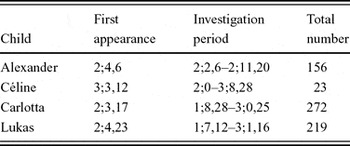
As in the preceding studies, we compare the onset of the use of reflexive object clitics with subject and non-reflexive object clitics. The first appearance of SE and SI and the absolute number of produced reflexive clitics in the investigation periods are shown in Table 9.
First appearance and total number of reflexive object clitics.

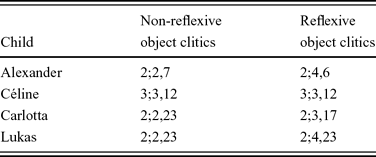
A comparison of the appearance of reflexive clitics with the one of non-reflexive clitics in Table 10 shows that non-reflexive object clitics are used somewhat earlier than reflexive object clitics by three of the four children – in the French-German child Céline both appear at the same time and quite late, her overall development in French being slowed down. Notice, however, that reflexive verbs occur rarely in the spontaneous data of all children.
Comparison of first occurrences of non-reflexive and reflexive object clitics.
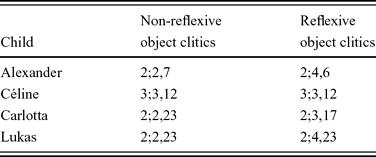
A summary of the results for the acquisition of reflexive clitics by bilingual children demonstrates the following: subject clitics are clearly acquired before reflexive object clitics. The order of acquisition of non-reflexive and reflexive object clitics is less clear: both are acquired either at the same time or reflexive object clitics slightly later than non-reflexive object clitics or vice versa.Footnote 12
In comparing the monolingual and the bilingual data, we can determine the following similarities and differences:
• Subject clitics appear before object clitics.
• Subject clitics appear at the same time as strong subject pronouns.
• In elicited production of monolinguals and longitudinal bilingual data strong object pronouns appear at the same time as subject clitics and strong subject pronouns.
• In the longitudinal monolingual data object pronouns appear generally later, i.e., independently of their status as clitic or strong pronoun.
• Reflexive clitics appear much later that subject clitics.
• The appearance of reflexive clitics in relation to non-reflexive clitics is random, i.e., they can appear simultaneously or one before the other.
The general conclusion is that the order of appearance of clitic and strong pronouns shows no difference in monolingual and bilingual children. The only difference is between the monolingual children of the longitudinal studies and those of the cross-sectional studies regarding the strong object pronouns, which might be due to the investigation of only two longitudinal studies compared to a much higher (and more representative) number of children in the cross-sectional studies. The following sections will examine the internal and external structure of clitics and strong pronouns in the two Romance languages and will explain the acquisition facts on the basis of this structure.
3. An analysis of clitics in adult language
In the following sections we will present two well-known approaches to clitics which, however, are unable to predict correctly the asymmetries found in the acquisition data. We will therefore develop an analysis of pronouns which is compatible with the data.
3.1 Clitics as DPs with internal difference
The first type of approach within generative theory argues that clitics differ from other pronouns in their internal structure. Some researchers have argued for their status as heads (mostly assumed to be D(eterminer)-like elements) in syntax (with a pro – an empty pronominal – in argument position which satisfies Case- and Theta-requirements; e.g., Roberge, Reference Roberge, Wanner and Kibbee1991), others for their status as elements which are inserted into syntax as categories of some type (XPs) but which move as heads (Xs) (e.g., Belletti, Reference Belletti and van Riemsdijk1999; for a discussion, see Müller, et al., Reference Müller, Crysmann and Kaiser1996). In this approach, all pronouns are of the same categorial type (e.g., DP) but their internal structures are different. The main evidence supporting this analysis comes from the observation that Romance object clitics often have the same phonological form as determiners. Furthermore, Raposo (Reference Raposo, Schwegler, Tranel and Uribe-Etxebarria1998) shows that there is a relation concerning the possibility to omit object clitics at the sentence level and to omit determiners at the level of DP.
The predictions for acquisition on the basis of this account are clear: clitics should pattern together (as they at least move as heads) and contrast with strong pronouns, the latter being analyzed uniformly as DPs. The summary of section 2 clearly showed that the predictions are not borne out by the data, neither by the monolingual nor by the bilingual children.
3.2 Clitics as a proper class of pronouns
This section presents in more detail the approaches from Cardinaletti and Starke (Reference Cardinaletti, Starke and van Riemsdijk1999, Reference Cardinaletti, Starke, Powers and Hamann2000) and Déchaine and Wiltschko (Reference Déchaine and Wiltschko2002), which assign a different categorial status to the various types of pronouns, according to their degree of deficiency. Apart from using different criteria and categorial labels for their classifications, the two approaches treat clitics differently: while Cardinaletti and Starke (Reference Cardinaletti, Starke and van Riemsdijk1999, Reference Cardinaletti, Starke, Powers and Hamann2000) establish a homogenous class of clitic pronouns, Déchaine and Wiltschko (Reference Déchaine and Wiltschko2002) group the clitics in different classes corresponding to their distinctive properties.
The tripartition of pronouns by Cardinaletti and Starke (Reference Cardinaletti, Starke and van Riemsdijk1999, Reference Cardinaletti, Starke, Powers and Hamann2000)
Cardinaletti and Starke (Reference Cardinaletti, Starke and van Riemsdijk1999) propose a tripartition into strong, weak and clitic pronouns which exhibit different degrees of syntactic, semantic, and morphophonological deficiency, expressed in the hierarchy in (1):
(1) Hierarchy of deficiency of pronouns


With respect to their syntactic derivation, strong and weak pronouns move as XPs while clitics move as heads. They also differ in the representation of projection layers which are each correlated to functional categories on the sentence level: strong pronouns are full nominal projections, with C° encoding case and referential information, parallel to CP (Complementizer Phrase) in sentence structure. Weak pronouns lack the highest functional projection and are compared to ΣPs, a functional projection between CP and IP (Inflection Phrase) encoding polarity and prosodic features. Clitics lack the two highest functional projections and are thus compared to IPs, the lowest functional category in sentence structure. Cf. the structures in (2).
(2)
Cardinaletti and Starke (Reference Cardinaletti, Starke and van Riemsdijk1999, p. 197) further claim that the choice of a particular pronoun type is regulated by a strong cross-linguistic generalization according to which the most deficient form must be chosen if available. The authors (1999, p. 215) specify that this rule holds only if the deficient pronoun is associated with the same features as those which would have been contained in the strong counterpart. This generalization is then reduced to the statement that a “smaller structure” is necessarily chosen if possible, expressed as the Economy Principle “Minimise Structure” (Cardinaletti and Starke, Reference Cardinaletti, Starke and van Riemsdijk1999, p. 198) and generalized even more to “Minimalise α” (Cardinaletti and Starke, Reference Cardinaletti, Starke and van Riemsdijk1999, p. 201). This principle leads to the following rule: strong elements have priority but a deficient element has to be chosen whenever it is associated with the same features that would be encoded by the corresponding less deficient element. Cardinaletti and Starke (Reference Cardinaletti, Starke and van Riemsdijk1999, fn. 71) claim that acquisition data show the primacy of strong pronouns in language acquisition: if confronted with a pronoun which in adult grammar can be classified as deficient or strong, a child always resolves ambiguity by postulating only one form, namely the strong one.
To sum up the statements regarding the acquisition of pronouns by Cardinaletti and Starke (Reference Cardinaletti, Starke and van Riemsdijk1999), we see that they predict that children react to the primacy of strong pronouns and therefore disobey the Principle Minimise α. It thus appears that two different generalizations hold, one for each period: initially a primacy of strong pronouns and later the Principle Minimise α. Since one of them is always active, the theory cannot be falsified by empirical results: if children start first with the production of strong pronouns, they obey the primacy of strong pronouns; if they start first with the production of clitics they respect Minimise α. What cannot be predicted, though, is the simultaneous acquisition of strong and clitic pronouns and the acquisition of different types of clitics at different points in time. Interestingly, both monolingual and bilingual children seem to acquire strong subject pronouns and subject clitics at the same time, as presented in section 2. Furthermore, subject clitics appeared before object clitics. We can thus conclude that this approach does not correctly explain the appearance of pronouns in child language.
The tripartition of pronouns by Déchaine and Wiltschko (Reference Déchaine and Wiltschko2002)
In what follows we present the approach by Déchaine and Wiltschko (Reference Déchaine and Wiltschko2002), which differs in one important aspect from the one by Cardinaletti and Starke (Reference Cardinaletti, Starke and van Riemsdijk1999, Reference Cardinaletti, Starke, Powers and Hamann2000): while Cardinaletti and Starke compare the different pronoun types to functional categories at the sentence level, the proposal by Déchaine and Wiltschko refers to the properties of the functional category D in the nominal domain. They propose the following three pronominal types in (3):
(3)
Comparing pronouns in Halkomelem, Shuswap, Japanese, English and French, Déchaine and Wiltschko (Reference Déchaine and Wiltschko2002) argue that the clitics which are of interest here, IL, LE/LO and SE/SI, are of the categorial type ΦP.Footnote 13, Footnote 14 Strong pronouns are pro-DPs and the clitics en/ne are Pro-NPs. In other words, this approach differentiates among pronouns assigning them a different categorial status. In contrast to Cardinaletti and Starke, clitics are not generally conceived of as the most deficient elements and the class of clitics contains categories of the type pro-ΦP and pro-NP.
Déchaine and Wiltschko (Reference Déchaine and Wiltschko2002, p. 427ff.) apply their approach to French clitics and conclude that en is a pro-NP clitic while 1st/2nd/3rd person subject and object clitics are pro-ΦPs. For the acquisition of the clitics of interest here, their approach predicts first that these clitics are acquired simultaneously and second that strong pronouns (as pro-DPs) and clitics are not acquired at the same time in development, if acquisition depends on the external syntax of pronouns. In essence, on the basis of Déchaine and Wiltschko's work, the same predictions can be made as with Cardinaletti and Starke's approach. As we have seen in section 2, neither prediction is borne out by the data.
In the next section, we will present an approach which combines the internal and external syntactic analysis of pronouns.
3.3 Combining the external and internal syntax of clitics
In what follows we will combine the two approaches from Cardinaletti and Starke (Reference Cardinaletti, Starke and van Riemsdijk1999) and Déchaine and Wiltschko (Reference Déchaine and Wiltschko2002) on the one hand, and Raposo (Reference Raposo, Schwegler, Tranel and Uribe-Etxebarria1998) on the other hand, following a proposal made by Gabriel and Müller (Reference Gabriel, Müller and Kaiser2005). We will argue for both an external and internal deficiency of clitics in the two Romance languages. If deficiency relates to external as well as internal syntax, we have the following possibilities, which are discussed in detail in Gabriel and Müller (Reference Gabriel, Müller and Kaiser2005), and which give rise to the typology in (4).
(4) A typology of clitics in relation to strong pronouns
IL is a pro-ΦP with the most articulated structure, LE/LO is a pro-ΦP as well, but lacking an N-layer, while SE/SI is a Φ-head. Clitics, as a class of Φ-expressions, differ from strong pronouns in that the former are of the categorial type Φ, the latter are DPs. In this respect clitics represent a homogeneous class. However, a crucial aspect of the proposal made by Gabriel and Müller (Reference Gabriel, Müller and Kaiser2005) is the fact that the class of clitics shows quantitative and qualitative differences. Therefore, the proposal is presented in two steps: the first subsection of 3.3 puts forward several reasons why clitics form a pronoun class in their own right which differs from strong pronouns, while the second subsection argues for a further subdivision of the class of clitics. The third and last subsection of 3.3 summarizes the proposal and makes predictions holding both for monolingual and bilingual first language acquisition.
Clitics as a homogeneous class of Φ
The first question is why the clitics IL, LE/LO and SE/SI represent a homogeneous class, differing in well-defined respects from strong pronouns.
It has been shown in the literature (Cardinaletti and Starke, Reference Cardinaletti, Starke and van Riemsdijk1999 among others) that Romance clitics exhibit a homogeneous syntactic, semantic and phonological behavior. On a syntactic level, the deficiency of clitics is evident under coordination. Whereas strong pronouns can be coordinated, clitic pronouns cannot, as shown in (5) for French.Footnote 15
- (5)
a.
*Il et celui de Jean sont beaux. <+h>
b.
c.
If we turn to the semantics of clitics, they can have human and non-human reference. Strong pronouns are restricted to human reference (see e.g., Jakubowicz et al., Reference Jakubowicz, Nash, Rigaut and Gérard1998; Cardinaletti and Starke, Reference Cardinaletti, Starke and van Riemsdijk1999). Both semantic properties assumed hold cross-linguistically and are exemplified in (6) for Italian:
- (6)
a.
“Here is the house of Piero. Gianni sees it with pleasure.”
b. Ecco Silvia. Gianni vede lei con piacere. <+h>
“Here is Silvia. Gianni sees her with pleasure.”
c.
“I will see Gianni tomorrow.”
d.
“I don't know if you want the wine now or later.”
Also with respect to the argument status, clitics (LE/LO) are less restrictive than strong pronouns since the former may act as arguments and as predicates. If clitics represent predicates, the unmarked (masculine) form LE/LO is used, as evidenced in (7) for French and Italian.
- (7)
a.
b.
“Mary is an advocate and Silvia will it be soon too.”
b′.
“Mary is an advocate and Silvia will be it soon too.”
Furthermore, clitics are deficient in their phonology. French liaison is possible only with deficient pronouns. In French, the feminine 3rd person strong pronoun and the feminine 3rd person clitic are homophonous. The reading as a strong pronoun is enforced if the pronoun is prosodically prominent (indicated by capitalization in (8a)) or used in the syntactic construction of complex inversion (in (8b)). Complex inversion with a clitic in (8c) is ungrammatical, while the use of a full DP or the strong pronoun is allowed; cf. Cardinaletti and Starke (Reference Cardinaletti, Starke and van Riemsdijk1999, p. 159) for French:
- (8)
a.
“They have said the truth.”
b.
“When did they say the truth?”
c.
“Did he say the truth?”
In brief, there is ample evidence that clitics differ from strong pronouns as deficient elements displaying a similar degree of deficiency which, in the framework of Déchaine and Wiltschko, would naturally be characterizable in terms of the syntactic category Φ. Furthermore, arguing within this framework, subject and non-reflexive object clitics are typical Binding Principle B pronouns, i.e., they must be free in their governing category and can function as bound variables (cf. French examples in (9) taken from Déchaine and Wiltschko, Reference Déchaine and Wiltschko2002, p. 429). We will argue further below that reflexive clitics cannot be used as evidence. Therefore they are irrelevant for Binding Theory.
- (9)
a.
b. [Chaque homme]i pense que Marie veut [l]i épouser.
c. [Ogni uomo]i pensa che María [lo]i voglia sposare.
“Every man thinks that Mary will marry him.”
However, the split between strong pronouns and clitics is not sufficient for a description of pronouns in French and Italian. There are differences among the types of clitics which can be observed both on a quantitative and a qualitative level. In what follows, we will present these differences and discuss, following Gabriel and Müller (Reference Gabriel, Müller and Kaiser2005), how these may be described in terms of the internal syntactic architecture of clitics.
Different types of clitics
The preceding section has shown that the clitics IL, LE/LO and SE/SI represent a homogeneous class when compared with strong pronouns. Within the present framework, it seems plausible to represent the homogeneity of clitics by the external syntactic category Φ, which all clitics share, since they all encode the phi-feature person, some also number and/or gender. However, there are also qualitative and quantitative differences among the clitics stemming, in our view, from their different internal syntax. As presented in section 2, spontaneous interactions by French and Italian adults show quantitative differences between the realization of the subject and the object position in the two languages which we interpret as reflecting qualitative differences.
Figure 1 in section 2 above shows that the two languages resemble each other in their realizations of the object position. This observation might suggest that the usage of object clitics is regulated by constraints on pronominalization, i.e., by discourse-pragmatic conditions. In other words, the usage of object clitics is not required by syntax, as will be argued for subject clitics in more detail below. Notice further that DPs are quite frequent in object position in both languages. Since objects often encode new information, this observation is not surprising.
If we compare subjects and objects, Figure 1 (see section 2) can be interpreted as revealing that the presence of subject clitics in French and the absence of a phonetically realized element in subject position in Italian are systematic syntactic properties of the two languages.
Figure 1 shows a very small number of subject omissions (ca. 10%) and a very high number of subject clitics (ca. 85%) in French. Interestingly, all subject omissions were omissions of the expletive pronoun il with impersonal verbs like falloir, for example, in constructions as (il) faut boire beaucoup “(one) has to drink a lot”. The high number of subject clitics points to the near-mandatory usage of subject clitics in French. We may thus conclude that the subject position in French must be phonetically realized, as a nominative clitic, as a strong pronoun or as a DP. Within syntactic theory, one may argue that the presence of subject clitics has syntactic reasons (as well as the absence of a phonetically realized element in Italian). Some researchers, like Jakubowicz et al. (Reference Jakubowicz, Nash, Rigaut and Gérard1998), have suggested that subject clitics are markers of finiteness, since they are restricted to finite clauses in French. However, not only clitics but also strong pronouns and DPs are excluded in non-finite clauses. Therefore, the near-mandatory nature of clitic pronouns in subject position seems rather to stem from the fact that French is not a pro-drop language (in contrast to Italian). The presence of a subject in SpecTP (Tense Phrase), or SpecIP in older analyses, has been attributed to the Extended Projection Principle (EPP) which claims that syntax always projects a subject position, even in the absence of an argument which may fill this position (Chomsky, Reference Chomsky1982). Within the minimalist framework the EPP has been modified to apply to every functional head, not just of T. The EPP is a parameterized property crucially related to the presence of the EPP feature on the head of a functional category. If present, it accounts for the presence of a mandatory specifier in the functional phrase since the EPP feature must be checked.Footnote 16 Quantitative analysis of the French corpus indicates that it is reasonable to ascribe the checking of the EPP feature to the clitic. We might say that subject clitics are expressions of two different functions: (i) they lexicalize the phi-features of T and check off the EPP feature which in turn forces the set of phi-features to be spelled out, and (ii) they act as arguments. Let us add that the assumption that subject clitics can satisfy the EPP like DPs does not imply that they are analyzed syntactically as DPs. In essence, we have seen in the preceding section that strong pronouns (like lexical DPs) are DPs, while subject clitics are ΦPs (like the other clitics). Subject clitics share with strong subject pronouns and lexical DPs that they are able to check off the EPP feature, a property which we would like to relate to referentiality or presence of an N-layer.
We have argued that the quantitative differences between subject and object clitics can be interpreted in terms of qualitative differences. There are also distinct qualitative differences between subject and object clitics in French.Footnote 17 Subject clitics can have wide scope over a coordinated VP, as can full DPs. Object clitics pattern differently in this respect: they have to be repeated with each VP, unlike a DP argument, which may undergo ellipsis as the examples in (10) show.Footnote 18 We may account for this difference by assuming that subject clitics resemble DP arguments in providing an N-layer, while object clitics are pure functional projections. If this is plausible, subject clitics do not differ from full DP arguments with respect to their internal structure. Object clitics, on the other hand, are purely functional categories which lack an N-layer, i.e., they lack referential properties altogether.Footnote 19
- (10)
a. Il/L'étudiant travaille à son article et pense à ses problèmes.
“He/The student works at his article and thinks about his problems.”
b.
“Paul hates her and considers her to be very stupid.”
(Kayne, 1975, p. 97)b′.
“Jean will wash and eat the apple which he bought yesterday.”
The lack of specifically referential characteristics may also be the reason why object clitics in Romance can represent either arguments or predicates, as shown in (7) above. Intuitively speaking, if co-indexed with an argument they can spell out the Φ-features of this argument. Put differently, they can act as arguments due to their co-indexation with an argument. In other cases, the object clitic can represent a predicate; in this situation, it surfaces with default Φ-features. Our approach would then assume that syntactic elements with an N-layer are genuine referential arguments; however, there is another way to act as an argument in syntax, namely by co-indexation with an N-layered element. The former case is indicative of subject clitics, the latter of object clitics. According to a recent proposal by López (Reference López2003), who has analyzed Catalan dislocations, object clitics mark presupposition, which would be the only LF-interpretable feature they express. The different quantitative and qualitative behavior of object and subject clitics we have outlined may be interpreted as evidence that subject and object clitics are not expressions of the same feature matrix. Whereas subject clitics are expressions of the EPP feature, object clitics spell-out [+presupposition].
Let us finally turn to SE/SI, for which it has been argued that it is a head (Zubizarreta, Reference Zubizarreta1982; Zribi-Hertz, Reference Zribi-Hertz1987; Crysmann and Müller, Reference Crysmann, Müller, Powers and Hamann2000; Gabriel and Müller, Reference Gabriel, Müller and Kaiser2005). It manipulates the argument structure of the lexical verb with which it appears. French causatives are sensitive to the transitivity of the embedded lexical verb. If the verb has one argument, the former external/internal argument of the embedded verb is realized as a DP. If the verb has more than one argument, the former external argument must be realized as a PP (see Crysmann and Müller (Reference Crysmann, Müller, Powers and Hamann2000) for an overview of the literature). The examples in (11) show that a se+V embedded under faire (11d) behaves syntactically as a verb with one argument (11a) and precludes the possibility of assigning argument status to se.
- (11)
a.
“Jean has Paul cry.”
b.
“Jean has the children wash the dishes.”
c.
“Jean has the children wash them.”
(Wehrli, 1986, p. 271)d.
“Jean has the children wash themselves.”
(Wehrli, 1986, p. 271)
We may assume that Italian SI behaves like French SE with regard to the manipulation of the argument structure of lexical verbs in Italian (see e.g., Manzini, Reference Manzini and Borer1986). This view is supported by the fact that Italian ne-cliticization and absolute participle constructions prove that SI functions as an ergativizer, i.e., it blocks the realization of the external argument in syntax. Ne cliticizes parts of internal arguments, not of external arguments (see Burzio, Reference Burzio1986). Since all readings of SI are compatible with ne-cliticization, it is clearly shown that these constructions do not involve an external argument.
- (12)
a.
“I-eat three apples.” / “I eat three of them.”
b.
“Three men sleep.” / “Three of them sleep.”
c.
“Many children wash themselves.” /
“Many of them wash themselves.”
Summary of the proposal and predictions for language acquisition
To summarize, we have argued for a similar degree of deficiency of clitics when compared with strong pronouns. Of course, we will have to refine our approach in future research by implementing the observation that the different forms of clitics do not encode all Φ-features (gender, number, person), an extreme case being reflexive se/si, which only encodes person. The purpose of the present article is not to discuss these different Φ-layers.
The discussion of the different clitic types has shown that there are qualitative and quantitative differences among them which we will capture by their different internal syntax, exemplified by the typology in (4), repeated in (13).
(13) A typology of clitics in relation to strong pronouns
We believe that our typology cogently reflects what we have argued for in the preceding paragraphs: we have shown that clitics differ from strong pronouns, the difference being displayed in terms of external syntax: strong pronouns, as lexical DPs, project a D-layer where clitics are homogeneously deficient in the sense that they project only as high as Φ. The typology can also explain the difference among the clitics: subject clitics are arguments, reflected in the presence of an N-layer, while non-reflexive object and reflexive clitics are pure functional categories, the difference between the two being that reflexives are heads whereas non-reflexive object clitics are maximal projections.
The typology of clitics and strong pronouns which we propose can make two predictions for acquisition:
(A) If the acquisition process is guided by the external syntactic architecture of pronouns, strong (subject and object) pronouns – D-elements – should be acquired either before or after clitic pronouns, i.e., all elements of the category Φ.
(B) If children rely on the internal syntactic architecture of pronouns, one can predict that strong pronouns and subject clitics – elements which possess an N-layer – should be acquired together, either before or after object clitics which lack the N-layer.
In section 2, we presented acquisition data which demonstrate the following generalizations both for monolingual and for bilingual first language acquisition:
• strong subject pronouns are acquired at the same time as strong object pronouns – same external (DP) and internal syntax (N-layer), supporting (A) and (B);
• subject clitics are acquired at the same time as strong subject pronouns – same internal syntax (N-layer), supporting (B);
• subject clitics are acquired at the same time as strong subject pronouns – same internal syntax (N-layer), supporting (B);
• subject clitics are acquired before object clitics – different internal syntax, supporting (B);
• reflexive clitics are acquired at the same time as object clitics – same internal syntax, supporting (B).
This observation can be explained by the following generalization: syntactic categories with an N-layer are acquired before categories which lack this layer (i.e., which are mere functional categories). In other words, internal syntax – not external syntax – matters for acquisition.
In the next section we will discuss our results with respect to language acquisition theory; in particular, we will address the issue of robustness of our findings for the different acquisition types.
4. Discussion
The analysis of the use and acquisition of strong and clitic subject and object pronouns and of reflexive clitics points to a clear asymmetry: non-reflexive and reflexive object clitics are acquired later than subject clitics. All object clitics are acquired later than strong subject pronouns, in all bilingual children the predicted order “strong object pronouns before object clitics” has also been confirmed. In the two monolingual children of the longitudinal study, the observed onset of development seemed to be confusing or simultaneous but the development of the target norm of object clitics always took place more slowly. Clearly, more longitudinal studies of monolingual children acquiring Romance or other languages with both strong and clitic object pronouns have to be studied in more detail in order to see whether the absence of a clear asymmetry in the acquisition of strong and clitic object pronouns is due to the method of data collection or other reasons. Notice, however, that our approach could only be falsified if strong object pronouns were to appear much later than object clitics in the data, which is not the case in either of the monolingual corpora.
The acquisitional asymmetry between subject and object clitics can be considered to be robust since it is found both in monolingual and bilingual language acquisition of French and Italian. The asymmetry of French subject (nominative) and reflexive clitics is observed by Jakubowicz et al. (Reference Jakubowicz, Müller, Ok-Kyung, Riemer, Rigaut, Springfellow, Cahana-Amitay, Hughes and Zukowski1996, Reference Jakubowicz, Nash, Rigaut and Gérard1998), and Crysmann and Müller (Reference Crysmann, Müller, Powers and Hamann2000). In contrast to claims made in the literature on the acquisition of French reflexive clitics, the comparison of French and Italian monolingual and bilingual data has revealed no fixed acquisition order between non-reflexive object and reflexive clitics.
The comparison of clitics and strong pronouns for the two Romance languages revealed that the acquisition of non-reflexive and reflexive object clitics is delayed. This observation holds true for subject clitics and strong pronouns. We provided evidence for the typology of pronouns presented in section 4.2: subject clitics resemble full DP arguments and strong subject/object pronouns syntax-internally, while reflexive and non-reflexive object clitics do not project an N-layer. The presence/absence of an N-layer is relevant for the description of the acquisition order found in the data: pronouns with an N-layer (all strong pronouns and clitic subject pronouns, i.e., IL) are acquired before pronouns which lack the lexical layer (i.e., LE/LO and SE/SI). In other words, syntactic objects which lack an N-layer take more time to be acquired than those which exhibit such a layer. Our approach is neutral with respect to the ordering of reflexive and non-reflexive clitics. Indeed, we found individual variation here. The data presented here tend to disprove the assumptions by Cardinaletti and Starke (Reference Cardinaletti, Starke and van Riemsdijk1999), since the children use clitics in unpredicted ways in subject and object position and seem to acquire strong subject pronouns and subject clitics at the same time.
Furthermore, the present approach contradicts a tendency common during the 1990s in discussions on early child development, mostly initiated by Radford (Reference Radford1990), which argued for a bottom-up development of layered functional projections. In contrast to Radford, the present approach emphasizes that children may still have problems with syntactic categories for which they have already acquired the necessary architectural ingredients. Subject clitics – as ΦPs – and object clitics – also ΦPs – are used at very different points in development and strong pronouns as DPs appear at the same time as pronouns which are ΦPs (subject clitics). Knowledge of the functional projection does not seem to pave the way for the acquisition of other externally similar syntactic objects.
One may object that the results of the present study directly reflect input frequencies. We have shown that subject clitics are very frequent in French input, much more frequent than object clitics. Frequency alone, however, cannot account for the observation that strong subject pronouns are used at an early stage in child language development since they are very rare in French finite sentences. Although we did not discuss the null-subject property of Italian, the data discussed fit into the general picture, namely that pro-drop is settled very early in development (cf. Pillunat, Schmitz and Müller, Reference Pillunat, Schmitz and Müller2006). In other words, a grammatical property which affects the absence of phonetic material can be developed very early by (monolingual and bilingual) children. Under frequency considerations, this is rather unexpected. It should be noted as well that other highly frequent grammatical domains have been shown to be fully acquired quite late in development: German V2 is a highly frequent grammatical domain but it is acquired only at the age of three years (see e.g., Müller and Penner, Reference Müller and Penner1996). Frequency cannot explain either why object clitics are acquired late, since they are used at a rate of 40% by adults. Yang (Reference Yang1999) discusses the case of negation in French, which is often argued to be a window into the acquisition of finiteness since finite and non-finite verbs are not clearly distinguished phonologically. With verbs of the first conjugation, there are only two distinct forms in the paradigm, [truv] and [truve] for the verb trouver “to find”, if one considers the fact that spoken French has substituted nous trouvons “we find” with on trouve “we find”. French children, whether monolingual or bilingual, place the negative particle correctly from very early on (Meisel, Reference Meisel1997). This example nicely shows that children are able to “learn” language on the basis of rather infrequent constructions.
Our analysis also raises the question of how omissions of subjects and objects are to be represented syntactically. In a recent study on monolingual French and Italian children, we have argued with Zushi (Reference Zushi2003) and Shlonsky (Reference Shlonsky1997) that the external syntax of pro differs in natural languages (cf. Müller, Schmitz, Cantone and Kupisch, Reference Müller, Schmitz, Cantone, Kupisch, Torrens and Escobar2006). The external syntax depends on how the empty element is identified, by AGR or by a zero-topic. The different options are discussed for child language. Needless to say, a discussion of the omission cases in subject and object position would go beyond the focus of the present study. We would note, however, that Müller, Schmitz, Cantone and Kupisch (Reference Müller, Kupisch, Schmitz and Cantone2006) argue that if children omit arguments, these syntactic positions are not radically empty. What needs to be explored further is whether the empty category is the same in child grammar as the phonetically realized category in adult grammar. Müller, Schmitz, Cantone and Kupisch (Reference Müller, Kupisch, Schmitz and Cantone2006) present a discontinuous approach.
Perhaps the most surprising result of our study is that the bilingual children pattern like the monolingual children. If it is plausible to assume that there are vulnerable grammatical phenomena in bilingualism and that one possible way to deal with these is cross-linguistic influence from the child's perspective (the less complex analysis of language A is also used for the analysis of language B, giving rise to cross-linguistic influence), then the result about the absence of influence has to be explained. Hulk and Müller (Reference Hulk and Müller2000) formulate two conditions for cross-linguistic influence to occur:
(a) the vulnerable grammatical phenomenon is an interface property, e.g., a grammatical property located at the interface between syntax and pragmatics;
(b) the surface strings of the two languages are similar for the expression of the vulnerable grammatical phenomenon.
What is meant by interface property? Let us take the example of null-subjects in Italian. Null-subjects are a possible syntactic option in Italian. However, the use of this option is constrained by pragmatics: the pronominal subject, if not stressed contrastively, is not phonetically realized, dorme “sleeps” means s/he sleeps. The null-subject is thus part of the interpretation of an Italian sentence. The use of null-subjects is not constrained via syntax, i.e., null-subjects can occur in main or subordinate clauses, for instance. As soon as a subject is known to the hearer, it can be dropped in syntax. The use of a pronoun in such a context leads to contrastive stress. Chomsky (Reference Chomsky1981, p. 65) has proposed a conversational maxim, which states that the speaker should not say more than is necessary, by postulation of the Avoid Pronoun Principle (APP). This principle can be used in order to explain why in null-subject languages the pronominal subject is indeed omitted (since these languages clearly show that pronouns do not have to be omitted in other contexts). In other words, pragmatics regulates whether a particular syntactic option is used. Violation of the APP leads to unacceptable but grammatical sentences, like Gianni iha detto che lui iandrà alla festa “John has said that he will go to the party”, if the pronoun lui is not stressed contrastively. The APP covers the observation that pronouns are omitted due to discourse-pragmatic reasons. It also guarantees that pleonastic subjects are not realized phonetically in Italian. Summarizing, null-subject languages like Italian, in addition to realizing the subject position phonetically with a pronoun, offer the syntactic option to omit the pronominal subject. The choice between these two options (realization/omission) is regulated by pragmatics. All things being equal, a universal principle, the APP, states that the subject may be omitted. This is the kind of interface property Hulk and Müller (Reference Hulk and Müller2000) have in mind, which leads to cross-linguistic influence in bilingual children who acquire a null-subject and a non-null-subject language simultaneously. Applied to the present case, the realization of the subject and the object position in terms of DPs, strong or clitic pronouns, we can deny the existence of an interface property in the above sense. What type of lexical material is chosen in order to realize the subject/object position overtly, is not a matter of the interface between syntax and pragmatics. Once determined that a syntactic position has to be realized phonetically, pragmatics decides on its final realization. However, the different realizations (as DP, strong pronoun or clitic) do not represent different syntactic options in the sense above.
Let us turn to the second condition of Hulk and Müller (Reference Hulk and Müller2000). What is meant by “similarity of surface strings” in (b)? German is a verb-second language, whereas French is generally treated as an SVO language. However, both languages share the word order SVO in some contexts: the German main clause in (14) can be translated directly into the French sentence in (15) below:
(14)
(15)
In other words, two otherwise syntactically different languages may share word orders at the surface. It is due to this similarity of surface strings that bilingual children may also use the underlying French syntactic analysis of SVO (a non-V2 analysis) for German sentences which would result in cross-linguistic influence (e.g., the absence of V2 if an adverbial has been fronted heute Maria liest ein Buch instead of the target-like heute liest Maria ein Buch “Today reads Mary a book”). The application of condition (b) to the present case, namely the use of pronouns, is difficult: the Romance languages and German have developed a series of strong pronouns, German, however lacks syntactic clitics, yielding mostly different surface strings. Although we did not study the syntactic behavior of the different lexical elements in subject and object position, we know from other studies (Schmitz, Reference Schmitz2006b) that monolingual and bilingual children place pronouns quite accurately in French and Italian as soon as they start using them. It is also hard to imagine how this condition (b) can be applied to the realization of the subject and object position, since no surface strings are involved in the different choices of how the positions are realized.
Interestingly, the bilingual children studied here differ depending on the presence of a dominant language. Céline develops French much more slowly than her German and than the Romance language of the other children. Notwithstanding, she shows the robust acquisition order related to the presence/absence of an N-layer. Besides the observation that unbalanced bilingual children may not show signs of cross-linguistic influence (cf. Müller, Reference Müller, Paradis and Prévost2004; Müller and Pillunat, in press), although there is a dominant language, Müller et al. (Reference Müller, Cantone, Kupisch and Schmitz2002) have shown that cross-linguistic influence may occur in balanced bilingual children. The influence appeared in relation to grammatical phenomena: phenomenon X of language A is affected at the same time as phenomenon Y is affected in language B (Müller et al., Reference Müller, Cantone, Kupisch and Schmitz2002). Furthermore, grammatical phenomenon Z may only be affected in language A, never in language B, i.e., influence may be uni-directional (Müller, Reference Müller1998; Müller, Cantone, Kupisch and Schmitz, Reference Müller, Cantone, Kupisch and Schmitz2002; Müller, Kupisch, Schmitz and Cantone, Reference Müller, Kupisch, Schmitz and Cantone2006; Schmitz, Reference Schmitz, Hole, Abraham and Meinunger2006a, Reference Schmitzb). Our study of a robust grammatical domain further completes a picture in which absence/presence of cross-linguistic influence is unrelated to language dominance or balanced bilingualism.
5. Conclusion
The present work examines the acquisition of different pronoun types in French and Italian. In the empirical part (section 2), we show on the basis of various empirical data from monolingual Romance and bilingual German–French and German–Italian children (longitudinal and cross-linguistic studies) that there is a stable asymmetry of different pronoun types in the acquisition process: object and reflexive clitics are acquired later than nominative clitics and strong subject and object pronouns, which is not predicted by previous studies. We explain this asymmetry, unlike previous studies, by relating strong and clitic pronouns and combining both the external syntax (categorial type) and the internal syntax (internal structure) of the different pronoun types. The assumed N-layer as part of the internal structure of strong pronouns and subject clitics is the crucial factor for their earlier acquisition (in relation to reflexive and non-reflexive object clitics).
Several aspects require future research: on the basis of our data, we could not find a stable acquisition order for reflexive and non-reflexive object clitics. This instability might be due to individual variation or to the effects of cross-linguistic influence in the bilingual children; this must be studied in further detail. Furthermore, a detailed investigation of more longitudinal studies of monolingual children acquiring Romance or other languages with both strong and clitic object pronouns is required.