The decision to administer antimicrobials at the end of life is challenging. End-of-life antimicrobials may be offered to meet family expectations, to avoid perceptions of “giving up,” and/or to reduce pain.Reference Gaw, Hamilton, Gerber and Szymczak1 However, there is weak evidence supporting antimicrobial use to achieve symptom relief and strong evidence of antimicrobial-associated harms. Reference Rosenberg, Albrecht and Fromme2–Reference Datta, Zhu, Han, Allore, Quagliarello and Juthani-Mehta5 Although guidelines suggest that antibiotic stewardship programs (ASPs) should support clinicians in decisions regarding end-of-life antimicrobial use,Reference Barlam, Cosgrove and Abbo6 current practices remain unknown. We surveyed ASPs to evaluate perspectives on end-of-life antimicrobial use.
Methods
We conducted an electronic survey of ASPs from the Society for Healthcare Epidemiology of America (SHEA) Research Network, a consortium of hospitals collaborating on multicenter projects in healthcare epidemiology. There were no exclusion criteria, and participation was voluntary. This study was considered not human subjects research by the Yale Human Investigation Committee.
Participants were informed that the survey intended to study perspectives on antimicrobial use during end-of-life care of hospitalized patients. Using a case vignette, end-of-life care was defined as the care of a patient whose goals of care do not include escalation, but comfort measures have not yet been implemented (Supplement 1 online). Participants were asked about ASP practices regarding end-of-life care, institutional guidelines, and drug approval according to a patient’s code status. One open-ended question assessed how ASPs should support clinicians during end-of-life care.
The survey was sent on May 17, 2018, and submissions closed on June 22, 2018. Responses were maintained using Microsoft Excel Software (Microsoft, Redmond, WA). Free-text responses were summarized.
Results
Members of 36 of 94 eligible hospitals completed the survey (response rate, 38%). Of these, 21 (58%) were academic centers. These hospitals had a wide range of beds: 7 hospitals (19%) had ≤300 beds; 14 (39%) had 301–600 beds; 5 (14%) had 601–900 beds; and 10 (28%) had ≥901 beds. These hospitals also had a wide range of medical/surgical intensive care units (MICUs and SICUs: 15 hospitals (42%) had ≤4 MICUs and SICUs; 13 (36%) had 5–8 MICUs and SICUs; 8 (22%) had ≥9 MICUs and SICUs. All hospitals had an ASP, and 27 (75%) had ≥1 full-time equivalent physician dedicated to antibiotic stewardship. Pharmacist data were unavailable.
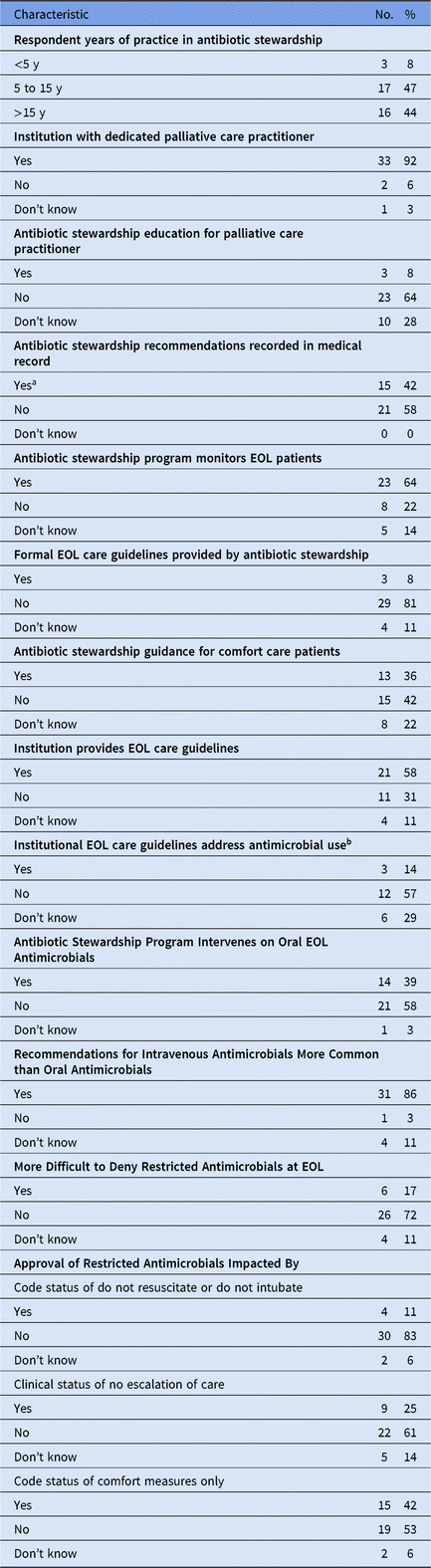
Overall, 23 (64%) hospitals had ASPs that monitored antimicrobial use in patients during end-of-life care (Table 1). Approval of antimicrobials appeared to be influenced by patient goals of care: do not resuscitate/intubate (n = 4 of 36 hospitals, 11%); no escalation of care (n = 9 of 36 hospitals, 25%); comfort measure only (n = 15 of 36 hospitals, 42%). Only 13 (36%) hospitals had ASPs that offered guidance for patients receiving comfort measures only.
Characteristics of Antibiotic Stewardship Programs With Respect to Antimicrobial Use During End-Of-Life (EOL) Care Among 36 Hospitals

Note. EOL, end of life.
a Antibiotic stewardship recommendations followed “most of the time” in 14 of these hospitals.
b Denominator includes the 21 hospitals that provide institutional EOL care guidelines.
Free-text responses indicated that ASPs should support clinicians in 4 general ways. (1) ASPs should discern antimicrobial-associated adverse effects. A representative comment was “If the antibiotic side effects don’t support [patient dignity and ease of suffering], then they need to be stopped, whether oral or [intravenous].” (2) ASPs should support palliative care providers. A representative comment included, “Support the recommendations of palliative care physicians during end-of-life discussions … antimicrobials can be seen as similar to intubation or cardiac resuscitation as a death prolonging measure as opposed to a palliative one … ” (3) ASPs should refine guidelines. Representative comments included, “Development of more formalized guidelines for helping all providers with decision-making about antibiotics not only for in hospital palliative care but also when transitioning to hospice” and “Development of clear guidelines, ideally within already developed plans for end-of-life management.” (4) ASPs should educate clinicians. A representative comment included “Provide clinicians with education, advice, and guidance regarding appropriate antibiotic use … [and] how the end-of-life time period affects risks and benefits of antibiotic use.”
Discussion
This survey shows that approximately one-third of ASPs offer guidance for inpatients receiving comfort care. Furthermore, recommendations for intravenous antimicrobials were more common than recommendations for oral antimicrobials in 86% of programs. Notably, approval of antimicrobials was often influenced by patient goals of care, and few ASPs engaged palliative care practitioners through educational activities. Collectively, our findings suggest that ASPs may support end-of-life care by providing education and guidance on optimal antimicrobial regimens that promote patient-centered goals of care.
We identified key areas for ASP efforts during end-of-life care. Respondents favor increased collaboration between ASPs and palliative care practitioners through education regarding the importance of de-escalation, appropriate duration, and the potential for adverse effects. ASPs can further serve as consultants for palliative care teams when contemplating the discontinuation of antimicrobial therapy. Additional activities may include education regarding optimal agents to facilitate discharge to home or hospice.Reference Datta, McManus, Topal and Juthani-Mehta7
Our data suggest that criteria are needed to support the assessment of the potential risks versus benefits of end-of-life antimicrobial use. Benefits of end-of-life antimicrobial use may be observed with topical metronidazole for malodorous wounds, nystatin for thrush, and oral vancomycin for Clostridioides difficile infection. In contrast, given the limited data on symptom relief, the potential risks of antimicrobials may be prohibitive in patients receiving comfort care.Reference Rosenberg, Albrecht and Fromme2 ASPs may also consider integrating antimicrobials into institutional end-of-life care guidelines, a practice that was adopted by only 14% of surveyed hospitals, and reviewing whether antimicrobials align with end-of-life treatment preferences.Reference Hickman, Keevern and Hammes8
This study has several limitations. First, responses may have been provided by participants unaffiliated with their institution’s ASP. However, the SHEA Research Network investigator was encouraged to forward the survey to an ASP participant. Second, the interpretation of end-of-life care may have varied. Finally, the number of participants was low. Further data are needed to understand ASP practices among US hospitals.
In conclusion, a minority of ASPs intervened on oral antimicrobials during end-of-life care or provided guidance for patients receiving comfort care. Educational collaborations between ASPs and palliative care practitioners are lacking, and institutional end-of-life care guidelines rarely include antimicrobials. Comparative studies evaluating the impact of educational interventions on the duration of antimicrobial use among hospitalized populations at the end of life are warranted.
Supplementary materials
To view supplementary material for this article, please visit https://doi.org/10.1017/ice.2019.194.
Author ORCIDs
Rupak Datta, 0000-0003-2281-7508
Acknowledgments
We thank the SHEA Research Network for their support of this study.
Financial support
This work was supported by 2T32AI007517-16 from the Section of Infectious Diseases at the Yale School of Medicine.
Conflicts of interest
All authors report no conflicts of interest relevant to this article.