Early transplantation: 1954–1983
The first successful kidney transplant was performed in Boston in 1954 by Dr Joseph Murray and Dr Hartwell Harrison and marked the beginning of a new therapy for end-stage organ disease. Ronald Herrick suffered from chronic nephritis and at the age of 23 received a kidney from his twin brother Richard. The surgery was a landmark because it was the first time that a recipient not only survived the surgery but regained renal function for an extended period of time (Ref. Reference Barry and Murray1). Following the successful transplant surgery, Ronald Herrick married his nurse and had two children. He died in 1963 when the donated kidney failed. Richard Herrick suffered no apparent complications from the donation of his kidney and reunited with Dr Murray at the 2004 Transplant Games to celebrate 50 years of organ transplantation. Fifty-six years after the landmark operation, Richard Herrick died at the age of 79. Joseph Murray was awarded the 1990 Nobel Prize for medicine for the historic operation and presently lives in Massachusetts.
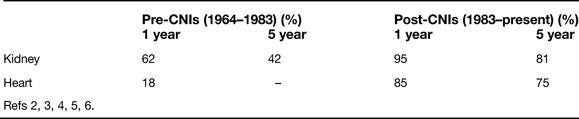
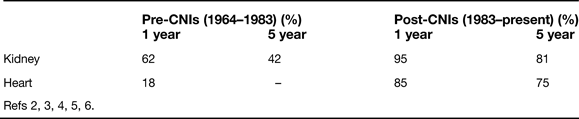
The kidney transplant of the Herrick brothers was successful largely because they were identical twins and the donated organ was not rejected by Ronald Herrick's immune system. However, organ donation by an identical twin is rare. Transplantation between nonidentical individuals during this era was far less successful. One-year survival of kidney transplant recipients during this early phase of transplantation was about 60% and less than half lived 5 years (Refs Reference Schweitzer2, Reference Murray, Tilney and Wilson3, Reference Krakauer4). Success for other organs was far worse. For example, fewer than one in five heart recipients lived for 1 year (Table 1) (Refs 5, Reference Moore6).
Transplant survival pre- and post-CNIs
With time, surgical techniques improved, leading to more viable organ transplant procedures, including lung, liver and pancreas transplants. However, the main barrier for post-transplant survival remained rejection of the grafted organ, which was swiftly and fatally attacked by the recipient's immune system. Early immunosuppression strategies used splenectomy and radiation, as well as drug therapies, including azathioprine (Imuran) and prednisone (Ref. Reference Hume7). However, these measures were only modestly successful at preventing rejection. The turning point came in the late 1970s with the discovery of cyclosporin A.
Calcineurin inhibitor era: 1983 – present
Cyclosporin A is a compound produced by the fungus Tolypocladium inflatum, an organism commonly found in soil. Sandov (now Novartis) discovered the compound in the early 1970s as part of efforts to identify pharmacological immunosuppressants. Cyclosporin A was found to have novel and potent immune suppressing properties (Refs Reference Petcher, Weber and Ruegger8, Reference Ruegger9). Dr Tom Starzl, an early pioneer and later legend in the transplant field, is credited with the first successful use of cyclosporin A to treat a 28-year-old transplant recipient at the University of Pittsburgh in 1980 (Ref. Reference Starzl10). Additional trials confirmed the efficacy of cyclosporin A and it was approved by the US Food and Drug Administration (FDA) for prevention of organ rejection in 1983. Within 5 years, cyclosporin A became the standard of care for transplant patients in the USA.
Research subsequently showed that the target of cyclosporin A is the calcium-dependent phosphatase calcineurin (Refs Reference Liu11, Reference Schreiber and Crabtree12). Calcineurin is ubiquitously expressed and plays a key role in T-cell function downstream of the T-cell receptor (TCR). The TCR is activated by antigen-presenting cells, which initiates a signal transduction cascade that includes a burst of reactive oxygen species, depletion of intracellular calcium stores, triggering of extracellular calcium entry and activation of calcineurin (Fig. 1). In the presence of calcium, the catalytic subunit of calcineurin (A) associates with the regulatory B subunit and the binding protein calmodulin to form an active enzyme complex (Ref. Reference Rusnak and Mertz13). Targets of calcineurin include proteins that are basally phosphorylated and inactive in the cytoplasm such as nuclear factor of activated T cells (NFAT) transcription factors (Ref. Reference Luo14). After dephosphorylation by calcineurin, NFAT proteins translocate into the nucleus and alter transcription of target genes including cytokines interleukin 2 (IL2) and interleukin 4 (IL4) (Refs Reference Graef15, Reference Macian16, Reference Masuda17). Blockade of calcineurin prevents upregulation of these cytokines and, in turn, prevents IL2- and IL4-induced proliferation of other immune cells.
Model of calcineurin Aα (CnAα) and Aβ (CnAβ) action. CnAα and CnAβ are activated downstream of the T-cell receptor (TCR) and other signals in a cascade that involves activation of phospholipase C gamma (PLCγ) and generation of inositol trisphosphate (IP3), release of intracellular calcium stores, extracellular calcium entry and activation of the enzyme complex. In addition, or alternatively, reaction oxygen species (ROS) generation stimulates calcium entry, which activates calcineurin. In the presence of calcium, CnAα and CnAβ associate with calmodulin and dephosphorylate substrates. CnAβ dephosphorylates nuclear factor of activated T cells (NFAT) transcription factors (and other targets), which translocate to the nucleus and regulate target genes including cytokines and matrix proteins. CnAα dephosphorylates tau, as well as other, less well-characterised substrates. Calcineurin inhibitors (CNIs) including cyclosporin A and tacrolimus enter the cell and bind to both CnAα and CnAβ enzyme complexes, inhibiting all downstream targets.

Cyclosporin A is a lipophilic, 11 amino acid peptide that interacts with small peptidyl-prolyl cis–trans isomerases called cyclophilins. When bound to cyclophilins, cyclosporin A can interact with calcineurin and block its association with substrates including NFAT (Refs Reference Masuda17, Reference Boss18). In particular, cyclophilin D was shown by crystallography to mediate the interaction of cyclosporin A and calcineurin (Refs Reference Petcher, Weber and Ruegger8, Reference Pflugl19). In 1994, tacrolimus (FK506) was granted FDA approval and became the second generation of calcineurin inhibitor (CNI). Although tacrolimus also inhibits calcineurin, it does so through a different set of intracellular binding partners, named FK binding proteins (FKBPs). Tacrolimus was shown to be roughly 100 times more potent an immunosuppressive drug than cyclosporin A and was slightly less nephrotoxic than cyclosporin A (Refs Reference Stephen20, Reference Jordan21). However, tacrolimus has been shown to be associated with higher rates of other side effects including new-onset diabetes (Ref. Reference Guitard, Rostaing and Kamar22).
With the addition of CNIs to post-transplant immunosuppression regimens, acute rejection events dropped and survival rates increased. It then became possible to expand transplantation as a treatment for other end-stage organ diseases including lung, liver, pancreas, intestine and bowel. Today, over 25 000 solid organ transplants are performed in the USA every year. Patients can expect to live decades with a transplanted organ.
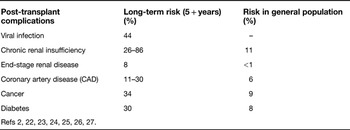
As a result of more people living longer with transplanted organs, the consequences of chronic CNI therapy have become a significant concern. Almost half of the patients will experience a viral infection; up to a third will develop coronary artery disease, new-onset diabetes or cancer (Refs Reference Schweitzer2, Reference Cecka23, Reference Kendrick24, Reference Kessler25, Reference Tremblay26) (Table 2). However, the most prevalent side effect from CNIs is renal disease (Refs Reference Guitard, Rostaing and Kamar22, Reference Busauschina, Schnuelle and van der Woude27). Virtually, all patients who take CNIs will experience some decline in renal function and up to 10% will eventually progress to end-stage organ disease – and require a kidney transplant. Surgical and pharmacological advances have made life-saving transplants available to hundreds of thousands of patients. The new challenge is mitigating the side effects that stem from CNIs without jeopardising the grafted organ.
Side-effects of CNIs

Calcineurin isoform specificity: 2012 onwards
The implementation and success of CNIs in the transplant field moved more quickly than research into the mechanisms of the drugs’ actions. However, in the past decade significant advances have been made that are particularly relevant to the challenges of the transplant field. Specifically, data clearly show that calcineurin is not a single enzyme, but rather a group of closely related isoforms with some distinct functions. The first isoform of the catalytic subunit of calcineurin was cloned in 1989 by Takehiko Tanaka's group (Ref. Reference Ito28); a second isoform with 81% similarity was soon reported by the same group (Ref. Reference Kuno29). A third isoform with more limited tissue expression was identified in 1992 by Randall Kincaid (Ref. Reference Kincaid30). Once full-length cDNAs encoding calcineurin had been described, it was clear that despite being the products of separate genes, all three isoforms are remarkably similar, with over 85% identifying across the whole molecule and close to 100% throughout the phosphatase domain (Ref. Reference Gooch31). The two isoforms with broadest distribution were eventually termed calcineurin Aα (CnAα) and Aβ (CnAβ) whereas the third, which is expressed primarily in the brain and testes, was named Aγ (CnAγ). Current genetic nomenclature identifies the genes encoding the two isoforms as PPP3CA and PPP3CB. These enzymes are related to a family of phosphatases called PP1A and PP2A and calcineurin is still sometimes referred to as PP2B. However, unlike PP1A and PP2A, calcineurin is dependent upon calcium to associate with its regulatory subunit (B) and with the binding partner, calmodulin (Refs Reference Ito28, Reference Kuno29, Reference Cooper32, Reference Tash33). Although calcineurin phosphatase activity had been reported as early as 1982 (Ref. Reference Stewart34), it was in 1992 that Fruman and colleagues first showed that calcineurin was the target of cyclosporin A and tacrolimus (Refs Reference Fruman35, Reference Fruman36). In vitro studies showed that the CNIs cyclosporin A and tacrolimus have very similar inhibitory kinetics on CnAα and CnAβ (Refs Reference Perrino37, Reference Fruman38). Likewise, CnAα and CnAβ demonstrate similar abilities to dephosphorylate several peptide substrates in vitro (Refs Reference Perrino37, Reference Fruman38).
No significant differences between the isoforms were identified until both CnAα- and CnAβ-knockout mice were developed in the late 1990s and early 2000s. First, Jon Seidman's group developed CnAα-knockout mice and reported, somewhat surprisingly, that the mice were not immune compromised. Although circulating levels of the NFAT target IL2 were slightly lower, development of T- and B-cells was unaffected, and the function of mature lymphocytes was only mildly altered (Refs Reference Zhang39, Reference Chan, Wong and Ohashi40). Moreover, immune activity could be reduced with cyclosporin A (Ref. Reference Zhang39). Interestingly, CnAα-knockout mice did show changes in the brain associated with increased levels of phosphorylated tau (Refs Reference Kayyali41, Reference Zhuo42), which has since been identified as a calcineurin substrate (Refs Reference Cross43, Reference Garver44, Reference Mandelkow45). Finally, the CnAα-null mice failed to thrive and died early, thereby limiting additional studies (Refs Reference Zhang39, Reference Gooch46). In 2002, Jeff Molkentin's group published their findings of CnAβ-null mice in back-to-back papers in PNAS (Refs Reference Bueno47, Reference Bueno48). The group showed that the CnAβ isoform was involved in cardiac hypertrophy. This finding provided a molecular basis for beneficial effects of cyclosporin A administration reported in animal models of cardiac hypertrophy (Refs Reference DeWindt49, Reference Lim50, Reference Molkentin51). In addition to attenuation of hypertrophy, Bueno and co-workers reported that CnAβ-knockout mice have distinct derangements in T-cell development and function and tolerate tumour growth comparably with an immunosuppressed mouse (Ref. Reference Bueno47). When viewed alongside the previous findings of Seidman's group, a provocative model emerges – despite in vitro data showing significant similarities, CnAβ and CnAα have distinct functions in vivo. CnAβ is required for normal immune function whereas CnAα is dispensible.
Because nephrotoxicity is a common concern in transplant patients, we were interested in examining the kidneys of CnAα- and CnAβ-knockout mice. We obtained both strains from the Seidman and Molkentin labs and in 2004, we published the first analysis of kidney development and function in the two models. Much like the immune system, we found that CnAα and CnAβ have distinct roles in the kidney. First, we found that loss of CnAα results in a developmental defect in late nephrogenesis (Ref. Reference Gooch46). Interestingly, the phenotype of CnAα-null kidneys is reminiscent of earlier work by Thierry Gilbert's group using cyclosporin A during gestation.
Tendron and colleagues reported that inhibition of calcineurin with cyclosporin A during the 3-day window of gestation when nephrogenesis is initiated is sufficient to impair development of nephrons (Refs Reference Tendron52, Reference Tendron-Franzin53). Interestingly, with either CnAα knockout or gestational exposure to cyclosporin A, this defect in nephrogenesis is most prominent in superficial glomeruli that are the last to develop, suggesting that CnAα plays a role during a specific aspect of nephrogenesis.
A potential pathway of CnAα action was reported in 2007 by Liu et al. who showed that developmental regulation of cyclooxygenase 2 (Cox-2) was abolished in CnAα- but not CnAβ-null kidneys (Ref. Reference Liu54). Cox-2-null mice share a defect in late nephrogensis identified by our group and Gilbert's (Ref. Reference Dinchuk55), leading to the conclusion that CnAα is required for regulation of Cox-2 during kidney development. An additional insight into CnAα and nephrogenesis was reported by Burn et al. in 2011. This group showed that calcineurin and NFAT function as a noncanonical pathway downstream of Wnt4. Treating developing embryos with cyclosporin A produced a similar impairment in nephrogenesis as observed in Wnt4 −/– mice (Ref. Reference Burn56). Taken together, these studies strongly support the conclusion that calcineurin plays an important role in normal kidney development. The impact of CNI therapy during pregnancy is thus of some concern and should be an area of additional study (Ref. Reference Gooch57).
In addition to altered kidney development, we also found accumulation of matrix proteins, increased levels of the cytokine transforming growth factor β (TGFβ) and reduced renal function in CnAα-null mice – all key aspects of CNI nephrotocixity (Ref. Reference Gooch58). By contrast, CnAβ-null mice have no gross abnormalities in renal development or function. Instead, CnAβ-null mice are protected from diabetic renal hypertrophy in a similar way to the attenuation of cardiac hypertrophy reported previously (Ref. Reference Reddy59).
In addition to the kidney, we have characterised isoform-specific differences in several other systems including the skin, where loss of CnAα results in increased apoptosis of squamous epithelial cells (Ref. Reference Pena, Losi-Sasaki and Gooch60) and salivary gland, where CnAα is required for vesicle transport (Ref. Reference Reddy61). Importantly, we also find that loss of CnAα does not significantly alter NFAT activity in vivo or in vitro. By contrast, loss of CnAβ is sufficient to inhibit NFAT nuclear translocation in vitro (Ref. Reference Gooch58) and transcriptional activity in vivo (Refs Reference Reddy59, Reference Reddy61).
Discussion and clinical implications
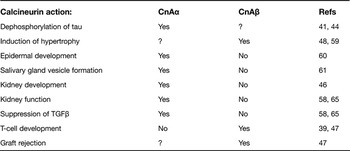
Taken together, these data create a compelling argument for distinct functional roles of CnAα and CnAβ, despite their structural similarities (summarised in Table 3). Moreover, the clinical significance of isoform specificity is hard to understate. Loss of CnAα activity is probably the basis for many CNI side effects, including loss of kidney function. Strategies and therapies to preserve CnAα function could therefore reduce side effects and prevent subsequent kidney transplants because of CNI toxicity. Animal models also show that loss of CnAβ produces immune suppression with no significant adverse effects to the kidney, skin, muscle or liver. Thus, a ‘next generation’ of CNI that selectively targets the CnAβ isoform would be a significant improvement over current, nonselective drugs. Moreover, it is still unclear whether all the effects of CNIs can be directly attributed to loss of CnAα or CnAβ actions. The contributions of the third calcineurin isoform CnAγ have been minimally explored. We also cannot rule out actions of CNIs that are independent of calcineurin. For example, there are several studies including our own that show that CNIs regulate the mitogen activated protein kinase pathway (Refs Reference Gooch62, Reference Akool el63). Non calcineurin-mediated effects of CNIs provide even more rationale for the development of more selective compounds.
Summary of calcineurin isoform-specific actions

The key to taking advantage of these experimental findings is identifying the mechanism of isoform-specific action. One clue to the basis of functional specificity between the isoforms was proposed by Kilka et al. in 2009. The group showed that in vitro, both CnAα and CnAβ could dephosphorylate NFAT. However, removal of a small proline-rich sequence present in the N-terminus of the CnAβ isoform, which is absent in the CnAα isoform, rendered CnAβ incapable of dephosphorylating NFAT (Ref. Reference Kilka64). This study brings up the intriguing possibility of developing tools to selectively target the CnAβ isoform. However, more research is needed to effectively translate these mechanistic opportunities into new therapies.
There are now a range of pharmacological options to suppress the immune system and prevent organ rejection. However, the off-target effects of these approaches are considerable and significantly limit disease-free survival of transplant recipients. Managing optimum suppression while minimising side effects is thus an ongoing challenge. Improved monitoring and post-transplant management is critical, given that availability of donor organs is the limiting factor for patients with end-stage renal disease. Decreasing the number of people with post-transplant end-stage kidney failure will increase the number of organs available for individuals waiting for a de novo transplant. Experimental data suggest that selective targeting of CnAβ could result in immunosuppression, but with less toxicity. Isoform-selective CNIs might therefore be the next era in transplant medicine.
Acknowledgements and funding
Funding for this work was provided by the Department of Veterans Affairs (J.L.G. MERIT) and the National Institutes of Health [grant number NIDDK T32DK7656-22].