Introduction
Area-wide programs to control codling moth, Cydia pomonella (L.) (Lepidoptera: Tortricidae), have transformed integrated pest management of pome fruits in western North America (Dyck et al. Reference Dyck, Graham and Bloem1993; Brunner et al. Reference Brunner, Welter, Calkins, Hilton, Beers and Dunley2002; Knight Reference Knight, Koul, Cuperus and Elliottt2008). In Canada, this new pest-management paradigm was uniquely founded on sterile insect technology (SIT). The Okanagan–Kootenay Sterile Insect Release (SIR) Program was initiated in 1992 (Dyck et al. Reference Dyck, Graham and Bloem1993) in an effort to eradicate populations of codling moth from montane fruit-growing valleys of southern British Columbia (BC). Since its inception, the SIR Program has consistently reported low recaptures of sterile males from late April through mid-June (Judd et al. Reference Judd, Cockburn, Eby, Gardiner and Wood2004). From 1994 to 2004, ratios of sterile (S) to wild (W) males in pheromone-trap catches, which the SIR Program uses as an indirect measure of performance, rarely reached the desired target of 40:1 during this spring period, often failing to reach 10:1 (Thistlewood et al. Reference Thistlewood, Judd and Clodius2004). Poor recapture of sterile males may be indicative of their poor flight ability and reduced mating competitiveness relative to wild males in springtime (Judd et al. Reference Judd, Thistlewood, Gardiner and Lannard2006b). Low S:W ratios and reduced competitiveness are thought to have contributed to slower than expected population reductions from using SIT against codling moth in BC (Thistlewood and Judd Reference Thistlewood and Judd2003; Judd et al. Reference Judd, Cockburn, Eby, Gardiner and Wood2004, Reference Judd, Thistlewood, Gardiner and Lannard2006b).
Given that densities of wild codling moth declined more slowly than expected, the goal of the SIR Program was changed from eradication to maintenance of wild populations at economically acceptable levels (Thistlewood and Judd Reference Thistlewood and Judd2003). Since that change, the SIR Program has sought ways to ensure the economic sustainability of SIT as a management tool, rather than a means of eradicating codling moth (Dendy et al. Reference Dendy and Powell2001). Taking corrective action to increase S:W ratios and mating competitiveness of sterile males in spring may provide a means of improving the economics of SIT, especially if this could be achieved using fewer sterile males having greater activity in the field.
Mass-rearing codling moths through a diapause stage before applying sterilizing radiation has been shown to significantly increase their recapture rates relative to similarly irradiated nondiapausing, mass-reared males (Bloem et al. Reference Bloem, Bloem, Calkins and Tan1998, Reference Bloem, Carpenter, Bloem, Tomlin and Taggart2004; Judd et al. Reference Judd, Gardiner and Thistlewood2006a). Increased catches of diapaused males in wild-female-baited traps were also indicative of their increased mating competitiveness compared with that of nondiapausing males (Judd et al. Reference Judd, Gardiner and Thistlewood2006a). This research suggests that the Okanagan-Kootenay SIR Program should consider mass-rearing codling moths through a diapause stage as part of its standard operating procedure (Bloem et al. Reference Bloem, Bloem and Fielding2000).
Incorporating diapause into a codling moth mass-rearing system requires a significant financial investment (Bloem et al. Reference Bloem, Bloem and Knight1997, Reference Bloem, Bloem and Fielding2000). Before making this investment, SIR staff wanted to conduct a small feasibility study to test whether or not the apparent benefits of diapause rearing could be realized when incorporated into normal operations of the SIR Program. To date, no research on the relative performance of diapaused sterile codling moths (Bloem et al. Reference Bloem, Bloem, Calkins and Tan1998, Reference Bloem, Carpenter, Bloem, Tomlin and Taggart2004, Reference Bloem, Carpenter and Dorn2006; Judd and Gardiner Reference Judd and Gardiner2006; Judd et al. Reference Judd, Gardiner and Thistlewood2006a) has handled or processed moths using all protocols and constraints imposed by the SIR Program. Furthermore, only one study has compared the performance of diapaused sterile males and wild males (Judd et al. Reference Judd, Gardiner and Thistlewood2006a). In fact, although use of SIT to control codling moth has a 50-year research history in Canada (Proverbs Reference Proverbs1964), we found surprisingly few published studies examining the performance of sterile codling moths relative to wild moths in any tests (Robinson and Proverbs Reference Robinson and Proverbs1975; White and Hutt Reference White and Hutt1975; Judd and Gardiner Reference Judd and Gardiner2006; Judd et al. Reference Judd, Gardiner and Thistlewood2006a, Reference Judd, Thistlewood, Gardiner and Lannard2006b). The Okanagan−Kootenay SIR Program does not currently make these kinds of comparisons as part of its normal operation (Okanagan-Kootenay Sterile Insect Release Program 2003), but the information could be valuable to understand the economics and ensure the sustainability of SIT as a management tool.
The objectives of this study were (i) to have the Osoyoos rearing facility successfully produce diapaused and non-diapaused sterile codling moths and to have SIR Program staff handle and deliver these moths to apple ((Malus domestica (Borkhausen) (Rosaceae)) orchards in spring using their normal procedures, and (ii) to measure the recapture rates and mating frequencies of these differently reared sterile males relative to diapaused wild male codling moths released into the same orchards.
Materials and methods
Rearing test moths
All mass-reared codling moths used in these experiments were produced by the Okanagan-Kootenay rearing facility located in Osoyoos. Nondiapausing codling moths (SIR-standard moths) were reared year-round on an artificial diet (Brinton et al. Reference Brinton, Proverbs and Carty1969) following standard protocols (Bloem et al. Reference Bloem, Bloem and Knight1997, Reference Bloem, Bloem and Fielding2000). Those rearing details needed for comparison with production of mass-reared diapause moths are described here. SIR-standard moths were reared from egg to adult under a 16L:8D photoregime at constant 27°C with humidity ranging from 50% in the rearing room (days 0–21) to 30% in the emergence rooms (days 22–45). Pupation occurs in the food and moths eclose from the surface of the food. The last adults emerge about 45 days after the food has been seeded with eggs.
In November 2005, several hundred trays of artificial diet were prepared for production of diapausing codling moth larvae. Wax sheets with eggs from the nondiapausing colony were placed above each tray of diet and then incubated under a 12L:12D photoregime at 25°C during the light phase and 21°C during the dark phase, with relative humidity maintained at approximately 50%. Fifteen days after eggs hatched, corrugated cardboard strips (2.5 cm × 100 cm) were rolled and placed on each tray of diet to collect diapause-destined fifth-instar larvae that leave the diet and wander in search of cocooning sites. In December 2005, cardboard rolls containing diapausing larvae were transferred to another environmentally controlled room and “conditioned” (Bloem et al. Reference Bloem, Bloem and Knight1997) in complete darkness for 98 days at 15°C and 50% humidity. In March 2006, conditioned larvae were transferred to a chilling room and held in complete darkness at 2°C until needed for experiments. Adult males from this group of larvae are hereinafter called SIR-diapaused moths. A subset of these diapausing larvae were transferred to the Pacific Agri-Food Research Centre (PARC) in Summerland, BC, and stored in a similar chilling room under identical environmental conditions of complete darkness and 2°C. Adult males from this group of larvae are hereinafter called PARC-diapaused males.
Wild diapausing codling moth larvae were collected in corrugated cardboard strips (banding) wrapped around tree trunks in infested apple orchards in summer 2005 (Judd et al. Reference Judd, Thistlewood, Gardiner and Lannard2006b). Banding was removed in October 2005, placed in plastic garbage bags, and held in an outdoor screen house through winter. Starting in February 2006, small quantities of banding were systematically placed at room temperature for 2–4 h, while larvae were extracted from cocoons and sexed. Sexed wild larvae were placed in separate containers (to prevent mating among emergent adults), where they spun new cocoons in corrugated cardboard. Cocooned wild larvae were stored in the same chilling room as PARC-diapaused larvae. Adults from this group of wild larvae are hereinafter called PARC-wild moths.
Starting 5 weeks before the first adult codling moths were required for field release, cardboard rolls containing the unsexed SIR-diapaused larvae were removed from cold storage and placed in one of the several moth-emergence rooms in the Osoyoos rearing facility. SIR-diapaused and SIR-standard moths were reared in identical emergence rooms maintained at constant 27°C with a 16L:8D photoregime. SIR-diapaused moths normally begin to eclose from the diet around day 30, with peak emergence on day 35 and completion by day 45. Diapausing larvae were transferred from cold storage to the emergence room in a series of small batches every 3–4 days for 2 weeks starting 3 May 2006. This staggered transfer ensured that there was a continuous daily emergence of SIR-diapaused moths and helped to maintain a verified 1:1 sex ratio in released moths (both sexes are released by the SIR Program) for a 2-week test period.
On the same days that SIR-diapaused larvae entered emergence rooms at the Osoyoos facility, unsexed PARC-diapaused and sexed PARC-wild larvae were removed from cold storage and placed in an environmental chamber at PARC. This chamber was maintained at constant 27°C with a 16L:8D photoregime to mimic conditions under which moths emerged at the Osoyoos facility. PARC-wild male and female larvae were placed in separate 11.4 L plastic buckets. PARC-wild moths were collected daily and transferred to new labeled buckets. Wild males were kept in the emergence room until the day of their field release. Wild females were transferred to an outdoor screen house where they were conditioned to natural photoperiod and temperature to ensure normal pheromone “calling” behaviour when needed for experiments.
PARC-diapaused moths were collected every morning, sexed, and separated. PARC-diapaused females were destroyed and males were placed in buckets and kept in the emergence room alongside PARC-wild males.
Nondiapausing SIR-standard moths were in constant production and available for experiments at all times as part of normal SIR Program operations.
Collecting, irradiating, handling, and shipping test moths
Codling moths eclosing from diet trays in the Osoyoos rearing facility were collected in flight as they approached UV lights installed in front of vacuum vents recessed within the ceiling of each emergence room. Moths from each emergence room were kept isolated as they were pulled through overhead vacuum pipes into a cold (2°C) collection room, where they accumulated in separate labeled plastic containers. During the field season, moths were collected throughout the 24 h day, but most accumulated during the 8 h scotophase from 2200 until 0600 Pacific Daylight Saving Time (PDT) the following day. Before the first release in week 1, SIR-diapaused moths were collected and stored over a 2-day period because of their slower and more asynchronous emergence compared with SIR-standard moths. Once an hour from 0700 to 2200 PDT, moths from each emergence room were weighed and packaged into plastic Petri dishes, sealed with tape, and labeled with a radiation sensitive tag. Each Petri dish held approximately 800 mixed-sex adults usually in a 1:1 sex ratio. Stacks of 10 Petri dishes were placed in a Gammacell 220 irradiator (MDS Nordion, Kanata, Ontario) where they received 250 Gy of radiation from a cobalt60 source. After irradiation, Petri dishes of moths were placed in sheet metal boxes and held in the collection room until being loaded into a refrigerated (2°C) trailer at 0600 PDT on the day of release. The refrigerated trailer was towed to a fruit-packing house in Summerland, which is one of several moth drop-off depots used by the SIR Program. In the packing house, dishes of moths were transferred into portable coolers with cold packs, where they would normally remain until field-release drivers picked them up at 0800 PDT. On the day of our releases, sterile moths were collected from the Summerland packing house at 0700 PDT, transported to PARC in coolers, and then placed in a walk-in cold room (0.5°C). At 0700 PDT, PARC-wild and PARC-diapaused males were also transferred from their emergence room to the same 0.5°C cold room.
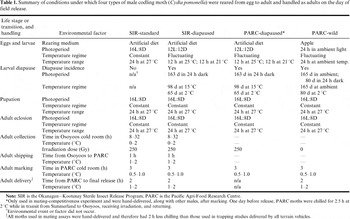
It is important to note that PARC-diapaused males had been irradiated (250 Gy) at the Osoyoos facility the previous day, and had been transported to and from the facility in coolers before returning to their emergence room at PARC. Table 1 provides a complete description of the environmental conditions to which all moths used in these tests were exposed before release.

Note: SIR is the Okanagan–Kootenay Sterile Insect Release Program; PARC is the Pacific Agri-Food Research Centre.
* Only used in mating-competitiveness experiment and were hand-delivered, along with other males, after marking. One day before release, PARC moths were chilled for 2.5 h at 2°C while in transit from Summerland to Osoyoos, receiving irradiation, and returning.
† Environmental event or factor did not occur.
‡ All moths used in mating assays were hand-delivered and therefore had 2 h less chilling than those used in trapping studies delivered by all terrain vehicles.
Marking and releasing test moths
All mass-reared codling moths were marked internally with Calco red dye, also known as Oil Red 2144 (Passaic Color and Chemical, Patterson, New Jersey), which is sequestered from the larval diet. On the day of release these moths were also marked externally at PARC using Day-Glo Daylight Fluorescent Powders (Switzer Brothers Inc., Cleveland, Ohio) of different colours to distinguish SIR-standard from SIR-diapaused moths. In the 0.5°C room at PARC, chilled sterile moths were emptied from their Petri dishes into a small plastic container, dusted with fluorescent powder, and returned to their Petri dishes. After marking, all Petri dishes were sealed, labeled, placed back in coolers, and immediately transported to the first of three apple orchards. On those days when wild males were also released, each Petri dish of mixed-sex SIR-standard and SIR-diapaused moths was seeded with 5–10 PARC-wild males. Each seeded dish of moths was then marked with fluorescent powder as before, according to its diapaused or nondiapaused designation.
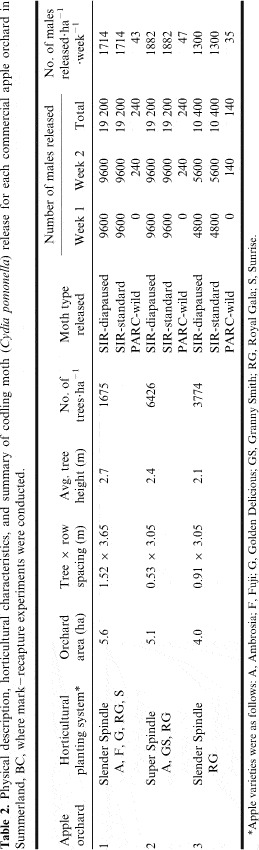
In the orchards, marked moths were given to an experienced SIR Program driver, who used an all-terrain vehicle (ATV) to deliver moths. Each ATV was equipped with a small hopper mounted on the front that dispensed moths by gravity feed onto a conveyor belt passing in front of a fan that blew moths onto the ground beneath trees (McMechan and Proverbs Reference McMechan and Proverbs1972). The ground speed of the ATV determined the rate at which moths were dispensed. Several Petri dishes of one randomly selected, colour-coded moth type were emptied into the hopper while all others were carried in the cooler on the back of the ATV. Starting at one edge of an orchard, the ATV was driven up and down rows, making one pass at each 30 m interval. Moths were moved from the cooler into the hopper as needed until the entire orchard was treated with a predetermined number of moths (Table 2). When one moth treatment was completed, the hopper and conveyor belt were cleaned with alcohol to remove residual fluorescent powder, after which the second moth treatment was applied exactly as the first, except that the ATV was driven on the opposite side of the original tree row. After both sets of moths were delivered to an orchard, the ATV and unused moths were transported by truck and trailer to the next orchard. Moths were delivered between 1000 and 1200 PDT on 9, 13, 16, and 20 June 2006 to each of three apple orchards with similar horticultural characteristics (Table 2). Orchards were located in the Trout Creek and Jones Flat areas of Summerland separated by 1–3 km.

* Apple varieties were as follows: A, Ambrosia; F, Fuji; G, Golden Delicious; GS, Granny Smith; RG, Royal Gala; S, Sunrise.
Recapturing test moths
On 9 June, 30–35 Pherocon 1-CP style wing traps (Contech Inc., Delta, BC), each baited with a single 1- to 3-day-old wild virgin female moths in a screen bag, were hung in trees 1.5 m above ground (Judd et al. Reference Judd, Gardiner and Thistlewood2006a). Traps were deployed 20–30 m apart in linear arrays set halfway between moth-release lanes. Sticky trap bottoms were replaced daily from 10 June through 23 June, and female moths were replaced each day moths were released. Trap bottoms were returned to the laboratory, where external marks of captured male moths were identified under UV light and then internal marks were revealed by squashing moths. SIR-standard and SIR-diapaused moths released in week 1 (9 and 13 June) were marked with Aurora Pink and Horizon Blue, and in week 2 (16 and 20 June) with Signal Green and Arc Yellow Day-Glo colours, respectively.
On 23 June, all caged females were removed from traps and each was replaced with a grey halobutyl rubber septum (West Pharmaceutical Services, Lionville, Pennsylvania) impregnated with 10 μg of the codling moth sex pheromone (E,E)-8,10-dodecadien-1-ol (99% isomerically pure codlemone, Shin-etsu Fine Chemicals Division, Tokyo, Japan) dissolved in 200 μL of dichloromethane. This methodology results in a pheromone release rate similar to that of a “calling” female codling moth (Bäckman Reference Bäckman1997). Trap bottoms were recovered on 26 June and captured moths were identified as before.
Mating competitiveness of different males
Mating activity of different types of male moths was assessed in a 0.4 ha high-density (876 trees/ha) McIntosh apple orchard consisting of 12 rows of 73 trees (1.5 m × 3 m tree-row spacing) with an average height of 3 m. On 9, 13, 16, and 20 June, a subset of SIR-standard and SIR-diapaused moths delivered to Summerland for previous field releases was sexed and separated. Equal numbers of SIR-standard, SIR-diapaused, PARC-diapaused, and PARC-wild males only were marked with fluorescent powders as before and placed in hand-release devices described by Judd et al. (Reference Judd, Thistlewood, Gardiner and Lannard2006b). One release device containing 10–15 males of one moth type was placed in each of 16 separate trees in a 4 × 4 grid pattern (64 release devices in total), using trees 15, 30, 44, and 58 from east to west in rows 2, 5, 8, and 11 from north to south.
Mating activity was assessed on eight nights (10, 11, 14, 15, 17, 18, 21, and 22 June) interspersed between each male release date as above. Tethered 1- to 3-day-old virgin PARC-wild female moths attached to mating tables were used to assess relative mating competitiveness of males by capturing mating pairs in copula (Judd et al. Reference Judd, Thistlewood, Gardiner and Lannard2006b). On any test day 40–100 tethered female moths were deployed in the field between 1200 and 1500 PDT. Mating tables were hung about 1.5 m above ground using trees 16–22, 34–40, and 48–54 in adjacent paired rows 3–4, 6–7, and 9–10, which were centred between the four moth-release rows as above. This pattern ensured that all females were surrounded by equal numbers of released males of each type. The maximum distance between any tethered female and a male release device was 10.9 m.
Each mating table was visited every 15 min between 1700 and 2200 PDT and illuminated with a small flashlight fitted with a red lens. Coupled moths were captured (Judd et al. Reference Judd, Thistlewood, Gardiner and Lannard2006b) and returned to the laboratory, where males were identified by their external and internal markings as before.
Data analyses
For each individual orchard the mean (n = 30–35 traps per orchard) numbers of SIR-diapaused and SIR-standard males caught in virgin female-baited traps, pheromone-baited traps, or both combined were compared using two-sample t tests (Zar Reference Zar1984). The mean (n = 3) numbers of these two moth types caught per trap across all three orchards, for each lure type individually or the two types combined, were compared using an F test from a two-way randomized block analysis of variance (ANOVA), where orchards represent blocks and SIR-diapaused and SIR-standard moths represent treatments.
The proportions (p) of wild and sterile males of each type recaptured in each orchard were calculated and then normalized using an arcsine √p transformation (Zar Reference Zar1984). The mean (n = 3 orchards) recapture rates for each of the three moth types were compared using a Student–Newman–Keuls' multiple-comparisons test following a significant two-way randomized block ANOVA where orchards are blocks and moth types are treatments. The paired proportions of SIR-diapaused (P 1) and SIR-standard (P 2) moths recaptured by all female-baited traps, or pheromone-baited traps, in each orchard, were also compared using binomial tests (z tests) where n 1 and n 2 are the numbers of males released (Zar Reference Zar1984).
Using total catches across all orchards, the S:W ratios based on catches of SIR-diapaused, SIR-standard, and PARC-wild males were calculated for each lure type. Equality of S:W ratios (recapture frequencies) across lure types was compared using χ2 tests under the null hypothesis of equal recapture frequencies across lures (Zar Reference Zar1984).
The proportions of matings between tethered females and each male moth type on any given evening (n = 8 nights) were compared using a two-way randomized block ANOVA where nights are blocks and moth types are treatments. Proportions were transformed as above and mean proportions of mating by different moth types were compared using the Student–Newman–Keuls' test. All statistical analyses were performed with SigmaStat version 3.0.1 (SYSTAT Software Inc., San Jose, California) with all experimental error rates set at ∞ = 0.05.
Results and discussion
Operational moth delivery summary
The numbers of sterile males delivered to each orchard based on a verified 1:1 sex ratio is given in Table 2. When the SIR Program was implemented, the intent was to dispense 1000 mixed-sex sterile codling moths in each hectare of orchard twice weekly. The assumption was that a S:W recapture ratio of 40:1 could be maintained if overwintering codling moth populations were limited to 100 larvae/ha (1:1 sex ratio) and no more than two wild male codling moths were caught per trap each week (Dyck et al. Reference Dyck, Graham and Bloem1993). The SIR Program currently delivers up to 4000 mixed-sex moths/ha once each week in most orchards (G.J.R. Judd, unpublished data). Our weekly delivery of each moth type (3050 moths/ha) was about 1.5× above what was deemed necessary for the eradication program (2000 moths·ha·week), but 25% less than what is currently done because our intent was to determine whether fewer SIR-diapaused males could improve the measured S:W ratios.
Recapture rates for sterile males
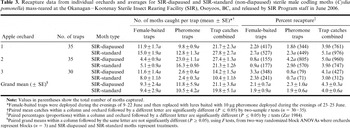
Within individual orchards, the mean numbers of SIR-diapaused males caught per trap, in either female- or pheromone-baited traps, were significantly greater than catches of SIR-standard males in only one of the three orchards (Table 3). When catches were pooled across trap types, the per-trap catches of SIR-diapaused males were significantly greater in two orchards. However, when averaged across all three orchards, the mean catches per trap for both types of males were nearly identical in either trap type alone, or the two combined, respectively (Table 3).

Note: Values in parentheses show the total number of moths captured.
* Female-baited traps were deployed during the evenings of 9–22 June and then replaced with lures baited with 10 μg pheromone deployed during the evenings of 23–25 June.
† Paired mean catches within a column and orchard followed by a different letter are significantly different (P ≤ 0.05) by two-sample t tests (n = 30−35).
‡ Paired percentages (proportions) within a column and orchard followed by a different letter are significantly different (P ≤ 0.05) by z tests (Zar Reference Zar1984).
§ Paired grand means within a column followed by the same letter are not significantly different (P ≤ 0.05), using F tests, from two-way randomized block ANOVAs where orchards represent blocks (n = 3) and SIR-diapaused and SIR-standard moths represent treatments.
When recapture data for sterile males in each orchard were expressed as proportions of the numbers released (Table 3), there were several significant differences (z tests) between SIR-diapaused and SIR-standard males, but no consistent pattern. Again, averaged across orchards, the mean recapture rates for SIR-diapaused and SIR-standard males were nearly identical in either trap type alone, or the two combined, respectively (Table 3).
The lack of a difference in recapture of SIR-diapaused and SIR-standard moths as delivered by the SIR Program herein, contradicts previous research showing that SIR-diapaused moths were usually recaptured more frequently (Bloem et al. Reference Bloem, Bloem, Calkins and Tan1998; Judd et al. Reference Judd, Gardiner and Thistlewood2006a, Reference Judd, Thistlewood, Gardiner and Lannard2006b). Examination of methodologies used in previous studies reveals two obvious differences. In all previous studies with SIR-diapaused moths, testing had been done in a single orchard planting. Judd et al. (Reference Judd, Cockburn, Eby, Gardiner and Wood2004) pointed out that orchard-to-orchard differences are an important and often overlooked source of variation that impacts evaluation of SIT. Orchard variation may be responsible for the particularly low response of both males to female-baited traps in orchard 2, followed by higher than average catches with pheromone traps in the same orchard (Table 3). The main difference between our study orchards was tree density (Table 2). In orchard 2, tree rows formed a dense wall of vegetation that may have impeded movement of males and air transport of pheromone signals. Naturally intermittent female pheromone signals may be more easily impeded or difficult to track than continuous synthetic pheromone signals. The effect of tree density on the movement of sterile males and the operation of pheromone traps may be worthy of further examination in studies like this. When moth behaviour is examined in a single orchard, differences in moth recapture rates might be detected, but the conclusions could be completely different depending on the orchard examined (Table 3). Before the SIR Program implements large changes to its operations, those changes should perhaps be tested and shown to have benefits in multiple orchard types.
The second, and probably most important, difference between previous studies on diapaused males, and the one described here, is how moths were handled before release (Table 1). In all previous studies the maximum time test moths had been chilled before being released was 12 h, whereas during normal operation SIR-standard moths can be chilled for up to 48 h before release. In this study, most SIR-standard and SIR-diapaused moths were chilled anywhere from 14 to 38 h, and most averaged 24 h of chilling before release (Table 1). By comparison the PARC-wild males were only chilled for 3–5 h during the same releases.
Chilling has a significant impact on the activity of mass-reared codling moths that have gone through diapause (Bloem et al. Reference Bloem, Carpenter and Dorn2006). In laboratory assays the mobility of SIR-diapaused males, relative to identical untreated males, was severely impaired by 24 h of chilling at 2°C (Bloem et al. Reference Bloem, Carpenter and Dorn2006). Interestingly, the baseline mobility of SIR-standard males was not impaired by this chilling treatment, but their activity with no chilling was as low as that of SIR-diapaused moths that received chilling. Longer chilling times and associated decreases in mobility could explain why SIR-diapaused and SIR-standard males were recaptured in similar numbers in this study (Table 3), whereas they have been significantly different in previous studies.
In the current study, standard operating procedures were used for rearing, collecting, handling, packaging, irradiating, shipping, and delivering sterile codling moths to orchards (Okanagan-Kootenay Sterile Insect Release Program 2003). In previous studies, most, but not all, commercial operations have been considered and controlled (Judd and Gardiner Reference Judd and Gardiner2006). Given how the current SIR Program operates, it is difficult to ensure that SIR-diapaused moths receive less than 14–38 h of chilling before they reach orchards, especially those released at the outlying areas of the program. Consequently, any increased mobility in newly emerged SIR-diapaused moths relative to SIR-standard moths would likely be lost as a result of chilling received during normal operations of the SIR Program.
Recapture of wild males
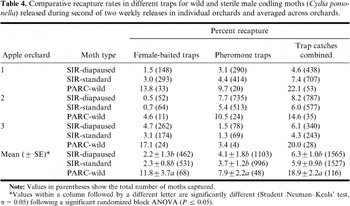
In each test orchard the proportion of wild males recaptured was greater than that of sterile males, and the mean recapture rates for wild males in female-baited traps, pheromone-baited traps, or the two combined, were significantly greater than those for either type of sterile male (Table 4). In practice, these differences are probably greater and have been greater in previous studies (Judd et al. Reference Judd, Gardiner and Thistlewood2006a, Reference Judd, Thistlewood, Gardiner and Lannard2006b). The differences in how moths were delivered in various studies could be a factor because the ATV mechanical delivery system used by the SIR Program is known to reduce recapture of sterile males relative to hand-delivery systems (Judd and Gardiner Reference Judd and Gardiner2006). Clearly, if wild males had emerged naturally in the field without any handling, chilling, and marking, their recapture rates and competitiveness compared with those for SIR males might have appeared far greater than they did. In this study we chose to release wild males mechanically by seeding Petri dishes before marking and delivering them with sterile moths in order to eliminate delivery as a factor contributing to recapture differences.

Note: Values in parentheses show the total number of moths captured.
* Values within a column followed by a different letter are significantly different (Student–Neuman–Keuls' test, ∞ = 0.05) following a significant randomized block ANOVA (P ≤ 0.05).
Operational S:W recapture ratios
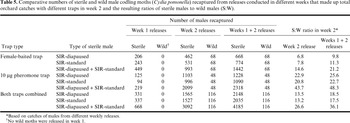
With the exception of the first week of the season, the weekly S:W ratios observed as part of the SIR Program arise from catches of moths released in the current and previous weeks because there is no way to identify moths surviving from previous releases. By marking moths released in weeks 1 and 2 differently, we were able to determine their respective contribution to the S:W ratios we observed in week 2 when wild males were released. Sterile males released in week 1 made up about 31% of the total number of sterile males recaptured in female-baited traps in week 2 (Table 5). SIR-diapaused and SIR-standard males were equally represented in this catch. In catches with pheromone-baited traps, week-1 sterile males only represented 9% of the total catch of sterile males, but again the proportions of SIR-diapaused and SIR-standard males were similar (Table 5). These data indicate that the youngest males (released in week 2) contributed most to the S:W ratios we observed, and that longevity and survival of both types of sterile males from week 1 was likely similar in the field. We had anticipated that one of the benefits of releasing SIR-diapaused males would be greater longevity or survival, and higher S:W ratios as their numbers increased in the field. This did not appear to happen.

* Based on catches of males from different weekly releases.
† No wild moths were released in week 1.
In female-baited and pheromone-baited traps, the S:W ratios calculated using week 1 and week 2 catches of either SIR-diapaused or SIR-standard sterile males alone were the same, and neither came close to their S:W release ratio of 40:1. Surprisingly, S:W ratios calculated with each type of sterile male alone, or combined, were greater with pheromone-baited traps than with female-baited traps (Table 5). Based on pooled catches of both types of sterile males summed across all three orchards (Table 5), the S:W ratio with pheromone-baited traps (2318:48) was significantly greater (χ2 = 19.395, df = 1, P = 0.001) than with female-baited traps (1442:68). This statistical difference arises because the total number of sterile males recaptured with pheromone-baited traps was 61% greater than with female-baited traps, whereas the reverse was true of wild males (Table 5). This difference is even greater when the total nights of trapping are considered. When corrected for trapping time, pheromone-baited traps actually caught about 5× more sterile males than did female traps because the former were deployed for 3 nights, whereas females were available for 14 nights.
This result can be interpreted several ways: (i) wild males may be more responsive to the quantities and (or) qualities of a naturally produced pheromone signal than are sterile males, (ii) the corollary of this being that sterile males are more responsive to synthetic pheromone signals than are wild males, or (iii) most of the small wild population was trapped by female lures or died before pheromone traps were deployed, leaving few wild males available for capture. We note that even if catches of wild males had been the same with each trap type, there would still be a statistical difference in the ratios based on increased catches of sterile males alone. Although it remains to be demonstrated which explanation is correct, any bias towards sterile males when synthetic lures are used to estimate S:W ratios is perhaps worsened when 1 mg monitoring lures are used. These lures release more codlemone than a female and attract males from greater distances than 10 μg lures. The SIR Program may be overestimating the local availability of sterile males, underestimating the relative size of the wild population, and thus, underestimating the potential for wild × wild mating by using 1 mg lures as a standard monitoring tool.
The argument that S:W ratios in traps can overestimate S:W mating ratios is supported by a detailed examination of wild male catches in our female-baited traps. Of the 100 female-baited traps deployed for a total of 7 nights each, 61 caught at least one wild male. Of these 61 female traps, 10 did not catch any sterile males on the nights those wild males were caught. This disparity did not happen with synthetic pheromone lures. Assuming that wild catches in female-baited traps could have resulted in mating, a minimum estimate for wild × wild matings in these orchards during week 2 is 10% of the 100 wild females we deployed, but the maximum could have been as high as 61% had we recorded which males arrived at female traps first (Judd et al. Reference Judd, Gardiner and Thistlewood2006a, Reference Judd, Thistlewood, Gardiner and Lannard2006b). The true percentage of wild × wild matings probably falls somewhere between 10% and 61%. In terms of ratios, sterile × wild matings might have outnumbered wild × wild matings by only 9:1, but perhaps as low as 0.63:1 (39/61), even though the combined releases of SIR-diapaused and SIR-standard males with wild males in week 2 produced a S:W release ratio of 80:1 and pheromone traps measured the S:W ratio at 48:1 (Table 5).
Using behaviour-based simulation models Tyson et al. (Reference Tyson, Newton, Thistlewood and Judd2008) also showed that counts from pheromone traps provided weak information about the effectiveness of sterile males and concluded that pheromone-trap catch ratios give little to no indication of changing mating rates during a season. Tyson et al. (Reference Tyson, Newton, Thistlewood and Judd2008) concluded that very high S:W ratios in traps were probably necessary in an operational program to assure that sterile releases were sufficiently effective to reduce the target population. Our data on the relative activity of wild and sterile males and their respective trap catches provide empirical evidence to support the general conclusions of these modeling studies. Collectively, this information helps to explain in part why the SIR Program has struggled to control codling moth populations in orchards where pheromone-trap catches often have S:W ratios of 10:1 or less in spring (Thistlewood et al. Reference Thistlewood, Judd and Clodius2004). More effort is certainly needed to develop methods that provide better measures of the rate at which infertility is introduced into wild codling moth populations being managed by SIT. Traps employing kairomones that catch female codling moths (Landolt et al. Reference Landolt, Suckling and Judd2007) could prove useful for monitoring S:W ratios of females and measuring mating rates of wild moths and threats of damage more directly.
Mating competitiveness of test moths
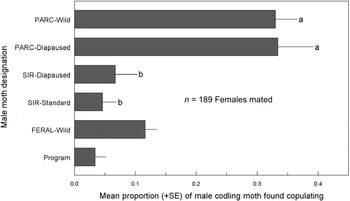
Mating studies showed that SIR-diapaused and SIR-standard moths were caught copulating with tethered wild females in equivalent proportions (Fig. 1). PARC-wild males released in the orchard were found in copula significantly more often (about 7× more frequently) than either the SIR-diapaused or SIR-standard males, but no more often than the PARC-diapaused males (Fig. 1). These findings are consistent with our previous study showing improved competitiveness of PARC-diapaused males relative to SIR-standard males, and their similar competitiveness to PARC-wild males (Judd et al. Reference Judd, Gardiner and Thistlewood2006a).

The most surprising finding in our mating studies was that SIR-diapaused males were found in copula significantly less often than PARC-diapaused males (Fig. 1). The main distinction between these two groups of moths appears to be the length of time each was chilled before release (Table 1). PARC-diapaused males used in this experiment received 3 h of chilling,whereas SIR-diapaused males received 12–36 h of chilling (Table 1). We hypothesize that these differences in prerelease chilling times may be responsible for this difference in mating frequency. The decrease in mobility that diapaused males experience after 24 h of chilling at 2°C (Bloem et al. Reference Bloem, Carpenter and Dorn2006) likely makes them less competitive with more mobile males, especially in mating assays requiring quick response times (Judd et al. Reference Judd, Gardiner and Thistlewood2006a). This means that SIR-diapaused males were probably less able to compete with PARC-wild or PARC-diapaused males that received less chilling. In contrast, chilling SIR-diapaused males for an average of 24 h makes their mobility similar to that of SIR-standard males (Bloem et al. Reference Bloem, Bloem, Calkins and Tan2006), likely resulting in similar response times and mating frequencies in these assays (Fig. 1).
Small proportions of tethered females were found in copula with feral male codling moths and, to a lesser extent, with sterile males delivered as part of standard SIR Program operations (Fig. 1). Tethered females found mating with feral and SIR Program males were not included in statistical comparisons with our test moths because their densities were unknown. These copulation data are included here for completeness and to demonstrate how inadequately standard SIR Program releases were overflooding matings with feral males in this orchard. Given the disparity between the mating frequency of SIR-standard or SIR-diapaused males and that of PARC-wild males, even when they are released in a S:W ratio of 1:1 (Fig. 1), we calculate that a S:W release ratio of 287:1, with sterile males of either type, might be necessary to reach a target of 40 sterile × wild matings for every single wild × wild mating.
Conclusions
Given certain assumptions, the basic principle underlying any sterile-insect program is that growth of a wild insect population is suppressed when sterile insects outnumber fertile insects in a mating population by some critical ratio, often called the overflooding ratio (Knipling Reference Knipling1979). Proverbs et al. (1982) established that a S:W ratio of 40:1 and 3 years of sterile release were necessary for eradication of codling moth. In practice these ratios are measured indirectly using traps, because even if the number of sterile insects is known, the true size of the wild population is usually unknown. In our experiments the densities of both wild and sterile insects released were known, and therefore mark–release–recapture experiments of this type seem appropriate for measuring relative activity of moths and comparing measured field ratios with known release ratios. There is, of course, an implicit assumption that the traps have an equal probability of sampling wild and sterile insects, and that the S:W ratios in catches reflect the S:W ratios of mating, which our data suggest may not always hold true. Combining releases with tests of mating competitiveness allows the development of a clearer understanding of the relationship between release ratios, recapture ratios, and mating ratios, the last of which ultimately determines the rate at which infertility is introduced to a population.
S:W ratios and the level of competitiveness in sterile insects relative to that of wild insects are the cornerstones of all sterile-insect programs. Our data indicate that there would be little to no improvement in either of these respects, and no economic advantages would be gained, if the Okanagan-Kootenay SIR Program introduced a diapause phase into its mass-rearing system at this time. However, the fact that irradiated PARC-diapaused males were competitive with PARC-wild males in mating assays is a promising result. These data suggest that the genetic stock of the mass-rearing colony and the rearing system employed in the Osoyoos facility are adequate for producing competitive males. They also suggest that any debilitating effects of irradiation can be overcome to some extent by putting insects through diapause, and more clearly point to postemergence handling and delivery as key factors in reducing the activity of sterile males (Judd and Gardiner Reference Judd and Gardiner2006). A better understanding of how the operations of the current SIR Program affect the mobility and relative mating activity of diapause males in the field, and how these effects might be ameliorated, is needed before any change in rearing is implemented.
Acknowledgements
We especially thank Joanne Parker from the Okanagan-Kootenay sterile insect rearing facility, Osoyoos, for providing us with mass-reared codling moths, and Bradley Garska of the Okanagan-Kootenay SIR Program field staff for dispensing moths in orchards. We thank the cooperating growers for allowing us to conduct research in their orchards, and Sara Cockburn for assistance with collecting, handling, and marking wild moths. We thank an anonymous reviewer for helpful comments that improved the clarity of the manuscript. This research was partially funded by financial assistance from the International Atomic Energy Agency under its Research Agreement with the Okanagan−Kootenay SIR Board for the production of diapause insects.