


Over the past decades, psychiatry has changed in many respects. Of particular note was the acceleration of advances in neuroscience and genetics during the 1990s, designated by the American Congress as the ‘Decade of the Brain’, that helped increase our understanding of the biological nature of mental disorders. Also during this period, a second generation of psychotropic drugs were introduced, which although not demonstrably more efficacious have either fewer or different side-effects. Reference Sartorius, Fleischhacker, Gjerris, Kern, Knapp and Leonhard1 Of equal importance, in Germany, as in other European countries, the provision and organisation of mental healthcare underwent profound changes. As a result the out-patient sector has expanded tremendously, accompanied by a substantial reduction in the number of beds in large psychiatric hospitals, the opening of psychiatric departments in general hospitals and an increase in places in day hospitals. 2,Reference Salize, Rössler and Becker3 The question arises as to whether these changes are reflected in similar changes in the attitudes of the German public towards people with mental illness and mental healthcare. It was hoped that the recognition of mental disorders as brain disorders, the increasing integration of psychiatry to the rest of medicine, advancements in treatment and the reform of mental healthcare would have a greatly beneficial impact on both the stigma attached to people with mental illness and the stigma attached to psychiatry. The expectation was that as a consequence the public would both reject less those with mental disorders and accept more the help offered by mental health services. Reference Kasper4,5
Data from two population surveys, conducted in the ‘old’ States of Germany (i.e. the old Federal Republic of Germany) in 1990 and 2011, provides us with the opportunity to examine how public attitudes have developed over the past two decades. More specifically, we will address the following three questions: (a) are the German public now more inclined to endorse biogenetic conceptualisations of mental disorders than in the early 1990s; (b) has the German public's acceptance of mental health treatment increased over the past two decades, i.e. is the public more ready now to recommend help-seeking from mental health professionals and to use psychiatric treatments than it used to be in the past; and (c) have public attitudes towards people with mental illness changed for the better, i.e. does the public react more positively now to people with mental disorders and express less desire for social distance than 21 years ago?
Method
Surveys
Our study is based on data from two population surveys among German citizens aged 18 years and over, living in the ‘old’ German States. The first survey was conducted in 1990 (n = 3067, response rate 70.0%), the second in 2011 (n = 2951, response rate 64.0%). In both surveys the samples were drawn using a random sampling procedure with three stages: (a) sample points (electoral wards), (b) households, and (c) individuals within the target households. Target households within the sample points were determined according to the random route procedure, that is, a street was selected randomly as a starting point from which the interviewer followed a set route through the area. Reference Gabler and Hoffmeyer-Zlotnik6 Target individuals were selected using random digits. Informed consent was considered to have been given when individuals agreed to complete the interview. Fieldwork was carried out in 1990 by GETAS (Hamburg) and in 2011 by USUMA (Berlin); both companies specialised in market and social research. Sociodemographic characteristics of both samples plus the general population in 1990 and 2011 are reported in online Table DS1. Except for containing slightly fewer people with a high level of educational attainment in 2011, both samples can be considered representative of the German population.
Interview
In both surveys, face-to-face interviews were conducted by trained interviewers using pen and paper. On both occasions, the fully structured interview was identical regarding wording and the sequence of questions. At the beginning of the interview respondents were presented with a vignette of a diagnostically unlabelled psychiatric case history. Then, respondents were asked a series of questions to assess their beliefs about the causes of the disorder described in the vignette, their recommendations for help-seeking and treatment, as well as their attitudes towards the person experiencing this disorder.
Vignettes
Vignettes depicting an individual with schizophrenia, major depressive disorder or alcohol dependence were used. The symptoms described in the vignettes fulfilled the criteria of DSM-III-R 7 for the respective disorder. Before the vignettes were used in the first survey, each was independently rated by five experts on psychopathology, masked to actual diagnosis, providing confirmation of the correct diagnosis for each case history. The gender of the individual presented in the vignettes was randomly varied. Respondents were randomly allocated to receive one of the three vignettes. In 1990, 1053 respondents were presented with the vignette depicting schizophrenia, 991 respondents with the vignette depicting major depressive disorder and 1022 with the vignette depicting alcohol dependence. In 2011, the respective numbers were 999, 985 and 967.
Beliefs about possible causes
Beliefs about possible causes of the problem described in the vignette were elicited with a list of various causes, each of which had to be rated on a five-point Likert scale anchored with 1 ‘certainly a cause’ and 5 ‘certainly not a cause’. The items ‘brain disease’ and ‘heredity’ were selected as representative of biogenetic causes, the items ‘stressful life event’ and ‘work-related stress (including unemployment)’ as representative of current stress, and the items ‘grown up in a broken home’ and ‘lack of parental affection’ as representative of childhood adversities.
Attitudes towards treatment
Regarding attitudes towards treatment a distinction was made between healthcare providers and treatment methods since in Germany a particular treatment can be offered by various professionals, for example psychotherapy provided by psychotherapists and psychiatrists.
Help-seeking recommendations
Help-seeking recommendations were assessed using a catalogue of the following six sources of help: psychiatrist, psychotherapist, general practitioner, health practitioner, priest and self-help group. The respondents were asked to indicate endorsement or rejection of each source of help, using a five-point Likert scale ranging from ‘would strongly recommend’ (1) to ‘would not recommend at all’ (5) plus a ‘don't know’ category.
Treatment recommendations
Using the same five-point scale plus a ‘don't know’ category, respondents were also asked to provide their treatment recommendations, offering a list of six different treatment methods, three representing established forms of psychiatric treatment (psychotropic medication, psychotherapy, relaxation techniques) and three ‘alternative’ treatment modalities (natural remedies, mediation, acupuncture).
Attitudes towards people with mental disorders
Regarding attitudes towards individuals with a mental disorder, we distinguished between emotional reactions and behavioural intentions as indicated by the desire for social distance.
Emotional reactions to the person described in the vignette were assessed by means of nine items, representing the three empirically derived emotional dimensions Reference Angermeyer and Matschinger8 ‘prosocial feelings’ ('I feel the need to help him/her', ‘I feel pity’, ‘I feel sympathy for him/her’), ‘fear’ ('I feel uncomfortable', ‘He/she makes me feel insecure’, ‘He/she scares me’) and ‘anger’ ('I feel annoyed by him/her', ‘I react angrily’, ‘I am amused by something like that’). Respondents were asked to rate the nine items on a five-point scale assessing their agreement or disagreement with the contents of each item.
For the assessment of respondents' desire for social distance we used the scale developed by Link et al. Reference Link, Cullen, Frank and Wozniak9 This scale encompasses the following social situations: rent a room, work together, have as neighbour, take care of a young child, have married into family, introduce to friends, recommend for a job. Using a five-point Likert scale respondents could indicate to what extent they were willing or unwilling to engage in the proposed relationships.
Statistical analysis
As the ratings for help-seeking and treatment recommendations included a ‘don't know’ category, which also needed to be included into the analysis, multidimensional logit models were calculated. Therefore, respondents who endorsed the two points on either side of the mid-point of the five-point scales (values 1+2 and 4+5) were grouped together into the categories ‘a cause’ and ‘not a cause’ (causal beliefs), ‘recommend’ and ‘advise against’ (help-seeking and treatment recommendations), ‘agree’ and ‘disagree’ (emotional reactions), or ‘accept’ and ‘reject’ (desire for social distance). The grouping also had the advantage of counterbalancing tendencies to preferably select or avoid the extreme response categories. To estimate the difference in attitude change between the three vignettes, an interaction effect between vignettes and time point was included. To adjust the year effect for demographic changes across samples, the regression analyses controlled for respondents' gender, age and educational attainment.
To illustrate the magnitude of changes, discrete probability changes were calculated for the attitude items. A discrete change coefficient is the difference in the predicted probability of a given outcome between 1990 and 2011, calculated with controls held at their means for the combined sample; it serves as an indicator of the effect size of the change. The delta method was used to compute 95% confidence intervals. To make adjusted predictions comparable with unadjusted predictions, probabilities and discrete changes were multiplied by 100 and can thus be read as percentages of respondents choosing each answer category. The calculation of probability changes and the testing for differences in probabilities between two time points were carried out using the modules prvalue and prchang Reference Long and Freese10,Reference Xu and Long11 in Stata, release 12 on Windows.
Results
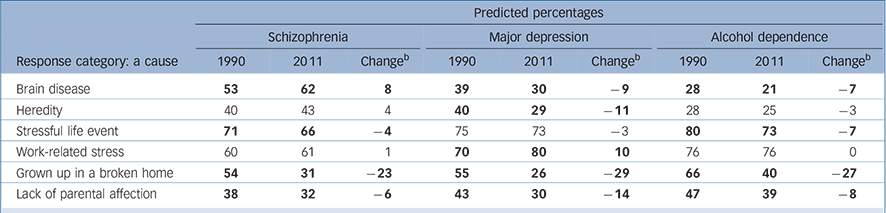
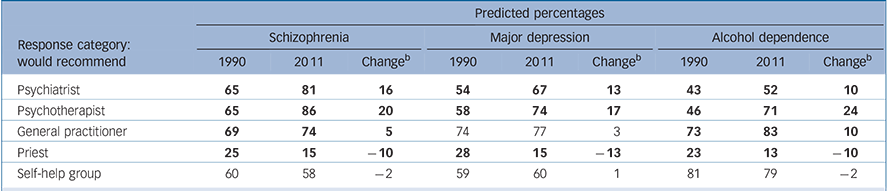
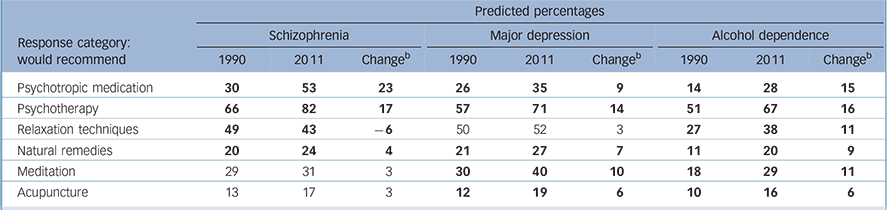
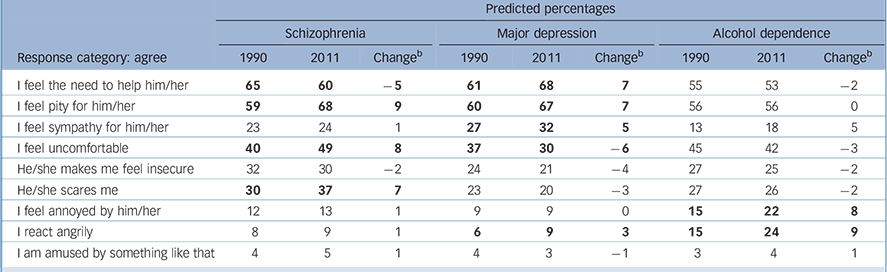
Tables 1, 2, 3, 4, 5 report the predicted percentages for 1990 and 2011 plus changes between both years for the endorsement of potential causes (Table 1), help-seeking (Table 2) and treatment recommendations (Table 3), emotional reactions (Table 4) and desire for social distance (Table 5). In these tables only results for the response categories ‘a cause’ (causal beliefs), ‘recommend’ (help-seeking and treatment recommendations), ‘agree’ (emotional reactions) or ‘reject’ (desire for social distance) are shown. In online Tables DS2-6 the complete results of the corresponding multinomial logit regressions are presented.
Causal attributions
From 1990 to 2011, the probability that a brain disease was endorsed as a possible cause of schizophrenia increased significantly, whereas the probability of negative life events being a cause decreased slightly. A trend in the opposite direction was observed for depression, with a decreasing endorsement of biogenetic causes and a significant increase in the endorsement of work-related stress as a cause. For alcohol dependence respondents tended to opt less frequently for brain disease as well as for negative life events as causes. Across all three disorders, the public embraced less frequently the role of childhood adversities in 2011 than in 1990, with the role of having grown up in a broken home showing the most marked change (Table 1 and online Table DS2).
Help-seeking recommendations
Across all three disorders, the probability of the public recommending seeing a mental health professional increased considerably, resulting in a majority of respondents in 2011 supporting specialty care for individuals with these three disorders. In contrast, the probability of respondents endorsing turning to a general practitioner (GP) increased only a little or not at all. Using psychotherapists showed the most pronounced increase in acceptance for alcohol dependence followed by psychiatrists and GPs. Across all three disorders, the public's readiness to recommend joining a self-help group remained unchanged but respondents' reluctance to recommend seeking help from a priest had increased significantly over the study period (Table 2 and online Table DS3).
Treatment recommendations
Across all three disorders, psychotherapy showed marked increases in endorsement by the public. A similar trend was observed for psychotropic medication, and this was more pronounced for schizophrenia than for the other two disorders. Whereas relaxation techniques were less frequently endorsed for the treatment of schizophrenia, there was no change for depression and a significant increase for alcohol dependence. In the case of schizophrenia, the public's acceptance of ‘alternative’ methods showed no or very little increase, which was significantly lower than that observed for psychotherapy and psychotropic medication. The increase of acceptance of natural remedies and meditation for the treatment of depression and alcohol dependence was not statistically different from that observed for psychotherapy and psychotropic medicine (Table 3 and online Table DS4).
Changes in causal beliefs about mental disorders between 1990 and 2011 (multinomial logit regression)Footnote a
| Predicted percentages | |||||||||
|---|---|---|---|---|---|---|---|---|---|
| Schizophrenia | Major depression | Alcohol dependence | |||||||
| Response category: a cause | 1990 | 2011 | ChangeFootnote b | 1990 | 2011 | ChangeFootnote b | 1990 | 2011 | ChangeFootnote b |
| Brain disease | 53 | 62 | 8 | 39 | 30 | –9 | 28 | 21 | –7 |
| Heredity | 40 | 43 | 4 | 40 | 29 | –11 | 28 | 25 | –3 |
| Stressful life event | 71 | 66 | –4 | 75 | 73 | –3 | 80 | 73 | –7 |
| Work-related stress | 60 | 61 | 1 | 70 | 80 | 10 | 76 | 76 | 0 |
| Grown up in a broken home | 54 | 31 | –23 | 55 | 26 | –29 | 66 | 40 | –27 |
| Lack of parental affection | 38 | 32 | –6 | 43 | 30 | –14 | 47 | 39 | –8 |
a. Statistically significant changes are in bold.
b. As a result of rounding the figures shown will not always equal the difference between predicted percentages.
Changes in help-seeking recommendations for mental disorders between 1990 and 2011 (multinomial logit regression)Footnote a
| Predicted percentages | |||||||||
|---|---|---|---|---|---|---|---|---|---|
| Response category: would recommend |
Schizophrenia | Major depression | Alcohol dependence | ||||||
| 1990 | 2011 | ChangeFootnote b | 1990 | 2011 | ChangeFootnote b | 1990 | 2011 | ChangeFootnote b | |
| Psychiatrist | 65 | 81 | 16 | 54 | 67 | 13 | 43 | 52 | 10 |
| Psychotherapist | 65 | 86 | 20 | 58 | 74 | 17 | 46 | 71 | 24 |
| General practitioner | 69 | 74 | 5 | 74 | 77 | 3 | 73 | 83 | 10 |
| Priest | 25 | 15 | –10 | 28 | 15 | –13 | 23 | 13 | –10 |
| Self-help group | 60 | 58 | –2 | 59 | 60 | 1 | 81 | 79 | –2 |
a. Statistically significant changes are in bold.
b. As a result of rounding the figures shown will not always equal the difference between predicted percentages.
Emotional reactions
The changes in emotional reactions towards persons with mental disorders were generally less significant. They were also less consistent across the various mental disorders. Whereas in 2011 respondents tended to express more fear from people with schizophrenia and felt more uncomfortable and insecure with them than in 1990, they showed more prosocial reactions (need to help, compassion) and reacted with less fear to people with depression than previously. When confronted with someone with alcohol dependence, respondents reacted with more anger and annoyance than two decades earlier. Regardless of the condition presented and at both time points, respondents most frequently showed prosocial reactions, followed by fear and related feelings; least frequently they reacted with anger (Table 4 and online Table DS5).
Desire for social distance
In 2011, respondents expressed a stronger desire for social distance from people with schizophrenia than two decades earlier. This applied to all seven social relationships studied. With the other two disorders no significant changes, or inconsistent changes, were observed. In 2011 as in 1990, people with alcohol dependence were facing the strongest rejection, followed by people with schizophrenia and those with depression (Table 5 and online Table DS6).
Discussion
Our main findings are that between 1990 and 2011: (a) the German public have become more inclined to endorse biological explanations of schizophrenia, whereas a trend in the opposite direction was observed for depression and alcohol dependence; (b) acceptance of treatment offered by mental health professionals has increased; (c) attitudes towards people with schizophrenia worsened, whereas attitudes towards people with the other two disorders showed no clear trend.
Changes in treatment recommendations for mental disorders between 1990 and 2011 (multinomial logit regression)Footnote a Predicted percentages
| Predicted percentages | |||||||||
|---|---|---|---|---|---|---|---|---|---|
| Response category: would recommend |
Schizophrenia | Major depression | Alcohol dependence | ||||||
| 1990 | 2011 | ChangeFootnote b | 1990 | 2011 | ChangeFootnote b | 1990 | 2011 | ChangeFootnote b | |
| Psychotropic medication | 30 | 53 | 23 | 26 | 35 | 9 | 14 | 28 | 15 |
| Psychotherapy | 66 | 82 | 17 | 57 | 71 | 14 | 51 | 67 | 16 |
| Relaxation techniques | 49 | 43 | –6 | 50 | 52 | 3 | 27 | 38 | 11 |
| Natural remedies | 20 | 24 | 4 | 21 | 27 | 7 | 11 | 20 | 9 |
| Meditation | 29 | 31 | 3 | 30 | 40 | 10 | 18 | 29 | 11 |
| Acupuncture | 13 | 17 | 3 | 12 | 19 | 6 | 10 | 16 | 6 |
a. Statistically significant changes are in bold.
b. As a result of rounding the figures shown will not always equal the difference between predicted percentages.
Changes in emotional reactions to people with mental disorder between 1990 and 2011 (multinomial logit regression)Footnote a
| Predicted percentages | |||||||||
|---|---|---|---|---|---|---|---|---|---|
| Response category: would recommend |
Schizophrenia | Major depression | Alcohol dependence | ||||||
| 1990 | 2011 | ChangeFootnote b | 1990 | 2011 | ChangeFootnote b | 1990 | 2011 | ChangeFootnote b | |
| I feel the need to help him/her | 65 | 60 | –5 | 61 | 68 | 7 | 55 | 53 | –2 |
| I feel pity for him/her | 59 | 68 | 9 | 60 | 67 | 7 | 56 | 56 | 0 |
| I feel sympathy for him/her | 23 | 24 | 1 | 27 | 32 | 5 | 13 | 18 | 5 |
| I feel uncomfortable | 40 | 49 | 8 | 37 | 30 | –6 | 45 | 42 | –3 |
| He/she makes me feel insecure | 32 | 30 | –2 | 24 | 21 | –4 | 27 | 25 | –2 |
| He/she scares me | 30 | 37 | 7 | 23 | 20 | –3 | 27 | 26 | –2 |
| I feel annoyed by him/her | 12 | 13 | 1 | 9 | 9 | 0 | 15 | 22 | 8 |
| I react angrily | 8 | 9 | 1 | 6 | 9 | 3 | 15 | 24 | 9 |
| I am amused by something like that | 4 | 5 | 1 | 4 | 3 | –1 | 3 | 4 | 1 |
a. Statistically significant changes are in bold.
b. As a result of rounding the figures shown will not always equal the difference between predicted percentages.
Changes in the desire for social distance from people with mental disorders between 1990 and 2011 (multinomial logit regression)Footnote a

| Predicted percentages | |||||||||
|---|---|---|---|---|---|---|---|---|---|
| Response category: would recommend |
Schizophrenia | Major depression | Alcohol dependence | ||||||
| 1990 | 2011 | ChangeFootnote b | 1990 | 2011 | ChangeFootnote b | 1990 | 2011 | ChangeFootnote b | |
| Have as neighbour | 19 | 29 | 10 | 16 | 15 | –2 | 36 | 31 | –4 |
| Work together | 20 | 31 | 11 | 15 | 18 | 3 | 35 | 34 | –1 |
| Introduce to a friend | 39 | 53 | 15 | 33 | 37 | 3 | 56 | 60 | 5 |
| Recommend for a job | 44 | 63 | 18 | 40 | 45 | 5 | 62 | 66 | 3 |
| Rent a room | 46 | 58 | 13 | 37 | 35 | –2 | 62 | 61 | –1 |
| Have married into family | 56 | 60 | 5 | 52 | 41 | –11 | 75 | 68 | –7 |
| Take care of children | 67 | 79 | 12 | 58 | 62 | –4 | 80 | 81 | 1 |
a. Statistically significant changes are in bold.
b. As a result of rounding the figures shown will not always equal the difference between predicted percentages.
Changes in causal explanations of mental disorders
There has been an increase in the German public's endorsement of biological causes for schizophrenia, however, for both depression and alcohol dependence there was a trend in the opposite direction. Whereas the first result is in line with findings from previous studies, this is not the case for the other two disorders, where other studies have also reported an increasing adoption of biogenetic causal attributions for these conditions. Reference Schomerus, Schwahn, Holzinger, Corrigan, Grabe and Carta12-Reference Angermeyer, Holzinger and Matschinger14 One reason for this discrepancy may be that previous studies covered the time period up to 2006, whereas our study ended more recently in 2011. A trend analysis in Western Germany between 1990 and 2001, based on a subsample that had been presented with the male version of the depression vignette, also showed a slight increase in the endorsement of brain disease as a potential cause for this disorder. Reference Angermeyer, Holzinger and Matschinger14 This suggests that the decrease in the public endorsing biogenetic explanations for depression observed in the current study is likely to have occurred between 2001 and 2011. We hypothesise that this new trend is the result of social developments that have taken place during this time frame, namely profound changes in working conditions in the wake of the process of globalisation and the economic crisis that began in 2008. Although Germany seems to be faring better than other Member States of the European Union, the German public are concerned by the crisis, as reflected by the results of a national survey conducted in 2010 according to which over half of respondents felt threatened as a result of the economic situation. Reference Heitmeyer and Heitmeyer15 This may have resulted in a growing awareness of the importance of social forces in people's emotional well-being. This interpretation is supported by our finding that significantly more people in 2011 endorsed work-related problems, including unemployment, as a cause of depression. Also of note, over the past 10 years there has been a rise in the labelling of depressive episodes as burnout. Reference Bahlmann, Angermeyer and Schomerus16
Changes in help-seeking and treatment recommendations
Across all three disorders, the German public's readiness to recommend help-seeking from mental health professionals has increased since 1990. Similar trends have also been reported from the USA, Australia and some European countries. Reference Schomerus, Schwahn, Holzinger, Corrigan, Grabe and Carta12-Reference Angermeyer, Holzinger and Matschinger14,Reference Reavley and Jorm17 It is evident that consulting a psychiatrist or a psychotherapist has become a less unusual and a more accepted way to deal with mental health problems than it used to be in the past. The trend towards greater acceptance of mental health services has also been observed with regard to psychiatric hospitals; here too, public attitudes have become more favourable over the past two decades. Reference Angermeyer, Matschinger and Schomerus18 However, it currently is not possible to establish what accounts more for this trend - the improvements in treatments offered by mental health professionals or the improvements in the organisation of mental health services. It is apparent that the German public has taken note of the reforms in mental healthcare as in the 2011 survey we found that the majority of respondents shared the view that the number of office-based psychotherapists had increased over the past 20 years as well as the proportion of people with mental illness being treated in out-patient services instead of hospitals. Reference Schomerus and Angermeyer19 The reforms may have resulted in lower barriers to help-seeking from mental health services, objectively in terms of a greater availability of such services as well as subjectively in terms of lower stigma attached to using them. This change in attitude was paralleled by a growing number of people turning to mental health professionals for help. Reference Gaebel and Zielasek20 However, the increasing acceptance of mental health professionals does not seem to be closely related to time trends about causal beliefs as, regardless of whether biological causes were more or less frequently endorsed in 2011, the public was more ready to recommend seeking help from psychiatrists as well as from psychotherapists.
Across all three disorders, the two best-established psychiatric treatment modalities, psychotherapy and psychotropic medication, showed the most pronounced increase in public acceptance. In the case of schizophrenia the readiness to recommend psychotropic medication grew significantly more than for the other two disorders. It was also only for schizophrenia that the increase in endorsement of medication was significantly greater than that for alternative methods, whereas with the other two disorders there was some overlap between the evolution of attitudes towards both treatments. Schizophrenia was the only condition for which the willingness to recommend relaxation techniques decreased significantly. This perhaps should be considered in relation to the increasing endorsement of a biological causation that we found, although it remains unclear whether there is a causal link between both trends or whether this is a coincidence. In support of the first view are the results of cross-sectional analyses of the data from both 1990 Reference Angermeyer and Matschinger21 and 2011 (unpublished results, details available from the authors on request), showing a positive association between the endorsement of biological causes and the propensity to recommend medication. On the other hand, the finding that psychotherapy has gained ground across all three disorders independently of how causal beliefs have developed argues against a close relationship between causal beliefs and treatment recommendations. This trend is more remarkable given that over the past decades the public has been increasingly exposed in the media to information on biological research about mental disorders and the pharmacological treatment of these illnesses, whereas reports about psychological interventions have been rather rare. Reference Lewison, Roe, Wentworth and Szmukler22,Reference Clarke and Gawley23
Changes in attitudes towards people with mental disorder
The marked trend towards greater acceptance of mental health treatment was not accompanied by greater acceptance of people with mental illness. Studies that have recently been conducted in the USA, Australia and some European countries Reference Schomerus, Schwahn, Holzinger, Corrigan, Grabe and Carta12-Reference Angermeyer, Holzinger and Matschinger14,Reference Reavley and Jorm24-Reference Grausgruber, Schöny, Grausgruber-Berner, Koren, Apor and Wancata26 have also found no substantial improvement in attitudes towards people with mental illness. In our study we found that although the desire for social distance from people with schizophrenia has increased, no consistent trend was observed for depression or alcohol dependence. There is an interesting parallel to the development of biological causal explanations, which have only increased for schizophrenia. Moreover, fear about people with schizophrenia, prosocial feelings towards people with depression and anger towards those with alcohol dependence have increased. This corresponds with the increase in the adoption of biological causes in the case of schizophrenia and the decrease in the cases of depression and alcohol dependence. A cross-sectional analysis of the 2011 data has revealed that biogenic causal beliefs are associated with increasing social distance in the cases of schizophrenia and depression but with a decrease in the case of alcohol dependence. Reference Schomerus, Matschinger and Angermeyer27,Reference Angermeyer, Holzinger, Carta and Schomerus28 The increase in fear about people with schizophrenia is also documented in the public's growing approval of compulsory admission to a psychiatric hospital for individuals with persecutory delusion or in cases of public nuisance. Reference Angermeyer, Matschinger and Schomerus29 This trend appears to be supported by the finding that a growing proportion of the public hold the view that psychiatric hospitals are necessary to protect society from mentally ill people. Reference Angermeyer, Matschinger and Schomerus18 Our result is all the more sobering given that over the past 10 years great efforts have been made in Germany to fight against the stigma attached to mental disorders. Reference Gaebel, Ahrens and Schlamann30 However, these campaigns have been mostly regional and probably therefore have less of an impact than a large nationwide campaign, such as the one recently launched in the UK. Reference Henderson, Corker, Lewis-Holmes, Hamilton, Flach and Rose31
Strengths and weaknesses
With a time span of 21 years, our study is the longest vignette-based trend analysis of public attitudes towards mental disorders. Another strength of our study is the large sample size (nearly 1000 respondents each being presented with one of the three case vignettes at each assessment point), allowing for complex statistical analyses. To achieve maximum comparability between both surveys we adhered to the recommendations of experts in survey research Reference De Leeuw, Hox and Dillman32 as closely as possible, using the same sampling procedure, interview mode and instruments. However, the exclusive focus on attitudes may also be seen as a limitation since it allows predicting behaviour with only limited accuracy. However, rather than using them as a proxy for individual behaviours public attitudes can also be conceptualised at a collective level as a reflection of cultural conceptions of mental illness. Such conceptions provide a cultural context that influences the way we think about mental illness and the people who have them. As Link et al have pointed out ‘as a context this cultural conception becomes an external reality, something that individuals must take into account when they make decisions and enact behavior’. Reference Link, Angermeyer, Phelan, Thornicroft, Szmukler, Mueser and Drake33 The aim of our study was to document the variations in these cultural conceptions of mental illness over time. For this purpose, the comparison between two cross-sectional assessments at different points in time appears to be the most appropriate study design. Although also providing insights into the changes in people's attitudes at an individual level, a panel study would struggle with the lack of representativeness of the follow-up assessment, due to the huge attrition rate that can be expected over a time period of 21 years, and, therefore, this type of study is less suitable for studying changes on a collective level.
Implications
In conclusion, public attitudes towards mental healthcare providers and the treatment offered by them has improved considerably in Germany over the past 20 years. However, attitudes towards those with mental illnesses have remained unchanged or worsened. Seemingly, the changes that have taken place in psychiatry over the past decades have benefited the image of psychiatry, but have failed to improve the image of its patients. Further efforts are necessary to combat the stigmatisation and discrimination of people with mental illness. In light of our findings it seems advisable to focus all available resources on this endeavour. In view of the growing divide between schizophrenia and other mental disorders, special efforts should be made to stop this disquieting trend.
Funding
The study was funded by the Fritz-Thyssen-Stiftung (Az. 10.11.2.175)




eLetters
No eLetters have been published for this article.