1 Introduction
Although the English noun phrase, its structure and use have received a fair amount of attention in the literature,Footnote 1 there are still some aspects which deserve further consideration. In an attempt to provide a full account of the noun phrase's internal make-up, its constituents and their interaction, it might be insightful to take a look at those more marginal phenomena beyond the well-researched facts.
Noun ellipsis, that is, the absence of a phonetically realized head noun, in contexts of adjectival modification is one such phenomenon. In English, there are two strategies which are closely related: in example (1), the head noun of the object NP in the second clause is missing, which is indicated by a gap. In (2) a semantically empty but overt nominal element, one, is used. Both types of head, i.e. the ‘silent’ noun and one, need an antecedent – provided in the first clause in this case – in order to be interpreted.
(1) This copy is defective but the other two __ are fine. (Payne & Huddleston Reference Payne and Huddleston2002: 416)
(2) I asked for a key but he gave me the wrong one. (Stirling & Huddleston Reference Stirling and Huddleston2002: 1511)
‘Noun ellipsis’, as used in this article, refers to the strategy in (1). The strategy in (2) is labelled as ‘one-replacement’. The italicized NPs are called ‘antecedent NPs’ and the NPs which lack a head noun are labelled ‘elliptical NPs’. It must be emphasized that the noun and not the entire NP functions as the antecedent. Similarly, ‘ellipsis’ does not affect the entire NP but relates to the nominal level.
Note that noun ellipsis as an antecedent-based ellipsis type needs to be distinguished from phenomena such as the following, where the absence of an antecedent gives rise to rather special interpretations such as [+human, +generic] (in (3)) or [+abstract] (in (4)). These cases are excluded from the present analysis:
(3) The rich cannot enter the kingdom of Heaven. (Payne & Huddleston Reference Payne and Huddleston2002: 417)
(4) This is verging on the immoral. (ibid.)
Another remark on the status of the remaining material needs to be made at this point. As pointed out by an anonymous reviewer, the question arises as to why reference is made to empty elements in the analysis. An alternative – possibly less controversial – option would be to consider (some of the) remaining material to function as head noun. However, there are a couple of reasons for not treating the remaining determiners, adjectives or numerals as (pro-)nominal elements. First of all, consider cases of optional one-replacement with elements such as another or ordinal numerals:
(5) These are excellent biscuits.
(a) Can I have another?
(b) Can I have another one? (Stirling & Huddleston Reference Stirling and Huddleston2002: 1512)
(6) Jill's first semantics book was clearer than
(a) her second.
(b) her second one. (Stirling & Huddleston Reference Stirling and Huddleston2002: 1517)
An analysis of these two instances of another and second as separate phenomena would neglect the parallelism between them (such as the antecedent-based interpretation). Second, the following example from Payne & Huddleston (Reference Huddleston and Pullum2002: 411) shows that few can take an adverbial modifier, which also indicates the non-nominal status of elements of this type:
(7) While Kim had lots of books, Pat had very few.
1.1 Conditions on noun ellipsis
English noun ellipsis is subject to a number of restrictions. First, the noun's content has to be recoverable from the (extra)linguistic context via a linguistic or discourse antecedent (Lobeck Reference Lobeck1995; Sleeman Reference Sleeman1996), as illustrated in the above examples.
Second, the range of pre-nominal elements that can precede the elided head noun is quite narrow: some determiners such as the plural demonstratives, certain quantificational expressions (such as the numerals) and the superlative forms of adjectives denoting properties can occur in contexts of noun ellipsis, as shown in the examples below – for a detailed outline the reader is referred to Payne & Huddleston (Reference Huddleston and Pullum2002: 410–21):
(8) Alice's performances were better than those of Helen. (Payne & Huddleston Reference Payne and Huddleston2002: 412)
(9) We have two keys but we need three. (Stirling & Huddleston Reference Stirling and Huddleston2002: 1512)
(10) I went up that skyscraper in Boston, but the tallest is in Chicago. (Payne & Huddleston Reference Payne and Huddleston2002: 416)
Whereas it is generally agreed which determiners and quantifiers allow for noun ellipsis, matters become more controversial in the case of adjectival modification – when it comes to non-graded adjectives, there is considerable disagreement in the literature as to which property-denoting adjectives can occur in elliptical NPs.
As Payne & Huddleston (Reference Huddleston and Pullum2002: 417) contend, the following (non-graded) adjectives do not necessarily require one-insertion: ‘[m]odifiers denoting colour, provenance, and composition’ (example (11)) as well as adjectives which denote ‘basic physical properties such as age and size’ (in (12); emphasis added):
- (11)
(a) Henrietta likes red shirts, and I like blue.
(b) Knut wanted the French caterers, but I wanted the Italian.
(c) I prefer cotton shirts to nylon.
- (12)
(a) Lucie likes young dogs, but I prefer old.
(b) Lucie likes big dogs, but I prefer small.
Adjectives other than those above, that is, those denoting character, do not yield acceptable results without an overt nominal head:
(13) *Lucie likes friendly dogs, but I prefer aggressive.
Hence, according to Payne & Huddleston certain semantic classes of adjectives allow for noun ellipsis in English. However, matters are not as straightforward as they may seem: there is considerable disagreement in the literature as to which adjectives allow for noun ellipsis in English, and some approaches even deny the existence of the phenomenon. Sleeman (Reference Sleeman1996: 50ff.), for example, claims that in English colour adjectives are the only property-denoting adjectives that can occur as modifiers in elliptical NPs (see also Lobeck Reference Lobeck1995: 67 fn. 5), whereas, for example, Llombart-Huesca (Reference Llombart-Huesca2002: 66) considers *I like the blue car but I don't like the pink as ungrammatical and claims that one has to be inserted to get an acceptable structure. Bouchard (Reference Bouchard2002: 225–6) also claims that noun ellipsis with modifying adjectives is only possible in a very salient context; in other words, when a sharp contrast is expressed, the content of the noun can be recovered, as in the well-known examples by Halliday & Hasan (Reference Halliday and Hasan1976, in Bouchard Reference Bouchard2002: 225; see also Sleeman Reference Sleeman1996: 51 fn. 18):
(14) I like strong tea. I suppose weak is better for you.
(15) Which last longer, the curved rods or the straight rods? The straight are less likely to break.
1.2 Aims and scope
In the previous section I showed that adjectives denoting properties seem restricted in their ability to occur in elliptical NPs and, second, that pragmatic factors play a crucial role, given the claim that the strict requirement of one-insertion can be relaxed in highly contrastive contexts. This gives rise to the following questions: do particular adjectives allow for noun ellipsis, as claimed by Payne & Huddleston (Reference Payne and Huddleston2002), or is it rather a certain contextual configuration that allows for the head noun's recoverability? In case the latter option holds, the nature of the context needs closer scrutiny; in other words, the question of what ‘contrastive context’ looks like has to be addressed. I will come back to these questions in what follows.
The aim of this article is twofold. First and foremost, it attempts to determine which adjectives can occur without overt nouns and in which type of syntactic construction or context the nouns can be left out. This will be undertaken by drawing on a study based on the British National Corpus (henceforth BNC). Second, it discusses the notion of ‘contrast’, relevant for the analysis of noun ellipsis in English, in order to determine what allows one to be left out in these contexts. The analysis of this phenomenon, hitherto rather underrepresented in the literature, is considered to provide deeper insights into the role of adjectival modification within the NP and into noun recoverability issues.
The article is structured as follows. The corpus analysis, its conception and outcomes are presented in section 2. Section 2.1 provides a detailed description of the methodology and discusses the problems posed by the search for a silent element. Section 2.2 is devoted to the question of why some adjectives feature prominently among the results. The properties of the contexts in which elliptical noun phrases show up are described in section 2.3. The outcomes are discussed in section 3, where I start out with a discussion of the notion of ‘contrast’ and its effect on noun ellipsis (section 3.1). Section 3.2 briefly discusses the idea that partitivity is the crucial requirement for noun ellipsis, which has been very prominent in the literature (Lobeck Reference Lobeck1995; Sleeman Reference Sleeman1996; Bouchard Reference Bouchard2002; Llombart-Huesca Reference Llombart-Huesca2002; Alexiadou & Gengel forthcoming). Section 3.3 analyses the context of elliptical NPs in spoken language (section 3.3.1) and written language (section 3.3.2). Section 4 summarizes the article.
2 A corpus study on noun ellipsis
2.1 Methodology
In order to shed light on the above issues I conducted a study based on data retrieved from the BNC. This method seemed the most promising to check the distribution of adjectives in elliptical NPs for two reasons. First, adjectives that allow for noun ellipsis can be identified without resort to the researcher's intuitions. A corpus-based approach allows the compilation of a more fine-grained list of adjectives in elliptical NPsFootnote 2 – especially if adjectives other than the expected turn out to qualify as modifiers in elliptical NPs. Second, a corpus, allowing for contextual aspects to be taken into consideration, provides insights into the pragmatic factors that may play a part in the use of elliptical NPs. As illustrated in the previous section, reference to pragmatic factors such as ‘contrastive context’ is frequently made in approaches to noun ellipsis. Hence, taking these contextual aspects into consideration is indispensible for a comprehensive account of noun ellipsis.
The BNC was chosen for the analysis on the basis of two requirements: it had to be a very comprehensive corpus – the BNC comprises 100 million words – and had to be tagged for parts of speech (henceforth POS). Recall the above discussion on the status of adjectives in elliptical NPs – it was suggested that noun ellipsis with adjectives is a rather marginal phenomenon in English. Thus a larger corpus is likely to yield a viable set of data.
In order to find instances of elliptical NPs, a search string consisting of three parts was used: article + adjective (in its uninflected form) followed by a non-nominal and non-adjectival element, i.e. basically by all parts of speech other than the (pro)nominal and the adjectival ones, in order to yield constructions of the type ‘determiner adjective’ not followed by a noun. Adjectives and participles were excluded as well in the position following the first adjective to avoid instances of stacked adjectives followed by a noun, as illustrated below.
(16) . . . as long as you make the full annual payment by the end of each 12-month period. (A01 256)
Note that these results are not sufficiently filtered in that they do not necessarily meet the requirements outlined above: only those cases where an antecedent provides the information needed to recover the silent noun's contents are understood as proper instances of noun ellipsis. Hence, to exclude the ‘nounless NPs’, where the absence of an antecedent leads to the special interpretations mentioned earlier (see section 1, example (3)), a manual examination of the data was needed. To keep the number of hits to a manageable level, further restrictions had to be made to thin out the results. They are outlined in what follows.
First of all, only the articles (the, a(n), no) were included in the determiner position because a wider range of determinative elements would include those which allow for noun ellipsis on their own. This leads to results such as the following, where the gap precedes the adjectival element and is licensed by the demonstrative those rather than by the adjective:
(17) Status of all rooms, including those ready for use, can be displayed . . . (A0C 734)
Furthermore, the comma was excluded from the search string as this would result in a large number of NPs headed by an overt noun displaying stacked adjectival modification. This is illustrated in the example below:
(18) She is a small, passionate, very striking young woman . . . (A03 811)
In order to capture cases where an instance of noun ellipsis is followed by a comma, an optional comma was allowed for. The above problems were circumvented by banning adjectival elements from the positions following that comma.
Another potential problem had to be taken into account: some of the adjectival elements that fulfil the noun-ellipsis criteria could have been tagged as common nouns rather than as adjectives.Footnote 3 In order to capture these data as well, I searched for common nouns in the first 1,000 most frequent adjectivesFootnote 4 in the BNC.
It is conceivable that there might be cases where a noun phrase bears an ellipsis site but lacks a determiner or an element preceding the property-denoting adjective (e.g. a numeral). Such an NP would thus consist of an adjective, this being the case of bare plurals without overt nouns. However, it is technically impossible to search for NPs which bear an ellipsis but lack a determiner or a quantificational element preceding the adjective. A POS-tag search for such a configuration finds every predicative adjective in the corpus. It might be interesting for an account of noun ellipsis to take into account those cases where the elided noun is definitely plural. Consider the following example:
(19) How safe is the new farming method of introducing new pests to fight the old? (EFF 2123)
The antecedent pests bears plural morphology and yet it is not clear whether the elliptical NP has to be interpreted as referring to a singular or a plural entity. Hence, in order to fully understand the phenomenon of noun ellipsis, it would be desirable to have clear cases of plurality. Therefore, the article was replaced by a cardinal numeral in an additional search. The searches returned roughly 35,000 hits; 965 ‘proper’ instances of noun ellipsis were identified in a manual analysis. ‘Proper’ here refers to those that match the criteria outlined above: noun phrases that lack an overt head noun, with the noun's meaning being recoverable with the help of an antecedent.
2.2 A particular type of adjective?
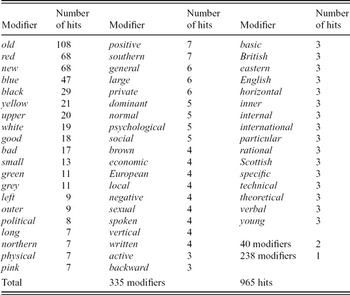
Table 1 illustrates which adjectives were among the results. They are ordered according to frequency. Due to space restrictions, those that occur three times, twice or only once are not listed as separate entries.
Modifiers in elliptical NPs

The table displays a multitude of different modifiers (335 altogether). Recall that Payne & Huddleston (Reference Payne and Huddleston2002) claim that particular semantic classes of adjectives are licit in elliptical NPs. Those are adjectives denoting basic physical properties, colour and nationality. Table 1 reveals that colour adjectives occur frequently as modifiers in elliptical NPs: red appears 68 times, blue 47 times, black occurs 29 times, there are 21 hits for yellow, 19 for white, 11 for green and 11 for grey. Furthermore, there are seven instances of pink and four of brown and, among the adjectives that are not listed separately, there are eight additional colour adjectives (lemon appears twice and there is one hit for silver-grey, black pied, red pied, gold, golden and white and red, respectively). So 225 instances of the 965 hits are colour adjectives and hence the result apparently mirrors the claim put forward by Payne & Huddleston. This is further supported by the fact that old and new, ‘modifiers denoting basic physical properties such as age’ (p. 417), also rank quite high in terms of frequency. However, this conclusion is too premature, as shown in what follows.
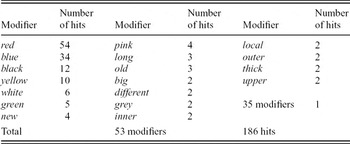
In order to spot potential flaws, a look at the differences in the distribution in spoken and written texts proves insightful. Table 2 summarizes the findings for spoken language.
Modifiers in elliptical NPs – spoken component

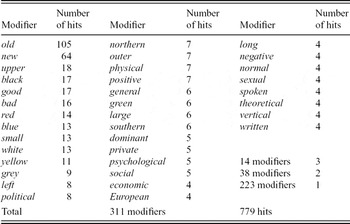
Table 3 displays the frequency of adjectives modifying empty nouns in written texts.
Modifiers in elliptical NPs – written component

Interestingly, colour adjectives constitute 129 of the 186 hitsFootnote 5 in spoken texts and 96 of the 779 hitsFootnote 6 that stem from written texts. Thus adjectives denoting colour add up to 69.35 per cent of the hits in the spoken texts and only 12.32 per cent of those in the written texts. The reasons for these differences between spoken and written language will be discussed in sections 3.2 and 3.3. Suffice it to say at this point that, on the basis of these insights, any quantitative statements as to which modifiers readily occur in elliptical NPs are hardly possible.
Observe that the data from the written component indicate that the adjectives denoting age feature prominently in elliptical NPs (105 hits for old and 64 hits for new). However, a look at the frequency lists of positive adjectives in the written texts in the BNC reveals that this ranking reflects their overall appearance in the corpus: other Footnote 7 is the most frequent adjective (116,786) followed by new (107,224), good (60,421) and old (46,857). A chi-square test indicates that there is a correlation between the frequency in elliptical NPs and the overall frequency in the corpus for old and new (χ2 = 81,604, df = 1, p<0.001). Therefore the analysis does not show a particular distribution of the semantic classes of adjectives. In addition, 335 different modifiers were identified. They range from adjectives denoting inherent properties of the referent to relative adjectives that express more speaker-oriented properties, such as good and bad. As evinced in table 1, they do not denote ‘basic properties’: adjectives such as psychological, social, active, economic, spoken and written can hardly be said to express basic notions.
The above discussion suggests that a classification of modifying adjectives in elliptical NPs according to semantic types is hardly fruitful on the basis of these corpus data. I will come back to this in section 3.3. In this vein, even though the data do not provide a positive answer to the first question, they turn out to be useful since they allow for deeper insights into contextual factors that play a role for noun ellipsis. A description of noun ellipsis contexts is provided in the subsequent section.
2.3 Contextual configurations
Reference to the notion of ‘contrast’ is frequently made in analyses of adjectival modifiers and their ability to occur in elliptical NPs. In a number of approaches, contrastive focus is taken to be the general condition on noun ellipsis, that is, it is the relevant requirement for the non-adjectival licensorsFootnote 8 as well (see Eguren's Reference Eguren2010 account of noun ellipsis in Spanish). Even those accounts in which the phenomenon is attributed to other factors (such as ‘partitivity’; see Sleeman Reference Sleeman1996 or Bouchard Reference Bouchard2002) posit a relation between contrast and adjectival modifiers in elliptical NPs in English. Bouchard (Reference Bouchard2002), for example, claims that ‘when a sharp contrast is presented, one may be omitted’ (225) and that ‘a very salient context allows recoverability of the content of the N’ (226). This gives rise to the following questions: what does a ‘contrastive context’ look like or, put differently, what makes a context salient enough? Furthermore, it needs to be examined whether particular contextual patterns emerge in order to define the contextual constraints on noun ellipsis in English. Finally, should it be the case that elliptical NPs occur in certain contextual configurations, this leads to the more general question of why one-replacement is not required here.
2.3.1 Adjective pairs
It has already been pointed out that numerous adjectives other than the ‘basic’ ones were found in elliptical NPs. An analysis of the lexical relations between the adjectives thus proves fruitful. Two types of relations were distinguished: first of all, an analysis was carried out to determine whether an adjective that stems from the same semantic class (semantic class here refers to categorization according to denotation, e.g. colour; as in Dixon Reference Dixon1982) as the modifier in the elliptical NP was contained in the antecedent phrase (or anywhere else within the immediate context). In a second step, these modifiers were classified into clearly antonymic and non-antonymic cases. ‘Antonymic’, as used here, refers to the lexical relation between adjectives which denote opposite notions: it refers either to binary pairs of non-gradable antonyms (such as dead/alive) or to the opposite endpoints on a scale of gradable notions (such as big/small).
Interestingly, 685 modifiers are of the first type, i.e. the antecedent NP and the elliptical NP contain adjectives of the same type, as illustrated by the following examples:
(20) . . . and delays rapidly reached six months on the French side and three months on the British. (BMJ 249)
(21) the Latvian rouble had the same value as the Russian. (K1B 2743)
(22) The flight of the red squirrels from the grey. (EFF 1838)
The total of adjectives of the same type, 685, comprises 430 which are in antonymic relationship to one in the immediate context. Among them are adjectives which denote what are considered basic notions (Jones Reference Jones1993; Sleeman Reference Sleeman1996): good and bad, old and new as well as small and large occur as binary pairs. An example for each of the above is provided below:
(23) . . . unemployed but taking the bad days as cheerfully as the good. (EVF 206)
(24) They are trying to isolate their good properties from the bad. (AKL 309)
(25) . . . who have done well under the old conditions . . . and lukewarm defenders in those who may do well under the new. (CKS 169)
(26) . . . an even worse headache for the new government than it was for the old. (AK2 284)
(27) Thus, the right of the large nation could deny that of the small. (ANT 680)
(28) . . . it should take into account the public as well as the private sector, the small practitioner as well as the large. (APX 169)
In addition to these adjectives, modifiers that indicate the position of a referent, such as vertical-horizontal, left-right, inner-outer, northern-southern, upper-low/lower, are also found:
(29) In Figure 1.1 we have represented the holism-individualism range on the vertical axis and the explaining-understanding contrast on the horizontal. (EDD 68)
(30) . . . keeping the right foot in place and stepping out with the left. (GVF 508)
(31) . . . the only entry to the inner room was through the outer. (B0U 2432)
(32) Serpens is divided into two parts, Caput (the Head) in the northern hemisphere and Cauda (the Body) in the southern. (EAW 595)
(33) Another factor is that the characteristics of intervals are greatly increased in the low registers and decreased in the upper. (GVJ 1486)
Interestingly, there are also pairs of modifiers that clearly do not fall into the class of ‘basic’ terms, e.g. spoken-written, private-public and rather complex ones such as brain-damaged as opposed to normal, as well as developing and developed.
(34) Some individuals spend more time with the written language than they do with the spoken. (F9V 227)
(35) . . . familiar to those in the public sector as much as they are to those in the private. (HTF 1312)
(36) . . . something that happens in the brain-damaged animal that doesn't happen in the normal. (CMH 926)
(37) . . . with the developing nations pulling towards overtaking the developed. (AB6 563)
Note that the antonymic relation is not necessarily restricted to antecedent modifiers and modifiers in the elliptical NP but can also hold between different instances of the latter, as the following example shows:
(38) But not all mosquitoes that breed in puddles or water pots are vectors of malaria, and it takes a competent entomologist to distinguish the dangerous from the harmless and to carry out this ‘species sanitation’. (B7E 413)
2.3.2 Syntactic configurations
Bouchard (Reference Bouchard2002) and Alexiadou & Gengel (forthcoming) quote an example from Sleeman (Reference Sleeman1996), repeated below, to illustrate where noun ellipsis in English and French is licit with adjectives:
(39) Parmi les tableaux exposés dans ce musée, je distinguerai trois catégories: les magnifiques, les bizarres et les affreux.
Among the paintings exhibited in this museum I will distinguish three categories: the magnificent ones, the strange ones, and the awful ones. (Sleeman Reference Sleeman1996: 16 fn. 3)
The corpus study revealed that this is a rather productive construction in English: 136 out of the 965 modifiers occurred in this particular setting. In this construction, henceforth referred to as ‘the taxonomizing construction’,Footnote 9 a set is established by the antecedent's denotation, and then different types are specified. The antecedent is usually accompanied by a numeral, which indicates the set's cardinality, as in examples (40) to (42).
(40) A narrow path led between the two waters, the wild and the domesticated. (ADM 409)
(41) . . . and as Hobsbawm (1964, p. 32) remarked there now seem to be three or four alternative routes out of the primitive communal system: the oriental, the ancient, the Germanic (or more broadly, feudal), and less clearly articulated, the Slavonic. (H9F 292)
(42) Habermas reveals three such interests. The technical, which corresponds to the activity of the nomological sciences, the practical, which corresponds to the hermeneutic sciences, and the emancipatory, which corresponds to the critical sciences. (CGY 1035)
There are other ways to indicate the number of referents the superset consists of, such as the modifier dual in (43) and the determinative both in (44):
(43) . . . the analysis of the dual functions of language, the cognitive and the performative, central to Paul de Man's work. (ATA 1308)
(44) Both aspects of language development, the personal and the social, contribute to giving pupils power over their own lives. (CCV 334)
Note that this construction has a rather fixed form and meaning: an antecedent, which supplies the ellipsis site with an interpretation, is introduced without any kind of descriptive modifier, and establishes the set of referents. In most cases this set is narrowed down in size by a numeral or a similar element. Then at least two subsets of that set are identified with the help of elliptical noun phrases that are coordinated by and. These constructions always take the definite article and contain an adjectival modifier. The two subsets made reference to by the phrases containing the ellipsis site are interpreted as available types.
The BNC study revealed a further mechanism that is very similar. An antecedent comes with a numeral, which delimits the set; then different referents that make up the set are listed. This is illustrated in (45) to (47):
(45) . . . while in the six-part sinfonia which follows these instruments are joined by 6 lutes (three large and three small). (GUH 627)
(46) The Gracious Speech contains three Bills on education; two English and one Scottish. (HHW 2310)
(47) . . . and two stars, a red, a white, shooting down the dark tunnel of road between the hedges. (H9G 1681)
These cases share the crucial aspect that a set is defined explicitly before a referent is identified, unlike in the examples provided in the previous section, where two (or more) subtypes of the set are given without explicit mention of the latter.
So far, two main aspects related to contrast and noun ellipsis have been outlined: the lexical relations of the modifiers, and the different ways in which sets are created and the members are subsequently identified. These are the contextual patterns that feature prominently among the results. Yet before these findings are discussed in greater detail, attention will be paid to the means to induce contrast, as found in the BNC data. They are summarized below to provide a comprehensive answer to the question about how contrastive contexts might look like.
The aspects to be presented here fall into two main categories: syntactic patterns and lexical means. As for the latter, use is made of elements that have a contrastive meaning, such as predicates expressing similarity or difference like different (from), compared (to) and compared (with).
(48) . . . if the new use is ‘substantially’ different from the old. (B2D 684)
(49) . . . but secrecy is still a significant feature of the British executive, especially compared to the American. (GV5 662)
(50) Certainly the absence of commercially significant rain-forest fruits in the New World, compared with the Old, . . . (J18 413)
In the above examples an adjective expresses a relation between a referent and another referent bearing the ellipsis site, which, as a complement of the adjective, is also part of the predicate. A similar case can also be found within the verbal domain – there is a range of verb-preposition/particle combinations which distinguish referents from each other, as becomes evident in the following examples:
(51) . . . Pascoe could tell a good lie from a bad. (FP7 2011)
(52) . . . the element of indecency is used to separate the sexual offence from the non-sexual. (ACJ 1119)
(53) . . . the line dividing the Eastern hemisphere from the Western. (ECR 446)
(54) Thompson's purpose here is to contrast the eighteenth century's passive materialism, reflected in Owen's views, with the active, . . . (EF4 506)
Verbal constructions such as tell from, separate from and contrast with, to name but a few, make a contrastive relation between referents explicit.
The other structural way to enhance contrast that was mentioned above is the use of parallelism. Consider the examples given below:
(55) the more recent folk-songs of America, which were borne out of economic collapse (on the white hand), and subservience and racialism (on the black). (A0P 1347)
(56) The creative and necessary activities are encouraged (even demanded) whilst the destructive are curtailed. (FE6 164)
Here, the NP containing the antecedent and the elliptical NP have similar syntactic roles: in (55) both phrases are coordinates in complement position to a preposition, and in (56) each of the two is in subject position of a passive clause. Note that in (56) contrast is also brought about by antonymic adjectives modifying the antecedent and the silent noun. Furthermore, the participles encouraged and curtailed denote opposite results of activities as well. In the examples below a similar way of enhancing contrast is apparent:
(57) The idea that the northern suite was used in summer and the eastern in winter does not convince. (CM9 229)
(58) . . . to associate the old nobility with inertia, the new with virtue. (EA7 315)
(59) The first are aimed at the commercial market; the latter at the technical. (CSV 446)
(60) It has a horizontal division across its pupil which effectively gives it four eyes – the two lower halves for seeing underwater, the two upper for doing so in air. (EFR 1720)
In these examples the elliptical and the antecedent phrases have comparable syntactic roles. Additionally, other constituents further incorporate contrast on a lexical level. In (57), for example, summer and winter are contrasted, and in (58) inertia and virtue, as complements to the same preposition, underline the differences between the two referents contrasted in the proposition.
3 The role of context
In order to account for the above data, two aspects have to be addressed: first of all, it has to be established what the notion ‘contrast’, as used in the accounts of noun ellipsis, actually refers to. Second, the properties of one, the other anaphoric nominal element, have to be considered. Remember that one, according to the literature, is required when an adjective precedes the ellipsis site. Thus, the question arises why one can be left out in the above cases.
3.1 Contrast conditions on noun ellipsis
Contrast is a notion that proves notoriously hard to define. An extensive discussion would certainly be beyond the scope of this article, hence only the aspects that directly relate to noun ellipsis will be taken into consideration.Footnote 10
Both Ntelitheos (Reference Ntelitheos2004) and Eguren (Reference Eguren2010), who relate the licensing of ellipsis in the nominal domain to contrast, make reference to Giannakidou & Stavrou (Reference Giannakidou and Stavrou1999), where such licensing is defined as follows:
A nominal subconstituent α can be elided in constituent β only if the remnant β is not identical to the corresponding part of the antecedent γ of α. (Giannakidou & Stavrou Reference Giannakidou and Stavrou1999: 305)
This definition accounts for examples such as (61), where both the antecedent NP and the elliptical one contain a numeral, which is not identical:
(61) We have two keys but we need three. (Stirling & Huddleston Reference Stirling and Huddleston2002: 1512)
However, as Eguren (Reference Eguren2010) points out, the elements can be identical. He puts forth the following example from Spanish:
(62) María ha leído dos artículos y Ana ha leído dos __.
‘Mary has read two papers and Ann has read two __.’ (Eguren Reference Eguren2010: 443)
Here, the modifier dos ‘two’ occurs in the antecedent and the ellipsis NPs. The important aspect is that the phrases are not coreferential. On the basis of this, Eguren (Reference Eguren2010: 443) revises the Contrast Condition by replacing ‘contrast’ by ‘non-identity’: ‘the focused constituent(s) in the remnant cannot be (semantically) identical to the corresponding part(s) in the antecedent phrase’. Thus the modifiers do not necessarily have to differ on the phonetic level.
Halliday & Hasan (Reference Halliday and Hasan1976) also present some interesting observations on the relation between anaphoric phrases and their referents, which are closely related to Eguren's insights but differ in that they take one-replacement into account as well. They describe the relation between NPs that are replaced by a pronoun (‘reference’) and NPs that contain one (‘substitution’) as follows:
In reference there is a total referential identity between the reference item and that which it presupposes, nothing is added to the definition. In substitution there is always some redefinition. Substitution is used precisely where the reference is not identical, or there is at least some new specification to be added . . . the new definition is contrastive with respect to the original one. (Halliday & Hasan Reference Halliday and Hasan1976: 95)
In other words, if two NPs are coreferential, the second one is replaced by a pronoun, as demonstrated in (63) and (64) below:
(63) In Britain it has long been believed that if a black cat crosses your path or enters your house it will bring you good fortune. (BMG 1648)
(64) Tim: I saw a black cat on the step.
Dorothy: Did you?
Tim: But he went away. (KBW 17664–66)
If the NP containing an anaphoric form and the antecedent NP are not coreferential, a modifier expresses a difference. This non-identity can be established prenominally (as in (65) and (66)) or postnominally (as in (67)).
(65) WHY are you less likely to get caught speeding in a black car and most likely in a red one? (CH5 3358)
(66) ‘I'm the entertainments director,’ Mandy repeated, missing the undertows that were now thick in the air around her, as dark blue eyes met light blue ones and clashed like hot air hitting cold. (JY6 519)
(67) The CO leant across to the officer on his right, and then to the one on his left. (ACE 523)
The aspect to be emphasized here is that very similar constraints seem to hold for both noun ellipsis and one-replacement. This directly follows from the properties of one and noun ellipsis outlined in section 1: both are anaphoric nominal forms, that is, both are interpreted with the help of an antecedent. This reveals the obvious parallelism between the two forms: both are empty nouns and do not contribute any lexical meaning. The difference is that one, in contrast to the ‘silent’ empty noun in elliptical NPs, has a phonetic form and therefore serves as a host for number morphology. A contrast or non-identity condition holds for the use of both forms. The exact nature of the condition is examined in what follows.
First of all, note that the use of one-replacement would be infelicitous under certain circumstances. This is illustrated by a modified version of (64) above:
(64′) I saw a black cat on the step. #But the black one went away.
However, the example would be acceptable if several cats were available:
(64″) I saw several cats on the step. But the black one went away.
The use of one-replacement presupposes the existence of alternatives: there must be several cats. Furthermore, those that do not leave have to be non-black, since being black is the defining property that distinguishes the referent under consideration from the other ones. Thus, even if no alternatives are explicitly mentioned, the use of one presupposes that other types of items of the same kind (cats, in the above example) exist. The types are defined by properties comparable to the one denoted by the modifier of one, i.e. colour in the above example.Footnote 11 Consider a discourse context, where several objects (cars) are under consideration:
(68) (Speaker looking at cars passing by). Look, a green one. And, here, another green one.Footnote 12
The modifier green bears contrastive stress – anaphoric one can never be stressed when it follows descriptive adjectives (Dahl Reference Dahl1985) – and signals that other types of the same kind (e.g. cars in other colours) are available. The use of the same modifier in the second NP is not problematic for the non-identity condition as no referential identity obtains.Footnote 13 Non-identity holds on the semantic level again.
There are some apparent counterexamples to the aforementioned conditions. First of all, as pointed out by Dahl (Reference Dahl1985: 67f.), the antecedent NP and the NP bearing one can be coreferential:
(69) A: Would you like me to change the pictures in your room?
B: No, I think I'd like to keep the same ones.
This is not exclusive to the use of prenominal adjectives expressing identity, as evidenced by (70):
(70) What was the name of that word mentioned in that handbook on psychology – the one in the chapter on sudden changes of personality? (B1X 1897)
This identity applies at the semantic level only, since the form does differ. Consider an example such as (71), where the form is identical and only one referent is under consideration:
(71) Dorothy: Is that a nice cat, do you stroke it?
Christopher: <-|-> Yes <-|-> it is a nice one mummy.
(KBW 17674, 6)
However, the NP bearing the anaphoric form is a predicate and not referential. Hence the NPs are not coreferential and do not violate the condition either.
On the basis of the above discussion, the following generalizations can be derived: if an NP contains an anaphoric nominal form, it can have the same referent as the antecedent phrase. If it does, it does not have the same form as its antecedent, as in (69) and (70) (Halliday & Hasan's Reference Halliday and Hasan1976 ‘redefinition’). If the NPs do not refer to the same referent, the modifiers expressing a defining property can be different (as in (65)–(67)) but do not have to be different, as evidenced by (68) and (71). Thus ‘contrast’, or ‘non-identity’, holds on a semantic or on a phonetic level, or on both at the same time. This implies that if non-identity between referents obtains, two types of relation between the antecedent NP and the NP containing one can be identified. Either the anaphoric NP's referent(s) is/are included in the set defined by the antecedent NP, as illustrated in (72), or the referents of both the antecedent NP and the elliptical NP are different types of the kind denoted by the lexical N, as in (73):
(72) My daddy has two vans, a blue one and a yellow one. (BNG 494)
(73) The reasons for the new tunnel were that the old one was a terrible bottleneck, and that it was unsafe. (B0A 1375)
As pointed out above, the non-identity condition applies to both one-replacement and noun ellipsis. Hence, in terms of non-identical referents, the same relation holds between the antecedent NPs and the elliptical NPs. In (74), a partitive relation obtains, in which the referents of the elliptical NPs are included in the set established by the antecedent phrase. In (75), the referent of the antecedent NP and the referent of the elliptical NP are different types (old and new) of the kind denoted by the lexical noun, world:
(74) . . . and two stars, a red, a white, shooting down the dark tunnel of road between the hedges. (H9G 1681) (= (47))
(75) The lower substage of barbarism is common and is marked by the discovery of pottery, but the middle substage is marked by agriculture and the domestication of plants in the new world, and by pastoralism and the domestication of animals in the old. (A6S 686)
To conclude, ‘contrast’, in the sense of ‘non-identity’, is a notion that is highly relevant for the discussion of noun ellipsis. However, due to the fact that this condition holds for noun ellipsis as well as for one-replacement, it cannot be taken to account for the differences in distribution of the two anaphoric nominal elements. Probably this is not the type of ‘contrast’ Bouchard (Reference Bouchard2002) and others had in mind when they claimed that one is not required in certain contexts. The question of which contextual properties allow for noun ellipsis can be shifted towards which properties a context must have to leave one out. However, before an analysis will be suggested in section 3.3, a brief comment on the notion of ‘partitivity’ is required since it plays a prominent role in the literature on noun ellipsis.
3.2 A short remark on partitivity
To my knowledge, Lobeck (Reference Lobeck1995) was the first to relate noun ellipsis to partitivity. She introduces it as one of several morphosyntactic features (such as [+plural] or [+possessive]) that license an empty noun (pro, to be precise). Sleeman (Reference Sleeman1996) revises Lobeck's approach. She considers partitivity a semantic feature that licenses noun ellipsis. Partitivity means ‘properly or improperly included within’ (1996: 34) and refers to the set of relations that hold between antecedent and elliptical NPs. Example (74) is a prime example of a partitive relation – the two referents of the elliptical NPs are subsets of the set introduced by the antecedent. Interestingly, for Sleeman a case such as the one presented in (75) counts as partitive as well since both referents (the new world and the old world) are members of a contextually active set (see (45)), the set of worlds in our case. Many subsequent approaches either adopt Sleeman's partitivity condition or put forth slightly modified versions (Bouchard Reference Bouchard2002; Gengel Reference Gengel2007; Valois & Royle Reference Valois and Royle2009; Alexiadou & Gengel forthcoming).
A detailed discussion lies beyond the purposes of this study. Suffice it to point out some of the crucial issues. The first, evident in the light of what has already been expounded, is that, even if there was a partitivity condition on noun ellipsis, this would apply to one-replacement as well and hence could not be taken to account for the differences between the two phenomena (noun ellipsis and one-replacement). The second issue is that, if cases such as (75) (and (73) in terms of one-replacement) are considered partitive, this amounts to saying that an empty noun (be it the silent version or one) needs an antecedent. The noun serving as the antecedent denotes a kind and then several types are specified. Of course, these types are subsets of the kind. This certainly does not make the wrong predictions but hardly goes beyond stating what is obvious.Footnote 14 Furthermore, no distinctions can be drawn in terms of descriptive modifiers – they all denote defining properties and hence one would not expect any differences as far as their ability to occur in an elliptical NP is concerned.
3.3 Contextual aspects
As pointed out before, the properties of one need to be considered in order to determine why they are not required in certain contexts. What sets one apart from noun ellipsis is its inflection for number (a green one, two green ones). Furthermore, as Stirling & Huddleston (Reference Stirling and Huddleston2002) point out, the former is compatible with count readings only; in other words, if the NP containing the antecedent is referring to a non-countable entity, one cannot be inserted:
(76) *The advice you gave me was more useful that the one I received from the Dean. (Stirling & Huddleston Reference Stirling and Huddleston2002: 1515)
To sum up, one expresses whether the NP containing one is singular or plural, and underlines that it refers to something countable. Hence, the question arises as to why the expression of number and countability is superseded in the above contexts.
3.3.1 Spoken data
Remember that a difference is displayed in the distribution of adjectives denoting colour within spoken conversation and written texts – colour adjectives were much more frequent in spoken interaction. The reason for this has to be sought within the contexts in which the NPs are used. Thirty-nine instances of the colour modifiers in the spoken subcorpus originate from file FYA,Footnote 15 a transcript of a teacher–student conversation on probability calculation that centres on red and blue beads that are drawn from a bag:
(77) John 1371 Right.
1372 So the chance of getting a red, is one in four.
Chris 1373 Ah.
John 1374 The chance of getting a blue?
Chris 1375 Is three in four.
John 1376 And the chance of getting either a red or a blue, If I say, Here you are, I’m gonna you’ve got this bag and it's got three blue and one red in it.
1377 And I’m gonna pick one at random, and I’m gonna have this bet with you that I will get either a red or a blue.
Twenty-six hits derive from one file part (KBKFootnote 16 5000ff.), where the discourse is centred on a game involving balls of different colours (probably snooker). Another context where the use of elliptical NPs with colour adjectives displays also involves a game with tokens in different colours (KBWFootnote 17):
(78) I need a red! (KBW 5498)
(79) I think I'll be a green. (KBW 5563)
(80) . . . just cos I saved you a green there love. (KBW 5569)
The crucial aspect here lies in the saliency of the referents. In these cases, the referents are physically present in the text-external world. Their number and countability properties can be identified without the use of an overt indicator. The entities in different colours are referred very frequently in these contexts. Therefore, the use of one might be avoided due to reasons of linguistic economy, that is, the speakers might choose not to repeatedly use a redundant element.
The frequent occurrence of colour as a defining property of text-externally present entities can be accounted for in terms of inherent vs more speaker-oriented properties: a certain colour is something that an object either has or has not, which means that this property is not really dependent on judgments on the part of the speaker (or hearer). Hence, absolute, intrinsic properties can serve to distinguish objects more easily than relative properties. In other words, a hearer will certainly be able to identify a red bead more easily than something like an interesting bead. Thus, even though the corpus analysis does not exactly mirror the claim that noun ellipsis is licit with a certain type of adjective, the use of colour adjectives in the spoken component indicates why more basic notions might allow for one to be omitted more easily.
3.3.2 Written data
In the written data two main contexts for elliptical NPs were identified: constructions with a taxonomizing function and adjectives that stem from binary pairs. The former was taken to have a particular form: first, the antecedent is given, accompanied by numerals or other number-indicating elements, which make the size of the set, that is, the number of referents, explicit. Then, the coordination of elliptical NPs exhaustively identifies the referents of that set.
(81) A narrow path led between the two waters, the wild and the domesticated. (ADM 409) (= (40))
(82) Habermas reveals three such interests. The technical, which corresponds to the activity of the nomological sciences, the practical, which corresponds to the hermeneutic sciences, and the emancipatory, which corresponds to the critical sciences. (CGY 1035) (= (42))
This contextual limitation of the set and the subsequent identification of each set member make the individual referents clearly identifiable: first, the kind denoted by the antecedent is given and then the different types of that kind are listed according to their defining properties. Due to the combination of set limitation and the exhaustive identification of referents, it is also evident that these NPs refer to countable singular entities: if two elements are identified in a set that only contains two elements, they necessarily have to be singular items. Hence, one is not required to indicate singularity and countability. In the same vein, the properties of one are contextually retrievable in (45)–(47), repeated below.
(83) . . . while in the six-part sinfonia which follows these instruments are joined by 6 lutes (three large and three small). (GUH 627) (= (45))
(84) The Gracious Speech contains three Bills on education; two English and one Scottish. (HHW 2310) (= (46))
(85) . . . and two stars, a red, a white, shooting down the dark tunnel of road between the hedges. (H9G 1681) (= (47))
A similar effect obtains in terms of binary adjective pairs: the use of two adjectives denoting opposite notions indicates duality of the set of referents. Thus, again, a set of referents is contextually limited and its referents are exhaustively identified. This increases the referents’ identifiability and makes the expression of number and countability redundant. Thus, in (86) and (87) the set of governments and nations is interpreted as containing two referents which are identified.
(86) . . . an even worse headache for the new government than it was for the old. (AK2 284) (= (26))
(87) Thus, the right of the large nation could deny that of the small. (ANT 680) (= (27))
Observe that the NPs are not necessarily singular:
(88) . . . unemployed but taking the bad days as cheerfully as the good. (EVF 206) (= (23))
(89) They are trying to isolate their good properties from the bad. (AKL 309) (= (24))
(90) . . . who have done well under the old conditions. . . and lukewarm defenders in those who may do well under the new. (CKS 169) (= (25))
Strictly speaking, it is not clear whether the elliptical NPs are singular or plural as number is not expressed. However, I assume that in these cases the set member receives the same specification as its opposite, that is, the NPs receive a plural interpretation.
4 Summary and conclusion
This article analysed adjectival modification in elliptical noun phrases in English on the basis of corpus data. It was demonstrated that headless NPs that are interpreted with the help of an antecedent (in contrast to non-antecedent-based cases such as the rich, the poor or the impossible) can be found in English, even though their existence is often denied in the literature. The search for elliptical NPs in the British National Corpus did not confirm Payne & Huddleston's (Reference Payne and Huddleston2002) claim that particular descriptive adjectives allow for one to be left out. However, it was pointed out that in terms of the discourse situation where the referents are physically present in the text-external world, adjectives denoting colour constituted most of the hits. It was argued that absolute and less speaker-oriented properties can more easily be used to identify referents. With respect to written data, no particular semantic type of adjective featured prominently. This was understood as the motivation for taking text-internal contextual aspects into consideration. It was argued that a conception of ‘contrast’ as semantic and/or phonetic non-identity cannot be used to account for the data: it applies to noun ellipsis and one-replacement since both are antecedent-based empty nominal forms. Therefore, the focus was shifted towards the differences between one and the silent empty noun. These differences were described as the indication of number and countability on behalf of one. It was argued that the contexts that allow for one to be left out must be sufficiently salient to make the number and countability properties of the referents retrievable. Two main mechanisms were identified: taxonomizing contexts and the use of modifiers that make up binary pairs. In both cases the size of the set of referents is limited, either explicitly by the use of a numeral or contextually by the use of opposite notions. The exhaustive identification of referents involves number and countability and, therefore, one is not required.
Two further aspects need mentioning here. First of all, the above explanation does not cover every case of noun ellipsis as found in the BNC. This is because the speaker judges whether a particular context is salient enough to make the referent's properties so indentifiable that one is not required, that is, it is a pragmatic decision that is certainly determined by a multitude of factors. Yet the number of elliptical NPs found in such contexts suggests that there is a tendency for elliptical NPs to occur in particular contextual settings. The second aspect relates to those examples listed in section 2 that have not been discussed so far. Remember that additional means to obtain contrast were identified, such as lexical expression and parallel syntactic structure. This, I believe, is the effect rather than the cause of noun ellipsis. As illustrated in the discussion of the non-identity condition, elliptical NPs usually presuppose the existence of further referents of the same kind. Hence, in these contexts, two or more referents of the same kind but of different types are under consideration. Therefore, it is hardly surprising that similarities and differences between these referents (or these descriptions in terms of non-referential NPs) are expressed in the proposition.