Temporary epicardial pacing wires have been placed after open cardiac operations for over 40 years.Reference Lillehei, Sellers, Bonnabeau and Eliot1 They have proven valuable for the diagnosis and treatment of cardiac arrhythmias following such surgery in both children and adults.Reference Waldo, MacLean, Cooper, Kouchoukos and Karp2–Reference Yabek, Akl, Berman, Neal and Dillon4 Many paediatric cardiac centres have adopted the practice of routine placement in most or all cases requiring opening of the heart. Despite decades of experience with this strategy, complications, while uncommon, may occur during placement, postoperative use, removal, and retention of these leads, including haemorrhage, tamponade, and even death.Reference Del Nido and Goldman5–Reference Dougenis, Dark and Gold10 The incidence of postoperative arrhythmias and heart block varies between surgical programmes, though improvements in surgical technique and myocardial protection appear to have diminished the overall risk of unexpected postoperative arrhythmias in the current era.Reference Weindling, Saul, Gamble, Mayer, Wessel and Walsh11–Reference Hoffman, Bush and Wernovsky13 These factors provoked the reexamination of the practice of routine placement of temporary epicardial pacing wires in all paediatric cardiac operations. We reviewed our institutional experience utilizing the approach of selective placement of temporary epicardial pacing wires during congenital cardiac surgery.
Methods
We reviewed the web-enabled electronic medical records and progress notes of all patients who had congenital cardiac surgery at Miami Children’s Hospital from February, 2002, through December, 2005. The i-Rounds (Teges™) real-time web based electronic database is capable of searching every word in the chart of every patient. This comprehensive database includes all progress, procedural, and operative notes, nursing notes, physician’s orders, admission and discharge summaries, echocardiogram reports, and electrocardiogram reports. These records at Miami Children’s Hospital were queried for the following terms; pacing, heart block, atrioventricular block, arrhythmia, tachycardia, supraventricular tachycardia, ventricular tachycardia, bradycardia, junctional ectopic tachycardia, junctional rhythm, atrial flutter, and sinus nodal dysfunction. The patients with these terms in their charts were selected for individual review. We excluded patients undergoing pacemaker implantation as a primary procedure, along with those having ligation of patent arterial ducts.
Each patient undergoing heart surgery was discussed in a combined cardiac medical and surgical conference, and those likely to require postoperative pacing due to prior rhythm abnormalities were identified. At the completion of each operation, as patients were being weaned from cardiopulmonary bypass, the attending physician in cardiac intensive care consulted with the surgical and anaesthetic teams in the operating room, and a consensus on the need for postoperative pacing was reached. Patients who required postoperative pacing had placement of temporary epicardial atrial and/or ventricular wires, which were attached to temporary pacemakers. All patients were managed in a dedicated paediatric cardiac intensive care unit, with “around the clock” coverage from the attending physicians. Additionally, the web-enabled i-Rounds system provides the opportunity for real time review of patient monitors and heart rhythms from a remote site. The attending electrophysiologists, therefore, had access to arrhythmic review at all times.
We identified the characteristics of all patients, and the procedures performed. The incidence and types of postoperative arrhythmias, arrhythmia related mortality, overall mortality, and length of stay was determined. The requirements for temporary pacing wires, and subsequent need for permanent pacing, were evaluated. The database was searched for any patient who did not receive temporary pacing leads, yet ultimately required them in the postoperative period.
Results
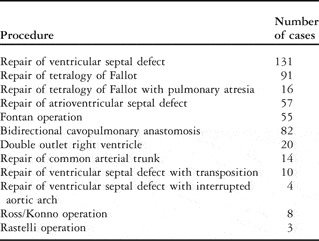
Over the period, we performed a total of 1193 operations, 1041 with cardiopulmonary bypass. Among these cases, there were 319 neonates and 433 infants. The median age of the population was 5.8 months, with a range from 0 days to 54 years, and with a median weight of 6.2 kilograms, the range being from 1 to 114 kilograms. The overall mortality was 2.5% with no deaths attributed to a bradyarrhythmia or tachyarrhythmia. The median postoperative length of stay was 6 days. A list of surgical procedures performed that are commonly associated with perioperative arrhythmias are reported in the Table 1.
Selected procedures.

Perioperative tachyarrhythmias included 2 patients with intraoperative atrial flutter (0.2%), 2 with postoperative atrial flutter, and 9 cases (0.8%) of postoperative junctional ectopic tachycardia requiring therapy. High grade atrioventricular block in 4 (0.3%), and sinus nodal dysfunction in 4 (0.3%), was identified prior to the conclusion of surgery, and these patients received temporary pacing wires.
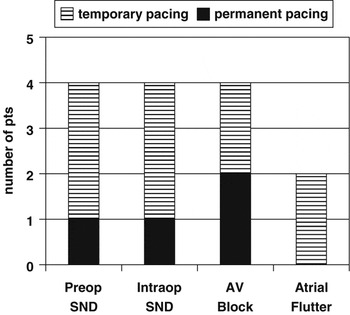
A total of 14 patients (1.2%) received temporary epicardial pacing wires during cardiac surgery. No patients required placement of temporary pacing wires following surgery. The indications for temporary pacing are presented in the Figure 1. None of the patients with postoperative junctional ectopic tachycardia had temporary pacing wires placed during surgery. All of theses cases were treated with intravenous amiodarone at a dose of 2 milligrams per kilogram per hour, to a maximum of 10 mg/kg, until an effective response was achieved, this being conversion to sinus rhythm or reduction of junctional rate with improved haemodynamics. Those patients with junctional ectopic tachycardia recovered without incident, and did not experience significant bradycardia or atrioventricular block. Among those who received temporary pacing wires, permanent pacing wires were subsequently placed in 2 patients with persistent sinus nodal dysfunction, and in 2 patients with persistent complete atrioventricular block. There were no complications related to the insertion, use, or removal of these temporary pacing wires.
Indications for temporary pacing wires. AV: atrioventricular; Intraop: intraoperative; Preop: preoperative; SND: sinus nodal dysfunction.

Discussion
The data presented demonstrates that the need for temporary pacing leads can be predicted preoperatively or intraoperatively. This practice avoids unnecessary exposure to the risks associated with these leads in patients who derive no benefit from their use.
In select patients, temporary pacing wires placed during open heart surgery are useful for the diagnosis and treatment of bradycardia and tachyarrhythmias. Atrial epicardial electrodes provide an atrial electrogram that may assist with establishing or confirming an arrhythmia suspected from standard electrocardiographic monitoring.Reference Waldo, MacLean, Cooper, Kouchoukos and Karp2, Reference Yabek, Akl, Berman, Neal and Dillon4 Bradyarrhythmias due to sinus nodal dysfunction or atrioventricular conduction block may be managed with temporary atrial and/or ventricular pacing.Reference Waldo, MacLean, Cooper, Kouchoukos and Karp2–Reference Yabek, Akl, Berman, Neal and Dillon4 Restoring atrioventricular synchrony with temporary atrial pacing is advocated as a strategy for the treatment of postoperative junctional ectopic tachycardia.Reference Walsh, Saul and Sholler14 Atrial flutter may be successfully treated with the brief administration of rapid atrial pacing.Reference Yabek, Akl, Berman, Neal and Dillon4 In the absence of specific abnormalities of rhythm, some centres utilize postoperative pacing in an effort to increase postoperative cardiac output through ventricular resynchronization.Reference Zimmerman, Starr, Koenig, Smith, Hijazi and Bacha15
The enthusiasm for universal placement of temporary atrial and ventricular pacing leads during cardiac surgery is tempered by reports of complications during their placement, removal, and retention. Bleeding and perforation have occurred during intraoperative placement and postoperative removal, resulting in cardiac tamponade and haemodynamic decompensation.Reference Del Nido and Goldman5, Reference Gal, Chaet and Novitzky7, Reference Dougenis, Dark and Gold10 Proarrhythmia has been reported due to temporary asynchronous pacing and lead removal.Reference Preisman and Cheng9, Reference Chung16, Reference Imren, Zor and Tasoglu17 Infection and reactions to the foreign bodies have been associated with retained pacing wires.Reference Gentry and Hassan8, Reference Kanoh, Ishikawa and Suzuki18 Unusual complications, including pacing wires ensnaring the heart and causing haemodynamic decompensation during attempted removal, have been reported in children.Reference Bolton and Mayer6
Selective placement of temporary pacing wires is described in adults, particularly after coronary arterial bypass grafting.Reference Puskas, Sharoni, Williams, Peterson, Duke and Guyton19 The results of our study demonstrate a marked decrease in the development of postoperative bradyarrhythmias and tachyarrhythmias after congenital cardiac surgery compared with previous reports in the literature. Improved surgical techniques, and better understanding of the disposition of the cardiac conduction system, has resulted in a dramatic decrease in the incidence of persistent postoperative atrioventricular block, from the early reports of around one-tenth of cases to more recent reports of 1 to 3%.Reference Lillehei, Sellers, Bonnabeau and Eliot1, Reference Weindling, Saul, Gamble, Mayer, Wessel and Walsh11 We found a total incidence of 0.3% of patients suffering transient or persistent atrioventricular block. The rare occurrence of tachyarrhythmias further supports the approach of selective placement of temporary pacing wires. The most common tachyarrhythmia that required intervention, junctional ectopic tachycardia, occurred in only 9 patients (0.8%), and was treated successfully with intravenous amiodarone without temporary pacing. Our strategy of treating these patients primarily with intravenous amiodarone limits our ability to determine whether atrial pacing would have affected their postoperative course.
This approach may be evaluated objectively by assessing outcome as it relates to arrhythmic mortality, overall mortality, and length of stay. The overall mortality of 2.5%, none of which were directly attributable to a primary arrhythmia, compares favourably to any of the other congenital cardiac centres currently dealing with large volumes of cases, as does the median length of stay of 6 days post surgery.Reference Welke, Shen and Ungerleider20
The limitations of our study include the retrospective nature of evaluation, which may result in incomplete capture of all postoperative arrhythmias. This possibility is less likely than traditional retrospective studies, due to the comprehensive evaluation provided by the web-enabled electronic medical records. Assessment of the value and utility of this approach is based on the experience and results in a single centre, and may not be generalized to other centres. Selective placement of temporary pacing wires in our centre is supported by the low incidence of postoperative arrhythmias and the ability to accurately diagnose and effectively treat those that occur. Multisite ventricular pacing was not used to manage states of low cardiac output, where anticipatory care using serial lactate measurements to assess end organ perfusion is routine.Reference Rossi, Khan, Hannan, Bolivar, Zaidenweber and Burke21 Preoperative, intraoperative and postoperative factors, including the experience and skills of the cardiac surgical and medical team, significantly impact on the incidence of arrhythmias and the outcomes for the patients. This is evident when comparing the incidence of junctional ectopic tachycardia (0.8%) in our series to recent reports by other experienced centres, with figures varying from 5.6% to 8%.Reference Delaney, Moltedo, Dziura, Kopf and Snyder12, Reference Hoffman, Bush and Wernovsky13, Reference Batra, Chun and Johnson22 Variability in the type and frequency of postoperative arrhythmias and heart block between institutions suggests that each institution should assess their individual incidence prior to adopting the selective approach for temporary placement of pacing wires. The low incidence of postoperative arrhythmias at our institution may be, at least in part, due to the experience and skill of the two paediatric cardiothoracic surgeons, and the lack of a surgical training programme. The presence of two full-time, experienced paediatric electrophysiologists on staff, one of whom is the medical director of the cardiac intensive care unit, further adds to the unique ability of our Institution to manage these patients.
The selective approach to placement of temporary epicardial pacing wires following congenital cardiac surgery is an acceptable strategy in our institution due to the diminished incidence of postoperative arrhythmias, and the ability accurately to predict those patients who will benefit. In programmes with highly experienced surgical and cardiac intensive care unit teams, the practice of routinely placing these wires on all patients who undergo congenital cardiac surgery may need to be reconsidered.