Introduction
Glyphosate-resistant (GR) cotton, introduced in 1997, was widely adopted because of the herbicide efficacy on a diverse spectrum of weed species postemergence, as well as the economic benefits of the herbicide system (Askew et al. Reference Askew, Bailey, Scott and Wilcut2002; Culpepper and York Reference Culpepper and York1998, Reference Culpepper and York1999a). However, the extensive use of GR cotton cultivars has placed intense herbicide selection pressure on certain weeds, resulting in resistance development in those species, ultimately limiting the utility of glyphosate for postemergence broadleaf weed control in cotton (Culpepper et al. Reference Culpepper, Grey, Vencill, Kichler, Webster, Brown, York, Davis and Hanna2006; Steckel et al. Reference Steckel, Main, Ellis and Mueller2008).
Glufosinate-resistant cotton was granted regulatory approval in 2003 and became commercially available in 2004 as LibertyLink® (LL) (Bayer CropScience, Research Triangle Park, NC) cultivars (CERA 2015; Gardner et al. Reference Gardner, York, Jordan and Monks2006). The development of glufosinate-resistant cotton was achieved by inserting the bar gene from the soil bacterium Streptomyces hygroscopicus using Agrobacterium tumefaciens (CERA 2015). The bar gene is responsible for expressing resistance to glufosinate through the enzyme phosphinothricin-acetyltransferase (pat), which acetylates glufosinate ammonium, transforming it to the inactive acetylated form, N-acetyl-L-phosphinothricin (CERA 2015; Devine et al. 1993; Hérouet et al. Reference Hérouet, Esdaile, Mallyon, Debruyne, Schulz, Currier, Hendrickx, Van Der Klis and Rouan2005; OECD 2002). Cotton that has the bar gene transformation has been shown to possess excellent tolerance to postemergence applications of glufosinate (Blair-Kerth et al. Reference Blair-Kerth, Dotray, Keeling, Gannaway, Oliver and Quisenberry2001). According to the manufacturer, glufosinate can be applied in broadcast, over-the-top applications to glufosinate-resistant cotton from emergence until early bloom (Anonymous 2017).
Glufosinate alone has been shown to be effective in controlling numerous weed species that are common in cotton cropping systems, such as velvetleaf (Abutilon theophrasti Medik.), common ragweed (Ambrosia artemisiifolia L.), and morningglory species (Ipomoea spp.) (Beyers et al. Reference Beyers, Smeda and Johnson2002; Culpepper and York Reference Culpepper and York1999b; Everman et al. Reference Everman, Burke, Allen, Collins and Wilcut2007). However, glufosinate is typically less effective in controlling grass species than broadleaves (Corbett et al. Reference Corbett, Askew, Thomas and Wilcut2004). Since the widespread occurrence of GR, weed control systems utilizing glufosinate-based systems have proved to be an effective alternative to glyphosate-based systems for postemergence weed control in cotton (Barnett et al. Reference Barnett, Culpepper, York and Steckel2013; Culpepper et al. Reference Culpepper, York, Roberts and Whitaker2009; Gardner et al. Reference Gardner, York, Jordan and Monks2006; Whitaker et al. Reference Whitaker, York, Jordan and Culpepper2011a).
WidestrikeTM (WS) cotton (DowDuPont, Wilmington, DE) was developed to confer resistance to lepidopteran pests (CERA 2015; Culpepper et al. Reference Culpepper, York, Roberts and Whitaker2009). During the breeding process the bar gene was inserted as a marker to determine the presence of the insecticidal proteins, thereby conferring some resistance to glufosinate. Because the pat gene was used only as a marker in the breeding process, the level of activity of pat is lower in WideStrike cultivars compared to LibertyLink cultivars (OECD 2002; Tan et al. Reference Tan, Evans and Singh2006). Crossing of WideStrike cultivars with glyphosate-resistant cotton cultivars has produced cultivars that are resistant to both glyphosate and glufosinate, giving producers more flexibility in postemergence weed management strategies (Steckel et al. Reference Steckel, Stephenson, Bond, Stewart, Barnett, Steckel and Barnett2012).
One to two postemergence applications of glufosinate to WideStrike cotton have been documented to cause visible plant injury ranging from 5% to 25% without having a negative effect on yield (Culpepper et al. Reference Culpepper, York, Roberts and Whitaker2009; Dodds et al. Reference Dodds, Main, Thomas Barber, Burmester, Collins, Edmisten, Stephenson, Whitaker and Boykin2015; Whitaker et al. Reference Whitaker, York, Jordan and Culpepper2011a). Three applications of glufosinate to WideStrike cotton, however, have been shown to reduce yield up to 7% (Barnett et al. Reference Barnett, Culpepper, York and Steckel2015). Glufosinate applications in combination with other herbicides have also been shown to delay cotton maturity and reduce yield (Steckel et al. Reference Steckel, Stephenson, Bond, Stewart, Barnett, Steckel and Barnett2012). The glufosinate rate applied influences the degree of visible cotton injury as well as yield, with rates higher than the standard 0.6 kg ha−1 tending to cause more injury. Glufosinate applied at 1.2 kg ha−1 to WideStrike cotton has proved to delay plant maturity as well as reduce cotton yield (Dodds et al. Reference Dodds, Main, Thomas Barber, Burmester, Collins, Edmisten, Stephenson, Whitaker and Boykin2015).
Dicamba herbicide is classified to have an auxin-mimicking mode of action (MOA) that has long been used for burndown applications prior to planting as well within season for dicotyledenous weed control in grain crops such as corn (Zea mays L.), grain sorghum [Sorghum bicolor (L.) Moench], and wheat (Triticum aestivum L.) (Mithila et al. Reference Mithila, Hall, Johnson, Kelley and Riechers2011).
Cotton cultivars resistant to the auxin herbicide dicamba (DT) were brought to market in 2015 (USDA-APHIS 2015). DT cotton was attained through the insertion of the dicamba monooxygenase (dmo) gene, isolated from Stenotrophomonas maltophilia, which transfers dicamba from the active form to the inactive 3,6-dichlorosalicylic acid and formaldehyde compounds (Behrens et al. Reference Behrens, Mutlu, Chakraborty, Dumitru, Jiang, LaVallee, Herman, Clemente and Weeks2007). In addition to DT, cultivars resistant to dicamba are also stacked with resistance traits conferring resistance to glufosinate, through the insertion of the bar gene, expressing the pat enzyme (event MON88701). This cotton cultivar was further crossed with a cotton cultivar resistant to the herbicide glyphosate, resulting in a cultivar resistant to three different MOAs (MON88701 by MON88913; known as Bollgard II® XtendFlex™ (DT) (XtendFlex); (ISAAA 2015).
Dicamba is effective at controlling numerous broadleaf weed species, including troublesome species and species resistant to other herbicides, including GR horseweed [Conyza canadensis (L.) Cronq.], GR Palmer amaranth [Amaranthus palmeri (S.) Watson.], acetolactate synthase–resistant Palmer amaranth, and Ipomoea spp. (Cahoon et al. Reference Cahoon, York, Jordan, Everman, Seagroves, Culpepper and Eure2015; Eubank et al. Reference Eubank, Poston, Nandula, Koger, Shaw and Reynolds2008; Joseph et al. Reference Joseph, Marshall, Sanders and Joseph2012; Montgomery et al. Reference Montgomery, Treadway, Reeves and Steckel2017; Steckel et al. Reference Steckel, Craig and Hayes2006). Mixing dicamba with glyphosate or glufosinate has resulted in increased control of GR weed species compared to single-herbicide applications (Byker et al. Reference Byker, Soltani, Robinson, Tardif, Lawton and Sikkema2013; Cahoon et al. Reference Cahoon, York, Jordan, Everman, Seagroves, Culpepper and Eure2015; Vann et al. Reference Vann, York, Cahoon, Buck, Askew and Seagroves2017).
Certain environmental conditions as well as application factors can influence the behavior of dicamba. Conditions such as high wind speed can cause dicamba droplets to drift off target, possibly causing damage to nearby sensitive crops (Everitt and Keeling Reference Everitt and Keeling2009). Emphasis must be placed on correct nozzle selection (ie, nozzles producing coarse to ultra-coarse droplets) so as to prevent off-target movement of dicamba with DT cotton.
Overlapping residual, soil-applied herbicides applied throughout the growing season are recommended for effective weed control in cotton (Tredaway Reference Tredaway2017). S-metolachlor is an herbicide in the chloroacetamide family (Senseman Reference Senseman2007). S-metolachlor has been shown to effectively control many troublesome weeds, such as Palmer amaranth when applied preemergence (Geier et al. Reference Geier, Stahlman and Frihauf2006; Steele et al. Reference Steele, Porpiglia and Chandler2005). Although postemergence applications of S-metolachlor does not provide any control of emerged weeds, the residual control provided is beneficial in cotton production systems (Clewis et al. Reference Clewis, Wilcut and Porterfield2006; Whitaker et al. Reference Whitaker, York, Jordan and Culpepper2011a, 2011b). However, postemergence applications of S-metolachlor to cotton typically results in minor crop injury such as necrotic speckling on leaf tissue, although cotton injury can be more severe if cotton is environmentally stressed (Clewis et al. Reference Clewis, Wilcut and Porterfield2006; Tredaway Reference Tredaway2017).
Droplet size has been shown to have a major impact on the drift potential of herbicide applications (Mueller and Womac Reference Mueller and Womac1997; Whisenant et al. Reference Whisenant, Bouse, Crane and Bovey1993; Yates et al. Reference Yates, Cowden and Akesson1985). Other than environmental factors such as wind speed and direction, as well as application speed and terrain type, nozzle type has a great effect on the overall droplet spectrum, as it influences spray deposition and pesticide drift (Taylor et al. Reference Taylor, Womac, Miller and Taylor2004). Generally, droplet size ranges from 10 μm to greater than 1,000 μm (Bouse et al. Reference Bouse, Kirk and Bode1990). Droplets with a diameter of 200 μm or less are considered “driftable fines” (Etheridge et al. Reference Etheridge, Womac and Mueller1999; Yates et al. Reference Yates, Cowden and Akesson1985). Herbicide efficacy has been shown to increase with decreasing droplet size, more so in grass species than broadleaves (Etheridge et al. Reference Etheridge, Hart, Hayes and Mueller2001; Knoche Reference Knoche1994). A flatfan nozzle, standard for most agricultural operations, produced droplets in the range of 200 to 300 μm, whereas newer nozzles are designed to produce larger droplets (in the range of 300 to 500 μm) and therefore sprays with reduced drift potential.
Little is known, however, about the effect that nozzle type, and therefore droplet size, has on foliar injury symptoms such as leaf necrosis caused by postemergence applications of glufosinate and glufosinate applied with S-metolachlor on the new XtendFlex cultivar compared to WideStrike and LibertyLink systems. The objective of this research is to evaluate cotton response to glufosinate applied with and without S-metolachlor, across LibertyLink, WideStrike, and XtendFlex cotton cultivars using a traditional flatfan nozzle and a low-drift nozzle.
Materials and Methods
Field experiments were conducted in 2016 and 2017 at the Alabama Agricultural Experiment Station Prattville Agricultural Research Unit in Prattville, AL (32.43° N, 86.44° W). The soil type is a Lucedale fine sandy loam (fine-loamy, siliceous, subactive, thermic Rhodic Paleudult) with a pH of 6.2 and 1.5% organic matter. Three cotton cultivars were planted on May 9, 2016 and May 15, 2017 at a rate of 7 to 10 seed m−1 row. Plot size was four 91-cm rows by 7.7 m long. Agronomic practices such as fertilization, insect management, growth regulators, and harvest aids were followed using Auburn University and Alabama Cooperative Extension Service recommendations. Herbicide treatments were applied using a CO2-pressurized backpack sprayer with four nozzles calibrated to deliver 140 L ha−1 at 262 kPA and 4.83 km h−1. Boom width was 1.9 m with 48 cm nozzle spacing. Treatments were applied over the two center rows, leaving a nontreated check on each side of the plot.
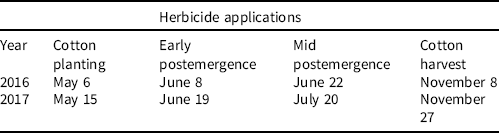
Three cotton cultivars with varying herbicide resistance traits were planted in both years. Cultivars planted were Stoneville ‘ST 4848’ (Bayer CropScience, Research Triangle Park, NC), a LibertyLink cultivar; ‘Phytogen 333’ (Dow Agrosciences, Indianapolis, IN), a WideStrike cultivar; and ‘Americot NG3406 B2XF’ (Americot, Inc., Lubbock, TX), an XtendFlex cultivar. Herbicide treatments consisted of either glufosinate (Liberty® 280 SL herbicide; Bayer CropScience, Research Triangle Park, NC) applied alone at 0.59 kg ha−1 or glufosinate applied at 0.59 kg ha−1 in combination with S-metolachlor (Dual Magnum®; Syngenta, Greensboro, NC) applied at 1.39 kg ha−1 applied with two nozzles types. A 110015 Turbo TeeJet Induction (TTI)® nozzle (TeeJet Technologies, Glendale Heights, IL) induction nozzle producing ultra-coarse droplets, or an 110015 extended-range (XR) flatfan nozzle (TeeJet Technologies, Glendale Heights, IL) producing fine droplets were used to apply to four-leaf and eight-leaf cotton. The trial was maintained weed free through methods similar to Dodds et al. (Reference Dodds, Main, Thomas Barber, Burmester, Collins, Edmisten, Stephenson, Whitaker and Boykin2015) by the use of preemergence herbicides and hand weeding. The center two rows of each four-row plot were harvested using a spindle picker modified for small-plot harvesting. Dates of cotton planting, herbicide applications, and cotton harvest are presented in Table 1.
Cotton planting, herbicide application and cotton harvest dates.

Visual evaluations were made on a scale of 0 to 100% with 0 = no crop injury, 100% = crop death (Frans et al. Reference Frans, Talbert, Marx, Crowley and Camper1986). Cotton injury was assessed 7 and 14 d after herbicide treatments (DAT). A randomized complete-block design with a factorial treatment arrangement was utilized with four replications. Treatment factors included a main treatment effect of cotton cultivar, a secondary effect of herbicide regime, and a third effect of nozzle type. Treatment effects were determined using ANOVA (R Core Team 2015) to test for main effects and all interactions. Statistical analysis was conducted using the methodology described by Crawley (Reference Crawley2013). Cotton cultivar, herbicide treatment, and nozzle type were considered fixed effects. Years, replications (nested within years), and all interactions of these effects were considered random (Blouin et al. Reference Blouin, Webster and Bond2011). Considering year as an environmental, or random effect, allows inferences about treatments to be made over a range of environments (Blouin et al. Reference Blouin, Webster and Bond2011; Carmer et al. Reference Carmer, Nyquist and Walker1989). A similar statistical approach has been used by several researchers using a factorial arrangement of treatments in a randomized complete-block design (Bond et al. Reference Bond, Walker, Ottis and Harrell2008; Dodds et al. Reference Dodds, Reynolds, Huff and Irby2010; Ottis et al. Reference Ottis, Barr, Mccauley and Chandler2004; Walker et al. Reference Walker, Martin and Gerard2006; Zhang et al. Reference Zhang, Webster and Leon2005). Multiple pairwise comparisons between treatments were performed using the “multcompView” package in R (Graves et al. Reference Graves, Hans-Peter, Selzer and Doraj-Raj2015). Each visible-injury rating, as well as yield, were evaluated separately, and means were separated using Fisher’s protected LSD at P ≤ 0.05.
End-of-season cotton mapping was performed in 2016 using the methods described by Jenkins and McCarty (Reference Jenkins and McCarty1995) to determine the contribution of each fruiting site on the plant to overall yield. However, no differences were observed; therefore, results are not included.
Results and Discussion
Cotton injury and yield differed by year; therefore, cotton injury as well as yield were analyzed separately for 2016 and 2017. As there were interactions between cultivar, herbicide combination, and nozzle type, interactions of main effects are presented.
Visual Estimates of Injury—2016
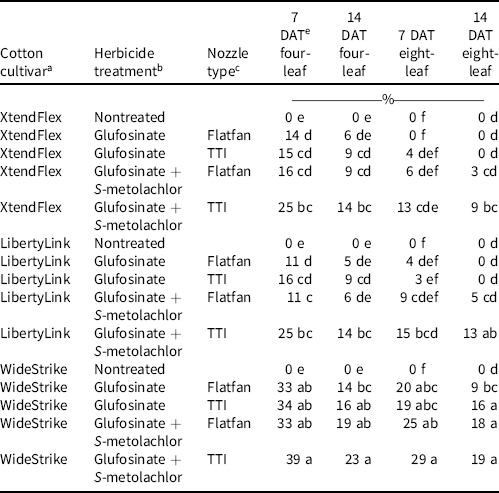
Within each cultivar, crop response to glufosinate alone was not influenced by nozzle type following applications to four-leaf or eight-leaf cotton. However, cotton cultivar influenced the level of crop response observed (Table 2). WideStrike cultivar response following application of glufosinate alone or glufosinate plus S-metolachlor to four-leaf or eight-leaf cotton was greater than DT and LL cultivars.
2016 Cotton cultivar injury to applications of glufosinate and glufosinate applied with S-metolachlor using two nozzle types to four-leaf and eight-leaf cotton.

a XtendFlex cultivar used was ‘Americot NG 3406B2XF’; LibertyLink cultivar used was ‘Stoneville 4848 GLT’; WideStrike cultivar used was ‘Phytogen 333 WRF’.
b All treatments containing glufosinate used the product Liberty; treatments containing S-metolachlor used the product Dual Magnum.
c Flatfan indicates TeeJet XR 110015 nozzle; TTI indicates Turbo TeeJet Induction nozzle.
d Means followed by the same letter within a column are not statistically different according to Fisher’s protected LSD test at P ≤ 0.05.
e Abbreviations: DAT, days after treatment.
Nozzle selection influenced crop response when considering postemergence treatment and application timing. DT cotton response at 7 DAT to glufosinate applied alone using flatfan nozzles cause 14% more injury when applied to four-leaf cotton than when applied to eight-leaf cotton. LL cotton response at 14 DAT to glufosinate applied alone using TTI nozzles caused 13% more injury when applied to four-leaf cotton than when applied to eight-leaf cotton. Crop response to glufosinate + S-metolachlor applied to four- or eight-leaf cotton was not influenced by nozzle selection at 7 DAT. However, at 14 DAT glufosinate + S-metolachlor applied to four-leaf cotton using a TTI nozzle caused 8% more injury than application using a flatfan nozzle in LL cotton.
Crop response was not observed at 14 DAT following glufosinate alone applied to eight-leaf DT or LL cotton. However, crop injury in WideStrike cotton using flatfan or TTI nozzles was 9% and 16%, respectively
Differences between nozzles may be due to a higher concentration of herbicide per droplet when droplet size is larger (McKinlay et al Reference McKinlay, Brandt, Morse and Ashford1972). Differences between application timing are perhaps due to the more mature eight-leaf cotton having greater energy reserves, therefore allowing the plants to compensate for the injury caused by the herbicide.
Visual Estimates of Injury—2017
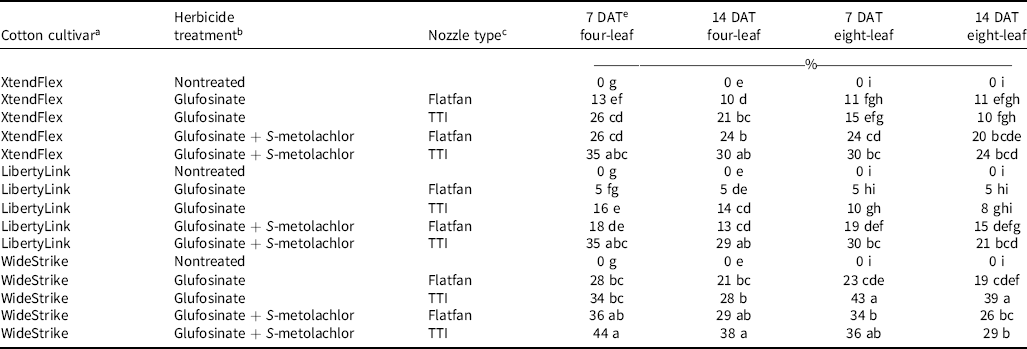
Within cotton cultivar, crop injury to glufosinate alone was greater with TTI nozzles when applied to four-leaf DT and LL cotton 7 DAT (Table 3). However, at 14 DAT there were no differences between nozzle types when glufosinate was applied alone.
2017 Cotton cultivar injury to applications of glufosinate and glufosinate applied with S-metolachlor using two nozzle types to four-leaf and eight-leaf cotton.

a XtendFlex cultivar used was ‘Americot NG 3406B2XF’; LibertyLink cultivar used was ‘Stoneville 4848 GLT’; WideStrike cultivar used was ‘Phytogen 333 WRF’.
b All treatments containing glufosinate used the product Liberty; treatments containing S-metolachlor used the product Dual Magnum.
c Flatfan indicates TeeJet XR 110015 nozzle; TTI indicates Turbo TeeJet Induction nozzle.
d Means followed by the same letter within a column are not statistically different according to Fisher’s protected LSD test at P ≤ 0.05.
e Abbreviations: DAT, days after treatment.
Nozzle selection influenced crop response when considering postemergence treatment and application timing. DT cotton injury to glufosinate applied alone at 14 DAT was 11% higher when applications were made to four-leaf cotton compared to eight-leaf cotton. Crop injury 7 DAT to glufosinate + S-metolachlor applied to four- and eight-leaf LL cotton resulted in 17% and 11% higher injury with TTI nozzles, respectively. Crop injury 14 DAT to glufosinate applied alone was 20% higher in WideStrike cotton when TTI nozzles were used. Glufosinate applied alone with a flatfan nozzle to WideStrike cotton resulted in 19% injury, the lowest for all herbicide treatments made to WideStrike cotton. There were no differences in WideStrike cotton injury between nozzle types for glufosinate + S-metolachlor.
Higher injury is observed when glufosinate is applied with S-metolachlor using a TTI nozzle, suggesting that although it does not affect yields, this particular treatment leads to greater crop injury. This suggests that overall herbicide concentration on a surface is increased with increasing droplet size, even though the droplet density may be decreased. Previous work by (Ferguson et al. Reference Ferguson, Hewitt, O’Donnell and Kruger2020) demonstrates this by explaining how traditional image analysis, historically used to determine spray coverage, measures spray distribution in only two dimensions; thus whereas spray droplet density may be lower for coarser-spraying nozzles, the overall percent coverage can be higher. The suggestion here is that concentration of herbicide per droplet is increased with larger droplets, leading to the larger necrotic speckling and higher visible injury trend with TTI nozzles.
Differences between years may be due to overall difference between performance of the cotton cultivars in different years. Certain environmental conditions present could affect the cotton cultivars in different ways, affecting the response to herbicide treatment.
Seed Cotton Yield
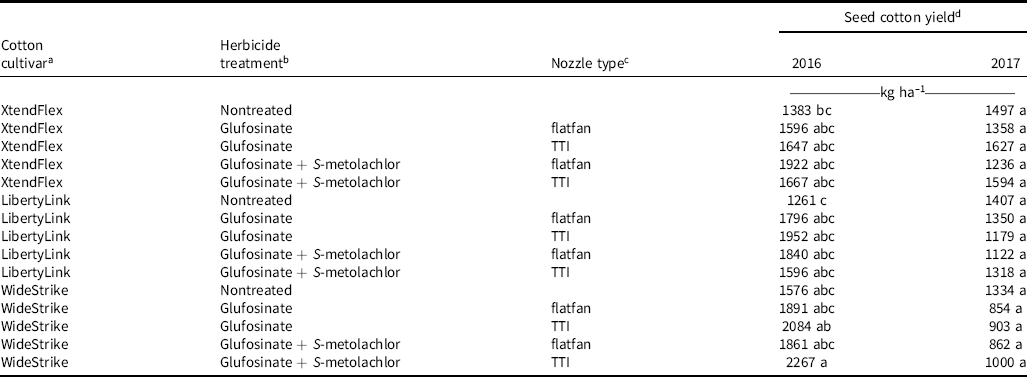
There were no differences in yield within each cotton cultivar in 2016 (Table 4). When all herbicide treatments, across all three cotton cultivars were compared, there were few differences. WideStrike cotton treated with glufosinate and S-metolachlor using a TTI nozzle had higher yields than nontreated LibertyLink cotton, as well as nontreated XtendFlex cotton. WideStrike cotton treated with glufosinate with TTI nozzles yielded better than the LibertyLink nontreated. In 2017 there were no differences in seed cotton yield within cultivars, as well as across cotton cultivars.
Seed cotton yield for 2016 and 2017 following applications of glufosinate and glufosinate applied with S-metolachlor using two nozzle types.

a XtendFlex cultivar used was ‘Americot NG 3406B2XF’; LibertyLink cultivar used was ‘Stoneville 4848 GLT’; WideStrike cultivar used was ‘Phytogen 333 WRF’.
b All treatments containing glufosinate used the product Liberty; treatments containing S-metolachlor used the product Dual Magnum.
c Flatfan indicates TeeJet XR 110015 nozzle; TTI indicates Turbo TeeJet Induction nozzle.
d Means followed by the same letter within a column are not statistically different according to Fisher’s protected LSD test at P ≤ 0.05.
The results of this study support previous research that WideStrike cotton is more sensitive to postemergence applications of glufosinate, compared to other cotton cultivars such as LibertyLink (Marten and Jordan Reference Marten and Jordan1979). Additionally, this study supports previous research that tank mixtures of S-metolachlor with glufosinate can result in greater injury than glufosinate applied alone (Dodds et al. Reference Dodds, Main, Thomas Barber, Burmester, Collins, Edmisten, Stephenson, Whitaker and Boykin2015). According to this research, nozzle type does not have a significant effect on visible crop injury when comparing identical treatments within cultivars in most comparisons.
Cotton yield was not affected by herbicide treatment in this study, supporting previous research suggesting that applications of glufosinate can be applied to WideStrike cotton without reducing yield (Steckel et al. Reference Steckel, Stephenson, Bond, Stewart, Barnett, Steckel and Barnett2012). However, because of the occurrence of greater visible injury, cotton plants may be more susceptible to stressors such as unfavorable growing conditions, which could lead to possible yield reductions. The risk of injury may deter producers from making applications if levels of visible injury are deemed unacceptable.
This research supports research suggesting that glufosinate can be applied with S-metolachlor to WideStrike cotton without reducing yield (Dodds et al. Reference Dodds, Main, Thomas Barber, Burmester, Collins, Edmisten, Stephenson, Whitaker and Boykin2015); this result differs from the results of others who reported a yield reduction (Culpepper et al. Reference Culpepper, York, Roberts and Whitaker2009).
Acknowledgments
Thanks to the Alabama Cotton Commission for funding this research. No conflicts of interest have been declared.