Introduction
Nothing better encapsulated the liminal state of farm workers in eighteenth- and early nineteenth-century England than their difficult relationship with animals. Cattle, pigs and sheep, amongst other livestock, and working animals like dogs, horses and oxen were at once workers’ charges, companions and co-workers. Such animals were cosseted capital yet bare fleshy life, friends yet constant reminders of the reduced material and bodily state of the rural worker. When dogs were enrolled to, in the words of one Swing riots activist, ‘bark at beggars’,Footnote 2 when prize stallions were lavished with expensive food and treatments, and when tenderness was shown, and was expected to be shown, to new-born lambs, the brute state of many rural workers was thrown into stark contrast. This wretched irony was further heightened by the fact that farm workers were hired as the agents of capital, to labour and give care to animals while they personally suffered.
This picture is inevitably painted with a broad brush, for not all farm workers were degraded to the state of, in the words of a Dorset magistrate, ‘parish slaves’.Footnote 3 Some farmers took pains to look after their ‘best’ workers, while, whatever the outcome, many parish relief regimes were based on humane intentions. But the point holds. The logic of agrarian capitalism meant that the relationship between rural workers and animals was necessarily ambivalent. And yet despite the fact that the lives of farm workers and animals were necessarily intertwined, work in rural history has tended to be driven by political economy perspectives that render animals as forms of capital, blood lines and pedigrees, figures on farm ledgers, ‘deadstock’, fleshy machines in the grand narratives of agricultural improvement, as productive things, or as vermin.Footnote 4
There are, however, important exceptions to this trend, most notably John Archer's and the late Timothy Shakesheff's examinations of animal maiming in early to mid nineteenth-century East Anglia and Herefordshire respectively.Footnote 5 But these studies are predicated on attempts to understand animal maiming as a protest practice rather than for what it tells us about the relationship between rural workers and animals. Moving beyond that perspective, it is the contention of this paper not only that animal maiming was an important expression of conflict, but also that it tells us much about a rural England that has been relatively understudied.Footnote 6 This paper therefore also represents part of a broader effort to think through our rural pasts from a more than human perspective. It is an attempt to write rural histories in which rural cultures are not framed exclusively by what can be broadly defined as social relations, but rather by the relations between all things: the rulers of rural England, rural workers, trees and crops, animals, machines, and so on.Footnote 7 This is, it is important to state, not to deprecate work on animals from a political economy perspective or research that foregrounds the social. Rather, inspired by broader trends in sociology and cultural geography, this paper offers a different perspective that builds upon more established approaches in rural history in thinking through, after Bruno Latour, how we might ‘reassemble the social’.Footnote 8 Indeed, in being attentive to human-animal relations, this paper argues, we can understand how rural social relations, not least between employers and workers, were often framed through differential relations with animals. This project is given further philosophical and political import because in ‘elite’ political discourses rural workers and animals were often equated, the poorest members of society depersonalised. In the words of Sir Thomas Pope Blunt in 1693, ‘it is only by favour of a metaphor we call [the mass of the population] men, for at best they are but Descartes's automata, moving frames and figures of men’. As Keith Thomas notes, the ethic of human dominion over animals served to ‘legitimise the ill-treatment of those humans who were in a supposedly animal condition’.Footnote 9
What follows is based on an analysis of 366 episodes of animal maiming recorded in the provincial and national press, legal records, and Home Office correspondence in southern England between 1750 and 1850, although the majority of the cases come from the counties of Dorset, Hampshire, Kent, Somerset, Sussex and Wiltshire for the period 1790 to 1850. Before analysing these sample episodes, the paper offers a more detailed reading of the ways animals have been inscribed in rural history. The analysis starts with a short methodological statement, paying particular attention to the difficulties of reading rural worker-animal relations in the archive of animal maiming episodes. It also asks what, and whose, animals were maimed; who were the individuals who maimed animals; and whether there was any geography to the resort to animal maiming. The following section starts with a consideration of the ways in which maiming was a form of symbolic violence enacted against animals, their bodies attacked as proxies for their owners as well as statements against the maltreatment of rural workers. It then goes on to consider forms of disfigurement and acts that subverted the care given to animals. Before concluding, the paper ends with a short consideration of attacks that do not appear to be politically motivated but instead targeted the agency of the animal.
Writing human-animal relations
Keith Thomas’ Man and the Natural World was lauded on publication in 1983 as a critical turning point in our understanding of the place of fauna and flora in human worlds. In some ways, however, it represented a cul-de-sac in the historiography of human-animal relations.Footnote 10 As Malcolm Chase related in this journal in 1992, Thomas’ book ‘radically changed perceptions of the relationship between humankind and nature in past time’ but ‘[British] historical scholarship has remained largely impervious to “green” issues’. In a call to arms, Chase notes that:
Rural history is well-placed to assist in initiating and developing the ‘greening’ of English social history. What is required is essentially a further extension of that conceptual and methodological cross-fertilisation which has been a prime objective and consistent theme in this journal. Footnote 11
Twenty years later, works on rural environmental histories have begun to assume increased importance.Footnote 12 The same is true for works on early modern philosophical and theological conceptions of what separated humans and animals,Footnote 13 and the ‘rise’ of human concerns with animal welfare in the modern age.Footnote 14 Yet historical research on the human-animal relations in the countryside which were central to Thomas’ thesis remains conspicuous by its relative absence.
In rural history this lacuna is particularly striking. A systematic reading of the archives for those journals explicitly focused on the history of the countryside, Rural History and the Agricultural History Review, since the publication of Thomas’ classic confirms the point. Back issues of this journal show the relative paucity of studies wherein animals have been the avowed focus of analysis. Studies of the cultures of hunting and poaching, of animals in sport and recreation, and of increasing concern for animal welfare are represented but not analyses of rural workers and animals. Interestingly, the majority of these animal-focused papers have been published in the past ten years.Footnote 15 The agricultural emphasis of the latter journal has long made it an intellectual home for studies of farm animals and this plays out in the significant list of papers published in the last three decades. Studies of changing pastoral practices, livestock breeding, animal disease, sheep stealing, vermin and pests, poaching, and Archer's study of animal maiming in East Anglia have played an important role, but, again, papers exploring the relationship between rural workers and animals are not in evidence.Footnote 16
Work on animal maiming has also shown the value of paying serious scholarly attention to animals from beyond the political economy perspective, not least in demonstrating how analysing rural worker-animal relations affords a richer understanding of the fabric of rural culture. Archer focuses on animal maiming in Cambridgeshire, Norfolk and Suffolk between 1815 and 1870, claiming that maiming was ‘a regular, albeit infrequent, East Anglian speciality [from] the mid to late 1820s’. Shakesheff extended the analysis to the very different rural and agricultural context of Herefordshire. Here, cases of maiming may have been relatively few, with Shakesheff recording twenty-one cases between 1800 and 1860 compared to Archer's 176 between 1830 and 1870,Footnote 17 but the same complex dynamics pertained. The archives probably under report the occurrence but it is clear that rural workers occasionally attacked and maimed a variety of different animals. Moreover, as I have shown, these acts can be read as part of the wider spectrum of abuse and violence that encompassed both human and animal forms of bodily violation.Footnote 18
Animal maiming in Ireland has received a little more in the way of scholarly attention. The ‘Houghers’ are synonymous with animal maiming in Ireland and Sean Connelly's studies of their movement in 1711–12 and of the Whiteboy movement starting in the 1760s have done much to extend knowledge of the practice. For the Whiteboys animal maiming was a key expression of conflict and during both these movements thousands of sheep and cattle belonging to graziers were destroyed in response to ‘the extension of more commercialised forms of agriculture and the disruption of existing tenurial relations’ in the shift towards pastoralism. But whereas the Whiteboys were drawn almost exclusively from the labourers, small farmers and tradesmen, the earlier Houghers operated with the ‘connivance’ and active participation ‘of persons drawn from higher social levels’.Footnote 19 More recently, James Patterson's analysis of the role of houghing in the aftermath of the ‘Great Rebellion’ of 1798 has shown that the practice persisted in what can be broadly defined as tenurial disputes. Moreover, the scale of destruction in 1798–9 was no less dramatic: victims of animal maiming were awarded compensation of £12,800 at the County Galway Lent Assizes in 1799. David Featherstone in his revisionist study of Whiteboyism has also asserted that houghing represented a ‘subaltern political ecology’ of the poor, the graziers’ cattle and sheep being the active agents, and hence enemies, in the ecological transformation of swathes of rural Ireland from petty production to depopulating pastoralism.Footnote 20
In an English context, beyond Archer and Shakesheff's work on animal maiming, the dearth of other studies that analyse the relationship between rural workers and animals is particularly striking. Indeed, Stephen Caunce's pioneering oral history of East Yorkshire ‘horselads’, a study that powerfully attests to the close bond that those who worked and lived with horses developed with their equine charges, is notable for being an exception.Footnote 21 The paucity of studies is perhaps best shown by the absence of consideration of this relationship from ‘survey’ texts of the history of the early modern and modern English countryside. The exception is Jeremy Burchardt's Paradise Lost which acknowledges the dramatic effect that post-1945 mechanisation had on the relationship between farm workers and animals. In the nineteenth and early twentieth centuries, Burchardt notes, farm work for many individuals was intimately tied up with animals. Shepherds lived for parts of the year among their sheep, and were often inseparable from their dogs; horsemen took huge pride in the condition of ‘their’ horses; milkmaids shared a tactile symbiotic relationship with the cows they milked; while pigs were often treated like members of the family by labouring households.Footnote 22
This gap in our historical knowledge can perhaps be read as a function of broader historiographical trends. Environmental history remains a sub-discipline that is far stronger in the United States than elsewhere, notwithstanding a recent upsurge in Britain and Ireland. In part this is a consequence of its intellectual roots being firmly planted in a distinctly American concern with the idea of ‘wilderness’ and its destruction by settlers. It is also a sub-discipline with an already well-defined set of canonical concerns, such as the loss of the ‘wild’, degradation, pollution, and speciation, in which agriculture is already written into established narratives of the loss of biodiversity and human responses to environmental and climatic change.Footnote 23 It could also be attributed to the fact that the ‘material turn’ has hitherto been played out most loudly in other historical contexts, not least in studies of consumption and domesticity.Footnote 24 Outside the disciplinary confines of history, the gap is less evident. Examinations of rural human-animal relations have, for instance, long been central to archaeological and anthropological research.Footnote 25 In the past fifteen years or so, cultural theorists, geographers and sociologists have also increasingly attempted to write animals into their studies, with concepts such as ‘hybridity’ and the more than human gaining considerable intellectual traction.Footnote 26
None of this is to argue that historians have ignored the culture of human-animal relations. Harriet Ritvo's pioneering study of changing human understandings, and social enrolments, of animals in nineteenth-century England demonstrate how domestic, farm, work and wild animals were framed by a complex blend of sentiment, pride and political economy. Beyond any of these considerations, Ritvo's analyses most strikingly suggest that animals were increasingly mobilised as symbols of identity and status.Footnote 27 Recent studies of the culture of hunting in early modern and modern Britain have also been attentive to the relationship between the hunter and the hunted, although this was necessarily an even more unequal bond than that between farmhands and farm animals.Footnote 28 Alun Howkins and Linda Merricks’ analysis of reactions to live animal exports also marks a notable exception to this general trend in rural history, if focused on middle-class opinion and the very recent past.Footnote 29 Erica Fudge's several studies of early modern England have also done much to increase our understanding of the contradiction between, on the one hand, attempts to assert the biological superiority of humans over animals and, on the other, the fact that animals in a variety of contexts were still ascribed capabilities beyond the provision of food and labour.Footnote 30 Serpell's landmark In the Company of Animals also remains a yardstick for understanding the deeper, global history of the relations between humans and animals.Footnote 31 Nor should we forget several recent studies of the ways in which livestock and their products inscribed urban space and urban social relations through practices such as pig and poultry keeping and through the provision of dedicated spaces and technologies for the rendering of animal products. Such practices and provisions, as Richie Nimmo notes, brought humans and animals together, yet continued to be a critical way in which the animal was used to define human distinctiveness and superiority.Footnote 32
Work on human-animal relations has clearly assumed an increased importance in historical research since the publication of Man and the Natural World, but the relationship between animals and those who worked closely with them remains little understood. This paper starts to think through the relationship from the particular perspective of animal maiming.
Understanding animal maiming: the sample
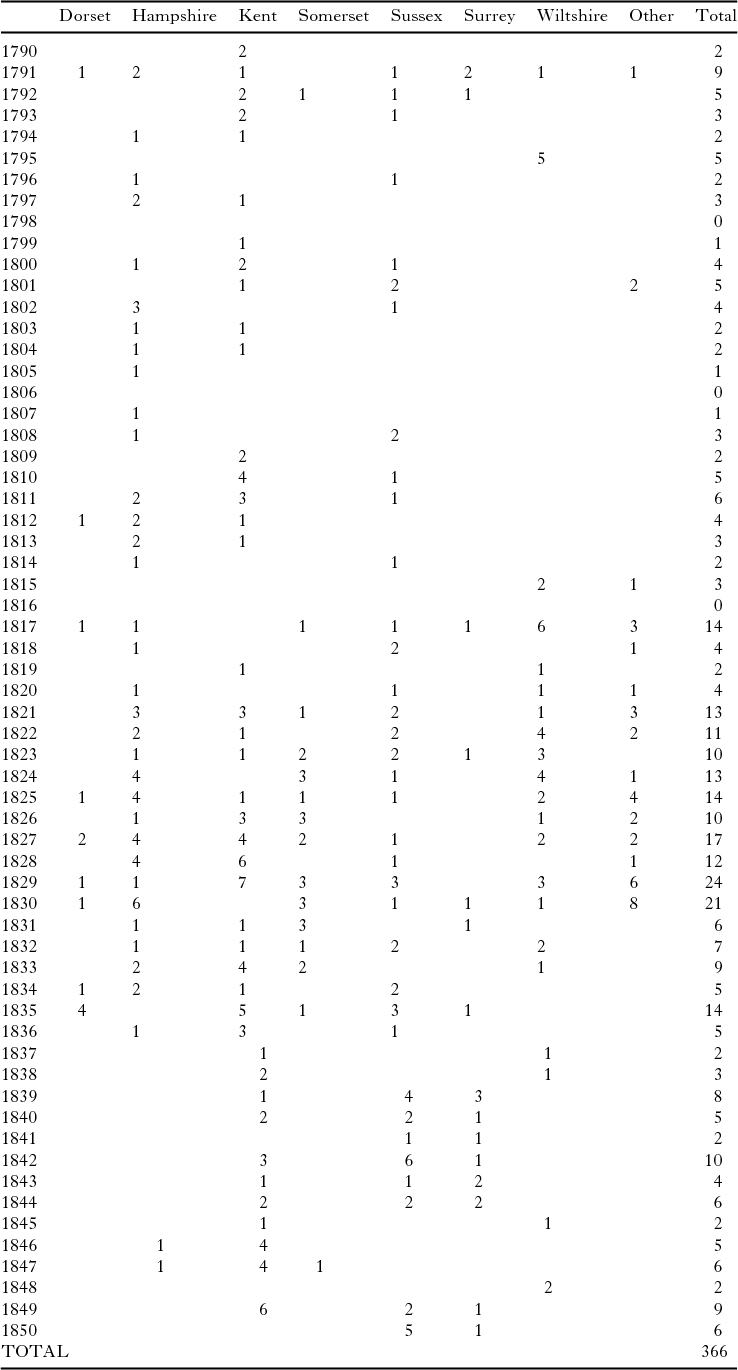
The ensuing analysis is based on a sample of 366 separate episodes (see table 1). I use the word episodes deliberately as in many of the cases several animals were attacked, usually of the same species, but sometimes involving multiple species. The episodes are drawn from the counties of southern England, primarily Dorset, Hampshire, Kent, Somerset, Sussex, Surrey, and Wiltshire, but with further episodes from Berkshire, Buckinghamshire, Devon, Gloucestershire, Middlesex, Oxfordshire, for the period 1790 to 1850. The sample is drawn from reports in the provincial and national press, court records, and correspondence with the Home Office, the first category being by far the most important source. While this is the largest sample of animal maiming cases studied, Archer's study being based on 222 cases, Shakesheff's 26,Footnote 33 it is important to note that it does not represent a perfect geographical coverage of the area. There are gaps in the coverage. Surrey was without a provincial press until the late 1830s, and much of Dorset was similarly ill served until the early 1820s and this means that it is not meaningful to map the resort to animal maiming. Besides, as with incendiarism and plant maiming, we cannot assume that episodes of maiming would necessarily be reported even if there were a local newspaper, the fear of copycat attacks being a major disincentive to report incendiary fires.Footnote 34 Nor is the sample based on a systematic study of extant archives for all the counties for every year. Indeed, only Kent, Sussex and Surrey have been systematically mined for the whole period, and Hampshire for the period 1790 to1834. The sample would not be an even geographical representation, even if such a thing were possible, but rather is a large reflection from across the rural south.
All episodes, 1790–1850, as recorded in the sample

Aside from unanswerable questions of how far it is representative of all acts of animal maiming, the sample allows us to ask what animals were maimed, who carried out the maiming and who owned the animals, as well as whether animal maiming was particularly prevalent in some locales. Before such analyses, it is important to consider what practices are embraced by the concept of animal maiming. As Archer notes, maiming encompassed any act of violence committed against an animal, acts of cruelty that left an impression on the animal and often killed it. Not included are those acts that were effected by carelessness or heartlessness, such as riding a horse too hard, or acts of maltreatment that were not intended to permanently injure or disfigure. In law, the critical distinction was malice. Until the early nineteenth century, this was not seen as directed against the animal, but rather against capital. Even so, by 1700 there was only one English statute that sought to protect animals as fleshy capital from human violence. This was a general ‘defence of the realm’ act passed in 1545 that made it an offence to cut the tongues of horses and cattle.Footnote 35 The Black Act of 1723 (9 Geo. 1, c. 22) introduced the concept of malice in relation to attacks on animals, and explicitly defined animal maiming for the first time in law, the practice now being punishable by forfeit of life. However, subsequent legal judgements interpreted the Act to mean that malice had to be explicitly directed towards the owner of the animal, the animal therefore being a proxy.Footnote 36 Early nineteenth-century Acts, enacted in part because the Black Act was perceived to be too draconian, sought to make further distinctions.Footnote 37 The most famous of these acts was ‘Humanity’ Martin's Act (3 Geo. IV c. 71) passed in 1822, which for the first time introduced the concept of cruelty as directed towards animals, thus making the distinction between acts directed out of deliberate malice and acts of carelessness and thoughtlessness which could now be tried as misdemeanours.Footnote 38
In some senses the distinction between cruelty and malice is opaque: after all, all acts of malice are, by definition, cruel. Moreover, the limited nature of reports in the archive often makes the difference difficult to discern. In short, the distinction made here is between those cases where the animal was deliberately cut, shot, poisoned, or was deliberately murdered by some other means, and the occasional acts of drowning, suffocation, and being driven off cliffs and ledges. This distinction, in turn, raises the possibility that in some apparent cases of maiming the animal was not cut with the intent to maim but rather with the intention to slaughter and steal, something especially problematic in relation to sheep. I will return to such problems in the following section.
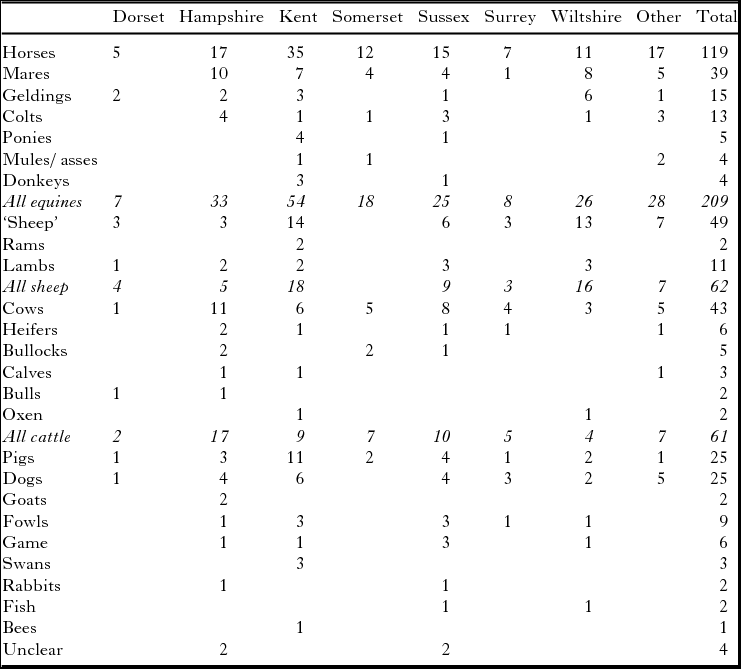
Table 2 details the numbers of cases by the type of animal maimed. In some episodes, several species of animal were targeted by the maimer/s, hence the overall number of cases recorded in table 2 (410) is higher than the sample number of episodes (366). I have also made the distinction between the maiming of animals and their young – horses and colts, cattle and calves, sheep and lambs – if a distinction is made in the report. The table does not record the number of animals so maimed. In part, this is because many reports did not detail how many animals had been maimed. For instance, two reports in the Hampshire Chronicle in early 1797 noted that at the Hampshire Quarter Sessions four girls and one lad had been found guilty of ‘poisoning hogs’ at Basing, while at Bentley the manes and tails of ‘several horses’ had been cut.Footnote 39 I have also made this distinction because the number of animals maimed often varied from case to case, and even from species to species. For example, Archer's tally of animals maimed, of 713 ‘plus’, includes 112 game birds, yet the latter figure comprised only two cases.Footnote 40
The resort to animal maiming by animal and by county
A similar distortion would also occur here. Most cases involved the maiming of only one animal. It was rare for more than one or two horses to be targeted, although the poisoning of ten horses belonging to the Harrietsham overseer in July 1835 was a notable exception.Footnote 41 But some cases involved the maiming of large numbers of animals and the maiming of sheep was particularly likely to involve mass slaughter. Eight of the forty-nine cases of sheep maiming involved the death of a total of 316 sheep and lambs but 198 sheep were killed in one case alone. This was the singularly most brutal case of animal maiming in the sample and will be examined in detail later in this paper.Footnote 42 Apart from in cases of poisoning, in general the smaller the animal, the easier it was to maim and in large numbers.
As table 2 shows, equines were by far the most frequent target of animal maimers. These episodes usually involved, as noted above, only one horse being maimed, although in the case of hair cutting several horses were often targeted at once. Sheep and cattle were the next most common targets, attacks on dogs and pigs were also far from unusual, while other animals were only subject to occasional maimings. The primacy of horse maiming in the southern counties follows the findings of Archer for Norfolk and Suffolk and Shakesheff for Herefordshire.Footnote 43 The dominance of attacks on horses in England was in contrast to the practice in Ireland, where ‘houghing’ during the eighteenth-century was targeted against graziers’ cattle and, to a lesser extent, sheep.Footnote 44
Animal maiming was overwhelmingly a practice of men, mostly young men, and sometimes children. In one case in June 1824, a ten-year old boy employed to look after the lambs on a farm at Idmiston, Wiltshire, was found guilty on his confession of killing twenty-one lambs and injuring a further three with an iron bar used to make sheep folds. The act was motivated by his desire to revenge his master for striking him three weeks previously.Footnote 45 Of the ninety-one individuals arrested on suspicion of maiming animals, only four were women. These four were all involved in the same case of poisoning hogs at Basing for which they and a male relative were adjudged to be vagabonds and sentenced to six months imprisonment at the 1797 Hampshire Epiphany Quarter Sessions.Footnote 46 In those cases where the occupation of alleged maimers was recorded, the status was usually agricultural worker, almost always labourers, servants and waggoners. There were exceptions however. Farmers, for instance, were the culprits in attacks against a bull at Littleton (Hampshire) in September 1822, and against a carthorse at Warminster Common (Wiltshire) in July 1823.Footnote 47
The occupational status of the animal's owner, when recorded or inferred from other details, was usually farmer or landowner. Given that most animals in rural England were the property of farmers or landowners, this is hardly surprising. But the animals of other occupational groups were occasionally targeted, including those involved in law enforcement. Mayor Greet of Queenborough on the Isle of Sheppy was targeted in November 1821, so the Home Office was informed, by his own bailiff and a neighbour ‘who he had to speak severely to lately as they were in the habit of attending the weekly meetings of what is called the Radical party in Queenborough’.Footnote 48 Sheriff's officer Edmund Miller's horse was also targeted at Sherston (Wiltshire) by animal maimers a year later. The motive was supposedly that Miller had been ‘called away’ by the ‘magistrates to assist in apprehending some notorious poachers’.Footnote 49 Clergymen's animals were not immune from maimers either. In a coincidence, two Hampshire clergy both had their Newfoundland dogs maimed in the 1820s. While the Reverend Richards’ dog survived being shot at Newport on the Isle of Wight in November 1827, the dog belonging to Reverend Monkhouse of Bramshott did not survive poisoning. The clergyman satirically left one shilling to the perpetrator in his will.Footnote 50
To claim that animal maiming was only enacted against the powerful and wealthy would be untrue, for some cases related to attacks on the animals of trades people and artisans. Butchers, another occupational group with temporary possession of large numbers of animals, were occasional targets, although the motives are unclear in any of the recorded cases.Footnote 51 Carriers and coach proprietors, blacksmiths, dealers, bootmakers, and beershop keepers also had their animals attacked, the latter for refusing to serve beer in the hours of Divine Service, although all such cases occurred not in the villages but in the market towns or the urban fringe.Footnote 52 Animal maiming was even practised against the animals of the poor. I have only uncovered six such episodes, three of which involved attacks against pigs, one against two cows, one against two mares, and one against a donkey. Again, motives are difficult to determine, although in one case, involving poisoning and thrusting a stick ‘hard up [a pig’s] body’, the action was supposed to have been provoked by the owner having provided evidence against a fellow Headley labourer tried at the Hampshire Quarter Sessions.Footnote 53 This was not just a weapon of rural terror used by the weak against the wealthy, but also a tool of intra-class conflict.
Was there any geography to animal maiming? On first inspection of the sample, it would appear that episodes tend to cluster on the urban fringes and in the immediate environs of the major towns but on closer analysis this is probably a reflection of the spatiality of newspaper reporting, with reports tending to cluster on the hinterland of the place of publication,Footnote 54 rather than representing anything sociologically meaningful. There were, however, at certain times, ‘waves’ of animal maiming. Wealden parishes in the late 1820s, for instance, were subject to a spate of attacks. Animal maiming, like incendiarism and ‘plant maiming’,Footnote 55 was an apparently widespread practice, albeit one that was seemingly rarely practised in the same parish on multiple occasions.
There are some rare places where there were multiple cases of animal maiming. The repeated ‘houghing and destruction of Sheep’ and sheep stealing in ‘the vicinity of Lewes’ in the Spring of 1835, reportedly in protest against the implementation of the New Poor Law, generated considerable alarm. Mrs. Dray of Alfriston was twice a victim. On the first occasion, one sheep was stolen, eight others killed and another badly injured, while two of the prized Southdown sheep belonging to chairman Ellman of the new West Firle Poor Law Union had crow bars thrust into their heads.Footnote 56 At Ash-next-Sandwich, a major centre of threshing-machine breaking and incendiarism against parish officers during Swing, four ewes and eight lambs were slaughtered in July 1835. As magistrate Norrice informed the Home Office, the act had been against the ‘working of the New Poor Law’ and ‘will in all probability be followed by others of a similar nature’.Footnote 57
If these multiple cases of maiming had similar motives, other ‘waves’ of maiming left the rulers of rural England bewildered. Farmers in Potterne, mid Wiltshire, were subject to repeated attacks in 1817. While the precise number of cases is unclear, mares, geldings, cows, and sheep belonging to at least four farmers were ‘cruelly and maliciously maimed’ on several occasions over the year. The initial cases were not publicised in the provincial press, but by October 1817 the local magistrates were so ‘anxious’ to detect the perpetrators that a reward of one hundred guineas was put up for information leading to a successful prosecution and an advert was placed in the Wiltshire press and reinforced by an editorial report.Footnote 58 Five years later, in nearby Melksham, when Mr. Hazeland's horse was stabbed to death it was the fourth horse to be so killed in the neighbourhood in the previous nine months. ‘A set of diabolical villains’, reported the Salisbury press, ‘now infest the neighbourhood of Melksham, carrying their depredations to a great extent’, having also now turned their hands to burglary. Sixteen months later, in March 1824, two further horses were killed following ‘other depredations equally heinous’. This was animal maiming, in Shakesheff's words, as ‘sheer intimidation’.Footnote 59 Elsewhere, the maiming of Mayor Greet's cattle at Queenborough in 1821 was one of three such attacks on his animals that autumn: first, a ram was killed, followed by the poisoning of four heifers, and shortly after there was the poisoning of a further two heifers.Footnote 60 Some parishes were even subject to multiple episodes of maiming over extended periods. For instance at Shere in Surrey, two cows and ‘several’ pigs were maimed in 1830, a dog was poisoned in 1842, and a cock was shot in 1843.Footnote 61
Understanding animal maiming as practice
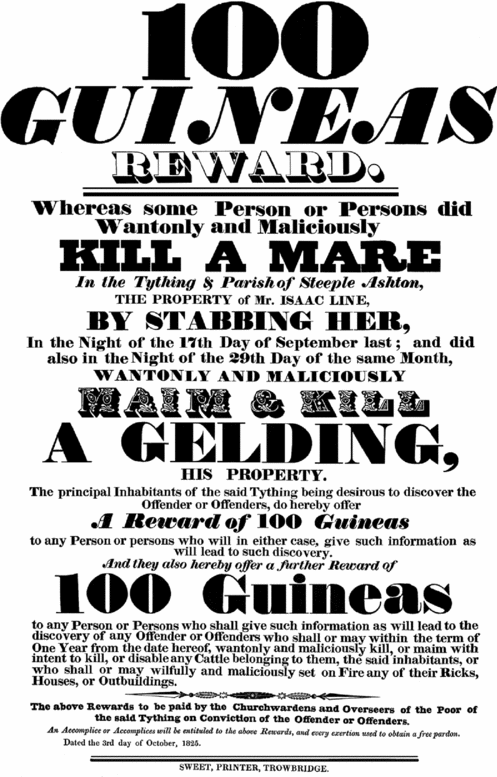
Given that animal maiming was occasionally practised against the animals of rural workers, we cannot simply label the practice as an act of popular protest as conventionally understood. Rather, maiming was deployed in a variety of contexts: in inter-class disputes; as an act of personal revenge; and, to quote Shakesheff, as a form of ‘psychological terror’.Footnote 62 No doubt many acts of animal maiming did express a degree of shared, ‘popular’ protest, especially against maltreatment by unpopular employers or poor-law officers, but ‘protest’ is too crude a tag to encompass all such acts. We do know, however, that animal maiming was often practised in tandem with other tools of rural terror. Occasionally, in addition to maiming animals, other property was maliciously damaged. At Crundale (Kent), hair cutting was accompanied by the cutting of harnesses and wagon whips, while at Newtimber in Sussex, not only was a cow stabbed with a hay cutter and other cattle allowed into a field of standing wheat, but ‘a quantity of husbandry tackle’ was also destroyed.Footnote 63 At Edmonton (Middlesex), Boldre (New Forest), and Hellingly (Sussex) horses, cattle and lambs respectively were maimed and threatening letters received by the animals’ owners. Revenge in all cases was the explicit motive. The Boldre letter threatened that the yeoman's houses would be set on fire, members of a local criminal gang having recently been sentenced to transportation. At Hellingly, farmer Akers’ shepherd was arrested for cutting the throats and otherwise mutilating six lambs, and a ‘diabolical letter’, supposedly in shepherd Rollason's hand, ‘rejoiced at the act and anticipated further harm by setting fire to the premises.’Footnote 64 The sample also contains eight cases where animal maiming was accompanied by resort to incendiarism.Footnote 65 Certainly farmers and the rural authorities perceived animal maiming as one of a broader set of protest practices. A poster produced by the parish officers of Steeple Ashton parish in Wiltshire in October 1825, after farmer Line's horses were twice attacked within a fortnight, extended the hundred guinea reward for information leading to the discovery of the culprit to any cases of cattle maiming and incendiary attacks on farm property (see figure 1).
Poster offering a 100 guinea reward in the case of the maiming of farmer Line's horses, Steeple Ashton, Wiltshire, 1825 (Wiltshire and Swindon Archives, 730/259). Reproduced with kind permission.
Symbolic violence
Maimers took considerable risks in deciding to maim an animal as opposed to using any other tool of terror. Compared to firing a hay rick or slashing hop bines, animal maiming was liable to attract immediate attention from the cries of the animal, while in most instances apart from haircutting, the culprit was likely to be left bloody-handed. And with equines, cattle, sheep, goats and dogs there was also the very real possibility that the maimer could get seriously hurt. To maim an animal rather than turn to incendiarism and ‘plant maiming’ was something deliberate and symbolic rather than a practice chosen pragmatically. It was to make a statement about, or through, the animal. To attack an animal was to attack a living body, something that when cut drew blood, something that could feel and react to pain in human-like ways. Animal bodies therefore became proxies for the owners’ body, the act a form of maiming and murder by proxy. As Archer notes, maiming was symbolically ‘a more personal act of violence by the maimer on the victim [the owner] than any other protest form’. It was, he continued, ‘almost. . . a form of symbolic murder. . . an extreme form of psychological terror’.Footnote 66
While many reports did not detail how the animal was maimed, a majority of reports did describe what had befallen the animal. Given that most animal maimers were not butchers, we can perhaps understand that their efforts were neither efficient nor clean. However, reports often indicate that acts of maiming were calculated to maximise the animals’ suffering. The maiming was intended to cause excruciating pain rather than death, to shock the owner and engender a bodily repulsion that was more than psychological. Beyond those infrequent acts which simply used brute force to batter the animal, such as the smashing of limbs, knees and heads, most maimings involved the cutting of the animal. Ears were removed, eyes knocked and gouged out, and tails severed. One cow, heavily in calf, was so treated at Winchester in February 1802, ‘which pretty clearly shews it was done through a spirit of revenge’, as the Hampshire press reported.Footnote 67 In another singular case, the upper lip was cut off a horse and the animal was also stabbed in the chest and ‘other parts of his body’, at Newbury in August 1791.Footnote 68 Hamstringing cattle and horses was uncommon, certainly in comparison to rural Ireland, but was occasionally practised, notwithstanding the obvious risk. In all such cases I have uncovered a reward for information leading to a conviction was offered, such was the horror the act induced.Footnote 69
Other symbolically extreme acts were designed not just to maim but to kill. The cutting, and occasionally the ‘pulling’ out, of horses’ tongues was clearly intended to lead to a slow death through starvation, although the animal was often destroyed by the owner first.Footnote 70 The slashing of the throats and necks of equines and sheep was similarly bound to be fatal. The cut was rarely clean, perhaps a reflection either of the act being hurriedly and frenziedly carried out, or, again, of a desire to maximise distress. As the Kentish Gazette related in the case of a horse having its throat cut at Margate in August 1837, the act was ‘not effectually done’. ‘A fine pony’ of carrier Parker at Wealden Heathfield was likewise killed by the ‘divers wounds’ made on the ‘upper of his neck and on the windpipe’, despite being inflicted by a penknife.Footnote 71 Sometimes this was so crudely done that the horse's throat was not cut but just stabbed.Footnote 72
Stabbing generally was the most frequent form of symbolic violence and was sometimes fatal. Reading these acts is complicated because in some cases it would appear that the act was committed in a fit of pique, rather than being premeditated, involving the picking up of pitchforks and other blunt instruments close to hand to stab animals, usually horses, in their sides.Footnote 73 However, there can be little doubt of the intention of such acts. John Duffin's horse was ‘so severely cut and stabbed’ at Fairoak near Southampton in January 1828 that its entrails protruded. Likewise, a horse belonging to farmer Whitfield at Bybrook near Ashford (Kent) was ‘inflicted’ with several ‘deep gashes’ and other lacerations from a knife.Footnote 74
More extreme, if not unusual, were those cases where whole limbs, even heads, were severed. A donkey had its foot cut off at Tonbridge having been stolen at Wrotham, while the heads were cut off a pig at Shaftesbury (Dorset) in January 1791, and two sheep at Pett (Sussex) in January 1841. In all of these cases, the animals were alive at the point of being maimed, no other injuries being evident.Footnote 75 In some such cases, as noted above, the line between animal maiming and theft was blurred. As historians of sheep stealing have suggested, while the act was often carried out by butchers, to those unskilled in the arts of slaughter and butchery the killing of sheep was a difficult business, the animal often being horribly mangled by their unskilled efforts.Footnote 76 Certainly sheep stealers often showed a particularly malicious brutality in their acts. On the night of 3rd June 1795, a sheep was stolen from a field at Harnham (Wiltshire) but a lamb was left ‘mangled’ in a ditch, and on the following night another sheep was taken from the same field but was left ‘dead and mangled’ in a neighbouring field. Perhaps the sheep stealer/s were startled and left the second sheep in fear, but the killing of the lamb suggests something driven by malice more than money.Footnote 77 It is also important to note that such cases did not just occur when food was most scarce, rather such crimes occurred throughout the year. Indeed, analysing the whole sample suggests that, in contrast to sheep stealing, poaching and incendiarism, there was no discernible seasonality to animal maiming.Footnote 78
Several cases suggest something altogether more complex. When a sheep belonging to butcher Dent at Milton-next-Gravesend was attacked, its shoulder was cut off, a leg mangled in an attempt to separate it from the body, and the body ripped open with the caul fat left on the ground. The sheep was found still alive the following morning making a ‘dreadful noise’. It is not clear whether this was a particularly inept and cruel attempt at sheep stealing, since the shoulder was carried away, or whether it was a particularly brutal case of maiming. The precise motives of the culprit are lost to history, although the removal of only one of the shoulders, prior to attempting to separate a leg and cutting the animal open, hints at something beyond ineptitude. There was malice in the act, or, at the very least, it showed a total lack of feeling to the animal so brutally mutilated.Footnote 79 This was not the only such case. Sheep had their hind legs cut off but were left alive at Dover in May 1827 and again at Goudhurst six years later.Footnote 80 The violence, pain and unpleasantness of these acts appeared quite deliberate.
While there is no denying the violence involved in such acts, and the sense of fear and repulsion they engendered, some cases displayed a singular brutality in their slaughter and barbarity. Sheep, again, were the usual targets, although the Devizes and Wiltshire Gazette, in reporting the maiming of a horse at Devizes in the summer of 1830, related that the animal had been killed ‘with a barbarity rarely exceeded’.Footnote 81 Brothers Ebenezer and Joel Wilmot were indicted at the 1830 Dorset Lent Assizes on the charge of animal maiming for an act that outwardly had the appearance of a case of attempted sheep stealing, or rather meat stealing. On the morning of 7th March three ewes and two lambs were found dead in a field of farmer Senior at Manston. One of the ewes had its shoulder ‘nearly dragged off’, hanging on only by a piece of skin, a second ewe was cut in several places but not quite dead, while the other ewe had been beaten across the head and the horns broken off. The lambs were cut ‘in several places in the neck’ and their windpipes cut down to the breast. On surveying the carnage, a gun was found, broken in two pieces, such was the violence inflicted on the sheep, as well as the handle of a sword covered in wool. The barrel of the gun, fully loaded, was found a little distance from the scene. Being found guilty, the two lads, aged nineteen and seventeen respectively, were sentenced to transportation for life, the judge thinking it necessary to ‘punish them as hard as possible’.Footnote 82 Again, even if this were a case of attempting to extract meat, it was carried out with so little efficiency and so much violence that the two lads were at least in some way motivated by malice. Similar levels of force were used at Urchfont (Wiltshire) in the spring of 1823, one sheep having its head almost severed from its body with a hatchet and other sheep ‘being nearly pierced through with the sharp end of the [fold] stakes, and many. . . otherwise dreadfully maimed’.Footnote 83
Yet more brutal, and reserved for particular revulsion, were mass maimings, symbolic of mass murder. While such cases were relatively few, they invariably targeted sheep. Moreover, they appear to have clustered in the remote downlands of Wiltshire, although the sample size of such cases is too small to draw any more definitive conclusions. The case at Idmiston involved the killing of twenty-one lambs and the injuring of a further three; at Haslemere (Surrey) twenty sheep were killed in revenge for ‘the ejectment of several cottagers onto the waste’; and on the Rye Levels in Sussex four sheep and twenty-three lambs were ‘bludgeoned to death’.Footnote 84 An easier, and less risky, method was to use poison. By far the most dramatic example of this practice came at Berwick St. James (Wiltshire) in January 1848 when 198 sheep of gentleman farmer Erlysman Charles Pinkney were killed by being fed copper sulphate.Footnote 85
Animal shootings were less dramatic, but in some senses just as terrifying for animal owners, as a form of proxy assassination. Of the seventeen such cases included in the sample, seven targeted equines (in one case a donkey), five targeted cows, two dogs, two fowls, and one sheep. It is possible that this technique was deployed because of the dangers of maiming large animals and dogs, and possibly so that the act could be undertaken at a distance, therefore lessening the chance of detection, although in one case a bull was not only shot at but also ‘wantonly and cruelly beaten, [and] abused’.Footnote 86 We also know that the practice was not always motivated by malice to the owner. A donkey was shot at Gravesend by an archery master on it having entered his grounds. Similarly, the shooting of a cow at Tunbridge Wells in 1828 was, so the accused claimed, an accident that occurred while he was attempting to shoot birds. That the owner had recently lost another cow through poisoning was, however, considered suggestive of a more malicious motive.Footnote 87
Some aspects of maiming can also be seen as financially symbolic. For, as Ritvo notes, farm animals were, in farmers’ eyes, a form of ‘lively capital’, and in law inscribed as being no different to other ‘less mobile goods’.Footnote 88 Therefore in the same way that setting a corn barn on fire was meant to both terrorise and financially hurt the farmer, so the maiming of a valuable mare was also meant to shock and dent the farmer's capital. Given that so many maimings were motivated by a sense of revenge following the maimer being dismissed from work or refused employment or relief, it made symbolic sense for the act to be targeted at undermining the relative wealth of the victim.
The Berwick St. John case is particularly instructive in this regard. Following the offer of a reward of a hundred guineas and the circulation of a handbill stating the facts of the case in Salisbury and the surrounding countryside, labourer James Blanchard was arrested on suspicion. Having been dismissed from Pinkney's employ in 1840 for misconduct, Blanchard threatened ‘to do for’ him, for which he was arrested and bound over to keep the peace. Blanchard again applied to Pinkney's steward for work in July 1847, but on being refused, again threatened to have his revenge: he would shoot Pinkney and would poison the sheep when they came home from the downs in the winter months and ‘would be d_d if he did not’. On being challenged by the steward, Blanchard responded ‘If I live, and you live, you will see; there will be mutton enough for many’. Blanchard was again arrested and placed in custody, but on his sending Pinkney a contrite letter, the gentleman decided not to seek his prosecution. There were limits to Blanchard's contrition however, for he confessed to a fellow prisoner that on his release he would poison the sheep ‘when all were in bed and asleep’ and that hundreds would die. The evidence presented at the Wiltshire Assizes was only circumstantial. Blanchard was therefore found not guilty and acquitted.Footnote 89 There was, it is possible to infer, a deep sense of injustice at profound inequalities in agrarian society that informed some cases of maiming. Many farmers were too wealthy and ignored their responsibilities; maiming would rebalance rural society and give ‘mutton enough for many’.
Disfigurement and subverting care
Many acts of maiming were not life-threatening but were instead, in the words of a report in the Salisbury and Winchester Journal, disfiguring.Footnote 90 Whether practices that fell short of mortal wounding betrayed a desire to avoid severe harm to the animal is perhaps a moot point, but that these practices altered the appearance of the victim is telling. In the acts of cutting off tails and ears, which admittedly showed absolutely no sentimentality or desire to avoid serious harm, to the widespread practice of cutting manes and tail hair can be discerned a very different set of symbolic practices. In part, such practices can be understood as the reification of popular resentment of the pride manifested by landowners and wealthy farmers in the appearance of their prize animals, which can be read as a form of reflected vanity. In the same way that ornamental trees, shrubs and flower gardens were often destroyed by plant maimers, so the use of animals as symbols of wealth by the rich was also attacked.Footnote 91 In November 1842, for instance, at Rolvenden (Kent) the tail and mane were cut off one of Captain Moneypenny's ponies, while a few days later a further pony was found starved to death in his icehouse. These were not working animals but fleshy ornaments, pets of the pasture.Footnote 92
The cutting of the tails and manes of horses and occasionally cows could be seen as a form of theft rather than of maiming. As Archer notes, the practice did not hurt the animal but instead gave it a ‘slightly unusual appearance’, while the hair was presumably sold by the maimer for use in brush making, upholstery stuffing, and plastering. Notwithstanding the apparent lack of malice in such acts, Archer still tellingly includes them in his analysis.Footnote 93 The act of cutting tails and manes was a highly risky form of theft for little reward, since the horse could sound the alarm that all was not well and therefore suggests something beyond mere opportunism. It was to make a statement, to leave a mark. Certainly, the practice was perceived as an act of bodily violation, ‘disfiguring’ in the words of the above report, ‘curtailing’ according to another.Footnote 94 There is also evidence that the practice was, at least occasionally, motivated by malice. In March 1850, when the mane and tail of a horse belonging to the master of Chichester barracks was cut, the rest of the animal's hair was also ‘singed’. Similarly, when the tails of sixteen cows at Rimpton (Somerset) were cut off in January 1829, the Sherborne Journal reported that it was believed this was ‘an act of revenge towards the farmers’.Footnote 95
Further evidence of the role of malice in the practice of hair cutting comes from the fact that the act was often practised in tandem with other attacks on the owners’ property. At Bishopstone, near Salisbury, the cutting of the tail hair of one horse was accompanied by the breaking of several fences and rails, the unhinging and placing in the public road of several gates, and ‘other depredations’ on several farmers’ property on the night of 5th September 1819.Footnote 96 Likewise labourer Thomas Bartlett was indicted at the Hampshire Lent Assizes in 1797 for the cutting of hair from the manes and tails of several horses and an ass belonging to William Eggar at Bentley, the ears of the same ass having only recently been cut off. To add further proof to the malice of the act, Bartlett was found bloody handed in the stable, for which he was found guilty and sentenced to death. This suggests that he was not just attempting to cut hair to sell.Footnote 97 In several cases horse tack was also destroyed or stolen. The destruction of wagon whips that accompanied the cutting of farmer Lancefield's horses at Crundale (Kent) was perhaps also deliberately symbolic.Footnote 98 In one case at Basingstoke, a boy employed by farmer Hutton thrust a whip down Hutton's horse's throat, the animal later dying from what the Southampton press described as a ‘wanton act of barbarity’.Footnote 99
The above case also highlights the role of farm servants, horselads and other farm workers responsible for the care of horses as animal maimers. Maiming their animal charges was an inversion of the care that was normally given and a marker that normal relations between employee and employer no longer held. In common with many customary rituals, it was a sign that the world had been turned upside down.Footnote 100 The case of the beating of twenty-one lambs at Idmiston by the boy employed to look after them was perhaps the most brutal example of this inversion, although just as shocking was the slashing of the throats of five lambs at Hellingly by shepherd Rollason.Footnote 101
These cases were relatively unusual since the most frequent practice amongst servants involved the poisoning or suffocation of horses, although in two cases, at Somborne (Hampshire) in 1811, and at Newton St. Loe near Bath in 1821, servants were responsible for pulling out horses’ tongues.Footnote 102 For suffocation, stones, flints, glass, nails, and the above-mentioned whip, were all thrust down the throats of horses by horselads.Footnote 103 Suffocation could also happen by accident, a fate that almost befell a carthorse at Godalming when an egg placed down its throat by a servant got stuck. ‘Farmers’ servants’, the report lamented, ‘have long been addicted to give their horses eggs, and a number of other far less harmless articles, with the silly view to making their coats finer than can be obtained from good corn and good rubbing’.Footnote 104 As the report indicates, it was common practice among those responsible for the care of horses to feed them small quantities of substances such as oil of vitriol and ill-brimstone to try to improve the sheen of horses’ coats, but given in excess these were lethal. It is hard to be certain that in cases where horses were so killed that the act was malicious as opposed to over-zealous, although in one case the servant thought responsible did disappear when three of Sussex farmer Wickens’ horses died.Footnote 105
Poisonous substances and chemicals were, however, frequently used in cases of animal maiming against dogs, fowls, mules, oxen, pigs, and sheep,Footnote 106 so it is possible that some horses were deliberately killed in this manner. Some cases make the link explicit. For instance, James Canter was indicted at the Sussex Lent Assizes in 1810 for having ‘maliciously poured of Oil of Vitriol into the mouths of five valuable cart horses’. While the act was perceived as a felony in law whatever the intentions of the maimer, in this case Santer had just been given notice to quit as farmer Baker's carter, hence the suspicion of malice. Similarly, farmer Pye of Cuxton (Kent) lost four horses over the period of a year to poisoning, a crime to which labourer Thomas Hutchings confessed upon questioning.Footnote 107
Against animal agency?
The cases of the donkey shot for wandering onto the archery master's grounds at Gravesend and the sheep poisoned by jealous shepherd Fisher at Great Bedwin raise a further important issue of whether the animals were always maimed as proxies in a protest against their owners or whether the animal itself could be the target. Beyond the cases of the trespassing donkey and the too fecund sheep, several other cases in the sample suggest motives that cannot be understood simply by ascribing all episodes of maiming to social protest. A ‘house dog’ belonging to Mr. Phillman of Nunton (Wiltshire) had its throat cut after it started barking and alerted the carter to the presence of three would-be burglars. Notwithstanding Phillman then shooting at the men, they retaliated by throwing large stones at his windows and shouting ‘abusive and violent language’.Footnote 108
Perhaps more typical of recorded cases were maimings of horses motivated by frustration with the animal by those ‘working’ it. Farmer Lyle of Brixton was brought before the Surrey magistrates for tearing the tongue from one of his horses when he lost his temper with the animal. Similarly, Daniel Ranger was sentenced at the Surrey Summer Assizes in 1793 to twelve months in gaol having been found guilty of stabbing a gelding of farmer Colyer. However, Colyer asked the judge to report to the Home Office to request clemency for the lad, since he was of previous good character and maimed the gelding in ‘instantaneous Passion + not of Malice’. Ranger was duly granted a free pardon.Footnote 109
A further case that became a staple of justices’ legal manuals involved the prosecution of a Gloucestershire labourer in 1789 for maiming a cow. However, in the trial it was revealed that the labourer had thrust a stick into the animal's body as it would ‘not stand quiet’ in his attempts to commit bestiality. Notwithstanding his admission of guilt, he was acquitted because his actions bore no malice towards the owner, only the cow.Footnote 110 This case is particularly instructive not only in that it reminds us that statutes against animal maiming only recognised animals as living capital, but also because it highlights the fact that many acts of maiming were sexually aggravated. As Archer has stated, animal's genitals ‘held a strange fascination for maimers’, something I have suggested elsewhere was a function of the close intimacy between animals and farm workers. Moreover, because the critical role of livestock in agrarian capitalism was to reproduce, sexual organs were of iconic importance.Footnote 111 Sticks were ‘forced up’ the wombs of animals,Footnote 112 teats were cut off cows,Footnote 113 and, in cases detailed by Archer, the penises were cut off a cart horse and a donkey, and the ‘bearing’ of a mare cut.Footnote 114 Yet there were relatively few acts of castration, despite the familiarity with the method of many farm workers. Moreover, I have not come across any accusations of witchcraft in such cases, even though, as Piers Beirne notes, those accused of bestiality in medieval England were often also accused of witchcraft.Footnote 115
The animal's own agency and bodily limits could even be used as an aid to maiming. At Hunston near Chichester in October 1834, the tails of two cows were tied together, one cow completely pulling off the tail of the other. Another occasional tactic was to let sheep into clover fields so that they became ‘blown’ or bloated through consuming too much clover and would die without prompt veterinary assistance.Footnote 116 Allowing horses to gorge themselves on wheat had a similarly mortal effect, as on the occasion when three cart horses were let into their owner's threshing floor at Westfield (Sussex) where they fed freely before dying a few hours later.Footnote 117
Conclusions
Building upon Archer's pioneering study of East Anglia, it is clear that animal maiming was a critical way in which rural workers, and others, revenged employers, poor law officials, officers of the law, informants and even neighbours. But because it was a practice, or set of practices, that sought personal revenge, targeting animal bodies as proxies for the owner's body, rather than expressing grievances shared by the community, it played little role in protest ‘movements’. For instance, during the wave of Swing protests that swept through southern England in the autumn and winter of 1830, I have only uncovered three cases of animal maiming compared to the hundreds of southern incendiary fires. These episodes occurred outside the areas of intensive protest, and outside of the periods of greatest protest activity. Moreover, in two of the episodes, the resort to animal maiming was accompanied by other forms of protest. Only during the introduction of the New Poor Law did it assume the same role as it did in rural Ireland.Footnote 118
It is probably because of its almost total invisibility during the major ‘landmarks’ of rural protest that animal maiming has remained so little studied and understood. Another possibility has been the tendency in rural history to conceptualise all acts of opposition as forms of social protest, and as best understood through political economy perspectives. Yet, as shown, even when the archive explicitly reveals maimers’ motives, the stimulus was often something other than an attempt to revenge an employer. In those cases where a breakdown in employer-employee relations was the evident motivation, it was consistently a response to the ill-treatment of servants rather than a reaction to having been dismissed. It made symbolic sense to attack the thing that was being cared for. The inversion of giving care exposed the irony that farmers’ animals were subject to care while farm workers often felt that they had no status beyond caregiver. Of course this is a generalisation, for not all farm workers were harshly treated, but for many their wretched experience was thrown into stark contrast by healthy, strong, well-turned out animals. This was especially the case in relation to horses, hence we should not be surprised that horses were the most frequent target of attacks. Attacking animals was therefore not always, or even often, an attempt to hurt the animal's owner by denting their wealth, by hurting them in the pocket. Rather, the decision to maim an animal rather than set fire to a barn or destroy a plantation was to make a deliberate statement about the nature of life in rural England.
This suggests that relations between rural workers, and especially farm workers, and animals were complex and seemingly contradictory. While there is a tendency to sentimentalise this bond in the oral histories and accounts of rural workers by middle-class chroniclers such as W. H. Hudson, George Bourne, or George Ewart Evans,Footnote 119 such accounts serve as a useful reminder that to rural workers animals were more than just lively flesh, and things to be enacted upon. Indeed, for many rural workers animals, and particularly horses, went beyond ‘things’ to become co-workers and companions. But in the same way that rural workers, or any other group of people, might assault, maim and murder those closest to them, so frustrations might be taken out by rural workers on those animals closest, spatially and emotionally, to them. Thus animal co-workers and companions became the focus for anger with employers and other humans. ‘Companion species’, to use a phrase coined by Donna Haraway, were treated no differently to fellow humans when it came to the playing out of violence.Footnote 120
While it is understandable why rural workers occasionally expressed their anger and frustrations through maiming animals, it is important to acknowledge that attacks on animals were more than just acts of violence. They were deliberate comments on the relative condition of rural workers and animals. As labourer and mass sheep maimer Blanchard put it, ‘If I live, and you live, you will see; there will be mutton enough for many’. If many farmers appeared to place their workers on a lower biological scale than their animals, rural workers themselves were clear that beyond sentiment and attachment, the role of most animals was to provide their sustenance. Those working households which were lucky enough to be able to keep a pig might soon become attached to the animal. As Cobbett noted, the animal went from ‘d–d hog’ to ‘pretty piggy’,Footnote 121 but it was still gratefully slaughtered when it was ready. That so many labouring families could not afford to eat meat, or at least much meat, meant that animal flesh assumed a particular political potency over and above other foodstuffs. If burning down a corn barn was to comment, ‘If I cannot eat this bounty, then you shall not profit from it’, maiming livestock was to claim ‘If I cannot eat this animal, then neither shall the rich’. The act therefore builds upon a persistent trope in English rural protest and indeed in satirical prints: hunger amidst plenty. The discourse of ‘mutton enough for many’ was thus both class politics and practical subsistence politics in one.
Through attention to these complex and seemingly contradictory human-animal relations, we can begin to understand that rural social relations, not least between employers and workers, were framed through differential relations with non-human things, and especially animals. The place of animals in rural life determined the status of rural workers in the wider biological scale. Labourers and horses both performed labour, but whereas horses were mobile capital and could be sold, labourers had no value beyond their labour. Similarly, livestock had value as deadstock, and also through their provision of wool and milk, whereas labourers merely laboured. This juxtaposition was most striking between horselads and ‘their horses’. The bond was genuine but their contrasting status undercut the relationship, so that love and care often turned to violence and abuse. Other people's animals were walking tormentors, fleshy punch bags, game and symbolic targets. Violence, as is so often the case, went hand in hand with care.