INTRODUCTION
The death of a child is considered to be the most traumatic of all losses, intensified and cumulative for women whom society has otherwise rejected. Women who have been incarcerated or are currently incarcerated in the criminal justice system may experience many losses, specifically the death of a child, at a greater rate than in the general population. A preliminary survey of child loss among a sample of 198 incarcerated women found that 32 (17%) reported the loss of a child (Farkas & Hrouda, Reference Farkas and Hrouda2007). This is in stark contrast to the national incidence of child loss among women in the general population that has been reported to be 1.3% for African American mothers, 0.8% for Hispanic-Puerto Rican mothers, 0.4% for Hispanic-Cuban mothers, and 0.6% in non-Hispanic white mothers (Mathews & MacDorman, Reference Mathews and MacDorman2008).
Regardless of how long ago the death occurred, incarcerated women are isolated and vulnerable and may live with their bereavement as a continuous grief experience. Prolonged and complicated grief such as that experienced with the death of a child can be related to the development of major depression and anxiety disorders, along with the risk for substance abuse and incarceration recidivism (Piper, Reference Piper, Ogrodniczuk and Azim2001; Farkas & Hrouda, Reference Farkas and Hrouda2007).
REVIEW OF THE LITERATURE
In empirical literature, there is a regularly occurring theme of family losses among women who are or have been incarcerated. Mothers involved in the criminal justice system experience episodic interruptions in parenting of their children, loss of child custody, and multiple impaired relationships with partners and family members (Alleyne, Reference Alleyne2006; Grella & Greenwell, Reference Grella and Greenwell2006; Farkas & Hrouda, Reference Farkas and Hrouda2007). The current, qualitative descriptive study focused on the nature of grief in women who experienced child loss, and the influence of the women's family members. The study sample included women who were currently or had been previously incarcerated. The study aims were to explore the subjective experiences so as to inform the development of needed services and reduce the role grief plays in the risks for recidivism of incarceration.
The study was guided a priori by a stress-coping model that highlights the transactional nature of stress (Lazarus & Folkman, Reference Lazarus and Folkman1984). Stress is defined as “a particular relationship between the person and the environment that is appraised by the person as taxing or exceeding his or her resources and endangering his or her well-being” (Lazarus & Folkman, p. 19). Responses to events that are stressful vary depending upon individual cognitive appraisal and coping. The use of cognitive appraisal by an individual determines the perception of potential harm or threat and evaluates if anything can be done to overcome the perceived harm. Coping is defined as the person's efforts to reduce the threat and regain stability, including seeking social support from others (Folkman et al., Reference Folkman, Lazarus and Dunkel-Schetter1986). The loss of a child certainly constitutes a stressor and is worthy of description in our study.
Other theoretical literature was examined that pertained to grief such as Lindeman's (Reference Lindemann1944) seminal work on complicated grief including the processes of denial, delay, distortion, and persistent sense of loss. Clinical symptoms of complicated grief include depression, anxiety, increased substance abuse, chronic sleep disturbances, and agitation (Carter, Reference Carter1989; Ferszt, Reference Ferszt2000; Kreicberg et al., Reference Kreicberg, Valdimarsdottir and Onelov2004; Ferszt & De Fedele, Reference Ferszt and DeFedele2005). Davies (Reference Davies2005) interviewed mothers about their needs while their children were dying or following the death. The mothers described the need for privacy and space with their children both before and after the death. In particular, mothers wanted to hold the child's hand, sit with the body, and place the child's body in the casket. Bereaved mothers also expressed the need to maintain an after-death bond with the child by placing mementos in the casket. Milo-Moulton (Reference Milo-Moulton1997) found that parents who were unable to retain some control over the funeral rituals or who were not able to be with their dying children felt guilty for what might have been done differently. Smith's research on parental bereavement found that participants were grateful to talk about their grief to a sensitive listener, with themes of “telling the story” and “expressing sorrow” (Reference Smith2000). Participants in Rosenblatt's grief study (Reference Rosenblatt1995) were relieved that they had the opportunity to talk to a sensitive listener. Conversely, incarceration prevents funeral attendance, the performance of burial rituals, and access to grief support (Hendry, Reference Hendry2009). In a study by Ferszt (Reference Ferszt2003) that included in-depth interviews of three incarcerated women, acute grief had to be “suspended” by the women during incarceration.
In general, grief literature describes the need for bereavement rituals, physical contact with the child's body, and opportunities for parents to convey their loss. For incarcerated women, there can be many barriers to these needed emotional and behavioral dynamics.
PURPOSE
The purpose of the study was to talk with women who had experienced the loss of a child, and who were currently or had been previously incarcerated. The investigators wanted to elicit a description of the grief process and the effects of the death of a child on the women's relationship with family members. The interviews were expected to enhance the knowledge of the complex dynamics of incarceration and grief from the death of a child.
METHOD
A descriptive qualitative design (Sandelowski, Reference Sandelowski2000) was used to describe the breadth and depth of the women's experiences and reflections. Rigor was enhanced by repeated reviews and discussions of the verbatim transcripts, the coding list, and consensus building among the investigators. The use of Atlas TI coding also assured that the transcripts were objectively searched for dominant and axial thematic phrases.
Guiding Questions
Interviews of each participant were guided by global questions that were designed by culling the literature. The open-ended questions were designed to encourage the women to describe their experience in their own words. The interviewer followed the lead of each participant to understand and explore the issues introduced in the interview. The guiding questions included:
1. Would you tell me what happened to your child? What were the events that led to this child's death?
2. How did you react to these events? How did you cope with them?
3. How well did these ways of coping work for you? Do you still use these ways of coping?
4. How did the death of this child affect your other children? Others in your family?
Participants
The purposive sample consisted of women who had experienced the death of a child before the child reached age 18, and past or current involvement with the criminal justice system. The investigators were interested in both recent and past loss experiences as a means of gaining longitudinal perspective. Study participants were included if they had experienced a child death from elective termination, miscarriage, stillbirth, and prematurity, as well as a death due to an accidental injury or a sudden or prolonged illness. Neither the cause of the loss nor the time since the death of the child was considered an inclusion or exclusion criteria by the investigators.
Research participants were identified from a community-based re-entry program for women and a county detention/jail facility located in a metropolitan, Midwestern city. The mission of the women's re-entry program was to reduce incarceration recidivism and to enhance the quality of life of women by providing supportive services for housing, employment skill building, household management, income stabilization, and counseling. The agency collaborated by providing information to women from their caseloads that met inclusion criteria and by allowing recruiting flyers and posters to be displayed. The investigators made a presentation about the study to several support groups at the detention/jail facility and left recruitment flyers with the facility's social work staff for distribution. Neither the community agency nor the detention/jail staff was directly involved in recruiting. Women who were interested in learning more about the study completed a tear-off slip or phoned the study office. Women from the community re-entry program who participated in the research interviews were given a $35 gift card to a local grocery chain and $10 cash for their transportation costs. Women recruited from the detention/jail facility received $35 deposited to their commissary accounts.
The study procedures were approved by the university affiliate Institutional Review Board (IRB) of the investigators. Informed consent was obtained from all study participants following the code of the United States Department of Health and Human Services Title 45 Code of Federal Regulations (CFR) part 45. Because the study included people who were under the supervision of the criminal justice system (either incarcerated or under community supervision), additional protection criteria under subpart C were met by the participation of an employee of the criminal justice system in the IRB review. Specific information about the child's death or the mother's situation was masked to maintain confidentiality. Informed consent was obtained from all study participants. The audio recordings of the interviews were deleted following the completion of de-identified transcriptions and review.
Active recruitment efforts for study participants continued until no one had made contact with the researchers for 3 months. A final sample of 10 women consented and completed the entire or most of the interview. Four of the participants were community dwelling and were recruited from the community re-entry program. Six of the participants were incarcerated in the detention/jail facility at the time of the data collection interviews. One of the interviews conducted in the jail was shortened when the woman was called to court, but the information that was elicited at the time of the court appearance was elaborate and substantial, and consisted of all the elements of the other interviews.
Data Collection
The interviews were conducted by a trained interviewer who had experience as a grief counselor and as an interviewer in prisons. The project interviewer contacted the interested women to arrange a time to meet with them and to review the informed consent. The interviews took place in a private room at either the community re-entry site or the detention/jail facility. The interviews lasted 1 to 2 hours and were audio recorded. Beverages, snacks, and tissues were provided in the interview rooms for the participants’ comfort. Each woman was asked to complete a structured data collection form that provided demographic information including characteristics of the mother, the child, and the circumstances of the death. Using the semi-structured question guide, the interviewer asked each mother to describe the experience of her child's death. The interviews were recorded, transcribed verbatim into electronic files, and de-identified for any mention of the child's or family members’ names to protect confidentiality. After each transcription was completed and reviewed, the audio recordings were destroyed.
There was an opportunity for the participants to debrief at the end of the interview and for the interviewer to express sympathy about the loss. A list of resources for grief counseling was available to each participant at the end of the interview. Grief counseling services were also available at the community agency and the detention/jail facility for the women in the study who indicated an interest. The interviewer contacted each participant within 3 days after the interview to ask about how she was doing and if she felt the need for additional grief support services. None of the participants needed crisis intervention as a result of the study.
Data Analysis
Descriptive data were entered into Atlas.ti, version 5 for content analysis for recurring themes and comparison among the participants. Data analysis was conducted through the use of constant comparison by the investigators (Strauss & Corbin, Reference Strauss and Corbin1990). The transcripts were reviewed repeatedly, along with highlighted, extracted phrases from transcript mining. As the investigators explored the data, 48 categories emerged from the first seven participant interview transcripts. The project interviewer and the two co-investigators each independently reviewed the categories and collapsed them into blended categories. These blended categories were compared by the research team members to identify areas of agreement and disagreement regarding the collapsing decisions. The areas of disagreement were discussed and guided by theory until all three coders were in agreement. No new dimensions emerged from interviews 7 through 10; therefore, no additional participants were recruited.
As a result of the investigators’ repeated review of the blended categories, the data were reduced to four dominant themes, including: (1) coping and family response, (2) higher power, (3) pattern of use and sobriety, and (4) events around the death or loss of the child. Given the magnitude of the data compiled in the single theme of coping and family response, it is the only theme described in this article. The data are reported using culturally and ethnically diverse pseudonyms for each mother and child to protect participant confidentiality, to provide clarity for the referenced child, and out of sensitivity to the participants’ losses.
Reliability and Validity
All interviews were conducted by the same member of the research team, who was an experienced interviewer in prisons and had experience as a grief counselor. Interview questions were designed based on a review of pertinent literature and research team planning sessions. Open-ended questions and probes were systematically used to enable the interview to follow a conversational style. The team pre-tested the interview procedures and questions using simulation that was audio/video recorded and reviewed. All of the data collection interviews were audio recorded for confirmability.
RESULTS
The average age of the participants was 38 years, with a range from 22 to 48 years. Eight women self-identified as African-American and two women self-identified as Caucasian. Nine of the women shared that they had a religious affiliation and one woman did not. At the time of the child's death, eight women reported that they had been single, never married; one was separated, and one was divorced at the time of her child's death. At the time of the interview, five women reported that they were single, never married; two were separated; two were divorced and one was married. All of the women had other children. Some of the mothers had not had custody of the child that had died.
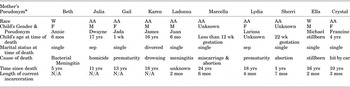
The 10 women reported 11 child deaths that occurred as recently as within the year and as long ago as 24 years before the interview. The average number of years since the child's death was 13 years. Although most of the participants defined their child's death as having occurred following a live birth, one of the women had lost two children in one year as a result of miscarriage and an elective termination. Another woman defined her child's death as an elective termination. Two children had died from premature birth and one child had been stillborn at 8.5 months of gestation. Four of the children were male, four were female, and two were of unknown gender. All but one of the children experienced death that was sudden. Two children died as a result of infectious disease, one was fatally shot, one drowned, and one child died as a result of injuries after being hit by a car. The three children who had died from accidents were aged 17, 16, and 4. The children who had died from infectious disease were both 6 months old (Table 1). Descriptive data in this qualitative study are reported as examples of the coping and family responses theme, however; not all of the participants are quoted.
Mother/child demographics and contextual descriptors (n = 10)

W, white; AA, African-American
aFictitious names are used for mothers and children
Coping
Various formulations of coping emerged from participant interviews across a range of emotional dynamics. All of the participants described understandable sadness and grief along with maladaptive responses to the loss of their child when they tried to cope on their own. They described cognitive impairment, anhedonia, detachment, and repression. Several women talked about the actions they had taken to deal with the child's death. Julia had seen a psychiatrist but did not feel any responsiveness: “They don't bring this subject up and the reason I'm here today is because I feel like I need to talk about it. It enters my mind and I just take it and shake it off because I believe I don't want to accept it.” Sherri found that the therapy group conducted in the jail was helpful: “I like when people talk to me like they do in the therapy group, how you feel and what you've been through. You cry a little bit then you feel better.” Crystal stated that she had been waiting to see a psychiatrist while incarcerated: “I need somebody to talk to at times. I just want to share my feelings and my thoughts with somebody, somebody I know that I can trust. It's hard to let go [in jail] because the first thing women do is use what you said against you. I would like to talk with a counselor.”
Women spoke about the ways that they coped by themselves. Beth said that “my mind goes in and out. I didn't understand why it was so important for me to sit there and hold her. It just felt so right.” Karen described “I have spent time by myself. The ways that I coped, I just thought maybe I'd just try to stay away from people; I didn't work after he passed away. I didn't get counseling, never have. I dreamed about my son, everyday I think about him, toys that he had that I kept.” Sherri described her feelings about an elective termination of her pregnancy: “I bonded with my baby while my baby was inside of me. Not a day that goes by that I don't think about what my baby would be doing, how my baby would look. I don't even know how to cope with my feelings. I still feel sad.”
Ladonna described her absence of feelings for the baby that died: “I didn't go to the funeral home. I had the baby cremated and about five or six years later my mother said the funeral home was trying to get in touch, I had to get the [remains]. I left him on a shelf.” Marcella isolated herself from her unborn baby's father stating that “things deteriorated between my boyfriend and me. [I] wasn't coping with anything. I finally decided to terminate the pregnancy because I didn't want to be with someone who didn't want to have the baby. I couldn't see myself raising a baby alone and being unstable myself.” Lydia experienced a spiritual isolation: “I didn't understand why God had to take my baby, it was like I just went through a lot of this emotion, I tried to commit suicide, and I felt very empty afterwards. I didn't want to talk. I just started using drugs and I tried to cut my wrists.”
Ella recognized the maladaptive effect of pent-up grief: “I bottled a lot of my emotions and I think I fought a lot and I think some of that is what actually has me sitting in [jail] today, not dealing with those feelings like I should have. I think I would have been a more laid back, relaxed person if I had of been sharing.” Crystal described a dissociated, depressive response to the loss of Francine: “Numb your pain; I'll shut down to where I'll stay in my room all day for two or three days. I'm isolating myself, because that's the best way I know.”
Several of the women specifically described their avoidance of other children and family groups. Karen said: “I didn't like seeing the families together, with little children. It's hard when I have to see a kid with their mother or their father.” Ella described that she has a brother that is the same age as her child would have been: “They would've [grown] up together. She happened to have the child and I didn't.”
There were instances where the participants described substance use as part of coping. Gail said: “After I came home and [saw] that she wasn't there anymore, I went straight back to drug use. There was nothing out there to help with coping. I started to use drugs more, crack cocaine medicates me, and I don't have to feel.” Ladonna recalled: “I had gotten introduced to smoking crack. In the meantime, my mother and my brother and [others] were taking care of my kids, because I wouldn't stop. Whatever I did, I did to the extreme and wouldn't stop.” Similarly, Ella said: “I think it would've been better for me to have shared those feelings back then instead of bottling them up and just drinking and drugging and using weed and crack and snorting coke and prostituting and not caring about myself.” Also, Crystal said: “It was my only way [ to cope] just shooting up with that stuff, crying at the same time, thinking it all was going to go away. I don't want to use drugs or drink anymore.”
Family Response
All of the participants described responses of their family members to the loss of their children. The participants described family responses ranging from supportive to conditionally supportive, to non-supportive. For example, Lydia told of her family's initial support when she lost her child: “It was like a family day, we cooked and talked. They tried their best to make me feel better.” Even though her family was supportive, Lydia was not able to benefit from their support. Her mother and grandmother encouraged her to talk with a psychiatrist but it had little effect. “It was like I was just there, but not there mentally” said Lydia. “I just didn't want to be around [anybody].” Lydia recalls the loss of her child had an impact on others in her family, especially her mother: “She was going through with it too and it was a long time – about a year or two later – for her to get over the fact that my baby died.”
Even though all of the women mentioned family as being involved in coping with the death, families did not consistently provide positive or ongoing support for these women. Beth stated: “I think my mom and I see more of letting go but sometimes I don't understand my mom because she says one thing but then she does other things.” Inconsistency in this family was paired with tension and role confusion. Beth disclosed that her sister had restricted her access to her child in the hospital. Another participant, Ella, recalled unconditional support from her extended family initially: “I'm grateful to have people around me that are saying it's okay.” However, in the months after her child's death, Ella experienced conflict with her mother: “She was kind of hard on me, and after that, I left my Mom.”
Conflict was part of family interactions for several of the women. Karen experienced several instances of barriers and control over the access she had to her child or to his possessions: “They told me I could not put clothes on him for the funeral. My mother stole the picture [of her child] and refused to give it back to me. To this day she has the picture. They [mother and siblings] never ask me how I'm dealing with it. I never really wanted to talk to my mother about it because she won't say anything. She says mean things.” Ladonna described that her family withheld support: “My family never reached out to me. I never had [anybody] to grieve [with me].” Similarly, Crystal found that her family withheld information regarding the cause of death: “She wouldn't reveal that to me, and still to this day she hasn't. She thinks its better that I just don't know and I personally think its better that I do know.” Beth's daughter, Annie, was being cared for by Beth's sister. Beth said that when Annie was seriously ill and dying in the hospital, she felt like “the underdog and had no say in anything. At the same time we were going to court about me signing permanent custody over to my sister, which I had continuously fought. I did not want to do that. My sister picked where [Annie] would be buried.” The custody proceedings created additional strain for Beth and did not allow her to fulfill any material function related to her child's death.
DISCUSSION
Child loss and grief patterns were difficult and complicated for the women in the study. Although none of the deaths of the children had occurred during the women's incarceration, the women experienced unresolved, prolonged grief. The coping patterns that emerged were complicated by substance use for self-medication following the child's passing. There were frequent descriptions of lack of access to their child while the child was dying or afterwards, little choice of grief rituals, a lack of sensitivity or responsiveness from family members, and grief experienced in isolation. Several women talked about the need to find an outlet for their grief and only one participant found partial relief in attending a support group organized in the jail. From the perspective of the mothers, family members were not reliably helpful. The participants described ambivalent, often conditional and conflicted relationships with family members. Several participants knew they had to isolate themselves from family members to avoid the emotional conflicts. In other instances, the women's families controlled or restricted the contacts with their children. Additionally, the mothers vividly described the control exercised over access to their child's health information and important representative objects. The women had less social support or sought it less perhaps because of shame and embarrassment related to their incarceration and involvement in the criminal justice system. These findings are similar to classic stress and adaptation literature that described distancing and avoidance in situations that were unchangeable (Folkman et al., Reference Folkman, Lazarus and Dunkel-Schetter1986).
Woodgate (Reference Woodgate2006) and Davies (Reference Davies2005) conducted interviews of bereaved parents who did not have a history with the criminal justice system. Parents in both studies described efforts to keep a presence of their deceased child in their lives through memories, significant objects and pictures, and reminiscing about their child. Parents maintained an after-death bond with their children that gave meaning to their bereavement. Parents in Woodgate's study articulated the benefit of good friends and supportive family members in their bereavement, nevertheless; this support was consistently absent for the mothers in the current study.
None of the participants in the study had received focused bereavement services from the criminal justice system, although two participants were on a waiting list for a grief group or a psychiatrist. Similarly, Ferszt (Reference Ferszt2000) recorded accounts of “suspended grief,” inadequate coping resources, and no access to important grief rituals in a sample of women who had been incarcerated. In stark contrast, the study by D'Agostino et al. (Reference D'Agostino, Berlin-Romalis and Jovcevska2008) of parents whose children died of long-term illnesses in hospitals found that they had contact with other parents with similar experiences and with hospital staff who knew or had provided care to their child. They also found that the use of flexible and continuous bereavement services in the community resulted in an improvement to the parents’ quality of life.
Women who have been involved in the criminal justice system who have had a child die have complicated histories that need sensitive assessments and multidimensional interventions (Freudenberg et al., Reference Freudenberg, Wilets and Greene1998). Not surprisingly, researchers have called for an examination of the relationship between traumatic grief and recidivism of incarceration (Leach et al., Reference Leach, Burgess and Holmwood2008). Critical to the development of efficacious interventions is an understanding of the bereavement dynamics and the context of adaptive and maladaptive coping. Psychiatric nurses, nurses who provide care in prisons, social workers, counselors, and other health professionals who interact with women within the criminal justice system may find that the descriptions provided in this study are informative when planning interventions. Healthcare and prison staff need to be sensitive to the many losses of these women who lack meaningful support for their bereavement and suffering. Referrals to Compassionate Friends, a community-based group for bereaved parents, or grief groups while incarcerated, are needed to address the loss of a child at the outset of the grief process. A previous study found that a targeted treatment of a 24-session grief group significantly improved depression scores (Zuckoff et al., Reference Zuckoff, Shear and Frank2006).
Limitations
Women who were willing to share their experiences were self-referred and it is only their perspectives about the loss of their children that were captured in this study. It is not known if the themes that were common for the sample participants are similar to those of other bereaved mothers who have been involved with the criminal justice system. Those women who were willing to participate may have had different experiences and feelings than those who did not participate.
Further Research
Information from this study can be used to develop further research that expressly examines loss and grief in the vulnerable population of incarcerated and formerly incarcerated women. Longitudinal research would be useful in determining critical timing for grief intervention and the value of interventional strategies. Ultimately, the implementation of sensitive and beneficial interventions based on evidence is essential for nurses, social workers, and other counselors who work with women in substance abuse treatment and the criminal justice system.
ACKNOWLEDGMENTS
The research team is grateful to those women who shared their experience of loss. The authors thank Lauren Stevenson for her substantial contribution to data collection and analysis and Matthew McManus for his assistance with manuscript preparation.
Funding for the study was provided by the Ohio Board of Regents Research Infrastructure Grant awarded by the Mandel School of Applied Social Sciences and funds from the Alpha Mu chapter of Sigma Theta Tau International Nursing Honorary.