Introduction
Apricot (Prunus armeniaca L.) is one of the most important economic fruit crops belonging to the Rosaceae family, cultivated in warm temperate to subtropical regions of all the continents of the world. It is believed that apricot has originated in the mountains of northern and north-eastern China, with central Asia's Dzhungar and Zachlag mountains as a secondary centre of origin (Zeven and De Wet, Reference Zeven and De Wet1982). The apricot gene pool contains species and varieties with a wide range of adaptations from the cold Siberian winters to the subtropical climate of North Africa and from the Central Asian deserts to the humid areas of Japan and eastern China (Mehlenbacher et al., Reference Mehlenbacher, Cociu and Hough1991; Ercisli et al., Reference Ercisli, Agar, Yildirim, Esitken and Orhan2009). With local apricots from Central Asia, Afghanistan, Xinjiang, Pakistan, Baluchistan and Northern India (Kashmir), the Central Asian group is the largest and richest group for biodiversity. It is believed that it was introduced via Baltistan into cold arid Ladakh, although some experts suggest that it has been imported directly from China via Tibet (Dwivedi et al., Reference Dwivedi, Kareem and Ahmed2007; Kumar et al., Reference Kumar, Mishra, Singh, Kumar, Naik and Singh2009). In India, different apricot genotypes are grown in Jammu and Kashmir, Himachal Pradesh, Uttarakhand and Punjab. However, the region of Jammu and Kashmir is the leading producer of apricots in India with a total production of 21,131 MT in the year 2017–18 (http://hortikashmir.gov.in/).
Although there is a rich diversity in the apricot germplasm of Jammu and Kashmir, there have been no breeding efforts to develop accessions that are suited for commercialization in India. Assessment of genetic resources of the indigenous accessions is important for breeding programmes aimed at incorporating features such as firmness and disease resistance from wild accessions into cultivated varieties (Ercisli et al., Reference Ercisli, Agar, Yildirim, Esitken and Orhan2009). Using morphological/agronomical traits and biochemical characteristics, significant levels of phenotypic diversity among wild and cultivated apricot germplasm have been observed from the different regions of the world (Drogoudi et al., Reference Drogoudi, Vemmos, Pantelidis, Petri, Tzoutzoukou and Karayiannis2008; Yilmaz et al., Reference Yilmaz, Kargi and Kafkas2012; Krichen et al., Reference Krichen, Audergon and Trifi-Farah2014; Pérez-Romero et al., Reference Pérez-Romero, Arroyo, Santamaría, Herencia and Daza2014; Khadivi-Khub and Khalili, Reference Khadivi-Khub and Khalili2017; Gecer et al., Reference Gecer, Kan, Gundogdu, Ercisli, Ilhan and Sagbas2020; Rezaei et al., Reference Rezaei, Heidari and Khadivi2020). However, studies on apricot germplasm of Jammu and Kashmir has mostly been restricted to the Ladakh region (Sofi et al., Reference Sofi, Zaffar and Mir2001; Zaffar et al., Reference Zaffar, Mir and Sofi2004; Malik et al., Reference Malik, Chaudhury, Dhariwal and Mir2010; Girish et al., Reference Girish, Tsering, Dwivedi, Ashish and Srivastava2012; Abdul et al., Reference Abdul, Ram, Dwivedi, Dwivedi and Meena2016; Angmo et al., Reference Angmo, Angmo, Upadhyay, Targais, Kumar and Stobdan2017; Naryal et al., Reference Naryal, Angmo, Angmo, Kant, Chaurasia and Stobdan2019). The result of some investigations from the Kashmir region has revealed that there is a huge genetic diversity in this fruit species (Bhat et al., Reference Bhat, Padder, Wani, Banday, Ahsan, Dar and Lone2013; Kumar et al., Reference Kumar, Lal and Ahmed2015; Wani et al., Reference Wani, Zargar, Malik, Kashtwari, Nazir, Khuroo, Ahmad and Dar2017) which has not been explored completely indicating that detailed information on the phenotypic diversity of apricot germplasm in Jammu and Kashmir is still lacking.
Hence, the current study aimed to analyse both quantitative and qualitative traits in wild and cultivated apricot accessions collected from different districts of Jammu and Kashmir, India. This is the first report on descriptive and multivariate analysis focusing on the phenotypic diversity of apricot germplasm that includes the accessions collected from the Jammu province apart from Kashmir province. The findings of this study can be helpful in the identification of superior accessions with economically important traits for direct cultivation as well as for implication in future apricot breeding programmes.
Materials and methods
Plant materials
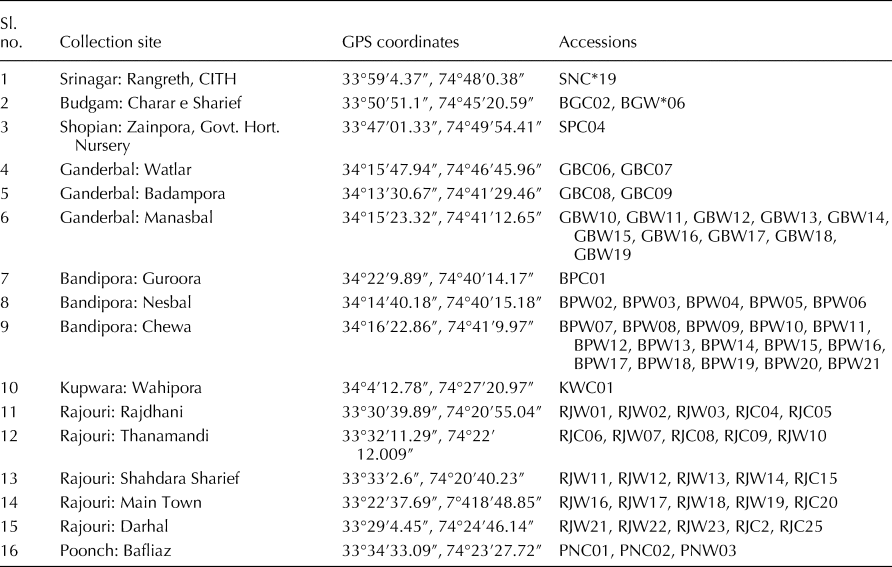
Sixty-eight accessions of P. armeniaca L. including material from both wild and cultivated populations were collected from different districts of Jammu and Kashmir, India (Table 1; online Supplementary Fig. S1).
List of apricot accessions collected from Jammu and Kashmir, India and their GPS coordinates

C*, cultivated, W*, wild.
Morphological analysis
The phenotypic characterization of apricot accessions was carried out by following the morphological descriptors selected from the International Union for the Protection of New Varieties of Plants (UPOV, 2007) and the standard DUS guidelines on apricot Protection of Plant Varieties and Farmer's Rights Authority, Govt. of India (PPV & FRA, 2012) (https://itestweb.in/ppvf/crop-dus-guidelines). Twenty-eight (12 quantitative and 16 qualitative) traits were collected over 3 years. Twenty representative samples of mature leaves were taken from the current season's shoot per tree in the areas of natural growth. The traits including leaf length and width, petiole length, and fruit length and width, were measured using a digital caliper while the area of the leaf was determined using millimetre graph paper (Pandey and Singh, Reference Pandey and Singh2011). The fruits were collected at the ripening stage, and the fruit weight, stone weight, and kernel weight were measured by using an electronic balance with 0.01 g precision. Furthermore, the characteristics comprising tree growth habit, leaf serration type, leaf apex, leaf base, petiole gland number, petiole anthocyanin coloration, fruit harvest maturity days, fruit shape, fruit suture, fruit apex, fruit colour, fruit firmness, separation of stone, stone shape, stone colour and kernel taste were measured based on ranking and coding. The list of evaluated morphological traits is shown in online Supplementary Table S1.
Data analysis
Descriptive statistics (including mean, median, minimum value, maximum value and standard deviation) were determined using Excel 2013 (Microsoft Office package). Coefficient of variation % (CV = (SD/Mean) × 100 ) was estimated as the indicator of variability. Execution of analysis of variance (ANOVA) was performed for all quantitative traits. Principal component analysis (PCA) based on all the quantitative and qualitative traits was performed to determine the relationships among the accessions using SPSS v20.0 (IBM SPSS Statistics, 2011). A scatter plot was created using PAST software (Hammer et al., Reference Hammer, Harper and Ryan2001) based on the first two principal components (PC1 and PC2). Also, multivariate cluster analysis was performed using the unweighted pair group method with arithmetic mean (UPGMA) based on the Euclidean distance coefficient and performed with PAST software.
Results
Morphological characterization based on quantitative traits
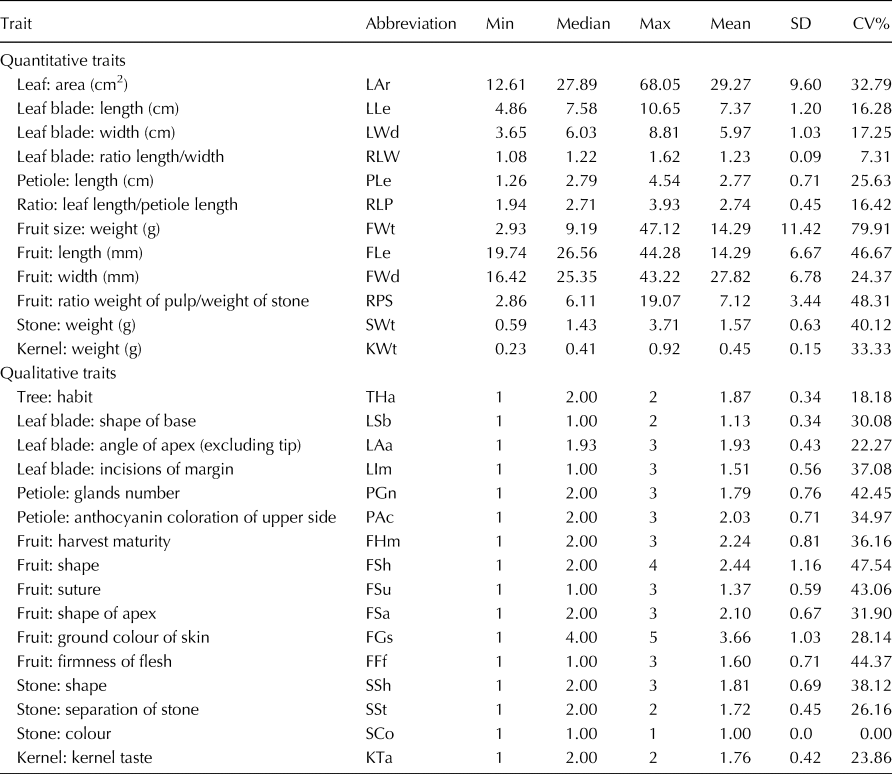
In the current study, a total of 68 diverse apricot accessions collected from different districts of Jammu and Kashmir, India were used. One way ANOVA and Fisher test values (probability level P < 0.0001) showed differences for all 12 quantitative traits that were highly significant at the threshold of 1% (online Supplementary Table S2). The descriptive statistics (minimum, median, maximum, average, SD and coefficient of variation (CV)) of 12 quantitative traits based on UPOV and FRA guidelines are given in Table 2. Among all the 68 accessions, leaf length ranged from 4.86 to 10.65 cm with an average of 7.37 cm, whereas leaf width varied from 3.65 to 8.81 cm with an average of 5.97 cm. Similarly, the leaf area ranged from 12.61 to 68.05 cm2. In addition, petiole length ranged from 1.26 to 4.54 cm (Table 2; Fig. 1a). A wide variation was observed in the fruit quantitative traits among the studied apricot accessions. The fruit weight ranged from 2.93 to 47.12 g with an average of 14.29 g. Similarly, fruit length ranged from 19.74 to 44.28 mm with an average of 14.29 mm, whereas fruit width varied from 16.42 to 43.22 mm with an average of 27.82 mm. Fruit ratio ranged from 2.86 to 19.07 with an average of 7.12. Besides, stone weight ranged from 0.59 to 3.71 g with an average of 1.57 g whereas kernel weight varied from 0.23 to 0.92 g with an average of 0.45 g (Table 2; Fig. 1a).
Descriptive statistics for the 28 traits describing the 68 apricot accessions measured according to UPOV (2007), PPV and FRA (2012) descriptors

Frequency distribution of (a) quantitative and (b) qualitative traits among 68 apricot accessions.

Among the analysed quantitative traits, the highest coefficient of variance (CV%) was shown by fruit weight (79.91%) followed by fruit ratio (48.31%), fruit length (46.67%), stone weight (40.12%) and kernel weight (33.33%). In contrast, quantitative characters such as leaf length (16.28%), leaf width (17.25%), leaf blade ratio (7.31%) and petiole length (25.63%) showed the least CV% (Table 2).
Morphological characterization based on qualitative traits
In the current study, 16 qualitative traits were used to characterize the collected apricot accessions. Except for stone colour, all the qualitative traits were polymorphic with variable distribution (Fig. 1b). Most of the accessions showed a predominance of spreading tree growth habit (86.8%) whereas the remaining accessions (13.2%) showed an upright tree growth habit. The majority of the accessions showed an obtuse (86.8%) leaf shape of the base, whereas the rest of the accessions showed truncate (13.2%) leaf shape of the base. Three types of leaf angles of apex including moderately obtuse (80.9%), right-angled (13.2%) and strongly obtuse (5.9%) were observed. Most of the accessions showed a predominance of crenate (51.5%) and serrate (45.6%) type of incision on margin. The anthocyanin coloration was medium (50.0%) to strong (26.5%) whereas petiole gland number was mostly <2 (41.2%) followed by 2–4 (38.2%) and >4 (20.6%) (Fig. 1b). In the current investigation, the traits including fruit harvest maturity (days), fruit shape, fruit apex, fruit ground colour of skin, fruit suture, fruit firmness, separation of stone, stone colour and kernel taste were taken into consideration. The studied accessions showed a difference in terms of the harvesting season. Depending on the accession, the period of fruit maturation (full flower bloom – harvest date) was different, with most of the accessions (47.1%) having late harvesting followed by mid harvesting (29.4%) and early harvesting (23.5%) (Fig. 1b). In the entire 68 accessions of apricot, 29.4% had fruits with round shape, whereas 22.1% had elliptic, 23.5% had ovate and 25.0% had oblong fruit shape. More than half of the accessions had rounded (54.4%) fruit shape of apex followed by pointed (27.9%) and flat (17.6%) fruit shape of the apex (Fig. 1b). The accessions were divided into five groups based on the ground colour of skin including the most predominant orange (36.8%), light orange (30.9%), red blush (22.1%), yellow (5.9%) and greenish-yellow (4.4%). Percentage of the accessions having the three types of fruit suture were as follows: shallow (69.1%), intermediate (25.0%) and deep (5.9%). Moreover, the firmness of flesh in most of the accessions was soft (52.9%) followed by medium (33.8%) and hard (13.2%). The separation of stone from the pulp was predominantly free (72.1%) in the majority of the accessions whereas 27.9% of the accessions had semi-clinging character. The majority of the accessions had ovate (48.5%) stone shape, whereas other stone shapes were round (35.3%) and elliptic (16.2%). Most accessions (76.5%) had a bitter kernel whereas the rest of the accessions (23.5%) had a sweet kernel (Fig. 1b).
Overall, the highest CV% among the qualitative traits was shown by fruit shape (47.54%), firmness of flesh (44.37%), fruit suture (43.06%), petiole gland number (42.45%), stone shape (38.12%) and incision of leaf margin (37.08%). On the contrary, the stone colour did not show any variability (CV = 0.00%). Moreover, the low CV% was shown by tree habit (18.18%), angle of apex of the leaf (22.27%), kernel taste (23.86%), ground colour of fruit skin (28.14%) and separation of stone (26.16%) (Table 2).
Correlations between morphological traits
Significant correlations were identified among various quantitative morphological traits (online Supplementary Table S3). Leaf length showed highly significant positive correlation with leaf width (r = 0.90), leaf area (r = 0.89) and petiole length (r = 0.79). Leaf area also showed a significant positive correlation with petiole length (r = 0.78). Petiole length showed a positive correlation with leaf length (r = 0.79) and leaf width (r = 0.80). By contrast, there were also negative correlations between leaf incision on margin and leaf length (r = − 0.62) (online Supplementary Table S3).
Fruit length showed a significant positive correlation with leaf length (r = 0.56), leaf width (r = 0.59), leaf area (r = 0.56), petiole length (r = 0.63) and fruit weight (r = 0.96). Similarly, fruit width showed a positive correlation with leaf length (r = 0.54), leaf width (r = 0.60), leaf area (r = 0.55), fruit weight (r = 0.97) and fruit length (r = 0.97). In addition, the ratio of pulp weight to stone weight also showed a positive correlation with fruit weight (r = 0.92), fruit length (r = 0.86) and fruit width (r = 0.90). Furthermore, stone weight was positively and significantly correlated with fruit weight (r = 0.88), fruit length (r = 0.91), fruit width (r = 0.89) and fruit ratio (r = 0.66). In a similar way, kernel weight showed a positive correlation with fruit weight (r = 0.80), fruit length (r = 0.79), fruit width (r = 0.82), fruit ratio (r = 0.76) and stone weight (r = 0.72) (online Supplementary Table S3).
PCA based on morphological traits
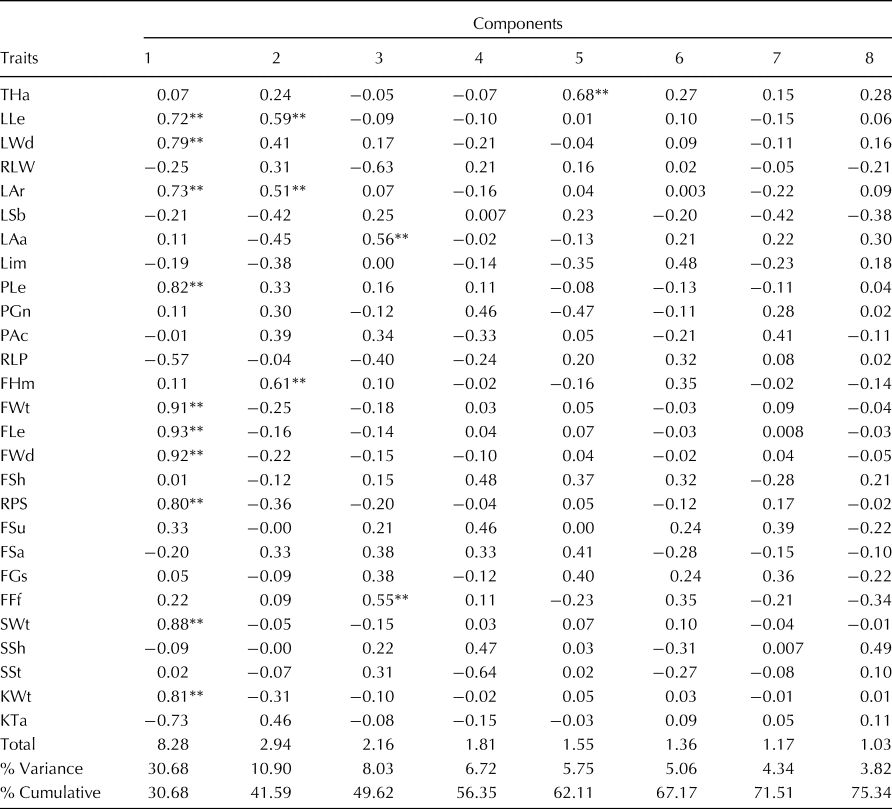
The PCA performed in this study revealed that more than 75% of the variability observed was defined by the first eight components (PC). The first three PC enclosed 49.62% of the total variation with 30.68% on PC1, 10.90% on PC2 and 8.03% on PC3. The remaining components (PC4–PC8) explained only 25.71% of the total variance. Traits with principal component loading >0.50 were considered significant for each factor (Table 3). The first PC (30.68%) included leaf length, leaf width, leaf area, petiole length, fruit weight, fruit length, fruit width, fruit ratio, stone weight and kernel weight. The PC2 (10.90%) was correlated with the length of the leaf blade, leaf area and fruit harvest maturity. The PC3 (8.03%) was correlated with the leaf angle of apex and fruit firmness of flesh (Table 3).
Eigen values of the principal component axes from PCA of morphological traits in the studied apricot accessions

**Eigen values are significant ≥0.50.
Refer to Table 2 for the code of traits.
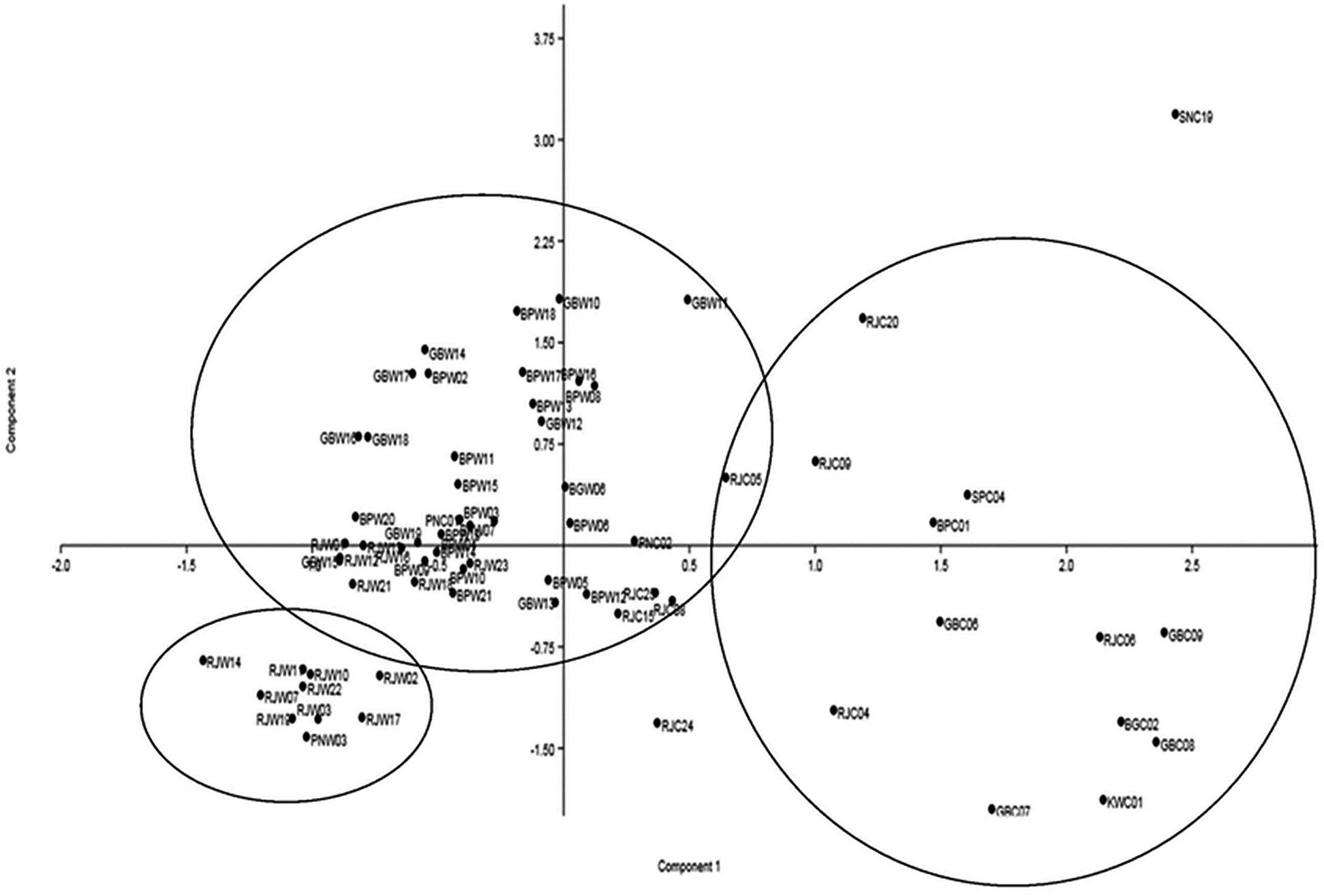
A PCA scatter plot was build based on the first two components which contributed 41.59% of the total variance (Fig. 2). In the PCA plot, the apricot accessions were grouped based on the resemblance of their phenotypic traits. PC1 is highly correlated with leaf, fruit, stone and kernel dimensions. Positive values of PC1 corresponded to the large-sized leaves and fruits whereas negative values are related to the small-sized leaves and fruits. Similarly, PC2 is highly correlated with large-sized leaves and fruit harvest maturity days. In the scatter plot, the formation of three distinct groups can be seen, 13 accessions with the highest leaf and fruit dimensions were positioned more dispersedly in the right plane. Yet, an outlier was also identified in this plane SNC19. The remaining 54 accessions formed two groups one in the central part of the plot and another small group in the lower left plane of the PCA plot. Apart from the leaf dimensions, important fruit quality traits including fruit harvest maturity days, fruit weight, fruit length, fruit width, fruit ratio, stone weight and kernel weight led to the formation of these three groups.
Scatter plot showing the distribution of 68 apricot accessions in three clusters based on the first two components PC1 (30.68%) and PC2 (10.9%).

Cluster analysis
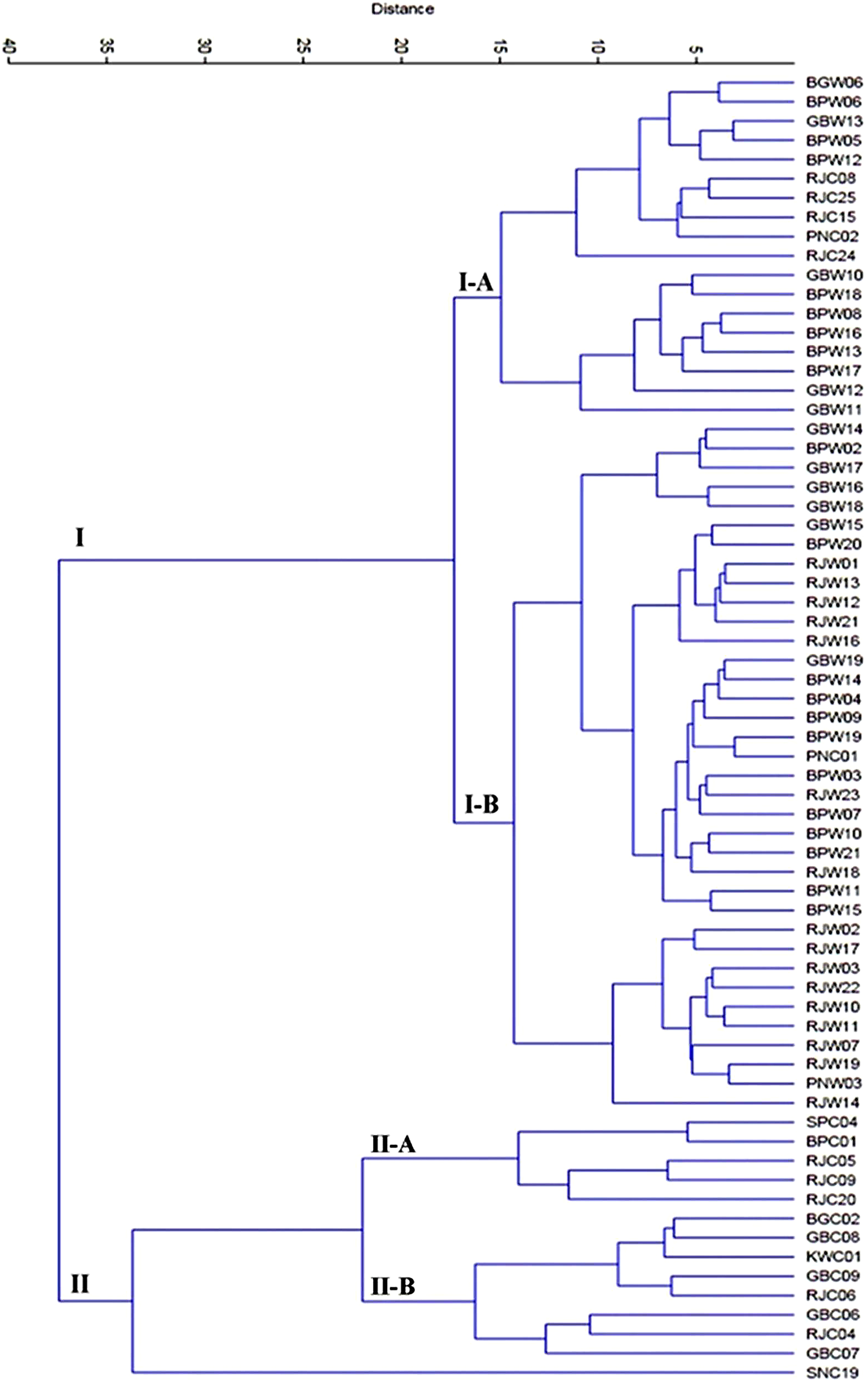
The dendrogram obtained by combining the data of quantitative and qualitative morphological traits formed two main clusters – clusters I and II grouped at an approximate genetic distance of 34.5 (Fig. 3). At an approximate genetic distance of 17, cluster I was further sub-divided into I-A (18 accessions) and I-B (36 accessions); cluster II is divided into two sub-clusters: II-A with five accessions and II-B with eight accessions, in addition, an out-group was also identified: SNC19. The accessions of main cluster I having smaller leaf and fruit dimensions tend to be more homogenous than cluster II having larger leaf and fruit dimensions.
Hierarchical clustering of the 68 apricot accessions based on UPGMA method using Euclidian distance.

Discussion
Germplasm characterization based on the morphological as well as agronomic traits is of great importance for plant breeders since it is the first step in the initiation of crop breeding programmes and identification of superior accessions to diversify local production (Pereira-Lorenzo et al., Reference Pereira-Lorenzo, dos Santos, Ramos-Cabrer, Sau and Díaz-Hernández2012). In the current study, we have studied the phenotypic diversity of 68 apricot accessions through 12 quantitative and 16 qualitative traits, collected from diverse locations of Jammu and Kashmir, India. According to previous studies (Badenes et al., Reference Badenes, Martinez-Calvo and Llácer1998; Asma and Ozturk, Reference Asma and Ozturk2005; Ruiz and Egea, Reference Ruiz and Egea2008a; Yilmaz et al., Reference Yilmaz, Kargi and Kafkas2012; Krichen et al., Reference Krichen, Audergon and Trifi-Farah2014; Raji et al., Reference Raji, Jannatizadeh, Fattahi and Esfahlani2014; Rezaei et al., Reference Rezaei, Heidari and Khadivi2020), both quantitative and qualitative traits have proved useful in distinguishing the apricot accessions from different parts of the world. Most of the studied traits were of potential economic benefits, especially the fruit, stone and kernel-related traits. Therefore, these traits can serve as a target for the growers and breeders. Moreover, the current results show that the phenotypic-based diversity assessment can be effectively used for the identification of superior accessions as well as in the estimation of genetic relationship between large and diverse groups of apricots. The current study suggests that significant phenotypic variability exists within the collected apricot accessions.
In terms of quantitative traits, the leaves of 68 accessions showed small to large leaf size. The minimum leaf length was recorded in RJW14 (4.86 cm) and the maximum was recorded in SNC19 (10.65 cm), similarly, the minimum leaf width was observed in RJW07 (3.65 cm) whereas a maximum leaf width was recorded in SNC19 (8.81 cm). Moreover, PNW03 showed a minimum leaf area (12.61 cm2) whereas SNC19 showed a maximum leaf area (68.05 cm2). In comparison, Krichen et al. (Reference Krichen, Audergon and Trifi-Farah2014) recorded the range of 4.28 to 9.33 cm for leaf length and 4.09 to 9.41 cm for leaf width in the apricot germplasm of Tunisia, whereas, Wani et al. (Reference Wani, Zargar, Malik, Kashtwari, Nazir, Khuroo, Ahmad and Dar2017) reported the range 6.75 to 11.87 cm for leaf length, 4.97 to 10.70 cm for leaf width and 18.02 to 96.52 cm2 for leaf area in the apricot germplasm of Kashmir Valley.
Characters associated with the external appearance of the fruit, including fruit dimensions, colour and shape are important considerations of horticultural crops for consumers (Maeda et al., Reference Maeda, Akagi and Tao2018). One of the most desired traits by consumers is the size of the fruit. The size of fruit and its weight has a direct impact on the sales and acceptance of fruit crops for fresh and processed markets and has a significant impact on performance. In the current study, fruit weight (size) ranged from 2.93 g (RJW14) to 47.12 g (GBC08) with an average of 14.29 g, which is following the previous studies (Krichen et al., Reference Krichen, Audergon and Trifi-Farah2014; Raji et al., Reference Raji, Jannatizadeh, Fattahi and Esfahlani2014; Gecer et al., Reference Gecer, Kan, Gundogdu, Ercisli, Ilhan and Sagbas2020). Ten accessions (SNC19, SPC04, BPC01, BGC02, GBC06, GBC07, GBC08, GBC09, KWC01 and RJC06) showed the highest fruit weight (>30 g), whereas 39 accessions showed the lowest fruit weight (<10 g). Significant variability was also observed in other fruit traits such as length and width of fruit. Previous studies on apricot also reported a high variability among accessions regarding fruit dimension (Mratinić et al., Reference Mratinić, Rakonjac and Milatović2007; Milošević et al., Reference Milošević, Milošević, Glišić and Krška2010; Yilmaz et al., Reference Yilmaz, Kargi and Kafkas2012; Krichen et al., Reference Krichen, Audergon and Trifi-Farah2014; Wani et al., Reference Wani, Zargar, Malik, Kashtwari, Nazir, Khuroo, Ahmad and Dar2017). Besides, consumer preferences for large-sized fruits, these traits are also important for packaging and transportation (Padilla-Ramirez et al., Reference Padilla-Ramirez, Gonzalez-Gaona and Ambriz-Aguilar2012). For other related fruit quantitative traits including fruit ratio, stone weight and kernel weight considerable variability was also recorded in the current study.
Regarding the qualitative traits of tree, leaf and fruit, significant variability was observed in almost all of the recorded traits. Spreading tree growth habit was predominantly found in most of the accessions followed by upright tree growth habit. Studies of Krichen et al. (Reference Krichen, Audergon and Trifi-Farah2014), Wani et al. (Reference Wani, Zargar, Malik, Kashtwari, Nazir, Khuroo, Ahmad and Dar2017) and Gecer et al. (Reference Gecer, Kan, Gundogdu, Ercisli, Ilhan and Sagbas2020) also reported the predominance of spreading growth habits in their studies on apricot germplasm of Tunisia, Kashmir and Turkey, respectively. Most of the accessions showed obtuse leaf shape of base, moderately obtuse leaf angle of apex and crenate incision on margins. These results confirm the importance of leaf quality traits for distinguishing the diverse apricot accessions.
All cultivar improvement programmes give priority to fruit quality, but this is a complex attribute that needs to be defined for each circumstance and use. Sensory fruit quality refers to the consumer perception of size, shape, taste, colour, texture and freshness (Llácer, Reference Llácer2007). In the current investigation, important fruit quality traits were taken into consideration such as fruit harvest maturity (days), fruit shape, fruit apex, fruit ground colour of skin, fruit suture, fruit firmness, separation of stone, stone colour and kernel taste. Great variation was observed in the fruit shape among the collected accessions with most of the accessions having round shape followed by elliptic, ovate and oblong fruit shapes. Our results are in close agreement with the studies of Milošević et al. (Reference Milošević, Milošević, Glišić and Glišić2014), in which they have also reported the round shape as the most predominant shape of apricot fruits. Colour has a direct impact on the perception of apricot value by consumers, particularly in terms of fruit attractiveness (Ruiz and Egea, Reference Ruiz and Egea2008a). In this study, most of the accessions showed the predominance of orange colour followed by light orange and red blush whereas few accessions had greenish-yellow skin colour. Milošević et al. (Reference Milošević, Milošević, Glišić and Krška2010) also reported orange colour as the most predominant skin colour of Central Serbian apricots. On the contrary, Batnini et al. (Reference Batnini, Krichen, Bourguiba, Trifi-Farah, González, Gómez and Rubio2016) reported that most Tunisian apricot genotypes showed yellow to light orange flesh colour, whereas the genotypes from the Spanish collection are characterized by light orange or orange skin colour. Fruit firmness, which is one of the most important indices for judging fruit maturity and quality, is most widely used in research. It is strongly influenced by the maturity of fruit because as the fruit ripens firmness usually decreases (Kingston, Reference Kingston1992). Most of the accessions were soft in firmness followed by medium firmness. Only 13.2% of the accessions were hard in firmness. This trait is important for the evaluation of the quality of the fruit, influencing its shelf life and for the acceptance of the customer. Besides, separation of stone from the pulp was found ‘free’ in the maximum number of accessions with most of the accessions having ovate stone shape and brown in colour. Moreover, the bitter kernel was found in a majority of the accessions. In recent years, parallel to the economic value, interest in apricot kernels increased, whereas large and sweet kernels are used for direct consumption; bitter kernels are used in the pharmaceutical and cosmetic industries (Asma and Ozturk, Reference Asma and Ozturk2005).
To calculate the strength of a linear relationship between two variables, the correlation coefficient is used, where r = 1 depicts a complete positive correlation whereas r = −1 depicts a complete negative correlation (Khadivi et al., Reference Khadivi, Mirheidari, Moradi and Paryan2020). Besides, this correlation is due to the action or linkage of the pleiotropic gene or more likely to be both. The variation in the correlation coefficients may be due to the different genetic compositions of a heterogeneous population. The significant positive association between different pairs can be useful in a single step for the genetic improvement of different traits if the higher or low value of both is desired. However, the traits that are negatively correlated and where the increase or decrease in the values of both traits is required cannot be improved in a single step. The traits with no significant correlation show that they are independent of each other (Chauhan et al., Reference Chauhan, Singh, Kumar and Dogra2020). In the current study, interesting relationships were shown by correlations among the studied quantitative and qualitative traits. For instance, there were positive correlations among different leaf traits such as leaf length, leaf width, leaf area and petiole length which are in close agreement with Krichen et al. (Reference Krichen, Audergon and Trifi-Farah2014), Wani et al. (Reference Wani, Zargar, Malik, Kashtwari, Nazir, Khuroo, Ahmad and Dar2017) and Rezaei et al. (Reference Rezaei, Heidari and Khadivi2020) who also reported the positive correlation in different leaf traits. By contrast, there were also negative correlations between qualitative and quantitative leaf traits. Apart from the different leaf parameters, positive correlations were found among quantitative leaf and fruit traits; fruit length showed a significant positive correlation with leaf length, leaf area and fruit weight. Moreover, fruit width showed a positive correlation with leaf length, leaf width, leaf area, fruit weight and fruit length. Significant correlations between fruit and leaf size were also recorded by other workers in plum (Khadivi-Khub and Barazandeh, Reference Khadivi-Khub and Barazandeh2015), apricot (Khadivi-Khub and Khalili, Reference Khadivi-Khub and Khalili2017) and almond (Khadivi et al., Reference Khadivi, Safdari, Hajian and Safari2019). Therefore, it can be inferred that these traits have a similar effect on the determination of accession's crop potential and the characterization of germplasm. In line with previous studies, there was no association between firmness and other quality attributes such as fruit size, fruit length, fruit width, fruit ratio and fruit colour (Ledbetter et al., Reference Ledbetter, Gómez, Burgos and Peterson1996; Badenes et al., Reference Badenes, Martinez-Calvo and Llácer1998). Positive correlations were also found between fruit dimensions, stone and kernel weight. Asma and Ozturk (Reference Asma and Ozturk2005) also found positive correlations between fruit and kernel weight and flesh/stone ratio. These may be justified because large-sized fruits would also have larger stones, kernels as well as higher flesh/stone ratio. The high correlation found between several traits could reduce the number of fruit quality traits that need to be studied in breeding programmes and taken into consideration in the selection of new cultivars.
In the current study, the PCA revealed that PC1 is highly correlated with the traits: leaf area and dimensions and fruit weight and dimensions, this means that the positive values of the PC1 refers to the large-sized leaves and fruits and negative values of the PC1 refers to small-sized leaves and fruits. As observed in PCA, the first three components described 49.62% of the total variance. This value is much lower than those reported by Asma and Ozturk (Reference Asma and Ozturk2005) 70%, and Yilmaz et al. (Reference Yilmaz, Kargi and Kafkas2012) 73%. In general, PCA may help to select a set of accessions with better fruit quality performances (Azodanlou et al., Reference Azodanlou, Darbellay, Luisier, Villettaz and Amadò2003; Ruiz and Egea, Reference Ruiz and Egea2008b). The PCA scatter plot showed that the collected accessions were classified into three groups. The traits that contribute to the formation of the three groups include the most important fruit quality traits (fruit harvest maturity days, fruit weight, fruit length, fruit width, fruit ratio, stone weight and kernel weight) apart from leaf dimensions. These results indicate the importance of using fruit quality traits for the selection of superior accessions. Similarly, cluster analysis divided 68 apricot accessions into two main clusters with 54 accessions in the main cluster I and 13 accessions in the main cluster II with an out-group SNC19. Similar results were found by Kumar et al. (Reference Kumar, Lal and Ahmed2015) and Khadivi-Khub and Khalili (Reference Khadivi-Khub and Khalili2017) who also observed two major groups of apricot accessions in the cluster analysis according to their important fruit quality traits grown in India and Iran respectively. Results from both PCA and cluster analysis revealed 14 (SPC04, BPC01, RJC05, RJC09, RJC20, BGC02, GBC08, KWC01, GBC09, GBC06, RJC04, GBC07, RJC06 and SNC19) superior apricot accessions based on important fruit quality traits such as fruit harvest maturity days, fruit weight, fruit length, fruit width, fruit ratio, stone weight and kernel weight that can be used in future national and international apricot breeding programmes.
Conclusion
The selected apricot accessions from the Jammu and Kashmir region showed significant variability in terms of all the phenotypic traits examined. All the selected apricot accessions were identified and distinguished based on the 12 qualitative and 16 quantitative traits. Accessions were clustered according to the most important fruit quality traits including fruit harvest maturity days, fruit weight, fruit length, fruit width, fruit ratio, stone weight and kernel weight apart from leaf size and dimensions in both the PCA and dendrogram. PCA scatter plot and cluster analysis enabled the establishment of similar groups of accessions confirming this clustering. From the current study, 14 accessions (SPC04, BPC01, RJC05, RJC09, RJC20, BGC02, GBC08, KWC01, GBC09, GBC06, RJC04, GBC07, RJC06 and SNC19) showed the highest values in terms of fruit quality traits which can be treated as superior accessions and can be used for direct cultivation as well as in the future apricot breeding programmes for fruit quality enhancement. Moreover, in the current study, most of the accessions possessed relatively small fruit dimensions, and in this respect breeding studies to improve fruit size will be helpful.
Supplementary material
The supplementary material for this article can be found at https://doi.org/10.1017/S1479262121000241.
Acknowledgements
This study was supported by the Department of Biotechnology (DBT), Govt. of India under grant No. BT/PR11394/PBD/16/1077/2014. The authors acknowledge Head, Department of Botany, Punjabi University, Patiala, Head, Department of Botany, University of Kashmir, Srinagar and Director CITH, Rangreth, Srinagar for their cooperation and support. Furthermore, the authors are highly grateful to the local apricot growers and Horticultural Department of Jammu & Kashmir, for allowing sample collections during our field surveys.
Conflict of interest
The authors declare no conflict of interest.