Introduction
Raspberries (Rubus idaeus L.) are important commercial plants, widespread throughout all temperate regions of the world (Graham et al., Reference Graham, Iasi and Millam1997; Castillo et al., Reference Castillo, Reed, Graham, Fernandez and Bassil2010). Most varieties that are present in the markets contain relatively low levels of antioxidants in comparison with wild and primitive varieties of raspberries, blueberries and blackberries (Bekkaoui et al., Reference Bekkaoui, Mann and Schroeder2003). Wild and primitive raspberry genotypes are an important source of genes for breeding improved varieties that can resist pests and diseases (Marshall et al., Reference Marshall, Harrison, Graham, McNicol, Wright and Squire2001; Ryabova, Reference Ryabova2007).
The morphological diversity of raspberries can be systematically analysed using morphological descriptors (Leemans and Nannenga, Reference Leemans and Nannenga1957; USDA, 2014). However, newer techniques such as molecular markers allow us to determine the variations at the molecular level (Graham et al., Reference Graham, Smith, Woodhead and Russel2002, Reference Graham, Smith, MacKenzie, Jorgenson, Hackett and Powell2004; Stafne et al., Reference Stafne, Clark, Weber, Graham and Lewers2005; Woodhead et al., Reference Woodhead, McCallum, Smith, Cardle and Graham2008).
Microsatellite or simple sequence repeat (SSR) markers are repeats of short nucleotide sequences, which demonstrate polymorphism due to differences in the number of repeated units within DNA (Beridze, Reference Beridze1980; Eisen et al., Reference Eisen, Goldstein, Schlötterer, Goldstein and Schlötterer1999). SSR markers have been found to be very useful for various aspects of molecular genetic studies, including the assessment of genetic diversity (Jennings, Reference Jennings1988; Graham and McNicol, Reference Graham and McNicol1995; Bekkaoui et al., Reference Bekkaoui, Mann and Schroeder2003; Fernandez et al., Reference Fernandez, Hernaiz and Ibanez2008; Castillo et al., Reference Castillo, Reed, Graham, Fernandez and Bassil2010).
Raspberries were very popular plants in the middle ages and were grown by feudal owners and local populations. In the 16th century, 94% of the populations were employed in agriculture (Gestrin, Reference Gestrin1991). In addition to private feudal estates, an important economic role also belonged to the monasteries (Gruden, Reference Gruden1912) as the monks were known to be good farmers (Jakic, Reference Jakic2001). During the process of developing the Slovenian medieval agriculture, the more active roles belonged to the Benedictines, Cistercians and Carthusians. Among them, the most important were the Carthusians (Gruden, Reference Gruden1912; Jacobus, Reference Jacobus1938) who were established in France in 1084 by St. Bruno (Jacobus, Reference Jacobus1938; Schlegel and Hogg, Reference Schlegel and Hogg2004).
Our determination of hypothetical medieval raspberry genotypes is based on the following assumptions:
-
(1) Raspberries were frequently present in the gardens of various medieval settlements such as feudal castles and monasteries.
-
(2) For study purposes, the most suitable are probably those raspberries grown around abandoned Carthusian monasteries. These monasteries were spatially isolated and had limited contact with local populations. Once a castle or a monastery was abandoned, the raspberries continued to grow and, due to predominant vegetative propagation, their genetic structure remained more or less unchanged. In extremely tough environments, propagation by seed was probably rare.
-
(3) At least some semi-cultivated and primitive raspberries (excluding genuine wild and highly improved genotypes), which were found close to the ruined walls of medieval castles and monasteries, could be considered as hypothetically medieval genotypes (which have been propagated vegetatively for three or more centuries), or their descendants.
-
(4) These hypothetically medieval genotypes have been exposed to various environmental pressures associated with numerous epigenetic changes, mutations and occasional genetic recombination. They may be morphologically similar and exhibit several primitive traits (smaller fruits, tough and long canes, long underground stems and extended flowering season).
Materials and methods
Plant material
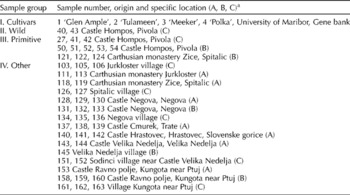
A total of 53 genotypes of raspberries were included in the study (Table 1). Out of them, 49 genotypes, two of them genuine wild, were collected in areas around six castles (Mureck, Hompos, Hrastovec, Negova, Velika Nedelja and Ravno Polje) and two abandoned Carthusian monasteries (Zice and Jurkloster), and four represented modern cultivated varieties used as standards in molecular and morphological analyses.
Plant materials included in the investigation

a Specific location (A, B, C) according to Fig. 1.
Brief description of locations
The castle Mureck (46°42′4.68″N 15°47′15.99″E) was first mentioned in 1299. The owners were various aristocratic families. From the 15th to 20th centuries, the owners were the Counts Stubenberg. In 1532, the castle was destroyed by the Turks (Bozic, Reference Bozic1969; Kodolitsch, Reference Kodolitsch1976) and then later rebuilt and upgraded. Today, it is used as a psychiatric hospital (Jakic, Reference Jakic2001).
The Castle Hompos (Haus am Bacher) (46°30′15.46″N 15°37′25.47″E) was walled-up at the end of the 11th century (Jakic, Reference Jakic2001). During the following centuries, it was upgraded several times. During the Second World War, the castle was used as a military hospital. After the war, it was a sanatorium for lung patients and later it became a psychiatric clinic (Ilaunig and Vogrin, Reference Ilaunig and Vogrin2006; Stopar, Reference Stopar2008). At the end of the 20th century, the castle was reconstructed and included within the University of Maribor.
The Castle Hrastovec (Gutenhag) (46°34′36.15″N 15°45′15.45″E) lies on a hill not far from the town of Lenart in Slovenske Gorice (Ilaunig and Vogrin, Reference Ilaunig and Vogrin2006; Stopar, Reference Stopar2008). It was first mentioned together with the chapel of St. Oswald in 1338 as Haus de Gutenhag (Gruden, Reference Gruden1912). Among the most important owners was the aristocratic family Herberstein who owned the castle from the 15th century to the beginning of the 19th century (Hogg et al., Reference Hogg, Girard and Le Blévec2001). Since 1948, the castle has been used as a psychiatric hospital (Jakic, Reference Jakic2001).
The Castle Velika Nedelja (Gross Sonntag) (46°25′25.81″N 16°6′57.54″E) is situated close to the town of Ormoz. The name Velika Nedelja means Easter. On Easter day in 1199, after a battle, Frederick of Petovia confiscated the nearby unpopulated land from the Hungarians. Later, he gave the castle to the Crusaders (Gruden, Reference Gruden1912; Bozic, Reference Bozic1969), who also used it as a hospital. After the Second World War, it became state property and, with the fall of communism, it was returned to the Crusaders (Gruden, Reference Gruden1912; Jakic, Reference Jakic2001). Today, the castle serves various purposes such as a cultural centre, a museum, and an inn.
The Castle Negova (46°36′32.21″N 15°56′13.51″E) was walled probably in the 12th century, during the dynasty of the Spannheims (Stopar, Reference Stopar2008). It is first mentioned in 1425 as West Negau (Jakic, Reference Jakic2001; Stopar, Reference Stopar2008). The castle was upgraded and reconstructed during the 16th and 17th centuries. After the Second World War, it was nationalised and used as housing for people. Today, the renewed castle serves as a museum, tourist centre, and for educational purposes (Jakic, Reference Jakic2001).
The Castle (renaissance mansion) Ravno Polje (Schloos Ebensfeld bei Pottau) (46°25′50.8″N 15°46′54.49″E) is situated close to Kungota near Ptuj. It was built in the 16th century. The first owners were the Lords of Petovia (Ptuj) and then the Stubenbergs (Mojsisovics et al., Reference Mojsisovics, Mojsvár, Hoernes, Molisch, Cisterich, August, Fritsch, Stummer-Traunfels and Ritter1908). From the 17th to 19th centuries, the owners were the Counts of the family Sauer. Since the late 20th century, the mansion has been in ruins (Hayns, Reference Hayns1906, Mojsisovics et al., Reference Mojsisovics, Mojsvár, Hoernes, Molisch, Cisterich, August, Fritsch, Stummer-Traunfels and Ritter1908).
The Zice Carthusian monastery (46°18′39.96″ N, 15°23′33.39″ E) was founded between 1155 and 1165 by Otokar III of Styria (Schlegel and Hogg, Reference Schlegel and Hogg2004). It is one of the oldest Carthusian monasteries in Central Europe and the oldest in Slovenia (Gagliardi, Reference Gagliardi and Biblioteca de1999; Schlegel and Hogg, Reference Schlegel and Hogg2004). At the end of the 14th century, Zice monastery became the residence of the Prior General of the Carthusian Order. After the Turkish invasion, the monastery was turned into a fortress. The monastery was an important cultural centre, especially during the 15th century (Gagliardi, Reference Gagliardi and Biblioteca de1999). In 1786, the monastery was badly damaged by fire and started to decay.
The Jurkloster Carthusian monastery (46°05.691′N, 15°20.658′E) was established in 1172 near Lasko, not far from Celje (Gruden, Reference Gruden1912, Hogg et al., Reference Hogg, Girard and Le Blévec2001). Among the supporters of the monastery were also the Counts of Celje (Celeia). The monastery was prosperous until the 15th century (until the arrival of Lutheranism) (Gruden, Reference Gruden1912). In 1591, the Jesuits from Graz became the owners of the monastery until their dissolution in 1773 (Hogg et al., Reference Hogg, Girard and Le Blévec2001). Today, most of the monastery's complex is in ruins.
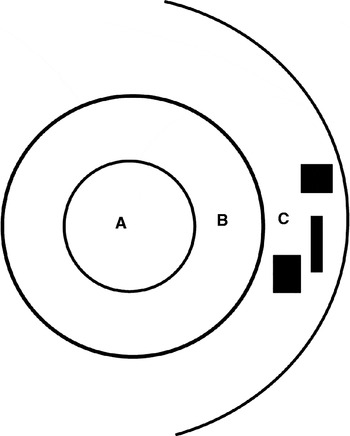
For each location, castle or monastery, samples were taken at three sites (A, B, C; Fig. 1, Table 1). Site A was within the walls of the castle, site B involved an area in the range of 100–200 m away from the walls and site C was the first settlement outside A and B, up to 2000 m from the castle or monastery.
Sampling sites: A – inside or very close to castle or monastery walls, B – 100 to 200 m away from castle or monastery building, C – a settlement up to 2 km away from castle or monastery building.

This sampling approach was based on a preliminary study conducted in 2011 and revealed that the raspberry genotypes around feudal settlements were morphologically and genetically highly variable. Some of them could be considered as cultivated, some as primitive and some as wild genotypes. We assumed that, after a feudal settlement had been abandoned, a process took place that was the opposite of domestication. We also assumed that seed propagation, due to tough environmental conditions, was probably rare or absent.
DNA extraction
DNA was isolated from fresh young leaves by the Cetyl trimethylammonium bromide (CTAB) method according to Doyle and Doyle (Reference Doyle and Doyle1990) (with some modifications, as described by Sisko et al. (Reference Sisko, Javornik, Siftar and Ivancic2009)). Two separate extractions were performed per plant. The quality of the extracted DNA was determined by agarose gel electrophoresis, and the quantity of obtained DNA was measured using a fluorometer DQ 300 (Hoefer, Inc., Holliston, MA, USA) and diluted with ddH2O (double distilled water) to concentrations of 4 ng/μl for each reaction.
SSR markers and polymerase chain reaction (PCR)
The twenty-two previously isolated and characterised SSR loci were selected from published papers (Graham et al., Reference Graham, Smith, MacKenzie, Jorgenson, Hackett and Powell2004; Castillo et al., Reference Castillo, Reed, Graham, Fernandez and Bassil2010) and their usefulness was determined regarding their abilities to amplify a product. Consequently, some of the loci resulted in unspecific amplification and, in presence of a monomorphic allele, only eighteen were selected and used for further experimentation. Non-labelled primers (Sigma, Germany) were used in PCR for testing the primer pairs. For the eighteen selected primers (Table S1, available online), one primer of each primer pair was labelled with fluorescent dye Cy 5 or Cy 5.5. The uses of different dyes made it possible to analyse three PCR products by capillary electrophoresis during the same reactions.
The PCR mixture measuring 10 μl contained 2 ng DNA, 0.5 μl of each primer and 5 μl of Multipleks PCR Plus Kit (Qiagen GmbH, Hilden, Germany). The PCR conditions have been previously optimised for each primer pair by considering the annealing temperature and the number of cycles. For the primers Rub 262, RiM15, Rub 25, Rub 157, Rub 108 and Rub 223, an annealing temperature of 59°C and 30 cycles were used; for RiM17, Rub 228 and Rub 277, an annealing temperature of 59°C and 25 cycles were determined as optimal; for primer pairs RhM021, RhM023, RhM001, RhM011, RiM19, RhM003, RhM043, RhM018, RiG001 and RiM036, an annealing temperature of 55°C and 30 cycles were used for PCRs.
The PCR was performed using a Whatman Biometra T-Gradient thermocycler (Goettingen, Germany). The capillary electrophoresis of PCR products was performed on a Beckman Coulter CEQ8000 according to the manufacturer's instructions. Fragment size analysis was performed using the built-in software. A fluorescently labelled size marker (Beckman Coulter DNA Size Standard Kit 400bp) was used as a molecular weight reference.
Data analysis
All unambiguous fragments were scored for the presence (1) or absence (0) of each band. Only clear and reproducible fragments were taken for data analysis. The binary data matrix was used to calculate Dice's similarity coefficients (Dice, Reference Dice1945). The values of Dice's coefficients were between 0 (there is no common band) and 1 (two genotypes had identical markers, so they were identical). Dice similarity coefficients were calculated using the DARWIN computer package (Perrier et al., Reference Perrier, Samuelian and Weber2005). For each microsatellite locus, the number of alleles per locus (n), allele frequencies, observed heterozygosity (H O), expected heterozygosity (H E) and probability of identity (PI) were calculated using the ‘IDENTITY 1.0’ computer program (Wagner and Sefc, Reference Wagner and Sefc1999). The average distance between pairs of accessions was obtained by taking into account the microsatellite data and a neighbour-joining tree was constructed using the DARWIN computer package (Perrier et al., Reference Perrier, Samuelian and Weber2005). A matrix of Dice similarity coefficients was used for assessing relationships among 53 genotypes using the neighbour-joining algorithm developed by Saitou and Nei (Reference Saitou and Nei1987). Bootstrapping (n= 10.000) was performed to evaluate the robustness of branching points using DARWIN computer package.
Results
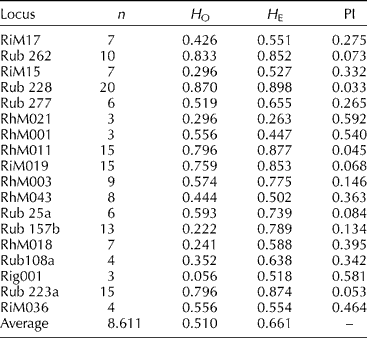
A total of 155 alleles were detected at 18 microsatellite loci. The number of alleles detected per locus ranged from 3 (RhM021 and RiG001) to 20 (Rub 228), with an average of 8.611 alleles per locus. The H O ranged between 0.222 (locus Rub 157b) and 0.870 (locus Rub 228), with an average of 0.510. The H E ranged between 0.263 (locus RhM021) and 0.898 (locus Rub 228), with an average of 0.661 (Table 2). Differences between observed and H E were observed at all loci. The largest difference was observed at Rub 157b (0.567) and the lowest at RiM036 (0.002). At 15 out of 18 loci, H O was lower than H E , but, at three loci (RhM021, RhM001 and RiM 036), H O was higher than H E .
Eighteen simple sequence repeat (SSR) loci analyzed and the parameters of genetic variability calculated for different microsatellite loci of 53 raspberry genotypes: number of alleles (n), observed (H O) and expected (H E) heterozygosity, and probability of identity (PI)

The most informative locus for the studied set of genotypes was Rub 228, having a PI of 0.033 and the least informative locus of Rig 001 with PI 0.581. The PI of a locus is the probability that two individuals share the same genotype at that locus. In general, we prefer loci with many different alleles that occur with roughly equal probabilities. That is, we want all alleles at the locus to have a small probability of occurrence.
The number of microsatellite markers sufficient for reliable cultivar identification depends on the nature and discriminatory power of each marker (Tessier et al., Reference Tessier, David, This, Boursiquot and Charrier1999). The allele sizes and frequencies for each locus are shown in Table S2 (available online).
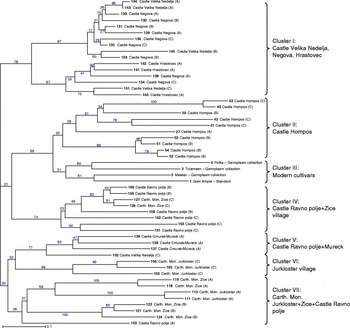
The neighbour joining cluster analysis based on microsatellite data arranged the analysed samples into seven main clusters (Fig. 2). Cluster I encompassed raspberries from [Q]North East (NE) Slovenia collected from around the walls of the Castles Negova, Hrastovec, and Velika Nedelja (positions A and B, Fig. 1), and in the corresponding nearby villages (position C, Fig. 1). The raspberries from this cluster represent traditional, locally grown, cultivated genotypes. The raspberries included in cluster II were collected along forest edges and around settlements on the NE slopes of the Pohorje mountains (c. 15–20 km from Maribor). These plants could be considered as primitive or semi-wild, characterised by very long canes and very aromatic and relatively small fruits. The smaller size of these fruits were at least partly caused by the high densities of the plants, competition with other plant species present within the plant community, absence of pruning and partial shade. Cluster III encompassed modern cultivars maintained in the gene-bank of the University of Maribor. Cluster IV included the genotypes collected around the Castle Ravno Polje, and two related genotypes that were found at a settlement near the abandoned Zice Carthusian monastery. The raspberries of cluster V were collected around the walls of the Castle Mureck (position A, Fig. 1), except for one sample originating from a village not far from the Castle Velika Nedelja. Cluster VI included the genotypes collected from settlements near the abandoned Jurkloster Carthusian monastery. The most probable medieval raspberries were included within cluster VII. According to relatively low bootstrap value, raspberries collected around the walls (position A, Fig. 1) of the abandoned Carthusian monasteries Zice and Jurkloster represent one genetically related group, except for accession 153 collected near the walls of the Castle Ravno Polje (position A, Fig. 1).
Dendrogram based on Dice's coefficient of genetic similarity among 53 raspberry genotypes. Bootstrap values are indicated for each node.

Discussion
When comparing clusters IV, V, VI and VII, we can assume that there was probably a considerable gene flow between the raspberry populations. Some of the raspberry genotypes cultivated around the two Carthusian monasteries were probably distributed to the local people (i.e. local peasants and people living in castles and other settlements). An example can be cluster IV, which suggests that, due to short distances (less than 30 km), there was an exchange of plant materials between the Zice Carthusian monastery and the Castle Ravno Polje. The most intensive exchange of raspberry material probably took place during the most prosperous period of the monasteries' history – between 12th and 15th century. When discussing the dissemination and heterogeneity of raspberry genotypes, we also have to consider birds and other animals that fed on raspberry fruits and distributed seeds around. In this way, the animals could have contributed significantly to the increase in heterogeneity, especially when taking into account the period of 300 or 400 years. The original medieval raspberries or their closely related descendants may also be found in clusters V and VI. Another candidate is accession 153 in cluster VII. However, morphological characteristics suggest that these genotypes do not differ much from modern cultivars. It is more likely that they are direct or indirect descendants of the original medieval Carthusian genotypes (i.e. genotypes from cluster VII, excluding accession 153, or genotypes which no longer exist). Raspberries are considered as allogamous plants (Frankel and Galun, Reference Frankel and Galun1977; Whitney, Reference Whitney1984.) and when they grew in a fertile garden soil, mixed with other genotypes, the hybrid plants had good chances to survive. If they were attractive for the growers, they were multiplied and gradually became traditional cultivars.
Morphological characteristics of the hypothetical medieval raspberries
Based on the dendrogram (Fig. 2), we can assume that accessions 118 and 119, collected close to the walls of the abandoned Zice Carthusian monastery, represent a group of genetically similar plants related to accessions 111 and 113 collected close to the walls of the abandoned Carthusian monastery Jurkloster. They are primitive, morphologically similar but different from the genuine wild genotypes (accessions 40 and 43 in cluster II). More probably, they represent abandoned cultivars that gradually adapted to their tough environments. They may also be descendants of direct or indirect genetic recombination between the original Carthusian varieties and primitive local genotypes. It is also possible that they have always been primitive and the monks cultivated them only as medicinal plants. In Medieval times, they were not cultivated as food plants (Hummer, Reference Hummer2010). The cultivation of raspberries for fruits appeared much later in the history and was closely associated with the genetic improvement aimed at bigger fruits. When taking into account the unfavourable environments, they are relatively vigorous. When they are transplanted to a fertile soil, they can be more than 2.3 m high. The canes are medium waxy, the lower and the upper parts of the canes are sparsely covered by short spines, the mid-parts are more or less completely smooth (except in short canes where the mid-parts do not differ from the lower- and upper-parts) and large spines are absent. The fully developed leaves are 15–25 cm long, about one-third of this length belonging to the leaf petiole, the leaf petioles have sparse spines, there are more spines on the leaf rachis and the number of leaflets is generally five (three or four leaflets are rare and more frequently appear on short, stunted canes, in late summer and autumn). Inflorescences are generally loose, the flowers are relatively small, the fruit setting is poor (probably because of the tough environment), the fruits are small but very aromatic (more than those of modern cultivated varieties) – ovoid to conical, the druplets are medium soft, their colours vary from light red to red depending on exposure to sunlight and removal of the fruits is easy.
If we consider that these accessions represent cultivars abandoned long ago, it is difficult to explain how these cultivars returned to such a primitive stage without or with very rare seed propagation. After raspberry gardens were abandoned, there was probably very high environmental pressure on the remaining raspberry plants. Complex interactions between the genetic structures of plants and their environments resulted in gradual, probably slow, changes due to occasional genetic recombination (hybridisation and/or self-fertilisation), mutations and especially epigenetic processes. What we can see now is that the remaining plants have become less productive (less and smaller fruits) but have kept good fruit flavour and growth vigour. Lower productivity within unfavourable environments represented an advantage because more energy and assimilates could be used for vegetative growth and vegetative propagation.
A similar case was described in New Caledonian taro (Colocasia esculenta (L.) Schott) populations (Ivancic and Lebot, Reference Ivancic and Lebot1999). The isozyme and morphological analyses of vigorous plants grown in the wild in one of the isolated river valleys on the East Coast of the Grande Terre (the largest and principal island of New Caledonia) showed that they represented a separate group which was different from local wild genotypes and cultivated varieties. It was assumed that they could represent the remnants of an early domestication that had taken place before the first cultivars were introduced from other Melanesian islands. With the introduction of new, better cultivars, the original cultivars (i.e. early domesticated genotypes) were left in the wild. Plants have been propagated vegetatively probably for many centuries (seed propagation of taro is much less frequent than in raspberries) and, in order to survive, they had to adapt to the existing environmental conditions: they had to reduce corm size and quality, and retain vigorous growth.
Conclusion
The history of the medieval raspberries is far from being simple. Some of the genuine medieval genotypes, due to predominant vegetative propagation, might have preserved their genetic identity for a very long period of time. The most closely related to the genuine medieval raspberries are probably the genotypes collected close to the ruined walls of the abandoned Carthusian monasteries Jurkloster and Zice. Based on our molecular and morphological data, it is not possible to conclude whether some of these hypothetically medieval genotypes are truly medieval, which survived at least three centuries without seed propagation. However, if they are not genuine medieval genotypes, they are most probably their closely related descendants. They are not very productive because of small fruits, but they can be used as medicinal plants and/or as sources of genes in breeding for adaptability to unfavourable environments.
Supplementary material
To view supplementary material for this article, please visit http://dx.doi.org/10.1017/S1479262115000209
Acknowledgements
This study was supported by the European Union-funded project QualiRedFruits (New agricultural practices for quality production of red fruits enriched in healthy compounds; Grant Agreement number: 262030, Funding Scheme: FP7-SME-2010-1).