In Presidential Power, Richard Neustadt argued that a president's “public prestige” was shaped not by marketing or attempts to boost his image, but rather by external events largely beyond his control (Reference Neustadt1991, 83). Nevertheless, American presidents continually try to mold their public reputations, particularly as elections approach. The 2012 campaign will be no exception. Although the state of the economy will powerfully influence president Barack Obama's reelection prospects, the president will likely seize any opportunity to improve his image in what is shaping up to be a real dog fight.
It is therefore no surprise that President Obama's campaign staff would jump on an issue that goes to the heart of the character of his Republican rival: how he treats his dog. After New York Times columnist Gail Collins (Reference Collins2007) hammered former governor Mitt Romney for driving to Canada for his family's summer vacation with his crated dog strapped to the roof of the car, David Axelrod, a top official in the president's reelection campaign, tweeted a photo of Obama in the presidential limousine with his dog, Bo, captioned “How loving owners transport their dogs” (Axelrod Reference Axelrod2012). The Times also featured Bo in a front-page article about Obama's attempts to be seen as an “everyman” in the campaign (Leibovich Reference Leibovich2012). Such anecdotal evidence, backed not only by systematic analysis of voting behavior (Mutz Reference Mutz2010) but also by a voluminous library of compelling insider accounts (e.g., Millie 1990; Socks 1993), provides powerful evidence that the First Family's four-legged members are an important political force.
Political scientists, however, have been slow to get the message.Footnote 1 Consider the vast international relations literature on diversionary war. When presidents facing tough times try to distract the public by waging war, we call it the “wag-the-dog” effect, after the 1997 movie in which a president concocts a fictional war to distract attention from a sex scandal. The diversionary war literature has bred divergent theoretical positions and empirical findings (Fravel Reference Fravel2010). The entire literature suffers, however, from an obvious, yet unappreciated, deficiency: “wag-the-dog” theory inexplicably ignores dogs. It seems that wag-the-dog theorists have been barking up the wrong tree.
Such theoretical and empirical gaps speak to a larger disciplinary failing: dogs (and pets more generally) feature little in serious political science research. As a preeminent pet researcher lamented in her seminal work highlighting the advantage that Republican candidate John McCain held over Obama in the dog-owner vote, “Despite their high profile once in office, there is little empirical evidence as to whether or why dogs matter either to electoral prospects or to a president's success once in office” (Mutz Reference Mutz2010, 707).
In this article, we attempt to fill the hole political scientists have dug by using a multimethod approach to shed light on the strategic use of presidential pets. First, we draw on primary source materials to demonstrate that pets are an important power center in the White House. Then, we turn to presidents' strategic use of their pets in public. We present a theoretical framework and statistical evidence to explore the conditions under which presidents are most likely to trot out their four-legged friends. Throwing a bone to the diversionary war literature, we show that presidents carefully gauge the best and worst times to conduct a dog and pony show. In times of war or scandal, dogs are welcome public companions, but not so in periods of economic hardship. In short, we find significant support for Harry Truman's famous adage that “if you want a friend in Washington, get a dog,” even if it is occasionally necessary to confine it to the doghouse.Footnote 2
EXECUTIVE POWER: THE NEGLECTED ROLE OF PETS
Evidence abounds that presidential pets are an integral part of White House political strategy. In a 1944 speech, Franklin Roosevelt defended himself against charges that he sent a US Navy destroyer to fetch his dog, Fala, from the Aleutian Islands after accidentally leaving him behind. “Well, of course, I don't resent attacks, and my family doesn't resent attacks, but Fala does resent them,” Roosevelt told a union audience. “I am accustomed to hearing malicious falsehoods about myself…. But I think I have a right to resent, to object to libelous statements about my dog” (Roosevelt Reference Roosevelt1944). Eleanor Roosevelt (Reference Roosevelt1949, 336) credited the speech with laying the foundation for FDR's reelection. Richard Nixon salvaged his political career with the 1952 “Checkers” speech, defiantly telling Americans that he would not return a dog recently given to his family. And who can forget the famous photo of the Clintons walking to Marine One, with their dog Buddy shoring up the image of family unity, just one day after the president admitted to having a relationship with Monica Lewinsky?
These claims find support in the rich presidential pets literature, which offers a number of insights into the political roles pets play in the White House. These ground-level accounts of political life in and around the Oval Office suggest convincingly that these members of the presidential family wield considerable influence. After all, President Garfield named his dog after the most important of presidential powers—Veto.
First, the literature demonstrates that presidential pets are key White House advisers. For example, many First Pets have marked their territory by sitting in on White House meetings. George H.W. Bush's dog Millie regularly attended morning briefings in the Oval Office (Millie 1990, 29). Presumably, these pets play an important watchdog role in the executive branch, given how closely presidents guard access to the Oval Office and how zealously advisers jockey for position in presidential meetings. Second, far from serving merely as gatekeepers, these presidential aides often push their own pet issues. In an (apparently unauthorized) autobiography, for instance, Socks the cat (a key figure in the Clinton administration) claims to have “dabble[d] in foreign policy,” stepping on the phone to force Clinton to hang up on a foreign leader (Socks 1993). Clinton's dog Buddy was said to “get away with some things that other presidential advisers would not dare try,” even resorting to running laps around the Oval Office rug when he “decided that he wasn't being paid enough attention” (Clinton Reference Clinton1998, 59).
Furthermore, presidential pets' unparalleled access means that they may be among the best-informed White House operatives, able to ferret out presidential intentions that other advisers might miss. One savvy young citizen wrote to Socks, asking, “Is there going to be a war in Iraq?” (Erik to Socks, reprinted in Clinton Reference Clinton1998, 157). Pets may also control presidential patronage. An aspiring young law-enforcement official wrote to Socks, asking, “Can you get me a job in the FBI?” (Gregory to Socks, reprinted in Clinton Reference Clinton1998, 109). Indeed, some political pets have developed reputations as fixers. In his memoir, senator Ted Kennedy's dog Splash—a Portuguese water dog—recalls barking at a strategic moment in a conference committee meeting, inducing a legislative compromise, rather than letting Kennedy's side roll over (Splash 2006).Footnote 3 He is also alleged to have used his family connections to get Bo—a distant relative—his position in the White House.
We admit that First Pet accounts can be methodologically problematic. Scholars must take exceptional care in drawing inferences from memoirs. One important concern is partisan bias—pets may simply parrot the party line. Indeed, some First Pets were battle-hardened campaign veterans: George H.W. Bush's dog, C. Fred Bush (Reference Bush1984, 44), for instance, recalls in his memoir that he sat in on all the campaign meetings during the summer of 1979, as Bush geared up for a 1980 run. Like any good candidate, C. Fred had burnished his foreign policy credentials with a stint in China during the Ford administration. Other pets are rabid partisans. Millie, no Blue Dog Democrat, attended a Republican “pet fete” with many other Republican dogs; Millie (1990, 22) reports that her efforts “made me feel that I was giving my all for George.” First Pet accounts raise other concerns that could threaten causal inference: presidential pets keep shoddy records, recount details with odd selectivity, and respond to events with inappropriate exuberance. They are also prone to self-aggrandizement: many appear to have shopped their manuscripts while still in the White House.
Scholars must also recognize that these research materials are sometimes marred by score-settling. Pets use their books to ruffle the feathers of their former political and bureaucratic adversaries. In Dear Socks, Dear Buddy (Reference Clinton1998, 46), for example, Socks is said to have cat-napped “on a wing chair in the receiving room just outside the Oval Office” and is frequently depicted on the outside of the Oval Office looking in, whereas Buddy sits in on Oval Office meetings. Such images are catnip for the bureaucratic politics argument that “where you stand depends on where you sit” (Allison and Zelikow Reference Allison and Zelikow1999). Given the well-known history of bad blood between Buddy and Socks, however, it remains unclear whether Buddy actually had the president's ear, or instead inflated his role as top dog.Footnote 4 There is no need to revisit the volatile dog-cat debate here, which often takes unproductive turns and ends badly for one side or the other. Suffice it to say that cats have a point when they surmise that dogs are prone to grandstanding, attention-seeking, and an inordinate need to please. Consequently, it is unsurprising that Millie would seek to highlight her role in Bush's campaign, Splash (2006) would fondly recall appearing at Senator Kennedy's press conferences, and Buddy would repeatedly remind readers of his insider access to the Oval Office. First pets may also play a role previously thought to fall primarily to the vice president: attack dog tasked with hounding the president's political enemies or tarnishing the legacies of previous occupants of the White House. Thus, Socks (1993) gleefully admits (through an admittedly dubious source) to breaking Nancy Reagan's china.
From our perspective, such problems with primary sources do not impugn their value, nor the general worthiness of pet-related research. Rather, they highlight the importance of using multiple methods to ensure that presidential pets' political influence passes the sniff test. We thus turn to the First Pets' public role, a focus that allows us to formulate statistically testable hypotheses.
DIVERSIONARY DOGS? A THEORETICAL FRAMEWORK
Presidents undoubtedly rely on their furry friends for political advice and enforcement. They may also use their pets as part of the White House communications strategy. To maximize good feeling, one might imagine that presidents would seek to choose the most adorable pets possible and make regular, public demonstrations of affection. But as one observer recently noted, “the political dogs for the ages are not necessarily the most loved, but the ones that have been used most effectively as makers of points or diffusers of scandal” (Davidson Reference Davidson2012). Presidents, it seems, may be strategic in how they publicly use their pets.
Our theoretical framework draws inspiration from the literature on diversionary war, which argues that presidents try to use war to distract the public during economic dog days. We build on this literature in two ways. First, contrary to extant work that focuses almost exclusively on negative mechanisms (e.g., war) for distracting the public, we also assess the more positive ways in which the president might try to distract or reassure the public. Second, we focus on the conditions that lead presidents to alternately hide or unleash their pets to divert the public's attention.
War provides presidents the opportunity to demonstrate leadership when their stewardship of the economy falters. Similarly, pets serve as a signal of steadfastness in wartime. In times of crisis, the American people want a steady hand at the helm. How else to establish that a president is in charge than seeing the commander-in-chief confidently playing fetch with a four-legged companion in the middle of the afternoon? Likewise, we expect to see First Pets let out of the White House more often in periods of presidential scandal or monkey business. What better way to get back in our good graces than for the president to be seen, alone, with only one loyal friend? Who are we to judge the president when the one who knows his soul can forgive him?
It is not always politically wise, however, for the president to trot out the First Pet. We contend that pets serve a valuable function in hard economic times simply by playing possum and staying out of sight. We surmise that diversionary pets are a political liability when their frolicking on the White House lawn in hard times might cue the public that not everyone in the country is suffering equally and that being president is not a full-time job. Does a president want to be seen playing fetch with a pampered pooch when the nation is dogged by a plummeting economy? We therefore hypothesize that mentions of presidential pets in the media are more likely in times of war or scandal, but less likely when the economy sours.
METHODS AND ANALYSIS
We test our hypotheses using a new data set of mentions of presidential pets between January 1961 and January 2011 in the Washington Post and the New York Times (to account for variation across media sources).Footnote 5 The data set captures all articles mentioning presidents' cats or dogs, and records whether each article concentrates primarily, partially, or merely incidentally on the pet. We also code whether the article discusses a White House cat or dog. For our dependent variable, we aggregate pet mentions by month.
Figure 1 shows the pattern over time. Clearly, Millie, Socks, and Buddy brought needed attention to pets in the White House in the late 1980s and early 1990s, rescuing the press from doing its business of covering far more pedestrian matters. Although the press redirected its focus—for some reason—in the George W. Bush administration, the Obama administration brought new attention to these principal White House players.
Number of Newspaper Reports on Presidential Dogs and Cats, Washington Post and New York Times (Combined), January 1961–January 2011

Purr the literature on diversionary war, we control for factors likely to influence the strategic appearance of White House pets. First, we use the Correlates of War data to create a dummy variable that denotes whether or not the United States was involved in a given month in a militarized international dispute (1 yes, 0 otherwise). Second, we create a dummy variable to denote whether or not a major White House political scandal or controversy broke out during the month (1 yes, 0 otherwise), as gleaned from a variety of sources.Footnote 6 Third, we control for both monthly US economic performance (including both the inflation and unemployment rates) and presidential approval ratings. In these analyses, the most recent data are substituted for missing data for the independent variables. We use a one-month lag for the approval and economic variables (given the lag time in the release of relevant statistics) and the scandal indicator (given an allowance for the weeks required for the president to shift into “recovery” mode). Furthermore, presidential transition months are excluded given the heightened coverage of the new White House occupants that accompanies the transition.Footnote 7
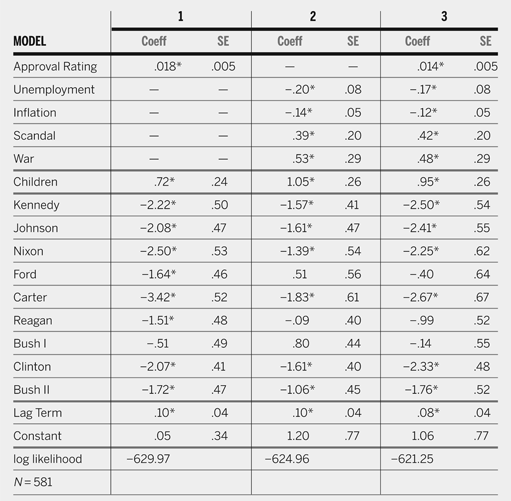
Table 1 presents our findings for the Kennedy through Obama administrations through January 2011. Given the count nature of our data, we use negative binomial regression. All versions of the model use fixed effects for each presidential administration (the Obama administration is the reference category), a dummy variable that accounts for the presence of young children (virtual pet magnets) in the White House,Footnote 8 and an endogenous lag term that controls for a possible contagion effect of pet coverage whereby stories about the travails of a pet unfold in serial fashion. We note that we did not generate statistically significant results for our independent variables of interest when we assessed articles that were specifically written about a given White House pet. This is unsurprising inasmuch as these articles are presumably fluff pieces and pets likely play their role by serving as a “backdrop” to the White House message. Consequently, pets matter politically when they appear in stories that are only partially about them or in stories in which they make a cameo or “incidental” appearance. In addition, most of the central coefficients are insignificant when the analysis is limited to stories that pertain only to cats. The findings are also strongest when combining articles that appear in the Washington Post and the New York Times. This likely reflects the skewed priorities of newspaper editors who choose to underreport presidential pet news, covering crises or natural disasters instead. For that reason, we combine these articles in the analyses that we report in table 1.
Negative Binomial Regression Models of the Effects of Political, Military and Economic Variables on the Number of Newspaper Reports on Presidential Dogs and Cats by Month, March 1961–January 2011

* p ≦ .05 (one-tailed test for hypothesized relationships; otherwise two-tailed). Reports are for combined incidental and partial reports, drawn from the New York Times and Washington Post. Data begin in March 1961 since the month of the transition and the following month are excluded.
Model 1 in the table represents a baseline. It shows that higher presidential approval ratings are conducive to greater incidental and partial pet coverage (indeed, approval is a significant predictor of each variety, when the types of coverage are modeled separately in unreported analyses). In short, an approving public increases the profile of White House pets. The model establishes further that the presence of young children and the endogenous lag terms are positive and statistically significant influences. Given that Obama is the reference category for the dummy variables, the positive and significant constant term and the nearly universal negative and significant coefficients for the presidential dummies indicate that Bo and the highly publicized quest for a White House companion for Malia and Sasha Obama represent a political high water mark for presidential pet coverage. The White House may have been compensating for Obama's 2008 campaign promise to get his daughters a dog—a promise that previous scholarship has shown to have unintentionally drawn attention to Obama's petlessness, thereby costing him votes among dog owners (Mutz Reference Mutz2010). The coefficient for the George H.W. Bush administration is negative but statistically insignificant in the model. Thus, Millie's public presence fails to match her literary profile.Footnote 9
Model 2 in the table provides insights into the conditions under which presidents are more likely to milk their pets for publicity. On the economic front, higher unemployment and higher inflation rates are negatively and significantly associated with combined incidental and partial pet coverage in the model (as is true, too, when the model is limited to partial or incidental pet coverage). This finding confirms our hypothesis that pets are muzzled in economic downturns. The table also reveals two factors that can boost a White House pet's profile. Both US involvement in a militarized dispute and a presidential scandal are positively and significantly related to increased pet coverage. We concede that our measures of war and scandal are somewhat blunt instruments in the model. The United States was involved in a militarized dispute in the great majority of months in our analysis and the involvement in a dispute says little about whether a conflict is going well for the United States or if the public approves of US involvement in combat. Moreover, scandals and controversies often lack clear beginnings and endpoints, sometimes persist over long periods, or subside and then flare up again with new disclosures. For these reasons, the approval variable—which is excluded from the model because it is influenced directly by economic conditions, war, and scandal—likely captures much of the variance that is linked to influences of interest. But our results do not merely reflect a dogged effort to find significance. Indeed, the results in the table for model 3 establish that when inserting public approval in the model, scandal, war, and the economic indicators remain significant variables and signed in the predicted direction.
Thus, as expected, a harsh economy is not a friend to pets who seek an active and visible presence on White House grounds; scandal and war are favorable to pets who seek the public company of their presidential owners. These pets must be willing to share that company with a gaggle of nosy journalists and to overcome the suspicion that maybe, just maybe, they are being used.
CONCLUSIONS
This article represents an important step toward remedying a woeful deficiency in the literature that can only fuel criticism that political scientists construct models that are divorced from political reality. Political scientists have searched for years for the “dogs that didn't bark,” while ignoring those that did—perhaps within earshot of a reporter. We view our findings as an important contribution to a research program that will bring the dog into political analysis.
We establish that presidential pets serve their masters in a heretofore underappreciated political capacity. Whatever their pedigree, they are unquestionably a mixed breed with an unusual combination of skills. In addition to their insider influence, pets serve the president in hard economic times by staying out of sight; in challenging political and military times, pets stand alongside the president as a reassuring public presence. In time of war, they tell the country that they and the rest of the nation are in good hands. In times of personal scandal, they convince us that the president is “only human.”
We conclude with several cautionary tails. First, our more robust findings relate to the effects of economic indicators and presidential approval ratings on newspaper accounts that make partial or incidental reference to pets. Second, we recognize that reporters might actually increase their pet reporting in good economic times or when presidents are popular. This could lead to the conflating in analysis of presidential pet-showing and newspaper pet-reporting practices. We note, however, that the press could as easily increase pet reporting when times are tough or when presidents are unpopular, and that the president chooses to have a Millie, Buddy, or Bo around when reporters are watching. In future research, we hope to disentangle these causal linkages by obtaining pet-appearance schedules (through Freedom of Information Act requests). Finally, we do not observe an identifiable “cat” diversionary effect. This will be unwelcome news to the feline's partisans in the dog-cat debate. Although Socks clawed and scratched his way through the cat ceiling, his kind has a long way to go before they achieve equality in the White House inner circle. This is not necessarily good news for those who value generalizable findings. Our hope is to avoid excessive specialization, the dissent into rival camps, and the proliferation of unproductive “isms” within this emerging research program.
ACKNOWLEDGMENTS
We gratefully acknowledge the contribution of the late Lee Sigelman, who inspired this study, among so many other things, in a casual lunchroom conversation. We are pleased to bring the work he began on this project to fruition. We also thank John Sides for harnessing the graphical potential of our data, as well as Sarah Binder, Christopher Deering, Martha Finnemore, and many other colleagues at George Washington University for comments and advice. We acknowledge the excellent research assistance of Matt Smith.