Although economists concur that international trade is mutually beneficial to both the United States and its trading partner countries, the American mass public does not share this consensus. As a result, perceptions of trade “winners” and “losers” may influence public preferences, particularly among people with a tendency to favor their in-group over potential out-groups. Concepts closely related to in-group favoritism have been proposed as explanations for trade preferences in the past. For example, surveys have found trade opposition related to personality characteristics such as authoritarianism,Footnote 1 ethnocentrism,Footnote 2 and a sense of national superiority.Footnote 3 Although these are distinct concepts, all three share the tendency to think in rigid, “us-versus-them” terms—they are all tendencies toward in-group favoritism. Unfortunately, the observational nature of past evidence has made it difficult to draw causal inferences about these concepts in relation to trade preferences.
Our representative national survey experiment provides an opportunity to evaluate the potential influence of two distinct forms of in-group favoritism. First, we evaluate the well-known tendency to favor one's national in-group in absolute terms; in other words, even if one trade policy produces the same total benefits as another, citizens will support the policy more if it benefits citizens within their own country. Second, we examine the role of in-group favoritism for the relative gains acquired by the in-group state compared to out-group states. In this case, in-group favoritism drives trade preferences only to the extent that one's in-group benefits relative to the out-group. This form of in-group favoritism suggests that even a win-win trade scenario may not be enough to generate support unless the in-group gains more than the out-group. A third hypothesis test facilitated by this experiment is the causal influence of the “sociotropic” perception of trade's impact. In observational studies, perceptions of collective national conditions with respect to trade have been proposed as independent causal influences on citizens’ trade preferences.Footnote 4
However, some scholars suggest that causality runs in the reverse direction, with people's trade preferences distorting their perceptions of how trade affects the country:
If people have attachments to organized interests or other individuals who present these political arguments, they might form their opinions about trade policy first, based on these group attachments. These opinions could then shape their beliefs about the economic impact of trade. In short, trade policy attitudes might influence individuals’ assessments of how trade affects their family as well as the country as a whole.Footnote 5
This possibility obviously cannot be ruled out except through experimental manipulation of whether the US is perceived to benefit from trade. Fortunately, the same independent experimental manipulations of a policy's impact on the national in-group and on national out-groups also facilitate a causal test of the sociotropic hypothesis. If trade preferences change as a result of this treatment, then we can be confident that sociotropic perceptions do, in fact, drive trade preferences. It would be difficult, if not impossible, to experimentally manipulate the extent of a person's tendency toward in-group favoritism. But to accomplish the same end, we can instead manipulate what in-group favoritism feeds upon, that is, the perceived benefits of trade policies for in-group and out-group countries. By independently manipulating the perceived benefits of trade for both in-group and out-group countries, we accomplish all three goals.
In-group Favoritism in the Context of Trade
We hypothesize that an individual's proclivity toward in-group favoritism plays an important role in influencing his or her trade preferences. A few previous surveys indirectly suggested this potential impact. For example, a standard measure of race-based ethnocentrism was found to predict trade attitudes in a large national survey.Footnote 6 A measure of how positively whites, blacks, and Hispanics feel about their own in-groups relative to the other two domestic racial out-groups negatively predicted support for trade, even after including a large set of control variables. There is no obvious reason why a measure of how domestic blacks, whites, and Hispanics feel about one another should have anything to do with preferences for international trade. However, to the extent that this measure taps a more general tendency to favor the in-group over the out-group, to think of the world in us-versus-them terms, it makes sense that those high in race-based ethnocentrism should extend their out-group animosity to people of other countries. Another possibility is that race-based ethnocentrism affects trade preferences indirectly because when Americans think of trading partner countries, they think primarily of countries such as China, where most citizens are also of another race/ethnicity.
In an experimental study attempting to link racial prejudice to trade preferences, American respondents were told about a policy that would potentially ease trade restrictions. The company that would be positively affected by this policy was given either a “culturally familiar” name (widely believed to be British) or an ambiguously foreign-sounding name (believed to be African or Asian).Footnote 7 Results demonstrated no main effect of the company name on trade preferences; however, prejudiced respondents were more likely to report protectionist views when assigned to the condition with the culturally foreign-sounding company name.
While these results are consistent with the theory that in-group favoritism drives trade preferences, they leave open the possibility that manipulating the assumed nationality of the company reduced support for trade liberalization for other reasons. Americans are clearly more positive about trade with some countries than with others, and many factors may account for this—perceived military threat, past intercountry relations, and government ideology—to name just a few possibilities.
The fact that nationalistic sentiments are related to trade preferences is also consistent with the general in-group favoritism thesis. Nationalism has been operationalized in many different ways, but when tapped as a belief that American citizens are more deserving than citizens of other countries (as opposed to a sense of patriotism or pride in one's country or government), it also serves as an indicator of perceived in-group superiority. A number of observational studies have found nationalism predictive of anti-trade attitudes.Footnote 8 Moreover, to the extent that authoritarianism is closely related to in-group-out-group modes of thinking,Footnote 9 the significant relationship between authoritarianism and preferences for trade protectionismFootnote 10 is also consistent with our thesis. But due to reliance on cross-sectional associations, it remains possible that negative attitudes toward trade and the general perceived threat of globalization may be producing increased ethnocentrism and nationalism rather than the other way around.
In another study seeking to establish that non-economic considerations influence trade attitudes, Margalit primed “perceived cultural threat” by preceding a question about trade preferences with questions about social and cultural threat.Footnote 11 Although the cultural prime threat did not have any direct effect on trade preferences, there was some evidence of effects among those with low levels of education.
At the core of the closely related psychological constructs we describe (prejudice, ethnocentrism, nationalism, and authoritarianism) lies the general tendency to see the world in in-group-versus-out-group, us-versus-them categories. This pervasive human tendency is known to affect many political and social attitudes,Footnote 12 but precisely why and under what circumstances it should affect trade preferences is not clear. Nationality is an important social identity for most Americans.Footnote 13 Given that even minimal, meaningless forms of social identity can provoke in-group favoritism,Footnote 14 it should not be surprising if national identity does the same.
Two Forms of In-group Favoritism
We hypothesize that two different forms of in-group favoritism have the potential to affect trade preferences. The first, which we dub compatriotism, refers to the tendency to favor in-group members strictly because they are citizens of the same country; in other words, people value the well-being of their compatriots over that of other strangers who do not share their nationality. Importantly, if one favors one's family members or a friend over unknown people in other countries, this is not compatriotism. The essence of compatriotism is that people categorically favor one group of unknown strangers over another purely because of their membership in the group.
Evidence of compatriotism occurs when people's preferences follow a strategy of maximizing in-group benefits rather than maximizing collective benefits or, in the case of trade, national benefits rather than global ones. In The Betrayal of the American Dream, Bartlett and Steele advocate precisely this form of in-group favoritism.Footnote 15 As they recount, a global hedge fund investor reported that “his firm's investment committee often discusses the question of who wins and who loses in today's economy … His point [the CEO explained] was that if the transformation of the world economy lifts four people in China and India out of poverty and into the middle class, and meanwhile means one American drops out of the middle class, that's not such a bad trade.”Footnote 16 Indeed, this represents a net gain of three good jobs. But, as the authors continue, “the only problem is that no one told working Americans they were going to forfeit their future so that people in China, India, Brazil and other developing countries could become part of a global middle class”Footnote 17 There is a net gain in collective well-being in this example, but this is deemed undesirable because it does not favor the in-group.
We call a second form of in-group favoritism with the potential to affect trade attitudes intergroup competition. This prediction suggests a tendency to favor the national in-group relative to other countries so as to maximize the relative advantage for one's own country. In other words, people will make choices to maximize the difference between the extent of in-group and out-group benefits rather than maximizing the extent of in-group benefit.
In some situations, intergroup competition even prompts people to disadvantage their own in-group to maximize their advantage relative to an out-group. This tendency has been dubbed “Vladimir's choice,” by Sidanius and colleagues,Footnote 18 based on an Eastern European folk tale in which a peasant is told by God that he will be granted any wish under the condition that whatever he is given, his neighbor Ivan will be given twice over. Vladimir cleverly decides to request that God take out one of his eyes. As irrational as this choice may seem from the perspective of self-interest, it accomplishes the end that Vladimir sought: to ensure that he was better off than his neighbor. A surprisingly consistent line of researchFootnote 19 shows that some people choose based on intergroup competition “even when doing so clearly minimizes absolute in-group gains.”Footnote 20
Vladimir's choice is unlikely to characterize the majority of preferences, but the likelihood of exhibiting this preference increases (a) with higher levels of perceived intergroup competition and (b) with higher levels of social dominance orientation.Footnote 21 Because intercountry competition is frequently referenced in the context of international trade, we expected to see this pattern of in-group favoritism primary among those who view trade to be a “zero-sum” policy in the sense that if one state gains, another must lose. Likewise, the tendency to make choices with an eye toward one's relative in-group advantage is known to be related to social dominance orientation, that is, the tendency to value hierarchy over equality. As Sidanius and colleagues suggest,Footnote 22 “the greater one's desire to maintain and establish group-based social hierarchy, the more likely one should be to endorse the relative advantage of dominant groups over subordinate groups.”Footnote 23 Thus we also predicted that Americans high in social dominance orientation would be especially likely to oppose trade even when the US benefits, if they perceive that the trading partner country also benefits, thereby canceling out the relative advantage.
By systematically altering which countries are said to gain or lose from a given trade policy (Americans and/or people in US trading partner countries), our experiment varies the role of in-group favoritism in influencing trade preferences. To test the compatriotism hypothesis, we hold constant the extent of total job gains resulting from trade, but vary which country gains and which country loses jobs. In addition to expecting a main effect of compatriotism, we expect that those with especially high levels of perceived national superiority will be particularly likely to view their compatriots as more deserving than those in other countries.
To test the intergroup competition hypothesis, we hold constant the extent of US job gains from a trade policy, but systematically vary whether the trading partner country also gains. The intergroup competition hypothesis predicts that even when the US in-group gains equally across two conditions, Americans’ support for trade will be lower if the trading partner country also benefits. Counter to intuitive expectations about the desirability of “win-win” trade agreements, we predict that Americans high in social dominance orientation will be more likely to support a trade policy that benefits the US and hurts trading partner countries than one that helps both the US and trading partner countries. Likewise, among those who view trade's impact on jobs in competitive, zero-sum terms, trade will be supported more when it benefits the US, but not the trading country, relative to when it benefits both the US and trading partner countries.
Research Design
Data for this population-based survey experiment were collected by GfK Research, which maintains a random probability sample of respondents who periodically answer short surveys.Footnote 24 Pre-experiment data were collected as part of a standard survey in October of 2013 with a sample size of 3,170 respondents. Survey respondents were asked a variety of questions about their trade preferences, as well as their perceptions of trade's impact on the US and trading partner countries. This survey was used to assess levels of social dominance orientation and national superiority given that these characteristics were expected to enhance the likelihood of in-group favoritism.
By separating the survey and survey experiment by two to three months, punctuated by other commercial survey requests of these same respondents, the experimental results could not be influenced by the earlier survey questions. In December of 2013, these respondents were recontacted for the population-based survey experiment (n = 2,350). At this point, specific trade policies were described as under consideration, with varying gains and losses for the US and for trading partner countries.Footnote 25
We chose employment as the dimension of gain/loss to manipulate for experimental purposes because Americans evaluate trade primarily through the lens of its impact on employment.Footnote 26 Thus our goal with the experimental treatments was to alter perceptions of a given trade policy's effects on unemployment so that we could systematically alter the number of people in the in-group and out-group who were perceived to gain and lose.
In all statistical models we include a covariate that represents the respondent's general attitudes toward trade when asked several months before the initiation of the survey experiment. At that time, respondents were asked five separate questions previously used to tap attitudes toward international trade.Footnote 27 A factor analysis confirmed that these items tapped a single underlying pro- versus anti-trade construct. Given the high levels of consistency in pro-globalization or anti-globalization sentiment among answers across these five items (Cronbach's α = .83), they were combined into pre-experiment trade preference index, representing respondents’ trade preferences before the experiment. Reliability is increased with multiple item measures so long as they tap the same underlying construct, as was the case here. Pre-existing preferences on trade served as a powerful covariate to increase the efficiency of the experimental design in the population-based survey experiment that took place months later.
The pre-experiment survey also included measures of social dominance orientation,Footnote 28 a scale that is not specific to any nation or group, and perceived national superiority (see Appendix A). To assess whether respondents perceive trade to be zero-sum, with one nation gaining at another's expense, the pre-experiment survey also asked respondents about their perception of whether trade generally helped or hurt employment in the US, and whether it helped or hurt employment in trading partner countries. Those who perceived it to help one country while hurting the other were coded as having a zero-sum perception with respect to trade's influence on jobs, while all others were coded as 0.
The basic design of the survey experiment involved three conditions representing who gains/loses: (1) the US gains jobs while the trading partner loses jobs, (2) the US loses jobs while the trading partner gains jobs, and (3) the US gains jobs and the trading partner also gains jobs. By manipulating these perceptions experimentally, we test three causal hypotheses involving explanations for trade preferences outside the usual self-interest paradigm.
First, to evaluate whether sociotropic perceptions influence trade preferences, we compare levels of trade support in the two conditions in which the US benefits versus loses. Importantly, because respondents are randomly assigned to the three conditions, differences in objective or subjective self-interest will cancel across conditions, and we also eliminate the possibility of reverse causation.
Second, to test the compatriotism hypothesis, we compare the condition in which the trading partner gains and the US loses a given number of jobs, to one in which the trading partner loses and the US gains the same number of total jobs. The total number gained or lost is held constant, but who gains and who loses systematically varies across conditions.
Third, for purposes of the intergroup competition hypothesis, we compared the condition in which the US gains and the trading partner loses, to the one in which the US gains and the trading partner also gains. In this comparison, we hold constant the benefit to the US, but vary the benefit to the trading partner country. This allows us to evaluate whether people care primarily about how their own country fares relative to the trading partner—in which case they should express stronger support for the policy in the US Gains/Trading Partner Loses condition, or about absolute gains—which are greatest in the US Gains/Trading Partner Gains condition.Footnote 29
Finally, after reporting their levels of support for the specific trade policy they were assigned, a final question asked respondents what thoughts they had while evaluating the trade policy. This open-ended thought-listing promptFootnote 30 was used to add further insight into the thought processes involved in evaluating trade policies. Respondents simply described in their own words what went through their minds in deciding whether or not the policy described should be supported or opposed.
Manipulation checks were included at the end of the survey experiment after the dependent variable had been assessed.Footnote 31 These checks verified that the manipulations worked as intended. Perception of trading partner gain was overwhelmingly greater in the US Loses/Trading Partner Gains condition than in the US Gains/Trading Partner Loses condition (F = 749.86, p < .001). Likewise, the perception of US gain in the US Gains/Trading Partner Loses condition relative to the US Loses/Trading Partner Gains condition was significantly different as intended (F = 908.46, p < .001). For the Intergroup Competition hypothesis, it was important that the US Gains/Trading Partner Loses and US Gains/Trading Partner Gains condition differed significantly in the extent of perceived gains to trading partner countries.Footnote 32 Again, the manipulation check was clearly significant (F = 355.23, p < .001).Footnote 33
Results
To test our hypotheses, we began by evaluating the two experimental main effects; the three who gains/loses conditions constituted one experimental factor and the seven extent of gain/loss conditions constituted the second factor in a full factorial analysis of variance.Footnote 34 Next we examined the interactions of the who gains/loses conditions with the characteristics hypothesized to exacerbate these effects if our theoretical predictions are correct. We relegate details on the full experimental models to Appendix C.
Is the Sociotropic Relationship Causal?
Do individual beliefs about the impact of trade on the nation as a whole influence trade policy attitudes as Mansfield and Mutz contend?Footnote 35 The main criticism leveled against their evidence is that even though it controls for both objective determinants of economic interests and respondents’ subjective beliefs about their self-interest, “it is not clear that the independent variable is causally prior to the dependent variable.”Footnote 36 We have circumvented this problem by experimentally altering respondents’ beliefs about the impact a trade policy will have on the US. We also used respondents’ general pre-experimental trade preferences as a covariate in the model, thus further accounting for pre-existing tendencies to support trade.
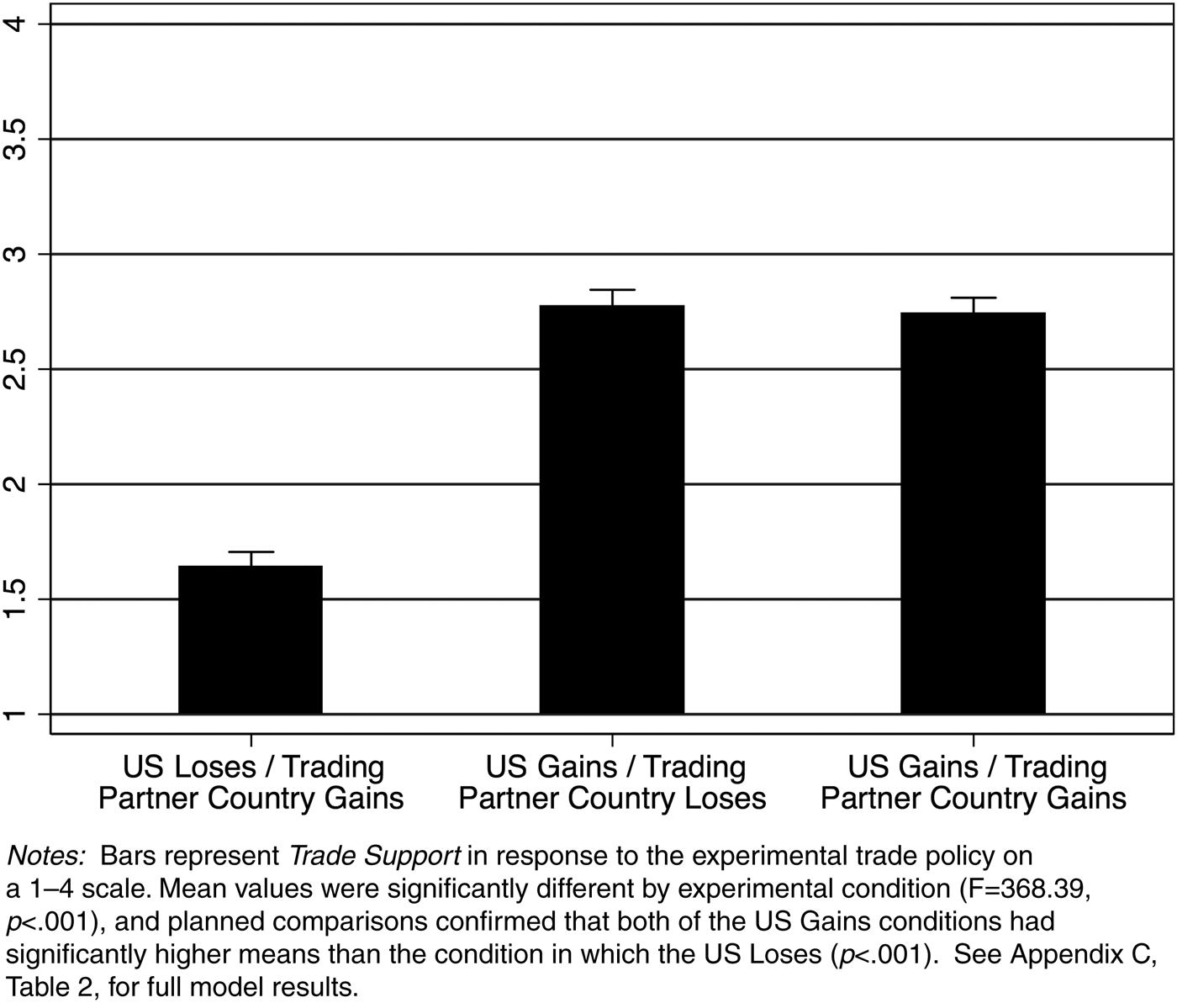
As Figure 1 shows, both randomly assigned experimental conditions in which the US gained jobs from trade demonstrated significantly higher levels of support than the one condition in which the US did not benefit. Believing that trade is in the collective national interest clearly has a strong causal impact on support for trade policies, just as the sociotropic hypothesis suggests. On average, support for trade is 69 percent higher when the US benefits, regardless of how trading partner countries are affected. This confirms the direction of causation from sociotropic perceptions to trade preferences.
Effects of who gains/loses on trade support

The Compatriotism Hypothesis
To test the compatriotism hypothesis, we varied whether it was the in-group or out-group that gained or lost while holding total gains constant. We hypothesized that Americans would, on average, consider their in-group members more deserving of the jobs created by trade than out-group members. As Figure 1 indicates, the basic Compatriotism Hypothesis was overwhelmingly confirmed (F = 545.58, p < .001), with a very large effect size. Indeed, even when the extent of trading partner gain is 1,000 jobs, relative to only one job lost in the US, the mean level of support is under 2 on a four-point scale, which is significantly lower than the level of support the policy receives when one American gains, and 1,000 people lose jobs in the trading partner country.
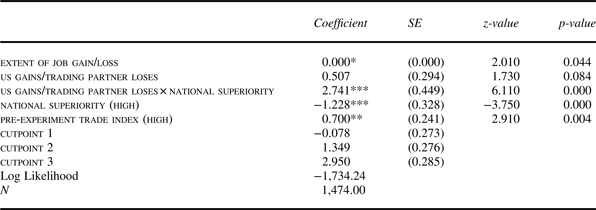
To evaluate whether respondents’ reactions to the experimental treatments were conditioned by a sense of perceived national superiority, Table 1 shows an ordered logit regression including an interaction between greater levels of perceived national superiority and the US Gains/Trading Partner Loses condition. The higher the level of perceived national superiority, the more the Who Gains/Loses manipulation made a difference to people's trade preferences. Those who perceive Americans to be a particularly deserving people are especially likely to support a trade agreement if it benefits Americans, and less likely to support the agreement if it instead benefits people in other countries.
Effects of compatriotism on trade preferences (ordered logistic regression)

Note: The reference group for the US Gains/Trading Partner Loses treatment is the condition in which the US Loses/ Trading Partner Gains. Entries are ordered logit coefficients with standard errors in parentheses. * p < .05; ** p < .01; *** p < .001.
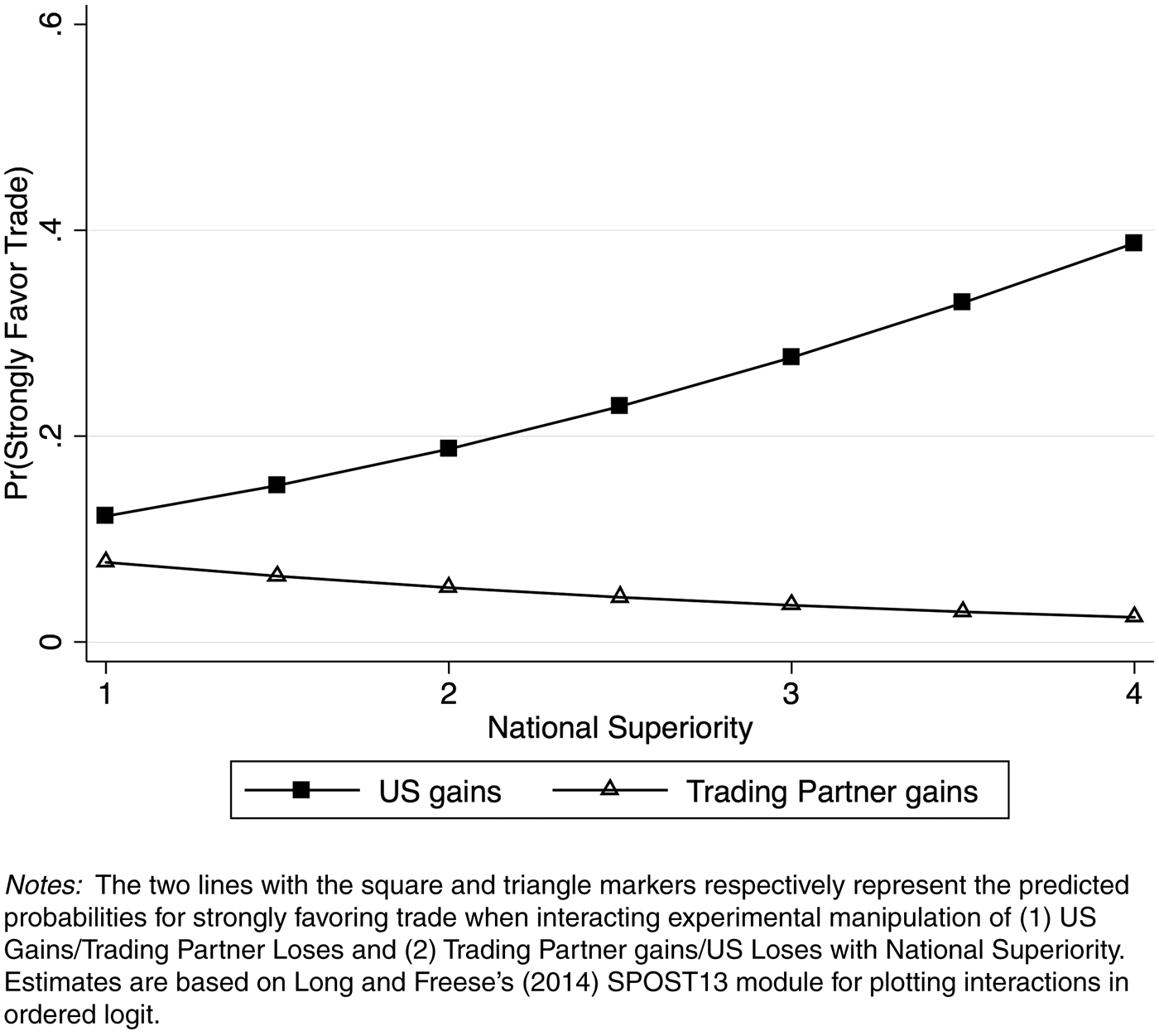
In Figure 2 we plot the predicted probability of “strongly favoring” trade by levels of perceived national superiority in the US Gains/Trading Partner Loses condition and for the US Loses/Trading Partner Gains condition. For people with the lowest levels of perceived superiority, the predicted probabilities of favoring trade across the two experimental conditions are not that different. But for people with the highest levels of perceived national superiority, the difference is roughly seven times larger, thus confirming the significant role of perceived national superiority in exacerbating in-group favoritism with respect to trade preferences.
Predicted probabilities of strongly favoring trade by level of national superiority

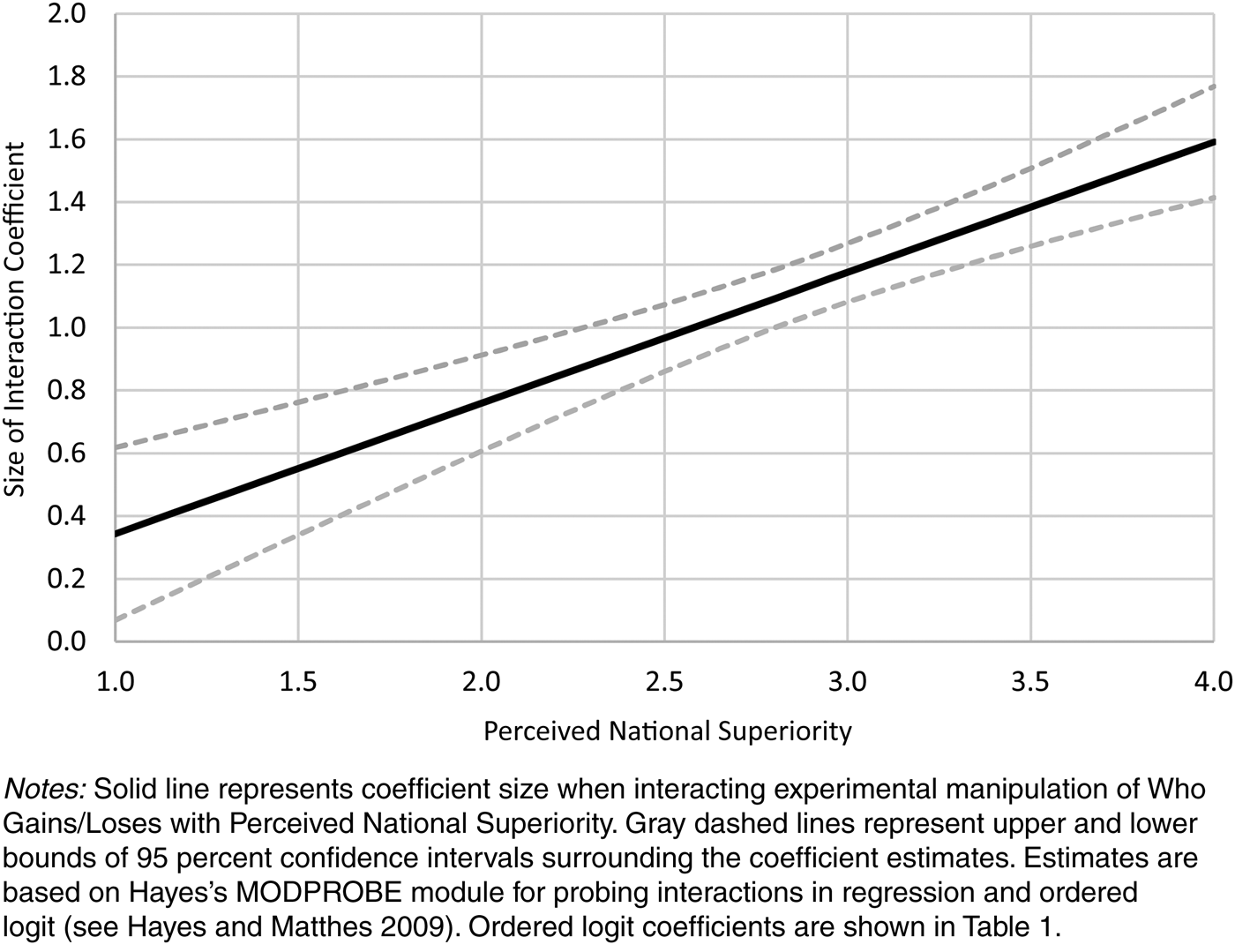
In Figure 3, we explore this interaction using the MOBPROBE moduleFootnote 37 to examine what level of perceived national superiority is required for this interaction to occur. Is this form of in-group favoritism limited strictly to those with high levels of perceived national superiority or is it more widespread? Figure 3 plots levels of perceived national superiority on a 1 (low) to 4 (high) scale on the x-axis, and the size of the interaction coefficient between national superiority and who wins/loses on the y-axis. Notably, who wins/loses significantly affects trade preferences even at the very lowest level of perceived national superiority. The confidence interval for the interaction coefficient at the lowest level of perceived national superiority still excludes 0, indicating that Americans do not require high levels of perceived in-group superiority to endorse policies that systematically favor their in-group. High levels of perceived national superiority exacerbate this tendency but even those who actively disagree with statements suggesting that their country is superior to others still systematically favor their national in-group.
Strength of effect on trade preferences of interaction between national superiority and who gains/loses

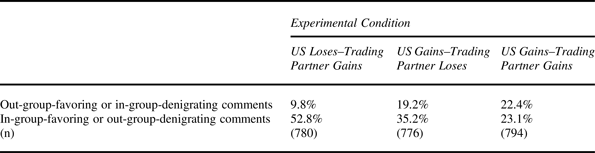
The role of in-group favoritism was also evident in the open-ended comments offered in response to the thought-listing question. We categorized responses into three groups: (a) those offering justifications for favoring the in-group (e.g., “We should care about our people first, not another country's people”) and/or for denigrating the out-group (e.g., “Frankly the rest of the world is uncivilized. Jobs matter more to us than to them”); (b) those suggesting justifications for favoring the out-group and/or denigrating the in-group (e.g., “100 people with jobs is better for the world than one American. At the end of the day, humanity, not nationality, is what matters”); and (c) those who answered but without reference to either.
As Table 2 shows, the extent of these types of comments varied considerably by experimental condition. Comments supporting the national in-group's deservingness relative to the out-group were far more common in the us loses-trading partner gains condition. Likewise, comments about the out-group were far less common in this condition. The condition in which both countries gained from trade produced the highest percentage of out-group-favoring comments, and the least in-group-favoring comments. Viewing trade as a competition prompted significantly more out-group vilification.
Open-ended comments favoring in-group and out-group, by experimental condition

Notes: Entries are percentages of respondents in each experimental condition (column) who mentioned anything suggesting either priority for the national in-group or consideration of the out-group nation as a percentage of respondents who made comments, regardless of their trade preference. Columns do not add to 100 percent because of respondents who did not offer comments. Chi-square tests indicated significant differences by condition for the frequency of out-group-favoring comments (chi-square = 36.8, p < .001) as well in in-group-favoring comments (chi-square = 115.72, p < .001).
The most common reason offered for opposing trade was, as one respondent emphatically put it, “AMERICA FIRST!!!” As another respondent commented, “I thought of the USA and their loss. I could care less [sic] about the other country.” Others were even more strident in their opposition to considering foreigners:
OH NO!!! The American people are getting crapped on again. We loose [sic] more and more every day, because OUR government thinks they should help everyone else in the world before they help the Americans!!! Somehow along the way we became the world saviors and they never ask US if we wanted to give our jobs and money away. If politicians want to help all of those other people so much, they should MOVE THERE and give all of their money away.
The US should worry about people in this country NOT other countries. That is why we have become a F***** up country.
But what about those respondents who were not vehemently anti-foreigner, those who favored the in-group without an obvious sense of national superiority? Their open-ended responses suggested that their preferences were driven by straightforward identification as American, devoid of necessarily feeling Americans are more deserving:
Hard situation. But I live in this country so I would choose a person from this country.
I … saw in my mind's eye the foreign people that would not be working, but perhaps they will be able to get another job. Since I'm an American, I favor Americans working.
I thought about the 1,000 people who would lose their job. I would feel really bad for them, but I live in the United States and the United States has to take care of the United States first.
Some respondents took great pains to indicate they were not indifferent to foreigners, but that the “natural” and appropriate priority was to put the in-group first. As one respondent said, “Although I sympathize with all people, I was thinking we need to take care of our own first, because that is most natural.”
Still others made a case similar to the inflight passenger announcement suggesting that one should always secure their own oxygen mask first, before assisting others:
What comes to mind is the loss of family and jobs in the US. We need to take care of our own first, neighbors second. If we don't take care of our own first, how can we be expected to help our neighbors when we are in such need ourselves?
Our domestic policy in the United States of America should be take care of our own first, PERIOD! When there is no longer a line at the unemployment office or people living in homeless shelters or children going to bed hungry then Americans should consider a trade policy that benefits those that live outside our country.
We need to support our own country before assisting others. Once we are working and supporting our families then we should help the less fortunate.
Favoring people strictly because they are fellow citizens appears to be highly socially acceptable; indeed, some respondents argued that it was unpatriotic to do anything but favor their national in-group.
The thought-listing items also provided some evidence of less parochial thinking. As one respondent suggested, “All lives [are] equal, so while it is hard to think about the one person losing their job, you can't ignore the fact that 100 others will gain jobs.” Others expressly negated the logic of in-group favoritism: “[It's a] numbers game. Have to consciously suppress tribalism. People shouldn't be favored just because of where they live.”
Others acknowledged helping the developing world as a positive externality. For example, one respondent indicated thinking about “how much good we could do if we created ten jobs for each one job created here. It could help tons of the developing world.” As another suggested, “I first thought of jobs gained by poor foreigners. Then I thought about jobs lost by Americans. They have more to gain than we have to lose from that trade-off, on a basic human level.”
Those expressing universalistic values were only a small proportion of those who volunteered open-ended responses in response to a large net gain without US job gain;Footnote 38 nonetheless, these respondents’ reactions beg the question of whether there is any level of out-group gain that would prompt the average American to favor trade. As the number of total jobs gained increases, so does mean support for the trade policy, although only to a very small extent. Of all of our experimental conditions, the scenario in which one American loses a job and 1,000 people in trading partner countries gain jobs is the most skewed toward large net benefits, just not for Americans. However, even in this condition, only 22 percent favored the policy, while over 78 percent opposed it.
The Intergroup Competition Hypothesis
To test the intergroup competition hypotheses, we used the two experimental conditions in which gain to the US was held constant, but the gain or loss to the trading partner country varied. Because the US gains equally across these two conditions, there is no reason to expect different levels of support for trade in these conditions unless respondents react to whether other countries gain as well. Our initial analysis showed no difference in level of trade support between these two experimental conditions (
 $\bar x= 2.78$
,
 $\bar x = 2.74$
, F = .23, p = .64). As long as the policy benefited American jobs, Americans supported it.
Thus far our findings suggest benign neglect; Americans appear not to care much about how trading partner countries are affected by trade policies. However, when examining those groups known to be most susceptible to intergroup competition, the results demonstrate confirmatory evidence both among those high in social dominance orientation, and among those who perceived trade to have zero-sum consequences in the pre-experiment survey.
As the left panel of Figure 4 shows, social dominance orientation interacts with whether the trading partner country also gains. For those below median in social dominance orientation, trade is more attractive when it is the win-win scenario that economists envision; both the US and its trading partner countries benefit. But for those above median in social dominance orientation, the trade policy is significantly more attractive when trading partner countries are hurt rather than helped. Consistent with the desire to maintain group hierarchy, those with high levels of social dominance respond to the relative advantage of the US over others rather than to how much the in-group gains.
Interactions of intergroup competition treatment with social dominance and zero-sum perceptions of employment

On the right-hand side of Figure 4 we see a similar interaction based on whether the respondent perceived trade's impact on jobs to be zero-sum in the pre-experiment survey. For the 50 percent of Americans who reported that if trade helps one country, it hurts another, the trade policy that helps the US and hurts trading partner countries is far more attractive than the policy helping both the US and trading partner countries. Far from worrying about the exploitation of other countries through trade, many Americans support trade more when it increases the relative advantage America has over its trading partner countries.
In examining Figure 4, it is natural to wonder whether these two interactions represent basically the same phenomenon. The weak correlation between social dominance orientation and zero-sum perception of trade (r = −.03, p = .10) suggests that this is not likely. As documented in the supplemental appendix, both groups tend to be conservative, white, and Republican. But zero-sum perceptions are more likely to be held by older people, the well-educated, and those with high incomes. In contrast, poorly educated men are higher in social dominance.
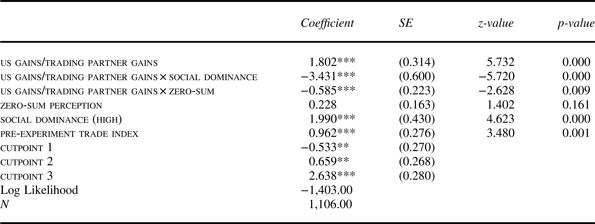
Table 3 combines these two intergroup competition analyses to evaluate the size of their respective impacts when considered simultaneously. The results of the ordered logit regression confirm that these are not redundant effects. Both interactions retain their significant negative impact on trade preferences. Those high in social dominance are especially opposed to trade if it benefits the out-group as well as the in-group, and those who perceive trade to be zero-sum with respect to unemployment are more likely to oppose trade if it does not explicitly advantage them relative to trading partner countries.
Effects of intergroup competition on trade preferences (ordered logistic regression)

Notes: The reference group for the US Gains/Trading Partner Gains treatment is the condition in which the US Gains/ Trading Partner Loses. Entries are ordered logit coefficients with standard errors in parentheses. * p < .05; ** p < .01; *** p < .001.
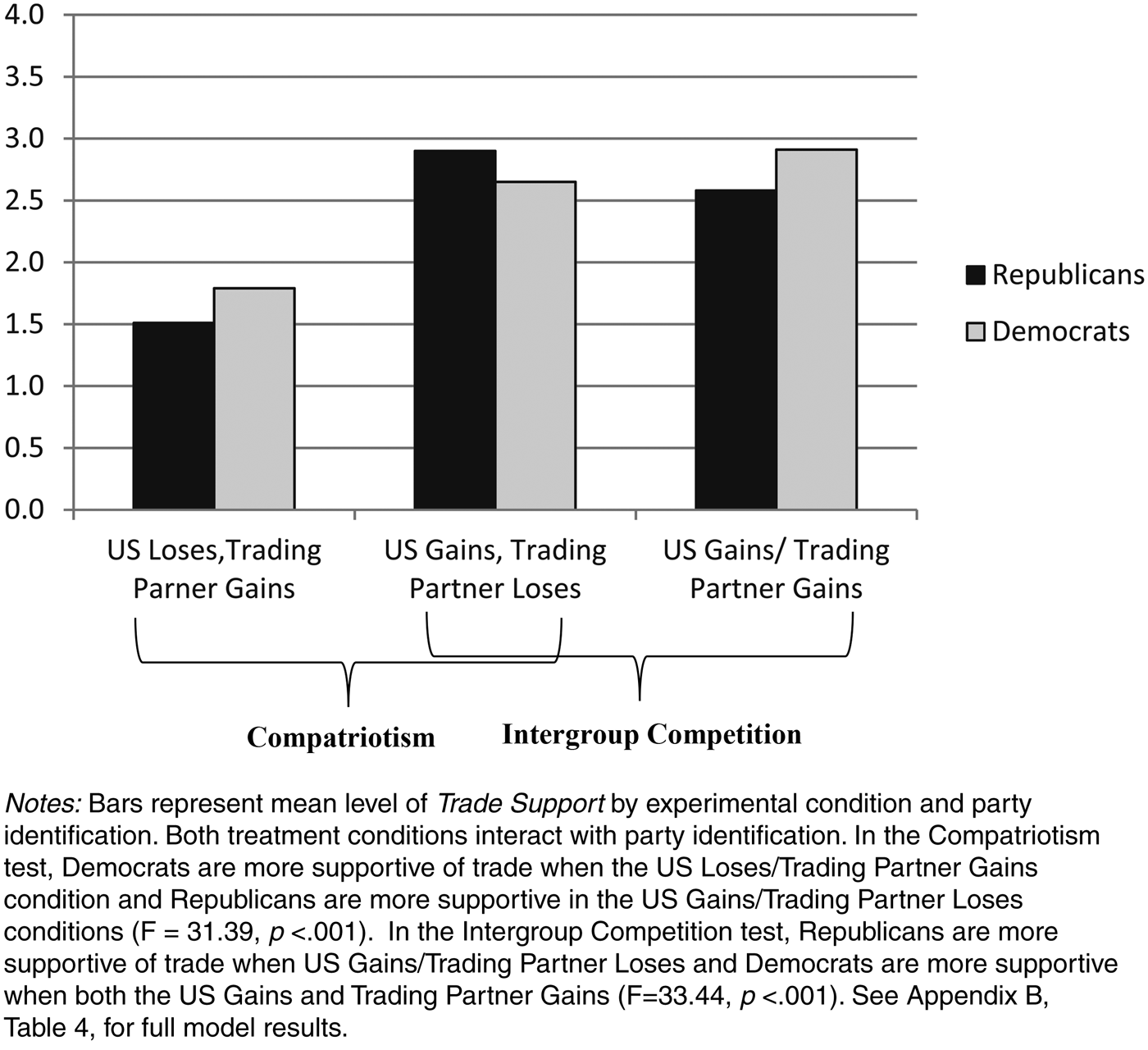
The intergroup competition findings also shed light on the widely noted inconsistencies in how party identification predicts trade preferences in the United States. Republicans should demonstrate greater support for international trade given their well-known faith in free markets. But other characteristics linked to Republican party identification are likely to suppress support for trade. For example, Republicans tend to be more nationalistic and higher in social dominance orientation.Footnote 39
Both experimental treatments interact with party identification (Figure 5). Democrats are more supportive of trade than Republicans in the US Loses/Trading Partner Gains condition, whereas Republicans are more supportive than Democrats in the US Gains/Trading Partner Loses condition. When both partners gain in the US Gains/Trading Partner Gains condition, Democrats are more supportive than Republicans. Given that the relationship between party identification and trade support depends on which of these three contexts a given agreement is perceived to be, it is no wonder that findings are inconsistent with respect to the direction of party influence.
Effects of experimental treatments by party identification

Generalizability of Findings
How well does our national probability sample represent the entire population? Given the two waves of data collection, some attrition is inevitable and could skew even an initially representative sample. Attrition analyses indicated a greater loss of participants who were younger, black, female, and those lower in education. For this reason, we reran all of the analyses using population-based survey weights that made the sample equivalent to the Current Population Surveys on all available demographic variables. All the significant findings remained so, with only slight changes in effect sizes.
However, another dimension of generalizability cannot be addressed by even the most representative sample. In the experiment, we artificially held constant whether trade benefits only the US, the trading partner country, or both the US and trading partner countries. In generalizing these treatments to the real world, it is essential to know how prevalent public perceptions are that match these profiles.
Our survey results demonstrated that when it comes to jobs, most Americans perceive trade to be a US loses/trading partner gains scenario. Respondents could say that trade helped, hurt, or had no effect on employment in the US and were asked the same question about its effects on trading partner countries. Of the nine possible categories formed by these questions, the percentage perceiving trade to be the gain-gain scenario was a mere 11 percent. Roughly 7 percent viewed it as hurting employment in both the US and trading partner countries. The proportion viewing it as exploitative was under 1 percent. In stark contrast, 50 percent of the national sample said that international trade helped trading partner countries and hurt the US.Footnote 40 Indeed, these two answers were negatively correlated; the more a person perceived trade to be a negative influence on job availability within the US, the more he or she perceived it to benefit jobs in trading partner countries.
Given that most Americans believe trade hurts the US and benefits trading partner countries, the effects of in-group favoritism on trade preferences that we observe in our experiment are fairly common. Given that half of Americans viewed trade through the lens of intergroup competition before any experimental treatment, even more may oppose trade at times even when they perceive it to benefit the US, if only because it does not increase their relative advantage over other countries. Further examination of our manipulation check indicated that even though, consistent with the treatments, Americans were perceived to benefit in both of the conditions in which American job gains were suggested, our experimental subjects perceived US gains to be significantly greater when the other country lost jobs relative to when the other country also gained. In other words, in the real world, sociotropic perceptions of gain and loss for the in-country are shaped by how trade is perceived to affect its trading partner countries. Ironically, the supposedly ideal “gain-gain” scenario is likely to make people feel as if their in-group has gained less.
Discussion
Perceptions of how trade affects the country as a whole have a large and important causal impact on trade preferences. Among political economists, support for trade is assumed to stem from the personal economic considerations and job dislocations that occur because of trade. By systematically manipulating perceptions of a trade policy's effects on the US in an experimental context, we confirmed the causal influence of sociotropic perceptions. If sociotropic treatments changed trade preferences by influencing personal concerns, this would have to occur by means of it changing their prospective personal concerns about trade. In either case, sociotropic perceptions play an important causal role.
Beyond sociotropic perceptions, two forms of in-group favoritism affect trade preferences. First, we find clear evidence of compatriotism. Americans will be systematically more likely to support a policy if it benefits Americans as opposed to equivalent benefits to citizens of trading partner countries. Although it is not a necessary condition, a sense of national superiority further encourages the view that Americans are more deserving of the benefits of trade than other countries. The perceived deservingness of those who benefit from a policy serves as a powerful heuristic for policy support.Footnote 41
Social identity theory suggests that a sense of in-group superiority typically accompanies in-group favoritism, and based on our results, it certainly helps. But it is useful to contemplate why those who do not see Americans as superior nonetheless favor their national in-group. It could be that Americans do not see themselves as more deserving so much as they feel more obligated to help their compatriots than those who live elsewhere.Footnote 42 In fact, most evidence is inconsistent with this thesis; those with a strong sense of national identity are typically more opposed to policies that might be construed as fulfilling some kind of obligation to less fortunate national in-group members. For example, those high in social dominance are against government-provided healthcare, and have lower levels of communality.Footnote 43 These patterns are not consistent with feeling a strong sense of obligation or duty to one's less fortunate compatriots.
One could argue that Americans have in mind a narrower form of social identity when they think about obligations, such as people of the same race or living in the same immediate community, but therein lies a central problem with using social identity theory to predict policy preferences; people can choose among a broad range of identities, including the nation or humanity at large, and these choices may be endogenous to trade preferences.Footnote 44 Our experimental design precludes these problems, which continue to plague observational analyses.
Although many interest groups and individuals say they oppose trade because they believe it has a negative impact on trading partner countries, we find little evidence in our experiment that the public's preferences are moved by this concern. Levels of support for trade are, on average, identical whether the trading partner country benefits or not. And some Americans are significantly more supportive of policies when the trading partner loses, holding constant the benefits to the US. Trade is not perceived as mutual cooperation for the collective benefit—it is about gaining an advantage over one's competitors. A desire to take advantage of the opposition is prominent among those who view trade in zero-sum terms, and among those high in social dominance orientation, a tendency tapping predilections toward prejudice and hierarchy.
Americans evaluate trade primarily in terms of jobs, where roughly half of the population perceive its impact to be zero-sum, with trading partners benefiting and Americans losing. Why is the American public's view of trade so different from how economists see it? Economists tend to focus on whether trade produces absolute gains;Footnote 45 the mass public, on the other hand, often views trade as a form of intergroup competition.Footnote 46 From this perspective, it matters not only how much the US gains but also whether the trading partner country also gains. Framed in terms of the standard theories of international relations, economists are liberal institutionalists who view the world in terms of the absolute gains that can be obtained from cooperation.Footnote 47 The mass public's understanding of trade, on the other hand, tends more toward a competitive, zero-sum, realist framework.
Unlike many forms of in-group favoritism, compatriotism and intergroup competition are both widely considered socially acceptable and even socially desirable in contemporary America. The consequence in the case of trade is to “naturalize” this form of in-group favoritism in the same way that other in-group biases were made to seem inevitable and natural in the past.
Normative political theorists have argued that citizens may reasonably be said to have special duties to their co-nationals, but discriminating against out-group members in situations that are mutually beneficial is not considered an acceptable form of partiality toward compatriots, nor is exploiting an out-group.Footnote 48
National groups are often large, amorphous, impersonal, and diverse—all characteristics that reduce people's willingness to consider themselves members of a mutual in-group.Footnote 49 In a country as diverse as the US, national in-group members often demonstrate very little enthusiasm for helping other in-group members unless they can personally select which particular in-group members benefit, as is the case with charitable giving or volunteering.Footnote 50 If Americans oppose trade policies out of a sense of duty to care for their compatriots whom they perceive to be hurt by trade, then why is there so little evidence of a sense of duty when it comes to helping compatriots in need via social welfare policies?Footnote 51 Instead, valuing the national in-group leads individuals to oppose social welfare and to favor more restrictive definitions of who should count as an American.Footnote 52 A sense of duty to the national in-group characterizes racially homogeneous more than heterogeneous societies.Footnote 53
The earliest recorded opinions on the nature and desirability of international trade indicate that people did not always see trade as a means of competing with their maritime neighbors.Footnote 54 Instead, it was a way to obtain access to what one did not already have. As Plutarch noted admiringly around 100 AD: “The sea brought the Greeks the vine from India, from Greece transmitted the use of grain across the sea, from Phoenicia imported letters as a memorial against forgetfulness, thus preventing the greater part of mankind from being wineless, grainless and unlettered.”Footnote 55
Economists may advocate trade on the basis of more efficient markets and the theory of comparative advantage but these arguments do not resonate with the American public. The increased availability of goods is still the primary reason that Americans offer for favoring trade, just as it was to Plutarch.Footnote 56 Thus the gap between economic theory and public psychology is cavernous at this point; they do not begin with the same assumptions or conclude with the same preferences about what is good for America or good for the world.
The 2016 election cycle brought these differences to the forefront of public attention as both major party candidates opposed major trade agreements and rallied supporters with claims that trade is a contest that one country must lose for another to win. Donald Trump, in particular, made claims that are clearly at odds with the classic understanding of trade, and that promote a zero-sum understanding of trade's impact.Footnote 57 As he put it, “We already have a trade war, and we're losing badly. Badly.”Footnote 58 The human tendency toward in-group favoritism only makes such beliefs more dangerous by promoting the view that trade is about intercountry competition more than cooperation for mutual benefit. While in-group favoritism is often persistent and intransigent, changing this belief probably offers the greatest potential for changing the American public's view of trade.
Supplementary Material
Supplementary material for this research note is available at <https://doi.org/10.1017/S0020818317000327>.