Introduction
An oroantral fistula is an epithelium-lined communication between the oral cavity and maxillary sinus. Most commonly, oroantral fistulas are the result of tooth extraction involving posterior teeth of the upper jaw.Reference Franco-Carro, Barona-Dorado, Martinez-Gonzalez, Rubio-Alonso and Martinez-Gonzalez 1 Other causes include: infections such as syphilis, neoplasm, Paget's disease, osteomyelitis, radiation therapy, and trauma. Recently, bisphosphonate-related osteonecrosis of the jaw has also been implicated in its causation.Reference Mast, Otto, Mucke, Schreyer, Bissinger and Kolk 2
The reported incidence of oroantral communications after tooth extraction is low, about 0.31–4.7 per cent for all tooth extractionsReference Punwutikorn 3 and 5.1 per cent in cases of upper third molar extractions.Reference del Rey-Santamaría, Valmaseda Castellón, Berini Aytés and Gay Escoda 4 However, given the large number of tooth extractions being performed, oroantral fistulas in clinical practice are not uncommon.
Many oroantral fistulas, especially those less than 3 mm in size, heal spontaneously, while those more than 5 mm in size do not heal without surgical repair.Reference Abuabara, Cortez, Passeri, de Moraes and Moreira 5 – Reference Awang 7 Oroantral fistulas persisting beyond three weeks are regarded as ‘chronic’.Reference Yilmaz, Suslu and Gursel 8 Chronic oroantral fistula is associated with a variable degree of rhinosinusitis. In fact, oroantral fistula is one of the most common causes of odontogenic maxillary sinusitis.Reference Brook 9
Studies have indicated that rhinosinusitis is responsible for non-healing of oroantral fistula.Reference Lin, Bukachevsky and Blake 10 Unfortunately, no definitive management protocols have been described in the literature or in guidelines developed by expert groups on rhinosinusitis for this subset of rhinosinusitis patients. In the past, radical surgery in the form of a Caldwell–Luc operation (involving the removal of part of the anterolateral wall of maxilla, the creation of a wide antrostomy in the inferior meatus and the excision of whole mucosal lining of the maxillary sinus) was used to clear the rhinosinusitis. The procedure was associated with significant morbidity and often failed to achieve the desired clearance.Reference Nemec, Peloschek, Koelblinger, Mehrain, Krestan and Czerny 11 The focus has now shifted to more conservative approaches. A more recent technique for relief of rhinosinusitis is functional endoscopic sinus surgery (FESS) with surgical repair of the fistula. This has been shown to provide equal or even better results than the Caldwell–Luc procedure, with considerably less morbidity, in the management of rhinosinusitis associated with chronic oroantral fistula.Reference Andric, Saranovic, Drazic, Brkovic and Todorovic 12 – Reference Joe Jacob, George, Preethi and Arunraj 14
The reasoning underlying the success of the minimally invasive FESS approach is based on the role of patent sinus ostia in maintaining the ventilation and health of the sinuses, which in turn is dependent on the health of the pre-chambers where they drain, namely the middle meatus (for anterior sinuses) and the sphenoethmoidal recess (for posterior sinuses). Blockage in these pre-chambers results in poor ventilation and the stagnation of secretions in sinuses, leading to sinusitis. Restoration of patency of these pre-chambers reverses the pathological changes, resulting in the clearance of sinusitis.Reference Stammberger and Posawetz 15
Extrapolating the concept of FESS, we employed a non-surgical approach comprising repeated local application of decongestant solution in the middle meatus and sphenoethmoidal recess along with systemic antibiotics, to achieve patency of the sinus ostia, with the aim of resolving rhinosinusitis associated with post-dental extraction chronic oroantral fistula.
In this prospective observational study, our objectives were to estimate the degree of rhinosinusitis resolution, and to compare various characteristics of the patients responding to this non-surgical approach with those not responding to it (primary objective). We also assessed the effect of this procedure on the closure of the oroantral fistula (secondary objective).
Materials and methods
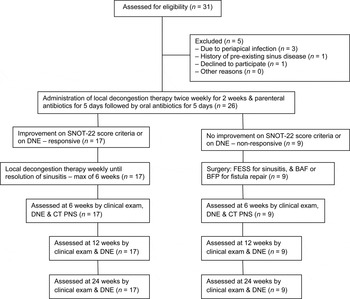
Thirty-one consecutive patients reporting to our centre with unresolved rhinosinusitis due to post-dental extraction chronic oroantral fistula from January 2007 to May 2013 were considered. Twenty-six of these patients were finally included in the study, while five were excluded (Figure 1). Informed consent from the patients was taken prior to enrolment. The study was approved by the standing ethical committee of our institute. All patients underwent complete ENT examination and full dental assessment prior to inclusion in the study.
Flow chart of the study. SNOT-22 = Sino-Nasal Outcome Test 22; DNE = diagnostic nasal endoscopy; FESS = functional endoscopic sinus surgery; BAF = buccal advancement flap; BFP = buccal fat pad; CT PNS = computed tomography scans of paranasal sinuses

Inclusion criteria
All patients had an oroantral fistula of 3 mm or more along with rhinosinusitis following tooth extraction that was not resolved, even after three weeks of management under the supervision of a dental surgeon.
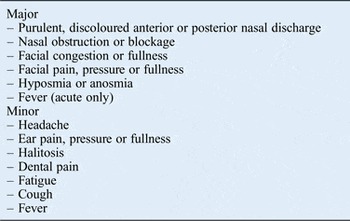
The diagnosis of rhinosinusitis was ascertained using the criteria proposed by the Rhinosinusitis Initiative (Table I).Reference Meltzer, Hamilos, Hadley, Lanza, Marple and Nicklas 16 Diagnostic nasal endoscopy was performed to document the presence of inflamed mucosa, mucosal oedema and purulent discharge as indicators of rhinosinusitis. Symptom severity and health-related quality of life was assessed using the Sino-Nasal Outcome Test 22 (SNOT-22) questionnaire.
Criteria for diagnosis of rhinosinusitis*

A diagnosis of rhinosinusitis is probable if two or more major symptoms, or one major symptom and two or more minor symptoms, are present.
* Adapted from Meltzer et al.Reference Meltzer, Hamilos, Hadley, Lanza, Marple and Nicklas 16
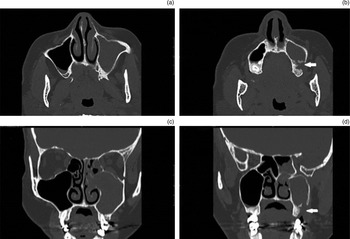
Fistula size and the extent of rhinosinusitis were determined by coronal and axial computed tomography (CT) scans of the upper alveolus and paranasal sinuses (Figure 2). The extent of paranasal sinus involvement on CT was calculated using Lund–Mackay scores.Reference Lund and Mackay 17 Fistula size was determined according to the widest diameter of the bony defect on CT scans of the paranasal sinuses.
Axial (a & b) and coronal (c & d) computed tomography images showing oroantral fistula (arrows; b & d), and associated rhinosinusitis involving maxillary, ethmoid and sphenoid sinuses on patient's left side.

Exclusion criteria
These were: fistula size of less than 3 mm (as these tend to heal spontaneously); pre-existing or co-existing chronic disease of bone or soft tissue, chronic infection such as syphilis, Paget's disease, osteomyelitis, trauma, malignancy, or irradiation of the area (oroantral fistula in such cases may not be attributable solely to tooth extraction); chronic periapical or periodontal infections, odontogenic cysts of the maxilla, dental implants, sinus augmentations, intra-antral foreign bodies and any anatomical abnormality or pathology of the paranasal sinuses capable of causing rhinosinusitis by itself (independent of oroantral fistula); a history of pre-existing rhinosinusitis prior to tooth extraction; and a history of hypersensitivity to the drugs used in the study.
Intervention, assessment and follow up
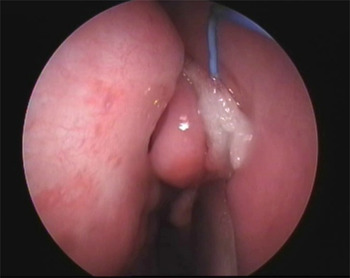
Cottonoids soaked in decongestant solution containing 30 ml of 4 per cent lignocaine and 10 ml of 0.1 per cent xylometazoline weight/volume were placed in the middle meatus and sphenoethmoidal recess using a 0-degree rigid nasal endoscope. A sufficient number of cottonoids were placed to fill these spaces completely (Figure 3). These cottonoids were removed after 15 minutes and any mucopus appearing on removal of the cottonoids was suctioned out. The procedure was termed ‘local decongestion therapy’. It was conducted twice weekly for two weeks initially to all patients, to evaluate their response.
Placement of decongestant-soaked cottonoids in middle meatus.

Additionally, intravenous antibiotics (co-amoxiclav 1.2 g 12-hourly and metronidazole 500 mg 8-hourly) were administered for 5 days during their stay as an in-patient. Thereafter, oral co-amoxiclav 625 mg 8-hourly was prescribed for the next 5 days, when the patient was an out-patient department case. No patients were prescribed steroids (spray or oral), decongestant nasal drops or antihistamines.
At the end of two weeks, the patients were reassessed by clinical examination, diagnostic nasal endoscopy and via the SNOT-22 questionnaire. Improvement in rhinosinusitis was defined as a reduction in SNOT-22 scores by at least 8 points (i.e. at least a 1-point reduction for questions on symptoms directly related to the nose and paranasal sinuses, namely SNOT- 22 question numbers 1–4, 6, 7, 11 and 12), and/or nasal endoscopic visualisation of reduction in mucosal inflammation, oedema and discharge. Based on this reassessment, two distinct categories of patients emerged: those showing improvement in rhinosinusitis (responsive patients) and those showing no improvement (non-responsive patients).
In the responsive patients, we continued local decongestion therapy weekly (without antibiotics) until the rhinosinusitis resolved completely (a maximum of six weeks, which is the generally accepted maximum duration of conservative rhinosinusitis management). The non-responsive patients instead underwent FESS and repair of the oroantral fistula using a buccal advancement flap or buccal fat pad; it was considered unethical to continue with local decongestion therapy beyond two weeks when there was no benefit to the patient.
All patients were reassessed at six weeks post-therapy (non-surgical or surgical) by clinical examination, diagnostic nasal endoscopy and CT scans of the paranasal sinuses (for Lund–Mackay scoring and fistula size assessment). They were reassessed again at 12 weeks and 24 weeks by clinical examination and diagnostic nasal endoscopy to evaluate the presence of rhinosinusitis and assess the oroantral fistula. The SNOT-22 questionnaire was completed by all patients at these follow-up sessions.
Complete resolution of rhinosinusitis was defined as the absence of any major rhinosinusitis symptom, the absence of mucosal inflammation, oedema or discharge on nasal endoscopy, and a Lund–Mackay score of zero on CT scans of the paranasal sinuses.
Fistula healing was defined as the closure of the defect (bony closure or soft tissue closure), and the absence of any evidence of leakage or communication between the maxillary sinus and oral cavity.
Statistics
We used IBM© SPSS© Statistics (version 21.0.0.0) software for the statistical analysis. Mean and range were calculated where indicated. The p-values were calculated for significance using the Fisher's exact test, chi-square test, student's t-test, Z score calculation or Pearson's correlation coefficient, depending on the nature of the variables. A p-value of less than 0.05 was considered significant at a 95 per cent confidence interval.
Results
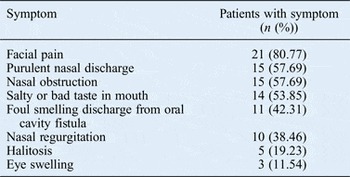
There were 15 males and 11 females in the study. The male to female ratio was 1.36:1. Patient age ranged from 28 to 72 years, with a mean age (± standard deviation (SD)) of 49.81 ± 12.25 years. The right side was involved in 10 cases and the left side in 16 cases. Facial pain was the presenting symptom in the majority of patients, followed by nasal discharge and nasal obstruction (Table II). The overall mean (± SD) pre-treatment Lund–Mackay score and SNOT-22 score for the cohort were 5.96 ± 2.95 and 48.19 ± 10.4, respectively. The pre-treatment Lund–Mackay scores and pre-treatment SNOT-22 scores showed a moderate positive correlation with pre-treatment oroantral fistula size (p = 0.00001 and p = 0.001 respectively).

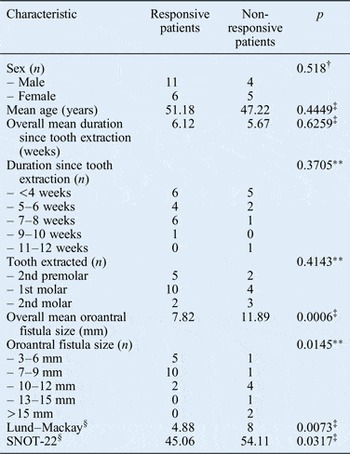
After non-surgical treatment (comprising local decongestion therapy twice weekly and a 10-day course of antibiotics) for 2 weeks, 17 patients (65.38 per cent) showed improvement in rhinosinusitis (responsive patients), while 9 (34.61 per cent) showed no change (non-responsive patients). Various characteristics of the two categories of patients at this stage were compared and analysed for statistical significance (Table III).
Comparison of responsive and non-responsive patients’ characteristics*

* Total n = 26. †Fisher's exact test; ‡student's t-test; **chi-square test. §Mean pre-treatment score. SNOT-22 = Sino-Nasal Outcome Test 22
There were no statistically significant differences between the two categories of patients (responsive and non-responsive) in respect of gender, mean age, duration of symptoms and the tooth extracted. However, significant differences existed in respect of fistula size, the extent of rhinosinusitis (as assessed by Lund–Mackay scores) and SNOT-22 scores. In the responsive patients, the fistula size ranged from 3 to 12 mm, with a mean (± SD) size of 7.82 ± 1.91 mm, as compared to a mean size of 11.89 ± 3.37 mm in the non-responsive patients. Similarly, the mean (± SD) pre-treatment Lund–Mackay scores (8 ± 3.64) and mean pre-treatment SNOT-22 scores (54.11 ± 10.53) were significantly higher in the non-responsive patients than in the responsive patients. However, the decrease in SNOT-22 scores (expressed as per cent reduction) after two weeks of non-surgical treatment was not related to pre-treatment Lund–Mackay scores or pre-treatment SNOT-22 scores. Only the size of the oroantral fistula showed a moderate negative correlation with the decrease in SNOT-22 scores after two weeks of non-surgical treatment (p = 0.004), implying that smaller oroantral fistulas were associated with a greater per cent reduction in SNOT-22 scores.
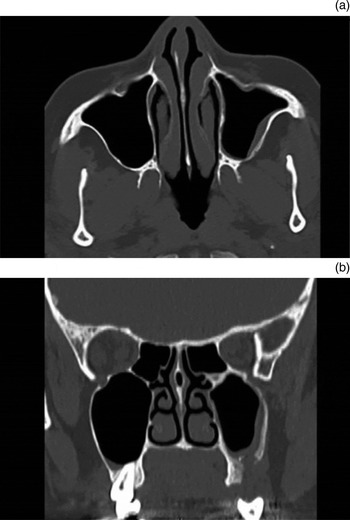
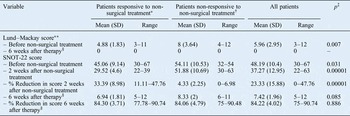
When assessed at 6 weeks post-therapy, 16 of the 17 patients in the responsive category (non-surgically treated group) showed complete resolution of the rhinosinusitis and closure of the fistula, without any surgical procedure having been performed (Figure 4). However, in one patient, although the rhinosinusitis resolved, the fistula persisted. The fistula in this patient was subsequently repaired surgically using a buccal fat pad. In the non-responsive patients (surgically treated group), there was no sign of rhinosinusitis or fistula in any patient. The patients in both categories achieved Lund–Mackay scores of zero on CT scans of the paranasal sinuses. Their SNOT-22 scores also showed no significant difference between the two categories (Table IV), and were comparable with SNOT-22 scores of a healthy general population reported previously.Reference Gillett, Hopkins, Slack and Browne 18 , Reference Yeolekar, Dasgupta, Khode, Joshi and Gosrani 19 The overall post-therapy mean (± SD) SNOT-22 score for the cohort at six weeks was 7.42 ± 1.96. The mean (± SD) reduction from pre-therapy SNOT-22 scores was 40.76 ± 9.68 points (i.e. a 84.22 ± 4.02 per cent mean reduction from pre-therapy scores).
Axial (a) and coronal (b) computed tomography images of the same patient as in Figure 2 after six weeks of local decongestion therapy, showing resolution of sinusitis.

Changes in lund–mackay and SNOT-22 scores at various stages of study

*n = 17; † n = 9. ‡ P-value for comparison of means for responsive versus non-responsive patients (student's t-test). **Computed tomography scans were not repeated at two weeks after non-surgical treatment; hence, Lund–Mackay scores are not available for follow up at two weeks after non-surgical treatment. §Non-surgical treatment or surgery. SNOT-22 = Sino-Nasal Outcome Test 22; SD = standard deviation
Overall, of the 26 patients, non-surgical treatment achieved complete rhinosinusitis resolution in 17 patients (65.38 per cent) and spontaneous closure of oroantral fistula in 16 patients (61.53 per cent) at 6 weeks post-therapy. At 12 weeks’ and 24 weeks’ follow up, there was no recurrence of rhinosinusitis or fistula in either group (non-surgical or surgical treatment).
The non-surgical treatment procedure was well tolerated by the patients. No major complications were observed as a result of the non-surgical treatment, FESS or fistula repair.
Discussion
The age and sex distribution of patients in our study was similar to that reported in previously published studies.Reference Franco-Carro, Barona-Dorado, Martinez-Gonzalez, Rubio-Alonso and Martinez-Gonzalez 1 The tooth involved in extraction and the presenting symptoms were also similar to those in earlier studies.Reference Guven 20 – Reference Visscher, van Minnen and Bos 22
Patient age, gender, location of the extracted tooth and duration of symptoms did not play a role in determining the response (or non-response) to non-surgical treatment. However, the size of the fistula, extent of rhinosinusitis (as determined by Lund–Mackay score) and SNOT-22 scores were significant contributory factors (i.e. a larger fistula, higher Lund–Mackay score and higher SNOT-22 score were associated with a decreased likelihood of responding to non-surgical treatment). As the extent of rhinosinusitis (expressed by the Lund–Mackay score) and SNOT-22 scores were also moderately positively correlated with the size of the oroantral fistula, the primary factor determining the response to non-surgical treatment may be oroantral fistula size alone.
Unlike other infected cavities, a fistulous opening in the maxillary sinus does not help in its drainage. Rather, it promotes rhinosinusitis by allowing the entry of infection into the sinus from the oral cavity. The mucociliary system of the maxillary sinus pushes all secretions and debris present in the sinus towards its natural ostium, which is situated at a higher level and opens into the middle meatus of the lateral wall of the nose. The works of Messerklinger and Stammberger have demonstrated that the mucus can move even over a defect in the maxillary sinus wall to reach the natural ostium, rather than draining out through the defect.Reference Stammberger and Posawetz 15 , Reference Messerklinger 23 They also pointed out that the main cause of rhinosinusitis is blockage in the osteomeatal unit, as described above.Reference Stammberger and Posawetz 15 , Reference Messerklinger 23 It is for this reason that inferior meatal antrostomy and anterolateral antrostomy (via a Caldwell–Luc operation) are not likely to help in the drainage of the maxillary sinus, unless ciliated mucosa is completely removed from the sinus.
It has also been proposed that, pathophysiologically, this subset of rhinosinusitis occurs due to a temporary and reversible mucociliary dyskinesia.Reference Rodrigues, Munhoz, Cardoso, de Freitas and Damante 24 Therefore, restoration of osteomeatal unit patency can enhance resolution of rhinosinusitis and pave the way for spontaneous healing of the oroantral fistula. Patency of the osteomeatal unit and natural ostia of the sinuses is achieved well by FESS, with much less morbidity compared to the Caldwell–Luc operation. Consequently, effective management of rhinosinusitis associated with chronic oroantral fistula has been achieved using FESS.Reference Andric, Saranovic, Drazic, Brkovic and Todorovic 12 , Reference Hajiioannou, Koudounarakis, Alexopoulos, Kotsani and Kyrmizakis 13 , Reference Fusetti, Emanuelli, Ghirotto, Bettini and Ferronato 25 Our non-surgical treatment comprising local decongestion therapy of the middle meatus and sphenoethmoidal recess along with antibiotics appears to work on the same principle (i.e. by keeping the osteomeatal unit and natural ostia of the sinuses patent), and may achieve clearance of rhinosinusitis in carefully selected cases, as seen in the present study.
Occasional reports of successful non-surgical management of rhinosinusitis associated with oroantral fistula are available in the literature. Kamadjaja treated one case of rhinosinusitis and oroantral fistula conservatively, utilising a combination of trans-alveolar sinus wash out, acrylic splint insertion, and two series of nasal and sinus physiotherapy procedures.Reference Kamadjaja 26 The size of the defect decreased gradually during the sinusitis treatment, and finally closed up without any further surgical intervention.Reference Kamadjaja 26 Lee and Lee had 8 cases of dental extraction related complications in their series of 27 cases of odontogenic rhinosinusitis. They managed seven of these cases with FESS and one case with antibiotics alone.Reference Lee and Lee 27 Most of our patients had used first-line antibiotics orally, along with self-administered nasal decongestant drops, but did not benefit. In our opinion, the key factor for resolution of rhinosinusitis in these cases is good decongestion of the pre-chambers and opening of the sinus ostia, which can be well achieved by local decongestion therapy. A similar level of decongestion is not achieved by nasal drops because of the short contact period and their inability to reach the sinus ostium in the pre-chambers.
As far as surgical closure of the oroantral fistula is concerned, numerous surgical techniques have been described, including the buccal advancement flap (Rehrmann flap), buccal fat pad (Bichat ball),Reference Jain, Ramesh, Sankar and Lokesh Babu 28 , Reference Abad-Gallegos, Figueiredo, Rodríguez-Baeza and Gay-Escoda 29 palatal rotation and palatal transposition flaps, tongue flap, nasolabial flap, autologous bone graft,Reference Scattarella, Ballini, Grassi, Carbonara, Ciccolella and Dituri 30 , Reference Haas, Watzak, Baron, Tepper, Mailath and Watzek 31 double-layer closure using a buccal advancement flap and buccal fat pad,Reference Candamourty, Jain, Sankar and Babu 32 third molar tooth transplant,Reference Kitagawa, Sano, Nakamura and Ogasawara 33 and septal cartilage graft.Reference Saleh and Issa 34 Of these, the buccal advancement flap, buccal fat pad and palatal flap have been the most widely used.Reference Cankaya, Erdem, Cakarer, Isler, Demircan and Oral 35 Recently, Borgonovo et al. suggested that the buccal advancement flap is best suited for large fistulas located in the anterior region, the palatal flap is suitable to correct premolar defects and the buccal fat pad flap is appropriate for a wide posterior oroantral fistula.Reference Borgonovo, Berardinelli, Favale and Maiorana 36
We too used the buccal advancement flap and buccal fat pad, with successful fistula closure in nine patients who did not respond to non-surgical treatment and in one patient with incomplete fistula healing who was otherwise responsive to non-surgical treatment. The remaining 16 patients showed spontaneous closure within 6 weeks with non-surgical treatment. Non-surgical management of oroantral fistula was also reported by Logan and Coates, who were able to achieve oroantral fistula healing in 8 weeks in an immunocompromised patient, using a dental plate and antiseptic washes alone (as the patient had no sinus involvement).Reference Logan and Coates 37
Contrary to the existing understanding that spontaneous healing may occur in oroantral fistulas of less than 3 mm in size, our study indicates that a great proportion of oroantral fistulas of up to 12 mm in size can also heal spontaneously with the help of non-surgical treatment, as a result of the enhanced resolution of associated rhinosinusitis. In this study, fistula size was determined based on the size of the bony defect (as observed on CT scans of the paranasal sinuses). Effective clinical size may actually be smaller given the space occupied by soft tissue in the fistula.
Antibiotics in this study were considered necessary as all patients had been symptomatic for more than three weeks. As the dental surgeons had already used first-line antibiotics on the patients, we preferred to use second-line antibiotics (i.e. co-amoxiclav). Metronidazole was used to cover possible intrusion by anaerobes from the oral cavity. Thus, antibiotics were an integral part of the non-surgical treatment, along with the local decongestion therapy. However, the extent of the antibiotics’ contribution to the success of the approach cannot be assessed with the present study design. A study with a control group receiving only antibiotics could have demonstrated such a contribution. We were unable to have such a control group because of the limited number of patients available, given the strict inclusion and exclusion criteria of our study. However, previous studies in which antibiotics alone were used (without local decongestion therapy) have not reported spontaneous resolution of rhinosinusitis to this extent or healing of oroantral fistulas larger than 5 mm. For example, in a large study comprising 175 oroantral fistula cases, Ehrl could avoid maxillary sinus surgery in 25 per cent of cases by using conservative management (e.g. antibiotics, nasal decongestion drops and saline irrigation).Reference Ehrl 38 Other studies have revealed that antibiotics are no better than placebo in acute bacterial sinusitis.Reference Hadley, Mosges, Desrosiers, Haverstock, van Veenhuyzen and Herman-Gnjidic 39 The same may be true for this subset of rhinosinusitis, as its presentation fits acute and subacute bacterial rhinosinusitis. Therefore, the resolution of rhinosinusitis in the responsive patients of our series appears to have been achieved by the combined effect of antibiotics and local decongestion therapy.
Our study is probably the first to report SNOT-22 scores before and after the successful treatment of rhinosinusitis associated with oroantral fistula. The SNOT-22 is a validated quality-of-life assessment tool for rhinosinusitis that measures the impact of a treatment modality by comparing pre- and post-treatment scores. It is a modification of a pre-existing questionnaire, the SNOT-20.Reference Picirillo, Merritt and Richards 40 Hopkins et al. validated the SNOT-22 in 2009. They found that the minimally important difference, that is, the smallest change in SNOT-22 score which can be detected by a patient, was 8.9 points.Reference Hopkins, Gillett, Slack, Lund and Browne 41 When we began our study, no validated minimal clinically important difference values were available for SNOT-22; hence, we accepted a reduction of 8 points or more as the ‘improvement’ in rhinosinusitis, considering at least a 1-point reduction in the eight SNOT-22 questions directly related to the nose and paranasal sinuses. However, we have since compared the reduction in SNOT-22 scores of all patients at two weeks after local decongestion therapy with the validated minimal clinically important difference value (8.9 points). We found that the study arm assigned to the patients (non-surgical or surgical) would not have changed even if the reduction in SNOT-22 scores by 8.9 points was considered as ‘improvement’ (instead of a reduction by 8 points).
-
• This study evaluated a non-surgical technique for managing rhinosinusitis associated with post-dental extraction chronic oroantral fistula
-
• Rhinosinusitis resolution was achieved in 65.38 per cent of patients using this technique
-
• Patients showing no improvement had larger fistulas, and higher pre-treatment Lund–Mackay and Sino-Nasal Outcome Test 22 (SNOT-22) scores
-
• This may be the first study to report pre- and post-treatment SNOT-22 scores in rhinosinusitis associated with oroantral fistula
Limitations
The small size of the study population is a limitation of our study. The cost of hospitalisation for 5 days for the parenteral administration of antibiotics and the multiple visits for local decongestion therapy vis-à-vis the cost of surgery will vary from place to place. These costs need to be considered to determine the economic viability of the approach.
Conclusion
In the absence of pre-existing sinus or bone disease, non-surgical treatment comprising local decongestion therapy and antibiotics may be helpful in promoting rhinosinusitis resolution and fistula healing in cases of chronic oroantral fistula resulting from dental extractions where the size of the fistula is less than 12 mm. The primary determinant of response to this approach is fistula size.
We recommend that a two-week trial of non-surgical treatment be given in such cases. If the patient falls into the responsive category after two weeks of non-surgical treatment, the latter may be offered as an alternative to surgery, with the benefit of reduced morbidity.