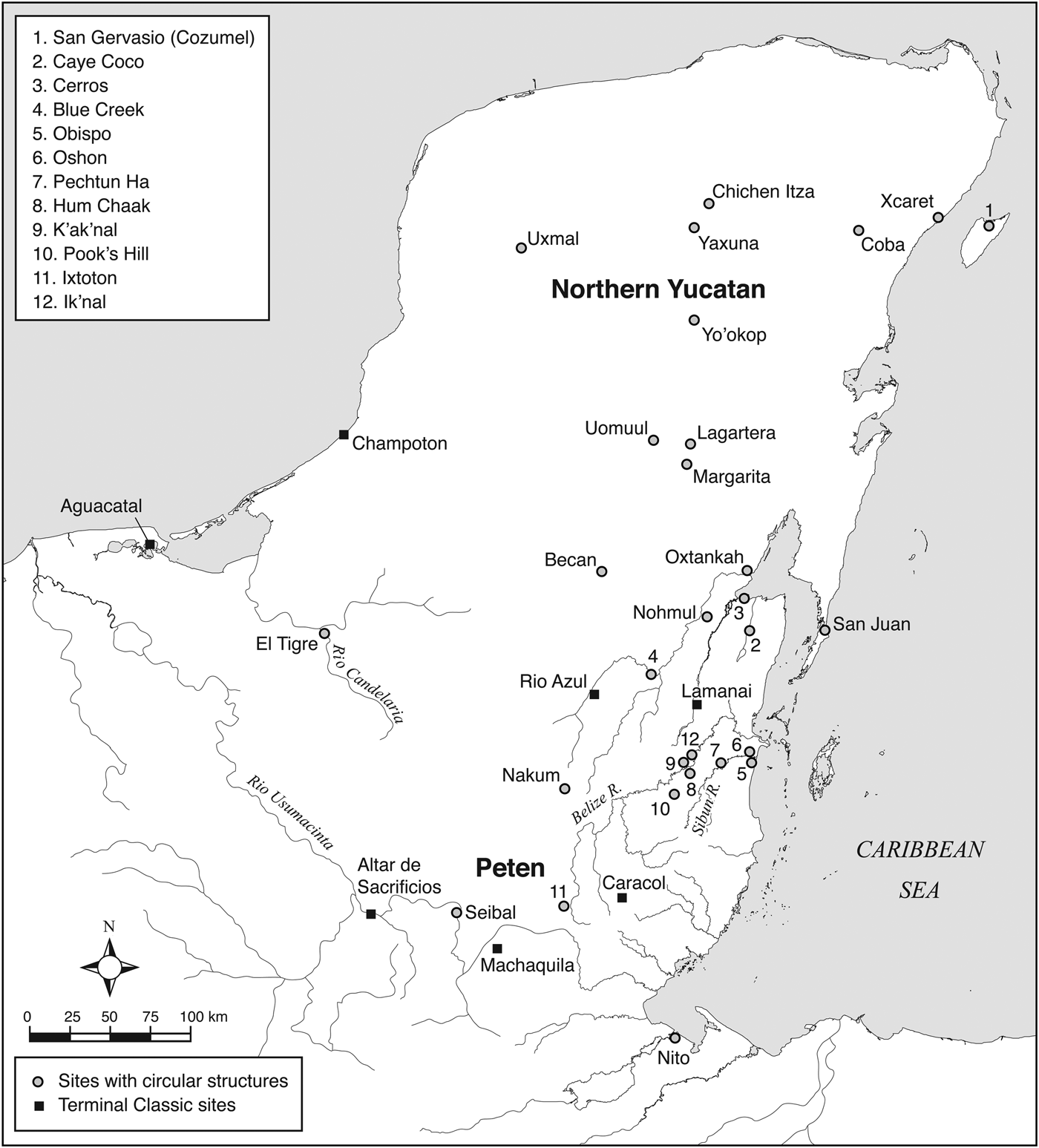
The Terminal Classic period—the transition from the Classic to Postclassic from around a.d. 780 to 900—marks an important period of political, economic, and social transformation throughout Mesoamerica (Demarest et al. Reference Demarest, Rice and Rice2004; Diehl and Berlo Reference Diehl and Berlo1989).Footnote 1 During this transitional period, the political influence of Maya cities in the Peten core area was declining as large centers in northern Yucatan, like Chichen Itza, rose to power (Figure 1). The recently revised chronology for the northern Maya lowlands suggests that the northern polity of Chichen Itza dates to between a.d. 800–1050, overlapping with other Terminal Classic and Early Postclassic Maya sites elsewhere in the lowlands (Andrews et al. Reference Andrews, Wyllys Andrews V and Castellanos2003; Milbrath and Peraza Lope Reference Milbrath2009; Peraza Lope et al. Reference Peraza Lope, Masson, Hare and Kú2006; Ringle et al. Reference Ringle, Negrón and Bey III1998). At Chichen Itza, the circular building known as the Caracol shrine is the largest and most famous example of circular architecture in the Maya area (Pollock Reference Pollock1936a; Ruppert Reference Ruppert1935). Other smaller-scale examples of circular architecture have been found along the eastern Caribbean watershed in Belize at the sites of Caye Coco, Cerros, Nohmul, Blue Creek, San Juan (on Ambergris Caye), as well as at other sites in the mid-to-lower Belize and Sibun River valleys—some 400 km to the south of Chichen Itza (see Figure 1) (Chase and Chase Reference Chase and Chase1982, Reference Chase, Chase, Demarest, Rice and Rice2004; Guderjan et al. Reference Guderjan, Preston, Beach and Luzzadder-Beach2007, Reference Guderjan, Preston, Luzzadder-Beach and Bozarth2009; Guderjan and Garber Reference Guderjan and Garber1995; Harrison-Buck Reference Harrison-Buck2007, Reference Harrison-Buck2011, Reference Harrison-Buck2012, Reference Harrison-Buck2013; Helmke Reference Helmke2006; Kowalski et al. Reference Kowalski, Robertson, Macri and McHargue1994:8; Rosenswig and Masson Reference Rosenswig and Masson2002).
Terminal Classic shrine sites in the Maya lowlands. Drawn by E. Harrison-Buck and digitized by M. Brouwer Burg.

For years, scholars interpreted round structures as Postclassic period architecture that resulted from a Toltec invasion of Chichen Itza (Tozzer Reference Tozzer1957). This theory has been reassessed as more examples of circular architecture dating to the Terminal Classic period (rather than the Postclassic) have been found. Kowalski and colleagues (Reference Kowalski, Robertson, Macri and McHargue1994:7–8) suggest that rather than the Toltecs of central Mexico, “the idea [of] the round structure form was disseminated by the Itza,” a branch of Chontal-speaking Maya people who appear to have their origins in the Gulf lowlands (Scholes and Roys Reference Scholes and Roys1968:23–24). Based on his study of ethnohistoric accounts, Thompson (Reference Thompson1970) suggested his now famous “Putun-Itza” hypothesis, arguing that Chontal-speaking Putun Maya groups invaded Chichen Itza in a.d. 918. While most scholars now find Thompson's chronology for Chichen Itza untenable, they generally accept his suggestion that an outward movement of Chontal-speaking “Mexicanized” Maya merchants from the Gulf Coast introduced a series of “non-Classic” traits in the southern Maya lowlands during the ninth century (Kristan-Graham and Kowalski Reference Kristan-Graham, Kowalski, Kowalski and Kristan-Graham2007:35). In evaluating Thompson's (Reference Thompson1970) argument, Kowalski (Reference Kowalski, Diehl and Berlo1989:173–177) and others (see, for example, Sabloff and Willey Reference Sabloff and Willey1967; Vargas Reference Vargas1997, Reference Vargas2001) have suggested that Chontal-Itza factions established themselves at Chichen Itza and developed a long-distance, circum-peninsular trade network that stretched from the Gulf Coast around the Yucatan, running along the east coast of Belize as far south as the Bay of Honduras and into the Guatemalan highlands.
The archaeological evidence cited in support of this long-distance trade network includes the widespread appearance of “non-Classic” Maya epigraphy, iconographic elements, fine paste ceramics, and new types of architecture, including circular shrines (Ball and Taschek Reference Ball, Taschek, Diehl and Berlo1989; Chase Reference Chase, Robertson and Fields1985; Kowalski Reference Kowalski, Diehl and Berlo1989; Proskouriakoff Reference Proskouriakoff1950; Sabloff Reference Sabloff and Culbert1973, Reference Sabloff and Willey1982; Sabloff and Willey Reference Sabloff and Willey1967; Thompson Reference Thompson1970; Vargas Reference Vargas2001). Kowalski (Reference Kowalski, Diehl and Berlo1989) dated this regional interaction to the ninth century Terminal Classic (a.d. 790–909), based on the epigraphic data. Archaeological data from the Sibun Valley lends support to this chronology for the circular shrine architecture in Belize. Below the archaeological evidence is presented from three circular shrine structures that were partially excavated at three sites in the middle and lower reaches of the Sibun Valley—Pechtun Ha, Oshon, and Obispo (Figure 1). We compare these buildings along side other examples from the Maya lowlands, including structures to the north found at Chichen Itza, Uxmal, and Nohmul—three of the best documented examples in the published literature. While the construction techniques show local variation, the architectural layout and design of the buildings sharply parallel one another. We examine the chronological evidence, focusing on associated radiocarbon dates for the circular shrines. Finally, this study maps out the distributional patterns of similar circular architecture found in the eastern Maya lowlands, which appear to represent a network of sites along the eastern Caribbean, clustering along the rivers and coast of Belize (Figure 1). We conclude by discussing several possibilities that might explain the introduction of these “non-Classic” traits in Belize, which include trading diasporas involving small-scale migration of Chontal-Itza merchants and possibly pilgrimage whereby local elites visited important centers, like Chichen Itza, for political accession ceremonies and emulated these “foreign” styles when they returned home. These scenarios are not considered to be necessarily mutually exclusive of one another. On the contrary, we have suggested elsewhere (Harrison-Buck et al. Reference Harrison-Buck, Moriarty, McAnany and Card2013) that hybrid forms of material culture in the Sibun Valley—in this case architecture with a fusion of local and “foreign” elements—reveal a process of transculturation that occurred at multiple scales of interaction (at both local and regional levels) and probably involved multiple variables, including local- and long-distance trade, small-scale migration, elite diplomatic ties, and in situ development.
THE SIBUN VALLEY
Positioned in the central part of Belize, the Sibun River valley is linked to the Peten area—and its many powerful Classic Maya centers, such as Tikal and Naranjo—via the Belize River, the proximate drainage immediately to the north. Both the Sibun and Belize Rivers bisect the country of Belize and drain into the inner channel of the Caribbean Sea, providing ready access via maritime transport to northern Yucatec capitals such as Chichen Itza. The extensive barrier reef that runs down the eastern Caribbean coast provided a protected route for those traveling by canoe up and down this inner channel. Both architecture and ceramic data suggest that the Belize inhabitants were interacting with both core areas in Peten and Yucatan during the Late-to-Terminal Classic transition (Harrison-Buck Reference Harrison-Buck2007; Harrison-Buck et al. Reference Harrison-Buck, McAnany, Storey, Tiesler and Cucina2007; McAnany et al. Reference McAnany, Thomas, Morandi, Peterson, Harrison, Masson and Freidel2002). However, by Terminal Classic times (around a.d. 830–900) as many Maya centers in the Peten decline, the influence of Peten-affiliated traditions (otherwise referred to as the Tepeu and Spanish Lookout Spheres) weakens in the Sibun Valley and elsewhere in the eastern Maya lowlands (Rice and Forsyth Reference Rice, Forsyth, Demarest, Rice and Rice2004:34–38, Figure 3.2). At sites in north-central Belize, such as Nohmul, Blue Creek, San Juan, and those in the mid-to-lower Sibun Valley, the introduction of circular architecture and other “non-Classic” traits, such as fine paste ceramics, points to an interaction with northern Yucatan and the Gulf lowlands and may signal Belize's growing participation in a new network of circum-peninsular trade that develops during this time.
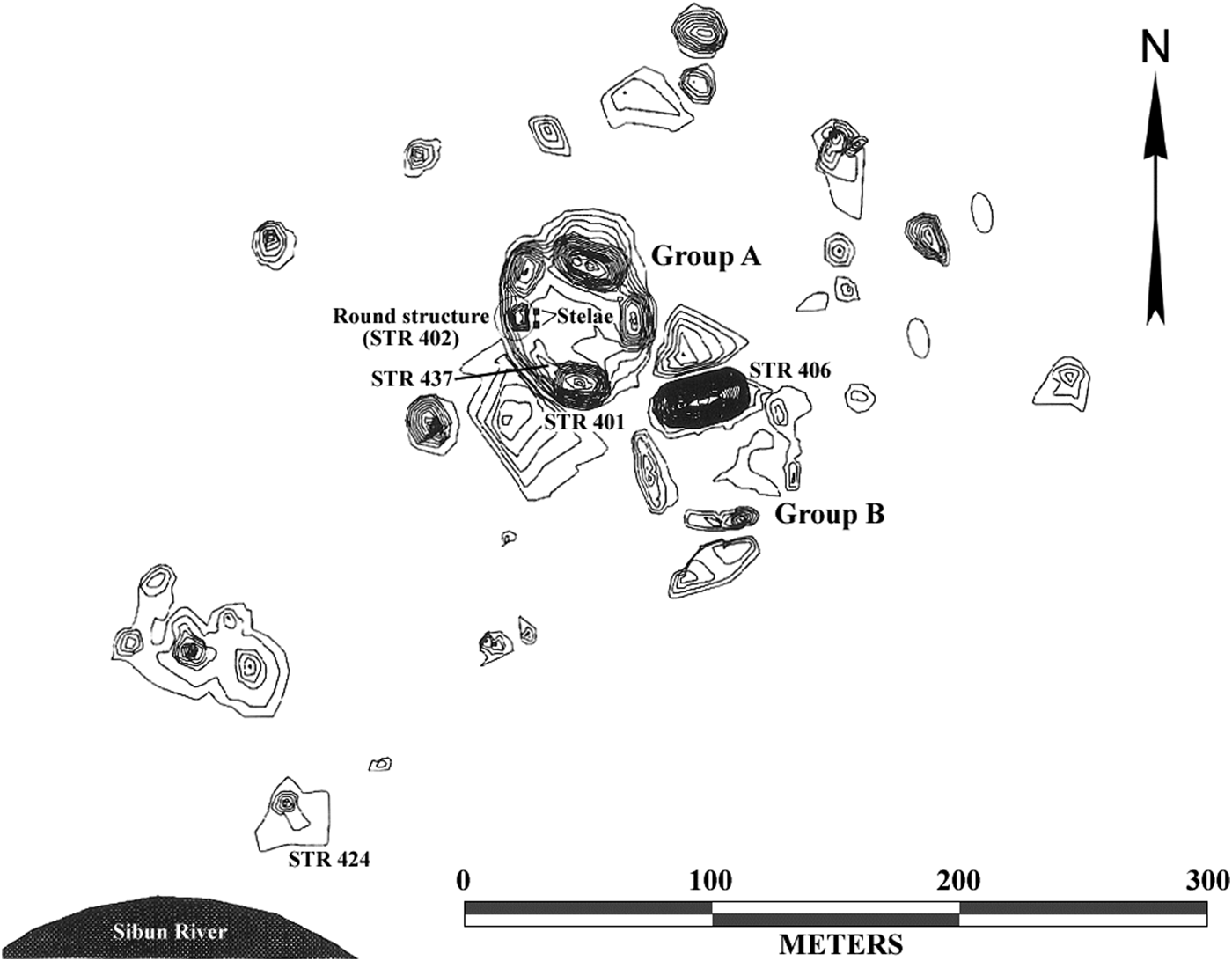
As noted above, three examples of Terminal Classic circular architecture were found at three sites in the Sibun Valley—Oshon, Obispo, and Pechtun Ha (Figure 1). Each of the three structures were partially exposed in excavations conducted by the first author from 1999–2003 as part of the Xibun Archaeological Research Project (XARP), directed by McAnany. In addition, test pitting and limited exposure of some of the neighboring elite residential structures in the plaza groups at Oshon, Obispo, and Pechtun Ha were carried out by XARP at this time. The three sites with circular structures are modest in size. Although Oshon (Figure 2) is the second largest site in the Sibun Valley and contains what might be considered a public ceremonial plaza in Group B, the site is relatively small. Ben Thomas (Reference Thomas2005:159, Table 5.2) characterizes Oshon as a “major regional center” for the Sibun Valley, but when compared to other sites in the Maya lowlands he notes that the site would probably be classified as “a minor regional center” (Bullard Reference Bullard1960; Hammond Reference Hammond1975). In all cases, the circular architecture appears well integrated into the original site plans and suggests that these structures were part of a long-term cultural establishment in the settlement history in the Sibun Valley. The similarities in site planning, architectural design, and building practice among all three structures in the Sibun suggest a prolonged and widely shared tradition involving shrine architecture. Similarities shared with other examples of circular architecture, such as those discussed below, point to a broader connection with other lowland Maya sites including Nohmul, Uxmal, and Chichen Itza. Local construction techniques and other distinguishing elements, however, suggest that the Sibun shrines are a hybrid blend of local and “foreign” styles (Harrison-Buck Reference Harrison-Buck2012; Harrison-Buck et al. Reference Harrison-Buck, Moriarty, McAnany and Card2013).
Map of the Oshon Site in the Sibun Valley. Drawn by B. Thomas.
CIRCULAR ARCHITECTURE IN THE MAYA LOWLANDS
Round structures have a wide geographic distribution in Mesoamerica, extending as far as Oaxaca and central Mexico (Finsten et al. Reference Finsten, Kowalewski, Smith, Borland and Garvin1996; Pollock Reference Pollock1936a:1–2; Rosenswig and Masson Reference Rosenswig and Masson2002:216–217) and have been documented in Belize as early as the Middle Formative period, between 900–500 b.c. (Aimers et al. Reference Aimers, Powis and Awe2000). Formative period round structures are fairly common in the Maya area (Aimers et al. Reference Aimers, Powis and Awe2000; Haberland Reference Haberland1958; Hammond et al. Reference Hammond, Clarke and Robin1991; Ricketson and Ricketson Reference Ricketson and Ricketson1937:115; Sidrys and Andresen Reference Sidrys and Andresen1978), although the shape and size vary considerably, ranging from 3–10.9 m in diameter (see Aimers et al. Reference Aimers, Powis and Awe2000:Table 1). These early constructions are substantially different from the later period circular architecture. The simple platform structures of the Formative period tend to have exterior retaining walls that are vertical or taper in slightly from the base, and usually consist of uncut or roughly cut rectangular limestone blocks, set in mortar and covered with a thick layer of plaster with a well-smoothed surface (Aimers et al. Reference Aimers, Powis and Awe2000: Figures 4, 5, and 7; Haberland Reference Haberland1958: Figure 2; Sidrys and Andresen Reference Sidrys and Andresen1978:642–643, Figure 5). These early round platforms have been variously interpreted as dwellings, astronomical observatories, altars, sweat baths, and places of ritual performance associated with ancestral veneration (Aimers et al. Reference Aimers, Powis and Awe2000:71).
Later versions of circular architecture, corresponding to the Terminal Classic and Postclassic periods (a.d. 800–1450), are quite distinct in both form and function from the Formative period round structures. Circular shrines from the Terminal Classic period are found at sites across a broad area of the Maya lowlands (Figure 1), from Chichen Itza (Pollock Reference Pollock1936a and Reference Pollock1936b; Ruppert Reference Ruppert1935) and Uxmal (Kowalski et al. Reference Kowalski, Robertson, Macri and McHargue1994) in northern Yucatan to Seibal in southern Peten, Guatemala (Smith Reference Smith and Willey1982), to Nohmul (Chase and Chase Reference Chase and Chase1982) and San Juan (Guderjan and Garber Reference Guderjan and Garber1995) in the eastern lowlands of Belize. Other examples of Terminal Classic circular shrines are found at Chontal sites in the Gulf lowlands, such as El Paraiso and El Tigre or Itzamkanac, the Acalan Putun capital at the time of the Spanish Conquest (Fox Reference Fox1987:60, 83; Thompson Reference Thompson1970:17; Vargas Reference Vargas2001).
Architectural Comparisons
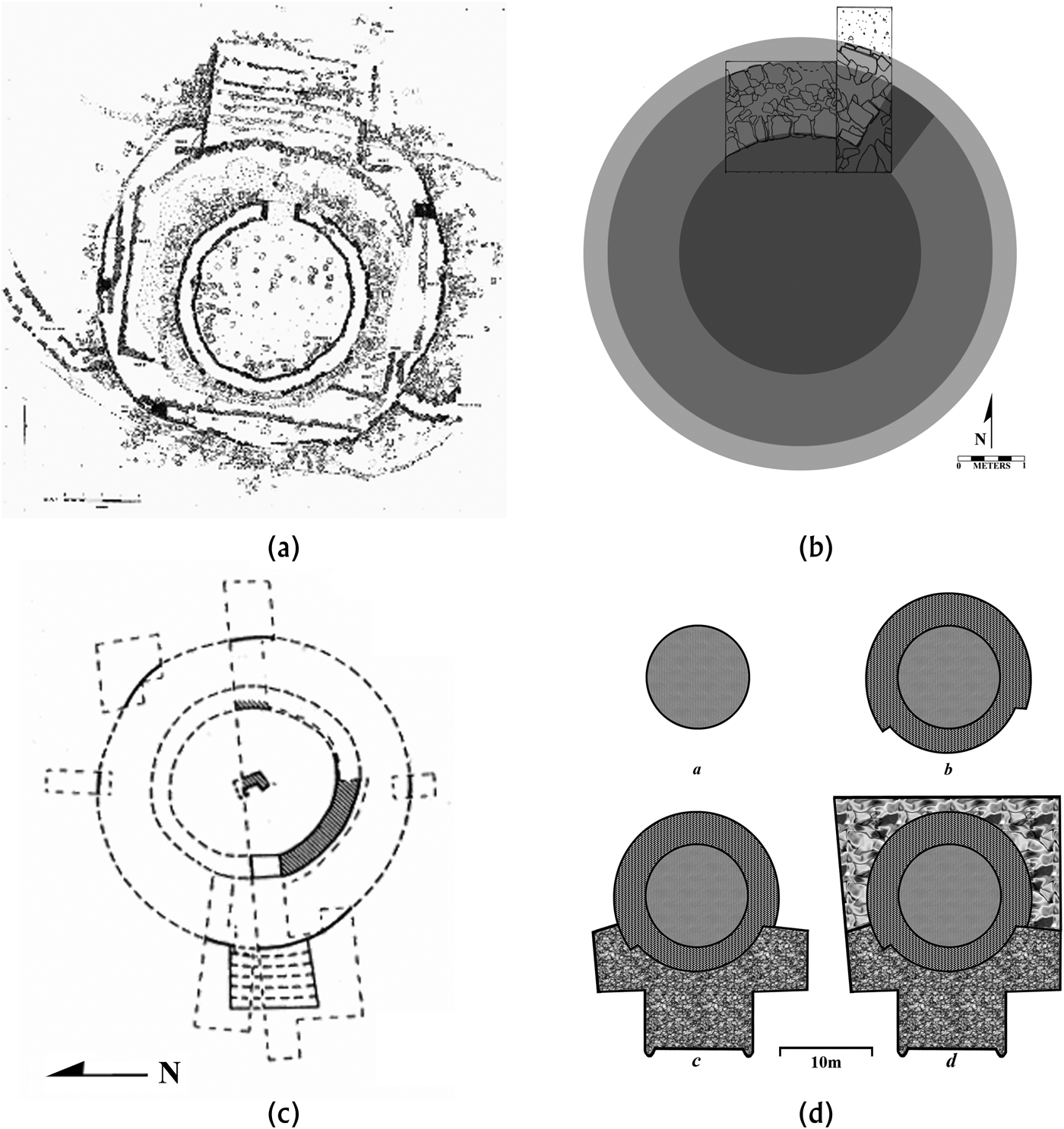
Architecturally, the three circular buildings found at the sites of Pechtun Ha, Oshon, and Obispo in the Sibun Valley are very similar to one another and also share similarities with other Terminal Classic circular structures found in the Maya lowlands, including those from Nohmul, Uxmal, and Chichen Itza (Figure 3). The construction of a superstructure comprising low stone walls characterizes the circular architecture in the Sibun Valley, as well as at Nohmul, Uxmal, and possibly the early phases of the Caracol at Chichen Itza. Excavation reports from Nohmul and Uxmal do not note any evidence of additional wall or vault stones in the collapse debris of the circular shrines, suggesting that the low superstructure walls were topped with a perishable structure and conical roof (rather than a vaulted stone roof like the final phase of the CaracolFootnote 2). This construction style, consisting of low stub walls topped with a perishable superstructure also characterizes the three circular shrines found in the Sibun Valley (Figures 3b and 4a, b). All of these buildings (including the examples from Nohmul, Uxmal, and Chichen Itza) contain an interior room, the dimensions of which range from 5 to 12 m. Most contain a single narrow doorway measuring between 1–1.5 m wide (see Figures 3 and 4). The outer dimensions of circular architecture, which usually consists of a round substructure, are more variable in size and format.Footnote 3 The range of substructure size appears relatively proportionate to site size and the degree of architectural elaboration may be contingent on the site's elite prestige. Other shared features that frequently occur include masonry walls with an overhanging cornice, a low circular plinth surrounding the footing walls, and the presence of paving stones sometimes lining the interior floors of the room (Figure 4a). These architectural features are not common in the southern Maya lowlands, but are construction techniques often found in the Puuc and Northern Plains region of Yucatan.
Lowland Maya circular architecture: (a) the round structure at Uxmal (Kowalski et al. 1996:Figure 3); (b) Structure 100 at Pechtun Ha (drawing by E. Harrison-Buck); (c) Structure 9 at Nohmul (Chase and Chase Reference Chase and Chase1982:Figure 2); (d) the Caracol at Chichen Itza (redrawn from Pollock Reference Pollock1936a:Figure 31).
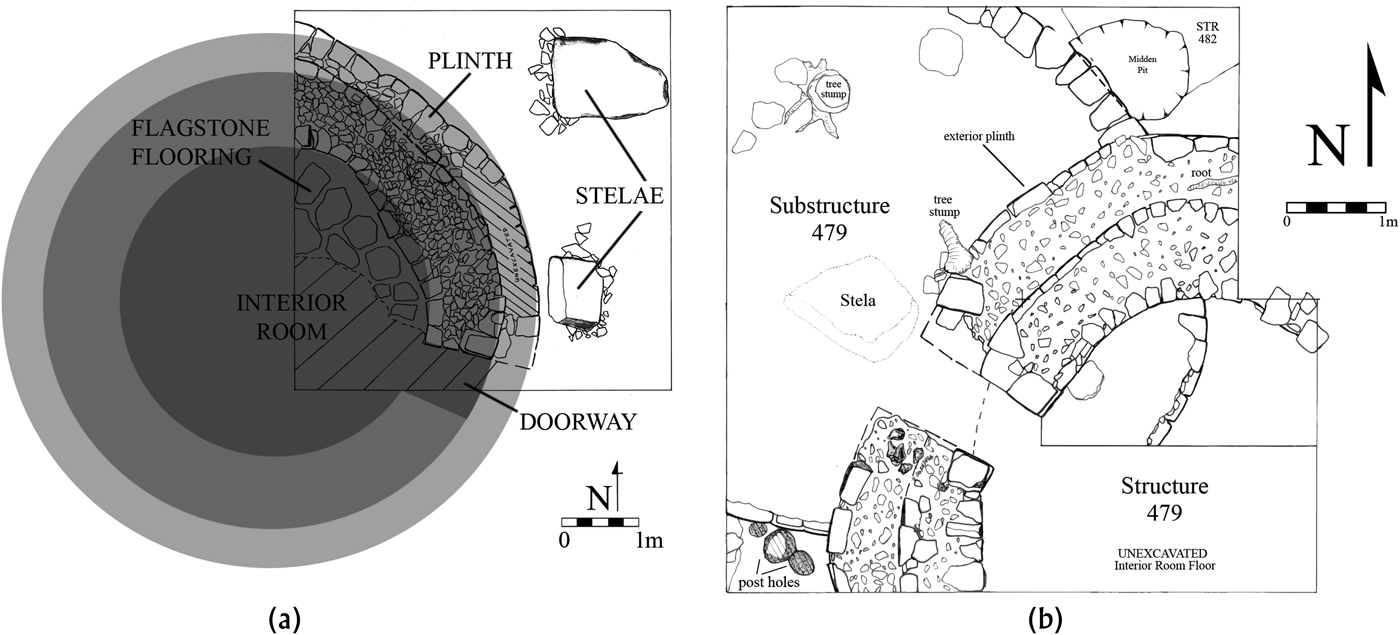
(a) Plan view of the circular structure at Oshon, Sibun Valley. (b) Plan view of the two superimposed circular structures at Obispo, Sibun Valley. Drawings by Eleanor Harrison-Buck.
As part of the first author's dissertation research, Harrison-Buck (Reference Harrison-Buck2007) conducted a thorough comparative investigation of circular architecture and defined three discrete building types (Types 1–3) for Terminal Classic circular architecture in the Maya lowlands. Simple circular platforms characterize Type 1 structures. In the Sibun Valley, only the Obispo site revealed a Type 1 platform (Substructure 479), which represents the earliest phase of circular architecture in the valley (Figure 4b). Other Type 1 circular architecture is found at Caye Coco (Structure 1) and San Juan (Structure 3B) in northern Belize (Guderjan and Garber Reference Guderjan and Garber1995; Rosenswig and Masson Reference Rosenswig and Masson2002:Figure 4), Becan (Structure 16) in Campeche, Mexico, and possibly at Nakum (Structure 12) in Peten, Guatemala (Źrałka Reference Źrałka2008:42; Źrałka and Hermes Reference Źrałka and Hermes2012; see Figure 1 for site locations). In addition, the earliest phase of the Caracol building (Structure 3C15-2nd) at Chichen Itza would be characterized as a Type 1 structure. This building phase may or may not have had a staircase leading to the top of the circular platform. In his excavation report of the Caracol, Ruppert (Reference Ruppert1935:86) noted that the moldings and cornice completely encircled the earliest circular platform and that he found no evidence of a staircase. He indicated that it was possible there once existed a perishable wooden staircase leading to the top, but admitted finding no firm evidence for this (Ruppert Reference Ruppert1935:87). In the Sibun Valley, the Type 1 platform at Obispo consists of a rough, cobble-filled surface and does not appear to have been formally topped with a paved plaster surface. This also was the case at Chichen Itza and is one reason why Ruppert (Reference Ruppert1935:271) speculated that the first two phases of the Caracol—both 3.7 m-high solid platforms—possibly were never completed or used prior to the final building phase (Figure 3d). However, despite the top surface looking incomplete, the exterior walls of the two earlier circular substructures of the Caracol appear to have been nicely finished with plaster (Ruppert Reference Ruppert1935:Figures 96, 103–104, 119).
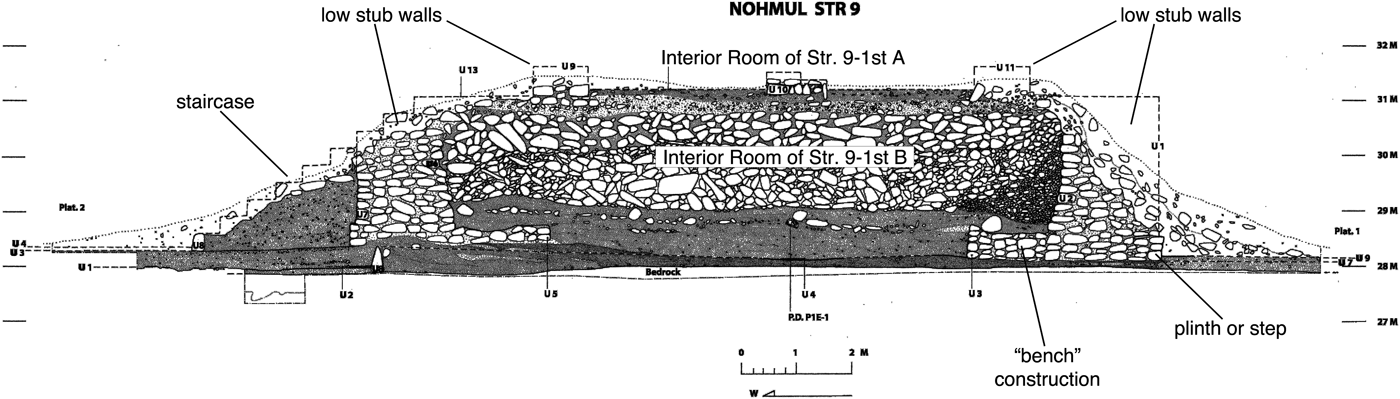
A superstructure with low stub walls about three or four courses in height characterize the Type 2 circular structures (Harrison-Buck Reference Harrison-Buck2012:Figure 5). These buildings typically have a single, narrow doorway leading into an interior room. In most cases, a plinth that resembles a molding or low step surrounds the exterior. Unlike a basal platform, the plinth does not extend under the entire building and only underlies the superstructure walls (see Figure 5 cross-section for a clear example). In some cases the plaza surface serves as the floor of the interior room, but in other instances the interior floor is built up roughly to the height of the plinth, sometimes lined with flagstones. The Type 2 architecture has been found in the Sibun Valley at Oshon (Structure 402-1st B), Obispo (Structure 479-1st B), and Pechtun Ha (Structure 100-1st B), at Hum Chaak and Ik'nal in the Belize Valley, and at Blue Creek (Structure 22 in the Rosita Group) in northern Belize. This architecture type may also be present in the circular structure at Nohmul in northern Belize (labeled Structure 9-1st B in Figure 5).
Cross-section of Structure 9 at Nohmul (adapted from Chase Reference Chase1982a:Figure 3-10).
Type 3 architecture marks the final construction phase of the Terminal Classic circular architecture in Belize (Harrison-Buck Reference Harrison-Buck2012:Figure 6). During this phase, the interior room of the Type 2 structure is infilled with large, loose cobble and boulders and transformed into a solid, round basal platform. In the case of the Caracol, it appears that a plinth or basal molding may have been added around the exterior base of the substructure at this time. In the Sibun Valley, set on top of this round substructure is another circular superstructure consisting of low stub walls as high as three courses. This building type is poorly preserved, but is found at Oshon (Structure 402-1st A), Obispo (Structure 479-1st A), and Pechtun Ha (Structure100-1st A). Other examples of Type 3 architecture—showing a circular superstructure positioned on a basal platform—are found in the final phases of the circular structures at both Uxmal and Nohmul (labeled Structure 9-1st A in Figure 5), and possibly the second phase of the Caracol (Structure 3C15-1st C) at Chichen Itza (Figure 3d). In some instances, stone used in the Type 3 superstructure appears to be recycled (taken from elsewhere at the site), perhaps indicating a decline in building practice during the final facet of the Terminal Classic period. In both Type 2 and Type 3 buildings, a perishable structure likely with a pointed thatch roof capped the low stub walls of the superstructure.
DATING THE CIRCULAR SHRINES
Associated archaeological evidence, specifically ceramics and radiocarbon assays that date discrete construction/occupational phases shed light on the chronology of these buildings. These data suggest that circular shrine architecture was introduced in the Belize area by at least the beginning part of the ninth century (a.d. 830–850) and appear to be abandoned by the early-to mid-tenth century. Radiocarbon dates associated with a series of construction phases for the circular structure at Obispo offer the clearest insight into the chronology of this building type found in the Sibun Valley. The plan view of the circular architecture at Obispo (Figure 4b) shows two distinct phases of the circular structure. The radiocarbon assays come from two carbon samples that were collected from these different architectural phases of the circular shrine at Obispo and suggest that the initial construction likely took place around the beginning part of the ninth century. The first charcoal sample was found in a midden-rich fill layer associated with the earliest structure (Substructure 479), a (Type 1) simple round platform, which resembles the initial phase of the Caracol at Chichen Itza (Structure 3C15-2nd). The charcoal sample yielded a 2-sigma calibrated date range of a.d. 758–887 (1,223 ± 35 14C age B.P.). The second charcoal sample came from the interior floor of the (Type 2) circular building that was constructed over top of the circular platform (Structure 479). This sample yielded a nearly identica. 2-sigma calibrated date range of a.d. 758–891 (1,231 ± 35 14C age B.P.). Both contexts contained a highly diagnostic Terminal Classic ceramic assemblage defined as the Ik'hubil Complex (Harrison-Buck Reference Harrison-Buck2007:Table 5.1). A final charcoal sample from Obispo that was radiocarbon dated was found associated with a thin scatter of terminal debris around the exterior of the circular structure, which contained Early Postclassic ceramic material (Harrison-Buck Reference Harrison-Buck2007:Table 5.2). It yielded a 2-sigma calibrated date range of a.d. 883–1018 (1,103 ± 35 14C age B.P.). These three dates firmly place the construction of circular architecture in the ninth century a.d.
The construction and occupation of the circular structures in the Sibun Valley and elsewhere in Belize appear to be temporally coeval with the Caracol at Chichen Itza, dating between roughly a.d. 830–900. The primary occupation of the Caracol building (and most of the Monjas Complex) probably dates to the ninth century—a time period that is variably referred to as early Sotuta (Cobos Reference Demarest, Rice and Rice2004) or Cehpech (Pérez de Heredia Reference Pérez de Heredia Puente2010, Reference Pérez de Heredia Puente2012) at Chichen Itza. One dedicatory cache found on the north side of the basal platform supporting the Caracol building (Structure 3C15) contains two vessels that Pérez de Heredia (Reference Pérez de Heredia Puente2012:Figure 17) identifies as either a Yabnal-Motul jar and a Cehpech bowl or a Motul jar and a Cehpech bowl, which dates the initial platform construction to around a.d. 830 (Pérez de Heredia Reference Pérez de Heredia Puente2012:393). The first phase of the Caracol—a simple circular platform (Structure 3C15-2nd)—was positioned on top of the square basal platform and another dedicatory cache was placed in a pit inside the fill of the circular platform. Pérez de Heredia (Reference Pérez de Heredia Puente2012:393) notes that the jar found in the cache is identical to others found in burial cysts under the Three Lintels Platform, a Puuc-style structure that he dates to a.d. 630–700 or the middle facet of the Yabnal-Motul Complex (Pérez de Heredia Reference Pérez de Heredia Puente2012:388). Despite its early correlates, Pérez de Heredia (Reference Pérez de Heredia Puente2012:393) dates the cache to the late facet of the Yabnal-Motul Complex or beginning of his Cehpech sequence (a.d. 830–850) based on its position in the construction sequence of the Caracol (see Brainerd Reference Brainerd1958:Figures 68e and 99). There is at least one reliable hieroglyphic date associated with the final phase of the Caracol that dates to a.d. 885 (Ringle and Bey Reference Ringle, Bey III, Fash and López Luján2009:Table 1). In the collapsed tower of the final phase of the Caracol a Tohil Plumbate vessel—a highly diagnostic trade ware—was found, which suggests the final use and subsequent abandonment of the building was during the late Sotuta phase, at approximately a.d. 900–1050 (Milbrath and Peraza Lope Reference Milbrath2003:23).
Similar deposits of Tohil Plumbate ceramics were found associated with the abandonment of the round structure at Uxmal (Kowalski et al. Reference Kowalski, Robertson, Macri and McHargue1994:5–6). Kowalski and colleagues (Reference Kowalski, Robertson, Macri and McHargue1994:6) note that Cehpech ceramics are found in the construction fill of the round building, while the Plumbate offerings represent post-abandonment deposits. They conclude “that a considerable span of time elapsed between the abandonment of the Round Structure [at Uxmal] and the deposition of the Plumbate offerings” (Kowalski et al. Reference Kowalski, Robertson, Macri and McHargue1994:6). Ringle and colleagues (Reference Ringle, Negrón and Bey III1998:222) suggest that the “post-monumental” quality of the circular building and the presence of Plumbate ceramics points to possibly a tenth century date for the construction and use of this building at Uxmal. The discrete stratigraphic sequence of the Cehpech and Plumbate deposits, coupled with the building's similarities with other Terminal Classic round structures in the Maya lowlands, however, suggest that it may have been constructed earlier in the ninth century. During the Terminal Classic period (a.d. 770/800–950) Uxmal was the capital of a regional state in the Eastern Puuc region of northern Yucatan (Kowalski Reference Kowalski, Kowalski and Kristan-Graham2007:253). Scholars suggest that monumental construction ceased at Uxmal as early as a.d. 950 but that just prior to this the site witnessed its greatest boom in construction, including the House of the Governor, the Nunnery Quadrangle, and Ballcourt 1, all of which have associated carved monuments that date between a.d. 890–915 (Carmean et al. Reference Carmean, Dunning, Kowalski, Demarest, Rice and Rice2004:425, 431–432).
Like Uxmal, the site of Nohmul in northern Belize, located between the Rio Hondo and the New River, also contains a substantial Terminal Classic occupation (Chase Reference Chase1982a, Reference Chase1982b; Hammond Reference Hammond1983, Reference Hammond1985; Hammond et al. Reference Hammond, Clark, Horton, Hodges, McNatt, Kosakowsky and Pyburn1985). Structures 9 and 20, two Terminal Classic structures located in the East Plaza at Nohmul, are situated in front of earlier Classic period structures and appear as intrusive construction (Chase and Chase Reference Chase and Chase1982:Figure 1). Structure 20, a so-called patio-quad structure with a sunken court area, is positioned at the base of Structures 18 and 19 and appears to be physically blocking the entrance to these two structures. Structure 9 (Figures 3c and 5) is a circular building and serves to further restrict access into an enclosed patio group in the East Plaza. Structures 9 and 20 contain Terminal Classic diagnostics, including Puuc and Thin Slate wares, and have been interpreted as Yucatec-style architecture emulative of Chichen Itza (Chase Reference Chase1982a; Chase and Chase Reference Chase and Chase1982). Recycled stones found associated with the northern-style structures, including a “cached” modeled stucco head, suggests that certain buildings associated with an earlier occupation at the site were demolished and perhaps “ritually” terminated. The evidence of architectural defacement and the intrusive nature and “foreign” style of Structures 9 and 20 at Nohmul suggests a significant shift in the political organization at Nohmul by Terminal Classic times. The evidence may indicate an invasion, as some have suggested, or that the Terminal Classic construction signifies a later re-occupation of an already abandoned site.
Diane Chase (Reference Chase1982a:122) states “although construction took place in a series of stages, Structure 9 does not seem to have been modified once built.” But, examining the cross-section drawing of Structure 9 (Figure 5) and comparing it to others, such as the early phases of the Caracol Building at Chichen Itza and those from the Sibun Valley, we suggest at least two discrete construction phases may be present (Structures 9-1st A and 9-1st B), including what appears to be the resurfacing of the interior room floor of Structure 9-1st B (Harrison-Buck Reference Harrison-Buck2007:137). The Ikikik Ceramic Complex is associated with both phases of construction (Structures 9-1st A and 9-1st B) and suggests that they were both built during the ninth century Terminal Classic period (Chase Reference Chase1982a).
DISCUSSION
Tracing out the presence and distribution of “non-Classic” Maya traits like circular architecture, scholars have proposed both western and eastern networks of interaction emanating from Chichen Itza (Ball Reference Ball1974, Reference Ball, Sabloff and Andrews V1986; Ball and Taschek Reference Ball, Taschek, Diehl and Berlo1989; Carmack Reference Carmack1981:45–47, Figure 3.7; Chase Reference Chase, Robertson and Fields1985; Florescano Reference Florescano2006; Kowalski Reference Kowalski, Diehl and Berlo1989 and 2007). While it is debatable whether circular architecture disseminated in a linear fashion directly from Chichen Itza, there is a clear pattern of coastal and riverine distribution for circular shrines in Belize where numerous examples have been found (Figure 1). In addition to Nohmul (Chase and Chase Reference Chase and Chase1982) and the site of San Juan in northern Belize (Guderjan and Garber Reference Guderjan and Garber1995), more recently discovered examples come from Caye Coco (Rosenswig and Masson Reference Rosenswig and Masson2002), Cerros (Walker Reference Walker1990:158–160, Figures 3.1 and 3.3c), Blue Creek (Guderjan et al. Reference Guderjan, Preston, Beach and Luzzadder-Beach2007, Reference Guderjan, Preston, Luzzadder-Beach and Bozarth2009), Pooks Hill (Helmke Reference Helmke2006), Hum Chaak, Ik'nal, and K'ak'nal in the eastern Belize Valley (Harrison-Buck Reference Harrison-Buck2011, Reference Harrison-Buck2013), as well as the three examples from the Sibun Valley discussed herein. To our knowledge, all of the circular architecture found in Belize is primarily associated with ninth century Terminal Classic ceramic assemblages, which reinforces the absolute chronology from radiocarbon dates presented here from the Sibun Valley. Farther afield in northern Yucatan, the ceramics associated with the construction phase of the circular structure at Uxmal and the initial construction phases of the Caracol at Chichen Itza that were reviewed above also point to a ninth century date, although radiocarbon dates would help to solidify the northern chronology.
Circular shrine architecture found at Uxmal in northwest Yucatan and Nohmul in northern Belize have been linked with the expansion of Chichen Itza as a northern regional capital in Yucatan (Kowalski et al. Reference Kowalski, Robertson, Macri and McHargue1994:8; Suhler et al. Reference Suhler, Ardren, Freidel, Johnstone, Demarest, Rice and Rice2004:458). Yet, most argue that Chichen Itza's period of peak political and economic influence as a Yucatec center did not occur until the late Sotuta phase, between a.d. 900–1050 (Cobos Reference Demarest, Rice and Rice2004:532; Kristan-Graham and Kowalski Reference Kristan-Graham, Kowalski, Kowalski and Kristan-Graham2007:48; Milbrath and Peraza Reference Milbrath2009:581–582; Ringle et al. Reference Ringle, Bey III, Freeman, Hanson, Houck, Smith, Demarest, Rice and Rice2004:505). According to many of these scholars, it was during the late Sotuta phase (traditionally referred to as the “Mexican” or “Toltec” period) that hegemonic rule and economic expansion occurred across the peninsula. Yet, others argue against the idea of an “Itza” hegemony and, instead, suggest that Chichen Itza was one of a number of important tollans or regional capitals throughout Mesoamerica that shared a structure of political leadership and ritual centered on the Mexican feathered serpent god, Quetzalcoatl (Ringle Reference Ringle2004:168–169; see also Ringle et al. Reference Ringle, Negrón and Bey III1998).
Ringle and colleagues (Reference Ringle, Negrón and Bey III1998:186) associate circular buildings with a so-called “cult of Quetzalcoatl” and the feathered serpent's wind aspect, Ehecatl. According to Taube (Reference Taube, Fields and Zamudio-Taylor2001), the circular form of these buildings evokes the coiled body of the feathered serpent and Ehecatl's primary insignia—the spiraled conch shell. Harrison-Buck (Reference Harrison-Buck2002) established a linkage between the feathered serpent and the Sibun Valley circular shrines, which she argues is expressed not only in the form of these buildings, but also in a high density of conch shell trumpets that she found in her excavations associated with the exterior of these buildings (for more recent discussion of some of these ideas see Harrison-Buck [2007, 2012] and McAnany [Reference McAnany, Sabloff and Fash2007, Reference McAnany2012]). Ringle (Reference Ringle2004:167, 183) has argued that the feathered serpent represents an “ideology of leadership” whereby client elites from other centers underwent rituals of investiture, received their implements of power, and were legitimized as local “feathered serpent” rulers at Chichen Itza and other tollans, such as Cholula and El Tajin. In such a case, the placement of a circular shrine within an elite residence might signify the coronation of a local leader as a feathered serpent ruler, whereby local leaders returned to their communities and built shrines to emulate northern styles. If circular shrine architecture is linked to this new form of leadership, it suggests that it was firmly in place by the ninth century and extended as far south as places like Belize.
Following Ringle and colleagues (Reference Ringle, Negrón and Bey III1998:227), pilgrimage and legitimation rituals would have been crucially important for reinforcing economic linkages in the long-distance, circum-peninsular trade network. That these were connected concepts is reflected in Mayan terms, like the K'iche' word b'inem, which is “a journey, for the purpose of either trade or pilgrimage” (Tedlock Reference Tedlock and Curry2010:14). Ethnohistoric documents support the idea of long-distance trade tied with elite pilgrimages to tollans, like Cholula and Chichen Itza, where legitimation rituals were performed and local elites were granted the right to govern their communities (Carmack Reference Carmack1981:45–47; Florescano Reference Florescano2006:130–134; Tedlock Reference Tedlock1996:179). To illustrate this idea, Ringle (Reference Ringle2004:169) cites the following passage by the sixteenth-century chronicler Gabriel de Rojas (Reference Rojas1927 [1581]:161) regarding pilgrimage to Cholula at the time of contact:
…kings or chiefs [from outside Cholula], in inheriting a kingdom or principality, would come to [the city of Cholula] to pay homage to the idol of this Quetzalcoatl, to whom they offered rich feathers, blankets, gold, and precious stones and other things of value, and having made offerings, they were put in a small room dedicated to this purpose in which the two highest priests marked them by piercing the ears, the nostrils, or the lower lip, depending on the kingdom, and they returned to their lands. And because of such things they were given credit and were respected by these lords. So that they might be respected by these lords, five indios from the priesthood also accompanied them home [Rojas Reference Rojas1927 (1581):161].
That five members from the priesthood would accompany the local elites home suggests that such interactions were not unidirectional. Ringle (Reference Ringle2004:204) argues that such pilgrimages occurred as early as the ninth century based on the evidence of investiture rituals at Chichen Itza associated with the warrior leader K'ak'u Pakal. If so, these politco-religious diasporas may have contributed to the spread of “non-Classic” traits stemming from tollans, like Chichen Itza.
Similar small-scale population movements linked to religious pilgrimages and trading voyages are described elsewhere as “circular” migrations, involving “regular population movements with an intention to return” (Knapp Reference Knapp2008:49). Colonial accounts, such as those recorded by Alonso Ponce and others, lend further support to the idea of circular migrations, suggesting that in some cases communities along the eastern Caribbean with shrines were established by Chontal-Itza merchants, who built and maintained the shrines while overseeing their commercial affairs along the coast (Ciudad Real Reference Ciudad Real1872:2:407–408; Lothrop Reference Lothrop1924; Scholes and Roys Reference Scholes and Roys1968:34). Such descriptions resemble trading diasporas where “some portion of one culture's people—usually merchants—settled as immigrants among a foreign population” (Cusick Reference Cusick and Cusick1998:4).
Migration as an explanatory process has a long-standing bias as an external model (Braswell Reference Braswell and Braswell2003:15–18). “Continuing skepticism about using migration to explain cultural change…is clearly part of the processual legacy that rejects diffusionism and migration as hallmarks of cultural history” (Knapp Reference Knapp2008:51). As Susan Alt (Reference Alt, Butler and Welch2006:290) notes, previous models dealing with culture change often suffered from an all-or-nothing approach, proposing either local evolutionary development or wholesale population replacement as a result of colonization. Cohen (Reference Cohen and Meillassoux1971) points out that ancient, non-Western trading diasporas diverge from European models of colonialism—groups entering an area did not necessarily dominate their local host community. Although they may have intermarried with locals, “the foreigners seem to have maintained a distinct social identity for an extended period of time” (Stein Reference Stein, Lyons and Papadopoulos2002:28, citing Abner Cohen's [1971] “trading diaspora” model).
For the Maya area, a combination of local elite pilgrimage and circular migrations of Chontal-Itza merchant-priests who regularly traveled back and forth along the eastern Caribbean might explain the widespread appearance of circular shrines found distributed along the coast and rivers of Belize during the ninth century. Involvement of the local Sibun population is reflected in the hybridized construction techniques of circular architecture and may explain why shrines do not appear in every community occupied in the Sibun Valley during the Terminal Classic period (Harrison-Buck et al. Reference Harrison-Buck, Moriarty, McAnany and Card2013). If trading diasporas or circular migrations did occur in this area, small groups of Chontal-Itza may have entered places like the Sibun Valley and become permanent or semipermanent residents, but these individuals (perhaps serving as merchants and/or specially trained priests) would have retained strong ties with their homeland and perhaps ultimately returned. This might explain why sites with circular shrine architecture are abandoned and “non-Classic” traits disappear rather abruptly in the early- to mid-tenth century in the Sibun Valley, yet small-scale local populations remain in the area during the subsequent Early Postclassic period.
CONCLUSIONS
In the Sibun Valley, the ceramic assemblages and associated radiocarbon assays from the circular shrines support a ninth century chronology for circular architecture, which appears to align with the ceramic chronology and the hieroglyphic record associated with the Caracol and other so-called “Old Chichen” structures at Chichen Itza dating to the early Sotuta phase, between a.d. 830–890 (Cobos Reference Kowalski and Kristan-Graham2007:326–327; Grube and Krochock Reference Grube, Krochock, Kowalski and Kristan-Graham2007:214, 229). The traditional interpretation of circular architecture as a “Toltec” form of architecture introduced in the early tenth century at Chichen Itza is no longer tenable (Kowalski et al. Reference Kowalski, Robertson, Macri and McHargue1994:8). The early phases of the Caracol building and other structures in the Monjas Complex reflect architectural features found in the Puuc region during the ninth century and may overlap in time with the circular building found at Uxmal, as well as those found elsewhere in the Maya lowlands, including Belize. The locations of sites with circular architecture appear to be positioned at strategic points along the coast and rivers of the Caribbean Watershed. The locations suggest an important connection between shrine architecture and the movement of goods and people, either on foot or via canoe, and may be tied to a circum-peninsular trade network developed by Chontal-Itza groups at this time, which continued in some areas through the Postclassic period. Cacao, honey and bird feathers—commodities highly sought after by the Chontal-Itza merchants according to ethnohistoric documents—were readily available in sub-tropical river valleys, like the Sibun, and may have been what stimulated an incursion into this part of the Maya lowlands during the ninth century. Future investigations will hopefully clarify the nature of this growing Terminal Classic political economy in terms of its the impact on the political and economic expansion of Chichen Itza, traditionally dated to the tenth century, and its potential relationship to the southern lowland “collapse” of Classic Maya aristocracy by the beginning the ninth century.
RESUMEN
La arquitectura circular del periodo clásico terminal ha sido descrita como un elemento “no-clásico”, sino derivado de grupos del Chontal-Itza en el Golfo de México. Estos grupos habrían desarrollado una extensa red de comercio, probablemente controlada por Chichen Itza en el norte de la península Yucatan. En el valle del río Sibun, en la zona central de Belice, y en otros lugares de la cuenca Caribe, se construyeron estructuras circulares muy similares a versiones pequeñas del Caracol de Chichen Itza. En este estudio presentamos las evidencias arqueológicas recabadas en tres estructuras circulares excavadas en Sibun, a la vez que establecemos comparaciones con otras estructuras ubicadas en las zonas bajas del mundo maya, como Chichen Itza, Uxmal y Nohmul. Las estructuras circulares del periodo clásico terminal presentan una distribución consistente dentro de un área extensa de las zonas bajas maya, resaltando la existencia de un estilo de construcción específico. Las similitudes en la planificación de los sitios y su diseño arquitectónico, sugieren una prolongada tradición ampliamente compartida que incluía la construcción de altares circulares. Por otro lado, el uso de técnicas locales de construcción y de otros elementos distintivos, sugieren que los altares circulares en Sibun representan una mezcla híbrida de estilos locales y “extranjeros.” Su distribución geográfica y temporal, combinada con su similitud arquitectónica, sugieren el establecimiento de una red extensa de altares circulares interconectados en las zonas bajas del Este durante el siglo IX del periodo clásico terminal.
Planteamos distintas posibilidades que podrían explicar la introducción de estas características “no-clásicas” en Belice. Por ejemplo, planteamos la posibilidad de diásporas comerciales que involucrasen migraciones en pequeña escala de comerciantes chontales. Del mismo modo, pudieron darse peregrinaciones durante las cuáles las elites locales habrían visitado centros importantes, como Chichen Itza, para participar en ceremonias políticas de adhesión que pudiesen luego ser implementadas al regresar a su propia región. Es posible que estos dos escenarios no fuesen mutuamente excluyentes entre sí. Por otro lado, sugerimos que las formas híbridas de la cultura material del Sibun—en este caso la arquitectura con una fusión de elementos locales y “extranjeros”—revelan un proceso de transculturación que ocurrió en múltiples escalas de interacción (tanto a nivel local y regional) y probablemente incluyó diversas variables, entre ellas el comercio local y a larga distancia, la migración a pequeña escala, relaciones diplomáticas entre las elites, y también el desarrollo en situ.
Acknowledgments
The X'ibun Archaeological Research Project (XARP), directed by Patricia McAnany, was funded by the Division of International Programs at Boston University. Additional financial support was provided by grants from the National Science Foundation awarded to Patricia McAnany (BCS-0096603) and Eleanor Harrison-Buck (BCS-0638592). The project staff members, field school students, and local villagers who conducted the fieldwork reported upon in this analysis deserve a large note of appreciation. The Institute of Archaeology as part of the National Institute of Culture and History in Belize issued permission to conduct field work in the Sibun Valley during 1997, 1999, 2001, 2003, and 2007 and we thank the staff and directors at the Institute, particularly Dr. Jaime Awe, Dr. John Morris, Dr. Allan Moore, and Mr. Brian Woodye for their patience, collegiality, and assistance. We also would like to thank William Ringle, Fernando Robles Castellanos, Joseph Ball, and an anonymous reviewer for reading earlier versions of this paper and for their constructive comments and suggestions. Finally, we extend our gratitude to Natalia Hoyos and David Buck for kindly providing the translations for the article abstract and resumen.