Implications
The environment is critical for the expression of appropriated behaviour by cows and calves just after birth. The presence of vultures at calving sites is one environmental aspect that can impair mother–offspring interactions during the first hours after calving, delaying the ingestion of colostrum. Documenting the effects of black vultures on cow–calf behaviour will aid in understanding the potential risk factors associated with reduced or delayed colostrum ingestion, an important cause of calf morbidity and mortality.
Introduction
The negative role of the black vultures (Coragyps atratus) has been described in relation to their attacks on neonates of some domestic species, for example, cattle (Umberger et al., Reference Umberger, Geyer and Parkhurst2009), pigs (Hagopian, Reference Hagopian1947; Lovell, Reference Lovell1947) and sheep (Sprunt, Reference Sprunt1946; Umberger et al., Reference Umberger, Geyer and Parkhurst2009). Recently, new evidence has arisen following an increase in the population of black vultures in the United States (around 2.5% per year, according to Lowney, Reference Lowney1999), with an increase (around 18%) in the reports of casualties of newborn farm animals because of vulture attacks (Tillman et al., Reference Tillman, Humphrey and Avery2002; Humphrey et al., Reference Humphrey, Tillman and Avery2004). It would be expected that vultures otherwise have a positive role in the ecology of pastures by removing animal carcasses or afterbirth; they also remove potential bacterial sources of diseases for livestock (Sekercioglu, Reference Sekercioglu2006).
Previous studies lack detailed information regarding the frequencies of injuries or mortality suffered by newborn livestock as a result of black vulture attacks. However, we found no literature addressing the potential problems that vultures may cause by disturbing the birth and the calf's efforts to suckle or the economic impact of these damages. The first suckling latency is crucial for calves’ survival, as it has an important role in their immune capability (Edwards and Broom, Reference Edwards and Broom1979; Blum and Hammon, Reference Blum and Hammon2000). Hence, the general recommendation is that calves must suckle as early as possible, and no later than 3 (Schmidek et al., Reference Schmidek, Mercadante, Paranhos da Costa, Razook and Figueiredo2008) to 6 h after being born (Edwards et al., Reference Edwards, Broom and Collis1982; Smith, Reference Smith1993).
The quality of mother–offspring interactions just after calving is clearly important for the efficiency of first suckling, and it depends on the expression of appropriate behaviours by both cow and calf (Paranhos da Costa et al., Reference Paranhos da Costa, Schimidek and Toledo2008). It is important for calves to be licked by their mothers to dry their coats and to prevent hypothermia (Edwards and Broom, Reference Edwards and Broom1982; Kendrick et al., Reference Kendrick, da Costa, Broad, Ohkura, Guevara, Le′Vy and Keverne1997); in addition, it is essential that a cow behaves in a way that facilitates the offspring's ingestion of colostrum (Paranhos da Costa and Cromberg, Reference Paranhos da Costa and Cromberg1998). Both licking and nursing require that the mother's attention be directed towards the offspring.
Another important maternal behaviour is to protect the offspring against predators. Vigilance behaviour increases the probability of detecting potential danger. However, the time spent on vigilance behaviour results in a reduction of time interacting with the offspring (Treves, Reference Treves2000; Childress and Lung, Reference Childress and Lung2003; Welp et al., Reference Welp, Rushen, Kramer, Festa-Bianchet and de Passilé2004). In extreme situations, this would cause first suckling delay or failure, increasing the risk of offspring mortality (Edwards et al., Reference Edwards, Broom and Collis1982; Paranhos da Costa and Cromberg, Reference Paranhos da Costa and Cromberg1998; Paranhos da Costa et al., Reference Paranhos da Costa, Schimidek and Toledo2008; Schmidek et al., Reference Schmidek, Mercadante, Paranhos da Costa, Razook and Figueiredo2008).
This study presents preliminary results to understand the role of the black vulture at the beef cattle calving sites, assessing any disturbance to the mother, effects on neonate behaviour and the occurrence of vultures attacking neonate cattle.
Material and methods
Location, animals and handling
The present study was carried out at Estação Experimental de Zootecnia de Sertãozinho (EEZS), a research farm belonging to the Instituto de Zootecnia (APTA, Secretaria de Agricultura e Abastecimento do Estado de São Paulo) in Sertãozinho county, state of São Paulo, Brazil. Three zebu breeds (Nellore, Guzerat and Gyr; all Bos indicus) and one criollo breed (Caracu, Bos taurus) were studied.
Calving season occured between September and November every year, at the end of dry season, which is characterized by high air temperature (26.6°C, on average), low air humidity (53% relative humidity, on average), high intensity of solar radiation and limited availability of poor quality grass.
Approximately 15 to 30 days before parturition, the cows were driven to the maternity paddocks, where they remained in their respective groups until 24 h after parturition. Each breed was housed in one paddock, with the exception of Caracu that was housed in two paddocks. Because of the housing distribution, we were not able to isolate the breed from the paddock, and thus we analysed them in a combined way (breed/paddock).
All paddocks were situated next to the farmyards having substantial human and animal activity, particularly the Nellore paddock, which was located around 40 m from the farm houses. All groups had free access to water and natural shade; the paddock dimensions varied, being (m2) 6790, 16 280 and 13 339 for Nellore, Guzerat and Gyr, respectively, and 15 362 and 14 009 for Caracu. In the maternity paddocks, the cows were fed once a day with corn or sorghum silage mixed with hay and cotton seeds as concentrate.
The number of cows in the maternity groups varied. The highest density occurred in October, during the peak of calving when around 100 Nellore, 80 Guzerat, 50 Gyr and 60 Caracu calves were born.
Behavioural observations and records
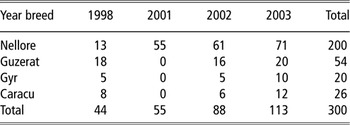
The behaviours of 300 mother–offspring pairs from four breeds were recorded over 4 years (1998, 2001 (Nellore only), 2002 and 2003), as presented in Table 1. Only 10.7% cows were observed more than one occasion over the 4-year period, and as they formed different pairs with the new offspring, the records were considered independent.
Number of mother–offspring pairs observed for each breed/paddock per year

Two observers previously trained recorded most of the data, except in 2001, when only one person carried out all the observations.
The observations were carried out using direct observations with focal sampling and instantaneous records at 5-min interval (Martin and Bateson, Reference Martin and Bateson1993). The identification number of each cow was recorded (which was branded on the hind legs of cows, following the Brazilian rules for identification of pedigree cattle) just before calving (when the cow was presenting signs of impending delivery) and the sex of the calf was recorded just after birth.
The position of the calving sites was recorded according to its distance from the herd, estimating the distances from the calving site to the herd by using the space between the fence posts, ∼2 m apart. Three calving site categories were defined: (1) within, when the calving site was up to 10 m from the edge of the herd; (2) close, when the calving site was between 10 and 30 m from the edge of the herd; and (3) distant, when the calving site was more than 30 m from the edge of the herd.
All observations focused on mother–offspring pairs from birth to the first suckling or, in case the calf did not succeed in suckling, until 5 h after birth. Behavioural recordings started just after the complete delivery of a calf. Four behavioural categories were recorded for calves: lying, standing, attempting to suckle (when a calf, after having found the udder, tried to get a teat into its mouth or had the teat in its mouth for <30 s) and suckling (when a calf had a teat in its mouth and made suckling movements for at least 30 s). Two categories of cow behaviour were also recorded: standing without activities (when a cow was standing, without any apparent activity) and touching the calf (when a cow was touching – the cow's muzzle was in contact with the calf's body, licking, pushing or sniffing its calf).
On the basis of these behavioural categories, five dependent variables were defined, two for cows (TC = touching the calf, defined by the percentage of the total time in that a cow was in physical contact with its calf, and ST = standing, defined by the percentage of total time that a cow was standing without any activity) and three for calves (LSU = latency to stand up, defined by the length of time from birth until the calf succeeded in standing up for at least 60 s, LST = latency to suckle after standing up, defined by the time between standing up and the first suckling and LS = latency to first suckling, defined by the time from birth until the first suckling). The cow's variables TC and ST were expressed as the percentage of the total time, as there was a substantial variation in the time from birth to the first suckling, defining the duration of each observation.
The presence of vultures near the calving site was also recorded for all mother–offspring pairs, and to analyse their effects on cow–calf behaviour, two classes were defined: vulture present (when there was one vulture or more within 10 m from the calving site) and vulture absent (when there was no vulture within 10 m from the calving site). The distance from the vultures to the calving sites was estimated by using the distance between the fence posts, 2 m apart, as indicators. The number of vultures at the calving site and pecking events was recorded only in 2003 for all breeds, using continuous recording.
Pecking behaviour was assessed by direct observations, recording whether pecking occurs or not. Pecking injuries were identified visually in the following day after birth, when the calves were handled for weighing and tattooing, recording any physical damage in the calves’ bodies.
Cows were classified according to their calving experience, defining two groups: naïve cows (represented by the first calving cows) and experienced cows (those with two or more calving).
Statistical analyses
Two data files were compiled, one with four breeds (n = 300) and the other with Nellore data only (n = 200).
The four breeds’ data file was used to determine the effects of breeds/paddocks on the presence or absence of black vultures at the calving sites. The data were analysed by a fixed effects model applying a logistic regression considering a binomial distribution model and a logit linking function, using the PROC GENMOD procedure from SAS software package (SAS Institute Inc., Cary, NC, USA).
Because of the high number of Guzerat, Gyr and Caracu calving with the vulture presence (close to 100%), we used only Nellore data file to analyse the effects of years, cows’ experience, month of birth and calving site on the presence or absence of black vultures, applying the methodology described in the previous paragraph.
The effects of vulture presence, years and calving sites on TC, ST, LSU, LST and LS were analysed applying a negative binomial distribution model and a log linking function, with the PROC GENMOD procedure of SAS. The variables year and calving sites were included in the TC, ST, LSU, LST and LS models only for adjustment purpose, to allow a better assessment of the effects of vulture presence.
Results
Factors affecting the vulture presence at the calving sites
Vultures were present in most of the calving sites, but the vulture presence was dependent on the breeds/paddocks (χ 2 = 33.53; d.f. = 3; P < 0.001), with Nellore and Caracu presenting lower frequencies of vulture in the calving sites than Guzerat (χ 2 = 8.77, d.f. = 1; P = 0.003 and χ 2 = 3.91, d.f. = 1; P = 0.048, respectively).
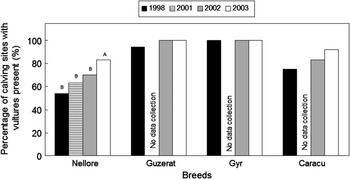
The percentages of calving sites with vultures present per year for all breeds/paddocks are shown at Figure 1.
Percentages of births with vultures present according to breeds/paddocks and year of study. Statistical comparisons between years were done only for Nellore breed; bars with different letters differ statistically (P < 0.05).

For Nellore, the frequencies of calving sites with the vultures present were dependent on the years (χ 2 = 11.95; d.f. = 3; P = 0.012) and calving site categories (χ 2 = 7.77; d.f. = 2; P = 0.021), but not on the calving experience and month of birth (P > 0.05). Significant differences (χ 2 = 7.15; d.f. = 1; P < 0.05; Figure 1) were found between the year 2003 and the others (χ 2 = 4.01; d.f. = 1; P = 0.045 for 1998, χ 2 = 6.19; d.f. = 1; P = 0.013 for 2001 and χ 2 = 7.15; d.f. = 1; P = 0.008 for 2002). A higher percentage of vultures were found at distant (92.3%, n = 26) than at close to (χ 2 = 3.54; d.f. = 1; P = 0.059) or within the herd (χ 2 = 5.69; d.f. = 1; P = 0.017) calving sites (69.1%, n = 55 and 67.1%, n = 82, respectively).
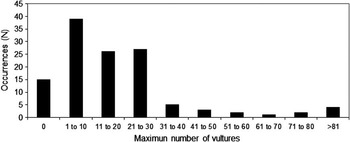
The number of vultures in each calving place varied from 0 to more than 80 vultures (Figure 2). The average number of vultures ± s.d. at the calving site was 20.45 ± 19.95, with a numeric variation within and among breeds/paddocks (Nellore = 12.29 ± 18.04, Guzerat = 37.92 ± 26.01, Gyr =28.73 ± 19.33 and Caracu = 20.07 ± 16.04) and among months (September = 12.50 ± 15.87, October = 23.13 ± 24.62 and November = 21.12 ± 21.32, which followed the same tendency of number of births per month).
Absolute frequencies of the maximum number of black vultures present near the calving sites of all herds in 2003.

Assessment of attacks and injuries from black vultures
Considering the data from 2003 (113 mother–offspring pairs), vultures were present in 100 calving sites (88.50%), with the occurrence of pecking calving cows and/or their neonates in 34.1% of all recordings.
However, injuries produced by pecking were confirmed in only two of the 41 cases (4.88% when considering only the calving sites with vulture present and 1.77% when considering all calving sites); the calves were still alive 1 day after birth, but showed lesions that were compatible with vulture's pecking: one case (a Caracu calf) presented opened wounds on the tongue, whereas multiple lesions were seen on both ears in the second case (a Gyr calf).
The effects of the vulture presence on the behaviour of cows and calves
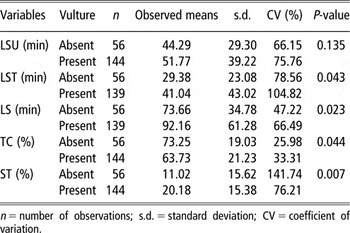
When vultures were present at the calving sites, Nellore cows exhibited higher ST (χ 2 = 8.14; d.f. = 1; P = 0.004) and lower TC (χ 2 = 4.06; d.f. = 1; P = 0.044) as presented in Table 2.
Descriptive statistics of cow (TC = percentage of the time that a cow touched the offspring and ST = percentage of the time that a cow was standing) and calf behaviours (LSU = latency to stand up, LST = latency to suckle after standing up and LS = latency to first suckling, in minutes), according to the vulture presence or absence

n = number of observations; s.d. = standard deviation; CV = coefficient of variation.
There were effects of the presence of vultures in the calving sites on LST (χ 2 = 4.28; d.f. = 1; P = 0.039) and LS (χ 2 = 5.33; d.f. = 1; P = 0.021), but not on LSU (χ 2 = 2.28; d.f. = 1; P = 0.131) of Nellore calves (Table 2). However, the birds’ presence resulted in a higher coefficient of variation than when vultures were absent (Table 2).
Discussion
Factors affecting the vulture presence at the calving sites
The vultures usually accompanied the cows from the start of parturition until placenta delivery. Several hypotheses could be formulated to explain the increase in the percentage of calving sites with vultures present over the years, among them: (1) there was an increase in the black vulture population, (2) there was a scarcity of food resources for vultures in the region as the area has been systematically occupied by sugar cane plantations over the years, (3) the vultures have learned about the time schedule of food availability in the maternity paddocks resulting in their waiting for placenta delivery and other feeding opportunities and (4) the high stocking density of calving cows in a small paddock when calving stimulates the vultures to be there. These hypotheses are not mutually exclusive.
We did not find any study addressing the variation in the Brazilian black vulture population that could explain the gradual increase of its presence on the cattle calving sites. However, in the United States the black vulture population has increased (USDA (U.S. Department of Agriculture), 2002), with proportional increases in the attacks reported (Lowney, Reference Lowney1999; Humphrey et al., Reference Humphrey, Tillman and Avery2004).
We also did not find any study assessing the feeding habits of black vultures in areas with intensive agriculture. Nevertheless, one could expect that the reduction in the food supply would, in the long term, reduce the black vulture population. On the other hand, in the short term, one might expect an increase in the damage caused by hungry vultures because of the reduction in their food supply.
The increase in the human population and consequently the increase in the volume of garbage disposal could compensate for the reduction in ‘natural’ food offered. However, in the recent years, important changes in the garbage handling close to the study area had occurred. The most important change was the newly constructed sanitary landfills in several cities surrounding the study area (CETESB (Companhia de Tecnologia de Saneamento Ambiental), 2006). This new strategy for disposal management reduces the vultures’ food supply, and could increase the presence of black vultures at the calving sites.
The systematic reduction in the food supply throughout the years, because of the reduction of natural food and garbage availability, could explain (at least in part) the effect of year on the number of vultures present in the calving sites, resulting in the crescent number of birth sites with vultures present during the calving season, as characterized for Nellore breed, even taking into account its paddock location, which was very close to the farm houses.
The ingestion of foetal membranes and placenta by cows has been described as an evolutionary strategy to reduce the risk of predation at the birth sites (Kristal, Reference Kristal1980, Edwards and Broom, Reference Edwards and Broom1982). In this study, we did not focus on this behaviour, but it was clear that there was an increase in the number of vultures just after the delivery of the amniotic sac, calf and placenta.
In all cases, the competition among vultures for the foetal membranes and the placenta was evident. In some cases, when the cows were still in the process of labour, the vultures came very close, touching the animals and sometimes pecking parts of the cows’ and calves’ bodies, perhaps seeking membranes.
The parturition period is predictable at the research station with its concentrated calving season, and the vultures have probably learned that food is then often available in the maternity paddocks. Consequently, the vultures remain at the sites waiting for the calving events.
At the commencement of parturition, cows usually isolate themselves from the herd and change their behaviour. The cows typically stop eating, increase walking and the frequency of changes in posture (from lying to standing, and back; Edwards and Broom, Reference Edwards and Broom1982; Broom and Fraser, Reference Broom and Fraser2007). These changes usually happen until the rupture of the amniotic sac, when the cows usually stop walking and start eating the amniotic fluid and membranes (Paranhos da Costa and Cromberg, Reference Paranhos da Costa and Cromberg1998).
Moving away from the herd just before calving is very important for the calving cow, as it reduces the probability that other cows or calves will disturb the mother–offspring interactions and, consequently, the risk of the calf being abandoned. A Swedish study assessing the parturition behaviour of heifers and cows found that heifers calved outside the herd despite harsher weather conditions, as the heifers left the shelter, whereas older cows remained with the herd in the shelter during calving (Lidfors et al., Reference Lidfors, Moran, Jung and Castrén1994). Calving outside the herd also increases the probability of shortening the latency to the first suckling, leading to a better immunological protection for the calves (Edwards et al., Reference Edwards, Broom and Collis1982; Lidfors, Reference Lidfors1994; Toledo et al., Reference Toledo, Paranhos da Costa, Titto, Figueiredo and Ablas2007; Paranhos da Costa et al., Reference Paranhos da Costa, Schimidek and Toledo2008).
On large areas of pastures, the majority of births might occur at a distance from the group, which was not the case in this study. This was most likely because of the small maternity paddocks and the high density of animals, especially for Nellore. However, to be distant from the herd during calving could also bring some risk, owing to predation. This last statement, which assumes a higher risk for a calf to be attacked when its mother stays isolated from the group during calving, was partially confirmed in this study for Nellore, as there was a higher percentage of vultures present when the cows calved distant from the herd.
As described previously, we were not able to analyse the effects of breeds and paddocks separately, because of every breed being kept always in the same paddock all over the years. One possibility to explain the effect of breed/paddock on the vulture presence at the calving sites would be that Nellore and Caracu paddocks were placed in busier places than the paddocks occupied by the other breeds. The Nellore paddock was close to the farmhouses and the Caracu close to a dirt road often crossed by walking people, cars and tractors. These conditions could lead the vultures to look for quieter places, such as the paddocks occupied for Guzerat and Gyr breeds. Besides, the Guzerat and Gyr paddocks were closer to a natural forest, which could be used by the vultures as roost, waiting for the deliveries.
On the basis of our results, we are not able to discard that one of the cattle breeds could be more efficient than others to scare away the birds; however, we are also not able to prove it, this question is still open.
Assessment of attacks and injuries from black vultures
The presence of black vultures at the cattle calving sites does not necessarily characterize the species as a predator. Vultures typically have a positive effect when cleaning the calving site by eating foetal membranes, placenta and stillborn calves.
However, in this and other studies (Lowney, Reference Lowney1999; Tillman et al., Reference Tillman, Humphrey and Avery2002; Avery and Cummings, Reference Avery and Cummings2004), black vultures have been seen pecking (34.1%) and injuring calves (4.9%), while calving was still in progress.
Three specific vulture attack situations were reported by Humphrey et al. (Reference Humphrey, Tillman and Avery2004); in two of them, the birds attacked heifers giving birth to very weak calves. These situations were similar to our observation with Caracu and Gyr cattle, where the calves were not able to stand until 5 h after birth.
The behaviour of the vultures may target at obtaining food by pecking and pulling at the tissue, not at killing the calf by showing specific predatory behaviour. However, in some occasions these actions by the birds result in calf mortality (Tillman et al., Reference Tillman, Humphrey and Avery2002; Humphrey et al., Reference Humphrey, Tillman and Avery2004). Results of our study show that black vultures have the potential to peck and injure newborn calves, but do not characterize the species as calf predators.
The effects of vulture presence on the behaviour of cows and calves
Maternal behaviour of the cattle during the first hours after birth follows a pattern of behavioural categories in a determined sequence (Edwards and Broom, Reference Edwards and Broom1982; Paranhos da Costa and Cromberg, Reference Paranhos da Costa and Cromberg1998). However, there is great variation in the time spent on each activity, depending on climate (Toledo et al., Reference Toledo, Paranhos da Costa, Titto, Figueiredo and Ablas2007) and other factors, such as the age of the cow (Lidfors et al., Reference Lidfors, Moran, Jung and Castrén1994). Our results indicate that the presence of black vultures altered the cows’ behaviours, diminishing the time they stay in physical contact with their calves.
Another change in this study was also observed in the time that a cow spent without any apparent activity (ST) during the first hours post partum, with higher values when the vultures were present. One explanation to that vigilance behaviour could not be separated from ST; during the observations, the cows appeared to be more sensitive to stimulation just after calving than before, including towards their offspring and to the potential threats of the vultures. Other studies support these findings. For example, Childress and Lung (Reference Childress and Lung2003) studied vigilance behaviour in elk and found that females with offspring spent more time on vigilance behaviour than females without offspring, 1-year-old juveniles and males. In dairy cows, Welp et al. (Reference Welp, Rushen, Kramer, Festa-Bianchet and de Passilé2004) used a vigilance score to assess cows’ reactions when facing different situations, and they showed higher vigilance score when exposed to the presence of a dog and an unknown person.
In spite of the big variation in the latencies to suckle after standing up (LTS) and for first suckling (LS) in both situations (vulture present and absent), longer LST and LS were observed when vultures were present. We are not able to prove that high LST and LS result in delaying or reducing colostrum intake, and hence immunoglobulines. However, considering the hypothesis that this was the case, the calves’ survival might be in danger (Schmidek et al., Reference Schmidek, Mercadante, Paranhos da Costa, Razook and Figueiredo2008). The possible delay in colostrum caused by the presence of black vultures could be, in addition to the impact of direct injuries, an important cause of calves reduced welfare and economical problems.
The between-calves variation in LST and LS may be due to many situations that were not controlled in this study, such as the weather and the animals’ density in the maternity paddock, among others. Other possibility would be the existence of individual differences in maternal behaviour when the cows face the presence of vultures in their calving sites; if this was the case, changes in the cows’ behaviour could also result in delaying or reducing the colostrum intake. Future studies should be carried out to address this hypothesis.
Acknowledgements
The authors thank the staff of the Estação Experimental de Zootecnia de Sertãozinho for the opportunity to be there, and for the hospitality and collaboration during data collection. Donald M. Broom and Lena Dahlström contributed by offering suggestions that improved the manuscript. This project was funded by Fundação de Amparo a Pesquisa do Estado de São Paulo (FAPESP) and Conselho Nacional de Desenvolvimento Científico e Tecnológico (CNPq).