Introduction
Cigarette smoke contains c. 7000 chemicals, some of which have toxic effects (Berridge et al., Reference Berridge, Apana, Nagano, Berridge, Leisure and Boswell2010). The detrimental impacts of cigarette smoke lead to a wide range of abnormalities and diseases, including abnormal cell differentiation, cardiovascular diseases, cancers, asthma, degenerative diseases, systemic disorders, inflammation, infertility, and reduced restoration of damaged tissues (Zhang et al., Reference Zhang, Guo, Wang, Zhao, Cheng and Qiao2005; Zdravkovic et al., Reference Zdravkovic, Genbacev, LaRocque, McMaster and Fisher2008; Lin et al., Reference Lin, Tran and Talbot2009, Reference Lin, Fonteno, Weng and Talbot2010; Kim et al., Reference Kim, Lee, Ko, Go, Jeung, Kim and Choi2020). A person who smokes more than one cigarette per day has been reported to have a plasma nicotine concentration greater than 25 ng/dl (Calabrese and Baldwin, Reference Calabrese and Baldwin2003; Calabrese, Reference Calabrese2013).
The adverse impacts of smoking on females and pregnancy’s reproduction system have been reported (Oboni et al., Reference Oboni, Marques-Vidal, Bastardot, Vollenweider and Waeber2016). Smoking increases miscarriage in both natural and laboratory conceptions (Harrison et al., Reference Harrison, Breen and Hennessey1990; Hughes and Brennan, Reference Hughes and Brennan1996; Ness et al., Reference Ness, Grisso, Hirschinger, Markovic, Shaw, Day and Kline1999; Zenzes, Reference Zenzes2000; Winter et al., Reference Winter, Wang, Davies and Norman2002). It has been shown that smoking increases the risk of early pregnancy loss in assisted reproductive technology (ART) treatment (Winter et al., Reference Winter, Wang, Davies and Norman2002). In an in vivo study, it has been shown that in mice that were exposed to cigarette smoke condensate (CSC), embryo fragmentation or delayed fertilisation is increased. Also, it has been noted that exposure to cigarette smoke significantly reduces fetal growth (Andreu-Fernández et al., Reference Andreu-Fernández, Sancho, Genovés, Lucendo, Todt, Lauterwasser, Funk, Jahreis, Pérez-Payá, Mingarro, Edlich and Orzáez2017; Kataoka et al., Reference Kataoka, Carvalheira, Ferrari, Malta, de Barros Leite Carvalhaes and de Lima Parada2018). It has been reported that smoking causes childhood disorders such as low birth weight, increased risk of respiratory disease and pancreatic dysfunction (Kataoka et al., Reference Kataoka, Carvalheira, Ferrari, Malta, de Barros Leite Carvalhaes and de Lima Parada2018). Different genes are involved in fetal development. Bcl2 and Bax are essential genes involved in mitochondrial apoptosis, in which Bcl2 is an inhibitor of apoptosis, and Bax is the proapoptotic equivalent of Bcl2 (Andreu-Fernández et al., Reference Andreu-Fernández, Sancho, Genovés, Lucendo, Todt, Lauterwasser, Funk, Jahreis, Pérez-Payá, Mingarro, Edlich and Orzáez2017). Pluripotency is controlled by transcription factors such as Oct4, Sox2 and Nanog (Niwa, Reference Niwa2001). Also, aryl hydrocarbon receptor (AhR) is a transcription factor that has a role in the metabolism of toxic compounds and fetal development (Gialitakis et al., Reference Gialitakis, Tolaini, Li, Pardo, Yu, Toribio, Choudhary, Niakan, Papayannopoulos and Stockinger2017).
In the present research, the impacts of different concentrations of CSC on the in vitro development of mouse embryos were assessed. In addition, the expression of pluripotency, apoptotic, and AhR genes in the development of mouse embryos in the preimplantation stages was evaluated.
Materials and methods
Cigarette smoke condensate
CSC was obtained from Murty Pharmaceutical Corporation (Lexington, KY, USA). It was dissolved in dimethyl sulfoxide (DMSO) and prepared at the concentrations of 20, 40, 80, 160 and 320 μg/ml.
Animals
The Pasteur Institute of Iran supplied the outbred NMRI mice that were used in this study. The mice weighed 20–25 g. They had free access to water and food and were housed in cages at the temperature of 22 ± 2°C under a 12-h dark/light cycle.
Experimental groups
In total, 3000 NMRI mice 2PN embryos were divided into six groups (n = 500). In the control group, CSC was not added to the culture medium during embryo culture. In test groups, 20, 40, 80, 160 and 320 μg/ml of CSC were added to the culture medium during embryo culture.
Investigating the effect of CSC on in vitro development of mouse embryos
Ovulation was induced in female mice with an intraperitoneal (i.p.) injection of 5 IU pregnant mare serum gonadotropin (PMSG) followed by 5 IU human chorionic gonadotropin (hCG) 2 days later (Sigma, USA). The female mice were housed in cages with the male mice. The next day, the mice with vaginal plugs were selected, and their ampullae were removed. The zygotes were harvested and incubated for 30 min in a human tubal fluid medium (HTF) containing 1% hyaluronidase. The zygotes were washed three times in potassium simplex optimisation medium (KSOM) medium and moved to KSOM medium. The 2PN embryos were exposed to different CSC concentration for 24 h, and the development of the embryo from the 2PN embryo stage to the blastocyst stage was evaluated.
Quantitative real-time polymerase chain reaction
The expression of the genes involved in pluripotency (Oct4, Sox2, Nanog), apoptosis (Bcl, Bax), and AhR processes was evaluated in the in vitro development of mouse embryos in three groups: control, 20 µg/ml of CSC, and 80 µg/ml of CSC.
The morulae were exposed to different concentrations of CSC for 24 h. Afterward, the blastocysts were collected. Total RNAs were extracted from all studied groups using an RNA extraction kit (Favorgen Biotech Corp., Taiwan) according to the manufacturer’s instructions. A cDNA synthesis kit (SinaClon, Iran) was used to synthesise the complementary DNA (cDNA). β-Actin was applied as the reference gene. The ΔΔCt method was used to calculate the data. Table 1 demonstrates the primers used in this experiment.
Primer sequences

Statistical analysis
We used SPSS 16 software for statistical analyses. Results are shown as mean ± standard deviation and a P-value lower than 0.05 was considered as statistically significant. Student’s t-test analysis was applied for comparing the differences between two groups, while the differences among multiple groups were analysed using analysis of variance (ANOVA) and Tukey’s test. All the experiments were performed in triplicate.
Results
Effect of CSC on in vitro development of mouse embryos
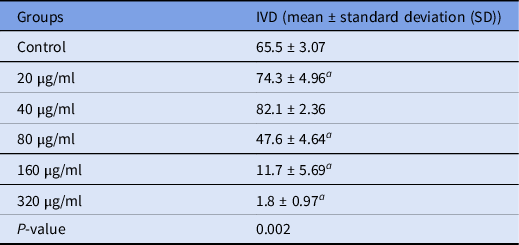
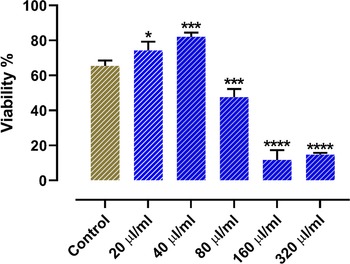
Compared with the control group (65.5 ± 3.07), the viability increased in 20 μg/ml of CSC (74.3 ± 4.96) and 40 μg/ml of CSC (82.1 ± 2.36) (P < 0.002). However, in 80 μg/ml of CSC (47.6 ± 4.64), 160 μg/ml of CSC (11.7 ± 5.69), and 320 μg/ml of CSC (1.8 ± 0.97), viability decreased compared with the control group (P < 0.002) (Table 2 and Fig. 1).
Effects of CSC on in vitro development (IVD)

a Significant differences between treatment groups compared with the control group. (P < 0.05) (n = 5) (mean ± SD).
Effects of cigarette smoke condensate (CSC) on in vitro development (IVD). The percentage of viability at different concentrations of CSC is shown for IVD of the embryos. *, ***, **** P < 0.002.

Effect of CSC on the expression of pluripotency genes
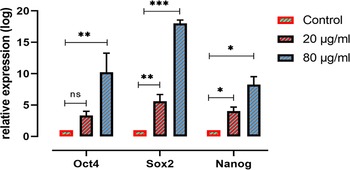
The results of real-time PCR showed that CSC caused a change in the expression of multiple genes. Compared with the control group, CSC at the concentration of 20 μg/ml did not have any significant effect on Oct4 gene expression, whereas CSC at the concentration of 80 μg/ml significantly increased Oct4 expression (P < 0.05) (Fig. 2). We found that concentrations of 20 μg/ml and 80 μg/ml significantly upregulated Sox2 gene expression (P < 0.05) (Fig. 2). A similar effect was seen with regards to the Nanog gene (P < 0.05) (Fig. 2). Also, the expression of Oct4, Sox2 and Nanog genes at the concentration of 80 μg/ml CSC were higher than at 20 μg/ml (P < 0.05) (Fig. 2).
Effects of cigarette smoke condensate (CSC) on the expression of pluripotency genes. The effects of CSC on Oct4, Sox2, and Nanog pluripotency genes are shown in the blastocyst embryos. (P < 0.05) (n = 500) (mean ± standard deviation (SD)). *, **, *** P < 0.05.

Effect of CSC on the expression of apoptotic genes
Compared with the control group, CSC at the concentrations of 20 and 80 μg/ml enhanced (P < 0.05) the expression of the Bax/Bcl2 ratio in blastocysts (Fig. 3). Also, the expression of Bax and Bcl2 genes at the concentrations of 80 μg/ml CSC were higher than 20 μg/ml (P < 0.05) (Fig. 3).
Expression of apoptosis genes. Relative expression of the Bax/Bcl2 genes in blastocysts is shown. (P < 0.05) (n = 500) (mean ± standard deviation (SD)). ** P < 0.05.

Effect of CSC on the expression of AhR
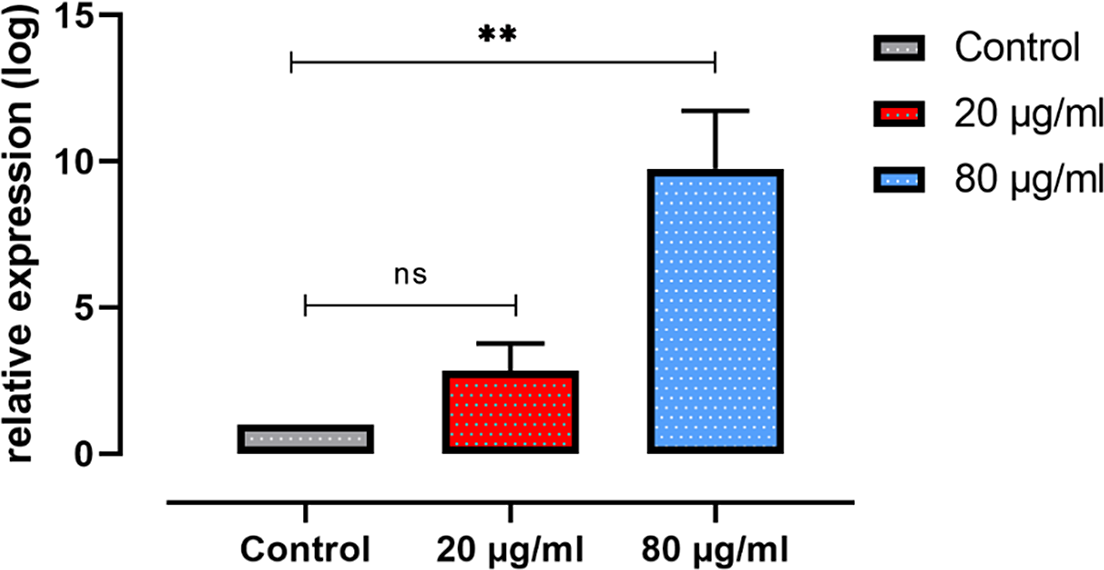
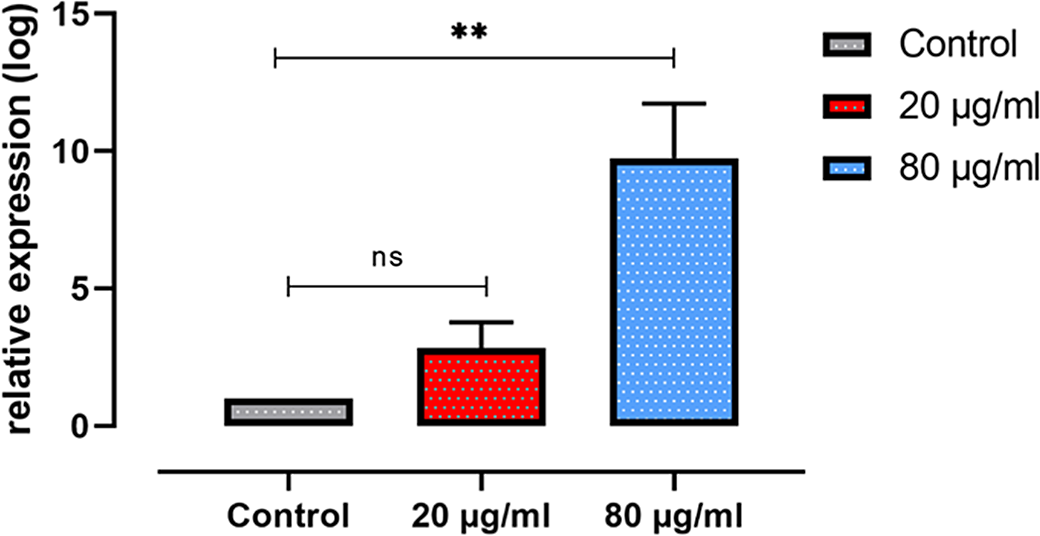
The results of real-time PCR showed that treatment with both 20 and 80 μg/ml CSC for 24 h significantly upregulated (P < 0.05) the expression of the AhR gene compared with the control group (Fig. 4). We also found that AhR expression was higher in the 80 μg/ml treatment group compared with the 20 μg/ml group (P < 0.05) (Fig. 4).
Expression of aryl hydrocarbon receptor (AhR). Relative expression of the AhR gene is shown. (P < 0.05) (n = 500) (mean ± standard deviation (SD)). ** P < 0.05.

Discussion
In this study, it was observed that CSC at concentrations of 80, 160, and 320 μg/ml had an undesirable effect on embryo development. Also, CSC had a significant effect on the expression of pluripotency, apoptotic, and AhR genes in the blastocyst embryo stage compared with the control group.
Exposing female mice to cigarette smoke for 3 days had detrimental effects on embryo development in treated mice (Hassa et al., Reference Hassa, Gurer, Tanir, Kaya, Gunduz, Sariboyaci and Bal2007). It has been shown that exposure to cigarette smoke resulted in a higher rate of multinucleated blastomere developed bovine blastocysts (Liu et al., Reference Liu, Li, Sessions, Rickords, White and Bunch2008). The effect of cadmium in cigarette smoke on mouse embryos has been investigated, and results have shown that it has no effect on mouse embryo development at low exposure levels. Nevertheless, at high exposure doses, it results in degenerated embryos with a necrotic appearance (Yu et al., Reference Yu, Tam and Chan1985). The results of the present research indicated that CSC at the concentrations of 80, 160, and 320 μg/ml reduced embryo development. However, it had beneficial effects at the concentrations of 20 and 40 μg/ml. According to research, a wide variety of drugs and chemicals such as nicotine (Csiszar et al., Reference Csiszar, Labinskyy, Podlutsky, Kaminski, Wolin, Zhang, Mukhopadhyay, Pacher, Hu, de Cabo, Ballabh and Ungvari2008) and CSC (Assadollahi et al., Reference Assadollahi, Mohammadi, Fathi, Hassanzadeh, Erfan, Soleimani, Banafshi, Yosefi and Allahvaisi2019b) with a low-dose stimulus or beneficial effect and a high-dose inhibitory or harmful effect are called hermetic dose responses (Calabrese, Reference Calabrese2013). The results of the current study may be due to the hermetic properties of CSC.
Oct4, Nanog, and Sox2 are transcription factors that regulate self-renewal and pluripotency in normal embryo development (Niwa, Reference Niwa2001). The expression of Oct4 is typically limited to ICM in preimplantation blastocysts which are needed for postimplantation in vivo development for embryonic stem cells to be established in vitro. Expression of Oct4 is considered as a blastocyst consistency indicator (Liu et al., Reference Liu, Czerwiec and Keefe2004).
In the current study, CSC at the concentration of 20 μg/ml showed no effect on Oct4 gene expression, whereas CSC at the concentration of 80 μg/ml increased Oct4 gene expression. Huang and colleagues showed that CSC could change the expression of Oct4 in embryos obtained from mice exposed to CSC (Huang et al., Reference Huang, Okuka, McLean, Keefe and Liu2009). It has been reported that the overexpression of Oct4 results in mesodermal and endodermal differentiation (Assadollahi et al., Reference Assadollahi, Fathi, Abdi, Khadem Erfan, Soleimani and Banafshi2019a). A study has shown that changes in Oct4 expression due to CSC reduced the quality of blastocysts (Huang et al., Reference Huang, Okuka, McLean, Keefe and Liu2009). Sox2 is involved in deciding the molecular fate of the cell and in controlling the development of the embryo (Kirby et al., Reference Kirby, Waters, Delbridge, Svartman, Stewart, Nagai and Graves2002), and any alteration of this gene’s expression profile will lead to the end of the undifferentiated state and the beginning of differentiation (Kopp et al., Reference Kopp, Ormsbee, Desler and Rizzino2008). This gene, which is part of the HMG-box family and is also a strong transcription factor due to its DNA-binding properties, is one of the most active genes in the early embryonic stage (Cömertpay et al., Reference Cömertpay, Lüleyap, Yılmaz, Tufan and Pazarcı2018). CSC at the concentrations of 20 and 80 μg/ml increased the expression of Sox2 and Nanog genes. In a previous study, we have shown that different doses of cigarette extract could alter the expression of Sox2 and Nanog in the mouse embryonic stem cells (Assadollahi et al., Reference Assadollahi, Mohammadi, Fathi, Hassanzadeh, Erfan, Soleimani, Banafshi, Yosefi and Allahvaisi2019b). Research has shown that nicotine performs its harmful effects by changing Sox2 master gene expression levels (Cömertpay et al., Reference Cömertpay, Lüleyap, Yılmaz, Tufan and Pazarcı2018). Nanog is a transcription factor that plays an essential role in regulating pluripotent cells by preserving the pluripotent epiblast and blocking primitive endoderm differentiation. Researchers have demonstrated that tobacco can increase the expression of Nanog (Liszewski et al., Reference Liszewski, Ritner, Aurigui, Wong, Hussain, Krueger, Oncken and Bernstein2012).
Bcl2 and Bax genes have a very significant role in mitochondrial apoptosis. In calculating the cells’ sensitivities to apoptosis induction, the Bax/Bcl2 ratio is considered to be more influential than the individual expression of each gene. The beginning of apoptosis is marked by the increase in the Bax/Bcl2 ratio (Andreu-Fernández et al., Reference Andreu-Fernández, Sancho, Genovés, Lucendo, Todt, Lauterwasser, Funk, Jahreis, Pérez-Payá, Mingarro, Edlich and Orzáez2017). The current study results demonstrated that CSC at the concentrations of 20 and 80 μg/ml increased the ratio of the Bax/Bcl2 genes in the blastocysts. As a transcription factor, AhR plays a significant role in metabolising toxic compounds (Gialitakis et al., Reference Gialitakis, Tolaini, Li, Pardo, Yu, Toribio, Choudhary, Niakan, Papayannopoulos and Stockinger2017). In the current study, the AhR gene had a significantly enhanced expression in the blastocysts treated with 20 and 80 μg/ml of CSC. Exposure to CSC changed the expression of AhR in blastocytes developed from fertilised oocytes in the C57BL/6 mice cell line (Assadollahi et al., Reference Assadollahi, Mohammadi, Fathi, Hassanzadeh, Erfan, Soleimani, Banafshi, Yosefi and Allahvaisi2019b). It seems that AhR appears gradually during embryonic development. This expression depends on time and explains the gradual effects of cigarette smoke on the development of the embryo (Tscheudschilsuren et al., Reference Tscheudschilsuren, Küchenhoff, Klonisch, Tetens and Fischer1999).
In conclusion, our data revealed that CSC at the concentrations of 80, 160, and 320 μg/ml has an undesirable effect on the development of the embryo. Conversely, CSC at the concentrations of 20 and 40 μg/ml showed some beneficial effects in vitro. However, further and more detailed studies in this field are recommended.
Acknowledgements
This study, as a Ph.D. thesis, was funded by grants provided from Kurdistan University of Medical Sciences (No. IR.MUK.REC. 1394/220).
Ethical standards
All animal procedures were conducted according to the Guidelines approved by the Ethics committee of Kurdistan University of Medical Sciences.
Funding
Kurdistan University of Medical Sciences (No. IR.MUK.REC. 1394/220).
Conflicts of interest
The authors declare they have no competing financial interests.