In the conclusion of her recent historiographical survey of the American Revolution, Gwenda Morgan points to the enormous difficulties historians face in “incorporating the vast array of actors who participated in [the Revolution] into a single narrative,” and suggests that now “the challenge is to create a new synthesis.”Footnote 1 This will, indeed, be quite a challenge. Over the last forty years our knowledge of those who shaped the new republic's protracted and bloody birth has expanded impressively. In particular, social historians have drawn previously neglected groups – women, artisans, the urban poor, African Americans – into the literature and convincingly portrayed a society at war with itself as much as with Great Britain.Footnote 2 Yet other actors still remain shadowy figures in the drama. Among them is the plantation overseer. Maligned in popular memory, neglected by academics, and thus marginalized in treatments of both slavery and colonial society as a whole, he was often caught in the eye of war's storm in the South as armies marched and raided, and bondsmen and women tested the limits of authority as the system of slavery wavered under the pressure of war. A far more socially diverse group than has generally been recognized, an analysis of the varied responses of overseers to the challenges, and opportunities, presented by revolution offers another illuminating insight into the fractious internal dynamics of the conflict and the vulnerability of slavery as an institution, and an intriguing suggestion concerning how that institution weathered the years of crisis.
The conventional historiography has yet to answer this question fully. The process by which “the Peculiar Institution” became embedded within the very constitution of the new republic has been explored particularly effectively by David Brion Davis and William H. Freehling.Footnote 3 Yet the survival of the institution during the crucial war years themselves remains a rather mysterious phenomenon. The southern colonies were not yet the mature “slave societies” of the antebellum period. Indeed, in Georgia, plantation slavery was a relatively recent innovation established in the face of some determined local opposition. It would be a mistake to project the racial solidarity of the antebellum South's putative “herrenvolk democracy” back into the colonial period when racial ideologies were developing but not yet hegemonic. The institution of race slavery was, thus, far from secure.Footnote 4 After all, it was precisely in circumstances of war and revolution that New World slave systems proved fatally vulnerable, most demonstrably in Haiti, 1791–1804, and the United States itself, 1861–65. In wartime, most of those “concrete political realities” of power relationships within slave societies were undermined as white manpower was drawn away from policing slavery; as existing political and legal structures crumbled; and as barriers to slave mobility, and the concomitant capacity to organize, disappeared.Footnote 5 Add in to the equation the emancipationist impulse within the Revolutionary movement and the deliberate use by the British of emancipation as part of the strategy of war in the South, and the vulnerability of American slavery during the War of Independence is manifest.
The existing historiography has not always addressed this issue convincingly. Against the backdrop of the civil rights movement, black history flourished and Peter Wood has identified interest in the revolution as a key trend in the literature of the 1960s and 1970s. Yet an overemphasis on the role of atypical individuals, such as Crispus Attucks, felled by a British musket ball during the so-called “Boston Massacre,” threatened to obscure wider understanding of the lives of those for whom “colonialism did not end in 1776.” Similarly, much productive work was done on the constitutional position of slavery but the lived experience of men and women, free and unfree, on Southern plantations during the war years remained largely unexplored.Footnote 6 The need for a specifically southern dimension in the writing of the history of the conflict began to be addressed at the time of the bicentennial.Footnote 7 Three key collections of essays were published in the late 1970s and early 1980s, edited by Jeffrey Crow, Larry Tise, W. Robert Higgins, Ronald Hoffman and Ira Berlin. A number of their contributors touch explicitly on the issue of slavery. Michael Mullin contrasts race relations in the Chesapeake, South Carolina and the British Caribbean across the “Revolutionary era.” Peter Wood highlights the race-conscious nature of the early republic, while Philip Morgan reflects on the Revolution's impact on slavery in the South Carolina Low Country in the aftermath of independence. Mary Beth Norton broadens the field by incorporating the experiences of southern women, black and white, into the story of the American Revolution.Footnote 8 Elsewhere, Jeffrey Crow himself wrote an insightful article highlighting the relationship between the Revolution and slave rebelliousness and suggested a growing political consciousness amongst the enslaved.Footnote 9 Yet, once again, even within these works of scholarship our understanding of the lives of those who continued to live and work on southern slave plantations during the conflict, including the overseers who were responsible for their management, remains very limited.
In this work, like Wood, I hope to “weave together incidents” that took place on slave plantations in Virginia and South Carolina in order to understand more clearly the “down-to-earth” and “localized” experiences of white overseers and the enslaved who inhabited these plantations.Footnote 10 This work will assess the impact the American Revolution had on the lives of these mostly illiterate men and women who have left very little direct testimony. In particular, this work examines the actions and allegiances of overseers (black and white) during the conflict and how their behaviour was perceived by the planter elite, their peers, and the enslaved they attempted to supervise during the tumult of warfare. Against the backdrop of this unfolding conflict, both the racial and class hierarchies of slave society proved mutable and easily prone to disruption, processes clearly discernible in the lived experiences of those who managed the workforces of the plantation. The colonial overseer lived and worked in a liminal space between the free and the unfree and, just as strikingly, between the planter elite and the poorer white yeomanry, agricultural labourers, and servants. His wife, too, took responsibility for a broad range of economic and supervisory roles on the plantation, as well as attending to the well-being of the slave labour force.Footnote 11 Together, even in peacetime, they worked and lived within a volatile nexus where race, class and power intersected; when revolution brought war to the plantation, they often bore the full brunt of its fury.
There are a number of practical factors that inhibit a systematic investigation of the lives of overseers in this period. The meagreness of the extant source materials related to the day-to-day management of plantations has contributed to our limited ability to explore the crucial theme of the often antagonistic relationships between owners, overseers and slaves. In the colonial period, and particularly during the Revolution, evidence and personal testimony authored by overseers is extremely scarce, which makes a thorough understanding of the overseer's personal perspective difficult to determine. The fragmentary nature of the evidence relating to overseeing means that, inevitably, the voices of the wealthy and the powerful are those heard most clearly in the surviving documentation, namely their letters, diaries and accounts books – thus these provide the main evidential base for this study. Yet these sources provide evidence from which to reconstruct plantation life in the eighteenth century and from which to glean fresh insight into the lives of overseers during the American Revolution.Footnote 12
Prominent and influential planters strove to build efficient plantations and simultaneously embody the paternalist ideal.Footnote 13 They aspired and competed to create models and set standards for other planters to follow. In their quest to become leading agriculturalists they provide avid commentary on the dramas and struggles that unfolded on their plantations along the way. Although, naturally, within such a multifaceted institution, no one man can stand as the “typical” planter, analysis of the records of Virginia and South Carolina's most successful slave-owning planters, with their extensive landholdings, multiple plantations and large numbers of slave labourers, who over decades constantly hired overseers, allows us to explore the precise function of overseers within the colonial slave society and assess their importance during the Revolution.
Unfortunately, the comments and details recorded by class-conscious planters have tended to focus closely on the disappointing cases rather than detailing the lives of those men who were conscientious, honest and successful. Though planters' petty prejudices or passing frustrations are useful for what they reveal about their attitudes and their often febrile relationships with their employees and slaves, in this study the overseer himself will no longer remain silent. Although testimony authored by overseers is extremely rare, as the historian of colonial Virginia Rhys Isaac has so forcefully emphasized, “actions must be viewed as statements.”Footnote 14 Even when filtered through a documentary record inevitably shaped by the partisan perceptions of a ruling class, the actions of the overseer can still speak loudly, of both his own milieu and, indeed, of a wider and discordant colonial society, where a recently established but fragile planter hegemony struggled to maintain its authority.
As a significant historical actor, therefore, the overseer needs to be recovered from an undeserved obscurity. His image has been most powerfully shaped by representations in popular culture that have relentlessly portrayed him as poor, cruel and a trial to both the employer he cheated and slaves he brutalized. Eighteenth-century planters did much to lay the foundations for what has become an undisputed caricature. Many planters claimed it was the “Tyranny and Villainy of Overseers,” and their “vicious designs” that were to blame for the many problems that arose on slave plantations in the colonial era. Though there is no doubt that some overseers were “troublesome,” all overseers have been tarred with the same brush.Footnote 15 The planters' negative views of overseers were not simply related to the perceived shortcomings of overseers as their employees; the disdain and contempt planters had for overseers was rooted in a strong prejudice against those from the lower classes. From the early eighteenth century, the white men employed to supervise labour and production on large plantations quickly became categorized as a “class.” The behaviour and characters of “that class of people” were, and still are, judged in relation to their reputation as a group, rather than as individuals or with regard to their particular circumstances on the plantation and within colonial society.Footnote 16 By the end of the eighteenth century the notion that this “necessary class of men” formed a separate social as well as occupational group, drawn from the poor and lowly sections of society, was universally accepted. Indeed, when Thomas Jefferson, in a letter to a friend, attempted to “state the differences between the classes of society” that had formed during the eighteenth century he noted that the “last and lowest” was a “seculum of beings called overseers.”Footnote 17 It is this view of overseers as a distinct social class, marked by its alleged dependency, and low character, that has formed the basis of their history in colonial Virginia and South Carolina, and has shaped modern scholarship on the subject. Though planters' statements give a clear indication of how they perceived overseers as essential but odious, the rhetoric does not always accurately express the reality; that in fact overseers were a mixture of people from different “classes” and occupational backgrounds.
Historical scholarship has, thus far, done a limited amount to overturn this caricature or thoroughly investigate the backgrounds or lives of overseers. John Spencer Bassett's The Southern Plantation Overseer as Revealed in His Letters, published in 1925, was, in its time, a groundbreaking investigation of the role of an overseer living and working on a slave plantation. The image created by this book, based entirely on the letters of one nineteenth-century overseer, however, has never been rigorously challenged. The book claims that there were a very small number of overseers of “an ambitious and advancing class,” but alleges that, beyond those few, the majority of overseers were “illiterate men,” “unimaginative” and unmotivated, due to their lower-class background.Footnote 18 Other analyses of plantation overseers have, by and large, endorsed this view, stereotyping the overseer as lazy, incompetent, dishonest and cruel.Footnote 19 William Scarborough's work was the first piece of scholarship to give overseers more credit for their “erudite comprehension of principles of scientific agriculture.” Like William Scarborough, the most recent study of overseers, Crafting the Overseer's Image by William Wiethoff, focussed almost exclusively on the antebellum era. Though Wiethoff provides a provocative analysis of the links between rhetoric, social hierarchy, race relations and power, it adds little to our understanding of the backgrounds and the day-to-day work carried out by overseers in the colonial era and during the Revolutionary period.Footnote 20 Indeed, they presume, without substantiation, that there were few important differences between the overseers of pre- and post- Revolutionary America.Footnote 21 It is a notable omission in the historiography for, as Max Edelson's thorough account of the “plantation enterprise” in colonial South Carolina has demonstrated, the overseer played a pivotal role in the exchange of goods and people which took place between town and Low Country plantations.Footnote 22 Although overseers' lives were intertwined with masters and slaves, and their futures were often determined by the part they played in slavery, they remain peripheral, mentioned most commonly for their failings or their role in plantation violence. While recognizing the key role of the overseer in using violence to maintain the slave order, we should nevertheless note that there were many other aspects to their job that continue to be ignored, which in turn prevents full understanding of their contribution to the plantation system. Indeed, they are almost entirely absent from the history of the American Revolution. Yet if we are to fully appreciate exactly how significant their role had become by the Revolutionary period, it is first necessary to dismiss the myth of the “ne'er-do-well” overseer, and establish the reality of their backgrounds, their responsibilities and their working lives before turning our attention to how, as linchpins of slave society, these men fared within the maelstrom of Revolutionary war.
Though there is a long-standing debate about the different slave-labour systems that developed on plantations in the Upper and the Lower South, and it is clear that Virginia and South Carolina differed markedly in physical landscape and climate, which in turn affected settlement patterns, demographic development and agricultural practises on plantations, the dominance of a coercive system of race-based slave labour, and the common use of white overseers to supervise plantation business, allow important parallels to be drawn between the two regions when analysing broader themes such as the impact of the American Revolution on the colonial inhabitants of the South.Footnote 23 In South Carolina, planters generally chose not to reside permanently among those who toiled to make them rich. Many chose to live either in comfortable town houses or in absentia, dwelling in Europe, rather than confront the fevers and heat of rice plantations.Footnote 24 Thus the overseer performed an essential supervisory task, as recognized by legislation; for example, in 1712, a deficiency law (revised and expanded in scope in 1726 and 1755) was passed in South Carolina that penalized the owners of plantations “wherein six negroes or slaves shall be employed without one or more white person living and residing on the same plantation.”Footnote 25 However, in Virginia and the Chesapeake region, overseers were no less important. Although the majority of planters resided on or near their plantations, the need for overseers was also recognized by the law. While the laws regulating the supervision of slaves on Virginia plantations were not quite as specific as those passed in South Carolina, early and recurring Virginia legislation penalized plantation owners in the seventeenth and eighteenth centuries who did not employ “free,” white, “Christian Overseers” to supervise their slaves and prevent them from taking part in unruly and criminal activities.Footnote 26 Even elite planters who made their plantation their permanent residence were continuously drawn away to govern and protect the development of the colonies, and thus relied on the support of overseers. As a result, by the time revolution broke out both the South Carolina and Virginia legislatures not only had declared overseeing crucial to the success of southern plantations and the defence of the surrounding countryside, but they also decreed it to be the domain of the white man.Footnote 27 Thus the role of the overseer was of paramount importance for a variety of reasons. The overseer, wherever he was hired, served as an intermediary link between the owner and the slaves, between the big house and the fields, and between the core and the periphery of plantation business. He would encourage, motivate or force slave labourers to be active and diligent, and, in so doing, he represented an integral part of labour management systems across the southern plantation landscape.
Successful southern planters and leading American revolutionaries such as Henry Laurens, George Washington and Thomas Jefferson often depended heavily on overseers. The expectation of overseers and the variety of backgrounds from which they came belies the notion that overseers were all men of “low circumstances” who lacked experience and were of questionable morals, drawn from the poorest echelon of society.Footnote 28 Reviewing the role, backgrounds, and behaviour of some overseers not only defies conventional stereotypes but also provides useful detail that helps us understand the different choices overseers made, regarding their conduct and loyalties, during the American Revolution. Bearing in mind that a planter's wealth, in the form of slaves, livestock, tools, buildings, provisions and the crop, was entrusted to his overseer, on top of the basic task of supervising slaves many planters expected their overseers to come to the job from backgrounds that fostered practical skills, agricultural knowledge, literacy and sometimes wealth, qualities the poorest members of society rarely possessed.
Planters insisted that overseers fulfil every article in their contracts; the great variety of tasks and expectations made this difficult, however, and most white men who undertook the job struggled to some extent to reconcile the conflicting social and economic demands put upon them by their employers. Planters desired men whom they employed as overseers to have some experience of agriculture and planting; however, men with little or no experience in planting were not discounted if they had other skills that were useful to the operation of a plantation. Generally overseers were expected to supervise the activities of slaves while at work, from sunup to sundown. Overseers distributed and organized labour activities, and although the majority of slaves performed agricultural labour, overseers also supervised slaves working in a variety skilled and semiskilled occupations such as carpentry, blacksmithing, gardening, milling and weaving and were expected to organize and keep track of slaves who moved and worked beyond the confines of the plantation. Most importantly, overseers were required to work the slaves they supervised hard enough to achieve a level of profit that satisfied their employer. As the white man who was in closest contact with bonded labourers, and who carried out unpopular directives to elicit maximum labour, the overseer was, however, frequently the focal point of the resentment and anger of slaves. This placed the overseer at the most vulnerable interface between the coerced slave and the profit-seeking (but ideally paternalistic) master. Regarding his slaves, South Carolina planter Henry Laurens advised all of his overseers, “with the well ones use gentle means … mixed with authority at first,” while for the more resistant and rebellious slaves he recommended punishment, but with “mercy so that they may be convinced that the end of their correction is to be amendment.”Footnote 29 However, in another typically ambiguous instruction, Laurens stated, “Frighten the two boys till you make them tremble but don't Whip them.”Footnote 30
It is hard to imagine how an overseer could make the slaves under his supervision “tremble” without resorting to physical punishment, as slaves were inured to the authoritarian approach and unlikely to be frightened by strictness alone. The traditional image of an overseer as the cruel whip-cracker on the plantation is not surprising when one reviews the incompatible instructions he received from his employer. Whilst threatening slaves and withholding privileges was likely to have some effect in discouraging their misbehaviour, mild punishments were unlikely to scare the most determined and rebellious. Given that the slaves had nothing to lose but their physical well-being, it is the sad truth that in most cases physical punishment and torture were the overseer's most effective means to enforce discipline. Those overseers who treated slaves with mercy and attempted to tame them gently also often found themselves in a problematic situation. Undue leniency often resulted in low productivity, which was equally unacceptable. The correct balance between care and coercion was a difficult one to strike, and overseers were just as likely to be dismissed for treating too leniently as too harshly.Footnote 31
Many planters also charged their overseers with numerous other responsibilities. Overseers were expected to ensure that all plantation property was well maintained. Overseers were to inspect land, crops, buildings, fences and tools and to arrange repairs and improvements where necessary. It was often the overseer's job to arrange and supervise the transportation of all goods and livestock to market as well as to oversee incoming shipments of plantation supplies. The welfare of livestock and slaves was also of prime importance. Livestock needed to be well kept and accounted for.Footnote 32 With regard to slave welfare overseers distributed provisions and rations among slaves and were expected to tend to sick slaves and weed out those who were feigning illness. Planters expected their overseers to diagnose illnesses and to administer treatment and medicine.Footnote 33 Doctors who visited plantations “fleeced” planters, agreed Laurens and his fellow planter Ralph Izard, who both felt that “where there is a careful Overseer & a good Medicine Box, cost could be kept to a minimum.”Footnote 34 Furthermore, overseers were expected to provide their employer with regular, detailed written or verbal reports on all plantation matters.Footnote 35
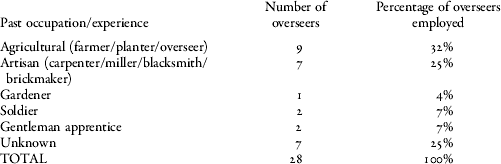
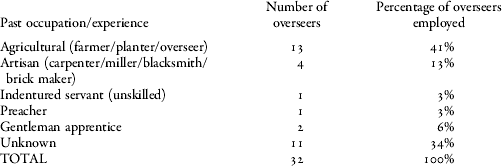
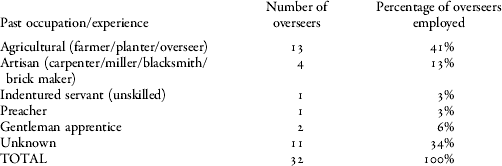
Defying the stereotypes, many men employed to take on the role of overseer were actually plantation- and landowners, artisans, indentured servants, professional overseers, sons of the planter elites, and even preachers. Leading planters such as George Washington and Henry Laurens employed men from a variety of backgrounds, as illustrated by Table 1 and Table 2 (see Appendix). From the sample it is clear that at least one-third of overseers employed by both Washington and Laurens had a definite tie to planting or some agricultural experience. Tenant farmers; small landowning planters; the sons of small, medium and wealthy planters took up the job. Yeoman farmers or small-scale planters and their sons who needed experience, money and the support of their social superiors often used overseeing as a stepping-stone to independence. For example, James Bloxham and John Green, both well-qualified farmers, served as overseers for Washington. Gilbert Simpson, Nelson Kelly and Samuel Johnson were tenant farmers who took up jobs as plantation overseers for Washington at various times before returning to their occupation as planters. Many other leading Virginia planters, such as Robert Carter, Landon Carter and William Cabell, also employed men with proven experience and expertise in farming as overseers.Footnote 36 In South Carolina leading planters also looked to hire experienced planters as overseers. John Christian Grenginger, a planter, and Robert James, first a planter and then a canal overseer, were both employed by John Ewing Calhoun as plantation overseers at the end of the eighteenth century.Footnote 37 However, approximately a third of those employed as overseers by Washington in Virginia and Laurens in South Carolina were drawn from a variety of backgrounds beyond agriculture. Artisans, tradesmen, military and religious men, skilled and unskilled indentured servants, and the sons of wealthy gentlemen who lived in the American colonies or in Europe became overseers. Skilled artisans who could not find work in their trade or who wished to expand their business turned to overseeing to ease or improve their situation. Some craftsmen wished to branch out into the sphere of planting, and used overseeing as a means to achieve this in terms of education and networking. John Patterson was employed by Washington as head carpenter and overseer in the 1760s. He worked for Washington for four years to the mutual satisfaction of both employer and employee.Footnote 38 Similarly, John Ehlers, a German gardener with twenty years' experience and excellent credentials, took a position at George Washington's home plantation, Mount Vernon, hoping that a job as an overseer would offer an opportunity to increase his own wealth, reputation and autonomy and facilitate a move into the planter class.Footnote 39 In South Carolina in 1771, Josiah Smith employed George Mollineaux and his apprentice from England. Mollineaux, a wheelwright and a carpenter, was to be overseer of the slave carpenters, and the other “Young Man to be brought up as an overseer.”Footnote 40 Some established craftsmen wished to branch out into the sphere of planting, and used overseeing as a means to achieve this in terms of education and networking. Peter Horlbeck had worked in England and Germany as a “master mason” before he moved to America. He initially pursued his trade in Charleston, then took a job as an overseer for Henry Laurens on his Mepkin plantation. Horlbeck later returned to masonry and, through his association with Laurens, gained patronage that greatly aided his ventures, so much so that he was eventually able to establish himself as a planter.Footnote 41 Stephen Brown, a ropemaker from England, was advised by an acquaintance who had progressed from overseer to independent planter that he should follow the same route. Brown took the advice and his friend commented further that “a few more years experience, gained through overseeing … would make him an able planter.”Footnote 42
Many planters also employed indentured servants and at the other end of the spectrum “gentleman overseers.” The indentured servants who were bought or hired in to act as overseers were evidently of a higher status than those of the previous century.Footnote 43 In 1768 Laurens indentured a Dutch or German man named Casper Springer to work on his plantations. Over the next few years, Springer worked in various capacities on Laurens's plantations. Laurens thought Springer “very industrious,” “honest and grateful,” and “a tolerable good planter,” enough so to reward his efforts. Springer was promoted from indentured servant to the position of overseer and Laurens “entertained great expectation of his management.”Footnote 44 Casper remained in this role after his indenture ended. Other South Carolina planters, for example Isaac Hayne, also proved eager to employ indentured servants from Europe as overseers.Footnote 45 “Gentleman overseers” were the sons of wealthy planters who viewed their job as an overseer as an apprenticeship. Under the watchful eye of their fathers' peers or friends, they enhanced their practical knowledge of plantation management. Henry Laurens took James Rossel and John Lewis Gervais under his wing as gentleman overseers. When they first came to him, he noted that, while they were clearly “gentlemen,” they were “no planters.” However, Laurens hoped that, after living on his plantations for a couple of years and with his guidance and the “tuition and assistance of a capable overseer,” both men had the potential to settle in the region as creditable planters. Similarly, Washington and other Virginia planters apprenticed the sons of their peers as overseers. These men went on to be successful planters, lawyers and politicians.Footnote 46 Furthermore, sometimes overseers who were employed on plantations in both Virginia and South Carolina were themselves slave-owners.Footnote 47 Slave-ownership, according to Robert Olwell, turned a man into “a master and, in a slave society, into a member of the ruling class.”Footnote 48 Though the elite planters who ruled the South were unwilling to allow any but the most prosperous and well-respected men into their circle, it is clear that overseers who owned land and slaves or possessed sought-after skills were certainly not members of the lowliest classes in colonial society.
Finally, some planters selected slaves from within the plantation to act as overseers.Footnote 49 The conventional historiography about plantation culture has minimized the opportunities that were presented to some slaves in order to improve their fortunes. It has been acknowledged that slaves received material rewards and praise, and curried favour with their employers, but even recent studies have claimed that “black men served as ‘drivers’ over slaves, but they never served as overseers.”Footnote 50 In fact, it was not uncommon for skilled or trustworthy slaves to be promoted to the position of overseer as a reward for their hard work and dedication. Furthermore, the infrequency with which planters and attorneys noted down job titles with regard to slaves suggests that many slaves may have performed the duties of overseers without carrying that title. Though the law clearly stated that white overseers were to be employed to assist planters in controlling slaves, slaves who had taken on the role in a temporary capacity often remained in the post permanently. The most obvious advantage of black overseers for planters was that they were unfree and could be subjected to long and uninterrupted periods of service and encouraged to remain dutiful through the offer of exceptional rewards. Eighteenth-century planters had serious problems with retaining white overseers for more than a couple of years, and during the Revolution the problem worsened as overseers enlisted, fled or found it increasingly difficult to maintain control over slaves. Black overseers, however, could be subjected to long and uninterrupted periods of service, and as property, if they proved satisfactory, could be retained as overseers for life. Black overseers were still subject to the will of their master and could be demoted or punished if they did not follow instructions and work hard; hence slaves, especially those with privileges and a high status on the plantation, were far less likely to run away or shirk their duties. Indeed, this was of great advantage to some planters during the Revolution. Many planters, such as George Washington, who resorted to the use of slaves as overseers had more confidence in their slaves' abilities to manage their interests than in the white men they used as overseers, and valued them “for their ability to take decisive and independent action.”Footnote 51 Black overseers, therefore, had the potential to provide plantations and labour forces with the consistency they often lacked under white overseers and the stability they needed during wartime. The value and importance tied to some black overseers was reflected in their market price, which could reach as much as five times that of an average slave labourer or field hand.Footnote 52 Incorporating the experiences of black as well as white overseers during the Revolution adds a new dynamic to the history of slavery and plantation management during the conflict.
The “class” of overseers to which wealthy planters habitually referred inevitably did include men who abused their position and took part in criminal activities; however, the profession was in fact manned by a heterogeneous mix. As an occupational group, overseers, if not quite representative of colonial society as a whole, were, nevertheless, clearly drawn from a surprisingly wide social spectrum and employed in an environment where gentlemen's sons might rub shoulders with indentured servants. The plantation environment of overseers was not a “subaltern world” restricted to the lowly, but a world in which men of different backgrounds, subalterns and their “betters,” might work and live (and drink and gamble) together. When war broke out, these men, whose common tie was that they inhabited a world that revolved around coercive slavery, would not simply act in accordance with a lower “class” mentality they all shared, but instead respond in a variety of ways which reflected their backgrounds, skills and personal beliefs and loyalties.
Even before the Revolutionary clash of arms, white society had long understood that war posed the most dangerous of threats to their system of racial subordination. Hence, in the militarized, frontier societies that characterized the southern colonies, the overseer had a quite specific role in wartime; he was to defend not only against the external enemy, be he Amerindian or Frenchman, but also against the fractious and potentially rebellious enslaved population. From the seventeenth century onwards, statute books in both Virginia and South Carolina show that plantation overseers were exempt from military muster, in order that they might remain on the plantation, keeping watch over their slaves.Footnote 53 Indeed, in 1753, “William Tucker an overseer who is exempted from appearing at musters” was fined “ten shillings or one hundred Pounds of tobacco according to the laws for his said offence” for appearing at a “private muster.”Footnote 54 Whether Tucker simply wanted to be involved in military activities or, perhaps more likely, in the entertainments that followed, is unclear. What is clear is that it was considered extremely important for overseers to remain at their posts, so much so that even those who were not slave-owners were exempted from military service in which their peers and even men of higher social status were expected to take part.
Numerous alleged slave plots and insurrections shook the colonies in the seventeenth and eighteenth centuries, which evoked fear from among the white populace.Footnote 55 The most dramatic of these was the Stono Rebellion that occurred outside Charleston, South Carolina in September 1739. A group of perhaps a hundred well-organised insurgents fought a running battle with militia for over a week, killing over twenty whites and plundering as they went, before finally being killed or captured. The memory of Stono haunted the white South for decades.Footnote 56 Nervous and prescient voices recognized the particular dangers to racial subordination posed by civil conflict. In 1755, after “signs of unrest [were] noticed among the slaves in Virginia and Maryland,” which were attributed to the upheaval of the French and Indian War, Governor Dinwiddie of Virginia warned that “any Emergency that divided white Americans” could give blacks the opportunity to launch rebellions.Footnote 57 The extent, long obscured, to which many slaves did in fact valiantly strive for freedom during the American Revolution which divided white colonists is now a matter of historical record.Footnote 58 The fears of the latter were further heightened by a deliberate British strategy that encouraged slave insurrection and offered slaves freedom if they fought for the British.Footnote 59 This promise was more than a mere war measure. As Christopher Brown has noted, it reflected a growing vision of Africans not as property but as subjects of the king, and “drew upon concepts of inclusion, allegiance' and protection that were strengthened, if not generated, by the accession of hundreds of thousands of aliens to the British Empire.”Footnote 60 Slaves, who were looking for the opportunity to revolt, escape their bondage or, in some cases, serve their sovereign, responded to Dunmore's offer by fleeing their owners to the British.
Defenceless or ineffectively supervised plantations were especially susceptible to the enlistment of slaves. Michael Kranis, who has recently written on Thomas Jefferson's experiences during the Revolutionary war, highlights the fact that even though “Virginians increased their patrols, guarded the waterways, and posted men at the highways,” and widely publicized that runaways would be punished with death, it was not enough to prevent Loyalists plundering the plantations and running off with slaves or encouraging them to flee to their camps and boats. On visiting his plantations after British attacks and occupations, Thomas Jefferson discovered that up to thirty slaves had been “carried off” by the Loyalist army. His overseer was clearly unable to prevent the British troops stealing his charges or aiding their escape. Many other Virginian slave-owners recorded the loss of their human property during the conflict. The Carters lost at least eleven slaves who fled to the British, stealing goods and weapons from their owners and an overseer before they absconded. John Willoughby returned to his plantation to find that all eighty-seven of his slaves had escaped to the British.Footnote 61 Though it has been argued by some historians that South Carolina plantations did not suffer the same loss of slave manpower or face the same threat of slave rebellion as their counterparts in Virginia, planters' correspondence reflects that slaves in both regions fled their masters in numbers significant enough to threaten the viability of the labour system. Even in defeat, when the British finally withdrew from the South, it is estimated that between eighty and a hundred thousand “stolen slaves” accompanied them.Footnote 62 Furthermore, it is clear that in both regions the planter elite shared similar sentiments concerning the impact of warfare on slavery and the material losses they suffered during the conflict.Footnote 63 In his plantation accounts South Carolinian planter John Ball recorded the loss of fifty-three slaves to the redcoats. Ball was just one of many planters in South Carolina whose slaves ran away in the hope of securing their freedom.Footnote 64 Interestingly, many of these slaves who initially took up arms for the king in the South Carolina and Georgia Low Country fought on even after British defeat. The radical historian Herbert Aptheker noted how some of the black soldiers who had served alongside the redcoats in Georgia were still waging a guerrilla campaign along the Savannah River in 1786. The following year, Governor Thomas Pinckney of South Carolina alluded to the “depredations” being committed in the south of that state by “maroons” and runaway slaves armed by the British.Footnote 65 It is thus small wonder that “white authorities appear to have believed that slaves, in particular runaways, presented a greater than usual threat to white people,” which evoked “fear everywhere” in the plantation South during the Revolutionary era.Footnote 66 The extent to which the slave population as a whole became more assertive and willing to resist their bondage during the Revolution is a matter of ongoing debate among historians; however, what is clear is that slave runaways, rebels and their powerful British allies posed the profoundest threat to southern slavery.
For the planter elite, therefore, if slavery was to survive the American Revolution, it was more important than ever that overseers remained at their station and upheld white supremacy. Overseers thus continued to be exempt from military service and many planters expected their loyalty to their role on the plantation to come before their desire to fight for their country.Footnote 67 Yet the middle ground, upon which the overseers stood, soon proved an inhospitable position, for it placed them immediately at odds with their neighbours and the wider community. In Virginia, for example, smallholders, non-slave-owners and the poor were outraged at overseers' exemption from military service. Although the Virginia Statutes at Large only exempted “bona fide” overseers, the increased number of men who, allegedly, became overseers “that Otherwise wou'd not, on purpose to Secure themselves from Fighting in defence of their Country as well as their own property,” caused a public outcry. Despite heated debate, the exemption of overseers from military service held, and represented an acknowledgement of their key role in slave management, and thus in the stability of a nation built on institutionalized slavery.Footnote 68 Indeed, the determination of the southern colonies to maintain and support the work of overseers, even at the expense of denying manpower to Patriot forces in the field, may have been one important factor in ensuring that the foundations of slavery, while shaken by the war, did not actually collapse. The significance of the overseer in the wider Patriot cause thus becomes apparent; he is a crucial figure in maintaining some sense of order in the colonial South, even as the Revolutionary war threatened to humble the mighty and liberate the slave.
Upholding racial hierarchies, or fulfilling obligations to an employer, carried with them a significant personal cost, and the war tested the loyalties of men to the extreme. Although rarely battlefields, plantations were military objectives, either for punitive expeditions or as a useful source of resupply and, in that sense, the overseer found himself in a post which carried little honour but much danger. In Virginia and South Carolina, plantations owned by both Loyalists and Patriots suffered great losses. Ralph Wormeley, a Loyalist, sent a letter to a fellow planter in Virginia complaining that the plunder of his plantation and loss of slaves and other possessions had cost him “upward £1500 sterling.” John and Margaret Colleton lived in England as absentee owners of an estate in South Carolina. In spite of their loyalty to the Crown, their friends and agents in America continued to manage the estate as best they could during the Revolution. William Ancrum, a successful planter in his own right, took over the management of the Colleton estate in 1779, after the death of Margaret Colleton. In 1780 he reported that he found the “plantation much distressed for provisions,” and that the estate had “suffered much by the different Armies.” Other agents for the Colletons' estate reported that the stock and slaves had been ravaged not just by soldiers, but also by “plunderers who go about in parties & distress the different plantations exceedingly.”Footnote 69 Eliza Pinckney, a plantation mistress and Patriot, summarized the effects of the Revolution on her family's plantation operations:
I tell you I have been rob[b]ed and deserted by my Slaves, my property pulled to pieces, burnt and destroyed; my money of no value … Such is the deplorable state of our Country from two armies being in it for nearly two years; the plantations have been some quite, some nearly, ruined – and all with very few exceptions great sufferers – their Crops, stock, boats, Carts gone, taken or destroyed; and the Crops made must be very small by the desertion of the Negroes in planting and hoeing time.Footnote 70
Henry Laurens also commiserated to a friend in 1783 that, at one plantation,
The British have carried off all my Negroes and they have either destroyed or carried off all my horses, cattle and stock of all sorts in a word they have left me nothing but the land which thank God they could not carry away, they made a hospital of my house in town and plundered all my furniture.Footnote 71
Similarly, in Virginia armies occupied and plundered plantations, in many cases wreaking havoc. When Jefferson visited his Elk Hill plantation after Cornwallis had occupied it his overseer informed him that not only had he been unable to stop his slaves from being “carried off” but that the crops had been destroyed, his horses slaughtered, fences burnt and animal stocks confiscated for the use of the British Army. Jefferson noted in his farm book that his Elk Hill plantation, like many other southern plantations, was reduced to “an absolute waste” during the Revolutionary conflict.Footnote 72 The consequences for overseers, as well as planters, could be dire. Whether owned by Loyalists or Patriots, the fate of a plantation was usually the same. Crops, livestock, possessions and buildings were sequestered or looted by whichever army reached them first. Plunderers with no political agenda robbed and pillaged any plantations that were exposed and defenceless. Some slaves could not be controlled or forced to labour, and many deserted to join the British. Few plantations were left undamaged, and some were almost destroyed. In the eye of this storm was the overseer.
Despite the difficulties many overseers faced during the Revolution, many men who were conscripted into the army and obliged to leave their jobs, farms and families continued to claim that “Overseers are aliving in ease & Affluence at the Expence of their Employers.”Footnote 73 In some cases the charge was not unjust. There were ways by which overseers who did remain on the plantation could profit and the Revolutionary war certainly presented opportunities that might appeal to the basest of self-interests. It was claimed by Henry Laurens that some overseers waged a “Predatory War,” exploiting the disruption and seizing the opportunity to profit from conflict. A number of overseers used their privileged position to advance themselves materially, and in some cases socially. One of Henry Laurens's overseers, George Aaron, who lived and worked at New Hope, one of Laurens's more isolated plantations, seized the opportunity when he was left unsupervised to “seduce & carry off” five of Laurens's slaves. Whether they were coerced or encouraged, the slaves fled with Aaron to St. Augustine in East Florida.Footnote 74 The backdrop of conflict and the success of this first “slave-stealing” operation provided Aaron with the confidence to plan a second attack on Laurens's plantation. Allied with “Floridians,” Aaron “returned with a party in order to carry off as many more [slaves] as he could take.”Footnote 75 Eventually he was captured in Georgia and placed in gaol. While incarcerated in Savannah, Aaron announced his support for the Loyalist cause, and was thus detained as a prisoner of war rather than a felon. Mr. Clay, a prominent merchant of Savannah who presided over some of Laurens's business affairs in the Low Country, complained to Laurens that “All these Thieves claim the privilege of being prisoners of War as Soldiers in the service of the King of Great Britain.” Those who managed Laurens's plantation affairs in his absence agreed that Aaron was a “Notorious Villain who robed & carried off your negroes.” Mr. Baillie, Laurens's head overseer, who remained loyal to his employer and supervised his plantations throughout the conflict, vowed he would get Aaron “out of the hands of the Military to be Tried by the Civil Law.” If sufficient evidence could be procured to have Aaron transferred from military to civilian jurisdiction, he would be hanged for his crimes. Clearly, some men suddenly professed an allegiance to King George and the Loyalist cause in an attempt to evade prosecution for their crimes and avoid the hangman's noose.Footnote 76 Laurens and his peers viewed men like George Aaron as traitors who had not only carried out assaults on their employer's property but also had allied with the enemy over their countrymen. Interestingly, many Loyalists also recognized that the Revolutionary war provided an escape route for “plunderers” and “villains.” The Loyalist Thomas Brown informed Cornwallis that overseers and other men “who presumed to plunder or otherwise disturb the peaceable, inoffensive planters” and who then, if they professed their loyalty to the British crown, “received protection as prisoners on parole,” should not be saved but instead should “hang without favour or distinction.”Footnote 77
Laurens's notion that men such as Aaron were fighting a “Predatory War,” disregarding their duties, abusing resources and stealing slaves, was one shared by both Patriots and Loyalists. According to southern planters, little escaped the “pilfering & destroying hands” of “Negroes & Overseers” during the conflict and thus the treacherous acts of some overseers during the Revolution rapidly tarnished the reputations of many others who remained at their posts, were attacked by soldiers or slaves or fought bravely to defend their beliefs.Footnote 78 As a consequence, many southern planters, regardless of their allegiance to the English crown or to American “liberty,” placed overseers in the camp of men who battled for nothing more than self-advancement. Though in Aaron's case the evidence suggests that this was true, many other overseers did not betray their employers in a reckless effort to pilfer and destroy, but in fact remained on the plantation and performed their duties as best they could. Still others, though hard-working and honest, felt compelled to leave their overseeing positions in order to enlist and fight for the political cause they believed in. Disinterested neutrality or self-interest was not, however, an option for most overseers. The choices overseers made at this crucial time provide fascinating insights into the wider dynamics of class, patriotism and loyalty.
At the start of the Revolution, Stephen Brown, the English rope maker turned overseer, worked for absentee plantation owner and Loyalist George Austin. Brown was imprisoned by the British when they occupied the estate. According to Josiah Smith, Austin's agent in South Carolina, Brown “contrary to my expectation” then “took protection, became a British Subject” and “soon rose to such consequence among the present rulers, as to accept a Commission as an Officer.” Brown was not only employed as an overseer by a Loyalist who resided in Britain, but he was also an English-born immigrant to South Carolina. His allegiance to the British crown was therefore not all that surprising. However, Josiah Smith, a wealthy Patriot, who continued to supervise the business affairs of Loyalist planters like Austin during the Revolution, considered Brown's conduct “imprudent.” Furthermore, he reported that from the moment Brown joined the British he became “obnoxious to the opposite party [the rebels],” and appropriated plantation resources and slaves for the use of the British Army. Until the outbreak of war Smith had sent glowing reports of Brown's conduct to Austin; however, when Brown placed his loyalty with the king and fought for the cause that his employer supported, he was chastised for his “misconduct” and alleged disloyalty. Shortly thereafter, Brown was imprisoned by the Patriot army, and a new overseer was appointed. Smith viewed Brown's allegiance to the British Army and his behaviour as an officer following orders during a war so “dishonourable” that when he applied to Smith for his wages and a one-fifth share of the last crop which was payment owed to him before he became embroiled in the Revolution, Smith, no doubt backed by Austin, refused, and further disagreements ensued. Surprisingly, the Loyalist planter Austin was similarly critical of his former overseer's behaviour, his neglect of his proper duties, and his social pretensions after he was commissioned as an officer. His loyalty to his king and his success as a British soldier, apparently, counted for much less than his presumed primary duty to the business interests of his British employer.Footnote 79 Once again, the middle ground proved a tricky spot upon which to stand.
Although many men were accused of choosing the occupation of overseer to avoid military service, it is apparent, then, that a number of men who were already in the occupation left their duties and families to voluntarily enlist with their fellow Patriots or in the service of King George. Like Stephen Brown, Henry Laurens's long-serving overseer Andrew Campbell enlisted with the “Enemy.” However, he did not simply abandon his overseeing duties. He carried out his military duties when necessary, but also continued to supervise production at his Patriot employer's Mepkin plantation. Though Laurens was impressed by his conduct as an overseer and hoped to keep Campbell in his employ, after the war Campbell followed his beliefs and evacuated with the British. He settled first in the British West Indies and then, due to ill health, removed to England. Also in South Carolina five of Ralph Izard's overseers left their posts, to Izard's dismay, and enlisted in the Continental Army in the first year of the war. In Virginia overseers also felt impelled to fight regardless of the legal exemption they were offered. Robert Wormeley Carter's overseer, John Reynolds, left his employer in the lurch when he enlisted in 1776. Carter, also a Patriot, was, like many of his fellow planters, dismayed and frustrated at his overseer's actions.Footnote 80 For many planters, whether residing in the Upper or the Lower South, the loss of their overseers not only signalled disloyalty to their employer, but also proved disastrous for their plantation businesses. Laurens complained bitterly that two of his overseers, even after being offered immunity from military service, still went off to do their “duty,” leaving a frontier plantation “without a White man upon it” and thus extremely vulnerable to enemy attacks or the rampages of men fighting a “predatory war.”Footnote 81
Once again, these incidents are telling; overseers who chose to enlist caused problems for planters who were attempting to conduct business as usual, in particular the tasks of keeping slaves on the plantation and at their work. Yet their actions demonstrate the considerable agency of men generally of the yeoman and artisan class and the fragility of the social hierarchy upon which elite claims to authority often rested. However, it was not simply their employers' interests that might suffer; those who chose to fight frequently left their families in a vulnerable situation, left alone in their quarters. Women were not immune from the violence of the war, as a report received by Henry Laurens concerning one of his plantations during the conflict indicated: “The Enemy certainly behaved very ill at Mepkin broke open every trunk and carried off every thing they could carry without a Cart and took from poor Roddick what little Money he had his Watch, Shirts Stockings and even the Shoes from his Wife's feet.” Laurens's agent reported that an attack by the British on one of his plantations had left one of the overseers, William Roddick, very shaken up. Undoubtedly his wife, whose own person was threatened as she was forced to remove the shoes from her feet, was extremely distressed by the attack, which was perhaps worsened by the sense of physical and racial isolation overseers and their wives must have felt on the plantation. Though “much frightened,” the couple dutifully remained on the plantation.Footnote 82 It is not hard to imagine how the wife of an overseer, whose husband was absent on plantation business or who had enlisted, felt while she remained living among slaves on the plantation that was a target for enemy attacks and the raids of bandits.Footnote 83
Yet, despite the increased expectations and dangers, and public insinuations of cowardice, many overseers and their wives remained faithful to their employers even when attacked by the British or American armies or by the slaves who were under their supervision. By so doing, they played their part in ensuring that slavery continued to function, even as the conflict raged around them and at a potentially grave personal cost. William and Susanna Roddick continued in their roles throughout the war; repairing buildings and dams, keeping slaves at work, tending to the sick and distributing supplies. The courage and continued diligence of the overseeing couple impressed Laurens throughout the war and encouraged him to admit, “I believe I am under great obligations to him [Roddick].” As a result, Roddick was promoted to head overseer in 1784 and the same year Laurens's agent reported that he had placed Roddick as overseer of two plantations which he assured “will be more to your advantage than to have employe'd Another Overseer at Small, last years crop justifies the supposition.” The “plentiful” crop Roddick was able to produce, under wartime constraints and even after being attacked by the British, was a clear measure of his resilience, dedication and success during the Revolution.Footnote 84 Similarly, Casper Springer, the former indentured servant who had been promoted to the job of overseer, sent reports that he was still able to make a “good crop” during the war. His employer noted during the conflict, “Casper seems to be held in contempt by the Negroes & I am afraid of some fatal accident.” However, he continued to serve as an overseer, deal with the problems that arose as best he could and keep enough slaves at work to allow planting to continue. Laurens's “great opinion of Casper” proved accurate and as a recompense for his efforts he too was offered more responsibility and greater rewards.Footnote 85
Remaining on the plantation, the only white face among a sea of slaves whose rebellious spirits had been roused by rumours of freedom, left overseers in an extremely vulnerable position physically. As has been noted, their situation was made even more dangerous by the constant threat of violence from soldiers and bandits. Attacks by both British and Patriot troops, as well as by bands of thieves, presented practical and material problems. In both South Carolina and Virginia, planters had difficulty obtaining food, clothes and other resources for their plantations during wartime. The chaos resulted in extensive loss of crops and livestock, due to neglect, destruction or theft. The shortages were made worse by problems of transportation between ports and plantations. Food, clothes and provisions, as well as other items that were usually imported, were frequently stolen en route, leaving slaves undernourished, unclothed, susceptible to disease and unable to work to their full capacity. Although Virginian Joseph Ball expected his overseers to continue to maintain and care for his slaves as best they could during the Revolution, he admitted that “I would send proper Things, but for fear of their being taken this War time.”Footnote 86
Due to the lack of money in circulation and the disruption to agriculture and the economy, many overseers did not receive all the pay they were owed during the war. Crops that were neglected, ruined or stolen, combined with the desertion or illness of slaves, not only presented problems of plantation management but also left overseers with vastly reduced shares and provisions for their own families. An overseer in Virginia requested to know “what hands were to be employed for the next crop,” as that year “sickness” and “Negroes going off to the Enemy” had left him “greatly distressed,” and the number of full shares he supervised (and thus his pay) had altered. The reduction in trade and the subsequent diminution of the amount of currency in circulation meant that there was a shortage of money or goods with which to pay overseers their wages. It is likely that many planters were in debt to their overseers at the end of the war and often reluctant to pay what was owed to their employees. In 1778, Ancrum reported that “Horse Thieves” had raided his plantation and also carried off “three negroes two of which belong to me & one to my overseer Mr Davis.” Overseers as well as planters suffered materially when troops and outlaws raided the plantations from which they derived their livelihood.Footnote 87
Undoubtedly the greatest challenge overseers faced was maintaining order on the plantation itself, a challenge that reflected in microcosm the nascent republic's battle to preserve its system of racial hierarchy. In such disrupted and uncertain times, keeping slaves at their labours and preventing the more rebellious from running to the British in pursuit of freedom or from being captured was no easy task. As we have seen, slaves absconded in both Virginia and South Carolina and when the British raided George Washington's Mount Vernon plantation in 1781 seventeen slaves fled from the plantation owned by the war hero and soon to be first President of the United States.Footnote 88 Even where escape and rebellion were not possible, slaves were quick to employ the characteristic weapons of the oppressed in resistance. Slaves' withdrawal of their cooperation in planting resulted in underproduction or crop loss. One planter reported that, even though the seasons had been favourable, the “desertion of the negroes, which they have been too much encouraged to by [the British]” cost him dearly in terms of planting and maintenance of “oxen and horses.” In 1779 Thomas Pinckney informed his mother, Eliza Pinckney, that after a British raid the only slaves who were left on his Ashpoo plantation in South Carolina were pregnant women and children who “pay no attention” to the orders of the overseer and “who are now perfectly free and live upon the best produce of the plantation.” Eliza Pinckney sympathized with her son's problems. The Revolutionary war, she claimed, had allowed slaves in South Carolina to “do as they please everywhere,” and she reported that her own slaves “behaved so infamously and even those who remain'd at home so Insolent and quite their own masters.”Footnote 89 In 1780, a report reached Charleston of the “ill-behaviour and insurrectious conduct of Mr Izard's Negroes toward their Overseer.”Footnote 90 Henry Laurens reported that many slaves on his plantation took the opportunity to steal what they pleased from the plantation, from livestock and crops to cutlery and other such items while his overseers did their best to maintain order.Footnote 91 British troops made some sequestered plantations their bases, and, according to John Laurens, the son of Henry Laurens who was killed in battle in 1782, they forced the overseers to supervise planting in order to produce crops for their use.Footnote 92
Seeing their overseers cowering before other white men encouraged slaves to assert their autonomy, and thus further weakened overseers' (and by extension white) authority. When the British attacked one plantation, the overseer ran off and hid in the swamp. Before they left they “burnt the dwelling house & books destroyed all the furniture, china & ca … and drank all the liquors.” After the British had left the plantation, his employer hoped that the overseer in question “would still be able to keep the remaining property in some Order,” though when the overseer returned “the Negroes [would] pay no attention to his Orders,” possibly a reaction to his fear of, and flight from, other white men. Incidents like this encouraged planters such as William Ancrum to believe that during the war many slaves were “under little or no subjection to the Overseers” even though many plantations continued to function and produce crops as best they could.
An even more extreme incident, which undoubtedly diminished an overseer's authority over his slaves, took place at Silk Hope plantation in South Carolina. In 1780, a passing British patrol “bound the overseer” and “whipped him unmercifully” in full view of the plantation slaves.Footnote 93 This no doubt encouraged some slaves to act violently towards their white overseers. In 1781, a group of slaves on a South Carolina estate set upon their overseer. The newspaper report about the incident claimed one slave “attempted to cut [the overseer's] throat with a rice hook, another beat out his brains with his own musket, while the others were mauling him with his powder horn and sticks.”Footnote 94 To add insult to injury, rather than punish rebellious and disloyal slaves, planters sometimes adhered to the requests or demands of their charges. Laurens's slaves, who were supervised by the Loyalist overseer, Campbell, ran to the enemy and then “deserted from the English and were willing to go home” if their master decided to consent to their wishes and “promised them their choice to remain at Mepkin or go to Sante [plantation].” He claimed he “was obliged to make them this offer as they openly declared to me they never would stay with Campbell again.” Though in previous correspondence Laurens acknowledged that Campbell carried out his role as an overseer successfully, rather than punish his rebellious slaves, and perhaps as a reflection of his disapproval of Campbell's collaboration with the British, he agreed to his slaves' demands.Footnote 95
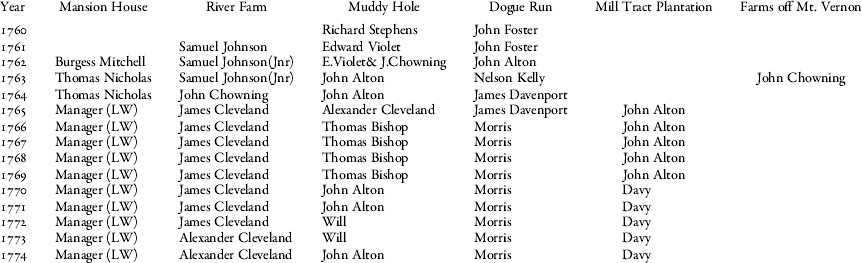
In view of the threat to white supremacy posed by the war, it is interesting to note that a number of planters continued to use slaves as overseers on their plantations and effectively promoted others to the position of overseer during the conflict. It is possible to speculate that, in some cases at least, it was the authority of trusted slaves that maintained the slave system at isolated plantations which had been abandoned by white overseers and planters alike. Personal bonds of duty and obligation often proved stronger than the disruptive forces unleashed by the war. A desire for managerial stability encouraged George Washington to search within the plantation for hard-working and loyal overseers, to assess his slaves' capabilities and to redistribute roles regardless of race. Like many planters in both Virginia and South Carolina, George Washington used faithful and diligent black slaves as overseers as well as free white men after many of his overseers left their posts swiftly.Footnote 96 The reasons for the short tenure of white overseers varied: misconduct, mismanagement and ambition.Footnote 97 The problems and inconsistency Washington encountered with his white overseers encouraged him to promote slaves to the position (see Appendix, Table 3). From the beginning of 1766, three black overseers were used on Washington's plantations.Footnote 98 Morris, Davy and Will were all skilled slaves who were promoted to the position of overseer as a reward for their hard work. These black overseers were entrusted with the care and maintenance of Washington's plantations and slaves before, during and after the Revolutionary conflict. Two of the three enslaved overseers remained in post through the entire conflict.Footnote 99 Washington, impressed by the conduct of one of his black overseers during and after the Revolutionary conflict, wrote, “Davy carries on his business as well as the white Overseers, and with more quietness than any of them, with proper directions he will do very well and probably give you less trouble than any of them.”Footnote 100 Black overseers were praised for their skill and diligence in the job. Another Virginia planter described his black overseer as an “Excellent Leader and indeed a Good Overseer,” while others claimed that black overseers were among the best overseers they ever had.Footnote 101
In South Carolina planters also placed slaves in leadership roles on the plantation during the Revolution. In 1782, at the height of the conflict, John Lewis Gervais reported to Henry Laurens that there was “no [white] overseer” at one plantation, and that his slave, Montezuma, a black driver, was “Commander in Chief” there and under his supervision Gervais reported that “upon the whole I think they [the slaves] have behaved very well.”Footnote 102 Charles Cotesworth Pinckney remarked that on a plantation where you make the “most to the hand” and a “really good Crop, there is no overseer, but only a Black Driver.”Footnote 103 However, on Low Country plantations where there was no white overseer the “black driver,” by proxy, became the overseer and some planters actually referred to their black “head-men” and promoted drivers as overseers and placed other drivers and foremen under their direction. The loyalty of such slaves was attested to both in public and in private. Laurens referred to slave “Watchmen,” drivers and overseers as “friends,” and, during the Revolution, on the death of a black steward who visited his plantations and sent him written reports he lamented the “very great loss,” and noted in his papers “Alas poor fellow! What shall I do without you?” a reflection of the bond that sometimes developed between planters and favoured slaves.Footnote 104 Following the war, a newspaper advertisement described one black overseer as a particularly valuable and loyal slave, because “during the invasion of the country, [he] never went with the British, and had the address to prevent any [slaves] going who were under his care.”Footnote 105 Other planters attributed the retention of slaves and maintenance of order on the plantation to loyal slaves who had sole charge of their plantations. Under the exigencies of war, some planters learned to empower trusted slaves and in some cases succumb to the demands of their bondsmen, thereby undercutting the authority of the white overseer, and, perhaps, contributing to his declining status in the early republic: all too often, in the selective memory of the planter, the overseer had proved faithless in war, unlike the loyal slave. Certainly, the role of some slaves in securing the trust of their owners and of their fellow slaves, who often had much “respect and love” for them, and thus gaining the status and responsibility that went with such trust, may hint again at why slavery proved flexible enough to withstand the shock of war in the South.Footnote 106 We should, thus, note the important part of the trusted slave and the black overseer too in this story. The conventional historiography has focussed on black agency as a disruptive element within slavery and during the American Revolution. Indeed the phrase has become almost synonymous with slave resistance.Footnote 107 Yet that agency is manifested here in an altogether different way, as loyalty to the master and support of the plantation hierarchy.Footnote 108
Though the plantation records are patchy at best during the American Revolution and are authored by, as Robert Olwell notes, “the dominant” group, whom he claims focus on “what slaves were not doing,” and in turn on overseers' failings, there is indeed much more to learn from re-examining these records. Though recent scholars of eighteenth-century slavery and the American Revolution have moved beyond the elite's view and tried to understand what “slaves were doing and of the Blacks' perspective” during the conflict, much is still missing in the history of the American Revolution, in particular the perspective of non-elite whites and the role of loyal slaves in the American South.Footnote 109 Moving the focus onto overseers tells a far less obvious story. It is a story of men and women who were in a unique position. They were caught in the no-man's-land between slavery and freedom that had developed during the course of the eighteenth century. The position they occupied, between planter and slave, was treacherous enough in peacetime. During the American Revolution, the pre-existing tensions were stretched to their limits. The expectations and actions of the overseer during the conflict highlight not only the fractures in white society, but also the particular divisions that arise during internecine warfare between people who had been only recently compatriots and had, perhaps, rubbed elbows on church pews and shared benches in taverns. For the northern colonies this is a familiar theme, examined in detail in the works of Gary Nash and Edward Countryman. Yet the impact of the Revolution on white class relations in the plantation South has been less thoroughly explored, notwithstanding the work of Holton, McDonnell, and Cary and Kay. It is for this reason that the overseer offers a particularly useful insight into the social dynamics of revolution in the slave South.Footnote 110
With the success and security of plantation slavery dependent on the overseer, he was often expected to remain loyal to a number of conflicting parties and their interests. Indeed, he was expected to remain dutiful to his social superiors at the expense of his political allegiances or personal interests and reputation. Unsurprisingly, some of these men, whom society deemed lowly, lazy, and miscreant, regardless of whether or not this was an accurate assessment, came in for heavy criticism during the conflict. Often “what they were not doing” embittered their peers, the community and their employers. Thus, while those who were conscripted into military service complained that men who were overseers had no sense of duty to their country, planters viewed those who left the plantation to fight as dissidents: men who not only threatened the social order that had taken root in the New World, but also failed to protect slavery. It is clear from studying the overseer that during the American fight for liberty many were in reality caught in a struggle to uphold an increasingly restrictive caste structure and an oppressive system of race-based slavery, while protecting their own interests and integrity. Those who were dutiful and remained at their posts played a significant role in preserving the institution of slavery through the turmoil of revolution, as is illustrated by the examples of William and Susanna Roddick, Casper Springer and others. Very strikingly, in some instances, when all white authority had fled away, it was black overseers who had maintained isolated plantations and won the respect from planters that was so often denied to their white peers. All those overseers who stayed in their place, however, faced the brunt of the violence and theft that went on in the plantation South during the American Revolution. In short, one might go so far as to suggest that the overseer was caught at the very heart of the conflict in all its manifestations: between social elite and fractious yeoman; between free and unfree; between loyalty to a king and commitment to liberty; and, on the plantation, all too frequently right between the bayonets of the rival armies. For, from that dangerous ground on which he stood, the overseer surely saw more of the war in its entirety than the “great man” from the lofty heights, the poor farmer scratching out a life in the backwoods, or the urban artisan in his workshop.
Appendix
Backgrounds of George Washington's overseers
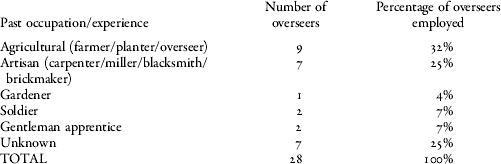
Backgrounds of Henry Laurens's overseers
Overseers supervising George Washington's plantations, 1760–74. Table 3 is made up from George Washington's memorandum lists of tithables, 1760–74, PGW. Will, Morris and Davy were slaves owned by George Washington, who, at various times, were all promoted to the position of sole overseer on one of Washington's plantations. LW=Lund Washington, manager of the plantations in Washington's absence. In 1785 Will, after the death of John Alton, was “sent to Muddy Hole as an overseer” (DGW, Volume IV, 252)