Introduction
In the long-term biological evolution, insects have formed a highly sensitive, complex and unique olfactory sensing system, which enables insects to specifically identify odour substances in the environment, and thus execute corresponding behavioural responses such as foraging, avoidance and mating (Vogt et al., Reference Vogt, Callahan, Rogers and Dickens1999; Field et al., Reference Field, Pickett and Wadhams2000). Insects use their sensitive and selective olfactory organs to search for habitat, mates and oviposition sites and escape natural enemies (Gadenne et al., Reference Gadenne, Barrozo and Anton2016). Odorant-binding proteins (OBPs) are small water-soluble proteins which are involved in olfactory sensation as a main accessory proteins (Sandler et al., Reference Sandler, Nikonova, Leal and Clardy2000; Suh et al., Reference Suh, Bohbot and Zwiebel2014; Wang et al., Reference Wang, Shang, Hilton, Inthavong, Zhang and Elgar2018), and transmit the signal to elicit behavioural responses (Larter et al., Reference Larter, Sun and Carlson2016; Silva and Antunes, Reference Silva and Antunes2017). Therefore, the understanding of OBPs is useful for green pest control and tools for developing pest control agents. It is of great significance to understand insect olfactory system and regulate insects through the olfactory system.
OBPs are polypeptides comprised of 100–200 amino acids which are involved in the sensitivity of the olfactory system and link external smells to olfactory receptor neurons (Maida et al., Reference Maida, Steinbrecht, Ziegelberger and Pelosi1993; Du and Chen, Reference Du and Chen2021). OBPs were first discovered in insects (Vogt and Riddiford, Reference Vogt and Riddiford1981) and vertebrates (Pelosi et al., Reference Pelosi, Pisanelli, Baldaccini and Gagliardo1981, Reference Pelosi, Baldaccini and Pisanelli1982). After several years, the olfactory receptors were also reported in nematodes (Troemel et al., Reference Troemel, Chou, Dwyer, Colbert and Bargmann1995) and the interaction of the olfactory receptors with OBPs was believed to response and recognise the signal transmission (Zhao et al., Reference Zhao, Ivic, Otaki, Hashimoto, Mikoshiba and Firestein1998; Hallem et al., Reference Hallem, Nicole Fox, Zwiebel and Carlson2004; Leal, Reference Leal2013). Among all olfactory proteins, OBP is the most abundant, it is a kind of low molecular weight protein, exists in insect olfactory receptor lymphatic fluid, selectively binds and transports odorant molecules, activates the odorant transduction pathway (Vogt et al., Reference Vogt, Kohne, Dubnau and Prestwich1989; Tegoni et al., Reference Tegoni, Pelosi, Vincent, Spinelli, Campanacci, Grolli, Ramoni and Cambillau2000; Zhou, Reference Zhou2010; Jia et al., Reference Jia, Gao, Ma, Li, Chen and Wang2019). OBPs are supposed to act in the first step of interaction with external odorants, binding to specific odorants and transporting them to specific membranes (Pelosi et al., Reference Pelosi, Iovinella, Zhu, Wang and Dani2018; Ullah et al., Reference Ullah, Quershi, Adeel, Abdelnabby, Waris, Duan and Wang2020). Most OBPs were mainly expressed in antennae (Niu et al., Reference Niu, Liu, Dong and Dong2016), taste system (Shanbhag et al., Reference Shanbhag, Park, Pikielny and Steinbrecht2001; Jeong et al., Reference Jeong, Shim, Oh, Yoon, Kim, Moon and Montell2013) and larval chemosensory organs (Park et al., Reference Park, Shanbhag, Wang, Hasan, Steinbrecht and Pikielny2000; Galindo and Smith, Reference Galindo and Smith2001). They are the primary elements for insects to recognise and transport external information materials, and also playing a key role in the olfactory system (Hallem et al., Reference Hallem, Dahanukar and Carlson2006; Conchou et al., Reference Conchou, Lucas, Meslin, Proffit, Staudt and Renou2019).
Frankliniella occidentalis is a polyphagous pest, which has evolved resistance and sensitivity to a variety of insecticides through metabolic detoxification, causing serious harm and economic losses to the yield and quality of fruits, flowers and crops (Morse and Hoddle, Reference Morse and Hoddle2006; Demirozer et al., Reference Demirozer, Tyler-Julian, Funderburk, Leppla and Reitz2012; He et al., Reference He, Guo, Reitz, Lei and Wu2020). As other insects, F. occidentalis conveys information or searches for their hosts by using colour, shape, size and volatiles of plant (Teulon et al., Reference Teulon, Hollister, Butler and Cameron1999; de Kogel and Koschier, Reference de Kogel and Koschier2002; Mainali and Lim, Reference Mainali and Lim2011). Most of current studies of insect OBPs are based on studies of species from different taxa, such as Diptera (Yasukawa et al., Reference Yasukawa, Tomioka, Aigaki and Matsuo2010; Chen et al., Reference Chen, Li, Zhou, Zhao, Zhang, Ni and Shang2013), Hymenoptera (Ji et al., Reference Ji, Shen, Liang, Wu, Liu and Luo2014), Lepidoptera (Wang et al., Reference Wang, Shang, Hilton, Inthavong, Zhang and Elgar2018), Hemiptera (Qiao et al., Reference Qiao, Tuccori, He, Gazzano, Field, Zhou and Pelosi2009; Gu et al., Reference Gu, Sun, Ren, Zhang, Zhang, Wu and Guo2010) and Coleoptera (Ju et al., Reference Ju, Qu, Wang, Jiang, Li, Dong and Han2012). Although many researchers majored in studying OBPs in different insects, the possibility of OBPs in Thysanoptera is still an open question.
In this study, FoccOBP9 gene was cloned, expressed and identified in F. occidentalis firstly. In addition, we also predicted its protein structure and determined its distribution in the insect body. The characteristics of FoccOBP9 that we have identified provide a reference for the further study of olfactory mechanism and for the development of non-pesticide control measures for F. occidentalis.
Materials and methods
Insects
Frankliniella occidentalis was provided by the Institute of Plant Protection, Chinese Academy of Agricultural Sciences, Beijing, and reared in MLR-351H Sanyo incubator using fresh beans at temperature 26°C under a 14/10 h light/dark cycle with a relative humidity of 65%.
Total RNA extraction and reverse transcription
Total RNA was isolated from the antenna of F. occidentalis by the Trizol reagent RNA Isolation System (MP Biomedicals, USA). The antennae were quickly cut under dissecting microscope and placed in 1.5 ml centrifuge tubes immersed in liquid nitrogen. RNA was extracted by grinding with TRIzol reagent (synthesised by Beyotime Biotech, Shanghai, China) and dissolved in DEPC, and tested for integrity using a 1.5% agarose gel. The first strand of cDNA was synthesised with Oligo (dT) primers.
First and second instar nymphs, pupae, female and male adults at 1, 5, 10 and 15 days of plumage, as well as 1-day plumage antenna, feet, head, thorax and abdomen of F. occidentalis after CO2 anaesthesia were quickly cut and placed in 1.5 ml centrifuge tubes immersed in liquid nitrogen, repeated three times.
Cloning of full-length cDNA of FoccOBP9
Bioinformatics analysis of transcriptome data and NCBI sequence alignment of F. occidentalis was performed to obtain sequence fragments of FoccOBP9 gene. PCR amplification was performed using the first strand of cDNA as template, and primers specific for 3′RACE and 5′RACE fragments of the target gene sequence were designed (table 1). The volume of PCR was 50 μl and contained 10× ExTaq Buffer 2.5 μl, cDNA 2 μl, MgCl2 (25 mmol l−1) 2 μl, 1 μl each of forward and reverse primers, TaKaRa ExTaq (5U μl−1) 0.25 μl,dNTPMix (2.5 mmol l−1 each) 2 μl and ddH2O 14.25 μl. PCRs were performed on a Mastercycler Gradient PCR machine (Eppendorf, USA) with the following cycling conditions: a pre-denaturation step at 95°C for 3 min, denaturation at 94°C for 30 s and a final extension at 56°C for 30 s, and 72℃ for 1 min and for 10 min, then storage at 4℃ with 30 cycles. PCR products were separated using a 1.5% agarose gel electrophoresis, purified with AxyPrepTM DNA gel extraction kit (Sangon, Shanghai, China), and ligated into the pEASY-T1 vector. The ligation mixtures were transformed into Trans1-T1 receptor cells and the positive clones were selected by ampicillin medium isolated from them. The correct sequencing results were spliced with DNAMAN 6.0 to obtain the full-length cDNA sequence of the gene (Zhao et al., Reference Zhao, Zeng, Liang, Zhang, Huang, Chen and Luo2015).
Primer sequences use for amplification of cDNA

Sequence analysis, phylogenetic tree construction and structure prediction
The basic physical traits of nucleotide sequences were predicted using Expasy (http://www.expasy.org). Sequence homology similarity was analysed using NCBI's BLASTx program (https://blast.ncbi.nlm.nih.gov). Signal peptides were predicted using SignaIP-5.0 Serve (https://services.healthtech.dtu.dk/services/SignalP-5.0/). Protein lipophilicity was analysed and protein sequence homology similarity was compared by the software ClustalX 1.83 (Kyte and Doolittle, Reference Kyte and Doolittle1982). The protein secondary and tertiary structures were predicted by Chou & Fasman and Swiss-PDB Viewer 4.1 (Kabsch and Sander, Reference Kabsch and Sander1983), respectively. The phylogenetic evolutionary tree of the proteins was analysed by bootstrap 1000 replicate sampling using MEGA 6.0 neighbour-joining.
Expression of FoccOBP9
Primers specific for the target gene and the internal reference gene, β-actin, were designed in the conserved sequence region (table 1). qRT-PCR reaction system was 20 μl and consisted of: Go Taq® qPCR Master Mix (2×) 10, 0.5 μl of each forward and reverse primer, cDNA 2 μl, nuclease-free water 7 μl. The two-step PCR standard method was used, and the amplification procedure was 95°C for 2 min; 95°C for 15 s, 60°C for 1 min, 40 cycles. The PCR product melting curve measurement procedure was 95°C for 1 min, 55°C for 30 s, 95°C for 30 s and 60°C for 15 s. Ultra-pure water was used as negative control. Each reaction was performed with three biological replicates and three technical replicates were assessed for each biological replicates. To calculate the relative expression levels, the 2−△△Ct relative quantification method was used to analysis the data. For tissue-specific expression pattern study, first instar nymph were used to collect samples of antenna, head (without antennae), leg and abdomen. All tissues were stored at −70℃ prior to use.
Statistical analysis
The expression of OBP in different tissue was analysed by one-way analysis of variance, and the average means were separated by Tukey's honestly significance difference test. All analyses were performed using Rv.4.1.2.
Result
Sequence determination and analysis of FoccOBP9
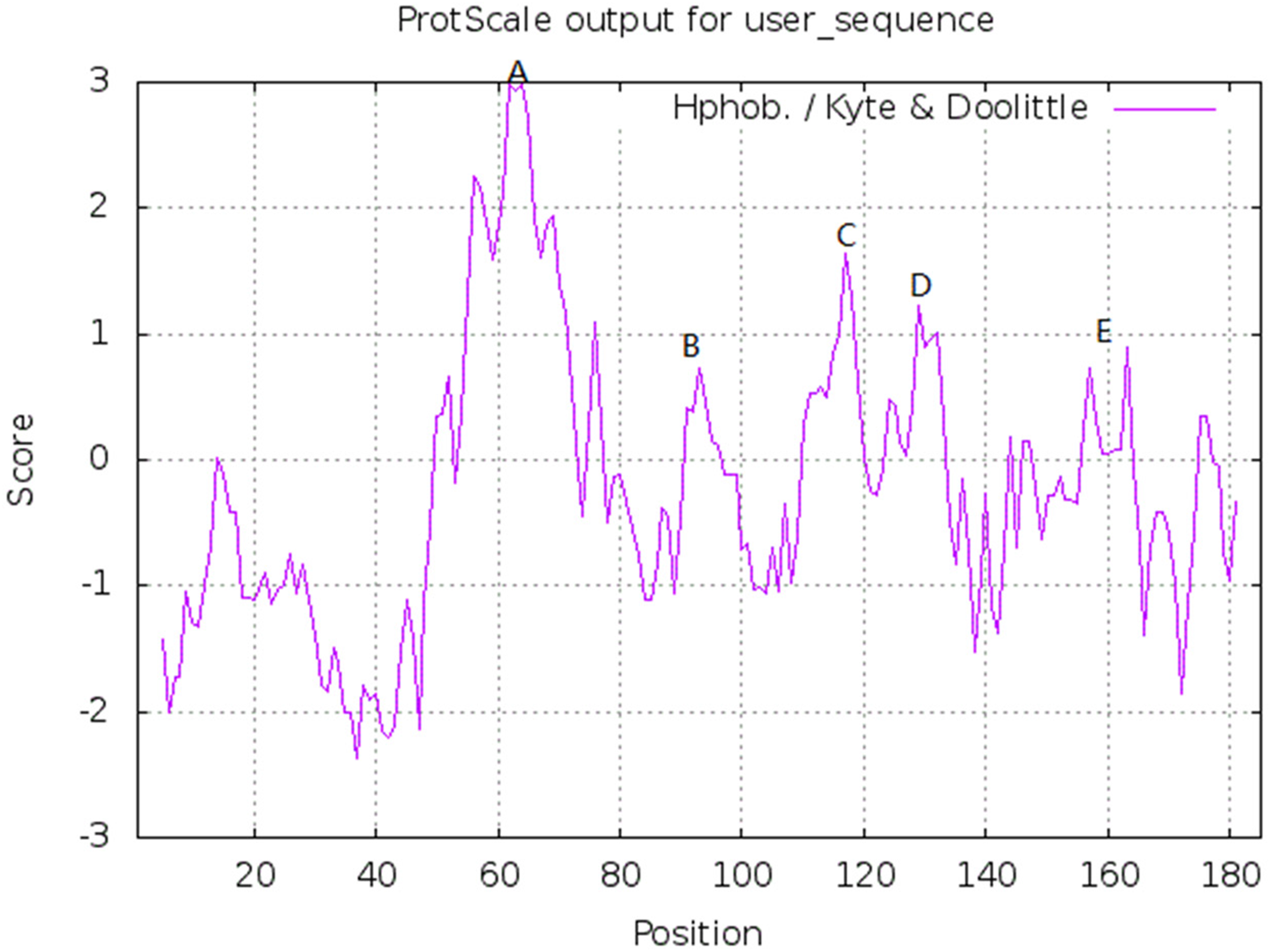
A new gene in F. occidentalis was cloned. Sequence analysis revealed that the full length of this gene is 846 bp (fig. 1), with an open reading frame of 558 bp, encoding 185 amino acid residues, 195 bp in the 3′terminal non-coding region and 93 bp in the 5′ terminal non-coding region. The protein was found to have no signal peptide, and five lipophilic regions were identified in the amino acid sequence using the Expasy website (http://us.expasy.org/cgi-bin/protscale.pl) (fig. 2). This protein has six conserved cysteines and fits the model ‘C1-X25-C2-X3-C3-X33-C4-X9-C5-X8-C6’, which is consistent with the typical OBPs ‘C1-X15−39-C2-X3-C3-X21−44-C4-X7−11-C5-X8-C6’. So a new OBP gene in F. occidentalis was identified and named as FoccOBP9.
Nucleotide and deduced amino acid sequence of odorant-binding protein gene of FoccOBP9. (Termination codons are indicated by an asterisk. Six conserved cysteine sites are marked with boxes.)

Predicted hydrophobicity profiles for the deduced amino acid sequences of FoccOBP9. Hydrophobicity index values are plotted against the amino acid residues using the method of Kyte and Doolittle (Reference Kyte and Doolittle1982). Positive values indicate hydrophobicity and negative values indicate hydrophilicity. A,B,C,D,E: five predicted hydrophobic domains.

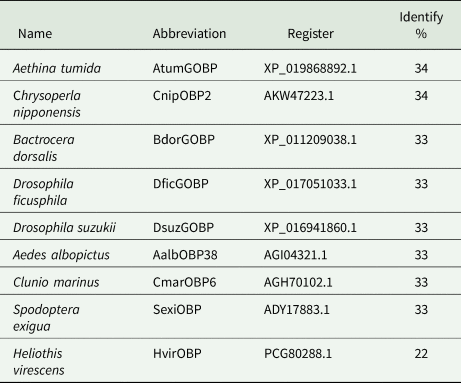
The homologous protein of FoccOBP9 result showed that the largest number insect OBPs belonged to Diptera, accounting for 57% of the total, followed by Hymenoptera, accounting for 30%, and the smaller number of Coleoptera, Plecoptera and Lepidoptera, accounting for 7, 2 and 2% of the total, respectively. The similarity between the sequences searched and FoccOBP9 ranged from 22 to 34% (table 2), the higher similarity was 34% with Aethina tumida (AtumGOBP) and Chrysoperla nipponensis (CnipOBP2), which indicated that FoccOBP9 had higher homology with them, followed by the similarity with Bactrocera dorsalis (BdorGOBP), Drosophila ficusphila (DficGOBP), Drosophila suzukii (DsuzGOBP), Aedes albopictus (AalbOBP38), Clunio marinus (CmarOBP6) and Spodoptera exigua (SexiOBP) with 33% similarity, and the lowest amino acid sequence homology was found with HvirOBP and FoccOBP9, only 22% similarity.
The consistency result between homologous protein and FoccOBP9

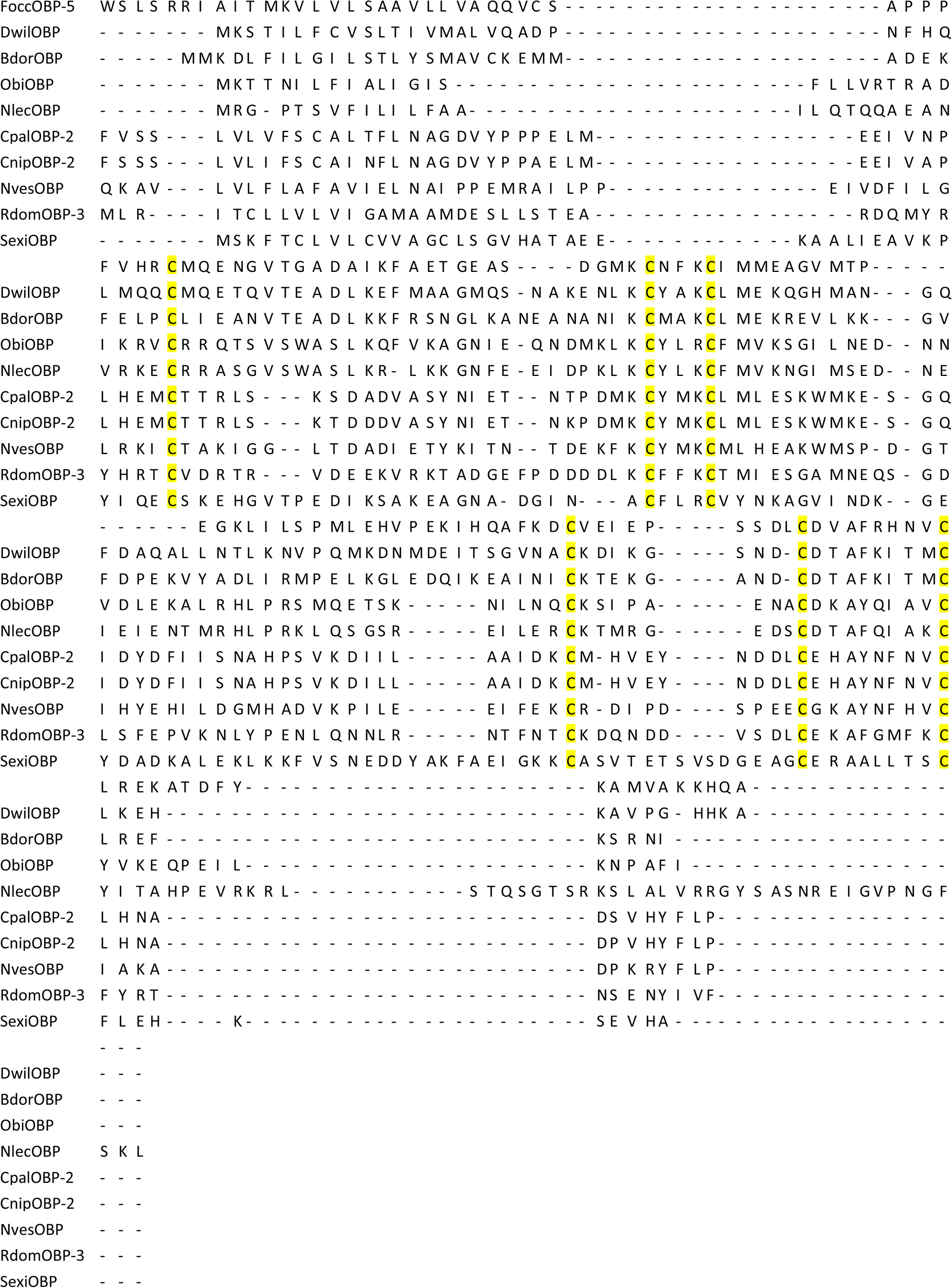
Compared with different target genes (nine insect OBPs), the sequences of FoccOBP9 were similar to DwilOBP, BdorOBP, ObiOBP, NlecOBP, CpalOBP2, CnipOBP2, NvesOBP and RdomOBP3. Although the homology of the genes was not high for SexiOBP in Lepidoptera, the six conserved cysteine sites were consistent in the location of OBPs in different insects, which indicated that the sequenced genes listed as OBP (fig. 3).
Alignment of FoccOBP9 with other order insect OBP. The conserved amino acids are highlighted under yellow. The other insect species are Drosophila willistoni (Diptera), Bactrocera dorsalis (Diptera), Ooceraea biroi (Hymenoptera), Neodiprion lecontei (Hymenoptera), Chrysopa pallens (Neuroptera), Chrysoperla nipponensis (Neuroptera), Nicrophorus vespilloides (Coleoptera), Rhyzopertha dominica (Coleoptera), Spodoptera exigua (Lepidoptera). Gene Bank accession numbers for all OBPs genes are DwilOBP, XP_002063852.1; BdorOBP, XP_011209038.1; ObiOBP, XP_011346593.1; NlecOBP, XP_015512408.1; CpalOBP2, AKW47195.1; CnipOBP2, AKW47223.1; NvesOBP, XP_017774856.1; RdomOBP3, AIX97144.1;SexiOBP, ADY17883.1.

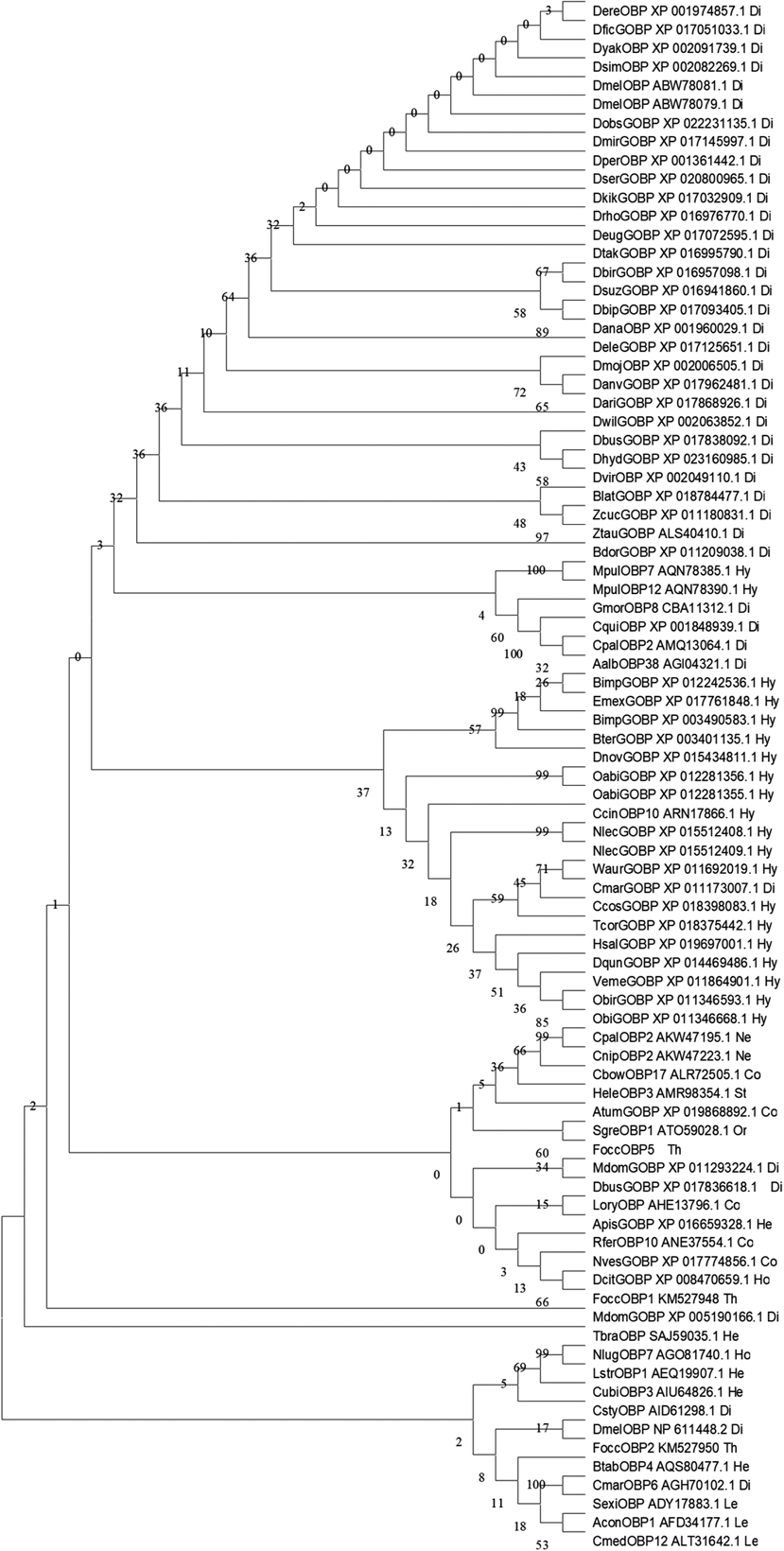
The evolutionary phylogenetic analysis (fig. 4) of the OBP amino acid sequences of 83 insects showed that FoccOBP9 had the highest identity (34%) with SgreOBP1 (Schistucerca gregaria), indicating FoccOBP9 may have a closer ancestor with SgreOBP1, followed by AtumGOBP (Aethina tumida), HeleOBP3 (Hylamorpha elegans), CbowOBP17 (Colaphellus bowringi), CnipOBP2 (Chrysoperla nipponensis) and CpalOBP2 (Chrysopa pallens), which makes it clear that the sequence belongs to the OBP (fig. 4). Among the amino acid composition of FoccOBP9, alanine (A) is the most abundant, followed by glycine (G), proline (P), valine (V), arginine (R), lysine (K) and glutamate (E), accounting for more than 50% of amount (fig. 5).
FoccOBP9 speculated protein phylogenetic tree based on N-J method. The length of the branch represents the genetic distance, the number on the branch is the confidence of the repeated calculation at ‘Bootstrap’ of 1000. The right is the abbreviation for the name of the insect species, protein name, accession number and the purpose of the insect acronym. Figure system tree insect head abbreviations were: Di (Diptera), Hy (Hymenoptera), Co (Coleoptera), Ho (Homoptera), Ne (Neuroptera), Se (Strongylida), Th (Thysanoptera), He (Hemiptera), Or (Orthoptera), Le (Lepidoptera). The species abbreviations are: Aalb (Aedes albopictus), Acon (Argyresthia conjugella), Apis (Acyrthosiphon pisum), Atum (Aethina tumida), Bdor (Bactrocera dorsalis), Bimp (Bombus impatiens), Blat (Bactrocera latifrons), Btab (Bemisia tabaci), Bter (Bombus terrestris), Cbow (Colaphellus bowringi), Ccin (Cephus cinctus), Ccos (Cyphomyrmex costatus), Cmar (Clunio marinus), Cmed (Cnaphalocrocis medinalis), Cnip (Chrysoperla nipponensis), Cpal (Chrysopa pallens), Cpal (Culex pipiens pallens), Cqui (Culex quinquefasciatus), Csty (Calliphora stygia), Cubi (Chinavia ubica), Dana (Drosophila ananassae), Danv (Drosophila navojoa), Dari (Drosophila arizonae), Dbip (Drosophila bipectinata), Dbir (Drosophila biarmipes), Dbus (Drosophila melanogaster), Dcit (Diaphorina citri), Dele (Drosophila elegans), Dere (Drosophila erecta), Deug (Drosophila eugracilis), Dfic (Drosophila ficusphila), Dhyd (Drosophila hydei), Dkik (Drosophila kikkawai), Dmel (Drosophila melanogaster), Dmir (Drosophila miranda), Dmoj (Drosophila mojavensis), Dnov (Dufourea novaeangliae), Dobs (Drosophila obscura), Dper (Drosophila persimilis), Dqun (Dinoponera quadriceps), Drho (Drosophila rhopaloa), Dser (Drosophila serrata), Dsim (Drosophila simulans), Dtak (Drosophila takahashii), Dvir (Drosophila virilis), Dwil (Drosophila willistoni), Dyak (Drosophila yubaak), Emex (Eufriesea mexicana), Focc (Frankliniella occidentalis), Hele (Hylamorpha elegans), Hsal (Harpegnathos saltator), Lory (Lissorhoptrus oryzophilus), Lstr (Laodelphax striatella), Mdom (Musca domestica), Mpul (Meteorus pulchricornis), Nlec (Neodiprion lecontei), Nlug (Nilaparvata lugens), Nves (Nicrophorus vespilloides), Oabi (Orussus abietinus), Obir (Ooceraea biroi), Rfer (Rhynchophorus ferrugineus), Sexi (Spodoptera exigua), Sgre (Schistocerca gregaria), Tbra (Triatoma brasiliensis), Tcor (Trachymyrmex cornetzi), Veme (Vollenhovia emeryi), Waur (Wasmannia auropunctata), Zcuc (Zeugodacus cucurbitae), Ztau (Zeugodacus tau).

Amino acid composition of FoccOBP9.

Predicted structure and analysis of FoccOBP9
The FoccOBP9 protein contained 135 amino acid residues forming α-helix, accounting for 73.0% of the overall amino acids, 91 amino acid residues forming β-sheets, accounting for 49.2%, and 24 amino acid residues forming β-angle, accounting for 13.0% (fig. 6). The Swiss model portal used 50 different templates to generate a refined model based on the best homology (fig. 7). OBP LmigOBP1 from migratory locust (No, ABA62340.1) was used as the best template. A total of six α-helices were predicted and the helix numbers were α1, α2, α3, α4, α5, α6, including five of the α-helices (α1, α2, α4, α5, α6) that form a binding pocket consisting mainly of hydrophobic and hydrophilic amino acid residues, while another α3 helix is at the top of the binding pocket.
Predicted secondary structure of FoccOBP9.

Predicted three-dimensional model of FoccOBP9. 3D structure of the FoccOBP9 from F. occidentalis. Six α-helices are represented in different colours such as N-terminus, α1: blue, α2: dark blue, α3: green, α4: sea green, α5: dark green, α6: brown and C-terminus.

Expression pattern of FoccOBP9
The expression of the FoccOBP9 in different developmental stages was examined using qRT-PCR (fig. 8). The result indicated that the expression level of FoccOBP9 in first instar nymph was significantly higher than in other developmental stages. However, it was highly expressed in 1-day-old females than in males, and although FoccOBP9 was not expressed in males at 5 days of fledging, it was higher at 10 and 15 days of fledging than in females.
The relative expression level of FoccOBP9 in F. occidentalis different developmental stages. Ny-1: the first instar nymph; Ny-2: the second instar nymph; Pu: pupae; Fe-1, Fe-5, Fe-10, Fe-15 means 1-, 5-, 10-, 15-day-old adult female; Ma-1, Ma-5, Ma-10, Ma-15 means 1-, 5-, 10-, 15-day-old adult male.

In adults, FoccOBP9 was most highly expressed in the antennae, significantly lower in the head and abdomen, and showed no gene expression in the thorax and legs (fig. 9).
The relative expression level of FoccOBP9 in different adult tissues of F. occidentalis.

Discussion
OBPs play an important role in insect olfactory perception at different stages and may have additional functions (Fan et al., Reference Fan, Francis, Liu, Chen and Cheng2011; Brito et al., Reference Brito, Moreira and Melo2016; Rihani et al., Reference Rihani, Ferveur and Briand2021). In our study, we cloned and identified an OBP gene of F. occidentalis, FoccOBP9. The result provides a basis for further investigation of the function of FoccOBP9 in the olfaction of F. occidentalis, especially in the olfaction of host plants, and for efficient screening of F. occidentalis, attractants or trophozoites.
Based on previous studies, we found that the OBP FoccOBP1 showed 37% similarity to AlinOBP5 (Adelphocoris lineolatus), AlucOBP8 (Apolygus lucorum) and LlinOBP2 (Lygus lineolaris) (Zhang et al., Reference Zhang, Wu and Lei2016). FoccOBP3 showed 36% similarity to DallGOBP (Diachasma alloeum), TcasPBP and TcasOBP07 (Tribolium castaneum) (Zhang et al., Reference Zhang, Hu and Ma2021). However, FoccOBP9 shared 34% similarity to Diptera and Hymenoptera, especially AtumGOBP (A. tumida) and CnipOBP2 (C. nipponens), followed by B. dorsalis, D. ficusphila, D. suzukii, A. albopictus and S. exigua (33%), and shared lower homology consistency with other insects, this may be related to the fact that OBPs come from different orders of insects.
Interestingly, FoccOBP9 was not in the same branch with FoccOBP1 and FoccOBP2 by phylogenetic analysis. Hence, we hypothesised that FoccOBP9 in F. occidentalis might have different functions. The adaptation and evolution of FoccOBP9 to different types of environmental chemical stimuli may lead to its differentiation, and it performs the same or some different functions.
Generally speaking, the expression of OBPs can reflect their role in insect life activities (Chang et al., Reference Chang, Liu, Yang, Pelosi, Dong and Wang2015; Li et al., Reference Li, Ni, Tan, Zhang and Hu2016b) and gene expression profiling of insects is an important way to reflect their gene functions (Xue et al., Reference Xue, Fan, Zhang, Xu, Han, Sun and Chen2016). Some researchers reported that OBPs are expressed in different developmental stages of insects, for example, HaxyOBP6 of Harmonia axyridis is expressed primarily in the adult stage (Han et al., Reference Han, Liang, Li, Han, Zhao and He2019), and OBPs of Braconidae are expressed primarily at specific developmental stages (Zhang et al., Reference Zhang, Zhang, Su, Gao and Guo2009). Our results showed that FoccOBP9 was expressed primarily in the first instar nymph stage. The reason may be that the first instar nymph of F. occidentalis is short and has an urgent need to feed to replenish its nutrients and FoccOBP9 plays a role in this process.
In addition, the expression of OBPs was also related to the male and female sex of insects, and OBP genes were commonly biased to be expressed in both male and female adults, which may be related to the respective roles assumed by male and female adults in life (Qin et al., Reference Qin, Cai, Zheng, Cheng and You2016). Our results showed that the expression of FoccOBP9 was higher in females than in males at day 1 of plumage and higher in males than in females at day 10 of plumage. This result implied that FoccOBP9 has difference in the recognition of external odour between male and females in adults and performs different functions in females and adults.
OBPs are not only expressed in the lymph of olfactory sensilla on the antenna but also found elsewhere. High and specific antennal expression of OBPs suggests an olfactory role of recognizing specific information such as SinfGOBP (Sesamia inferens) (Zhang et al., Reference Zhang, Ye, Yang and Dong2014), EoblOBP9 and EoblOBP11 (Ectropis obliqua) (Ma et al., Reference Ma, Li, Bian, Cai, Luo, Zhang and Chen2016; Li et al., Reference Li, Cai, Luo, Bian, Xin, Chu, Liu and Chen2018), CcOBP5 (Chouioia cunea) (Pan et al., Reference Pan, Xiang, Sun, Yang, Han, Wang, Yan and Li2020), AcerOBP14 (Apis cerana) (Du et al., Reference Du, Xu, Zhao, Jiang and Li2021), AipsPBPl-3 (Agrotis ipsilon) (Gu et al., Reference Gu, Sun, Yang, Wu, Guo, Li, Zhou and Zhang2014) and CpunOBP4 (Dichocrocis punctiferalis) (Jia et al., Reference Jia, Wang, Yan, Zhang, Wei, Qin, Ji, Falabella and Du2016). Of course, some OBPs are also expressed in other tissues, such as GmolOBP3 (Grapholita molesta) (Li et al., Reference Li, Chen, Li, Zhang, Li and Wu2016a), AzanOBP4 (Agrilus zanthoxylumi) (Guo et al., Reference Guo, Chen, Gao, Jia, Zhang, Xie, Lv and Chen2021), PxylOBP2 (Plutella xylostella) (Cai et al., Reference Cai, Zheng, Huang, Xu and You2021), CforOBP8 (Cylas formicarius) (Hua et al., Reference Hua, Pan, Huang, Li, Li, Wu, Chen, Ma and Li2021), OBP10 and OBP14 (Apis mellifera ligustica) (Zhao et al., Reference Zhao, Zeng, Liang, Zhang, Huang, Chen and Luo2015). However, FoccOBP9 gene was the most highly expressed in the antenna of F. occidentalis, and scarcely expressed in the head and abdomen. OBP distribution pattern can provide key clues to control pest; we hypothesised that FoccOBP9 mainly exercises olfactory-related functions and is involved in odour binding and transport, but it may also be involved in other non-olfactory physiological functions, such as taste and touch. Based on previous study, OBP genes are mainly distributed in sensilla basiconica, a previous study in this laboratory found that multiple sensilla basiconica are distributed on the antenna of F. occidentalis (Zhang and Lei, Reference Zhang and Lei2022), so FoccOBP9 gene is highly expressed in the antenna, it is supposed that this gene may play an important role in host localisation and foraging of first instar nymph. This study may lay the foundation for the follow-up study of FoccOBP9 and further investigation of the olfactory mechanism in F. occidentalis.
Conclusions
In summary, we identified an OBP gene (FoccOBP9), and determined the relative expression level of FoccOBP9 in F. occidentalis at different developmental stages and in different adult tissues, which revealed that FoccOBP9 may play a prominent role in the olfactory chemoreception of F. occidentalis. These results can provide insight into the mechanism of olfactory communication of F. occidentalis, and provide scientific basis for further research and development of physical and chemical inducers for F. occidentalis.
Acknowledgments
We thank Professor Zhongren Lei (Institute of Plant Protection, Chinese Academy of Agricultural Sciences, Beijing, China) for providing the test insect.
Author contributions
Zhike Zhang conceived and designed the experiments, performed the experiments, analysed the data and wrote the paper.
Financial support
This research was funded in part by the Special Project of the National Natural Science Foundation of China (grant number 32460673) and the Natural Science Foundation of Ningxia (grant number 2022AAC02053).
Competing interests
None.