

The Chairman (Mr J. B. Orr, F.F.A.): I am the chief actuary for general insurance (GI) at the Prudential Regulation Authority, which is a subsidiary of the Bank of England. We are very much focussed on the discipline around reserving adequacy. The robustness of reserves is absolutely critical to the general insurance business model and in many ways from a regulatory issues perspective it is a gift that keeps giving. Issues still arise in the reserving space and it is one that we are “constantly anxious about”; it is one that we do expect to have the odd nasty surprise, and even in the last few years we have seen the examples of Equity Red Star and in the Irish operations of Royal and Sun Alliance. If we go back a little bit further, we have the example of Independent Insurance. I believe there was also an example called Vehicle and General in the 1970s where a reserving issue came through.
So, reserving is absolutely critical in GI. As well as that, what we would observe is that the demands on reserving are increasing. The frequency of reserving exercises is increasing and the range of reporting requirements, whether those are internal or external, is proliferating.
Therefore the work that Dr Bruce and his colleagues are doing in the Towards Optimal Reserving Process (TORP) working party is absolutely critical, in terms of investing in more efficient and effective processes. I am very keen to see this work shared.
Moving onto the speakers’ biographies. Mr Taylor has worked as an actuary in the UK GI market since 1983, having spent his career prior to that in life and pensions roles. He qualified in 1990 and held GI reserving roles at General Accident, Co-op, Direct Line, before joining Axa Insurance in 2014. At Axa Insurance, Mr Taylor is a senior manager with responsibility for delivering reserving aspects of Solvency II. He has been a member of the TORP working party since its inception in 2012.
Dr Bruce has been an actuary in the general insurance market since 1997. He qualified in 2001 while at PwC and has held senior roles in two managing agents before taking his current role as chief actuary at TSM, which is part of the Travelers Group, in 2008.
He has been involved in the General Insurance Reserving Oversight Committee and various working parties over the years, including as chair of the Reserving Uncertainty working party, and currently as chair of the TORP working party. He has published articles in the actuary and is a member of the Committee of Actuaries in the Lloyd’s Market (CALM) and the London Market Actuaries Group (LMAG).
Dr N. A. Bruce, F.I.A. (introducing the paper): The paper aims to highlight areas where efficiencies within the fast close reserving process can be obtained. It also tries to highlight the messaging within the reserving process, so the balance between delivering key messages and detailed information needs to be absolutely correctly tuned because that is quite critical in a lot of these processes.
The working party itself aims to develop practical solutions to common reserving issues that arise over time. We also look to highlight techniques and processes that are in use at the moment but are not widely distributed, and we also try to disseminate that sort of information across the wider reserving community.
This is the second paper that we have produced. The first one is on Actual versus Expected techniques and the associated processes around those techniques.
The problem that we set ourselves to solve is really looking at the limited time available in the fast close process. Typically, this can be a week, maybe 2 at the outside, to do a reserving analysis and a reporting process. What we are looking to do is to identify where in that process we can tighten up things. Unfortunately, reserving processes do not go smoothly all the time and there can often be issues that arise during the process that can derail or disrupt the reserving process as planned. We want to try to deal with some of those as well.
One way of thinking about this problem is pictorially, as in Figure 1.
The problem (pictorially)

The way we have tried to think about how reserving processes evolve over time is you start at a point where you have status quo, so you are regularly producing reserve analyses to a specific timetable and set of deliverables. Over time, people ask you for more information, regulations come in that you have to deal with, and incrementally you absorb these into your reserving process and the amount of time taken to complete your reserving process increases. I am not saying that it is linear, but this sort of process evolves over time and you tend to need a longer period to carry out your analysis. This can continue only up to a certain point. At that point either your process becomes too unstable and you start dropping the ball occasionally or you simply cannot get everything done in the timescales that you have available.
At that point or just before, what you need to do is have a step change in how you deal with reserving. This will require some kind of re-engineering process across all of your systems and your processes to make yourself more efficient while still being able to achieve all of the reporting requirements that you need to perform.
You could possibly do this as a series of circles. This is an iterative process over an extended period of time as reporting requirements come and go and the abilities to do ever more detailed analysis evolves.
Various firms will be at various stages of this process. Some will have already been in a perfect situation for the amount of reserving reporting they need to do; others will be very much still working their way up the first stage of the graph. It is important that people who are further down the process help share their experiences with those closer to the start of that process to help them reach a better position as quickly as possible. That is what we are trying to do.
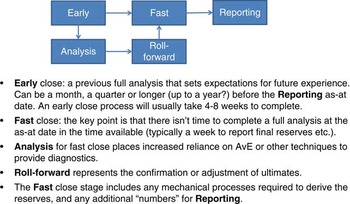
Breaking the fast close process out a little more, Figure 2 shows the stages that we have chosen to use in the paper. The early close process is not a true part of the fast close process. It essentially is a series of analyses that you do at an earlier balance sheet date, which sets the underlying assumptions that you are going to use to anticipate the expected movement in various variables over the roll-forward period. These assumptions are crucial to the start of any fast close process.
Early/fast close

When you combine these assumptions with the data for the reporting as at date, it permits you to proceed to the analysis phase. What we are anticipating is that there is a series of mechanical calculations that will produce a number of exhibits to be used in the roll-forward stage.
The roll-forward stage has been broken out as almost all of the expert judgement is required in this process. Everything else in Figure 2 should ideally be automatic, with maybe some expert judgement in the reporting, onto which we will come later. All of the expert judgement should be contained within a defined place where it can be most effectively applied to the process. That process should come up with revised estimates for ultimates or reserves, which will then feed into the fast part of the fast close, which is essentially converting all of those assumptions into various reporting bases, preferably automatically, to produce reporting bases on GAAP, US GAAP, Solvency II and also to populate any ancillary calculations, such as unallocated loss adjustment expenses (ULAE) and bad debt calculations. So the fast close needs to produce all of the information required within the reporting framework.
First of all, I am going to deal with the reporting framework. The reason why it needs to be front and centre is because it will define your critical path. The whole point of a reserving exercise is to put that information out into the wider community so that all your stakeholders can make their appropriate decisions based on the results of your analysis at the appropriate time.
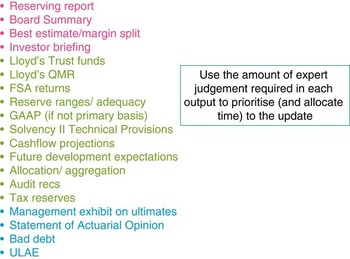
Figure 3 shows a list of reporting requirements. Not everybody has to do all of these; there is a lot of work involved if you do have to do them all. What you are trying to do is make sure you are spending the appropriate amount of time on the appropriate outputs. The way that we believe you should prioritise that effort is using expert judgement. For example, we would suggest that the reports at the top of the list are more heavily expert judgement based. You will add more value by spending more time on those. The ones towards the bottom of the list are less important, with potentially little or no expert judgement involved in them from an internal perspective, and maybe they could be unchanged from whatever came out of the early close process. So prioritise your effort using this list to help identify where you could best spend your time as far as expert judgement time is concerned.
Reporting requirements

If you combine that expert judgement triaging with a materiality threshold, what we hope is you will come to a stage where you have identified some reports that you do not have to update since the early close, as if the magnitude of the reserves is below your materiality threshold then the chances of there being any changes during the fast close process that would then escalate over that threshold can be very limited. What you want to be doing is concentrating most of your efforts on the output that goes to the board, the investors and the senior management, and very little on filling in forms that contain data that should really be automatically populated out of the back end of your process.
Also, using the critical path analysis, you may identify that you do not even have to complete some of these reports before the fast close process is finished and you have made all your decisions and they may be able to be populated at a slightly later date and take some pressure off the core element as you fast close.
Mr Taylor will now talk through the Actual versus Expected elements.
Mr K. M. Taylor, F.I.A.: Our previous paper covered some of the varied techniques and options available under Actual versus Expected analysis. In this paper, we show that the analysis can play a key role in a fast close situation. It lends itself well to lean process, being capable of being automated and a straightforward presentation to stakeholders.
The process does involve practical complications. A wide range of metrics are possible if you have the data and while this gives more insight, it also increases the time and effort involved in producing and explaining the analysis.
There can be more than one kind of expected value to consider. For example, an actuarial best estimate, a management or book estimate and possibly a pricing estimate. This not only creates effort in producing multiple versions of the analysis, but creates a requirement for further reconciliation and explanation. Different metrics can produce contradictory outcomes. For example, payments data may lag their expected values at the same time as incurred costs exceed theirs. Explanations may then require investigation of either or both of actual data and expected values.
Using high-level groupings can save time and effort, but it also risks missing granular changes in trends. Early warning signs of change may not be found until the next deep dive review or until changes become sufficiently large to be noticeable using a higher level analysis.
Many regular and common place claims influences can produce Actual versus Expected differences. For example, large claims, weather events, process backlogs, etc. Time and effort is needed to adjust for these if other less predictable influences are to be identified and allowed for in adjustments to early close ultimates. There are practical actions that can help to mitigate these difficulties such as:
∙ To pre-explain as much as possible at early close when detailed analysis is ordinarily carried out.
∙ Agree materiality thresholds with stakeholders in advance of the fast close. This is key to keeping analysis focussed on important areas.
∙ Agree the basis of expected values and the key metrics to be used up-front so there is no need for debate within the fast close timescales.
∙ Manage stakeholders’ expectations. The business needs to know not to expect deep insights from a light touch process and to address doubts if they do not already have confidence in the fast close process.
We show the aim of the roll-forward process as being to confirm or adjust a set of ultimates from a previous early close review, but doing so based on latest data available within the fast close timeframes. Devising a process to meet this aim becomes a balancing act between the need to analyse in more depth to support decision making and the need to abbreviate processes to sit within required timescales.
We show a number of options in the way that adjustments to early close ultimates can be selected. Examples are given covering holding ultimate costs static and using latest payments data to derive claims reserves, holding loss ratios static and applying them to latest premium and payments data to generate claims reserves.
Holding IBNR values static and combining these with the latest payments and claims estimates data to give fresh ultimate costs and ultimate loss ratios. Or you can apply previously parameterised methods and assumptions, and apply these to latest data points, this being the most complicated of the approaches identified.
We give examples demonstrating these approaches and indicating where one approach might be more appropriate than another. In common to all, though, is the need to achieve operational efficiency, and we suggest that analyses are carried out at the most granular level practical in the time available (it being easier to summarise up to a high level, than to reanalyse down to a more detailed level). We also suggest applying automated decision-making rules to keep debate about results to manageable levels. We further suggest holding high-level adjustments at the same level of detail as margin adjustments to reduce the need to analyse down to potentially lower levels of detail, at which best estimates are often held, unless, of course, adjustments are derived at this level already.
So the roll-forward process presents a number of challenges. Different business segments may suit different methods. For example, an approach that works well with attritional claims may not work well with the lumpy development of large claims. Care is also required where a mixture of reserving methods is applied within a given business segment to ensure that any roll-forward adjustments selected are appropriate in each of the modelling situations involved.
The selection process needs to be quick and, wherever possible, rule based, using indicators and RAG status flags to ensure that time is spent on the areas where it is most needed.
Reinsurance data is not always available concurrently with gross data and may have specific features depending on the firm in question. This might require a higher level approach for reinsurance reflecting data limitations.
Top-down and bottom-up approaches to analysis can both be valid, but we know that top-down is more readily suited to effective reporting in tight timescales. Some challenges relate to cultural aspects within a given insurer. For example, relating to the confidence in a “no change” approach to selection, particularly among the board or within the actuarial team, or relating to deriving sufficient value from the actuarial team or relating to other stakeholders such as underwriters who might naturally believe that their perspective needs to be taken into account.
So different firms are likely to face a differing balance of such challenges at different times. We believe that for all, the key to succeeding in a short timescale is to ensure movements are based on the most significant issues and effects, and the key to maintaining success is not to miss anything important in so doing, so clearly there is significant judgement in setting the roll-forward process, as well as in more familiar areas, like selecting the ultimates.
Dr Bruce: So, it is not really a surprise, but planning and communication are absolutely critical in any process, particularly the reserving process. Identification and prioritisation of reports and analyses is absolutely key, as well as making sure you are spending the time where you are going to add value. And also, although we are talking about fast close as a specific example, the principles underlying this work, and a number of the conclusions that we have made, can also be applied, more generally, to a normal reserving exercise.
Mr J. A. Bielski, F.I.A. (opening the discussion): In the context of Solvency II, what impact would that have on the fast close process, particularly thinking about technical provisions, allowance for discounting, future premium and profit and also the relationship between the QRT, which ultimately has to be produced in 5 weeks, and other capital requirement calculations that have to be produced within the same timescale.
Dr Bruce: A very good question and very topical as well. Technical provisions calculation is a true best estimate and so the first thing that is important to note is whatever basis on which you are reserving, and hence booking your reserves, you need to have a clean best estimate from which to work to derive technical provisions.
A lot of the technical provisions conversions can be done automatically. A lot of the GAAP calculations we do have to be done within a week of quarter end. So, certainly, a personal point of view is that the assumptions you have made to close your GAAP reserves can form the basis of your technical provisions reserves, and so long as you have those automated with the assumptions set prior to the end of the quarter, most of that calculation can be done relatively smoothly.
On the capital setting front, certainly in the original Solvency II documentation, there were comments where a proportional approach is allowed on the quarterly reporting basis rather than the annual reporting basis, so I think you can phase, or off-cycle, your annual process to feed into your next four quarterly processes.
Mr Taylor: I know of at least a couple of offices that are striving to make sure that their best estimate values will be equally applicable in both an IFRS environment and in a Solvency II environment, even though the underlying definition of each of those do not necessarily have to be the same, very much with the view of avoiding doubling up on the process.
Actual versus Expected within the Solvency II world focusses again on best estimate liabilities, so there is an opportunity for one analysis to serve both sets of purposes. I think a particular area where there is a need for explanation is in respect of the events that are not in data within Solvency II, which can be a broader spectrum than one might consider in an IFRS world, and you would need to bring that into the thinking in a fast close environment.
Mr P. O. J. Kelliher, F.I.A.: In terms of the life perspective, I suspect 1 week for obtaining the GAAP is very challenging for the likes of a realistic balance sheet involving thousands of simulations of the balance sheet and different kinds of investment rules. There are certainly differences.
My concern is more on operational risk. We have this very slick fast close process, but how do you pick up any kind of issues in terms of reserving? We have obviously seen RSA in Ireland. We have seen quite a number of companies over the years have been systematically under-reserving. I wonder where is the space in this fast close process for controls to pick up on such under-reserving?
Dr Bruce: It is always a concern in any reserving process whether you are picking up all of the trends that are within your data.
There are probably two parts to the answer. One is that in some cases the fast close projection period is relatively short and it is debatable about how much weight you should put on your last data point, so reacting to volatility in the process may be balanced out by taking a slightly longer term view on the trends which are emerging.
But, saying that, if you are doing a fast close process and you are reporting your Actual versus Expected, what that will be doing is showing you where those underlying assumptions are not valid. Although you may not be able to do a huge amount of analysis in the time available to react fully to that information, you can take a view as to how much to react to it at that stage.
It then gives you until your next fast close process to do some more detailed analysis around any emerging trends so that information can be baked into your next early close or your next fast close process, depending on how your company works.
That is about the communication of the process. You can imagine all senior management will think “My actuaries are not doing anything. I am going to go seriously under water at some point because they are only scraping the surface of the analysis”.
I strongly suggest that the fast close process and the Actual versus Expected analysis in itself is an early warning process. If treated correctly, it could allow you to concentrate more on those things that have gone amber, rather than the sea of green that you would have if everything was going normally but you would still be looking at every number during your process, which can distract you.
Mr Taylor: Irrespective of the close processes, early or fast close, reserving teams will ensure that they have close links with claims departments, with underwriters and a continuous flow of information (probably monthly) and that the fast close process will take the latest information from those, even if it does take place in a short space of time.
I think that is probably where security lies in terms of finding issues that you might not otherwise discover without a deep dive into the data.
Mr B. G. Moretta, F.F.A.: I am an external user of accounts as an investment analyst.
It seems to me that one of the key questions, as an external reader, is that by fast closing you are reducing the confidence of your estimate to some extent because you are not doing the ideal process. Obviously, in your paper, you analyse steps to try to minimise the reduction in confidence.
How do you convey that reduced confidence to stakeholders? Is that something you can and should be quantifying? What do you expect those people to do with that knowledge?
In the process of reserving, there are various legal requirements in terms of best estimates. If we get to the stage where this fast close process is used for these statements, when we are capable of producing a better estimate given more time (and it may be the best estimate in the time available, but it is not the best estimate), is this something that in some sense is a potential hazard?
Dr Bruce: That is a slightly different take from the previous question. Is there more risk within the reserving process? In some ways I would say: “No”.
What you are doing, is putting more effort in those areas that are causing you concern and less effort in the areas where things are going as expected. So what you are doing is very much a risk-based analysis within your reserves. What you can see if you did do a deep dive process on a quarterly basis, is quite significant fluctuations in your best estimate over time due to fluctuations in the data, which is not normal.
I would not say that any reserve estimate at any point in time if you were doing deep dives was necessarily better than any others, which infers that you have a margin for error in your best estimate. If you are reacting every quarter to all of these movements, what you might be doing is masking the big picture with lots of small movements.
If you are trying to explain lots and lots of small variations, you may not be seeing the big emerging trend, because every quarter you are reacting to a quarter’s worth of data rather than having a bit more of a holistic view as to the impact on the balance sheet.
I would say what a reserving process is there to do is to provide comfort that there are sufficient reserves in the pot, and so any RAG status would be there flashing red if you thought you were going under water in any particular area.
It is also to identify the emerging risks, to quantify them and to play them out to all stakeholders in a way that they understand. I would say that is easier to do if there only a few things going on in your reporting compared to having swathes of numbers in your appendices.
I do agree that it is something of which you need to be conscious. It is all in the preparation of putting in a fast close process. You need to talk every stakeholder through what it will do to the process, how it will impact the process and what they will see in the numbers that they look at as result of implementing this process. Dry runs and parallel runs are very important in making sure that everybody is comfortable about the results that are going to come out.
I agree it can make people nervous, but, as a practitioner, it does allow me to concentrate on the things that matter rather than try to force through a whole bunch of stuff, with swings and roundabouts going on left, right and centre, which is a much more difficult position about which to portray a coherent message.
The Chairman: My immediate boss in my job is a former audit partner, and he talks about the diminishing funnel of focus which was how they would manage quite a long list of unresolved issues, or questions or uncertainties, as they moved towards an audit opinion, where they would say “With a month to go, we have these dozen or so issues, at which we are looking”. As they moved closer and closer to the audit opinion, they would intentionally trim that down just to the top one, two or three issues, and those were going to be the ones on which they really focussed.
There are almost endless uncertainties and questions and areas of potential downside within these calculations. It is trying to manage that process as effectively as possible that often drives the activities within it.
Mr Moretta: I think you made a very good justification on a management basis and I am not disputing that this is not a useful process. It just seems to me you may be able to select things, you may be able to minimise that risk, but you are still reducing the confidence in your estimate, and your estimate is not quite as good as it was before. That may be a small amount. I think that it is still beholden on whoever is doing this process to demonstrate that that is a small amount because you have shortened the process.
Dr Bruce: I would totally agree. I would suggest that it is a relatively small amount and certainly relatively small in comparison to the underlying uncertainty of the reserves themselves.
I think many people underestimate volatility in the reserves that are set and concentrate on the profit and loss aspects of the movement between various points in the balance sheet. If they think that those movements in the profit and loss are the biggest uncertainties in the reserving process, they are very much mistaken. The fact that you do deep dives, and you may do them at various points in the year, means that you will reset your assumptions at least annually. If there is any miss on some of the aspects underlying the reserves, it will be corrected at some point during the year. The uncertainty within the overall provision is much bigger, generally, than any emerging issues that are not picked up using an Actual versus Expected or other forward-looking assessment.
I do understand that people feel uncomfortable when it feels as if actuaries are not doing the best job that they can.
Mrs I. M. Paterson, F.F.A.: You were looking to provide information more quickly and efficiently. I noticed that you had in your list in Figure 3 future development expectations within the second group. I wondered why that was the case.
One of the purposes I would have liked to have heard about was the helicopter view of what you might expect. What warnings you might want to give which might affect social policy or have wider implications, and, echoing the previous speaker, whether there is anything of which we should be aware when the next fast close comes?
Dr Bruce: I think that it was further down the list largely because it was not critical in the fast close process. You can come to a set of assumptions that get you to an appropriate reserving basis and then you can do some more work after that point where your Actual versus Expected is identified where actual is not quite as expected, and you look into that to refine your assumptions for the next fast close or the next deep dive exercise. Although it is not on the critical path for closing as a fast close process, it is absolutely what you should be looking at before the next time you do a reserving exercise.
I agree with your sentiment. That is what actuaries should be doing, trying to predict the future. When the previous assumptions are shown not to be doing their job, then you do need to do further investigation. I would say that it can be done after you have closed the books and you have achieved your balance sheet.
A lot of it is around timing. We are thinking that it is in the second part of the list and it can be done a week later, for example. It is not that you are never going to do it or I am going to push that under the carpet and never see it again. It is all about critical path, get the job done. Then you have the luxury of time to do the detailed analysis for which we are paid.
Mrs Paterson: Great, you are doing it a week later, you still have your eye on the ball, but in terms of challenge, in terms of advising stakeholders and talking about the disclosure, where does that come?
Dr Bruce: The disclosure is very important. If you are seeing areas where your actual experience is deviating from your expectation, then that should be flagged in your report and you should say “I have seen this happen. My response is that I am going to do this about it in this particular reserving exercise. We will look at it in further detail and report back at the next early close or deep dive”, or something like that.
The stakeholder should know where you are concerned that your initial assumptions are not being met to your satisfaction, and where you think that there is additional risk within your process because of that reason. You should definitely do something about it afterwards. Yes, you are right, it should be flagged up, front and centre.
Mr Taylor: I have worked in a couple of offices that apply these processes. In both cases, the businesses are very hungry to discover everything that you are finding even in a fast close process, even if it is just hints to something that might be round the corner. The investigations absolutely do continue even though the fast close position has had to be struck and signed off. The businesses are aiming to obtain ultimate value out of the actuarial team.
The Chairman: Is there a question there for the actuary in terms of doing this work? I know you defended it very well against the initial question. It is in some way, though, a compromise approach that you are taking because you have to fit it within a timeframe that is allowed to meet these kinds of hurdles. Is there any kind of professional issue here?
Dr Bruce: Definitely. I would say that the timescales to which we have to work always require us to balance the detail against the wider picture, and it is up to us to be able to choose our battles, and make sure we are providing the best value in the time available. So concentrating on the bigger picture in the fast close process is appropriate, and then looking at a much more granular level in, say, the early close in advance of the fast close tends to mop up any of the issues that have emerged over that period. Yes, it is a constant battle.
Mr C. Taylor, F.F.A.: I believe that obtaining the right analysis at the right time to help make better decisions is key to protecting the financial world. So I support what you are trying to do. Why can you not obtain the information? How does uncertainty of regulation impact on your ability to invest in the process using technology to bring this to bear?
To use an example, I am a pensions actuary, but we have complex membership data; we have complex investment; we provide our clients with daily funding updates and risk analysis. I think the certainty our regulations have had and their stability has helped us invest in that approach. How does regulation impact you?
Dr Bruce: I think regulation has been evolving ever since I have been qualified. Thinking of Figure 1, that has driven a lot of the fast close techniques that have been embedded in a lot of companies’ processes.
I would say evolving regulation has been driving a lot of it. Uncertainty of regulation, I think, has primarily been Solvency II over the last 5 or 6 years, and also IFRS in development at the moment.
If you are trying to identify your ideal reserving process, but you still do not know what the output of that process is going to be, then there is very much “I am not going to do everything I can at the moment until I have that last ‘I’ dotted and that last ‘t’ crossed”. To do otherwise just takes an inordinate amount of effort. I do think that is stopping us, to a certain extent, from having the ideal process.
I know that some firms have push button reserving. It sucks all the data from a central warehouse, does all the calculations and spits out the answers within a quarter of an hour. That is possible but you need to have those data systems, you need to have quite simple reinsurance arrangements, and you need to be very confident about the mechanics within that process.
I would love to be there. I am not there yet. I think there is still room to manoeuvre.
Mr Taylor: I wanted to point out that the data that we are talking about is largely the policy data and the claims data that sits on systems. This is the data that you can refresh on a monthly basis.
The uncertainty in claims costs arises from other areas. It arises from external influences from changing internal claims processes. These tend to be the substantial areas of uncertainty. These are the areas where the actuary has to investigate as best as they possibly can and form their own view and then influence the stakeholders to the point that they can also accept a view, and do so with some degree of confidence, which often means putting together numbers, sizes and quantifying the risks involved.
All the regulation is really heading towards making this more and more explicit. Certainly the Solvency II regulation is literally requiring us not just to say what it is we are allowing for but why we are allowing for it, and to be able to make that plain to the board and to the regulator.
Mr T. M. Ross, F.F.A.: I have been thinking of parallels in other actuarial areas. One that struck me was to do with models generally. Two of the very important attributes of an actuary building a model are to understand the limitations of the model and to communicate effectively to end users what are those limitations. Some would say that shortcomings in these areas – not by actuaries, hopefully – were among the many factors leading to the financial crisis of recent years. In the context of this topic, these attributes seem to me to be very important, given the very short timescales involved.
I was very encouraged when Mr Taylor said that executive managements were hungry for more information. I would have thought that that in itself is a positive sign in a management culture. I would not, however, be surprised if there were other managements out there, perhaps more at non-executive director level, who, given information which has considerable limitations attached to it, would prefer that those limitations were not expressed too forcefully so that they could take the most positive spin from the information that is put in front of them. An attitude of that kind should sound warning bells to the regulator, and the company concerned should be watched very carefully. I would be interested in practitioners’ experience on whether limitations are respected, or can actuaries be criticised for trying to cover themselves against all eventualities? I can see this being an interesting challenge.
I assume that fast closing is a relatively recent requirement prompted by regulatory pressures, and that the process is ripe for further development. I am wondering whether techniques could be improved by some sort of back-testing. You look at your fast close numbers and decisions and then, with the benefit of hindsight, you go back over them and you check to see whether there are things that you could have done better. I imagine that deciding the areas to prioritise for analysis could be particularly difficult and judgemental.
Dr Bruce: It is absolutely vital that the stakeholders do understand the limitation of the techniques that we use in fast closing any other reserving process or actuarial process.
What we suggest in the paper is that there are very clear materiality limits that are agreed up-front that help identify the uncertainties that are allowed to pass through the process on the understanding that some are up and some are down, rather than all being trending in one direction.
I would say that the level of materiality is very important to identify to be consistent with the other reporting bases within the company. So, for example, in our company we report any loss over $1 million up a fair number of levels of management and we have to provide some kind of commentary and understanding about what we think that is going to do and why we think it has happened and whether it is within expectations. So when I am doing reporting on reserving, I know exactly where my materiality limits are for movements at a particular origin period class of business level. So if Actual versus Expected is within a certain tolerance, I know that that is fine. As soon as it is above that, then I know that I have to make a comment about that within the reporting framework.
So, I agree that the limitations must be very clearly set out. People need to understand where to draw the line.
Mr Taylor: Something I want to emphasise is that I have worked for insurers who specialise in personalised motor business, which is both price driven and it is data hungry. Those businesses naturally want much more out of the data than even the regulator would want from us, or the shareholders. They want to be able to beat their competitors using the findings from the data. So the pressure is there to pick up more and more from the reserving process as a constant feed into the business.
I suppose the difficult areas are where that constant refreshing of data is not readily at hand, and you are forced much more into judgement-based assessment of the situation and into comparison with market positions.
I am not sure quite what conclusion I am heading to with these comments, but it emphasises that fast close can work well in a data-driven situation. Whichever kind of business you are aiming at, it is very important to be able to supplement that with all of the business findings. That is like a community endeavour within a firm. The hunger that I mentioned previously is still your safety mechanism.
Dr Bruce: On your point about back-testing, I would say that Solvency II requires back-testing of every assumption you make. The Actual versus Expected process is essentially back-testing original assumptions. Certainly Solvency II requires back-testing of any assumption used in technical provisions calculations as well as the capital modelling elements. It forms quite a substantial part of the annual process around the setting of provisions and capital.
Mr Ross: What I was thinking of was back-testing the decisions that were taken as to what you should prioritise.
Dr Bruce: You do get pulled up if you make the wrong call. Hindsight reserving is a difficult thing to do because you already know the thing that has emerged that you did not see when you should have done. Is that more where you are heading?
For example, if you made a call during the first close process and you thought that a particular issue was worth £X million and then it turns out, over the course of time, that it was £2X million, then that would be very much flagged up within your reserving process and within your reporting requirements. I think even having a deep dive does not necessarily guarantee becoming closer. Maybe the range of uncertainty within that first estimate is higher if you are just reacting in a fast close environment. I think that in reserving in general you will always see areas where you did not get it right the first time.
Mr A. P. O’Farrell, F.I.A.: Mr Taylor briefly mentioned a certain general insurer is moving towards a kind of automated system for their reserving process, where you push a button and within 15 minutes you obtain all your results. I was wondering whether this is something you see generally happening across the general insurance market? Having implemented something like this, how close is the insurer to the kind of idealised reserving process?
Dr Bruce: I do not think that it is very widespread at all, certainly not in the London market. In personal lines it is much closer.
My personal point of view is the way that reserving is trending at the moment, is that eventually we will be doing policy-level reserving. It will be a database-driven process. There will be high-level checks at the end of it and you will be monitoring things on a much more granular level, very much doing risk-based reserving. That is quite a way in the future I would say at the moment.
The ability to extract that sort of information so quickly from the database, the structure of the systems and processes around that are not easy to create, particularly if you have legacy systems. Certainly in the Lloyd’s market, where you are relying on third-party data which is not of the granularity that you would like, that is pretty much out of scope at this stage.
Mr Taylor: There is also the thought that the optimal data solution is running away from you. Just when you think you have a handle on how to process your existing policy and claims data, you have telematics coming along and the world of data becomes bigger.
I do not think we will ever quite reach the optimal. We will always be on this journey, and excited as a consequence.
The Chairman: We observe a lot of firms where the regular reporting cycle is a significant challenge for the actuaries who are doing that work in the firms themselves, particularly where they have had an acquisitive past and they have multiple legacy systems that they are trying to bring together.
A concern that we had within the regulator was that actuaries were so involved in just the processing that the analytics were being neglected. There was a concern that insights were not being gained. Accepting that within the fast close process the processing is onerous and is better looked at and designed as a straight through process, the analysis can follow in a more considered manner. In some ways that is an attractive solution to this problem because the concern is that reporting actuaries might not be an effective part of the risk management framework within firms, which is what we really want to see where firms are alert and are thinking about what is happening. If this process can become more predictable, in many ways that might be the best compromise with ever-shortening processing times.
Mr Moretta: I was interested in your choice of processes where you give various options about keeping various items static. The one that caught my eye was you have static ultimate loss ratios.
Is there a danger that that is perhaps a KPI within the company, and by keeping that static, that is not quite manipulating the answer, but anticipating the answer a little bit? I am sure it is also quite possible with some of the other methods. Is that something that would seriously affect choice of systems or choice of methodology here?
Dr Bruce: Each of the methods that you can choose to select your roll-forward estimates has its own limitations. As we set out in the paper, you would choose different ones for different purposes. The overriding issue here is if the assumptions underlying that choice are deemed to be inappropriate or not being held, then you would need to look at it further external to any kind of mechanical process.
The loss ratio, I think, was chosen as an example of where if you need to generate, say, attritional claims on an earned basis each quarter, you would apply a loss ratio to the earned premium to generate those claims. If you were also aware that your attritional claims development was doing things that you were not expecting, then obviously you would need to delve into that and maybe reassess that element of the book.
Loss ratios are not appropriate for other aspects of the book, such as catastrophe provisions, so you need to tailor your methodology and your risk assessment with the data that you see, to come up with this holistic process and definitely do not just rely on techniques that ignore all of the data that you have to select your ultimate as a matter of course.
Mr Taylor: Ultimate loss ratios tend to be the metric that receives the closest attention when it comes to challenging the reserving results. All of the other methods might produce a change but might equally produce an inappropriate change, so that challenge process is still necessary to be able to question the assumptions or to verify that the output, is the right result.
I think that it is the challenge process that acts as your safety mechanism if the selected method is not leading to the right place.
Dr Bruce: And obviously the professionalism of the actuaries to choose the right technique in the first place.
The Chairman: If the choice of metrics and thresholds is one that the actuary develops, given their knowledge of the process, and they then sell it to the stakeholders and say “You should buy into this and I will deliver”, where is the independence in that process? It seems a design and delivery conflict that the actuary seems to be holding two roles. How has that been handled?
Dr Bruce: I think that you would always be caught out if you do it wrongly. Experience will emerge the way that it is going to emerge, no matter what reserve you decide to post. Having defined control points within your process where you report, say, your pure A versus E analysis together with your recommendations for the reserves to the board, the board needs to have enough information to be able to make that challenge. That is absolutely critical to any reserving process.
If they are not receiving the information that allows them to challenge you, then there is something wrong with the process. I think having the information will enable the independent challenge, at least to a certain extent, maybe not at the granular level but certainly at the board level.
The Chairman: The regulator is very interested in the source of challenge, the independence of thought that can come from independent non-executives in particular. Do you see them playing a role within this process where there are champions?
Dr Bruce: That is a difficult question.
Mr Taylor: Non-executive directors ask a different kind of question. It is often much more challenging in that it asks you to explain, almost from first principles, why the set of options are what they are.
In my experience, the senior actuary within the reserving function will have conversations with the non-executive directors specifically to get them up to speed from the start of a process and to get them up to speed with all of the options.
It does tend to be more demanding than the internal management team, who are coming from their own perspectives.
The Chairman (closing the discussion): I think that we have covered most of the areas that are important, certainly the ones that have been highlighted in the original paper. This is an emerging process. This is something that is already there as a challenge within businesses, and the authors are trying to make it better by actuaries sharing their experience and ideas.
In many ways, this is quite an exciting stage in terms of developing regular reporting, making more industrially efficient the reserving processes within general insurance firms, which are absolutely core to what we do, perhaps in a more sophisticated data science direction.
I must admit that I thought there would be more discussion of stakeholders because I think obtaining buy-in from stakeholders is an absolutely key aspect, as is ensuring businesses focus in on this process and buy-in to the caveats, including what is and what it is not absolutely certain.