With c. 9500 sequences currently uploaded to GenBank (September 2014) for the class Lecanoromycetes alone, the nuclear large ribosomal subunit (LSU) is one of the top three loci used for amplification of fungal DNA for molecular phylogenetics of lichenized fungi. The availability of LSU sequences for a large number of species, and the effectiveness of this locus at resolving both higher- and lower-level relationships (Schoch et al. Reference Schoch, Seifert, Huhndorf, Robert, Spouge, Levesque and Wen2012), means that this is one of the most frequently targeted loci for barcoding following the internal transcribed spacer which is itself located immediately upstream of the LSU on the ribosomal operon. Because of these attributes, it was recently considered a top candidate for a universal fungal barcode (Schoch et al. Reference Schoch, Seifert, Huhndorf, Robert, Spouge, Levesque and Wen2012). The LSU is often referred to by its size in Svedberg units as the 25S, 26S or 28S ribosomal subunit in Eukaryotes although a wide range of sedimentation values have been measured in fungi (Taylor et al. Reference Taylor, Glasgow and Storck1967). LSU is essential for the translation of mRNA into polypeptides and is widely conserved across Eukaryotes. Nevertheless, large sections of the LSU accumulate phylogenetically informative polymorphisms.
Several primers have been used for over 20 years to target the most informative regions of LSU, especially in the 5' half (position: ~1–1500 bp), which usually exhibits greater variability (Porter & Golding Reference Porter and Golding2012): LR0R, LR3R, LR5R, LIC24R [forward primers; R. Vilgalys, unpublished (http://sites.biology.duke.edu/fungi/mycolab/primers.htm); Miądlikowska & Lutzoni Reference Miądlikowska and Lutzoni2000] and LR3, LR5, LR6, LR7, LIC2044 (reverse primers; Vilgalys & Hester Reference Vilgalys and Hester1990; Kauff & Lutzoni Reference Kauff and Lutzoni2002). In addition, Döring et al. (Reference Döring, Clerc, Grube and Wedin2000) published a set of ostensibly fungal-specific LSU primers developed from a set of Lecanoromycetes and tested against two accessions of Trebouxia photobionts, though these primers return shorter amplicons than, and have not been as widely used as, the common LSU primers mentioned above and on popular reference websites (e.g. http://lutzonilab.org/nuclear-ribosomal-dna).
The ever-increasing taxonomic range targeted in recent sequencing efforts has tested the specificity of popular primers in binding fungal genomic DNA co-extracted with previously unknown or obscure algal photobionts. This has led to frequent co-amplification of algal DNA or even selective amplification of only algal products using LSU primers intended for fungal targets. We suspect that this phenomenon is common though rarely mentioned in the literature, as researchers probably develop more specific primers without mentioning the capture of algal sequences, or move on to use other loci. We know of unintentional amplification of algal products across a wide range of taxonomic groups in both the subclasses Lecanoromycetidae and Ostropomycetidae.
As part of an expanded study of the subclass Ostropomycetidae, we undertook a small study to find a primer combination that amplifies a large section of fungal LSU overlapping with the 3' end of most sequenced ITS fragments. In the present Short Communication we analyze LSU sequences over a cross-section of Lecanoromycetes to identify primer binding sites that would consistently discriminate against the alga and work for the core group of lichenized fungi.
We used sequence data from c. 180 species of Lecanoromycetes, as well as members of the classes Eurotiomycetes and Saccharomycetes, combined with algal LSU sequences from the Trebouxiophyceae to develop a set of LSU primers that both reliably amplify fungal, while excluding algal, LSU. This was achieved by searching for conserved regions across fungal taxa that differ in the algae. To avoid the potential formation of hair-pins and self-dimerization, the online tool OligoCalc was used to inspect primer candidates (Kibbe Reference Kibbe2007). The primer pair candidates obtained were then subjected to a further analysis with the Multiple primer analyzer web tool to find optimal annealing temperatures and check for potential dimerization (http://www.thermoscientificbio.com/webtools/multipleprimer/).
Total DNA from voucher specimens was extracted using the QIAGEN DNeasy Plant Mini Kit Quick Start Protocol (Centrifugation Protocol), the E.Z.N.A. HP Plant DNA Mini Kit (Centrifugation Protocol for Fresh or Frozen Specimens), or the QIAGEN QIAamp DNA Investigator Kit (Protocol: Isolation of Total DNA from Tissues) for samples with little available material. For extraction we mainly used apothecia or soredia. Only in cases where the available apothecia or soredia were deemed insufficient did we use non-sorediate thallus material. The primer pair selected (Table 1) was then used for amplification of nuLSU of various test targets, with an optimal annealing temperature in the range of 56–58 °C determined by gradient PCR (Ta=50–60 °C). Annealing temperatures below that range yielded unspecific PCR products in some cases. We used Illustra PuReTaq Ready-To-Go PCR Beads for amplification. The PCR conditions for amplification of LSU with the primers LRlecF and LRlecR were as follows: initial denaturation at 95°C for 5 min; 35 cycles: denaturation at 95 °C for 1 min, annealing at 56 °C for 45 s, 1 min, or 1 min 15 s, elongation at 72 °C for 1 min, 1 min 30 s, or 2 min; final elongation at 72 °C for 7 min; storage at 4 °C until further use. We also performed PCRs with common LSU primers LR0R and LR7. The PCR conditions for these primers were: initial denaturation at 95 °C for 5 min; 35 cycles: denaturation at 95 °C for 1 min, annealing at 52 °C for 45 s, 1 min, or 1 min 15 s, elongation at 72 °C for 1 min, 1 min 30 s, or 2 min; final elongation at 72 °C for 7 min; storage at 4 °C until further use.
Names and sequences of primers used in amplification of nuLSU DNA in lichens; forw.= forward primer, rev.=reverse primer. Position is relative to the large ribosomal subunit gene of Saccharomyces cerevisiae (J01355).

* Breslauer’s nearest-neighbour method (Breslauer et al. Reference Breslauer, Frank, Blöcker and Marky1986); temperatures obtained with other methods can deviate significantly from this estimate.
All PCRs were conducted on an Alpha Metrix Biotech G-STORM GS482 Thermal Cycler or, in some cases, on an AB GeneAmp PCR System 2700. We visualized amplified DNA fragments using ethidium bromide or Midori Green (NIPPON Genetics EUROPE) as the fluorescent dye under UV light. PCR products were purified using the Omega E.Z.N.A. Cycle Pure Kit Centrifugation Protocol, Agencourt AMPure XP Bead Cleanup, or the QIAGEN QIAquick PCR Purification Kit. Prior to the separate sequencing of double bands, each DNA band was excised and purified using the Omega E.Z.N.A. Gel Extraction Kit (Spin Protocol). Automated Sanger sequencing was performed on an ABI 3730xl by Microsynth (Switzerland). Subsequent nucleotide BLAST (Altschul et al. Reference Altschul, Gish, Miller, Myers and Lipman1990; Johnson et al. Reference Johnson, Zaretskaya, Raytselis, Merezhuk, McGinnis and Madden2008) was used for coarse orientation of taxonomic affiliations.
The optimal primer pair obtained (Table 1) includes a new forward primer (LRlecF) with two substitutions between Lecanoromycetes and common symbiotic algae such as Trebouxia or Stichococcus, as shown in Fig. 1. The new reverse primer (LRlecR) binding site (Figs 1 & 2) exhibits one indel and two to three substitutions between Lecanoromycetes and algae. Based on the available sequence data (19.02.2015), we also expect the primers to discriminate against, for example, Coccomyxa peltigerae (FN597599), Dictyochloropsis symbiontica (EU734575) and D. reticulata (FJ792803). Using LRlecF and LRlecR we obtained single DNA bands instead of the double bands obtained for the same DNA extracts with, for example, LR0R and LR7 primers, with one band produced by fungal and the other by algal LSU fragments. Double bands have only been obtained in rare cases where untargeted, unannotated DNA was co-amplified at high primer concentrations (0.8 µM), as revealed by subsequent gel clean-up and sequencing. Sequencing revealed that the LSU of samples amplified with LRlecF and LRlecR was exclusively of fungal origin.
Alignment regions of common Ascomycota and algae including binding sites (in bold) of six different LSU primers. NCBI accession numbers and genus names are denoted. The scale refers to the position on the large ribosomal subunit gene of Saccharomyces cerevisiae (J01355).

LSU: schematic of primer binding sites. Numbered nucleotide positions refer to Saccharomyces cerevisiae nuLSU (J01355).
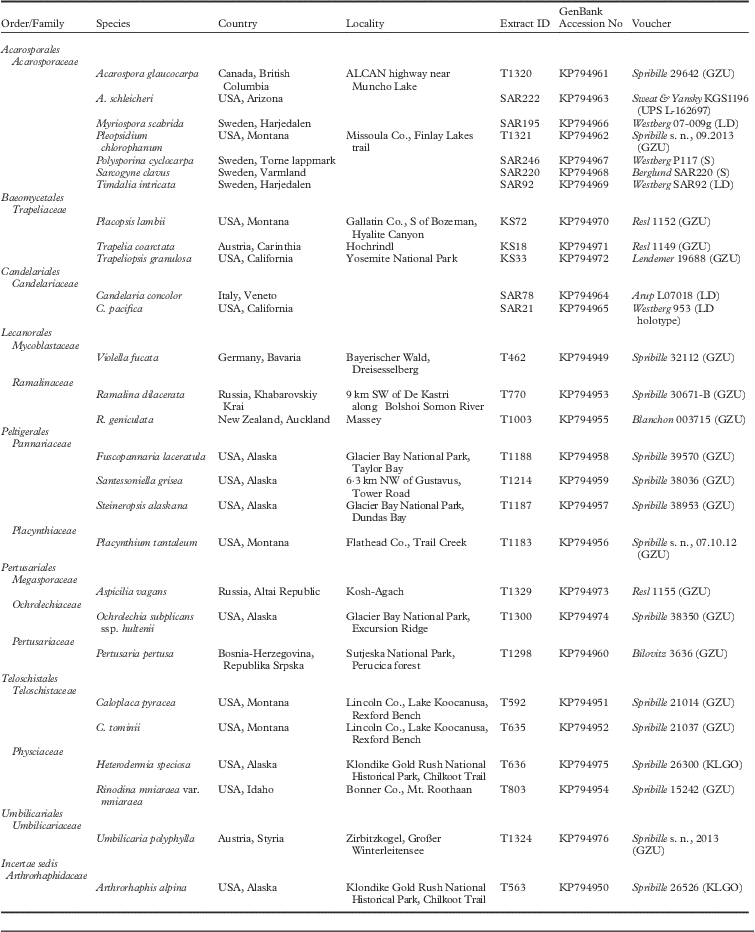
Our results indicate that the newly developed primers LRlecF and LRlecR are not only highly effective in excluding the photobiont partner in lichen symbioses from amplification of large ribosomal subunit DNA, but are also one of the most reliable primer pairs we have worked with for obtaining fungal LSU products across the whole of Lecanoromycetes. To date we have obtained clean fungal LSU products of ~1350–1850 bp length (depending on intron length) from representatives of 24 genera and 14 families in all five recognized subclasses of Lecanoromycetes after Miądlikowska et al. (Reference Miądlikowska, Kauff, Högnabba, Oliver, Molnár, Fraker, Gaya, Hafellner, Hofstetter and Gueidan2014): Lecanoromycetidae, Ostropomycetidae, Umbilicariomycetidae, ‘Candelariomycetidae’ and Acarosporomycetidae (Table 2). The co-amplification of DNA from co-occurring Ascomycota is still possible because of the broad affinity these primers exhibit to the phylum as a whole. The primers, however, exclude Basidiomycota such as Tremella in in silico tests as well as in actual PCRs conducted on co-extractions with Violella fucata.
Voucher information and GenBank accession numbers for LSUs obtained with the newly designed primers. For convenience, KS18 and KS33 were co-deposited with contiguous sequence regions obtained as separate products.
Amplification of algal LSU with common primers is not random in our experience but instead specific to certain lichen genera and over time became predictable, amplifying especially algae of the genus Pseudochlorella and more rarely Trebouxia. We have no reason to believe that the phenomenon reflects anything more than minor homoplasies at primer binding sites in specific strains of Trebouxia. Most Trebouxia strains exhibit up to three substitutions at LR0R binding sites and are probably sufficiently discriminated by common LSU primers in most cases. This likely explains why co-amplification of 26S rDNA from Trebouxia photobionts has not been reported for most groups of lichens. However, co-amplification of algal DNA with standard LSU primers may be a more widespread problem in Pseudochlorella and other members of the Prasiola clade of Trebouxiophyceae, which are widespread in Ostropomycetidae. The primer pair we report here appears to offer a reliable way to obtain long fungal-specific products over a wide range of lichenized Lecanoromycetes, irrespective of photobiont.
We thank Theodora Kopun for helpful advice in the laboratory, Celia Hampton Miller for providing isolates of Ramalina used here, and one anonymous reviewer for valuable comments on the manuscript.