


I. Introduction
With the Government's rhetoric on the Big Society it is now time to review a number of legal doctrines from the perspective of the phenomenon of volunteering. Volunteers contribute significantly to the United Kingdom's GDP, between 2–3% according to the European Union.Footnote 1 As reported by a Department for Communities and Local Government survey, a significant proportion of adults in the United Kingdom volunteer.Footnote 2 A volunteering industry has developed.Footnote 3 The Government as part of its Big Society project has encouraged volunteering organisations to provide services which were traditionally delivered by paid employees of the state or local authorities.Footnote 4 Voluntary organisations also compete amongst themselves, and with commercial concerns for contracts to deliver services on a commercial basis, although the service itself may be delivered by unpaid volunteers. For example, a volunteer staffed Legal Advice Centre may hold a contract with the Legal Services Commission and use paid employees and volunteers working alongside one another to fulfil the contract, or a first aid organisation such as St John Ambulance may contract to provide first aid coverage to a commercial event, but the staff provided will be volunteers.Footnote 5 Volunteers may work alongside paid employees, carrying out the same tasks, receiving the same training, and wearing the same uniform. They may be indistinguishable by members of the public, or consumers of their services, from the paid employees that they work alongside.
Our present approach to vicarious liability has problems in accommodating volunteers, and others in non-economic or non-employment relationships. Whilst these problems presently manifest themselves in the case law dealing with religious ministers and members of religious communities, the problem is of a significantly broader scope.
The rhetoric urging expansion of the voluntary sector, the sector's take-over of public services, and its competition with commercial concerns, should lead to a reconsideration of vicarious liability. A volunteer can be as much a part of a team as a professional. It would be odd if a victim, injured by a volunteer working alongside paid employees and indistinguishable by onlookers to them, is subject to a different legal regime, than if the victim is injured by the volunteer's co-worker within the organisation who happens to be a paid employee. Further, an absence of vicarious liability for volunteers would potentially place the individual volunteer in a detrimental position to his employee colleague, in that vicarious liability can have the practical effect of acting as a protective mechanism for the tortfeasor.Footnote 6
We have allowed our understanding of vicarious liability to become a polarised division between employees with contracts, and independent contractors. This fails to give a rational account of other forms of vicarious liability which have simply become additional pockets of liability in addition to the “main” category. There is presently no overarching doctrine that unites them. It is suggested that the law is mature enough to accept vicarious liability for non-contractual employees. It is further argued that the categories of vicarious liability are not in fact separate categories and can instead be rationalised. A new test of association is proposed. All relationships between two persons can be subjected to analysis along the twin axes of day to day control and discretion in role to determine whether or not their relationship should trigger vicarious liability. This association model accommodates all of the existing forms of vicarious liability and places them into a single category. It also allows the accommodation of new and emerging forms of economic and non-economic occupations. This will include at least some forms of volunteers.
II. Vicarious Liability
Vicarious liability is a system of strict liability through which one entity A is made strictly liable for the torts of another, B, even though A is not at fault. An action may be brought against A or B, or both. The paradigm example of vicarious liability is that of an employer's liability for the torts of their employees committed within the course and scope of their employment. This is not the only example where such liability operates, for example, it also applies in the context of “principal” and “agent”,Footnote 7 and between partners,Footnote 8 amongst others. The categories of vicarious liability are presently increasing. There is no overarching theory which coherently explains the reason for these individual pockets of liability.
Vicarious liability multiplies the number of possible defendants to the claimant's action and thus increases the probability of finding a solvent or insured defendant.Footnote 9 It is not the only way of claiming against A. B's tort may place A in breach of a direct duty of care to the victim of the tort to select,Footnote 10 train, and monitor B, or, A may have a non-delegable duty to the victim, the performance of which A cannot delegate to another,Footnote 11 so that, even if A has selected, trained, and monitored B properly, B's tort will place A in breach of this duty. One example of such a duty is bailment.Footnote 12 These three different routes to establishing liability on A's behalf must be kept distinct.Footnote 13 Whilst they are not mutually exclusive, in some cases only one of the routes will result in a successful action against a defendant. For example in circumstances where A does not owe a non-delegable duty to C, and where A properly selects, trains, and monitors B, and is thus not in breach of a direct duty to C, an action may only be brought against A by invoking vicarious liability.
Accounts of the rationale behind vicarious liability differ. The problem may be that “Vicarious liability is the creation of many judges who have different ideas of its justification or social policy, or no idea at all.”Footnote 14 This problem is also recognised by the judiciary, MacDuff J. recently declaring: “[t]here is no precise unanimity between judges (or between academics) about the rationale; no single accepted truth.”Footnote 15 The main justifications presently advanced by the judges in the case law appear to be loss distribution,Footnote 16 and enterprise liability.Footnote 17 Loss distribution is that “D2 [is] more able to bear the loss than D1, often (although not always) because he can and will in practice insure against it. Where there is such insurance, the cost is often in effect passed on to the buyers or users of the service or goods provided by D2.”Footnote 18 Stevens argues that this cannot be the, or indeed a, rationale for vicarious liability since this does not explain why employers of domestic staff who are not insured may also be vicariously liable, further that this collapses into state liability, since this is the entity which can spread the loss most widely.Footnote 19 Relatedly, loss spreading does not explain why we have vicarious liability instead of other more efficient forms of loss spreading such as taxation funded compensation or social security schemes.Footnote 20
Enterprise liability justifications are based on the idea that with benefits come burdens, he who takes the profit of the enterprise should take the loss. However, this justification for vicarious liability as Stevens points out fails to explain why non-profit making organisations such as the State and charities may be vicariously liable.Footnote 21 Brodie responds that “charities still run risks for the benefit of the organisation”,Footnote 22 and that the criticism only stands “if profit is viewed in a purely financial sense”.Footnote 23
Recognising this, Steele notes that there may be two versions of enterprise risk, one an economic variant, and secondly a moral version.Footnote 24 To justify vicarious liability where a community interest is being fulfilled she states that the response of the moral version is that it would not be fair and just for an individual alone to bear the whole risk created by satisfying the communities' need for activities such as policing, “[t]he costs and risks of essential public services should be spread around.”Footnote 25 This however, is a disguised loss spreading model to which Stevens' criticisms stand. A counterargument to this is that it is not just a loss spreading model, but instead it is an attempt to explain why the loss should be spread. It is a justification for state liability, rather than an exercise that collapses into state liability. If so, the explanation fails to explain at what point loss spreading should cease. In the case of policing it fails to explain why the loss spreading should stop with the Chief Constable or Police Authority for the Area, and not the nation, which can of course spread the loss most widely.
This argument may be seen to conflate two notions of loss spreading, loss spreading as a social outcome, and loss spreading as a legal outcome. It is however, submitted that the distinction between the two is artificial. Loss spreading as a social outcome is where the loss is passed on as a matter of fact to another, for example where a supplier passes on the costs of vicarious liability by requiring its clients to pay increased prices for its products. In such a case the victim of the tort cannot directly sue those who ultimately bear the financial consequences. Loss spreading as a legal outcome is where the loss is spread by making another directly liable in law to the victim for the loss, for example through vicarious liability, or direct actions against insurers.Footnote 26 The victim may sue these others directly. There are two flaws to this approach. Loss spreading justifications for vicarious liability do not rely on loss spreading as a legal outcome, this is since vicarious liability only increases the number of defendants who sustain the loss by one, or by a small number in the case of dual vicarious liability. Loss spreading as a legal outcome thus produces little loss spreading. Instead loss spreading arguments look at the ability of these others to spread loss, as a matter of fact.Footnote 27 Secondly, this distinction in the context of the loss spreading justification for vicarious liability is somewhat artificial, since there are cases in which another can be made liable in law for the loss, although the victim cannot sue these individuals directly. An entity may compel another by force of law to pay for the consequences of vicarious liability, even if that other is not technically made vicariously liable. For example, with the Chief Constable, the vicarious liability stops with the Chief Constable, and not the society which the Police Force serves, however the Police Authority may place a precept on the council tax, effectively compelling local council tax payers to pay for the cost of the vicarious liability, with criminal sanctions for non-payment. Either form of loss spreading social or legal, still does not explain why as a matter of law the vicarious liability buck stops with the Chief Constable.
Further as Steele notesFootnote 28 enterprise liability fails to explain and distinguish between employees and independent contractors,Footnote 29 unless in such cases the contractor can be considered to be in an enterprise of their own, something doubtful in many cases.
Of course, there may be more than one explanation for vicarious liability,Footnote 30 however, care should be taken not to use this an excuse to incorporate flawed explanations, as Stevens pithily puts it: “Justifications for legal rules are not like the ingredients of vegetable soup. We cannot simply add together a number of disparate ingredients and expect to get a satisfactory result.”Footnote 31
Stevens instead relies on the idea of attribution, and uses a football analogy: whose team does D1 play for?Footnote 32 However, this is not just a question of who is a player since whilst players may score goals, the club manager, or physiotherapist could trigger penalties within the league if they invade the pitch and assault the referee. To extend the football analogy, with attribution, if a goal is scored, it matters not if it is scored by professional footballer, or his amateur teammate who wears the same strip and plays for the same team.
This concept of attribution is closely linked with two further justifications for vicarious liability given by Atiyah, that of controlFootnote 33 and group identification.Footnote 34 Whilst control has been criticised as a theory for vicarious liability, it is submitted below that these criticisms are not well founded. It further plays a significant part in the case law in determining who is an employee for the purpose of vicarious liability. Control has two aspects, and the flaw in some of the criticisms of control based explanations is to focus only on one dimension.Footnote 35 This will be developed in the final section of the article.
An employer is not liable for all of the torts committed by its employees. Rather the employer is only liable for those employee torts which are committed within the course and scope of the employee's employment.Footnote 36 There are differences in approaches within the case law as to the applicable test and factors to apply to determine what is within the course and scope of employment. The starting point is now the speech of Lord Steyn in Lister v Hesley Hall,Footnote 37 as developed by Lord Nicholls in Dubai Aluminium Co Ltd v Salaam and Others Footnote 38 as: “the wrongful conduct must be so closely connected with acts the … employee was authorised to do that, for the purpose of the liability of the … employer to third parties, the wrongful conduct may fairly and properly be regarded as done … while acting in the ordinary course of … the employee's employment”.Footnote 39 Whilst the exact nature and scope of the mainstream “close connection” test that determines for which of B's acts, the principal A, is liable for, is uncertain, it is clear that the employers of a Warden of a school boarding house employed to look after children in a residential setting are vicariously liable for his deliberate acts of abuse.Footnote 40
In the case of Maga v The Trustees of the Birmingham Archdiocese of the Roman Catholic Church,Footnote 41 vicarious liability was found for the acts of abuse committed by a Roman Catholic Priest against a child who lived within the parish, but who was, and whose family were unconnected with the Church. The Priest was treated as an employee for the purpose of the appeal.Footnote 42 Partly based on the Supreme Court of Canada's reasoning in Bazley v Curry,Footnote 43Maga introduced a status based risk test.Footnote 44Maga does not answer the question of for whom may you be vicariously liable, but instead it answers the different question of which acts committed by a person whom you may be vicariously liable for, trigger vicariously liability.
The core of Maga is that where you elevate the status of another such that it materially increases the risk of the commission of a tort, you are vicariously liable for that tort, at least where the person whose status is elevated is your employee.Footnote 45 The author has criticised this case elsewhere on a number of grounds.Footnote 46 These criticisms also stand for the subsequent decision of the High Court in JGE v The English Province of Our Lady of Charity and The Trustees of the Portsmouth Roman Catholic Diocesan Trust,Footnote 47 in so far as it relied on Maga and attempts to use status elevation as a mechanism in determining the question, for whom a principal may be vicariously liable.
III. Contract?
It is seen as a basic principle of vicarious liability that whilst one may be vicariously liable for an employee's wrong, one is not vicariously liable for the wrongs of an independent contractor.Footnote 48 In determining whether a person is an employee or an independent contractor it is necessary to examine whether or not these agreements amount to a contract of service (employee), or a contract for services (independent contractor). It is however submitted that there is in fact no need for a contract between A and B, for A to be vicariously liable for B's torts. The present mainstream justification for the requirement for a contract between A and B is based on a subrogation model of vicarious liability, which as set out and dealt with below is incorrect. Nevertheless given the control and attribution approach adopted, the relationship between A and B is important in its effect on A's relationship with the victim C. With a control based model of vicarious liability it is possible to argue that a contract between A and B is required to provide the necessary vinculum iuris for control to be present. This too is a flawed argument, a contract is just one of many ways in which A can exercise control over B, other methods of control exist, for example public or regulatory law, tortious duties, criminal law, and factual control. You do not necessarily need a contract with another for them to “play for your team.” A serviceman does not have a contract with the Crown, yet he may be criminally liable for a failure to obey a lawful order.
There are a number of tests for determining employment for the purposes of vicarious liability. As the Editors of Clerk and LindsellFootnote 49 state there is no one simple test and the modern approach rests on “multiple factor[s]”. Many of the tests used come from other areas of law. These areas have different policies to vicarious liability, for example the policy of who is an employee for the purposes of National Insurance is different to the policy of who is an employee for the purposes of health and safety regulation, which in turn has a different policy to vicarious liability.Footnote 50 With the un-codified area of vicarious liability, whilst employees almost invariably have such contracts of service it is argued that they are not essential.
Neyers advances the view that vicarious liability is explicable only as a matter of contract.Footnote 51 His theory focuses on the employee-employer relationship, rather than the employee-victim, or employer-victim relationships.Footnote 52 He alleges that vicarious liability results from the “employer's implied promise in the contract of employment to indemnify the employee for harms (including legal liability) suffered by the employee in the conduct of the employer's business”.Footnote 53 The tort victim is then “subrogated to the employee's right of indemnity”.Footnote 54 This theory he alleges “explains why the tortfeaser must be an employee – since if the tortfeaser is not an employee he or she will not have a right of indemnity from the person sought to be made vicariously liable”.Footnote 55
Such an approach requires there to be a contractual relationship between the employer and employee. With no contractual relationship there can be no vicarious liability. Supporting this proposition is the fact that it was considered necessary to introduce statutory vicarious liabilityFootnote 56 for police officers, who do not hold ordinary contracts of employment. Neyers' theory however is contradictory to the general thrust of allowing vicarious liability for deliberate torts, including those which are also criminal acts, such as the sexual abuse in Lister. No employer would agree to indemnify an employee for such acts of abuse, and there would be public policy reasons to prevent any such agreement to do so from being enforceable. Whilst Neyers accepts that deliberate torts are a problem with his theory he alleges that all such cases must be instances of personal fault or wrongly decided.Footnote 57
A second criticism of this theory is that vicarious liability is not just restricted to the employer – employee relationship, and further that there are also a number of categories of case in which an employer is vicariously liable for a person who does work for him in a manner similar to an employee but with whom he has not contracted. An example of such is the case of Hawley v Luminar Leisure Ltd.Footnote 58 Here the door attendants did not contract with Luminar, rather they contracted with ASE Security Services Ltd, however, they were employees of Luminar for the purposes of vicarious liability since they were controlled by Luminar's management and integrated into its business. A second example is the case of Viasystems (Tyneside) Ltd v Thermal Transfer (Northern) Ltd Footnote 59 which introduced dual-vicarious liability which rendered two entities vicariously liable for an employee even though one had not contracted with him. A further example is the case of JGE v The English Province of Our Lady of Charity and The Trustees of the Portsmouth Roman Catholic Diocesan Trust where it was held that a Bishop may be vicariously liable for the actions of a Diocesan Priest, even where their relationship was not governed by contract, but was instead governed by Roman Catholic Canon Law.Footnote 60
If vicarious liability were to require a contract it would also prevent it arising for volunteers. An individual may volunteer for a charitable entity such as Oxfam or St John Ambulance, wear their uniform, receive their training, work for them under their direction and control, and be a part of the public face of that organisation, yet have no contract of employment with that entity. It would be odd if the entity could then disclaim vicarious liability for them on that basis. Members of the Armed Forces too, do not hold contracts of employment with the Crown,Footnote 61 instead they serve under terms of service. Nevertheless the Ministry of Defence is regularly held liable for the torts of members of the Armed Forces.Footnote 62 The test for employment is thus more multifaceted in vicarious liability, and there should be no requirement for a contract.
The significance of non-contractual employees and volunteers is that there is no contract in which a term of indemnification can be implied that the non-contractual employee or volunteer will indemnify the employer for the losses sustained in being held vicariously liable for their wrongs. This is, however, not a problem given that vicarious liability applies in other contexts in which no contract exists in which such a term can be implied, the industry practice in not enforcing such provisions, and the fact that the “employee” indemnification approach is itself incorrect.Footnote 63
As argued above vicarious liability is not founded on contract, rather control and attribution. This means that one need not have a contract for vicarious liability to be present, provided an individual plays for your team. Both employees and volunteers may play for the same team, and be indistinguishable to outsiders. Given the industry practice in not enforcing employee indemnification where an employer has been held vicariously liable,Footnote 64 vicarious liability has developed into a protective mechanism for employee tortfeasors. This is since claimants bring their actions against the employer (since they are often a richer and insured entity) instead of the employee, thus in practical terms protecting the employee's assets from being used to satisfy any judgment in favour of the claimant.Footnote 65 To deny this protection to a teammate that discharges the same function, in the same way, as his paid colleagues, on the basis that he is not paid, and does not have a contract, seems odd. With the expansion of the voluntary sector, the development of a volunteering industry which provides services traditionally provided by paid employees of the state or local authorities, and the competition between the voluntary sector and commercial concerns, to impose this litigation risk on the individual volunteer instead of the volunteering organisation, the controlling enterprise, seems to unduly penalise the volunteer over his employee counterpart. This would also favour volunteering organisations over commercial concerns when they compete for business, albeit at the expense of the unpaid volunteer.
IV. Broadening of Vicarious Liability
In recent years there has been significant broadening of the concept of vicarious liability, and the categories of vicarious liability, both extending a previous category and creating new ones. Most of these however appear to be additional pockets of liability, and are not rationalised together with liability for employees.
A. Agency
Vicarious liability is not limited to the case of employer and employee, it may also apply in the context of principal and agent. In this context the word agent may be confusing.Footnote 66 This is since generally when one is liable for one's agent the liability is primary not vicarious.Footnote 67 However, in the context of vicarious liability agent is not used to connote agency in the sense meant by commercial lawyers, but rather a different concept. Bowstead and Reynolds consider that such cases are in fact not linked to agency.Footnote 68 In Launchbury v Morgans Footnote 69 Lord Wilberforce accepted “that ‘agency’ in contexts such as these is merely a concept, the meaning and purpose of which is to say ‘is vicariously liable,’ and that either expression reflects a judgment of value”.Footnote 70
The language of principal and agent in the context of vicarious liability is typically found in the cases where one individual who has lent a motor vehicle to another has been held vicariously liable for that other's wrong.Footnote 71 In such cases one may be liable for one's “agent” who is not an employee. The “agent” need not have a contract with the liable party.
Debates exist as to the nature of this liability. The Editors of Clerk and Lindsell allege that this form of vicarious liability for an “agent” is a sui generis form of liability,Footnote 72 and for cases other than fraud the category “agent” in vicarious liability has no relevance.Footnote 73 Giliker too argues that agency is distinct from vicarious liability,Footnote 74 and is critical of a resort to it. She acknowledges that two types of claim persist in this area, that of fraudulent mis-statements and lending of a car.Footnote 75 The policy behind its use in a motoring context appears to be based on reaching an insured defendant. The need for this is now significantly less pressing given compulsory insurance and the Motor Insurance Bureau for uninsured drivers.Footnote 76
Nevertheless cases do exist outside of the motoring and fraud contexts in which a principal has been held vicariously liable for the tort of their agent, even where the tort is not one of fraud, and where the agent is not an agent in the contractual sense. An example is the case of the League Against Cruel Sports Ltd v Scott and Others Footnote 77 which held that a master of hounds was vicariously liable for trespasses committed by mounted hunt subscribers (followers) over whom he exercised control, in addition to the hunt servants.Footnote 78 However, a hunt master is not vicariously liable for the hunt followers and supporters who follow on foot, in cars, and on motorbikes, over which the master has significantly less control. Whilst the League Against Cruel Sports may be a controversial case, further examples of this concept of agency are to be found in cases dealing with trade union officials or shop stewards,Footnote 79 and also the case of “Thelma” (Owners) v University College School Footnote 80 where School Governors were held vicariously liable for the negligent act of a pupil who was acting as the Cox of the School VIII.Footnote 81 Another such application outside of these contexts is Moores v Bude-Stratton Town Council.Footnote 82 In this case a Councillor was abusive to a Council employee. The Councillor was not an employee or officer of the council, nor a person to whom any of the Council's relevant powers had been delegated. Whilst the Employment Appeal Tribunal was divided, the majority held that the Council were vicariously liable for the Councillor's acts.Footnote 83 In S v Walsall MBC Footnote 84 which deals with foster parents, the case was argued as one of principal and agent in a vicarious liability context, and no objection was taken to this that vicarious liability could not apply to principals and agents in the non-technical sense, rather the question was instead whether foster parents were agents.Footnote 85
Nevertheless, it is difficult to find an overarching concept of vicarious liability for agents, but the categories are not as closed as Clerk and Lindsell otherwise suggest. One starts to agree with Rogers that the operation of vicarious liability in the context of principal and agent rests on “ad hoc judgment[s] that for one reason or another the principal ought to pay”.Footnote 86 If so, if one is to follow a traditional analysis, care is needed so as not to remove the divide between employers and independent contractors. Broader use of agency within a vicarious liability context is made within other common law jurisdictions, and this route was used to establish vicarious liability for foster carers in New Zealand.Footnote 87
Nevertheless this resort to the concept of agency is uncertain and unpredictable. Agency seems a conclusion rather than a characteristic which triggers vicarious liability. Whilst agency is available as a mechanism to deal with some unusual cases it should not become the norm. Giliker argues that vicarious liability for agents was used to extend vicarious liability to those who work gratuitously for a defendant.Footnote 88 It is submitted that courts are masking their dislike of the binary test of employee/independent contractor, which is becoming increasingly unsuitable in the modern workforce,Footnote 89 through recourse to this notion of agency. There is less need to resort to agency if we acknowledge that one can be a non-contractual employee (either where one has a contract with another, one's relationship is governed by a regulatory regime, or one is a volunteer). The concept of non-contractual employee would also provide a neat solution to the situation where a relationship is governed by a non-contractual religious vow governed by Canon Law, such as the position of a member of a monastic community, where the control by the Abbot over a monk may be far greater than any employer. But there will still be cases in which policy requires vicarious liability to be present, even if by strict application of the binary divide of employee/independent contractor, (even including non-contractual employees), it should not be present, as in the case of the League Against Cruel Sports. An account of vicarious liability is required which will accommodate both these and the cases which we have called non-contractual employees. Such an account is set out below.
V. Other Emerging Categories of Vicarious Liability
Recently, new categories of vicarious liability have been emerging, and developing in a piecemeal and ad hoc fashion. There has been no attempt to give an account of them which also incorporates the traditional areas of vicarious liability. It is submitted that they are a manifestation of the increasing unsuitability of a model of vicarious liability founded on traditional notions of employment. In so far as they show the inadequacies of the present approach to vicarious liability, and the need for the approach to match the needs of today, a broader account of vicarious liability is required. Our account of vicarious liability needs to be able to accommodate these.
A. Employer +
The first new category of liability can be termed employer +, this is where A, the employer of B may be vicariously liable for B's tort, and additionally, a second principal C may also be simultaneously vicariously liable for B's tort even though C does not have a contract with B. In Viasystems Footnote 90 work was carried out by a fitter and a fitter's mate, supplied to the second defendants by the third defendants on a labour-only basis, under the supervision of a fitter working for the second defendants. The fitter's mate was negligent. The Court of Appeal held that, both the second and third defendants were vicariously liable for the negligent act.
May L.J. stated one should concentrate on the relevant negligent act and whose responsibility it was to prevent it. There could be more than one person responsible and thus may be more than one “employer”. This is a control analysis. That this is a control analysis is reinforced by May L.J.'s useFootnote 91 of the dicta of Denning L.J. in Denham v Midland Employers' Mutual Assurance Ltd:Footnote 92 “if a temporary employer has the right to control the manner in which a labourer does his work, … then he should be responsible when he does it in the wrong way as well as in the right way. The right of control carries with it the burden of responsibility”. May L.J. also stressed that the critical relationship for vicarious liability to be present is “the employers' right (and theoretical obligation) to control the relevant activity of the employee”.Footnote 93 The language of a second employer, is a fiction, and is simply shorthand for the position where the second entity is vicariously liable for the individual. Rix L.J.,Footnote 94 however, doubted that the doctrine of vicarious liability should depend solely on the question of control and suggested a broader test of “whether or not the employee in question is so much part of the work, business or organisation of both employers that it is just to make both employers answer”.
In Luminar Hallett L.J. noted the distinction between the two approaches and considered that the question of control is at the heart of dual vicarious liability.Footnote 95 This is further supported by Biffa Waste Services Ltd and another v Maschinenfabrik Ernst Hese GmbH and others,Footnote 96 which supports a control analysis. In Biffa supervision is distinguished from control.Footnote 97 The extra element that makes C liable is control.
The existence of a form of liability founded on control and a fictional deeming of a second employer based on their control of B would suggest that it is not too great a leap to establish a form of vicarious liability based on control alone. It is submitted that the law has now established such liability. If control is sufficient to establish the additional vicarious liability of C, it should be enough to establish vicarious liability even if there is no other entity to which C's vicarious liability may be dual or additional. Luminar as a case in which dual vicarious liability was held not to be present supports this. The door attendant in Luminar did not contract with Luminar, rather he contracted with ASE Security Services Ltd, however, he was an employee of Luminar for the purposes of vicarious liability since he was controlled by Luminar's management and integrated into its business. Luminar had no contract with him. They did not pay him. Yet they were vicariously liable for him. The employer with whom he had a contract, and who paid him, ASE Security Services Ltd, on the other hand, were not vicariously liable for him – they did not exercise the requisite control. Whilst the language of transfer of employment is often used, this is a fiction, there is no transfer of contract.Footnote 98 One entity is made vicariously liable for another simply on the basis of control, and (possibly) integration. The application of this to volunteers and volunteering organisations is obvious. It should make no difference that there is another entity with whom that individual does have a contract with who does not exercise any control. Luminar also shows the centrality of control, an employer who pays you, and with whom you have a contract of employment ceases to be vicariously liable for you if they cease to have control over you.
B. Unincorporated Associations
In Various Claimants v Institute of the Brothers of the Christian Schools Footnote 99 the Claimants alleged abuse by staff at their former school.Footnote 100 For the relevant period the School was run by a board of managers. Some, but not all, of the School's teachers were supplied by the Institute of the Brothers of the Christian Schools,Footnote 101 an unincorporated association. The question was whether the Institute, in addition to the School Management, were liable for the acts of abuse committed by the Brothers who were employed by the Managers.Footnote 102 In addition, at least one volunteer helper was alleged to have been an abuser,Footnote 103 however, the Court of Appeal did not address the issue of vicarious liability for volunteers.
The Institute is a ‘lay community of teachers’, who swear lifelong vows of poverty, chastity, and obedience, live under a strict rule of conduct and wear habits.Footnote 104 Members are addressed as ‘Brother’. A brother is a ‘lay’ religious and cannot be ordained as a priest, since the “reason for his ministry is not to preside at liturgical services or to administer the sacraments, but to educate his students as Christians in secular subjects as well as in religion”.Footnote 105 They live in communities and evangelise through teaching. They are a ‘lay’ rather than a monastic order since they are subject to the authority of the Diocesan Bishop.Footnote 106 Whilst the issue of vicarious liability was in the context of dual vicarious liability it did not turn on this issue and the Court of Appeal examined the question of vicarious liability for members of unincorporated associations generally.
The Institute was held not to be vicariously liable for the Brothers' acts of abuse. Hughes L.J.,Footnote 107 held that vicarious liability could apply to unincorporated associations,Footnote 108 but treated the position differently to employment, appearing to propose that the test for establishing sufficient connection to the tort is different. This is an additional form of vicarious liability, although Hughes L.J. did not consider it to be a new one.Footnote 109 Pill L.J. held that the case did not turn on the Institute's unincorporated association status,Footnote 110 as it is a hierarchical tight-knit organisation with a mission, and thus a Court should not be deterred from finding vicarious liability by qualms about finding members responsible for the conduct of another member. He correctly noted thatFootnote 111 the Institute is distinguishable from a professional or educational organisation.Footnote 112 Nevertheless the claim to vicarious liability failed upon an analysis of the responsibility for managing the School.Footnote 113 The School was run by a Board of Managers, not the Institute. The Institute had not undertaken the role of managing the School,Footnote 114 and did not manage the School.Footnote 115 The Institute did not exercise effective control over a Brother's conduct of his teaching job,Footnote 116 instead a Brother's teaching was subject to the control of the Board of Managers.Footnote 117 It was the Board of Managers, the employers of the Brother Teachers, who managed the School, who were vicariously liable for them.Footnote 118
In examining the connection of the tort to the relationship, Hughes L.J., noted that the position of an agentFootnote 119 is not the same as an employee,Footnote 120 and that the relationships should be treated differently: “They are clearly not all treated the same. They do not all create the same connection between the tort of D1 and his relationship with D2”.Footnote 121 He evoked the close connection test in Lister, nevertheless he did not reach the outcome which an application of the Lister close connection test would reach in the circumstances. This was recognised by Pill L.J., who considered that if vicarious liability were to be established, applying Lister it would extend to the alleged acts of abuse.Footnote 122 Instead Hughes L.J., with whom Tomlinson L.J. agreed,Footnote 123 as shown by his conclusion that there was no close connection, used a narrower test, although he did not fully elucidate it. He considered that “the risk must be inherent in a business or operation carried on by D2, entrusted by him to D1”.Footnote 124 He considered there was no entrustment to the Brother Teachers by the other members of the Institute, and even if there was they did not have the “required interest” to “create the necessary close connection”.Footnote 125
Whilst the case was decided in the context of institutional abuse, vicarious liability within unincorporated associations obviously extends beyond this area. It is the category of vicarious liability that you would wish to examine if during a village cricket match a club member of a visiting team negligently hits a six into a playground and injures a child. This form of vicarious liability seems to be founded on control and interest in the activity,Footnote 126 which in turn relates to the issue of attribution. The test for sufficient connection, whilst only loosely elucidated, would appear to be different from the close connection test adopted within the employer/employee context.
The recognition of vicarious liability in the context of unincorporated associations is significant. Within English law the notion of an unincorporated association is very broad. Unincorporated associations do not have legal personality.Footnote 127 They may encompass large complex and disciplined organisations, such as the Institute, to informal and temporary groups that have come “together for temporary and specific purposes with little or nothing by way of formally-agreed rules”.Footnote 128 According to Hughes L.J. in R v L Footnote 129: “the legal description “unincorporated association” applies equally to any collection of individuals linked by agreement into a group. Some may be solid and permanent; others may be fleeting, and/or without assets. A village football team, with no constitution and a casual fluctuating membership, meeting on a Saturday morning on a rented pitch, is an unincorporated association”.
Lawton L.J. in Conservative and Unionist Central Office v Burrell Footnote 130 stated that an unincorporated association is “two or more persons bound together for one or more common purposes, not being business purposes, by mutual undertakings, each having mutual duties and obligations, in an organisation which has rules which identify in whom control of it and its funds rests and upon what terms and which can be joined or left at will”. For there to be an unincorporated association there is a need for a contract between each and every member.Footnote 131 However, such contracts are easily found, and if an “implicit but sufficiently clear understanding is reached by two or more people, there is a contract forming an unincorporated association”.Footnote 132
Various Claimants turned on issue of control, who had power to control the Brothers in their teaching role, whilst the Institute no doubt had significant control over the Brothers' day to day lives and conduct, it did not control the Brothers in their teaching role, instead, the Board of Managers did. It would appear that both the employer + category of vicarious liability, and the category present in Various Claimants can collapse into a single category based on control and interest in the activity, this leading to attribution, whose team are they playing for?
Whilst the requirement for a contract for there to be an unincorporated association would suggest that the category of vicarious liability for unincorporated associations cannot be joined with the employer + category, this is to fall into a trap. Although such contracts are readily found, for vicarious liability to be present what is required by Various Claimants is control and interest, membership alone is not enough. With the unincorporated association category the control is provided by, and the interest demonstrated via, the contract, however, in vicarious liability control may be present via other means such as criminal law, public or regulatory law, tortious duties and factual control. The unincorporated association category is simply an illustration of that concept. That such categories can collapse into a single category is supported by the Luminar decision.
C. Elevation of Status?
The core of Maga Footnote 133 is that where you elevate the status of another such that it materially increases the risk of the commission of a tort, you are vicariously liable for that tort, at least where the person whose status is elevated is your employee.Footnote 134 Is there also a category of vicarious liability whereby A who confers office upon B, or elevatesFootnote 135 a particular individual B to a position of authority and grants them status over another (C), may be vicariously liable for B's torts by mere fact of the conferral of or elevation of status alone, even when B is not treated as A's employee? Such a category would have obvious application in the case of foster carers, or religious ministers. This idea of status is broader than the conferral of powers of control over the victim, for example a religious minister, such as the priest in Maga may occupy a position of authority and has status conferred upon him through ordination, but that minister will not necessarily have any power of control, even over his own congregation, or those unconnected with his religion or religious denomination.
Leaving aside the criticisms made of a status elevation approach by the author in an earlier piece,Footnote 136 status elevation or status conferral by themselves cannot be enough to trigger potential vicarious liability. More must be required. A change in status may enhance the risk of the commission of a tort, and therefore play a role, but risk enhancement by itself is also not a justification for vicarious liability. Even if status elevation has been used within existing categories of vicarious liability in establishing close connection, it cannot establish new categories of vicarious liability by itself. This is so even if the elevation is to a high status, such as that of a Peer; in such a case the Crown cannot be vicariously liable for the acts of the newly ennobled who utilise their newfound status to defraud others. A response to this is that ennoblement confers status, but not authority, over others, and it is the status derived authority that is the core of the elevating status approach. For example, a University may confer degree awarding powers on a private college, this confers a status on that college which it did not previously have. However, it does not grant authority to the college over the students of that college. Any authority the private college has over its students stems from its contractual arrangements with those students. Although the conferral of status may have facilitated that authority in that the students may not have contracted with the private college if it did not have degree awarding powers, the authority is not directly derived from that status. This objection is still unsound, with the case of adoption, where a person is elevated to the ultimate position of authority over another, that of parent to a child, the state cannot be subject to vicarious liability for the acts of the adoptive parent post adoption despite the state's role in the adoption process. Simply placing B in a position where they may have authority or control over another is not enough, there should be no vicarious liability without control or attribution (of or over B) being present.
Whilst the point of whether or not there could be vicarious liability for a Priest was not taken in Maga, it was in JGE and in the decision of the Supreme Court of Canada in Doe v Bennett.Footnote 137 With a religious minister such as the Priest in Maga or JGE, control and attribution may be present. It is these, rather than the status alone which mean that the Roman Catholic Church should be vicariously liable for a Priest's torts provided there is a sufficient connecting factor to the tort. The decision of the High Court in JGE to the extent that it can be interpreted to suggest otherwise is incorrect. Reliance on status based risk enhancement/creation to establish a category of vicarious liability is unwelcome.Footnote 138
D. Close Connection
Recently an alternative category of vicarious liability has been suggested based on close connection. If there is a sufficiently close connection between A and B, A may be vicariously liable for B. This is a relationship close connection test. Confusingly the same language is used in this relationship close connection test as the close connection test which is used to determine whether or not the tort was sufficiently connected to the relationship.
The relationship close connection test stems from the Supreme Court of Canada's decision in Doe v Bennett. This case concerned the question of whether or not a Roman Catholic Episcopal Corporation could be vicariously liable for the torts of a Roman Catholic Priest of the Diocese. The significance of this case is not the fact that it addresses the question of vicarious liability for a religious minister, but rather that it successfully invoked vicarious liability for a non-employee. In doing so Doe proposed a test of broad application to distinguish between those for whom vicarious liability should be present, and those for whom it should not.
Whether or not Roman Catholic Priests are employees does not affect the potential value of the close connection approach proposed in these cases, given that these tests will be applicable to those who are clearly not employees, such as unpaid volunteers, or those to whom other categories of vicarious liability have been applied so far. Whilst recent case law on the employment status of religious ministers has accepted employee status for certain purposes,Footnote 139 these cases deal with other denominations with very different systems of regulation and canon law to the Roman Catholic Church, and the Court of Appeal in JGE held that Roman Catholic Priests were not employees.Footnote 140
In Doe, McLachlin C.J., giving the judgment of the court, considered that there were two elements to vicarious liability, “[f]irst, the relationship between the tortfeasor and the person against whom liability is sought must be sufficiently close. Second, the wrongful act must be sufficiently connected to the conduct authorized by the employer.”Footnote 141 This is a model of vicarious liability based not on employment, but instead predicated on the proximity of the relationship between two parties. Its applicability to volunteers is clear. For the Supreme Court of Canada the determination of the sufficiency of closeness of the relationship, is strongly influence by control: “[a]t the heart of the inquiry lies the question of power and control by the employer”.Footnote 142 The Supreme Court of Canada held that the relationship between priest and bishop was sufficiently close for vicarious liability to be present, since a bishop exercises significant control over a priest.Footnote 143 Whilst the invocation of control in Doe is theoretically sound, the flaw in Doe it that it is a model based on a single dimensional idea of control, that is too simplistic and would lead to odd conclusions (see below).
This use of the language of close connection to establish whether or not a relationship between parties is sufficient for it to trigger vicarious liability was used in an English context in the first instance decision in JGE. JGE was the first case in which an English Court was specifically asked the question of whether a Diocesan Bishop of the Roman Catholic Church can be vicariously liable for the acts of a priest within the diocese. In other English cases this point has been assumed or conceded.Footnote 144 Both the High Court and Court of Appeal concluded that the relationship was sufficient to trigger vicarious liability, only the High Court relied on a close connection test. An efficient shortcut to the conclusion existed through the notion of vicarious liability within unincorporated associations, however, this form of vicarious liability was not discussed.Footnote 145
The High Court in JGE however, despite utilising the language of close connection, and citing McLachlin C.J.'s, two stages, ignored the Supreme Court of Canada's approach to control as being a key part of the determination of close connection. The motivation behind this appears to be the different findings of fact at first instance in JGE compared to Doe on the evidence of canon law as to the question of the control that a bishop exercises over a priest. The test proposed at first instance in JGE, whilst using the same language, is more fluid, indeed, MacDuff J. recognised the possibility for uncertainty, admitting that the close connection test is easier to recognise than defineFootnote 146 and stated that: “[t]he court will look carefully at the full nature of the relationship. All the surrounding facts and circumstances are to be considered. These will include many of the matters which are of relevance also at stage two”.Footnote 147 Again, the significance of this case in the context of this article, is not that it concerns priests, or its conclusion on that issue, but rather the alternative category of vicarious liability that it proposes.
MacDuff J's close connection test in JGE may be seen as attempt to introduce a new, more encompassing form of vicarious liability to English law. Despite invoking Doe and the same language, this close connection test, is a different test to that in Doe. Its applicability to volunteers, however, is also clear. Whilst not expressly stated,Footnote 148 that this was intended as a new overarching category of vicarious liability, this is clear from the conclusion that a relationship of employer/employee would meet this first test, but other relationships would also be sufficient, including Bishop/Priest.Footnote 149 An overarching category of vicarious liability is welcome, the current un-rationalised pockets of liability that currently exist lead to artificialities and anomalies. However, a shift away from control, given its centrality to vicarious liability is unwelcome.
Unfortunately, in so far as either version of the relationship close connection test were an attempt to create an overarching category of vicarious liability they were both flawed. Firstly, with such an approach the same factual material may need to be examined twice, firstly in establishing the close connection between the persons, and secondly to establish the close connection between the tort and the relationship.Footnote 150 Thus in some cases if the first stage is fulfilled, the second stage which determines the connection to the tort may be a formality, in that the question and test will not be sufficiently different.
Secondly, whilst an attempt at rationalising vicarious liability is welcome, close connection is not the appropriate way in which to do so. Close connection as a test in this context (in either form) is too broad. Simply assessing the association between two individuals would lead to vicarious liability of parents for the acts of their children, something which is not accepted in English law.Footnote 151 That this test is too broad is implicitly admitted in MacDuff J.'s comments in JGE: “to assist the performance of the role”,Footnote 152 and further through his use of the language of just and fair,Footnote 153 as a control mechanism for vicarious liability which is reminiscent of fair, just, and reasonable, the language used to control direct duties and to determine whether or not they exist in a given context. It is therefore with some relief that the Court of Appeal accepted the author's criticisms of the close connection test in JGE Footnote 154 (including the parent/child example)Footnote 155 and refused to endorse such a test.
Although the model of close connection in Doe is preferable to that at first instance in JGE since it correctly incorporates the centrality of control to vicarious liability. The flaw with either model of relationship close connection test is that vicarious liability does not look at the strength of association between two individuals. Instead it looks at the strength of association between two individuals in the context of a purposeful activity assigned by one (A) to the other (B) (or assigned by and to one another, such as in some unincorporated associations), for the benefit of A, or in order to achieve A's objectives.Footnote 156 This is the reason why a parent is not vicariously liable for their child. The child has no assigned purposeful activity, unless it is assigned a task by another, which must be for that other's benefit or to achieve that other's objectives. Of course, there will be some circumstances of parental vicarious liability, where a parent has employed their own child, but vicarious liability does not stem from the parental relationship alone, or their status. This is further dealt with below. An alternative rational account of vicarious liability is proposed later in this article, with a different overarching category.
E. Akin to Employment
In holding a Bishop vicariously liable for a Priest the majority of the Court of Appeal in JGE stepped away from the close connection test used by the High Court and utilised a new category of vicarious liability, that of “akin to employment”. This new category does not require a contract of service,Footnote 157 and applies to where the relationship “is so close in character to one of employer/employee that it is just and fair to hold the employer vicariously liable”.Footnote 158
This is an incremental response, which will catch what the author has termed non-contractual employees. Its parameters are not yet hammered out. It may be open to criticism in that in operating this test Ward L.J. overstressed the economic element required for vicarious liability.Footnote 159 With some volunteers there may be no remuneration or financial benefits. The test also does not encompass some forms of vicarious liability based on agency and within some unincorporated associations. However, this criticism is unfair since unlike the close connection test this test does not attempt to encompass all forms of vicarious liability, and is not an overarching category of vicarious liability. There will still be cases in which policy requires vicarious liability to be present, even if by strict application of the binary divide of employee/independent contractor, (even including non-contractual employees, or relationships akin to employment), it should not be present.
VI. Alternatives to Vicarious Liability
Non-delegable duties are often resorted to and adopted as a response to perceived inadequacies in vicarious liability.Footnote 160 It is being increasingly utilised to “plug the gaps left by … vicarious liability” particularly given that formal employee-employer relationships are “dwindling”.Footnote 161
Lister suggests that there may be such a duty in a child care context.Footnote 162 Such a duty would however depend on the wording of the relevant statute or statutory instrument.Footnote 163 Non-delegable duties are easy to invent. Indeed, Glanville Williams described them as a “logical fraud”.Footnote 164 One cannot simply manufacture non-delegable duties for cases where liability for volunteers or other non-employees is desired, this would make liability for volunteers or non-employees more onerous than for employees, in that with non-delegable duties there is no need for a close connection to the tort for liability to be triggered.
Direct duties too are not the solution. To take an example, St John Ambulance may select a volunteer, train them, and assess them to ensure that they meet industry standards. That individual might also be a professional health care worker in their non-voluntary employment. Whilst the organisation owes a duty of care to the victim to properly select, train, and monitor the volunteer, to breach this duty fault is required. Where proper selection, training, and monitoring has occurred, if such a volunteer whilst on duty with St John Ambulance then attempts to use Reiki to deal with a heart attack, this causing harm, there will be no direct claim on St John Ambulance since it is not in breach of a direct duty to the heart attack victim as it is not at fault. If however an NHS ambulance paramedic responded to the incident, the NHS likewise owes a duty of care to the victim to properly select, train, and monitor its paramedics. Where the NHS has carried out proper selection, training, and monitoring, but the paramedic attempted to treat in the same negligent way, causing harm, there would also be no direct action against the health authority, since it is not at fault. However, in the latter case vicarious liability would be present as the paramedic is an employee. Likewise if St John Ambulance were utilising an employed staff member, instead of a volunteer, there would be vicarious liability.
VII. A Rational Account?
In examining the question of whether vicarious liability is present for a volunteer or for a non-employee there is presently a need to examine a number of different categories of vicarious liability, some of which overlap. The present system produces presently unlinked pockets of vicarious liability, in doing so it accepts vicarious liability for some individuals who do not have contracts of employment such as members of the Armed Forces and some office holders. Nevertheless, it fails to account for volunteers, of which there are many types from employees in all but name on the one hand, to occasional Church flower arrangers on the other.
The problem is that vicarious liability is not properly rationalised. Rather than accept that pockets of liability exist outside of the normal contractual employee -employer category which may render a principal vicariously liable for another who they would not be liable for under the traditional divide, there has been a tendency to ignore them, or to declare them anomalous, whereas they are a natural release of steam caused by the inadequacies of the present approach to who is an employee for the purposes of vicarious liability. We tend to think of employer and employee, and employer and independent contractors as a binary divide. We forget that these divides are largely labels which we use to describe the outcome, of vicarious liability, or no vicarious liability. There are of course a range of relationships which are analogous to, but are not quite, employment, just as there are ranges in types of employment.
A better approach, linked to the idea of control and attribution is to think of vicarious liability as being a two axes scale, which assesses association. The position of a person on this scale indicates whether or not they are part of the principal's team so as to trigger vicarious liability for them. This approach does not require there to be any contract, and volunteers can be plotted onto the scale. A volunteer can be as much part of the team as a professional.
Along the X axis is day to day control. This aspect of control covers all day to day aspects of a person's role excluding the method of working. This axis ranges from the lowest level of control to the highest. Factors to determine the level of day to day control would cover, a range of matters including for example dictation of working hours and location, dress codes and uniforms, disciplinary systems, and whether or not they may have a lunch break, amongst many others. This ranges from a level of control from a highly regimented system where day to day control exists over persons even when they are off duty and where criminal penalties may be imposed for a failure to follow lawful orders (such as in the Armed Forces) or to act (such as within the Police Service), to a level of day to day control where the only control the principal has over the person is the power to exclude them from their premises, for instance a volunteer who cleans the Church hall after hours. This need not be control in law though, but rather control in fact, since in a highly regimented religious community such as a monastery there may be no “legal” control by the leader of a religious community such as an Abbot over the individual monk since English law may not recognise the canon law under which the monk made his vow of obedience, whereas in fact the Abbot's control over the monk would typically exceed most employers' control over their employees. With what we currently label independent contractors the principal is likely to have significantly less day to day control than over what we currently label employees, this will however, not always be the case.
The second axis is labelled discretion in role. This covers how the person carries out the role, and the level of direction they receive. At one end of the scale the individual has little discretion in how to carry out the role, they must follow the direction and instructions of their principal as to the exact process they must use. At the other end of the scale is complete discretion, provided the person achieves the required end result it matters not which method they used to get there. This is a better approach than simply examining whether someone is an employee or independent contractor. The volunteer cleaner of the Church hall may be able to clean it using whatever method and equipment they like, however, an unpaid volunteer for St John Ambulance must follow certain processes, and may not for instance use Reiki to treat a suspected heart attack.
Using these two axes a person can be plotted on to the chart. Their position on the chart determines whether or not the principal is vicariously liable for them, whether or not they play for the principal's team, or are one of the support staff sufficiently connected to trigger vicarious liability. This method therefore includes those who do not have contracts of employment such as members of the Armed Forces, office holders, religious ministers and members of religious communities, volunteers, agents, hunt followers, and requires no stretching or the development of new categories. This approach would explain for instance why mounted subscribers for a hunt trigger vicarious liability on the part of the master of a hunt, but not the followers in cars. 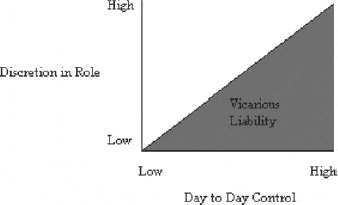
What the diagram demonstrates is that for vicarious liability to be present, as the level of discretion in role increases, more day to day control is required to compensate for this higher level of discretion. For vicarious liability to be present where the level of discretion in role is at its highest, day to day control must be at an extremely high level.
Such an approach will make little difference for many of those over which vicarious liability is presently acknowledged to exist in so far as those currently considered employees are concerned, or those currently considered independent contractors, however, it will make a difference for some. This use of a two axes approach to the elements of control also ensures that vicarious liability does not result for parents for their children, since one axis is discretion in the role.Footnote 165 The singular approach to what are presently seen as different forms of vicarious liability does appear to indicate that the same test of connection of the person's role to the tort is used for all cases, however, this need not be the case and the close connection test, which assesses the links between the relationship and the tort, can operate more strongly or weakly depending on where the relationship falls on the chart.Footnote 166
Of course, there will be some circumstances of parental vicarious liability, but in these cases vicarious liability does not stem from the parental relationship alone, or their status. An example of where such vicarious liability is present is where a child is employed in the parents' family business. For the vicarious liability axis test to be triggered, a parent must assign the child an activity that has a purpose beneficial to the parent or which achieves the parent's objectives; the parent's objectives for the child (the actor), are not enough. Thus ordering the child to do its homework is not enough. Once such an assignment of a role has taken place, just like any relationship where someone is carrying out a role for another it becomes subject to the two axis test.
Thus where a child carries out work for the family business, there will be vicarious liability in some cases, but not in others which are more in the nature of what is currently termed an independent contractor relationship.
An example of where there would be no vicarious liability in most cases is where a parent orders their child to wash the parent's car. Just as if they get anyone else to wash their car for them, such as a scout carrying out work for “bob-a-job” week, the relationship becomes subject to the axis test. However, in both cases there would be no vicarious liability (the relationship is more in the nature of an independent contractor), they are not playing for the parent's team, and their discretion in role is high, even if the parent provides the relevant equipment. Supervision, as noted in Biffa, is not control. There is however a difference between the unrelated scout and the parent's child, in the context of the level of day to day control. However, vicarious liability is not present apart from the most extreme cases of when the parent directs exactly how the child is to carry out the job for them, so as to remove most of their discretion, and disciplines the child when they deviate from this; however, vicarious liability would be present for anyone working under such a strict regime, whether they were the parent's child or not.
Control analysis is often discredited using the example of the hospital surgeon or ship's master.Footnote 167 The argument is that the hospital cannot direct the surgeon as to exactly how to carry out the operation, it itself lacks that skill. This is however artificial. There is nothing preventing a hospital or health service from laying down exactly how its employees must work, and the procedures they must follow, or for a shipping company to direct how its masters must navigate and the techniques they must use.Footnote 168 With an independent contractor, this right is not present. A shipping company cannot tell the harbour pilot how to conduct his pilotage when in their vessel.Footnote 169 A second criticism which has been given of control analysis is that it would result in superior employees being vicariously liable for subordinate employees.Footnote 170 This however does not follow. A company may employ two employees, one of which it makes the manager of the other. The power and control a manager has over an inferior employee does not result from the manager's relationship with the employee, but rather the employee's relationship with their shared employer. Any power or control that the manager exercises is power delegated to it by the controlling body, the company. For our twin axes approach delegated control is not a relevant form of control, we are instead interested in the control that exists due to an individual's direct relationship with another.
The twin axes approach gives a coherent account of all forms of vicarious liability. The place on the chart will determine the question of liability. The chart however is not an exact science with arbitrary measurements, instead the positions are relative, and there will of course be some cases which are difficult to place. The greatest difficulties as with the present law will be at the boundaries. It however produces a single rational scheme for vicarious liability.Footnote 171 It is also superior to the relationship close connection test, in so far as such a test is an attempt to produce a single rationalised approach to the categories of vicarious liability, not only in that it provides greater guidance, but also through the fact that it recognises that vicarious liability does not simply look at the strength of association between two individuals. Instead vicarious liability looks at the strength of association between two individuals in the context of a purposeful activityFootnote 172 assigned by one (A) to the other (B) (or assigned by and to one another, such as in some unincorporated associations), for the benefit of A, or in order to achieve A's objectives. The twin axes ensures that this is required and do not, for instance, result in vicarious liability for a parent for their children.
The scheme would not change the end result in Doe or JGE (at least under Roman Catholic Canon Law). Whilst the relationship of Bishop/Priest is close to the line, at first instance JGE unlike Doe downplayed the control that a Bishop had/has over a Priest by focusing on the Bishop's lack of a power to dismiss a Priest,Footnote 173 by which the Court meant dismiss from the clerical state (a form of laicisation, the power is reserved to the Vatican).Footnote 174 The majority of the Court of Appeal in JGE disagreed with MacDuff J's findings on the level of controlFootnote 175 and found the level of control to be “real and substantial”.Footnote 176 A Priest was/is subject to a highly developed disciplinary system and the Bishop did/does have other significant powers to remove a Priest from his Parish (with cause),Footnote 177 or to discipline or coerceFootnote 178 him in a number of circumstances, many of these being in excess of the powers which an ordinary employer would have.Footnote 179 By analogy, whilst a Bishop cannot dismiss a Priest from the clerical state, he can remove the Priest from active ministry or suspendFootnote 180 him, just as a hospital can dismiss or suspend a doctor from his position at the hospital but cannot strike the doctor off the Medical Register, this is instead for the General Medical Council. Significantly, control is assumed in safeguarding reports relating to the Roman Catholic Church.Footnote 181 There are also a number of restrictions on the conduct and requirements in conduct of a Priest's day to day life, which few employees face,Footnote 182 and a requirement of a uniform.Footnote 183 A Priest's discretion in role varies depending on the function he is exercising. He has significant discretion in his evangelic function, and may for instance evangelise through running a football club or a youth disco, but he has very little discretion in his liturgical function.Footnote 184 He may also be granted a specific function by his Bishop such as vocations director or hospital chaplain. That these cases often involve sexual abuse may distort our view as to the applicability of vicarious liability to the relationship of Bishop/Priest. If a Priest who is appointed Hospital Chaplain by his Bishop, and whose duties require him to attend the hospital to administer the sacraments (where his liturgical discretion is minimal) to Catholic patients, negligently injures a patient during the administration of the sacraments, that there should be vicarious liability seems clear cut.Footnote 185
It has to be acknowledged that this rationalised model of vicarious liability will produce some limited expansion to vicarious liability in that relationships which have not been previously examined in English case law will become subject to analysis to see if vicarious liability may be present. An example of this is the relationship between franchiser and franchisee. In some cases the balance between day to day control, and discretion in role will be such that vicarious liability will be present between the franchisor and franchisee. Tools, equipment and uniforms may be provided by the franchisor, who in a number of cases will also advise and support the franchisee, exercising supervision and some control to ensure that the value of the brand is maintained. The franchisee's discretion in carrying out the role may be severely limited, and the franchisee may in some cases be required to perform their role in accordance to strict instructions and policy to ensure conformity between different franchisees. Whilst the franchisee will have a separate legal identity, they are often indistinguishable from the franchisor to their customers.Footnote 186
A further example of a potential expansion is in the case of some PhD students. Whilst not considered “employees” some PhD students, particularly in the sciences, work on part of a funded project in a way that may resemble a job. The student may be required to work in the University's laboratory, as part of a team, under the instruction of others, working on the project of their supervisor, and in some cases the level of discretion in role may be minimal. Control may also be exercised over the student, in that there may be a dictation of regular working hours, working location, dress codes, and potential for withdrawing of funding. These are factors that will need to be considered when subjecting the relationship between the student and their university to the axis test. Some PhD students in the sciences may be in a relationship to their university sufficient to trigger vicarious liability. The same factors will of course need to be considered for PhD researchers in the arts and humanities, however, very few are likely to trigger vicarious liability.
The twin axes scheme which explains the case law and accommodates all of the current forms of vicarious liability, is not by itself incompatible with the notion of enterprise liability, provided a broader notion of enterprise liability is taken, a non-economic version, which considers an enterprise as the embarking on a purposive pattern of conduct with a definite end in view. For adherents to non-economic enterprise liability theories, this is an association with the enterprise test.
VIII. Conclusion
The law is mature enough to accept non-contractual employees for the purposes of vicarious liability. So far the law has tended to attempt to squeeze non-economic actors into poorly rationalised additional categories of vicarious liability which are not accounted for in traditional vicarious liability doctrine. It is now possible to rationalise these different forms into a single category which accommodates all present and emerging forms of vicarious liability. The twin axes of day to day control and discretion in role can encompass all instances and determine in all circumstances whether a principal should be vicariously liable for an actor. Unlike the relationship close connection test the twin axes approach takes into account the fact that vicarious liability is not simply about associations between individuals, but rather associations in the context of beneficial purposeful activities.
Volunteers may work alongside paid employees, carrying out the same tasks, receiving the same training, and wearing the same uniform. They may be equally associated with the enterprise as employees. They may be indistinguishable to members of the public, or consumers of their services, from the paid employees they work alongside. Writing in 1990 McKendrick suggested that the development of an ‘atypical’ workforce, of the self employed, casual workers, temps, and homeworkers, outside the classic contract of employment, “undermines the goals served by the doctrine of vicarious liability”.Footnote 187 To this development, and the greater use of subcontracting, can now be added the expansion of the voluntary sector into the commercial sphere, and also into the delivery of formerly public services. Voluntary bodies are often contracted to deliver services on a commercial basis, although the service itself may be delivered by unpaid volunteers. A system of vicarious liability founded on a binary division between employee and independent contractor is proving increasingly unsuitable. Courts are masking their increasing dislike of the binary test of employee/independent contractor through recourse to these other categories, particularly agency, and also employer +. The proposed model in this article faces up to this issue, rationalises these and other emerging categories of vicarious liability, and deals with and provides a way to assess new and emerging forms of occupation. In subjecting at least some volunteers to the principle of vicarious liability, it is providing them with a form of protection that their employee colleagues who are often indistinguishable to outsiders possess. This acceptance of vicarious liability for at least some volunteers is not out of step with other common law jurisdictions.Footnote 188 Giliker considers that vicarious liability will “continue to evolve and change in accordance with the changing values of society. … It is not static: this is its strength, not its weakness”.Footnote 189 It is submitted that this new rationalisation of the categories is a step in its evolution.


