

Introduction
Meta-analytic reviews have provided robust evidence that acute bouts of exercise can enhance feelings of energy and pleasantnessReference Reed and Ones1 and reduce feelings of state anxietyReference Petruzzello, Landers, Hatfield, Kubitz and Salazar2. However, there is little evidence of a reliable dose–response relationship between exercise intensity and changes in these affective outcomes. Demonstration of a dose–response would provide a fundamental criterion for establishing a causal association between exercise and psychological well-beingReference Dishman3.
The dual-mode modelReference Ekkekakis4 has been proposed to account for the effects of different levels of exercise intensity on affect. The model proposes that both cognitive processes (e.g. self-efficacy) and interoceptive cues associated with exercise-induced physiological changes (e.g. muscle fatigue and acidosis) are responsible for affective responses to exercise. In addition, the relative importance of these factors shifts as a function of exercise intensity. Cognitive processes are posited to be more important for determining affective responses to activities below or at the aerobic–anaerobic transition, while interoceptive cues are expected to take precedence for determining affective responses when the intensity exceeds the aerobic–anaerobic transition. Thus, arousal is believed to increase as a function of exercise intensity due to the limited plasticity of pathways carrying interoceptive information to the affective centres of the brain. On the other hand, affective valence (i.e. feelings of pleasantness) is believed to vary from person to person, due to the reliance on cognitive factors, to the point when the aerobic–anaerobic transition is reached. Consequently, as exercise poses a threat to homoeostasis the balance shifts toward dominance of physiological factors, and valence declines thereafter. Therefore, feelings of pleasantness during exercise are expected to occur for intensities at or below the aerobic–anaerobic transition, while feelings of unpleasantness are expected to occur for exercise intensities that exceed the aerobic–anaerobic transition. To date, the dual-mode model has been able to account for findings in the relevant literature.
Relatively few studies have tested the tenets of the dual-mode model. In one studyReference Ekkekakis, Hall and Petruzzello5, participants exercised at 80% of their ventilatory threshold (V T) and 110% of V T for 15 min. While there was a non-significant decline in affective valence over the bout in the 80% V T condition, there was a much larger decline in the 110% V T condition, which reached statistical significance as early as the sixth minute. Similarly, another studyReference Hall, Ekkekakis and Petruzzello6 found declines in affective valence during an incremental treadmill test. However, it was only once the participants exceeded V T that significant declines in affective valence occurred.
Cognitive and physiological correlates of affective valence
In a study assessing affective valence every minute during an incremental treadmill test, Ekkekakis et al. Reference Ekkekakis, Hall and Petruzzello7 found that self-efficacy was responsible for almost all (80–100%) of the total variance explained in affective valence for exercise performed below V T. Furthermore, participants' respiratory exchange ratio (RER) was responsible for most (65–80%) of the total variance explained in affective valence for exercise performed above V T. The finding that physiological variables (e.g. heart rate and blood lactate) show increasingly negative correlations with affective valence as exercise intensity increases is consistent with other work in this areaReference Acevedo, Rinehardt and Kraemer8. However, the relationship between cognitive variables (e.g. self-efficacy) and affective valence has been less clear. Some studies have shown a relationship between self-efficacy and affect at moderate intensitiesReference Tate, Petruzzello and Lox9, while others have shown this relationship at only light and maximal intensitiesReference McAuley, Blissmer, Katula and Duncan10. These differences may be due to methodological inconsistenciesReference Ekkekakis and Petruzzello11, or the age and fitness level of the participants included in these studies. As such, further research is warranted to determine the relationship between exercise-related cognitive variables and affective valence, and the potential role of both cognitive and physiological variables in mediating the exercise–affect relationship. In addition, most studies examining affective responses to intensities relative to V T have not included a non-exercise control condition and have focused on lower body aerobic exercises. It would be an important contribution to demonstrate whether exercise provides more affective benefit than quiet rest, and whether upper body exercises yield similar affective benefits to lower body exercises. At present, no published studies have examined affective responses to single, acute bouts of arm ergometry. The lack of data on responses to arm ergometry is disappointing, given that important information could be obtained for those who use such equipment on a regular basis for health benefits (i.e. people living with mobility disability such as lower limb amputation or spinal cord injury).
Given these important issues, the primary purpose of this study was to test the tenets of the dual-mode model by examining cognitive and physiological variables as possible mediators of affective responses. The cognitive and physiological mediators selected were based on previous research in this areaReference Ekkekakis, Hall and Petruzzello7–Reference McAuley, Blissmer, Katula and Duncan10, Reference Motl, Berger and Leuschen12–Reference Martin Ginis and Latimer14. Some of the mediators assessed in previous studies (e.g. RERReference Ekkekakis, Hall and Petruzzello7 and blood lactateReference Acevedo, Rinehardt and Kraemer8) were not examined in the present study, as either resources were not available or the study design precluded the measurement of these variables (e.g. as participants were asked to verbalize responses during exercise, collection of inspired and expired gases, for RER calculations, would not be possible). The second purpose of this study was to compare affective responses across lower-intensity, higher-intensity and control conditions during upper body exercise.
It was hypothesized that (1) changes in affect will be larger in the exercise conditions compared with the control condition; (2) changes in affective valence and state anxiety in the 80% V T condition will be more positive than in the 105% V T condition (i.e. less tense arousal and anxiety), while changes in arousal will be similar between the exercise conditions and (3) the effects of exercise on affective responses will be mediated by cognitive factors (i.e. self-efficacy and enjoyment) for the 80% V T condition, and by physiological factors (i.e. heart rate, perceived exertion and pain) for the 105% V T condition.
Method
Study overview
A within-subjects study design was used such that all participants completed four sessions: (1) a peak oxygen uptake assessment, (2) 80% V T aerobic exercise, (3) 105% V T aerobic exercise and (4) a control condition (i.e. quiet reading of Men's Health and Sports Illustrated). Each session occurred on a separate day. The order of sessions was assigned using a random numbers table with the exception of the peak oxygen uptake assessment, which occurred at the first visit. Participants exercised at each intensity for 15 min. This duration was chosen because (a) affective benefits have been shown with exercise bouts of this durationReference Ekkekakis, Hall, Van Landuyt and Petruzzello15, and (b) 15 and 30 min bouts of exercise have shown similar affective benefitsReference Daley and Welch16. The assessment time points during exercise (i.e. 5 and 10 min) were chosen because multiple measurement time points employed in other studies (e.g. every min of the exercise boutReference Hall, Ekkekakis and Petruzzello6), coupled with multi-item questionnaires, might annoy the participants and disrupt the cognitive and physiological processes that could cause affective changes. The exercise intensities below and above V T were selected based on previous research examining affective responses to aerobic exercise that lasted at least 15 minReference Ekkekakis, Hall and Petruzzello17, Reference Kilpatrick, Kraemer, Bartholomew, Acevedo and Jarreau18.
Participants
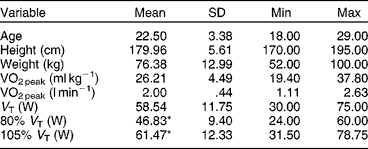
Participants were 24 male undergraduate and graduate students (M age = 22.50, SD = 3.38) who were physically active at a moderate to heavy intensity at least 3 days per week, and had little to no experience of using an arm ergometer. The size of the sample was based on the recommendations of CohenReference Cohen19, with effect sizes based on previous workReference Ekkekakis, Hall and Petruzzello5, Reference Kilpatrick, Kraemer, Bartholomew, Acevedo and Jarreau18, Reference Acevedo, Kraemer, Haltom and Tryniecki20. Physically active men were included because (1) most studies examining the acute effects of above- and below-V T exercise on affect have used samples with these attributes; and (2) we wanted to ensure that the participants would be able to complete the exercise tasks without any untoward physical or psychological effect (e.g. distress). The project was approved by the University Research Ethics Board, and all participants provided informed consent. Participant characteristics are presented in Table 1.
Participant (N=24) characteristics
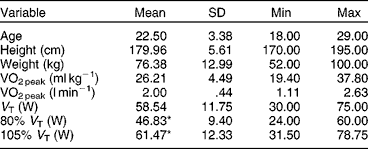
Min, minimum; Max, maximum; W, watts. *t-test, p < 0.01.
Measures: outcome variables
Affective valence and arousal
The 20-item Activation Deactivation Adjective Checklist (AD-ACL)Reference Thayer21 was used to assess both affective valence and arousal. The AD-ACL consists of two bipolar dimensions, tense arousal (affective valence) and energetic arousal (arousal). Tense arousal refers to feelings that can range from tension to calmness, whereas energetic arousal refers to feelings that can range from energy to tiredness. Participants responded to each item by indicating how they felt at this moment by circling the appropriate response on the rating scale. Each item was rated on a four-point scale: (1, definitely do not feel; 2, cannot decide; 3, feel slightly; and 4, definitely feel). The AD-ACL can be scored either in terms of the bipolar dimensions (ten items each) or in terms of four unipolar scales (i.e. energy, tiredness, tension and calmness, 5 items each). For this study, scoring was done according to the bipolar dimensions in order to draw comparisons with studies that have used the Feeling ScaleReference Hardy and Rejeski22 and the Felt Arousal ScaleReference Svebak and Murgatroyd23. The AD-ACL was chosen to assess affect in this study, as other studies in this area have not included multi-item measures of affect during exercise. Therefore, we wanted to determine whether responses to multi-item measures such as the AD-ACL were similar to single-item measures such as the Feeling Scale and the Felt Arousal Scale.
Anxiety
The 20-item version of the State Anxiety Inventory (SAI)Reference Spielberger, Gorsuch and Lushene24 was used to assess state anxiety. Participants were asked to rate how they felt right now, that is, at this moment by circling the appropriate response beside each item. Each item was rated on a four-point scale: (1, not at all; 2, somewhat; 3, moderately so; and 4, very much so). The scale is scored by reverse scoring the positive items (e.g. ‘I feel at ease’) and then summing the scores for all items.
Pain
One item from the Brief Pain InventoryReference Cleeland and Osoba25 was used to measure pain. Participants responded to the item ‘Please rate your upper body pain by circling the one number that tells how much pain you have right now’ with ratings ranging from 0 = no pain to 10 = pain as bad as you can imagine.
Physical effort
The Category Ratio (CR-10) Rating of Perceived ExertionReference Borg26 scale was used to measure feelings of physical effort. The CR-10 is an 11-point, single-item scale ranging from 0 = nothing at all to 10 = very, very strong (almost max.).
Heart rate
Heart rate was assessed using a telemetry monitor (Polar Electro, Woodbury, NY, USA).
Task self-efficacy
At the start of each testing condition, participants were asked about the belief in their ability to continue exercising for incremental 2 min periods. In order to provide a basis for their efficacy appraisals, participants completed a familiarization protocol in which they performed a 1 min bout of arm ergometry at the same intensity as the forthcoming bout. For the control condition, participants performed a 1 min bout of arm ergometry at an intensity that was set very low (i.e. 20 W). Eight items were used, ranging from ‘I believe I am able to continue for 2 min’ to ‘I believe I am able to continue for 16 min’. For each item, participants rated their confidence on a 100-point scale consisting of ten-point increments ranging from 0% = not at all confident to 100% = very confident. An average of the eight item scores was used as the participant's self-efficacy score.
Enjoyment
The Physical Activity Enjoyment Scale (PACES)Reference Kendzierski and DeCarlo27 was used to measure enjoyment. The PACES is an 18-item questionnaire which asks participants to ‘rate how you feel at the moment about the physical activity you have been doing’ on a seven-point scale. Total scores are calculated by summing all items (reverse scoring negative items) and can range from 18 to 126, with higher scores indicating greater enjoyment.
Procedure
At the baseline testing session consent was obtained, and height and weight were measured. Subsequently, participants underwent a progressive exercise test on an arm ergometer (Monark 881, Sweden) to determine their peak oxygen uptake (VO2 peak). The testing protocol was the same for all participants with the exception of their starting workload, which was based on the participant's weight. These workloads were established according to previous research that sought to assess the effectiveness of different VO2 peak protocols in healthy active men who were not experienced in arm ergometryReference Washburn and Seals28. The workload was increased by 10 W every 2 min for the first 6 min of the test, and then by 10 W every 1 min for the remainder of the test. Pilot testing in our laboratory indicated that increasing the workload by 10 W every 2 min for the entire test resulted in participants not reaching their VO2 peak before 20 min. Therefore, after the sixth min, the intervals were shortened from 2 to 1 min. The procedure was terminated when participants could no longer maintain a cadence of 50 rpm (i.e. if they fell below 50 rpm for more than 5 s). The cut-off value of 50 rpm was used, as the arm ergometer's output in watts was based on this cranking rate. A metronome was also used to assist participants in maintaining the desired cadence of 50 rpm. All participants ‘maxed out’ between 8 and 14 min.
Expired gases were collected during the baseline testing session using a Medisoft metabolic cart (Medisoft, Ergocard: Cardio Respiratory Instrumentation) for measurements of oxygen uptake and carbon dioxide output. V T was calculated using the V-slope methodReference Beaver, Wasserman and Whipp29. Each participant's heart rate was monitored during the procedure.
Participants were scheduled for three more experimental sessions (i.e. low-intensity exercise, high-intensity exercise or control). For each exercise session, the wattage was altered on the arm ergometer to correspond with each participant's predetermined output at 80 and 105% V T. As per the baseline testing session, participants had to maintain a crank rate of 50 rpm. Prior to, during and after each session, participants completed the study measures. The AD-ACL, SAI, pain and perceived exertion scales were administered at baseline, at the 5th and 10th min in-task, and immediately following the end of the bout/15th min. Self-efficacy and physical activity enjoyment were assessed after the familiarization protocol, and immediately following the 15th min (i.e. immediately post-exercise). During the exercise bouts, the investigator asked participants to verbalize their responses to the questionnaires, which were placed on the table beside them so that they did not have to stop exercising to give their response. For the control condition (i.e. quiet reading), all questionnaires were completed by the participants, and those referring to feelings during physical activity (e.g. the PACES) were modified to simply read during this activity.
Each experimental session took approximately 20 min to complete, including 1 min prior for the self-efficacy appraisal and a 2 min cool-down. Upon completion of the final experimental session, participants were thanked, debriefed, given a copy of their VO2peak assessment results and paid $40.
Analytic approach
The Delta area under the psychological response curve (DAUC), adjusted for baseline scores, was calculated to assess changes in affect in-task as this approach offers the opportunity to assess the overall affective response while still taking time intervals into account. Furthermore, as research has yet to indicate whether ‘in-task’ or ‘post-task’ affective responses are the more important for defining the exercise experience, we chose to focus on the overall response using a summary function like DAUC. This was also a more appropriate statistical approach to facilitate the meditational analyses noted below.
A general linear model repeated-measures ANOVA was used to compare DAUC across the three conditions. Post hoc comparisons were adjusted with the Bonferroni correction. Linear regression was used to determine whether changes in cognitive variables (e.g. self-efficacy) mediated the relationship between exercise and changes in affect in the 80% V T condition, and to determine whether changes in physiological variables (e.g. pain) mediated the relationship between exercise and changes in affect in the 105% V T condition.
Results
Psychological responses in-task as a function of condition
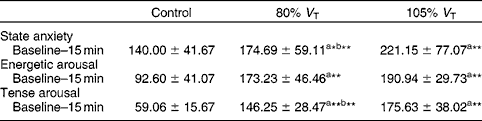
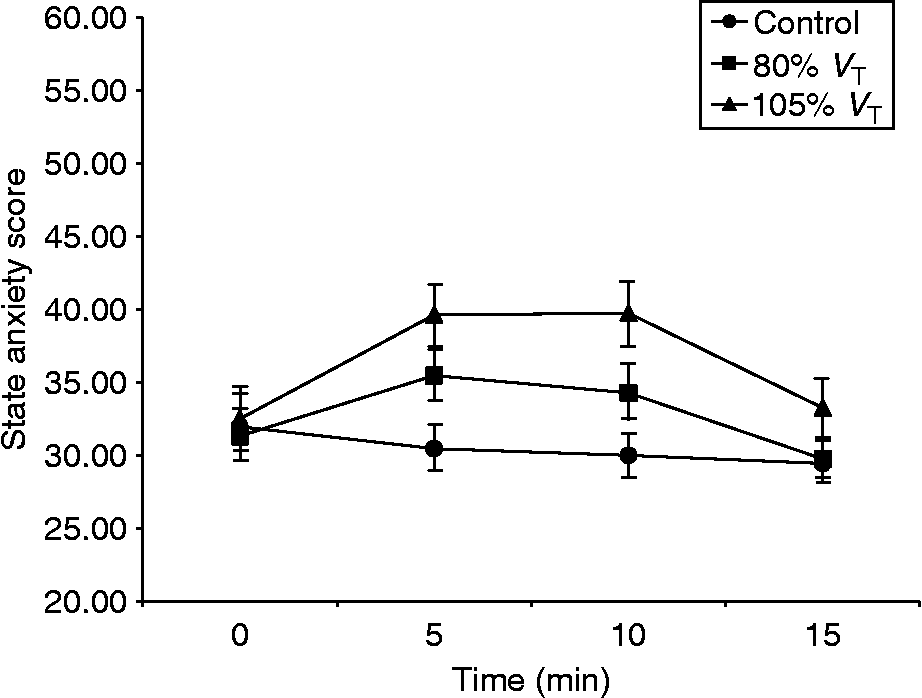
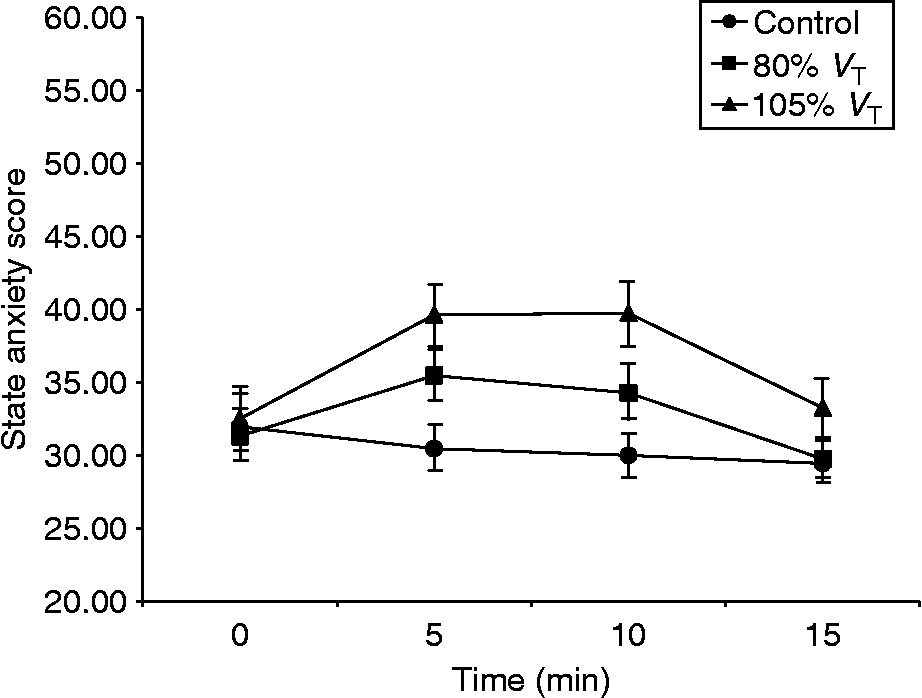
There was a significant effect of condition on state anxiety, F(2,46) = 18.57, p < 0.01. Consistent with hypotheses 1 and 2, pairwise comparisons revealed a significant difference between all conditions, with the 105% V T condition exhibiting the largest increase in state anxiety, followed by the 80% V T condition (all p < 0.05; Table 2 and Fig. 1).
DAUC of psychological responses (mean±SD) for the control and exercise conditions
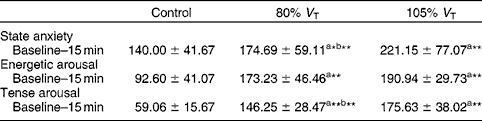
DUAC: dual area under the psychological response curve. *p < 0.05, **p < 0.01.
a Significant difference compared with control.
b Significant difference compared with 105% V T.
Changes in state anxiety
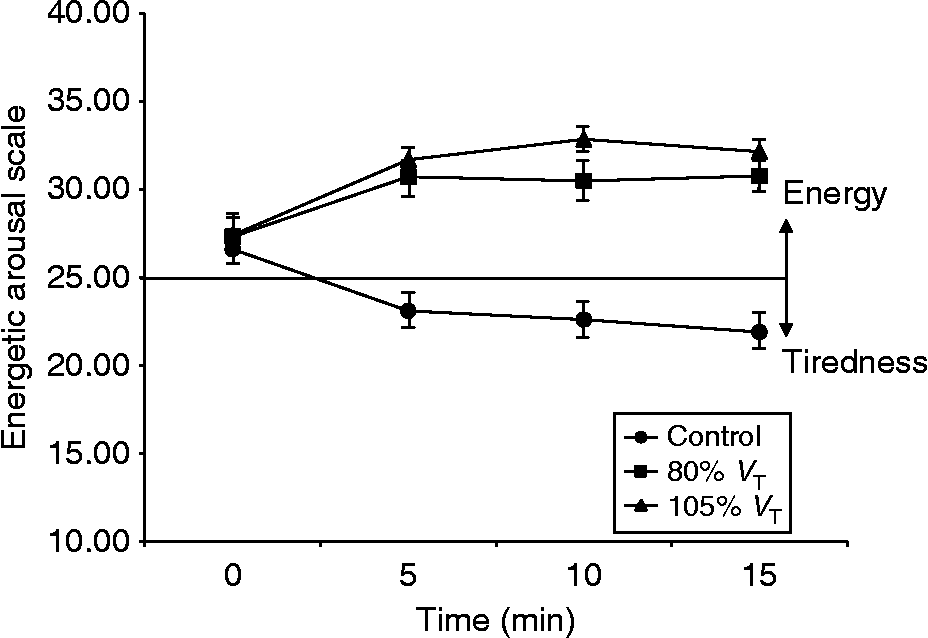
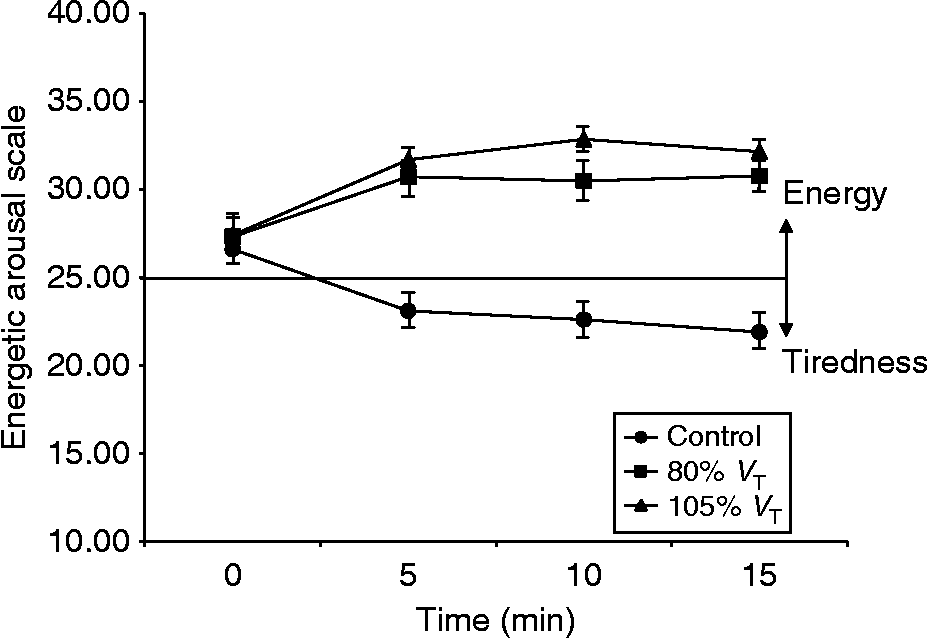
As predicted for arousal, increases in the exercise conditions were significantly larger than the control condition F(2,46) = 57.53, p < 0.01, but were not significantly different from each other, p>0.10 (Table 2 and Fig. 2).
Changes in energetic arousal
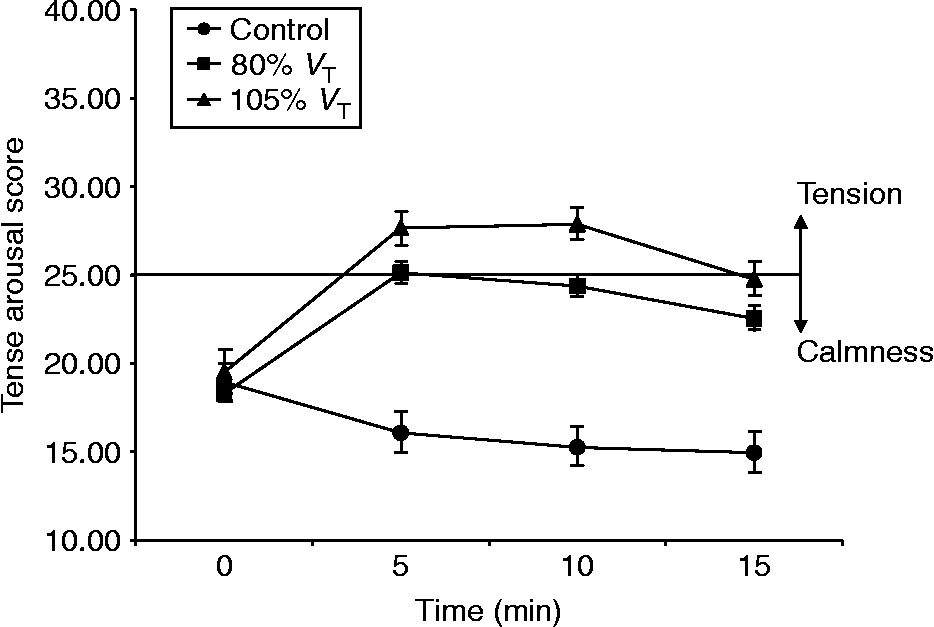
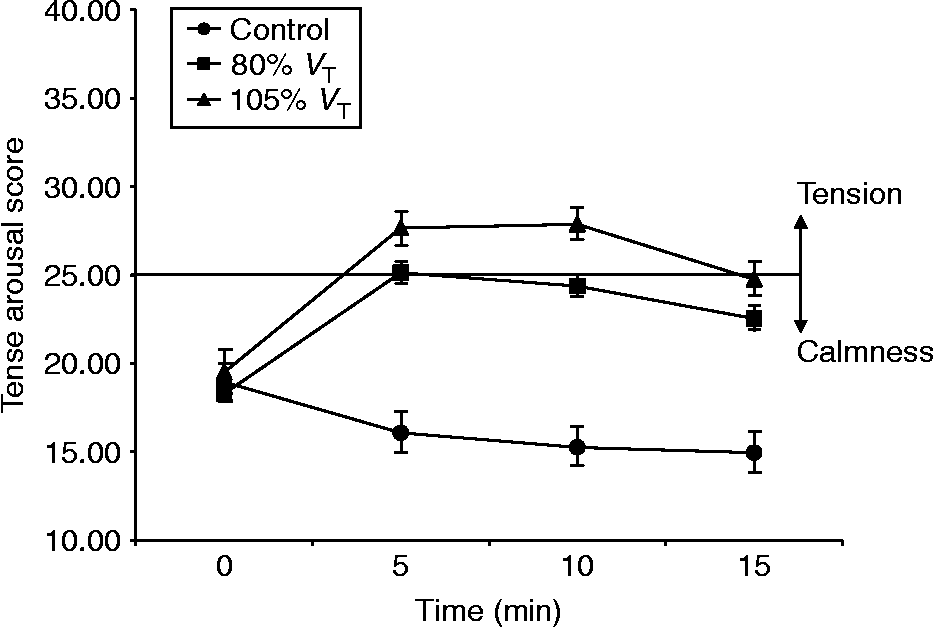
There was a significant effect of condition on affective valence, F(2,46) = 161.00, p < 0.01. Also as predicted, pairwise comparisons revealed a significant difference between all conditions, with the 105% V T condition exhibiting the largest increase in tense arousal, followed by the 80% V T condition (all p < 0.01; Table 2 and Fig. 3).
Changes in tense arousal
Before testing for mediation, the criteria for mediation had to be met (i.e. the independent variable should be significantly related to the dependent variable, the independent variable should be significantly related to the mediator and the mediator should be significantly related to the dependent variable)Reference Baron and Kenny30. As noted above, there was a significant effect of condition (independent variable) on measures of affect (dependent variable). What follows are tests of the remaining criteria for mediation.
Differences in change scores of the potential mediators as a function of condition
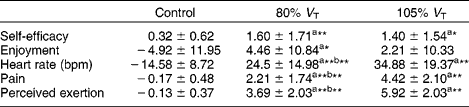
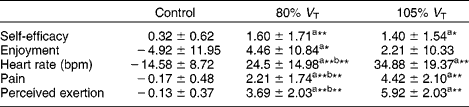
There was a significant effect of condition on the change scores for self-efficacy F(2,46) = 7.21, p < 0.01, physical activity enjoyment F(2,46) = 5.22, p < 0.01, heart rate F(2,46) = 83.12, p < 0.01, pain F(2,46) = 65.56, p < 0.01 and perceived exertion F(2,46) = 112.68, p < 0.01. For self-efficacy, the exercise conditions exhibited significantly greater change than the control condition, but not from each other. For physical activity enjoyment, the only significant difference was between the 80% V T condition and the control condition, such that enjoyment increased in the 80% V T condition and decreased in the control condition. For heart rate, pain and perceived exertion, all conditions were significantly different from each other, with the 80% V T condition scoring higher than control, and the 105% V T condition scoring higher than the 80% V T condition (Table 3).
Change scores for the potential mediators (mean±SD) for the control and exercise conditions
*p < 0.05, **p < 0.01.
a Significant difference compared with control.
b Significant difference compared with 105% V T.
Relationships between the mediators and psychological responses for the exercise conditions
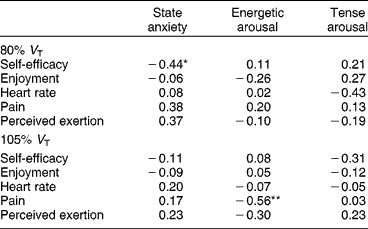
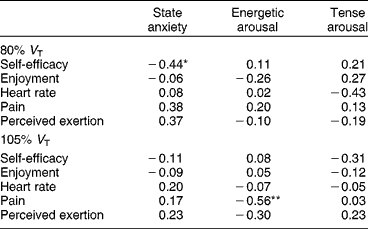
In order to determine whether changes in the cognitive mediators were related to changes in affect during the 80% V T condition and whether changes in physiological mediators were related to changes in affect during the 105% V T condition, Pearson correlation coefficients were calculated (Table 4). Self-efficacy and state anxiety were significantly related in the 80% V T condition. Pain and energetic arousal were significantly related in the 105% V T condition. Therefore, only these variables were included in the final regression model testing for mediation.
Correlations between affect scores (DAUC) and change scores of the potential mediators
*p < 0.05, **p < 0.01.
Test for mediation
In order to test for mediation, the recommendations of Judd et al. Reference Judd, Kenny and McClelland31 for testing mediation in a within-subject design were implemented. The within-subject design test for mediation involves four steps: (1) calculate the difference in the scores of the mediator of interest (i.e. mediator difference) between the conditions of interest (e.g. difference in self-efficacy change scores between the control and 80% V T conditions); (2) calculate the sum of the mediator scores (i.e. mediator sum, such as the sum of self-efficacy change scores between the control and 80% V T conditions); (3) calculate the difference in the scores of the outcome variable of interest between the conditions of interest (i.e. outcome difference, such as the difference in state anxiety change between the control and 80% V T conditions); and (4) regress the outcome difference on both the mediator sum and mediator difference. Assuming that there is an overall treatment effect on the outcome, if the mediator difference predicts the outcome difference, mediation is indicated.
The summed score of self-efficacy and the difference score in self-efficacy were entered into the regression model and accounted for 20% of the variance in differences in state anxiety. However, only self-efficacy difference was a significant predictor (β = − 0.52, p < 0.05), indicating that self-efficacy mediated the effects of below-V T exercise on state anxiety.
The summed score of pain and the difference score in pain were entered into the regression model and accounted for 14% of the variance in difference scores for energetic arousal. However, only pain difference was a significant predictor (β = − 0.44, p < 0.05), indicating that pain mediated the effects of above-V T exercise on energetic arousal.
Discussion
The purpose of this study was to test the predictions of the dual-mode model using upper body exercise, and to examine cognitive and physiological variables as possible mediators of affective responses. Results showed that during 15 min of arm ergometry, changes in affect were greater in the exercise conditions than in the control condition, and affective valence in the exercise conditions declined relative to the control condition (this effect being more pronounced in the above V T condition). In partial support of the dual-mode model, a cognitive variable (i.e. self-efficacy) mediated the relationship between below-V T exercise and affect, and a physiological variable (i.e. pain) mediated the relationship between above-V T exercise and affect.
As predicted, changes in affect were larger in the exercise conditions than in the control condition. This finding is consistent with previous literatureReference Tate and Petruzzello32, Reference Van Landuyt, Ekkekakis, Hall and Petruzzello33, suggesting that arm ergometry and lower body exercises have similar effects on affect relative to a control condition. Also as predicted, changes in affective valence and state anxiety in the 80% V T condition were more positive than in the 105% V T condition, while changes in arousal were similar between the exercise conditions. Overall, our findings using arm ergometry exercise are consistent with previous studies of lower body exercise showing that lower intensity exercise produces more positive in-task affective states than higher-intensity exerciseReference Ekkekakis, Hall and Petruzzello5, Reference Ekkekakis, Hall, Van Landuyt and Petruzzello15, Reference Tate and Petruzzello32, Reference Bixby and Lochbaum34. While there was a decline in affective valence in the 80% V T condition, participants' responses were still indicative of calmness (Fig. 3). Consistent with the tenets of the dual-mode model, exceeding V T during arm ergometry leads to a notable decline in affective valence.
In contrast, our findings for arousal are consistent with some previous findings (i.e. Kilpatrick et al. Reference Kilpatrick, Kraemer, Bartholomew, Acevedo and Jarreau18), but not with others (i.e. Ekkekakis et al. Reference Ekkekakis, Hall and Petruzzello5). We suspect that our results differ from those of Ekkekakis et al. Reference Ekkekakis, Hall and Petruzzello5 as they measured arousal using the Felt Arousal Scale, which may be more sensitive to changes than the Energetic Arousal scale employed in our study. Although Kilpatrick et al. Reference Kilpatrick, Kraemer, Bartholomew, Acevedo and Jarreau18 also used the Felt Arousal Scale, their exercise sessions were different not only in intensity, but also in duration. Therefore, the length of the exercise sessions in the Kilpatrick et al. Reference Kilpatrick, Kraemer, Bartholomew, Acevedo and Jarreau18 study may have contributed to the finding that arousal was similar between groups.
The prediction that the effects of exercise on affective responses will be mediated by cognitive factors for the 80% V T intensity and by physiological factors for the 105% V T intensity received partial support. The finding that self-efficacy mediated the relationship between below-V T arm ergometry and measures of affect is consistent with previous literature in lower body exerciseReference Ekkekakis, Hall and Petruzzello7, and suggests that increased feelings of mastery and accomplishment are notable contributors to the effects of acute exercise on affectReference McAuley, Talbot and Martinez35. The finding that enjoyment did not emerge as a mediator is inconsistent with previous research (e.g. Motl et al. Reference Motl, Berger and Leuschen12). Enjoyment may not have emerged as a mediator in our study because the change in enjoyment over the exercise bout was relatively small, which may be partially attributable to the participant's inexperience with the unique form of exercise (e.g. unfamiliar feelings of arm muscle fatigue). In addition, the relatively low variability in enjoyment change scores makes it difficult to detect significant correlations with the measures of affect.
Upon examining the 105% V T intensity condition, pain was found to be a mediator, but heart rate and physical effort (i.e. rating of perceived exertion) were not. Feelings of pain may alert the body that resources are diminishing and, thus result in a negative affective response in order to prevent further exercise and disruption in homoeostasisReference Ekkekakis4, Reference Cabanac36. Feelings of pain also probably reflect increasing acidosis from the non-steady state exercise. Interestingly, our findings parallel other studies showing that exercise-related changes in pain are related to changes in affectReference Focht, Gauvin and Rejeski13, Reference Martin Ginis and Latimer14.
Heart rate may not have emerged as a mediator in the 105% V T condition, because arm ergometry at this intensity may not induce as great a change in heart rate as lower body exercise (e.g. average maximum heart rate while running at V T = 180 bpmReference Acevedo, Kraemer, Haltom and Tryniecki20). Indeed, the average maximum heart rate in the current study was 128 bpm, a result that may not have disrupted the participants' homoeostasis sufficiently to significantly influence affect. While perceived exertion did increase substantially (i.e. 5.92 units), some participants may have been focusing on feelings of exertion related to their arms, rather than on an overall sensation of bodily physical stress, which may not have been strong enough to influence affect. These explanations also account for the relatively smaller correlations between heart rate, perceived exertion and affect at high intensities observed in our study compared with other studiesReference Acevedo, Rinehardt and Kraemer8, Reference Hardy and Rejeski22. Bearing the above limitations in mind (e.g. relatively low heart rate), our findings using arm ergometry provide partial support for the dual-mode model. In addition, as previous research in this area has been correlational, our study is the first to demonstrate cognitive and physiological variables as mediators of the relationship between acute aerobic exercise and affect.
Future directions
Future study of affective responses to exercise would benefit from testing participants who use arm ergometers on a regular basis, such as those with lower limb disabilities. On the one hand, familiarity with arm ergometry could positively influence affective responses to ergometry exercise (e.g. ergometry exercisers may be more used to fatigue, and find these sensations less unpleasant). On the other hand, people with disability may have poorer cardiovascular fitness, a factor that has been shown negatively to influence affective responses to exerciseReference Bixby and Lochbaum34, Reference Gauvin, Rejeski, Norris and Lutes37. It may also be informative to assess whether intensity-dependent differences in affective responses make a difference to exercise adherence. This is an area of study that has been proposed for some timeReference Morgan, Gedvilas and Kneer38, but has still not received sufficient attentionReference Dishman39.
Conclusions
The results of the present study have important theoretical and applied implications. From a theoretical standpoint, support was provided for the use of the dual-mode model as a methodological framework for investigations of the exercise and affect relationship in dose–response studies. From a practical perspective, exercising above V T was shown to elicit declines in affective valence, which may ultimately reduce motivation for exercise and decrease adherence. Taken together, our findings address the importance of self-monitoring and self-regulating exercise intensity to maximize the affective benefits of exercise.
Acknowledgements
This project was funded by a CIHR New Investigator award, held by K. A. Martin Ginis. Among the many people who made this study possible, our greatest appreciation goes to all the participants who volunteered their time, as well as to the individuals partaking in the Spinal Cord Injury Exercise Program at McMaster University.