Introduction
Aerobic activity appears to moderate the decline of cognitive function associated with aging (Angevaren et al., Reference Angevaren, Aufdemkampe, Verhaar, Aleman and Vanhees2008). Moderately intense aerobic activity results in an increase in the ability of the heart to deliver oxygen to the working muscles, and this is indicative of an increase in cardiovascular fitness (American College of Sports Medicine – ACSM, 2006a). These gains in cardiovascular fitness are thought to be associated with other physiological changes influencing cognitive performance. These include improved cerebral blood flow and energy metabolism (Rogers et al., Reference Rogers, Meyer and Mortel1990), changes in cerebral structure (Colcombe et al., Reference Colcombe2003), and alteration in neurotransmitter activity (Neeper et al., Reference Neeper, Gomez-Pinilla, Choi and Cottman1995). Thus, improvement in cardiovascular fitness has potentially beneficial effects on cognitive capacity (Colcombe et al., Reference Colcombe2004).
Large-scale studies based in the community support this assumption, indicating that physical activity (Yaffe et al., Reference Yaffe, Barnes, Nevitt, Lui and Covinsky2001; Weuve et al., Reference Weuve, Kang, Manson, Breteler, Ware and Grodstein2004) or physical fitness (Barnes et al., Reference Barnes, Yaffe, Satariano and Tager2003) are related to the preservation of cognitive health in older adults. While these studies utilized the Mini-mental State Examination (MMSE) (Folstein et al., Reference Folstein, Anthony, Parhad, Duffy and Gruenberg1985) as a cognitive outcome measure to determine the risk for developing dementia, this screening tool is not sensitive enough to reveal subtle changes in specific cognitive functions.
Recent cross-sectional studies have described the association between age and physical activity on the one hand, and various aspects of executive function on the other (Hillman et al., Reference Hillman2006; Themanson et al., Reference Themanson, Hillman and Curtin2006). These studies generally evaluated the frequency, duration and intensity of physical activity by means of self-reported questionnaires. However, such questionnaires may also reflect other factors, such as the level of social engagement or a generally healthy lifestyle, which in turn may protect against cognitive decline. In addition, even though cardiovascular fitness is largely a product of aerobic activity, the ability of subjective questionnaires to reflect cardiovascular fitness is limited. Previous studies have in fact indicated that it is physical fitness and not physical activity that is related to cognitive function (Etnier et al., Reference Etnier, Sibley, Pomeroy and Kao2003; Netz et al., Reference Netz, Argov and Inbar2009). Therefore, aerobic fitness (as reflected by the predicted peak VO2) and maximal heart rate (HRmax), which are based on objective physiological measurements, may better depict the relationship between physical fitness and cognitive function.
Some studies have assessed aerobic fitness in relation to cognitive function in older adults. However, although many of the age-related decrements in cognition are not observed until after 60 years of age (Schaie, Reference Schaie, Pew and Can Hemel2004), the age of participants in those studies did not go beyond a mean age of 70 years (Etnier and Landers, Reference Etnier and Landers1997; Barnes et al., Reference Barnes, Yaffe, Satariano and Tager2003; Netz et al., Reference Netz, Argov and Inbar2009). This is in spite of the significant increase in life expectancy, with those older than 85 years representing the fastest growing segment of the population (National Center for Health Statistics, 2004). Unfortunately, although people are living longer, they are not necessarily living healthier lives (National Center for Health Statistics, 2004).
Most studies examining the relationship between physical activity or fitness and cognitive function usually assess only one or two specific cognitive tasks, most often an executive control task such as the flanker task (Hillman et al., Reference Hillman2006), task switching (Themanson, et al., Reference Themanson, Hillman and Curtin2006), or the alternate uses test (Netz, et al. Reference Netz, Argov and Inbar2009). Quantitative reviews exploring a wider range of cognitive tasks, however, failed to find consistent results – possibly due to the application of different approaches to classifying cognitive tasks. While Colcombe and Kramer (Reference Colcombe and Kramer2003) reported that physical activity improved all cognitive categories, they emphasized the benefit on executive functions. In contrast, although a recent review (Angevaren et al., Reference Angevaren, Aufdemkampe, Verhaar, Aleman and Vanhees2008) found a positive relationship between cardiorespiratory fitness and cognitive capacity, the greatest benefits were rather on motor function and auditory attention. The authors recommend that clinicians and scientists in the field of neuropsychology seek mutual agreement on the use of a standard battery of cognitive tests, in order to make research on cognition more clinically relevant and results more reproducible. We thus decided to use a standardized computerized cognitive assessment battery (Mindstreams, NeuroTrax Corp., NJ, U.S.A.) in the present study.
We aimed to assess whether physical activity and fitness, as determined by the completion of a self-reported questionnaire and by measuring predicted peak VO2, was associated with cognitive function comprising multiple cognitive domains in older community-dwelling subjects.
Methods
Participants
Subjects were residents of a retirement village who expressed their willingness to participate in the study. Exclusion criteria included a score of <24 on the MMSE (Folstein et al., Reference Folstein, Anthony, Parhad, Duffy and Gruenberg1985), active ischemic heart disease, congestive heart failure (functional capacity level 2 or more according to the American Heart Association), uncontrolled hypertension (systolic blood pressure of over 160 mmHg and diastolic 90 mmHg), neurological deficit due to previous stroke, depression (>8 on the short version of the Geriatric Depression Scale (GDS), Brink et al., Reference Brink, Yesavage, Lum, Heersema, Adey and Rose1982), dementia (according to DSM-IV criteria; American Psychiatric Association, 1994), cancer treated by chemotherapy, anemia (Hb < 12g%), renal failure (creatinine > 1.5mg/dL), poorly controlled diabetes mellitus (HBA1C > 8%), change in medications in the two weeks prior to the study, inability to use a computer (due to difficulties in vision or motor function) and smoking.
The study was approved by the Ethics Committee of the Meir Medical Center (Kfar Saba, Israel). All subjects provided written informed consent for participation in the study.
Clinical assessment
Demographic information, including education level, marital status, country of origin, handedness, prior computer experience, occupation and employment status was provided by the participants. Medical history was obtained by interview. Cognitive screening was performed using the MMSE, screening for depression utilized the 15-item GDS, and functional status for instrumental activities of daily living (IADL) was assessed using the Lawton and Brody Scale (Lawton and Brody, Reference Lawton and Brody1969). Medications were coded according to therapeutic categories (for example, antihypertensives, anticoagulants, etc.). Diseases were categorized according to systems (such as cardiovascular, gastrointestinal, musculoskeletal and others). For the purpose of the study, a score of 0–2 on the GDS was considered to be “no depression'” and 3–6 partial depression, and a score of 1 on the Lawton IADL was considered high functioning, 1.1–1.66 average and 2 low functioning.
Physical activity assessment
The Habitual Physical Activity Questionnaire (HPAQ; Baecke et al., Reference Baecke, Burema and Frijters1982) was used for assessing the level of physical activity. This questionnaire provides four indices of habitual physical activity: an occupation activity index, a sport activity index, a leisure activity index; and a total score. The sport activity index is composed of the multiplication of three scores: level of intensity, time and proportion (activity per month). The range of possible scores on the full questionnaire is 3 to 15. This questionnaire has been shown to be reliable and valid in previous studies with older adults (Pols et al., Reference Pols, Peeters, Kemper and Collette1996; Netz et al., Reference Netz, Argov and Inbar2009). Because participants in this study were retirees and did not have a score on occupation activity, this part was excluded. Therefore, the total score included the sport index and the leisure activity index only.
Assessment of aerobic fitness
In order to assess the level of aerobic fitness level (predicted peak VO2) and maximal heart rate (HRmax), participants performed a graded, progressive, maximal exercise test on a motorized treadmill (Woodway, Germany). For the duration of the test, the electrocardiogram (ECG), heart rate (HR), blood pressure, and rating of perceived exertion were monitored continuously, using a 12-lead ECG, a sphygmomanometer, and the Borg scale (Borg, Reference Borg, Borg and Ottoson1986), respectively. Subjects with abnormal cardiac signs or symptoms were excluded from the study. The test commenced with a 2–5-minute practicing and adaptation. Based on the modified Balke protocol (ACSM, 2006a), an initial speed of 3.2 km/hr with a gradient of zero was determined. The gradient was increased by 2.5% every 2 minutes until a symptom (dizziness, breathlessness, changes in ECG, etc), limited max was reached or until the subject reached exhaustion. The test continued for 6–13 minutes (mean 9.75 ± 1.6).
Prediction of peak VO2: Peak VO2 was estimated from the last stage of the graded maximal treadmill exercise challenge. The following equation was used to estimate peak VO2 for each subject: VO2 (ml*kg−1*min−1) = 0.1 (final speed) + 1.8 (final speed) (final fractional grade) + 3.5 ml*kg−1*min−1 (ACSM, 2006a).
Cognitive assessment
Cognitive function was assessed using the Mindstreams (NeuroTrax Corp., NJ, U.S.A.,) computerized battery that utilizes novel adaptations of traditional neuropsychological tests to provide an overall measure of cognitive function as well as an evaluation of specific cognitive domains. The battery comprised the following tests: Go-NoGo Response Inhibition, Verbal Memory, Stroop Interference, Nonverbal Memory, Catch Game and Visual Spatial Imagery. Previous research has shown that these tests have good concurrent validity and reliability and are highly correlated with performance on traditional neuropsychological batteries (Dwolatzky et al., Reference Dwolatzky2003; Schweiger et al., Reference Schweiger, Doniger, Dwolatzky, Jaffe and Simon2003). The battery is simple to use, requires no previous computer experience and is web-based with a central database. All tests are run in the same fixed order, and all responses are made using either the computer mouse or the number pad on the keyboard. Outcome parameters include accuracy, reaction time (RT) and standard deviation (SD) of RT, as appropriate for each test. Given the speed-accuracy tradeoff (Cauraugh, Reference Cauraugh1990), a performance index (computed as [accuracy/response time] × 100) is computed for timed tests in an attempt to capture performance both in terms of accuracy and response time.
Outcome parameters are calculated using custom software blind to group membership (VO2 scores). To permit summarizing the performance in each cognitive domain across different types of outcome parameters (e.g. accuracy, RT), each outcome parameter is normalized and applied to a standard score scale (mean 100; SD 15) in an age- and education-specific fashion. Normalized subsets of outcome parameters are averaged to produce four summary scores, each indexing a different cognitive domain:
Memory: mean accuracies for learning and delayed recognition phases of the Verbal and Nonverbal Memory tests.
Attention: mean response times for the Go-NoGo test and the no interference (meaning) phase of the Stroop test and mean standard deviation of response time for the Go-NoGo test.
Visual-spatial: mean accuracy for the Visual-Spatial processing test.
Executive function: performance indices for the Stroop test and Go-NoGo test mean weighted accuracy for Catch Game.
These index scores (cognitive domains), and a Global Cognitive Score, computed as the average of these index scores, provided a measure of cognitive function (Dwolatzky et al., Reference Dwolatzky2003).
Procedure
Following a lecture at the retirement village on cognitive functioning and physical activity in advanced age, residents were invited to participate in the study. Possible candidates were interviewed by trained research assistants to provide general demographic and medical data, and received an outline of the proposed study. Those who expressed an interest in participating in the study were interviewed by a physician (TD) and provided written informed consent following a detailed explanation of the study. The physician then performed a complete medical chart review to gain a more complete medical history and the subject underwent a physical examination. Questionnaires were administered and Mindstreams testing was performed. All these procedures were carried out at the retirement village. Within two weeks of the final interview, suitable participants underwent exercise testing at the physiology laboratory of the Wingate Institute.
Data analysis
The small number of participants who were eligible to complete the exercise test, and the fact that tests of normality (Kolmogorov-Smirnov) indicated that three cognitive domains (Memory, Attention and Global Cognitive Score) were not normally distributed (also medications and diseases are nominal variables that cannot be analyzed by parametric tests) have led us to use non-parametric tests – i.e. Mann Whitney and Spearman correlation.
Initially, our plan was to divide participants into fitness categories based on the ACSM (2006a) norms. However, all participants in the present study had very poor scores relative to the ACSM norms, thus limiting the possibility of using these norms. More specifically, while age norms for peak VO2 are provided by the ACSM (2006a) for each decade for men and women, the highest decade specified is that of 60 years and older. For this age group the average (50th percentile) peak VO2 for men is 34.6 ml*kg-1*min-1 and for women 26.7 ml*kg-1*min-1. In our study the median score for men was 23.95 (range 7.0–34.8) and for women 18.0 (range 5.4–31.5), both representing poor scores (below the 10th percentile) relative to the ACSM norms for those older than 60 years (ACSM, 2006a). Since no specific values were provided by the ACSM for age groups 70–80 or 80–90, participants in the present study were divided into two groups somewhat arbitrarily – namely above and below the 50th percentile.
A median score (50th percentile) of 18.5 ml*kg−1*min−1 was determined for both genders combined, for the following reasons: (i) group differences on gender distribution were not significant; (ii) no gender differences were detected on any variable including all cognitive tests; and (iii) only one male was misplaced relative to the median score for men in this study (although he had a score of 22.4, which is less than the median score for men, he was placed in the moderate VO2 group). Thus, those with predicted peak VO2 ≤ 18.5 ml*kg−1*min−1 were defined as the low fitness group and those with VO2 > 18.5 ml*kg−1*min−1 as the moderately fit group.
Results
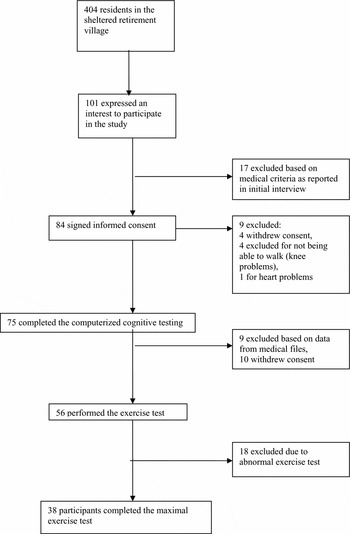
Figure 1 describes the selection of subjects for participation in the study. Prior to the exercise test, 31 subjects (out of the 101 elderly residents who expressed interest in participating in the study) were excluded based on the criteria noted previously, and 14 withdrew consent. During the exercise test, 18 more subjects were excluded due to abnormal exercise test, including ST segment changes, atrial fibrillation, or multiple ventricular premature beats. Thirty-eight individuals, 26 women and 12 men, aged 65.30 to 85.31 years old, mean age 77.54 (±5.28) years, were found to be eligible to complete the maximal exercise test, and thus participated in the study.
Selection of participants.

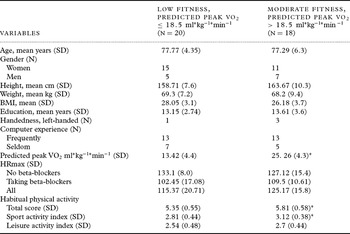
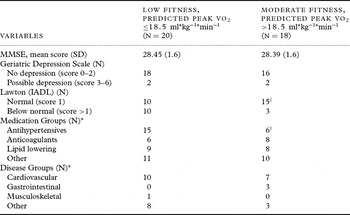
Demographic and physical characteristics of the two groups are presented in Table 1. As beta-blockers (antihypertensive medication) affect heart rate, HRmax scores are presented separately for those who were on beta-blockers and those who are not. Apart from predicted peak VO2, the groups differed with respect to physical activity level (HPAQ). No differences were found on any other demographic variables and no relationship was found between age and any of the cognitive tests or categories. The two groups had similar clinical characteristics (see Table 2); however, significantly (Fisher's Exact Test) more subjects in the low fitness group used antihypertensive medications (p = 0.02) and were more limited in IADL (p = 0.04) than those in the moderately fit group.
Participants' demographic and physical characteristics

BMI = Body Mass Index.
HRmax = maximal heart rate.
*t test p≤0.03.
Participants' clinical characteristics

MMSE = Mini-mental State Examination.
IADL = Instrumental Activities of Daily Living.
† Fisher's Exact Test p<0.05.
* Participants may belong to more than one group.
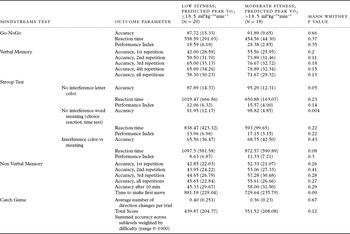
Table 3 presents all outcome parameters. A clear trend for better scores among participants with a moderate peak VO2 compared to those with low peak VO2 emerged in all scores, both in terms of accuracy as well as reaction time. Although in most cases differences were not significant, the trend of scores consistently favored the group with moderate VO2. Generally, the standard deviation of the reaction time scores in the low VO2 group was greater than that of the moderate VO2 group.
Summary score performance for low- and moderate fitness groups*

* Note: All Accuracy parameters are in % correct; all timed parameters are in milliseconds; performance index is (accuracy/response time) × 10.
Results for each cognitive domain are reported in Table 4. A clear trend for better scores (in absolute values) in the moderately fit compared to the low fitness group was present for all scores. Significantly better scores for the moderate VO2 group were observed for the Attention and the Global Cognitive Score. Spearman correlations assessing the relationship between the scores on each cognitive domain and the predicted peak VO2 scores were significant for Executive Function, in addition to Attention and Global Cognitive Score. None of the correlations assessing the relationship between the scores on the cognitive domains and the HPAQ scores was significant (range −0.2 to 0.2).
Mindstreams cognitive function index scores (means and SDs) for low and moderate fitness groups

Since the predicted peak VO2 groups differed with regard to the use of antihypertensive medications and Lawton IADL scores (more subjects in the low VO2 were taking antihypertensive medications and had lower Lawton IADL scores than those in the moderate VO2 group), the Mann-Whitney test was performed assessing differences in the Global Cognitive Score between participants taking antihypertensive medications and those not taking these medications, and between high and low Lawton scores, for both VO2 groups. No differences were detected between those taking and those not taking antihypertensive medications in the moderate (U = 35, p = 0.96) or in the low (U = 25, p = 0.39) peak VO2 groups. On the other hand, differences were found in the low VO2 group, with those with a higher level of function on the Lawton IADL scoring higher on the Global Cognitive Score than those with a lower functional level (U = 17, p = 0.02). No differences were found on the Global Cognitive Score between high and low Lawton IADL scores in the moderate VO2 group (U = 22, p = 1).
Discussion
The main finding of the present study is that even in subjects of advanced age with similar education level, health and mental status, improved aerobic fitness is associated with superior global cognitive function.
We found a significant difference in the Global Cognitive Score, which is based on the collective results of all cognitive domains tested. While the differences in the individual tests comprising the Mindstreams battery did not reach significance in most cases, the trend for better cognitive scores in the moderate-fitness compared to the lower-fitness groups was clear (the direction of scores was consistently in favor of the moderate VO2). This was demonstrated in all cognitive measures without exception, reflecting both accuracy and reaction time (Table 3) and indices of cognitive domains (Table 4). These results support the assumption that cardiovascular fitness is associated with cognitive capacity (Colcombe et al. Reference Colcombe2004), and conform to results from previous studies indicating a relationship between aerobic fitness and various aspects of cognitive functioning (Etnier and Landers, Reference Etnier and Landers1997; Barnes et al., Reference Barnes, Yaffe, Satariano and Tager2003; Netz et al., Reference Netz, Argov and Inbar2009).
The present study is innovative in that it extends the evidence regarding this relationship to more advanced ages than previously reported. Furthermore, the VO2 scores observed in the present study for both groups are considered very poor (below the 10th percentile) relative to normal values for those older than 60 years (ACSM, 2006a). However, even within those low scores, the group exhibiting higher scores evidently functions better cognitively. This suggests that even at more advanced old age, where a lower level of cardiovascular function is typical, small improvements in physical fitness, usually related to the level of physical activity, may have a positive impact on cognitive capacity.
Not surprisingly, participants at a higher level of fitness also reported that they were more active, although their level of physical activity was relatively low (Baecke et al., Reference Baecke, Burema and Frijters1982). One possible interpretation is that at such an old age, even a small challenge (physical activity) can be sufficient to trigger changes in the cardiovascular system, which mediates cognitive functioning (Colcombe et al., Reference Colcombe2004). Of note is the fact that we did not find an association between physical activity and cognition, consistent with previous studies suggesting that physical fitness and not physical activity is related to cognition (Etnier et al., Reference Etnier, Sibley, Pomeroy and Kao2003; Netz et al., Reference Netz, Argov and Inbar2009). One possible explanation for this lack of association may be the limited range of scores obtained in the physical activity questionnaire. However, this also reflects the zero score on the occupation index of physical activity, since most participants were retirees as expected at this older age. In addition, the methodological limitation of a self-report measurement may explain these findings.
Apart from the Global Cognitive Score, significant differences in the level of attention between the two fitness groups were also observed. Attention in the present study was evaluated by means of a combination of choice reaction time measurements. It should be emphasized that the high variability in reaction time scores in the low functioning group found in the present study is not uncommon (Der and Deary, Reference Der and Deary2006). These differences on attention conform to the findings of a recent review reporting the effects of increased cardiorespiratory fitness on cognitive speed and auditory and visual attention, in particular (Angevaren et al., Reference Angevaren, Aufdemkampe, Verhaar, Aleman and Vanhees2008). The significant relationship between fitness and executive functions (Table 4) are in line with a previous review (Colcombe and Kramer, Reference Colcombe and Kramer2003) and with recent studies emphasizing the beneficial effect of exercise and fitness predominantly on executive functions (Hillman et al., Reference Hillman2006; Themanson et al., Reference Themanson, Hillman and Curtin2006). The differences between the two fitness groups on executive functions were not significant; however, it is not unlikely that significant differences may be found in a larger sample.
Although there is agreement that executive function refers to the ability to plan and perform goal-directed activities (Spreen and Strauss, Reference Spreen and Strauss1998), and that it involves planning, scheduling, working memory, interference control and task coordination, it has also been proposed that it is closely linked to the ability to focus on a given task necessitating attention (Spreen and Strauss, Reference Spreen and Strauss1998). As a result, Barnes et al. (Reference Barnes, Yaffe, Satariano and Tager2003), in their longitudinal study on cardiorespiratory fitness and cognitive function, integrated both attention and executive functions into one category. Thus, the classification of these cognitive functions is not uniform in the literature.
It is clear that the tasks and task components proposed for measuring cognitive processes can only rarely be neatly and orthogonally arranged into one category (Colcombe and Kramer, Reference Colcombe and Kramer2003). Consequently, there is a great deal of variability in classifying cognitive tasks into categories, as demonstrated in recent reviews examining the same type of studies and/or cognitive tasks (Colcombe and Kramer, Reference Colcombe and Kramer2003; Angevaren et al., Reference Angevaren, Aufdemkampe, Verhaar, Aleman and Vanhees2008). It should be noted that the methodology used in these reviews was not uniform in that they compared different population groups evaluated by the use of various cognitive tasks. Our study, therefore, has the clear advantage of using a uniform computerized battery assessing multiple cognitive domains within a specific population.
Our study has a number of limitations. The estimated (predicted) peak VO2 is not as precise as the measured VO2. While it is accepted that the estimated peak VO2 provides a reasonably accurate reflection of an individual's fitness at a lower cost and reduced risk (ACSM, 2006a) and is thus widely used, the precision of these estimates in the older study cohort has not been adequately determined. The error in estimating exercise capacity from prediction equations is more significant in advanced-age adults with chronic diseases than in young individuals (ACSM, 2006b). Thus, even if gold standards for adults aged 77.5 years (the mean age of our study participants) were available, the discrepancy between the estimated scores and the actual measured score is expected to be larger than in young adults. On the other hand, while this error may result in the spurious elevation of the estimated peak VO2 (ACSM, 2006b), the estimated scores in the present study were so low that it is questionable whether the real scores were much lower than these. Further data providing actual VO2 in very old subjects with chronic diseases will define the gold standard for VO2 in this population. Since no such data were available at the time our study was conducted, we had to rely on estimated peak VO2 based on data from younger subjects.
In addition, although this study is innovative in assessing aerobic fitness at a more advanced age than previously reported, the risk involved in a maximal stress test (HRmax) and an emphasis on the safety of the subjects limited eligibility, raising the possibility of selection bias and thus questioning the external validity of the study. On the other hand, it is quite likely that any study assessing aerobic fitness at such an advanced age will face similar limitations. It is therefore not surprising that the published norms at age 60+ are based on a much small number of individuals compared to younger ages (ACSM, 2006a).
Another limitation of our observational study is that the differences demonstrated in cognitive function between the moderate and lower fitness groups do not necessarily indicate a causal relationship between physical fitness and cognition. It is known that the adoption of exercise as a lifestyle is related to a higher level of education and socioeconomic status, both associated with better cognitive function (Etnier and Landers, Reference Etnier and Landers1997). However, participants in our study, both in the moderate as well as the low fitness groups, represent subjects of the same relatively high socioeconomic class and education level. Further, the difference found between the two groups with regard to antihypertensive medications does not seem to be related to cognitive function. On the other hand, the differences between groups in IADL do seem to be related to cognitive function. That is, the moderately fit participants seemed to function better than those who are less fit, in addition to their superior cognitive function. This is not surprising, as instrumental activities of daily living, such as handling finances or planning and preparing meals, require cognitive skills. It is clear that these differences between the groups limit the findings of our study.
In conclusion, this pilot study involving relatively healthy residents of a sheltered housing facility demonstrates a positive association between physical fitness and multidomain cognitive function in a group of subjects older than those previously studied. This suggests that the maintenance of higher levels of cardiovascular fitness may be beneficial to cognitive function even at an advanced age in this population group. An adequately powered randomized controlled trial involving a more heterogenic population of community dwelling older subjects should be performed to further evaluate this hypothesis.
Conflict of interest
None.
Description of authors' roles
YN designed the study, supervised the physical fitness data collection, performed the statistical analyses, and wrote the paper. TD designed the study, obtained Ethics Committee approval, performed medical evaluations of the subjects and wrote the paper. EA coordinated the collection of data, formulated the statistical design and interpreted the data. YZ designed the study, coordinated the collection of data, and interpreted the data. RA coordinated the collection of data, and interpreted the data.
Acknowledgments
The authors wish to thank the residents and staff of the Protea Retirement Village in Israel for their cooperation and support. The authors also wish to express their appreciation to Dr. Martin Ellis and Professor Menachem Shapira of the Meir Medical Center for their assistance.