1. Introduction
Research in the history of political thought (HPT) is typically divided into categories such as contextualist, Marxist, and Straussian. But previous categorizations have three significant weaknesses. First, they omit much research—often a majority, sometimes a large majority. Second, research done by political theorists and philosophers is often misrepresented, if it is even mentioned. Third, the categorizations exaggerate differences, presenting researchers as taking fundamentally different approaches. Yet even when pursuing different ends, we often take similar routes, for some of the journey.
This paper thus proposes a different kind of framework, which captures much more research and recognizes what we share in HPT, not just what differentiates us. Rather than taking a one-dimensional approach, listing a series of categories presented as alternatives, I propose a two-dimensional approach. One dimension involves ends, the second involves means. I avoid traditional names of categories, especially those involving specific disciplines such as history or philosophy.
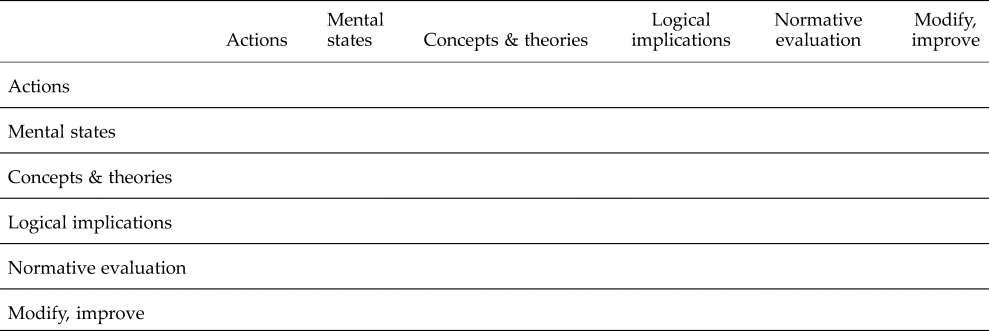
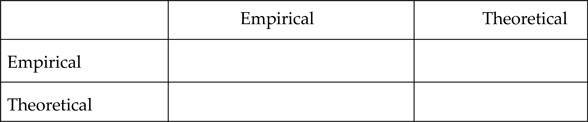
The first two categories are empirical, the latter four are theoretical. A study can have empirical and/or theoretical ends, but all studies use empirical and theoretical means (never one or the other). The two empirical categories are actions and mental states. The four theoretical categories are concepts/theories, logical implications, normative evaluation, and modifications/improvements. Furthermore, each category contains subcategories. For example, there are eight subcategories of mental states: beliefs, motivations, influences, and so on. I exemplify each subcategory with different questions, to make the framework more concrete.
Importantly, each category can be both an end and a means. For example, our ultimate aim might be to recover authors’ mental states, such as what they meant by what they wrote. But even when our ultimate aim is something else—say, evaluating how well an author's arguments work—we usually try to recover some of what authors meant. For example, normatively evaluating Rousseau's account of the general will requires grasping his distinction between the general will and will of all.Footnote 1
The reverse scenario is also possible: we can use normative evaluation to help choose between conflicting interpretations of ambiguous passages, in order to recover authors’ intended meanings. If one interpretation of the general will / will-of-all distinction makes philosophical sense while a second interpretation implies that Rousseau made an unexpectedly egregious philosophical error, we will probably favor the first. Here, normative evaluation is a means to the end of recovering mental states.
In short, no study sits in just one category. Even when pursuing a single goal, we typically ask several questions from different categories. Many studies pursue more than one goal. Different studies by the same author will probably not fit into exactly the same categories either. A key advantage of the new framework is to discourage us from asking which “box” any researcher fits into.
A second key advantage is to discourage us from thinking in overly disciplinary terms. Some scholars will focus on the empirical/theoretical metadistinction and accept that even research with empirical ends will use theoretical means, and vice versa. Some scholars will focus on the six main categories. This too involves crossing boundaries: recovering mental states, for example, often requires analyzing theories and/or probing logical implications. But historians, political theorists, and philosophers do not do HPT in fundamentally different ways. Even where we have different ends, we often use similar means.
This helps us do better HPT research. Too often, thinking in disciplinary terms shuts us off from valuable research or useful perspectives, for instance, “I don't do this because I'm a historian” or “that's not what philosophers do.” Orthodox categorizations foster excessive disciplinarity, encouraging narrowness of perspective. Such simplicity has significant costs. We need a better balance. The new framework frees us to ask how best to do our research, without being constrained by university disciplinary boundaries that solidified a century ago. In short, the problems of HPT research do not fit into neat disciplinary boxes. Nor does our research. Nor, therefore, should our categorizations.
The new framework's key advantage is not so much the categories themselves as their two-dimensional arrangement. Consider so-called contextualism. Historians often present this both as a purpose and an approach: we seek to recover authors’ meanings and beliefs, and we do so using contextualist techniques.Footnote 2 But these two things can be separated. For example, many political theorists use contextualist techniques as means to different ends, such as evaluating how well authors’ ideas work: without contextual analysis, we may misunderstand authors, potentially undermining the evaluation.Footnote 3 Meanwhile, some historians with contextualist ends use more theoretical/philosophical means to reach those ends. They might, say, probe the logical implications of an argument to test if it is what the author had in mind, as exemplified below. So, by differentiating means and ends, the new framework shows that to reach a given end we must often use very different means.
For example, historians asking how Rousseau responded to his contemporaries, and political theorists and philosophers asking how well Rousseau's ideas work, will likely all spend time asking how he linked freedom and the general will and struggling to understand tricky passages like “forced to be free.”Footnote 4 At such points, ideally, we should stop seeing ourselves as historians, political theorists, or philosophers, and resolve these problems by any means possible. And usually, by more than one means: if contextual and philosophical evidence imply the same conclusion, the interpretation is stronger than if they diverge.Footnote 5 Alas, most HPT categorizations overlook the crucial point that the nitty-gritty of textual interpretation often requires thinking outside of our disciplines, or at least, consulting research from other disciplines.
In previous publications, I have treated these issues as methodological, where “methodology” is defined as “the logic of inference”—how we reach our conclusions and defend them against objections.Footnote 6 As Michael Frazer notes, though, “what sort of questions we should devote our careers to trying to answer in the first place” is ethical, not methodological.Footnote 7 But in the context of this paper, the dichotomy is not always so strict: answering the questions that primarily concern us still involves asking other questions along the way. For example, historians who have no intrinsic interest in how well an author's arguments work—a question many associate with “presentist” or “contemporary” ethical orientations—must sometimes ask this question to help recover authors’ meanings and intentions.
Why categorize HPT research at all? Precisely because many of us already use categories that accentuate disciplinary perspectives, potentially limiting our research by dissuading us from valuable approaches. To channel Richard Rorty, we might say that the new framework helps “josh” us out of certain habits and ways of thinking.Footnote 8 Historians, political theorists, and philosophers are surely all open to the idea that we may be influenced by certain assumptions and categorizations, consciously or subconsciously. I offer the new framework to help us question our commitments.
Section 2 critically assesses orthodox categorizations. Section 3 presents an alternative framework. Section 4 exemplifies this with Skinner's book Hobbes and Republican Liberty, which combines empirical and theoretical analysis far more than is usually recognized. Section 5 concludes by recommending a different methodology for writing about methodology.
Ultimately, the new framework is not intended to be comprehensive. I believe it covers more research than previous categorizations have covered, but I expect readers to spot gaps and recommend revisions. This is intended to be the start of a debate, not the end of one.
2. Orthodox Categorizations: A Brief Survey
I start by questioning some recent categorizations of HPT, primarily written by historians, political theorists, or philosophers. None of the categorizations claims to be exhaustive, and some are very brief. Nonetheless, most exhibit one or more of three problems, to a greater or lesser extent. First, research is overlooked—often in large quantities. Second, where it is even mentioned, HPT work by political theorists and philosophers is misrepresented. Third, the categorizations mostly imply that a given piece of research occupies a single category, even though studies with different end points often walk the same paths.
The Oxford Handbook of the History of Political Philosophy, edited by George Klosko, only has chapters on contextual, Straussian, and postmodern approaches to HPT.Footnote 9 This excludes the majority of HPT publications. Obviously, edited books cannot cover everything and may be victims of late dropouts. But Klosko's own monograph on Plato is not included in these three categories. After placing Plato's ideas in their Athenian and Greek intellectual and political contexts, Klosko analyzes what Plato meant, how his ideas connect, and how well they work.Footnote 10 This is completely standard among political theorists and philosophers—probably the plurality of HPT research. But it is not contextualist, Straussian, or postmodern. Fortunately, in Klosko's edited book, John Gunnell's fascinating chapter on the history of the field, while not offering a typology as such, captures more approaches than just contextualism, Straussianism, and postmodernism.Footnote 11 But the book as a whole sends out a narrower message.
John Dunn distinguishes “three very different approaches”: Skinner-style historical intentionalism, Marxist emphases on social context, and contemporary analyses which treat historical aspects of texts with “massive indifference.”Footnote 12 This overlooks much scholarship, including some of Dunn's own. For example, his first published paper relates Locke's theory of consent to Locke's broader political theory. It is historically respectful, trying to recover Locke's views on consent, but not via contextual analysis. Dunn makes Locke's implicit theory of consent explicit; he tests it, criticizing deficiencies in Locke's position; and he analyzes its implications. As with Klosko's monograph on Plato, the focus is primarily on the author's writings, not contexts. It is, essentially, straight political theory, with little history, social context, or contemporary insights.
Terence Ball covers six categories, each “highly critical of the others” and with its own “distinctive approach” to interpretation: Marxian, totalitarian, psychoanalytic, feminist, Straussian, and contextualist.Footnote 13 But this probably covers at most a third of recent HPT scholarship. In a later study, Ball adds perennial problems, ideological, and postmodern approaches, producing nine “competing ‘schools’ of interpretation.”Footnote 14 This is a healthy range of approaches, but still has significant gaps—including the kind of political theory Ball himself sometimes practices, as when asking what Machiavelli meant by virtù and how it relates to Machiavelli's theory.Footnote 15 Despite emphasizing difference and “competing” approaches—the latter term is too strong, as my paper suggests—Ball follows up his categorization by advocating “pluralistic and problem-driven” analysis, rightly.Footnote 16 Ball's discussion of pluralism, moreover, implicitly includes previously excluded political theory, for example questions about the role of Rousseau's civic religion in The Social Contract. So, Ball's final recommendations work well, but the categorization itself is incomplete and exaggerates the distinctiveness of supposed “schools” of interpretation.
Daniel Schulz and Alexander Weiss compare contextualist, conceptual history / Begriffsgeschichte, and Foucaultian genealogical approaches.Footnote 17 I do not agree that “most of the studies in our field” fit in “one of these three approaches,”Footnote 18 as the above examples of Klosko, Dunn, and Ball show. Schulz and Weiss later add institutional, cultural/intercultural, and quantitative computer-based analyses.Footnote 19 These are welcome additions but they are far rarer than standard political theory/philosophy analyses of HPT, omitted from this categorization.
John Pocock compares historical and philosophical approaches.Footnote 20 However, for Pocock philosophy mainly involves contemporary appropriations from texts. Pocock grudgingly accepts that formalizing an author's philosophical system is “not an illegitimate activity,” but sees this as “generically different from, and only contingently coincident with,” historical explanations of what authors meant and why; the two involve “different procedures and answer different questions.”Footnote 21 Yet as Skinner had previously argued, it is “essential, in assessing the seriousness of Hobbes's various passing remarks, to consider what place they could have within the general philosophical framework to which he is committed.”Footnote 22 In fact, this applies not only to the “seriousness” of different comments but their meanings too. We probably cannot understand what Mill meant by “harm” or “utility” without thinking through his utilitarianism more generally. Likewise, Machiavelli does not define virtù, and grasping its meaning probably requires some sense of how it fits into Machiavelli's broader theory. Skinner himself offers such a systematic reconstruction.Footnote 23 In short, “historical” approaches must also be “philosophical,” to greater or lesser extents.
Pocock rightly sees that historians of political thought are “engaged both in strictly historical reconstruction and in a kind of philosophical reconstruction.” Unfortunately, he depicts the latter as “seek[ing] to understand past political thought by raising it to ever higher levels of generality and abstraction.”Footnote 24 Perhaps this accurately captured some philosophically minded HPT analysis in the early 1960s, but it is not what I am getting at. For example, recovering what Rousseau means by the general will is central to understanding many aspects of The Social Contract, including related ideas like liberty, sovereignty, and representation. (I do not assume that Rousseau had a single precise meaning in mind: we must always consider the possibility that an author's ideas were ambiguous or unclear.) Rousseau does not define “general will” in The Social Contract or even describe it clearly. Fortunately, the Discourse on Political Economy, completed several years earlier, is more helpful.Footnote 25 So, we can think philosophically, asking if what Rousseau says about the general will in the former text casts light on the latter. But to do this, or even if we concentrate on The Social Contract alone, we must still try to piece together the many things that The Social Contract says or implies about the general will. (Again, we should not assume that they must fit together.) This too requires thinking somewhat abstractly, but note that this is aimed at a concrete question: What did Rousseau mean by “the general will”?
Historical analysis should be part of this process. How did Rousseau's predecessors and contemporaries use the term? What intellectual positions or political events might Rousseau be responding to? Yet even if historical analysis produces a hypothesis about what Rousseau was getting at, as with Helena Rosenblatt's research,Footnote 26 we must still test how well this fits with what Rousseau says and implies in various places. This is not an optional extra: it is necessary for recovering Rousseau's meanings. But historians may not do this if they stick to caricatures like Pocock's and see themselves as doing historical analysis only, not philosophical analysis too. Indeed, Rosenblatt does not do such philosophical analysis as much as she needs: her historical hypothesis does not fit everything that Rousseau says here and thus needs more testing.Footnote 27
More recently, Pocock compares history to what is actually a caricature of political theory.Footnote 28 He assumes that all political theorists have contemporary orientations,Footnote 29 and claims that “the distance . . . between the questions asked by the theorist or philosopher, and by the historian, has grown wider” since contextualism arose.Footnote 30 He talks as if contextualists had not influenced political theorists at all.Footnote 31 Fortunately, the end of the chapter considers an “imagined” political theorist doing something much closer to history: it is “possible” that political theorists address the same things as historians, Pocock speculates.Footnote 32 This is not just possible: it happens constantly. Strikingly, Pocock's chapter has no references to actual political theorists doing HPT. This is a prime example of why we need the more inductive approach to methodology recommended in this paper's final section.
Richard Rorty covers four approaches: perennial problems, sweeping historical narratives, historical reconstruction, and rational reconstruction.Footnote 33 His account of historical and rational reconstruction is problematic. These two approaches, respectively, involve fleshing out authors on the basis of what they could have said to their contemporaries, and on the basis of what they could have said given more recent philosophical ideas. However, Rorty's ensuing comments are misleading: he describes the two approaches as “historical” and “philosophical,” links historical reconstruction to Skinner, and refers to knowledge gained from historical reconstruction as “historical knowledge.” Yet it is not historical knowledge to conclude “this means that Aristotle's conclusions do not follow,” say, or “this means that Aristotle has not defined the concept clearly.” Nor do many historians typically analyze such issues; Skinner does so occasionally, as we will see, but this is never his main aim, and some of his historical reconstructions say nothing about how well an author's arguments work.Footnote 34 Meanwhile, political theorists and philosophers need not only probe authors’ arguments using modern ideas. For example, A. P. Martinich assesses Hobbes's reasoning both on its own terms and using modern notions and distinctions.Footnote 35 These are both “philosophical” reconstructions.
Revealingly, actual “rational reconstructions” sometimes show the deficiency of Rorty's distinction. Bernard Williams and Michael Rosen, who both describe rational reconstruction in a way similar to Rorty, implicitly apply it more widely and usefully. Williams initially proposes reconstructing Descartes using modern perspectives but then tests Descartes partly with Cartesian perspectives.Footnote 36 Rosen also depicts rational reconstruction in modern terms but later tests and reconstructs Mill in a Millian manner.Footnote 37 Rightly, then, neither Williams nor Rosen restricts his actual reconstruction to modern perspectives.
William Richter contrasts textual, contextual, and postmodern approaches.Footnote 38 Textual analysis gives “primary attention to the written texts of past political thinkers.”Footnote 39 Strictly speaking, though, so does much “contextual” analysis. As Skinner writes, contextual evidence provides “a further test of plausibility, apart from the evidence of a writer's own works, for any suggested interpretation of those works.”Footnote 40 But I suspect Richter is simply contrasting historical and nonhistorical analyses. Yet all “nonhistorical” research makes historical/contextual assumptions, and using context to uncover authors’ own meanings does not preclude us from then doing philosophical analysis.Footnote 41 Indeed, philosophical analysis may help uncover authors’ own meanings, as discussed below. But Richter's typology is broadly legitimate, and rightly includes HPT as practiced by many political theorists and philosophers.
Also useful is Don Garrett's typology of contextualization (which he treats as an end in its own right), interpretation (recovering authors’ intended meanings and seeing how ideas fit together), evaluation (seeing how well texts work), and application (to other philosophical problems).Footnote 42 This is superior to the other categorizations above, especially by virtue of its including evaluation. However, contextualization need not be an end in its own right: as discussed above and below, it is also a means to recovering authors’ meanings, beliefs and motivations. This is a fundamental point for any categorization which seeks to guide research. Garrett's two types of “interpretation” are essentially separate, moreover.Footnote 43 And the name is not helpful: all of Garrett's categories involve interpretation. Nonetheless, suitably amended, Garrett's typology has significant benefits.
My own previous publications have questioned existing categorizations,Footnote 44 but on reflection, my proposed alternatives are problematic. My textbook chapter offers the traditional categories, albeit in an extremely unconventional way: contextualism; Begriffsgeschichte, conceptual history and genealogy; reconstruction (empirical, systematic, and adaptive); and theoretical and normative perspectives (including feminist, Straussian, Marxist, republican, classical liberal, international, game-theoretic, race/ethnicity, and so on). The chapter repeatedly emphasizes the universal relevance of core principles from all of these “approaches.” That said, if everyone has theoretical lenses through which they read texts,Footnote 45 then “theoretical and normative” is not really an approach in and of itself—“a different style of analysis.”Footnote 46 Nor is reconstruction a category in its own right, since “everyone reconstructs.”Footnote 47
In another study, I distinguished between four main kinds of evidence: textual, contextual, philosophical, and motivational. Consistent with the present paper, I stressed that we need more than one kind of evidence.Footnote 48 However, the “motivational” category is questionable. As I admitted at the time, this category is different from the others: motivations are always inferred, indirectly. Moreover, if an author states “I wrote this text for reason X,” is this textual evidence or motivational evidence? And if motivational evidence is a kind of evidence, why not psychological evidence (e.g., given our understanding of Machiavelli's state of mind, do we think that he wrote The Prince satirically?) or biographical evidence (e.g., did Machiavelli know enough Greek to have understood Thucydides?).Footnote 49 Because of my growing doubts about the category of motivational evidence, I dropped it from a more recent discussion.Footnote 50 So, the details of that categorization no longer convince me, although the basic message remains valid: we do not restrict ourselves to one kind of evidence.
Given that political theorists and philosophers still do HPT despite being excluded from several categorizations, we should ask: Do these categorizations actually encourage narrowness in interpretation? A full answer is beyond the scope of this paper, but there is some evidence that these categorizations influence our actions. For example, political theorist Devin Stauffer sees contextualism as an end in itself, preferring the “alternative” approach of “immersion in Hobbes's own writings” in order to “understand Hobbes's arguments as he presents them” and “grasp the interconnections between different arguments,” before then “questioning the adequacy of his arguments.”Footnote 51 This is a false dichotomy, as sections 3 and especially 4 show. Historians Pocock and Richard Tuck do not define their key terms in asking whether Guicciardini's and Gianotti's ideas amount to a “separation of powers,” or whether Hobbes was “utopian,” respectively.Footnote 52 These are deeply conceptual questions, and conceptual questions require a more philosophical outlook than Tuck and Pocock take here, perhaps because they see themselves essentially as historians not philosophers. As noted above, historian Rosenblatt only uses contextual evidence when asking how Rousseau linked liberty and the general will; philosophical analysis would also help here.Footnote 53 Finally, John Simmons uses powerful philosophical reasoning to generate hypotheses about what Locke meant by key terms.Footnote 54 These hypotheses should interest historians, but alas they have “largely sidestepped” Simmons's book.Footnote 55 I assume that historians disregard this first-rate philosopher's claims about Locke's meanings because they see philosophy as a fundamentally different enterprise, incapable of uncovering information about how authors understood the terms they used.
In sum, the orthodox categorizations have some value, but unless significantly amended, they work best if offered alongside the framework that I now offer, or something similar.
3. An Alternative Framework
My proposed framework thus seeks (a) to cover more research than previous categorizations, (b) to represent political theory and philosophy more accurately, and, crucially, (c) to show that different objectives involve overlapping techniques. This requires moving from a one-dimensional to a two-dimensional approach.
The methodology of my methodology—in other words, how I went about developing this methodological contribution—is primarily inductive. I initially listed a long series of different questions by reflecting on research I do or know. I then extended the list by reading much more widely beyond my own specialist areas, before developing six categories:
• actions
• mental states
• concepts and theories
• logical implications
• normative evaluation
• modifications/improvements.
Since every end can also be a means, this produces a two-dimensional table (Table 1). The first two categories are empirical, the last four are theoretical. Some scholars will prefer to see my framework as a two-by-two matrix (Table 2). Others will focus on the subcategories and questions within each category. These too are not exhaustive, but cover more than section 2's categorizations, expanding our armory of perspectives.
Ends and means in studying history of political thought

Empirical and theoretical ends and means

I use “end” and “goal” interchangeably, and “means,” “process,” and “technique” interchangeably (also “thinking,” as in “thinking theoretically”). “Analysis” and “question” may refer to end or means, depending on context.
The above framework is arbitrary, as with any categorization.Footnote 56 I do not pretend that my distinctions are right, merely that they are useful. I hope they may even be useful to poststructuralists who reject the empirical/theoretical distinction.Footnote 57 But ultimately, the key is to think abstractly and concretely. Just as historians have rightly convinced political theorists and philosophers to think like historians, so too historians sometimes need to think like political theorists and philosophers. My typology is one way of capturing this.
I will first run through the six main categories, subdivided into different kinds of questions, before discussing a series of questions which could be empirical and/or theoretical, depending on how we ask them; often we will be ambivalent or agnostic about this. For the sake of simplicity, I take my examples from Rousseau alone. I do not pretend that the questions exemplified below exhaust the kind of questions we ask in HPT.
3.1. Actions
(1) Dating texts and ideas. E.g., when did Rousseau write the Geneva Manuscript, his draft of The Social Contract? When did he get the idea of “forced to be free”?
(2) Authorship. E.g., did Hume actually write the infamous satire of Rousseau that Rousseau accused Hume of writing?
(3) What authors actually wrote. E.g., what did Rousseau write in the letters of his that have been lost?
(4) Originality. E.g., how original was Rousseau's idea of the general will?
(5) Other actions. E.g., what was Rousseau's relationship with Françoise-Louise de Warens?
3.2. Mental States
(6) Recovering intended meanings. E.g., what does Rousseau mean by “L'homme est né libre”?
(7) Recovering understandings. E.g., how did Rousseau's contemporaries understand “forced to be free”? What does The Social Contract tell us about governmentality—i.e., what background assumptions and understandings does this text imply about modes of governing?
(8) Recovering beliefs. E.g., was Rousseau aware of problems with his arguments? To what extent did the Creed of a Savoyard Priest in Emile reflect Rousseau's own religious beliefs?
(9) Recovering attitudes/emotions. E.g., what did Rousseau really think of Hobbes's ideas?
(10) Recovering knowledge. E.g., how much classical rhetoric did Rousseau know? Which of Hobbes's texts had Rousseau read?
(11) Uncovering intended audiences. E.g., to what extent was The Social Contract written for Genevan citizens and/or as a contribution to the ages? Whether Rousseau was fully conscious of it or not, to what extent was he thinking only of men as his readers, or of women also?
I now discuss two mental states with causal/explanatory dimensions: motivations, i.e. what caused an author to do something and/or what she hoped to achieve, and influences on or by authors.
(12) Recovering motivations. E.g., why did Rousseau write the first Discourse? Did he write esoterically?
(13) Uncovering influences. E.g., to what extent did Diderot influence Rousseau? To what extent was Rousseau responding to his local political contexts?
Obviously, the category of mental states covers a huge amount of HPT. This is unsurprising, given that the different subcategories here are so central for so many scholars, and often matter as means even to scholars with different ends.
I should reiterate that we often ask two or more questions simultaneously. For example, questions about Rousseau's audiences probably link to his motivations for writing his texts. More importantly, empirical goals may involve empirical and/or theoretical means. I thus turn to four types of theoretical end.
3.3. Concepts and Theories
(14) Recovering concepts, positions, accounts, arguments, and theories. E.g., how fundamental is the general will to Rousseau's political theory? What is the relationship between the general will and justice? Is this relationship the same in The Social Contract and the Discourse on Political Economy? How are Rousseau's educational and political writings connected?
(15) Conceptual and theoretical redescription. E.g., is Rousseau a totalitarian? Are his ideas of liberty negative, positive, or republican?
Obviously, all of our questions are typically conceptual in some way. For example, in category 10 (recovering knowledge), how much classical rhetoric Rousseau “knew” depends on what we mean by “know.” If he had vaguely heard of Cicero's ideas, does this count? Nonetheless, while conceptual issues are often relevant in such places, sometimes they are absolutely fundamental, as when we classify authors/ideas as “totalitarian,” “republican,” and so on. Such questions thus deserve their own category.
3.4. Logical Implications
(16) Uncovering presuppositions. E.g., does Rousseau's moral freedom presuppose civil freedom? To what extent does his political theory assume a gendered division of labor?
(17) Uncovering implications. E.g., is “forced to be free” consistent with Rousseau's definitions of moral and/or civil freedom? (Note that I use logical “implication” more loosely than a strict deduction.)Footnote 58
3.5. Normative Evaluation
(18) Evaluating ideas/arguments. E.g., how convincing is Rousseau's critique of representation? Does he successfully differentiate government and sovereignty?
(19) Evaluating authors more generally. E.g., is Rousseau's democratic theory more convincing than Bentham's? Can we excuse Rousseau's egregious sexism?
3.6. Modifications/Improvements
(20) Modifying and even improving concepts, positions, theories, or arguments. E.g., does dropping the assumption of intuitable normative truths affect Rousseau's conclusions? Does seeing the general will as the voice of the collective conscience square the circle of Rousseau's different commitments?
3.7. Borderline Cases
I now address questions which could be empirical and/or theoretical. We often pose questions ambiguously, masking their nature, and we may be consciously or subconsciously agnostic about their focus.
One group of these questions has already been covered above, in categories 6 (intended meanings), 8 (beliefs), 14 (concepts, positions, etc.), 16 (presuppositions) and 17 (implications). Consider questions such as “For Rousseau, what is the general will?” We could be asking how Rousseau himself understood it, and/or what his position implies. We are often agnostic here: we do not know, and may not care, if authors were conscious of these things, as with Frederick Neuhouser's reconstruction of Rousseau.Footnote 59 The same applies to questions such as whether Rousseau's or Bentham's democratic theory is preferable. We might work with how they themselves presented their theories, or with the versions we think they were reaching for, or, often, aspects of both. Some questions in categories 6 and 14 might actually turn out to be theoretical and empirical respectively, or both.
A second group of questions, about coherence, could fit in category 6 (intended meanings), 14 (concepts, positions, etc.) and/or 18 (normative evaluation). This is because “coherent” could simply mean “consistent,” or could have a more normative tone.
A third group of questions, classificatory questions (category 15), may be empirical, not just theoretical. “Is Rousseau a totalitarian?” could be based on what Rousseau thought and/or the implications of his ideas. For example, we could ask if Rousseau's own ideas amounted to totalitarianism, or whether his ideas might lead to totalitarianism if implemented. Skinner opposes such anachronisms, partly because saying an author “has” an idea means the author intended it, empirically.Footnote 60 But in practice, many of us speak more loosely, asking if an author's comments amount to ideas like “totalitarian,” theoretically.Footnote 61
Three other borderline sets of questions deserve their own categories.
(21) The meaning of texts. E.g., what is the meaning of The Social Contract?
We should be cautious here: it is not clear that a complex text like The Social Contract has “a meaning.” But many scholars ask such questions, which I include here to illustrate the principle that we could be referring to authors’ motivations (e.g., what did Rousseau mean by this text?) and/or to the motivations that we could attribute to the text even if the author did not see this (e.g. what are the implications of the Rousseau's text—what does it amount to?).
(22) “Real” positions. E.g., what is Rousseau's actual position on voting? The Social Contract sometimes depicts voting as what isolated individuals do, sometimes as something more participatory. Which was Rousseau's “real” view?
Such questions risk making authors more coherent than they were.Footnote 62 Rousseau may well have sincerely believed both things and not spotted the contradiction. Some scholars would leave it at that; on this view, Rousseau has two “real” positions, empirically. Some scholars might argue that one position makes more sense given Rousseau's other commitments; this “real” position is a theoretical one. In practice we do not usually distinguish these things, but this example again shows how a given question may be empirical or theoretical depend on the precise angle one pursues.
(23) Speculations and extensions. What would Rousseau have said about the Genevan government if he could have spoken freely? Would he have supported deliberative democracy? How do his ideas of nondomination / republican liberty help us today, e.g. as regards workplace democracy, removal of citizenship, etc.?
Such questions are not as fundamentally unhistorical as they might sound (cf. Dunn, Pocock, and Garrett in section 2). The first question above is essentially empirical: What did Rousseau actually think about the Genevan government? Such questions are quite legitimate for historians, albeit tricky to answer.
The second question is essentially theoretical: How consistent with deliberative democracy are Rousseau's ideas and their implications? But as discussed above, “Rousseau's ideas” could be treated empirically and/or theoretically (see the discussion about questions such as “For Rousseau, what is the general will?”). So here too, the same question may be empirical or theoretical depending on the particular angle one takes.
The third question above, too, might involve Rousseau's actual/empirical comments on nondomination and republican liberty, or a more theoretical reconstruction, e.g., resolving inconsistencies in Rousseau's position or dropping his deeply gendered position.Footnote 63
3.8. Ends and Means
I now turn from a one-dimensional list of categories to a two-dimensional matrix—a key contribution of this paper. Obviously, any end can also be a means, to both empirical and theoretical ends. This is why HPT scholars with very different ends often use the same kind of analysis to reach those ends. One-dimensional categorizations accentuate divisions between us; two-dimensional categorizations invite us to see similarities as well as differences.
Clearly, there may be several steps in our research—a series of means to our ends. For example, we might first try to recover Rousseau's motivations (empirical), which helps grasp his intended meanings (empirical), before assessing the clarity of his definitions (empirical) and the consistency of his ideas (empirical and/or theoretical), then normatively evaluate his arguments (theoretical). This primarily theoretical goal thus requires careful empirical analysis, with multiple means en route to this end.
More importantly, empirical ends often require theoretical means. This is one of my most important points. Several thinkers may suppose that when they say “man” they include males and females, but scrutinizing the implications of their comments often reveals primarily male-centric views. “Man is born free” sounds universalistic, but elsewhere Rousseau's theory is often intensely gendered. We can legitimately ask whether some or all of his universalistic comments might actually be more partial than they seem.Footnote 64
This technique is extremely important for historians. After all, Rousseau does not say exactly what he thinks about Geneva in The Social Contract. But contextual analysis, and the implications of his ideas, suggest that he is often highly critical of the Genevan government and of many Genevan citizens’ subservience. Take his comment that states are “close to ruin” when citizens “prefer to serve with their purse rather than with their person.”Footnote 65 It is not hard to infer that Rousseau was really chiding Genevan citizens here, especially given contextual information about Rousseau's political commitments and the debates of his day.Footnote 66 Here, then, empirical and theoretical analysis go hand in hand: they are complementary means to the same end—of recovering Rousseau's beliefs, intended meanings and motivations. If empirical analysis and theoretical analysis point to different conclusions, we have a problem, but it is often sensible to pursue both approaches.
This is very important. The categories themselves are distinct (except for section 3.7's borderline cases). But our research typically involves multiple categories. So, I must again stress that even historians with primarily empirical ends must often think theoretically. There are three main tools here: logical consequences, consistency/inconsistency, and correctness/error.Footnote 67 Consistency is a particularly useful tool here. If we believe we have grasped an author's intended meaning in one use of a term, can we inject that meaning into a second use of the term? Can we better understand ambiguous passages by drawing on other parts of the text, or other texts by the same author? Such analysis need not be very sophisticated, but understanding authors is almost impossible without it.
Interestingly, contextual analysis has the same logic of inference as theoretical analysis here. Can we better understand ambiguous passages by drawing on texts by other authors at the time? Does an author's use of a term match or undermine linguistic conventions? Does an author's argument match or challenge orthodoxies? Here, we do the same things as in the previous paragraphs, using different kinds of evidence and sources.Footnote 68
This point is worth emphasizing. The two-dimensional nature of my framework makes it easier for historians to recognize that contextual and theoretical analysis are both powerful means to empirical ends. Ironically, while Skinner's methodological writings imply a fairly narrow contextual approach, as section 1 noted, his substantive interpretations embody the wider approach just advocated: he powerfully combines contextual and theoretical means to his ends. I now exemplify this, and the framework more generally, with a case study involving Skinner's research.
4. Example: Quentin Skinner's Hobbes and Republican Liberty
Skinner's Hobbes and Republican Liberty is a primarily historical study that actually sounds as if much of it was written by a political theorist or philosopher. Skinner's “main purpose” sounds theoretical: “to contrast two rival theories about the nature of human liberty”—the traditional, neo-Roman/republican idea of liberty as nondomination, and Hobbes's alternative, liberty as absence of external impediments to motion.Footnote 69 The book's final paragraph seems to support the former over the latter.Footnote 70 Skinner makes this normative argument elsewhere,Footnote 71 so normative evaluation might be another of Skinner's goals.
Most of the book, though, avoids these theoretical questions and simply asks in what ways Hobbes's account of liberty changed, and why. The “why” part is empirical: Hobbes must have had certain reasons for the changes, even if subconscious. The “in what ways” question could be empirical or theoretical (section 3.7). Skinner does examine implications of Hobbes's ideas and their changes (empirical), but except for one problem that Hobbes only grasped later (theoretical), Skinner mostly assumes that Hobbes spotted these implications at the time (empirical). So, strictly speaking, this question is primarily on the empirical side of the boundary.
Clearly, answering this empirical question sometimes requires theoretical means, in three ways. First, Skinner shows how Hobbes's early ideas do not quite work; Hobbes later resolves these problems. Skinner mentions an argument in the 1640 Elements of Law that “appears to be a slip.”Footnote 72 Skinner mentions another “slip” which Hobbes repeated in the 1642/1647 De Cive and which he only corrected in Leviathan in 1651.Footnote 73 Hobbes's psychology “might be thought to raise more puzzles about freedom of action than it manages to solve,” leaving “several loose ends”—troubling implications that Hobbes does not initially address.Footnote 74 Moreover, De Cive's discussion of arbitrary impediments uses Scholastic jargon of the kind Hobbes normally disparages. It is not “easy to understand” what Hobbes is thinking of in this unclear passage, although Skinner does suggest what Hobbes “seems” to be getting at.Footnote 75 But the new definition of liberty in Leviathan (trialled in the mid-1640s)Footnote 76 “not only alters but contradicts his previous line of thought,” and the troublesome idea of arbitrary impediments is “silently dropped.”Footnote 77 Hobbes's new account thus lets him “tie up a number of loose ends.”Footnote 78 The new definition of liberty in Leviathan also strengthens Hobbes's defense of absolute sovereignty.Footnote 79 Here, Skinner examines links between ideas, a theoretical question—but Skinner assumes, again, that this is Hobbes's intention.
Skinner's theoretical analysis of these issues is extremely important. Without analyzing Hobbes's theoretical strengths and weaknesses, Skinner would conclude that Hobbes's ideas only changed as a result of contemporary developments. But clearly, Hobbes's ideas also needed philosophical improvements. Historians asking why Hobbes's ideas changed must consider both options.
Second, Skinner uses the implications of ideas to infer what Hobbes was getting at, as in the tricky passage on arbitrary impediments.Footnote 80 This technique, widely used by political theorists and philosophers, can also be vital for historians.Footnote 81 It may be particularly helpful for ambiguous passages and where contextual evidence is inconclusive (see section 3.8).
Third, Skinner uses theoretical means in testing consistency in Hobbes's ideas over time, and between Hobbes's ideas and those of his predecessors and contemporaries. Hobbes uses different lines of argument in chapters 12 and 22 of the Elements,Footnote 82 and a new theme entirely in chapter 14,Footnote 83 which Skinner contrasts with Hobbes's predecessors and contemporaries.Footnote 84 De Cive offers “a new analysis of the concept of liberty.”Footnote 85 Skinner compares and contrasts the two accounts,Footnote 86 then addresses the “completely new terrain” of De Cive chapter 9, where Hobbes gives a new, extremely stark definition of liberty.Footnote 87 The changes in Leviathan Footnote 88 partly reflect Hobbes's contexts.Footnote 89 Again, while the goal is empirical—do Hobbes's definitions and understandings of liberty change over time?—the means are theoretical: Skinner can hardly answer this question without thinking through the implications of the ideas and their links to related ideas.
I thus do not entirely agree with Jeffrey Green when, in a penetrating methodological discussion, he writes that contextualists’ use of philosophy “is not integrated with historical analysis, but comes after or in any case separately from historical analysis . . . the combination does not take the form of melding” as it does with political theorists like Berlin or Arendt.Footnote 90 Green justifies this via contextualists’ methodological writings.Footnote 91 This paper, though, recommends scrutinizing substantive interpretations too, and Skinner's Hobbes book displays considerable melding. Indeed, such melding is highly desirable. Parts of texts should be read theoretically as well as empirically if we are to have a hope of understanding them.Footnote 92
So, Skinner's two main aims in most of the book involve mental states, dealing with intended meanings, beliefs, influences, and motivations. But asking how Hobbes understood liberty is very close to the theoretical goal of recovering concepts/positions. And unsurprisingly, Skinner's empirical goals both require theoretical analysis, as just depicted. Skinner's possible broader philosophical end, justifying republican liberty, does not really require analyzing Hobbes's changing ideas on liberty; simply exposing readers to republican liberty in the course of discussing Hobbes would suffice. Overall, Skinner's book is much more wide-ranging than the traditional understanding of “contextualism” would imply.
Skinner's theoretical techniques are worth highlighting because of his famous methodological comments in the book's introduction, which sound somewhat opposed to philosophizing. Placing Hobbes in context shows that “even the most abstract works of political theory are never above the battle; they are always part of the battle itself,” so we should “bring Hobbes down from the philosophical heights.”Footnote 93 Yet Skinner's book shows that Hobbes changed his account of liberty both for contextual reasons and to correct philosophical weaknesses. Skinner's much-cited methodological maxims should thus be rephrased. Even the most abstract works of political theory are never fully above the battle; they are also part of the battle itself. We cannot just study their authors as abstract philosophers: we should also bring them down from their philosophical heights.
Unfortunately, though understandably, Skinner's explicit methodological comments have been prioritized over his actual methodology: the “above the battle” comment is usually interpreted as a commitment to purely historical analysis, even if only by implication—mentioning Hobbes's contextual motivations and not his theoretical ones.Footnote 94 Some of those who do not quote “above the battle” also imply that Skinner's approach in the book is purely historical.Footnote 95
In short, Skinner, the world's foremost HPT methodologist, sounds narrowly contextualist in his methodological comments. But what he actually does when interpreting Hobbes—and what makes his book so remarkable—is far broader. Alas, narrow contextualism is how most people see him, and how historical research is represented in most HPT categorizations. This is unsurprising, given Skinner's methodological comments here and elsewhere, but it is not true to Skinner's actual Hobbes interpretations.
This caricature misrepresents not only Skinner but how HPT should be studied. Especially for more philosophical thinkers, we must often think theoretically, even to answer empirical questions. Our ends often differ, but in practice the means we use to reach those ends overlap.
5. Conclusion
There is a curious disjuncture in much of our methodological literature, between how it says HPT is studied and how HPT actually is studied. This disjuncture has led to political theory and philosophy being particularly mistreated. Several categorizations of HPT approaches exclude large amounts of mainstream work in political theory and philosophy. Where such work is mentioned, it is often misrepresented.
Perhaps most insidiously, these categories are typically presented as exclusive: each researcher picks one category or another. This is simply untrue to the actual practice of much HPT. But as we have seen, it does seem to dissuade some researchers from crossing disciplinary boundaries. Words and ideas have consequences—an idea hardly surprising to historians, political theorists, and philosophers.
In short, the disjuncture between theory and practice is not absolute: misleading categorizations do discourage many researchers from covering as much ground as they could. The framework presented here encourages us to break free of artificial disciplinary boundaries and use any means to help us answer the questions we ask. This is what Skinner himself does, but he and others depict his work as primarily or entirely historical, and too few historians see the need to think philosophically as well.
Our current methodological literature would benefit from a more inductive approach, in one or both of two senses of “inductive.” One is the sense used by qualitative social scientists doing “grounded theory”: let a theory grow out of empirical analysis, rather than starting with a ready-made theory. Although I did have some categories in mind before I started, this is an approach I tried to emulate above, and it made me modify and supplement the initial categories very markedly. Another example of such inductive methodology is Arthur Melzer's guidance for esoteric interpreters.Footnote 96
The second sense of “inductive” simply means testing theory against reality, as when rational choice theorists test how well a formal model fits actual situations. I suggest above that traditional categorizations fare poorly against such tests. My own framework does seem to capture much more research than traditional categorizations, but further testing will doubtless show the need for revisions.
Traditional categorizations of how we do HPT are not only inaccurate but constrain our ability to think freely about how we do and should interpret texts. My two-dimensional framework better captures what we do and thus encourages us to use whatever techniques help us interpret texts better—whether or not these techniques are ones traditionally associated with our home disciplines. A more inductive approach to this aspect of HPT methodology thus helps us do our thinking for ourselves.