Implications
It is well known that essential oils and enzymes might have beneficial effects on animal health status. This could be especially true during the weaning period that is characterized as stressful period for gut environment and immune response. The present study evaluated the effects of a blend of essential oils and an enzyme combination on gut environment and immune response of weaned piglets. The results may outline a possible synergic action of essential oils and enzyme when combined that lead to decreased faecal pathological population and downregulated gene expression of ileum inflammatory cytokines of piglets in early rearing stages.
Introduction
Post-weaning piglets are vulnerable for gastrointestinal disorders and infections, usually leading to diarrhoea and subsequent economic losses. Changes in gut histology and reduction in enzyme activity of the small intestine are associated with the weaning process (Pluske et al., Reference Pluske, Hampson and Williams1997), which causes decreased digestive and absorptive capacity. Weaning is also associated with increased pro-inflammatory cytokine mRNA content in the intestine of piglets (Pié et al., Reference Pié, Lalles, Blazy, Laffitte, Seve and Oswald2004).
Previous studies indicated that certain essential oils (EO) and enzymes might have beneficial effects on animal performance and health status because of other properties besides their respective functional characteristics (Windisch et al., Reference Windisch, Schedle, Plitzner and Kroismayr2008; Zijlstra et al., Reference Zijlstra, Owusu-Asiedu and Simmins2010). Numerous studies have shown that thymol and carvacrol in vitro exhibit antibacterial effect (Dorman and Deans, Reference Dorman and Deans2000; Lambert et al., Reference Lambert, Skandamis, Coote and Nychas2001; Burt, Reference Burt2004), and cinamaldehyde from cinnamon has shown to have antimicrobial effects (Mancini-Filho et al., Reference Mancini-Filho, Van-Koiij, Mancini, Cozzolino and Torres1998). EO have also been reported to improve animal performance because of their stimulating effect on salivation and pancreatic enzyme secretions or by a direct bactericidal effect on potential pathogen microorganisms of the gut microflora (Hardy, Reference Hardy2002). Improvements of digestibility were reported for the enzyme supplementation of wheat-based diets in pigs (Diebold et al., Reference Diebold, Mosenthin, Piepho and Sauer2004; Woyengo et al., Reference Woyengo, Cowieson, Adeola and Nyachoti2008; Emiola et al., Reference Emiola, Opapeju, Slominski and Nyachoti2009). Moreover, enzymes supplementation would affect some components of gut health and intestinal barrier, including intestine structure, bacteria populations and microbial metabolites released in the gut lumen (Zijlstra et al., Reference Zijlstra, Owusu-Asiedu and Simmins2010). The administration of enzymes such as a combination of XB improves growth performance in piglets due to increased nutrient digestibility (Omogbenigun et al., Reference Omogbenigun, Nyachoti and Slominski2004; Kiarie et al., Reference Kiarie, Nyachoti, Slominski and Blank2007; Fan et al., Reference Fan, Han, Xu, Wang and Shi2009).
Thus, the current study was conducted to investigate the effects of an experimental EO blend (thymol and cinnamaldehyde), XB mixture or EO+XB on nutrient digestibility, microbial counts, ileum histology and gene expression of inflammatory mediators in weaned piglets. In addition, growth performance and faecal score were also determined in this study. This study will potentially help the management of reared pigs in a period such as the weaning period that is especially rich in stressful agents which in turn are responsible for economic losses.
Material and methods
The experimental protocol was reviewed and approved by the Animal Care and Use Committee of the University of Milan (Protocol No. Dan.Piglet.EOSW0111).
Animals, housing, experimental design
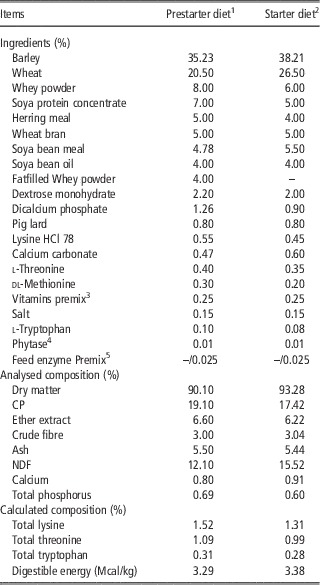
The experiment was carried out at the facility for Animal Production Research and Teaching Centre of the Polo Veterinario, Università degli Studi di Milano (Lodi, Italy). At weaning, a total of 192 crossbred (Stambo HBI×Dalland) piglets (8.10 kg of initial BW) of the same age (24 days of age) and litter origin were randomly assigned to treatment groups. Animals were housed in two identical rooms which were balanced for BW, litter of origin and sex, equipped with 24 pens each, in an environmentally regulated, isolated stable. A combination of daylight and artificial light was used. Ventilation was achieved by using variable-speed fans. The starting temperature of 28°C was adjusted weekly to reach a final temperature of 24°C. Piglets were housed in pens (four piglets/pen), located beside a 120 cm walkway with 12 pens (1.20×1.00 m) each side, with a slatted floor. Each pen was equipped with two water nipples and self-feeder. Piglets were allocated for 42 days to one of the following dietary treatments: basal weaning diet supplemented with (i) no additive (CTRL); (ii) 50 mg/kg EO blend (thymol and cinnamaldehyde); (iii) 100 mg/kg enzyme combination (XB); (iv) 50 mg/kg EO+100 mg/kg XB (EO+XB). Both EO and XB were provided by Danisco Animal Nutrition (Marlborough, UK). Each treatment consisted of 12 replicates with four piglets per replicate. Each pen represented one treatment replicate. The basal diet was formulated to be iso-nutritive, deceeding the protein requirement recommended by NRC (1998) for pigs. The approximate composition and the chemical analysis of the diet are presented in Table 1. The basal diet was formulated and manufactured before starting the trial, without the inclusion of any antibiotic growth promoters or antibiotic growth promoter alternatives. The experimental diets were administered as meal (1.5 mm particle size). Prestarter feeds were fed to piglets from days 0 to 14 of the trial, and the starter feeds were fed to animals for the last four weeks. Chromium (III) oxide (Cr2O3, 2 g/kg) was used as an indigestible marker for the determination of apparent nutrient digestibility.
Composition and nutrient content of the experimental diets (as fed basis)

1 Prestarter: 1st to 2nd week after weaning at 24 days of age.
2 Starter: 3rd to 6th week after weaning at 24 days of age.
3 Vitamin–mineral premix supplies per kg final feed: Vitamin A: 10 500 IU; Vitamin D3: 2500 IU; Vitamin E: 15 mg; Vitamin B1: 1.5 mg; Vitamin B2: 3.8 mg; Vitamin B12: 0.025 mg; Vitamin B6: 1.6 mg; Calcium pantotenate: 12 mg; Nicotinic acid: 15 mg; Biotin: 0.15 mg; Folic acid: 0.5 mg; Vitamin K3: 3 mg; Fe: 100 mg; Cu: 6 mg; Co: 0.75 mg; Zn: 150 mg; Mn: 65 mg; I: 0.75 mg; Se: 0.4 mg; Ethoxyquin: 150 mg.
4 Phyzyme XP 5000 TPT.
5 Feed enzyme premix: essential oils (EO) group: premix 250 g/tonne (50 g EO/tonne); xylanase and β-glucanase (XB) group: premix 250 g/tonne (100 g XB/tonne); EO+XB group: premix 250 g/tonne (50 g EO/tonne+100 g XB/tonne).
Growth, faecal microbial count and nutrient digestibility
Piglets were individually weighed at weaning (day 0 of the trial) and at the end of the trial (day 42). Feed intake was recorded daily and the residual feed was measured at the end of the trial. The average daily gain (ADG), average daily feed intake (ADFI) and gain to feed ratio values (G : F) were calculated for each pen. Pen faecal score was recorded weekly using a scale as follows: 1=hard, dry pellet; 2=firm, formed stool; 3=soft, moist stool that retains shape; 4=soft, unformed stool; 5=watery liquid that can be poured. Liquid consistency (score 4–5) was considered indicative of diarrhoea. Pooled faecal samples from each pen (~20 g), were collected on days 0, 14 and 42, placed in small sterile containers, and immediately sent to the laboratory for microbiological analysis. One gram of the fresh sample was diluted with 99 ml sterile physiological NaCl solution. Following homogenization on a vortex, 1 ml of the suspension was mixed with 9 ml NaCl solution. Serial dilutions (1 : 10) for culturing were prepared down to 10−9. From each obtained sample, 0.1 ml was plated on the appropriate medium for enumeration of microbial populations. Three replicates were carried out for each sample. Plates for the Coliforms (using m-FC agar) were incubated at 37°C for 20 h. Escherichia coli was grown in tryptic soya agar at 37°C. Lactobacillus faecal content was determined using MRS agar (Lactobacillus agar) with an incubation time of 72 h at 37°C (10% CO2), and the Clostridia procedure used an incubation time of 48 h at 37°C with tryptose sulphite cycloserine (TSC) agar.
Two periods were performed during days 15 to 21 (Period I) and days 29 to 35 (Period II) for measurement of apparent faecal digestibility of nutrients, and chromium oxide (2 g/kg) was added to the diet, as an indicator for digestibility measurement, few days before Period I in order to analyse the Cr concentration in the feed. Following 5-day adaptation to the diets, faeces collection started at 0700 h on 6th day of each period and continued for 48 h every 6 h from at least two piglets of each pen via rectal massage. At end of each collection period, pen samples were pooled. All the faecal samples (about 200 g/pen) and the feed samples (300 g/treatment) were frozen and stored at −20°C before sending to laboratory for digestibility assays.
Determination of dry matter (DM), CP, NDF, ash and dietary fibre (DF) were performed using the Association of Analytical Communities (AOAC, 2005) official method AOAC 930.15, AOAC 2001.11, AOAC 2002.04, AOAC 942.05 and AOAC 985.29, respectively. The lipid content was determined according to Italian D.M. 21/12/1998 – GU no. 31 8/2/1999 suppl. no. 13 (Decreto Ministeriale, 1999). The contents of calcium (Ca), phosphorus (P) and chromium (Cr) were analysed as described by Emiola et al. (Reference Emiola, Opapeju, Slominski and Nyachoti2009). The organic matter (OM) was estimated by ashing at 550°C overnight (OM=DM – ash).
Digestibility of nutrients and energy was calculated using Cr content as the indicator according to the following equation:
 $$\eqalignno{{\rm Digestibility\ (\,\%\,)}=\,&{\rm 1}00\,{\minus}\,{\rm 1}00\,\,{\times}[(\,\%\,\,{\rm Cr}\ \,{\rm diet}\,\,{\times}\%\,\,{\rm nutrient}\,\cr &\quad{\rm faeces)}/(\,\%\,\,{\rm Cr}\ \,{\rm faeces}\,\,{\times}\%\,\,{\rm nutrient}\ \,{\rm diet})]$$
Ileum histology and histometry
At the end of the trial, six piglets (three male and three female) per treatment with the BWs close to the pen average were selected and slaughtered. Immediately after slaughtering, the gastrointestinal tract was removed from each animal. The distal ileum (2 cm before its opening into the caecum) was collected and promptly fixed in neutral buffered formalin for 24 h at 4°C. The specimens (total number=24) were then dehydrated in graded ethanol series, cleared with xylene and embedded in paraffin. After dewaxing and re-hydration of the embedded specimens, microtome sections (4 µm thick) were stained with hematoxylin and eosin sequential staining and examined by an Olympus BX51 light microscope to either assess the ileum micro-anatomical structure or perform histometry. The following parameters were evaluated for each section (the observer was not aware of the origin of the sections): the villus height (V) (six villi measured per section at 100×), crypt depth (C) (six crypts measured per section at 100×), the villus height to crypt depth ratio (V : C ratio), the number of lymphatic follicles of Peyer’s patches (counted in five fields per section at 40× and expressed as n/mm2 of mucosa), the area of the lymphatic follicles of Peyer’s patches (five follicles per section at 40×), the number of mucosal macrophages (counted in eight fields per section at 400× and then expressed as n/mm2 of mucosa). Other sections of the distal ileum were processed by immune-histochemical analysis to identify mucosal macrophages with a macrophage monoclonal antibody (1 : 400, ab22506; Abcam, Cambridge, UK) after antigen retrieval with K-protease (20 μg/ml of buffer solution). For each section, the number of immuno-positive mucosal cells was counted in eight fields at 400× and subsequently expressed as n/mm2 of mucosa (Bontempo et al., Reference Bontempo, Jiang, Cheli, Lo Verso, Mantovani, Vitari, Domeneghini and Agazzi2014).
Quantification of gene expression by real-time PCR
At necropsy, ~10 mg of tissue from ileal Peyer’s patches was sampled from each slaughtered piglet, immediately stored in 1.5-ml cryovials with 0.9 ml of RNAlater solution (Invitrogen, Life Technologies Ltd., Paisley, UK) and frozen at −80°C. The levels of interleukin (IL)-1α, IL-1β, IL-6, IL-10, tumor necrosis factor (TNF)-α, toll-like receptor (TLR)-2, TLR-4 and the housekeeping gene β-actin in the samples of ileal Peyer’s patches were subsequently measured. Total RNA was double extracted with TRIzol reagent (Invitrogen, Life Technologies Ltd.), purified with a commercial kit (Macherey-Nagel, Oensingen, Switzerland) and quantified using a NanoDrop spectrophotometer (Thermo Scientific, Waltham, MA, USA). Specific mRNAs were amplified and quantified using the iScriptTM One Step RT-PCR for Probes reagent (Bio-Rad, CA, USA) according to the manufacturer’s instructions. RT-qPCR analysis was performed with a CFX384 Real-Time System (Bio-Rad). The thermal protocol was as follows: 50°C for 10 min for reverse transcription and 95°C for 10 s/60°C for 30 s for 40 cycles. The mix containing primers and probes for RT-qPCR were purchased from Applied Biosystems (Carlsbad, CA, USA). Primers and probes are proprietary and their sequences are not available (IL1α: Ss03391335_m1, IL1β: Ss03393804_m1, TNF: Ss03391318_g1, IL6: Ss03384604, IL10: Ss03382372_u1, TLR2: Ss03381278_u1, TLR4: Ss03389780_m1). The primer pair for β-actin quantification (forward primer 5′-ACTCGATCATGAAGTGCGAC-3′, reverse primer 5′-GTGATCTCCTTCTGCATCCTG-3′, Taqman probe 5′-CGTGTTGGCGTAGAGGTCCTTCC-3′) (Eurofin MWG Operon, Huntsville, AL, USA) was designed with IDT software (available online) and optimized to work in a one-step protocol. The relative expression of target genes was measured by using a calibration curve, prepared with four-point dilutions of random samples from each group and by setting the arbitrary unit of the first point to a quantity level of 1000 and the quantity level of serial dilutions to 200, 40 and 8, respectively. Based on the C t value of every sample, we measured quantity value of each gene. The quantity value of target genes was normalized with the quantity value of the housekeeping gene. The levels of β-actin were comparable in all samples of all animals.
Statistical analysis
All experimental data relative to growth performance, ileum histometry and gene expression were analysed as a completely randomized block design by ANOVA using the MIXED procedure of SAS v. 9.2 (SAS Institute Inc., Cary, NC, USA). The model included the treatment effect, and the pen represented the experimental unit for growth performance, while individual piglet was the experimental unit for ileum histometry and gene expression. Treatment comparisons were done using a Tukey’s honestly significant difference test for multiple testing. Moreover, faecal score, microbial count and nutrient digestibility were analysed by a generalized randomized block design with repeated measures over time, where the pen was the experimental unit.
Results
Growth performance and faecal scores
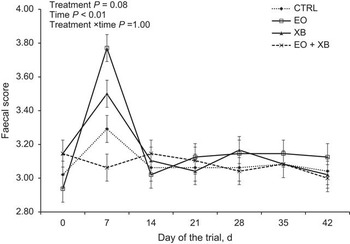
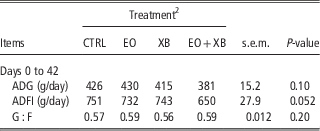
Table 2 shows the results of BW, ADG, ADFI and gain to feed ratio (G : F) of weaned piglets. ADG in the dietary EO+XB treatment had a tendency to be lower than the EO group during the overall study period (P=0.11). EO+XB supplementation tended to decrease the ADFI compared with the CTRL diet from days 0 to 42 (P=0.06). However, no diet effect (P>0.05) was observed on the G : F ratio for the overall experimental trial. The effect of EO, XB or EO+XB on faecal score of weaned piglets is shown in Figure 1. Significant time effect and interaction between treatment and time on faecal score were observed (P<0.01 and P<0.01, respectively). On day 7, high faecal score in EO was observed compared with EO+XB (P<0.01). However, no diarrhoea incident was observed throughout the whole period.
Effect of essential oils (EO), enzymes (xylanase and β-glucanase (XB)), or EO+XB supplementation on faecal score of weaned piglets. CTRL=basal diet without additive; EO=CTRL+0.05 g/kg essential oils (thymol and cinnamaldehyde); XB=CTRL+0.1 g/kg enzymes (XB); EO+XB=CTRL+0.05 g/kg essential oils+0.1 g/kg enzymes. Pooled s.e.m.=0.08. Faecal score were recorded using a 5-point scoring system: 1=hard; 2=firm; 3=soft (moist stool); 4=soft (unformed stool); 5=watery faeces. Diarrhoea: liquid consistency (score 4–5).

Effect of essential oils (EO), enzymes (xylanase and β-glucanase (XB)) or EO+XB supplementation on growth performance of weaned pigletsFootnote 1

ADG=average daily gain; ADFI=average daily feed intake; G=gain; F=feed.
1 n=48 (12 pens/treatment).
2 CTRL=basal diet without supplementation; EO=CTRL+0.05 g/kg EO (thymol and cinnamaldehyde); XB=CTRL+0.1 g/kg enzymes XB; EO+XB=CTRL+0.05 g/kg EO+0.1 g/kg enzymes XB.
Faecal digestibility of nutrients
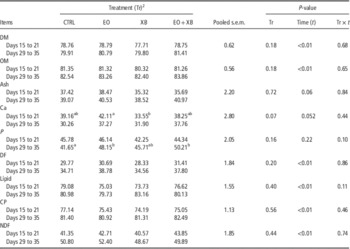
There was no interaction (P>0.05) between dietary treatment and time on the faecal nutrient digestibility (Table 3). The faecal digestibility of DM, OM, lipid, CP, DF and NDF increased from Period I to II (P<0.01), and faecal ash digestibility of piglets in Period II had tendency to be higher than period I (P=0.06), whereas Ca digestibility reduced from Period I to II (P=0.052). The DF digestibility increased from 30.05% to 36.46% from Period I to Period II, and the NDF digestibility increased in the same order as the periods from 42.12% to 50.44%. The XB piglets had lower Ca digestibility than the EO animals in Period I (P=0.04), and EO and EO+XB supplementations tended to increase the Ca digestibility in comparison with the CTRL group in the Period II (P=0.08 and 0.06, respectively). In addition, dietary EO and EO+XB increased the P digestibility compared with the CTRL group in period II (P=0.03 and P<0.01, respectively). In addition, our results indicated that the P digestibility tended to be affected by treatment and time (Treatment×time, P=0.10).
Effect of essential oils (EO), enzymes (xylanase and β-glucanase (XB)) or EO+XB on faecal nutrient digestibility (%) of weaned pigletsFootnote 1

DM=dry matter; OM=organic matter; DF=dietary fibre.
a,bMeans listed in the same row with different superscripts are significantly different (P<0.05).
1 n=48 (12 pens/treatment).
2 CTRL=basal diet without supplementation; EO=CTRL+0.05 g/kg EO (thymol and cinnamaldehyde); XB=CTRL+0.1 g/kg enzymes XB; EO+XB=CTRL+0.05 g/kg EO+0.1 g/kg enzymes XB.
Faecal microbial counts
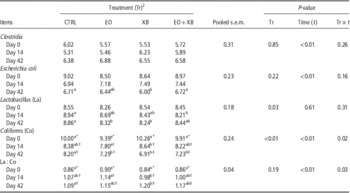
The effect of EO, XB or EO+XB on the faecal microbial counts of weaned piglets is shown in Table 4. Significant time effect was observed on the counts of Clostridia, E. coli, Coliforms and Lactobacillus to Coliforms ratio (La : Co) (P<0.01). XB supplementation decreased the counts of E. coli compared with the CTRL and EO+XB groups on day 42 (P=0.03 and 0.03, respectively). In comparison with the CTRL diet, EO+XB supplementation decreased (P<0.01) the bacterial counts of Lactobacillus on day 14, and dietary EO or XB reduced the populations of Lactobacillus (P=0.04 and 0.01, respectively) on day 42. Two interactions between the treatment and the time of sampling were observed for Coliforms count and La : Co ratio in the faeces (P=0.02 and 0.03, respectively). EO, XB or their combination supplementation did affect the measurements on days 0 and 14, but each supplementation reduced the Coliforms count (P<0.01) and dietary XB (P=0.03) increased the La : Co ratio on day 42, as compared with the CTRL group. In the XB and EO+XB groups the values of the Coliforms count reduced and the La : Co ratio increased from days 14 to 42 (P<0.05), but no difference was seen in the CTRL or EO group.
Effect of essential oils (EO), enzymes (xylanase and β-glucanase (XB)) or EO+XB supplementation on faecal microbiological counts (Log10 cfu/g) of weaned pigletsFootnote 1

a,bMeans listed in the same row with different superscripts are significantly different (P<0.05).
*,†,‡Means listed in the same column with different superscripts are significantly different (P<0.05).
Test on the means of diet×time interaction: Means listed in the same row with different letters, or in the same column with different symbols, are significantly different (P<0.05).
1 n=48 (12 pens/treatment).
2 CTRL=basal diet without supplementation; EO=CTRL+0.05 g/kg EO (thymol and cinnamaldehyde); XB=CTRL+0.1 g/kg enzymes XB; EO+XB=CTRL+0.05 g/kg EO+0.1 g/kg enzymes XB.
Ileum histology
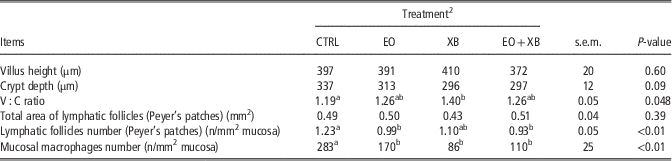
The ileum micro-anatomy was judged to be normal, irrespective of the treatments (data not shown). The effects of different dietary supplementations on ileum histometry of weaned piglets are shown in Table 5. Piglets fed XB alone or in combination with EO tended to reduce the crypt depth compared with the CTRL animals (P=0.11 and 0.12, respectively). The administration of XB increased V : C ratio compared to the CTRL group (P=0.04). Dietary EO (P=0.01) or EO+XB (P<0.01) significantly decreased the number of lymphatic follicles in comparison with the CTRL group. In addition, the EO, XB or EO+XB piglets had less number of mucosal macrophages than the CTRL animals (P=0.02, P<0.01 and P<0.01, respectively).
Effect of essential oils (EO), enzymes (xylanase and β-glucanase (XB)) or EO+XB supplementation on ileum histometry of weaned pigletsFootnote 1

a,bMeans listed in the same row with different superscripts are significantly different (P<0.05).
1 n=24 (6 piglets/treatment).
2 CTRL=basal diet without supplementation; EO=CTRL+0.05 g/kg EO (thymol and cinnamaldehyde); XB=CTRL+0.1 g/kg enzymes XB; EO+XB=CTRL+0.05 g/kg EO+0.1 g/kg enzymes XB.
Ileum gene expression
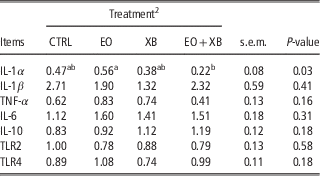
The gene expression levels of inflammatory mediators in the ileum of weaned piglets are summarized in Table 6. The expression level of interleukin (IL)-1α in the EO+XB piglets was significant lower than the EO animals (P=0.02), and also tended to be decreased in comparison with the CTRL group (P=0.12). Similarly, a tendency towards a downregulation of TNF-α was also observed in the EO+XB group compared with EO group (P=0.15). Adding EO+XB to diet also promoted greater mean values in the expression of IL-10 (1.19 RAU), although in this case differences compared with the CTRL (0.83 RAU) were not significant (P=0.21). In contrast, no differences between groups were observed in the ileal expression of the IL-1β, IL-6, toll like receptor (TLR)-2 and TLR-4.
Effect of essential oils (EO), enzymes (xylanase and β-glucanase (XB)) or EO+XB supplementation on ileal cytokines mRNA expression of weaned pigletsFootnote 1

a,bMeans listed in the same row with different superscripts are significantly different (P<0.05).
1 n=24 (6 piglets/treatment).
2 CTRL=basal diet without supplementation; EO=CTRL+0.05 g/kg EO (thymol and cinnamaldehyde); XB=CTRL+0.1 g/kg enzymes XB; EO+XB=CTRL+0.05 g/kg EO+0.1 g/kg enzymes XB.
Discussion
The objectives of the study were to determine whether EO, enzymes or the combination of both compounds added to the diets of weaned piglets would improve gut environment and downregulate gene expression of inflammatory mediators in the gut, and whether there would be a synergistic effect of EO and enzymes. In the present trial positive results were obtained using EO, XB or EO+XB supplemented diets on ileum histometry, faecal microbial population, and inflammatory IL-1α gene expression in the ileum. Villus : crypt ratio represents the nutrient digestion and absorption capacity of the small intestine (Pluske et al., Reference Pluske, Thompson, Atwood, Bird, Williams and Hartmann1996; Montagne et al., Reference Montagne, Pluske and Hampson2003). In our study, the enzyme combination supplemented to the piglets increased V : C ratio in the ileum of piglets by decreasing crypt depth, which may be due to the modulation activity of intestinal microflora and viscosity by XB (Bedford and Schulze, Reference Bedford and Schulze1998). Enzymes may improve gut health through the production of a variety of polysaccharide hydrolysis products that manipulate the growth of gastrointestinal microorganisms and/or reducing the intestinal viscosity due to the soluble non-starch polysaccharide, which might reduce rate of digesta passage and diffusion of digestive enzymes (de Lange et al., Reference de Lange, Pluske, Gong and Nyachoti2010). Fan et al. (Reference Fan, Han, Xu, Wang and Shi2009) evidenced an increase of the villus height in the duodenum, jejunum and ileum and decreased crypt depth in response to dietary supplementation of Acanthopanax senticosus extract, and Mathlouthi et al. (Reference Mathlouthi, Lallès, Lepercq, Juste and Larbier2002) found that the addition of XB increased the villus size and V : C ratio of broilers. Despite the positive results obtained over intestinal histometry in treated animals, in the present study no enhanced faecal nutrients digestibility was observed, possibly because the observational period of the present study was that one around weaning, a period notoriously rich in stressful events which tend to diminish performances.
The antibacterial activity of EO and their positive effects over intestinal microflora were demonstrated in in vitro studies (Mancini-Filho et al., Reference Mancini-Filho, Van-Koiij, Mancini, Cozzolino and Torres1998; Dorman and Deans, Reference Dorman and Deans2000; Lambert et al., Reference Lambert, Skandamis, Coote and Nychas2001; Burt, Reference Burt2004). EO comprise a large number of components and it is likely that their mode of action involves several targets in the bacterial cell. Supplementation of EO may improve gut health by reducing the burden of enteric pathogens in the gut of weaning piglets (de Lange et al., Reference de Lange, Pluske, Gong and Nyachoti2010). Macrophages are known to secrete inflammatory mediators and kill microbial pathogens on activation (Nathan, Reference Nathan1987; Mosser, Reference Mosser2003). Wehner et al. (Reference Wehner, Behrendt, Lyutenski, Lysson, Bauer, Hirner and Kalff2007) observed that depleted and inactivated muscularis macrophage markedly decreased the expression of inflammatory responses and prevented the postoperative ileus. In our study the significant decrease in the number of lymphatic follicles and mucosal macrophages in treated groups might be due to a lower activation of the lymphatic follicles and macrophages than in CTRL piglets, possibly on the bases of a lesser stimulation of defensive mucosal structures by potential pathogen microorganisms. This might suggest that guts from EO, XB and EO+XB groups were healthier than CTRL. As an important character of antibacterial action, the hydrophobicity of EO enables them to partition in the lipids of the bacterial cell membrane and mitochondria, and the consequent higher permeability leads to the leakage of cell contents (Burt, Reference Burt2004). In addition, XB, as the important exogenous enzymes, might exert their beneficial action by influencing the intestinal microflora (Bedford and Schulze, Reference Bedford and Schulze1998). An increase in Lactobacillus and the Lactobacillus to Enterobacteria ratio in the caecum of early-weaned pigs has been reported at dietary application on carvacrol and cinnamaldehyde (Castillo et al., Reference Castillo, Martín-Orúe, Roca, Manzanilla, Badiola, Perez and Gasa2006). In our study, we observed that EO, XB and EO+XB induced significant decreases of Coliforms counts in the faeces, indicating the antibacterial activities directed against potential pathogens. Although dietary EO, XB and EO+XB tended to reduce population of Lactobacillus, an increase of Lactobacillus to Coliforms (La : Co) ratio was observed in the treated groups due to a significant decrease in Coliforms numbers. The decreases of E. coli and Coliforms counts and the increase of La : Co ratio from days 0 to 42 in our study might be due to more mature gastrointestinal system in older pigs (Graham et al., Reference Graham, Hesselman, Jonsson and Aman1986). However, the interactions in the Coliforms counts and La : Co ratio indicated that the improvements of faecal microbial status from days 14 to 42 were due to the supplementations of XB and EO+XB but not EO, suggesting that the effect obtained when two additives were combined was primarily due to the XB. The reduced E. coli and Coliforms counts by the XB supplementation at the end of this study support our hypothesis that the exogenous enzymes may improve intestinal morphology, in particular the V : C ratio.
The weaning phase is characterized by many stressful conditions, including low feed and water intake, separation stress and exposure to novel antigens that could lead to increased levels of pro-inflammatory cytokine mRNA (Pié et al., Reference Pié, Lalles, Blazy, Laffitte, Seve and Oswald2004) in the jejunum, ileal gut walls or Peyer’s patches (Levast et al., Reference Levast, De Monte, Melo, Chevaleyre, Berri, Salmon and Meurens2010). In the present study, EO+XB may have the potential to modulate the expression of pro-inflammatory cytokines involved in innate immune defence against the dietary stress. For instance, a tendency toward a decrease in the expression of IL-1α, a pro-inflammatory cytokine, was observed in the EO+XB group in comparison to the CTRL piglets, but not in the EO or XB group. EO significantly increased the expression of the IL-1α gene compared with EO+XB group, suggesting that the effect obtained when the EO and XB were combined was probably due an unknown synergistic interaction. As the production of monocytes and macrophages, IL-1α plays an important role in the regulation of immune response and immune cell fate, which is proteolytically processed and released in response to cell injury, and thus induces apoptosis (Aho et al., Reference Aho, McNulty and Coussens2003). Similarly, ileal TNF-α gene expression tended to be downregulated in the EO+XB group in comparison with the EO group, whereas there was no difference between any additive and CTRL group. These results suggest that the administration of the combination of EO and XB induced less inflammation response than the feeding of an EO diet. In our study, EO+XB supplementation may also have potential to upregulate the expression of IL-10, an anti-inflammatory cytokine, compared with the CTRL group.
In the present trial, we found that the faecal DM, OM, DF, lipid, CP, NDF and ash digestibility were increased from Period I to II in all the experimental groups, which were in accordance with the observation by Diebold et al. (Reference Diebold, Mosenthin, Piepho and Sauer2004). This period effect can probably be correlated by the growing microbial population in the large intestine and the more developed gut in older pigs. According to Graham et al. (Reference Graham, Hesselman, Jonsson and Aman1986), older pigs have a functionally more mature gastrointestinal system and are able to better digest cereal components of the diet through the effects of both enzyme secretion and bacterial fermentation. Consequently, as the pig ages, the potential for responses to enzymes supplementation declines (Lindemann et al., Reference Lindemann, Cornelius, el Kandelgy, Moser and Pettigrew1986). In contrary to other nutrients digestibility, a reduced Ca digestibility was observed from Period I to II, which may be due to high Ca content in faeces. In this study, Ca supplied in feed was 0.91% from days 14 to 42, which may be over the metabolizable capacity for piglets. In addition, increased BW with age of the piglets may result in decreasing P absorption and retention (Kemme et al., Reference Kemme, Radcliffe, Jongbloed and Mroz1997). Many studies reported that EO or enzymes improved apparent ileal digestibility of nutrients of weaned piglets (Emiola et al., Reference Emiola, Opapeju, Slominski and Nyachoti2009; He et al., Reference He, Yin, Wang, Yu and Chen2010; Owusu-Asiedu et al., Reference Owusu-Asiedu, Simmins, Brufau, Lizardo and Péron2010; Maenner et al., Reference Maenner, Vahjen and Simon2011). In our study, EO and EO+XB supplementation increased Ca and P digestibility of piglets, but no effect of XB was observed suggesting that the effect obtained when the two additives were combined was primarily due to EO. Some EO such as cinnamon, supplying cinnamaldehyde, have been demonstrated to stimulate salivation (amylase production) and pancreatic enzyme secretions (protease production), and result in improvements in nutrients digestibility and availability (Hardy, Reference Hardy2002). Probably, the digestive enzymes which are stimulated by EO may be more effective than XB to utilize the surplus Ca and P. In contrast to the effect on Ca and P digestibility, there was no effect of XB or EO or their combination on faecal nutrients digestibility values in the present trial, which could be due to the evaluation site for digestibility. Diebold et al. (Reference Diebold, Mosenthin, Piepho and Sauer2004) observed that supplemented xylanase positively affected ileal nutrient and energy digestibility when piglets were fed a wheat-based diet, while in the same trial there was no effect of xylanase on the faecal nutrient digestibility. As discussed by Dierick and Decuypere (Reference Dierick and Decuypere1996), the measurements in ileal digesta were more sensitive than those in faeces for detecting the possible effects of enzyme supplementation.
The obtained positive results on gut histometry, microbial gut contents and inflammatory mediators in post-weaning piglets were expected to lead to better growth performance of treated animals based on the fact that more energy should have been available for growth, if not used for immune response processes. In our study, dietary supplementation of EO+XB negatively affected ADG and ADFI, whereas the result indicated that the G : F values of EO+XB piglets were not different from the others experimental groups during the whole period of the trial. Previous studies, regarding the effects of EO and enzymes on growth performance in piglets, are not always consistent. Similar to present study, EO and XB supplementation did not improve ADG in piglets fed wheat barley-based diets (Muhl and Liebert, Reference Muhl and Liebert2007; Owusu-Asiedu et al., Reference Owusu-Asiedu, Simmins, Brufau, Lizardo and Péron2010). In contrast, increased growth performance was reported by other authors (Fan et al., Reference Fan, Han, Xu, Wang and Shi2009; Maenner et al., Reference Maenner, Vahjen and Simon2011). The obtained results on growth performance could outline that the positive effects over the gut environment and inflammatory mediators or microbial faecal counts lead to a better health status of the piglets, but the effects of the administered compounds over these parameters was not sufficient to translate in increased growth. This can be due to the lack of a challenge over experimental animals with pathogens, which could lead to impaired health status of animals and enhance the positive effect of additives over gut environments more than observed in the present trial, thus increasing performance during a stressful event such as challenge. The general good health status of the experimental groups in the present trial is evidenced by the fact that no dietary effect was observed on faecal score, and there was also no diarrhoea incidence. The increased faecal score on day 7 may be due to the stress produced by the transition from milk to a solid diet and the new environment, and the interaction between treatment and time indicate that the combination of EO and XB might reduce the environmental stress by decreasing the faecal score. The present trial showed how the administration of EO, XB or their combination to post-weaning piglets can enhance some gut environment parameters related to morpho-functional aspects, microbial counts and inflammatory responses, but further researches should be done to understand the possible beneficial effects on growth performance.
Conclusions
The current observations demonstrated that dietary EO or XB improved ileum histology in the piglets and decreased the populations of Coliforms in the faeces of animals. In addition, the combination of EO and XB may have a synergistic interaction to improve ileum morpho-functional aspects, modulate faecal microbiology and downregulate inflammatory reaction. However, further works should be continued to demonstrate the preliminary observations in the current study due to the huge variation in weaning period.
Acknowledgements
This project was funded by Danisco Animal Nutrition, DuPont Industrial Biosciences, Marlborough, UK. The authors thank the technicians at Department of Health, Animal Science and Food Safety for performing the analysis of nutrient digestibility. The authors also thank the staff of the Animal Production Research and Teaching Center of the Polo Veterinario dell’Università degli Studi di Milano who took care of the animals and to Dr D. Sciacca for the assistance during the project.