Aluminum (Al) and its alloys are most important lightweight materials with widespread applications for aerospace, transportation, and defense.Reference Clyne and Withers1–Reference Hunt and Herling3 Improving their mechanical properties has been a major research focus in last decades. Among various reinforcing technologies, incorporating ceramic particles to form aluminum matrix composites [referred to as discontinuous reinforced aluminum (DRA)] has attracted extensive attention.Reference Clyne and Withers1, Reference Flom and Arsenault4–Reference Ashby, Kelly and Nicholson6 Mechanical properties of DRA strongly depend on the particle size (d) and volume fraction (f v) of the reinforcements and interparticle spacing (λ). Assuming cubic particle shape and uniform particle dispersion, these structural parameters can be related to each other by the following equationReference Ravichandran7:
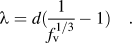
Note that the interparticle spacing can be less than the particle size when the volume fraction is >12.5 vol%.
Previous work on DRA was primarily focused on the materials reinforced with large-sized particles (a few to a couple of hundred micrometers; referred to as category 1 in this article).Reference Flom and Arsenault4, Reference Shi and Arsenault8–Reference Gustafson, Panda, Song and Raj15 For these materials, the interparticle spacing was at micrometer scale, and the reinforcing mechanism is the geometrical necessary dislocations resulted from thermal mismatch between the aluminum matrix and the ceramic particles.Reference Flom and Arsenault4, Reference Kouzeli and Mortensen9 Materials reinforced with a small amount (<5 vol%) of nanoparticles (referred to as category 2) have also been investigated by several groups.Reference Zhang, Maljkovic and Mitchell16–Reference Li, Yang and Weiss20 For these materials, the resultant interparticle spacing is at nanometer scale but much larger than the particle size, and several reinforcing mechanisms were identified for the materials including grain refinement, Taylor effect, and Orowan strengthening, with a major contribution from Orowan pinning.Reference Kang and Chan17 In contrast, materials reinforced with a large amount (>12.5 vol%) of nanoparticles (referred to as category 3) have not been explored yet. The unique feature of the materials in the category 3 lays in that the interparticle spacing is comparable or smaller than the particle size, thus the metallic phase takes nanosheet morphology. This structural feature is similar to that of nacre—a natural nanocomposite which exhibits both high strength and high toughness.
In this article, we report an Al matrix nanocomposite in category 3 with superior wear resistance. We demonstrate that the nanocomposite exhibits abrasive wear with the wear rate even lower than that of stainless steel. The excellent wear resistance makes the nanocomposites very promising for many advanced applications.
The materials studied in this research were synthesized using pure aluminum powder (Alfa Aesar Corporation, Ward Hill, MA) and Al2O3 powders of 50–100 nm and 2–3 μm as starting materials (Buehler Ltd., Lake Bluff, IL). Three composites with different particle sizes and concentrations of Al2O3 reinforcement (in different categories) were prepared (Table I). First, pure aluminum powder and alumina powders with desired concentration and size were mixed together by mechanically alloying in pure Argon environment to form composite powders.Reference Prabhu, Suryanarayana, An and Vaidyanathan21 The uniform distribution of the Al2O3 particles in the Al matrix can be achieved after ball-milling for 20 h.Reference Prabhu, Suryanarayana, An and Vaidyanathan21 Examination of the milled powders revealed that there was no detectable contamination and phase transformation occurred due to milling.Reference Prabhu, Suryanarayana, An and Vaidyanathan21 The milled composites powders were then consolidated using a two-step process: the powders were first sintered at 640 °C under a uniaxial pressure of 20 MPa to 95% of the theoretical density in a vacuum hot press furnace; the sintered pellets were further densified at 650 °C under an isostatic pressure of 100 MPa, in a hot isostatic press furnace using argon as the pressurizing medium. For comparison, pure aluminum sample was also prepared using the same milling and consolidation conditions.
Materials composition, density, and properties.

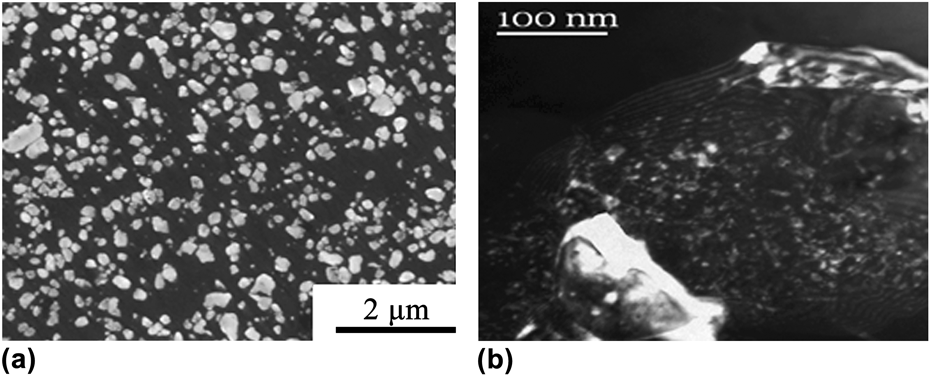
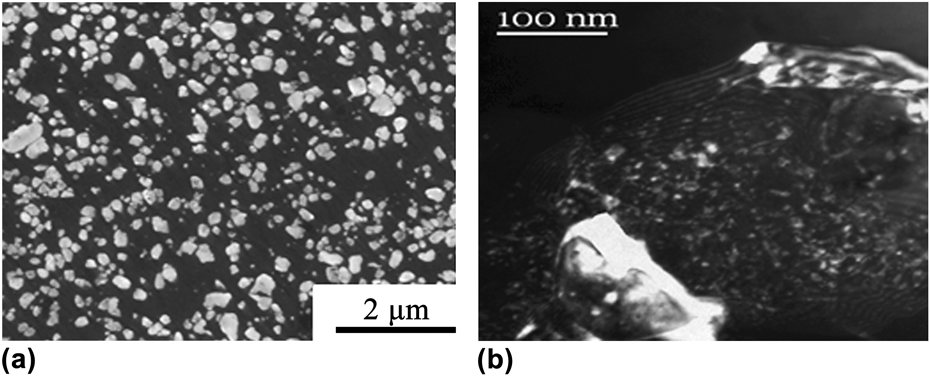
The obtained composites were first examined using scanning electron microscopy (SEM). Figure 1(a) is a typical SEM image obtained from the nanocomposite AA-50-15, showing a homogeneous dispersion of Al2O3 nanoparticles in the Al matrix. Further examination of the composites was carried out using transmission electron microscopy (TEM), as shown in Fig. 1(b). The dislocation density of the materials was measured by measuring the total dislocation length within unit volume. It was found that the nanocomposite in category 3 (AA-50-15) contains much more dislocations than the composites in categories 1 and 2. The measured dislocation density of the AA-50-15 is 7.0 × 10¹⁵ m−2, whereas that of the AA-2000-15 and AA-50-5 is 6.5 × 10¹³ and 1.5 × 10¹³ m−2, respectively, which is in the same order of magnitude as that in the conventional Al-based composite with 20 vol% of SiC microparticles (∼2 × 10¹³ m−2).Reference Arsenault and Shi14 The dislocation density in DRA is determined by two opposite processes: the thermal-mismatch-induced strain (generating dislocation) and thermal-activated strain release (removing dislocation). The thermal mismatch strain is supposed to be independent of the particle size of the reinforcing phase.Reference Arsenault and Shi14 The much higher dislocation density found in the nanocomposite AA-50-15 is rather interesting. This indicates a less effective thermally activated strain release process in AA-50-15, which is probably due to the confining effect in the constrained nanosheet-shaped Al matrix since dislocation motion within such nanosheet becomes more difficult.
(a) Scanning electron microscopy image showing the microstructures of the AA-50-15 nanocomposite; (b) transmission electron microscopy image showing the dislocation pattern in the AA-50-15 nanocomposite.
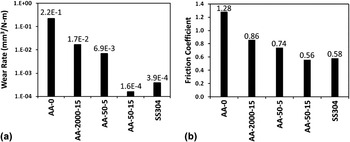
The wear behavior of the resultant materials was tested under nonlubricated ball-on-flat reciprocating sliding in ambient environment (similar to American Society for Testing and Materials G 133-02 procedure A), using an AISI 52100 steel ball of 9.525-mm diameter as the counterface. The normal load was 25 N, and the oscillation rate was 5 Hz with a 10-mm stroke. A relatively short sliding distance (30 m) was used due to the severe wear on AA-0. Wear rates were calculated from weight change measurements after testing normalized by the load and sliding distance. Figure 2(a) compares the measured wear rates of various materials. It is seen that the nanocomposite AA-50-15 (material in category 3) showed the lowest wear rate of 1.6 × 10⁻⁴ mm3/N-m, which is about 1300 times lower than that of the pure aluminum AA-0 (2.2 × 10⁻¹ mm3/N-m). Notably, the wear rate of the nanocomposite is even less than half of that for Type 304 stainless steel (3.6 × 10⁻⁴ mm3/N-m). It is interesting to notice that the wear rate of AA-50-15 is two orders of magnitude lower than that of AA-2000-15 (material in category 1), which contains the same amount, but micrometer-sized Al2O3 particles. The wear rate of AA-50-15 is also 40 times lower than that of AA-50-5 (material in category 2), which is reinforced by Al2O3 nanoparticles in the same size, but at a lower concentration. Figure 2(b) compares the friction coefficients of the test materials. It is seen that AA-50-15 exhibited a friction coefficient much lower than AA-2000-15 and AA-50-5, and comparable to that for the stainless steel. Above results clearly reveal that the Al composites in category 3 possesses superior tribological properties over those in categories 1 and 2.
Comparison of (a) the wear rates and (b) the friction coefficient of different materials.

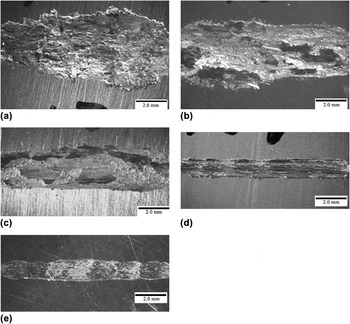
Further investigation of the tribological behavior of the materials was carried out by observing the morphology of the wear scar under optical microscopy (Fig. 3). It is seen that adhesion dominates the sliding wear for the pure aluminum sample [Fig. 3(a)], which is common to conventional aluminum alloys. Adhesive wear was also observed on the worn surfaces of AA-2000-15 [Fig. 3(b)] and AA-50-5 [Fig. 3(c)]. Such severe adhesive wear is a key limitation for the applications of aluminum-based materials.Reference Deuis, Subramanian and Yellupb22 In contrast, the wear mode of AA-50-15 was mainly abrasive wear and plastic deformation [Fig. 3(d)], similar to that of stainless steel [Fig. 3(e)]. These results suggest that the significantly lower wear rate for the composite in category 3 was associated with the change of wear mode from adhesive wear to abrasive wear, which is very important for aluminum applications.
Optical photomicrographs showing wear features of (a) AA-0, (b) AA-2000-15, (c) AA-50-5, (d) AA-50-15, and (e) SS304.

The above results clearly demonstrate that the nanocomposites in category 3 are fundamentally different and possess significantly improved tribological behavior than those in categories 1 and 2. Such improvement is remarkable and will potentially broaden the applications of aluminum-based materials. The adhesive wear behavior of Al-based materials was attributed to the subsurface crackingReference Sanniao and Rack23 caused by the contact-induced shear stress (whose maximum value occurred in the subsurface area). Although the wear resistance can be increased by introducing ceramic reinforcements, results indicated that the wear behavior of the materials in categories 1 and 2 is still dominated by such a subsurface cracking process. In contrast, the wear mode of the materials in category 3 is no longer controlled by subsurface cracking, suggesting a higher resistance to shear fracture. The difference between the materials in category 3 and categories 1 and 2 is likely due to the dislocations in the materials of category 3 being much more difficult to move. Additional contribution to the improved wear resistance in the materials in category 3 could be due to the rotation of nanoparticles. Recently, it has been demonstrated that such nanoparticle rotation was the major mechanism for the superior mechanical behavior observed in nacre.Reference Li, Xu and Wang24
In summary, Al2O3-reinforced Al matrix composites with different sizes and concentrations of the reinforcing phase have been synthesized using a two-step consolidation process. We have demonstrated that the nanocomposites in the category 3, which contains a large amount of nanoparticles, exhibited superior wear resistance as compared to those in the categories 1 and 2 and unreinforced aluminum. The wear rate of the nanocomposite is even lower than that of stainless steel. The improved mechanical behavior has been attributed to the unique structure of the nanocomposite where the Al matrix took nanosheet morphology, which is similar to nacre—a nature nanocomposite. The current results not only may potentially lead to wider applications of Al-based materials but also could inspire a new approach to design engineering materials by mimicking the nature materials.
ACKNOWLEDGMENTS
This work was financially supported by the National Science Foundation of United States (CMMI-0800086) and Hundred Person Program of Chinese Academy of Science. A portion of this research was sponsored by the U.S. Department of Energy, Assistant Secretary for Energy Efficiency and Renewable Energy, Office of Vehicle Technologies, as part of the High Temperature Materials Laboratory User Program.