Introduction
Humour is an important part of daily life. It brings with it pleasure and enjoyment. Having a good sense of humour is considered a positive social trait that facilitates social interaction and bonding. Fraley & Aron (Reference Fraley and Aron2004) reported that humour has a significant effect on the sense of closeness felt initially when meeting strangers. People value a good sense of humour in both friendships and romantic relationships (Sprecher & Regan, Reference Sprecher and Regan2002). Hence, humour has a positive influence on an individual's desirability within a relationship (Bressler & Balshine, Reference Bressler and Balshine2006). Similarly, lack of sensitivity to humour deprives an individual of an important source of pleasure (Brownell et al. Reference Brownell, Michel, Powelson and Gardner1983).
Two elements to the overall humour experience include cognitive and affective components (Gardner et al. Reference Gardner, Ling, Flamm and Silverman1975). The cognitive element incorporates humour detection. In turn, humour detection is regarded as a two-step task (Suls, Reference Suls, Goldstein and McGhee1972). Here, the first step is the detection of incoherence in a humorous event. The second step is the reinterpretation of the event based on alternative possible meanings. Martin (Reference Martin2006a) has further elaborated the cognitive elements of humour using the idea of schema. Here, a schema is considered to be a dynamic mental representation that enables us to build mental models of the world. Martin (Reference Martin2006a) suggested that, when facing a humorous situation, a schema is invoked that enables us to make sense of the incoming information. If the information in the humorous situation does not fit with this schema, we search for an alternative schema that matches. This second schema, in turn, allows for an alternative interpretation of the situation. If this second schema is invoked simultaneously with the initial schema, then humour results. Hence, simultaneous activation of two incompatible schemata is the essence of incongruity in humour.
The affective element of the humour experience refers to humour appreciation. This element often involves experiencing different emotions including positive and negative ones. Funniness and aversiveness of different types of humour are associated with certain personality traits, age and gender (Ruch & Kohler, Reference Ruch, Kohler and Ruch1998).
Humour, as a unique human quality, is highly dependent on cerebral function. Gardner et al. (Reference Gardner, Ling, Flamm and Silverman1975) first reported that patients with brain damage, particularly over the right hemisphere, were impaired in their ability to detect the most humorous cartoon in a cartoon task. Shammi & Stuss (Reference Shammi and Stuss1999) found that individuals with right frontal lobe damage had particular difficulty in appreciating humour. There are a few neuroimaging studies investigating the neural correlates of humour in healthy volunteers (Goel & Dolan, Reference Goel and Dolan2001; Mobbs et al. Reference Mobbs, Greicius, Abdel-Azim, Menon and Reiss2003; Moran et al. Reference Moran, Wig, Adams, Janata and Kelley2004). These studies suggest that the inferior frontal gyrus and temporo-occipital junction are involved in the cognitive aspect of humour, whereas the mesolimbic reward system (e.g. amygdala, ventral striatum, nucleus accumbens) is involved in humour appreciation.
There is substantial evidence suggesting that individuals with schizophrenia have deficits in social cognition, which includes recognizing others' mental states (theory of mind), social perception and attributional style (Pinkham et al. Reference Pinkham, Penn, Perkins and Lieberman2003; Lee et al. Reference Lee, Farrow, Spence and Woodruff2004). These skills are likely to play an important role in humour appreciation. A few studies have examined humour appreciation in patients with schizophrenia. Corcoran et al. (Reference Corcoran, Cahill and Frith1997) investigated the appreciation of visual jokes in people with schizophrenia, focusing on their ability to attribute mental states to others. Patients with schizophrenia showed impairment in understanding jokes, in particular when these require inferences to be made about others' mental states. Patients with positive symptoms showed impairment specific to understanding jokes that relied upon attributions of others' mental states, whereas patients with negative symptoms or disorganization symptoms had difficulties in understanding jokes irrespective of the need to infer the mental states of others. An additional study reported that individuals with schizophrenia performed significantly worse than healthy controls in understanding visual jokes (Marjoram et al. Reference Marjoram, Tansley, Miller, MacIntyre, Owens, Johnstone and Lawrie2005). However, in this study, no differences were reported between patients and controls in subjective appreciation of jokes. Furthermore, neither Marjoram et al. (Reference Marjoram, Tansley, Miller, MacIntyre, Owens, Johnstone and Lawrie2005) nor Polimeni & Reiss (Reference Polimeni and Reiss2006) reported any significant correlation between ability to understand humour and clinical symptoms.
The relatively few studies that explore humour experience in schizophrenia rely on visually presented static cartoon pictures. Thus, we do not know whether patients with schizophrenia respond differently to humour of other modalities such as dynamic comedy film clips. Apart from the study by Marjoram et al. (Reference Marjoram, Tansley, Miller, MacIntyre, Owens, Johnstone and Lawrie2005), the affective appreciation of humour has not been investigated. Previous studies suggested inconclusive results about whether there was any difference in emotional experience between patients with schizophrenia and healthy controls. Kring and colleagues reported that patients with schizophrenia did not differ from healthy volunteers in their reports of pleasant emotions in response to positive film clips (Kring et al. Reference Kring, Kerr, Smith and Neale1993; Kring & Neale, Reference Kring and Neale1996; Earnst & Kring, Reference Earnst and Kring1999). However, other studies have suggested that individuals with schizophrenia reported less positive affect compared to controls, after viewing positive affect-inducing stimuli (Blanchard et al. Reference Blanchard, Bellack and Mueser1994; Schneider et al. Reference Schneider, Gur, Gur and Shtasel1995). Moreover, the relationship between humour experience and different symptoms in schizophrenia is so far ill-defined, and the cognitive and neuropsychological basis underlying the deficit in understanding humour in schizophrenia is largely unexplored.
In this study, we attempted to investigate, in greater detail, humour experience in schizophrenia. We used dynamic humorous film clips in an attempt to approximate as closely as possible to everyday situations. We hypothesized that individuals with schizophrenia would have diminished ability to recognize and appreciate humorous moments compared with healthy controls. We also examined the relationship between humour experience and clinical symptoms, neuropsychological as well as social functioning in schizophrenia. We predicted that ability to experience humour would be associated with patients' social functioning and executive function.
Method
Subjects
Thirty patients who fulfilled operational criteria for DSM-IV diagnosis of schizophrenia (APA, 1994) were recruited from in-patient wards (11 patients) and from the community (19 patients). Thirty gender-matched healthy controls were recruited from the community through advertisement. The controls were interviewed to confirm that they did not have any personal and family history of psychiatric disorders. Exclusion criteria for both groups included the presence of a history of neurological disorders (e.g. head injuries, epilepsy) or learning disability, and a current diagnosis of alcohol or drug dependence. Patients with major visual impairment that could affect viewing film clips were also excluded from the study. Both patients and controls use English as their first language and gave written informed consent before their participation in the study. The study was approved by the local ethics committee.
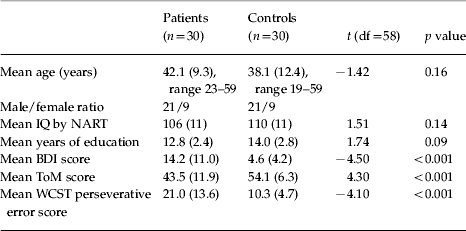
The demographics of the subjects are summarized in Table 1. All patients were on antipsychotic medication at an equivalent mean chlorpromazine dose of 445.2 mg (s.d.=305.9 mg) (Woods, Reference Woods2003). Eight of the patients were on typical antipsychotics and the other patients were on atypical antipsychotics. The mean duration of illness was 17.5 years (s.d.=9.9 years, range 1–40 years).
Demographics, mean BDI scores, ToM scores and WCST perseverative error scores for patients and controls (standard deviation in parentheses)
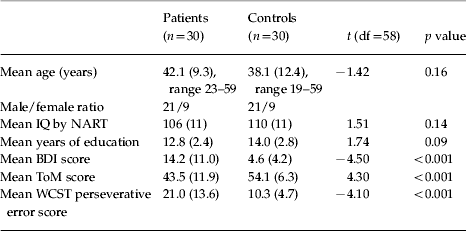
BDI, Beck Depression Inventory; ToM, Theory of Mind; WCST, Wisconsin Card Sorting Test; NART, National Adult Reading Test; df, degrees of freedom.
Procedure
On the day of testing, all participants were interviewed individually for demographic information and they also completed the National Adult Reading Test (NART; Nelson & Willison, Reference Nelson and Willison1991). Afterwards, each participant independently watched four comedy clips on a 14-inch screen of a laptop computer approximately 60–80 cm in front of them in a quiet well-lit room. There was an assistant present in the room to operate the equipment during the study. Subjects were asked to identify the humorous moments in these clips by pressing a key on another computer immediately. Humorous moments were defined as any moment during the clip that subjects found funny. There was no limit to the number of humorous moments that participants could identify.
As a measurement of their current mood state, subjects completed the Positive and Negative Affect Schedule (PANAS; Watson et al. Reference Watson, Clark and Tellegen1988) before the study and after each comedy clip. The PANAS is sensitive in measuring transient mood fluctuations within a subject (Watson & Clark, Reference Watson and Clark1994). Participants were asked to give a rating from 1 (not at all) to 5 (extremely) for different adjectives that best described their feelings at the moment they filled in the questionnaire. These adjectives describe both positive and negative emotions and the scale provides ratings of positive affect (PA) and negative affect (NA) by adding the total scores of the positive emotion and negative emotion adjectives respectively. According to Watson & Clark (Reference Watson and Clark1994), PA reflects the extent to which the subject feels active and alert. A high PA score suggests a state of high energy, high concentration and pleasurable engagement whereas a low PA score suggests sadness and lethargy. NA is a dimension of subjective distress and unpleasant mood states such as nervousness, fear and anger. A low NA score suggests a state of calmness and serenity whereas a high NA score suggests an aversive mood state. After each comedy clip, subjects were also asked (1) to rate the funniness of the clip on a visual analogue scale (VAS) from 0 (not funny at all) to 10 (extremely funny) and (2) to indicate whether they had watched this clip before the study.
The four clips were extracted from the British comedy Mr Bean (A&E TV Networks, 2003) (The Department Store, Turkey and Judo – three clips) and The Full Monty (Twentieth Century Fox Inc., 2000) (Doing the Rumba and Gerald's Interview – one clip). These clips were between 2 min 24 s and 5 min 28 s long. They were shown to the participants in a random sequence. The clips were selected because funny moments could be readily identified even when the sound tracks of the clips had been removed. The sound of the clips was removed to minimize the effect of hearing laughter from the laugh tracks on the subjects' responses. This removal could also reduce the potential confounding effect of language ability on appreciation of humour (Johnson, Reference Johnson1992). As a result, all these clips had the characteristics of ‘slapstick’ comedies.
The clips had been shown previously in a pilot study to a separate group of 35 healthy volunteers to identify ‘standard humorous moments’ for comparison. The healthy volunteers were asked to watch the four clips individually and identify all moments they found to be funny in the clips by pressing a key on a computer. They also rated the funniness of the clips on a VAS from 0 to 10 after watching each clip. ‘Standard humorous moments’ were defined as the moments that at least 70% of the subjects in the pilot study reported to be funny from the pilot study. We also checked with the laugh tracks of these clips to confirm these moments. There were 16 ‘standard humorous moments’ in these four clips. The clips were comparable in their funniness ratings. However, we did not examine whether they were comparable in complexity and brightness.
To adjust for potential differences in performance of recognition between the patient and the control group, participants also completed a baseline recognition task by watching a silent non-humorous video clip lasting 3 min 50 s after the first two comedies. This video clip was extracted from the television game show A Question of Sport. The clip showed the only female host asking a few male sportsmen questions. Participants were asked to indicate by pressing a key when they saw the female host, who appeared repeatedly (total 26 times) during this video clip.
After watching all the video clips, participants completed the Wisconsin Card Sorting Test (WCST; Kongs et al. Reference Kongs, Thompson, Iverson and Heaton2000) and a theory-of-mind (ToM) task (Brüne, Reference Brüne, Brüne, Ribbert and Schiefenhovel2003). The ToM task consists of six sets of cartoon picture stories, with four cards in each set. Participants were asked to order the cards in a logical sequence of events. Questions of different levels of complexity were also asked to test the subjects' ability to appreciate the mental states of the characters involved in the cartoon stories. This task has been used in patients with schizophrenia to investigate their ToM (Brüne, Reference Brüne2005).
Patients with schizophrenia were also interviewed with the following assessment scales by an experienced psychiatrist (D.T.T.): (1) the Scale for the Assessment of Negative Symptoms (SANS; Andreasen, Reference Andreasen1983) and the Scale for the Assessment of Positive Symptoms (SAPS; Andreasen, Reference Andreasen1984); (2) the Calgary Depression Scale for Schizophrenia (CDSS; Addington et al. Reference Addington, Addington and Schissel1990), a scale designed specifically for measuring depressive symptoms in schizophrenia; (3) and the Life Skills Profile (LSP), a measurement of social functioning (Rosen et al. Reference Rosen, Hadzi-Pavlovic and Parker1989). Both patients and controls also completed the Beck Depression Inventory (BDI; Beck et al. Reference Beck, Ward, Mendelson, Mock and Erbaugh1961). The ratings of the BDI allowed comparison of the severity of depressive symptoms between the two groups.
Data analysis
Each clip was subdivided into periods of 3–5 s. These periods were classified as ‘humorous moments’ when participants identified them as such by responding at any juncture during the period. Thus, we were able to classify ‘humorous moments’ even when responses were relatively slow, allowing for potentially slow reaction times in patients with schizophrenia (Cadenhead et al. Reference Cadenhead, Geyer, Butler, Perry, Sprock and Braff1997; Fleck et al. Reference Fleck, Sax and Strakowski2001). Humour recognition was measured by comparing ‘humorous moments’ identified by participants with the ‘standard humorous moments’, using the concept of signal detection theory (Macmillan & Creelman, Reference Macmillan and Creelman1991). Signal detection theory attempts to explain quantitatively how individuals make decisions based on the evidence they have received. One of the measures that signal detection theory can provide is d-prime (d′). d′ is a measure of sensitivity that determines how well the subject is able to identify appropriate stimuli. It takes into account both true positive and false positive responses, independent of the criteria for response adopted by different subjects. As a result, the use of d′ minimizes the potential effect of random responses by the subjects on the results. In this study, d′ (humour) denotes the sensitivity of detecting the ‘standard humorous moments’ that were identified in the pilot study. A higher value of d′ means a higher ability to discriminate ‘humorous moments’ from other moments. To control for the potential differences in depressive symptom scores and performance in the baseline non-humorous recognition task between the patient and control groups, analysis of covariance (ANCOVA) was used with BDI scores and d′ (non-humour) as covariates.
Humour appreciation was measured using the ratings of the PANAS and the funniness ratings of the clips. PA and NA scores were calculated from the sums of the scores of positive and negative items on the PANAS respectively. Mixed analyses of variance (ANOVAs) were conducted to assess whether there were differences in PA and NA ratings, as well as the funniness ratings between groups assorted by subjects or by clips.
Results
Subject demographics and mean scores of BDI and ToM
There were no significant differences between patients and controls in age, IQ (as measured using the NART) and years of education. There was also no significant difference between the percentage of white British in the patient group (93.3%) and the control group (90.0%) [χ2(1, n=60)=0.22, p=0.64]. Subjects with schizophrenia had significantly higher BDI scores, more perseverative errors on the WCST and lower scores on the ToM task (Table 1).
Humour recognition
There was no statistically significant difference in the total number of ‘humorous moments’ recognized by the patient group (mean=37.4, s.d.=23.1) compared with those recognized by the control group (mean=41.0, s.d.=21.1) [t(58)=0.62, p=0.54]. However, patients recognized significantly fewer ‘standard humorous moments’ (mean=4.6, s.d.=3.1) compared with the control group (mean=6.5, s.d.=3.8) [t(58)=2.08, p=0.04].
The mean value of d′ (humour) in the patient group was 0.45 (s.d.=0.42), which was significantly lower than that of the control group (mean=0.73, s.d.=0.42) [t(58)=2.60, p=0.01]. Patients also had a significantly lower d′ (non-humour) (mean=3.86, s.d.=0.72) than that of the control group (mean=4.42, s.d.=0.42) [t(58)=3.71, p<0.001]. After controlling for the BDI scores and the performance in the baseline non-humorous recognition task with ANCOVA, there was still a significant difference between the patient and control groups in d′ (humour) [F(1, 56)=4.70, p=0.03]. The statistical significance of the group difference in d′ (humour) was lost when controlling for the WCST perseverative error score [F(1, 57)=1.64, p=0.21].
The number of clips that subjects had watched before the study was significantly lower in the patient group [t(58)=3.01, p<0.01]. The difference of d′ (humour) remained statistically significant when the number of clips that subjects had watched before was controlled for [F(1, 57)=5.33, p=0.03].
There was no statistically significant difference of d′ (humour) between patients on typical and atypical antipsychotic medication [t(28)=−0.32, p=0.75]. There was also no statistically significant correlation between d′ (humour) and chlorpromazine equivalent dose of antipsychotic medication in the patient group [r=−0.05, p=0.80].
Humour appreciation
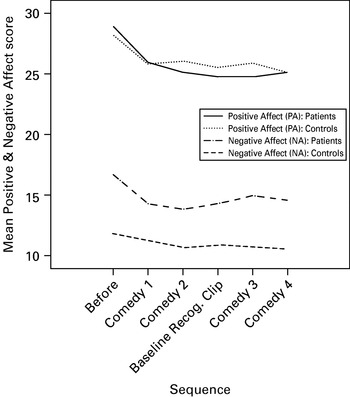
Figure 1 summarizes the PA and NA during the study for both patient and control groups. There was a significant reduction in PA ratings by watching the clips [F(3.70, 214)=8.69, p<0.001]. However, there was no significant effect of the group on the PA ratings [F(1, 58)=0.02, p=0.88] and there was also no significant effect on PA by interaction between group and clips [F(3.70, 214)=0.64, p=0.62]. Moreover, there was a significant reduction in NA ratings by watching the clips [F(3.29, 191)=4.84, p=0.002]. The patient group had significantly higher NA ratings during the study [F(1, 58)=13.9, p<0.001]. Nevertheless, there was no significant effect on NA ratings by interaction between group and clips [F(3.29, 191)=1.27, p=0.28]. There was no significant effect on the funniness ratings by the group [F(1, 58)=0, p=0.99], the clips [F(2.69, 174)=1.73, p=0.17] or the interaction between group and clips [F(2.69, 174)=0.58, p=0.61].
Changes in positive affect (PA) and negative affect (NA) ratings in patient and control groups during the study. A high PA score represents a state of high energy, full concentration and pleasurable engagement whereas a low PA score is characterized by sadness and lethargy. A high NA score suggests a state of subjective distress and includes a number of aversive mood states such as anger, contempt, disgust, guilt, fear and nervousness. A low NA score is characterized by a state of calmness and serenity (Watson et al. Reference Watson, Clark and Tellegen1988).

Correlations with clinical symptoms, neuropsychological function and social functioning
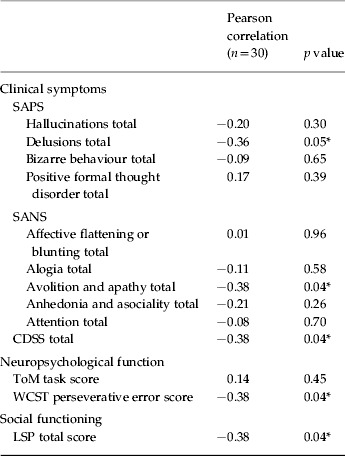
Table 2 summarizes the correlation coefficients between d′ (humour) and other measures in the patient group. d′ (humour) had statistically significant negative correlations with the SAPS delusions total score, the SANS avolition and apathy total score, the CDSS total score, the WCST perseverative error score and the LSP total score. These negative correlations with d′ (humour) remained statistically significant after controlling for d′ (non-humour): the SAPS delusions total score [r=−0.39, p=0.03], the SANS avolition and apathy total score [r=−0.38, p=0.04], the CDSS total score [r=−0.41, p=0.03], the WCST perseverative error score [r=−0.40, p=0.03] and the LSP total score [r=−0.40, p=0.03]. There was also a statistically significant negative correlation between WSCT perseverative error score and the ToM total score in the patient group [r=−0.46, p=0.01].
Correlations of d′ (humour) with other measures in the patient group

SAPS, Scale for the Assessment of Positive Symptoms; SANS, Scale for the Assessment of Negative Symptoms; CDSS, Calgary Depression Scale for Schizophrenia; ToM, Theory of Mind; WCST, Wisconsin Card Sorting Test; LSP, Life Skills Profile.
* Two-tailed, statistical significance at 0.05.
For the control group, d′ (humour) had no statistically significant correlation with the ToM total score [r=0.26, p=0.17], the WCST perseverative error score [r=−0.16, p=0.40] or the BDI total score [r=0.10, p=0.60].
Discussion
The results of our study show that individuals with schizophrenia demonstrated a significantly reduced sensitivity in humour recognition as measured by d′. Patients with schizophrenia recognized fewer ‘humorous moments’ and ‘standard humorous moments’ compared with the controls. However, only the difference in detection of ‘standard humorous moments’ between the patient and control groups was statistically significant. There were no significant differences between the patient and the control groups in affective response to viewing the clips (measured by the PANAS) and in the funniness ratings they attributed to the clips.
These findings seem to support our hypothesis that individuals with schizophrenia show a diminished ability to recognize humour compared with healthy controls. Although the patients with schizophrenia also showed a general deficit in recognition ability (impaired performance in the baseline non-humorous recognition task), the reduced ability to recognize humour in schizophrenia remained significant after controlling for their performance in the baseline recognition task. This diminished ability of humour recognition in schizophrenia also could not be explained by the presence of depressive symptoms.
The results of the affective and funniness ratings did not support our proposed hypothesis that individuals with schizophrenia would have diminished ability to appreciate humour. The significant change in PA and NA ratings of the clips indicated that these clips were able to induce mood changes in both patients and controls alike. The lack of interaction effect between group and clips on both PA and NA ratings suggested that the induced mood changes between the patient and control groups were similar. This similarity was consistent with the comparable funniness ratings given by both patients and controls. Unexpectedly, there was a reduction in PA ratings after the comedy clips in both the patient and control groups. This finding may be spurious because the PA ratings of the PANAS included items such as ‘enthusiastic’, ‘attentive’ and ‘alert’, which were likely to decrease when the subjects had to concentrate on the task. Another possible explanation is that the subjects did not find these video clips funny. It is also possible that some individuals were annoyed by the clips. Certainly, the response of humour is not exclusively positive and depends on factors such as personality characteristics (Ruch & Kohler, Reference Ruch, Kohler and Ruch1998).
Previous research reports that individuals with schizophrenia have similar subjective reports of emotion in response to film clips as compared to healthy volunteers (Kring et al. Reference Kring, Kerr, Smith and Neale1993; Kring & Neale, Reference Kring and Neale1996). Kring (Reference Kring1999) suggested that patients with schizophrenia have a deficit in experiencing appetitive pleasure (pleasure derived from anticipating or expecting that something will bring pleasure) but an intact ability to experience consummatory pleasure (pleasure derived from participating in a pleasurable activity). According to these studies, patients with schizophrenia can derive pleasure when they were told and presented with pleasurable stimuli. However, patients on their own may have not been able to expect that pleasurable stimuli would be likely to bring pleasure. Every subject in the patients' group in our study was told that they would watch comedy clips. We did not find any difference in humour appreciation between patients and healthy controls, possibly because patients have an intact ability to experience consummatory pleasure (i.e. watching comedy clips in the present study), as Kring suggested.
Although our results suggest that patients with schizophrenia may have a diminished ability in humour recognition but not in humour appreciation, these findings could have a different explanation. As patients with schizophrenia did not differ significantly from the controls in the total number of ‘humorous moments’ but only in the number of ‘standard humorous moments’, presumably patients with schizophrenia found overall the same number of funny moments as did controls. Hence, they must have identified funny moments additional to the ‘standard’ ones. Thus, even though patients recognized fewer ‘standard humorous moments’, they still showed similar a level of humour appreciation as controls.
To our knowledge, this is the first study to demonstrate an association between humour recognition and psychosocial functioning in schizophrenia. Humour has been shown to be important in facilitating interpersonal relationships and social interactions (Martin, Reference Martin2006b). Impaired ability to recognize humour in schizophrenia may contribute to the difficulties in daily interpersonal interactions experienced by patients with schizophrenia. Roncone et al. (Reference Roncone, Falloon, Mazza, De Risio, Pollice, Necozione, Morosini and Casacchia2002) have reported that social cognition, in particular the capacity to make social inferences, has a significant contribution in the global social functioning in individuals with schizophrenia. The authors suggested that the ability to make an accurate appraisal of a social situation is a core component of all interpersonal and social skills. A deficit in social cognition affects interpersonal relationships, resulting in psychosocial impairment. Consistent with this is the finding that social cognition impairment accounted significantly for the variance in social functioning in schizophrenia (Brüne, Reference Brüne2005; Brüne et al. Reference Brüne, Abdel-Hamid, Lehmkamper and Sonntag2007). Our findings suggest that this impaired humour recognition may underpin some of the deficits of psychosocial functioning in schizophrenia.
In the patient group, d′ (humour) had significant, though moderate, negative association with delusion, depression, avolition and apathy. Corcoran et al. (Reference Corcoran, Cahill and Frith1997) reported that patients with paranoid symptoms had deficits in understanding jokes that demanded inferences to be made as to the state of mind of one of the characters but did not have any deficit in understanding physical jokes (i.e. jokes that did not require the attribution of mental states to others). Similar findings have not been replicated in other studies (Marjoram et al. Reference Marjoram, Tansley, Miller, MacIntyre, Owens, Johnstone and Lawrie2005; Polimeni & Reiss, Reference Polimeni and Reiss2006). Our findings suggest that the presence of delusions has significant effects on the ability to recognize humour in schizophrenia. The lack of any statistically significant correlation between delusion score and the ToM scores in our study suggests that the association between the presence of delusions and inability to recognize humour may operate independently of ToM. Hence the exact relationship between delusion and humour experience needs further exploration.
Corcoran et al. (Reference Corcoran, Cahill and Frith1997) also reported that schizophrenia patients with behavioural signs (i.e. patients with either formal thought disorder or prominent negative symptoms) had difficulties in understanding both ‘mentalizing’ and ‘non-mentalizing’ jokes. In the present study, we found humour recognition ability had a significant negative association with both avolition and apathy in schizophrenia. In addition, our findings of significant negative associations between humour recognition ability and both avolition and apathy suggest that, among the broadly defined ‘behavioural signs’ by Corcoran and colleagues, both avolition and apathy have important contribution to the humour recognition deficit of schizophrenia.
Ability to recognize humour was found to have significant negative correlation with the perseverative error score of the WCST. In addition, the observation that the difference of sensitivity in humour recognition between patients and controls disappeared when the perseverative error score was controlled for implies that this key executive function may provide an important link between frontal lobe function and humour recognition. The WCST measures the ability to identify abstract categories and shift cognitive set. The number of perseverative errors has been shown to be most sensitive to frontal lobe damage (Anderson & Tranel, Reference Anderson, Tranel and Grafman2002). The frontal lobe plays a role in humour appreciation in patients with brain damage (Gardner et al. Reference Gardner, Ling, Flamm and Silverman1975; Shammi & Stuss, Reference Shammi and Stuss1999). Recent neuroimaging studies have also suggested the involvement of the frontal lobe in the cognitive aspect of humour (Goel & Dolan, Reference Goel and Dolan2001; Mobbs et al. Reference Mobbs, Greicius, Abdel-Azim, Menon and Reiss2003; Moran et al. Reference Moran, Wig, Adams, Janata and Kelley2004). The presence of more perseverative errors in the patient group than the control group suggests that the patients had difficulties in shifting response strategies such as holding different concepts simultaneously. Shifting response strategies is required for humour recognition according to the schema-based cognitive theory of humour, proposed by Martin (Reference Martin2006a). Similar explanation may be applied to mental state attribution in the ToM tasks. The negative correlation between the WCST perseverative error and the ToM total scores in our study and in the study by Brüne et al. (Reference Brüne, Abdel-Hamid, Lehmkamper and Sonntag2007) supports the idea that difficulties in holding two schemata together in schizophrenia may contribute to the impairment in mental state attribution.
Antipsychotic medication may affect cognitive function and hence could have contributed to the deficit in humour recognition in schizophrenia that we observed. Previous studies have suggested that atypical antipsychotic medication may provide some improvement in cognitive function in schizophrenia, particularly when compared with that in those treated with typical antipsychotic medication (Keefe et al. Reference Keefe, Silva, Perkins and Lieberman1999; Bilder et al. Reference Bilder, Goldman, Volavka, Czobor, Hoptman, Sheitman, Lindenmayer, Citrome, McEvoy, Kunz, Chakos, Cooper, Horowitz and Lieberman2002). However, our results did not show any significant difference in humour recognition between patients on typical and atypical antipsychotic medication, nor did we find any significant correlation between humour recognition and chlorpromazine equivalent dose of any antipsychotic medication. These findings suggest that the effect of antipsychotic medication is unlikely to affect significantly the association between impaired humour recognition and schizophrenia.
Finally, it was perhaps surprising that we did not find any significant correlation between the ToM score and humour recognition. This might be because all the comedy clips were slapstick in nature, and understanding the intention and mental state of the actors in the clips was not totally necessary to understand and appreciate the humour in the clip. Further studies are necessary to investigate whether our findings can be extended to other types of humour. Nevertheless, previous studies that used cartoon pictures have demonstrated that individuals with schizophrenia have difficulties in understanding jokes with and without the need to infer the mental states of others (Corcoran et al. Reference Corcoran, Cahill and Frith1997; Marjoram et al. Reference Marjoram, Tansley, Miller, MacIntyre, Owens, Johnstone and Lawrie2005). In addition, although the WCST has been used extensively to measure executive function and as a test of frontal lobe function (Demakis, Reference Demakis2003), some evidence suggests that the WCST may involve non-frontal brain regions (Anderson et al. Reference Anderson, Damasio, Jones and Tranel1991). Hence, humour recognition impairment may depend on a complex network of executive functions that need further exploration.
Conclusions
The present study attempted to examine humour experience in schizophrenia using ‘real-life’ dynamic comedy video clips and signal detection analysis. This study focused more specifically on the broader humour experience in schizophrenia, in particular the cognitive recognition and affective appreciation, rather than the ‘pure understanding’ of the meaning of jokes. We have shown that individuals with schizophrenia may have a deficit in humour recognition, but not in humour appreciation. The difficulty in humour recognition was associated with the severity of delusions, depressive symptoms and perseverative errors in schizophrenia. The ability to recognize humour is an important component of the executive skills necessary for adaptive social interaction. Lack of humour recognition in schizophrenia is likely to reflect a deficit in the ‘social executive’ system.
Declaration of Interest
None.
Acknowledgements
This study was supported by a grant from the Sheffield Health and Social Research Consortium. We are grateful to Dr Rajinder Bhaker for his help in data collection.