Introduction
Over the past two decades, the world has been experiencing a significant growth of the senior population because of longer life expectancy and declining fertility. The United Nations (2015) predicted that the global population aged 60 years or over to increase from 901 million in 2015 to 1.4 billion in 2030 and double the growth by 2050 to 2.1 billion. According to the Hong Kong Special Administrative Region (HKSAR) Census and Statistics Department (2017), 16.5 per cent of the total population in Hong Kong were over 65 years of age in 2017, meaning that Hong Kong has already become an aged society. Authorities forecast that ageing will be at its peak in the next 20 years, with aged 65 and above reaching 23 per cent in 2024 and 30 per cent in 2034 (Census and Statistics Department, 2015). Thus, Hong Kong will very soon become a ‘super-aged society’, a growing challenge that will endure for decades. This drastic growth in the population of elderly/seniors (hereinafter used interchangeably) will lead to a surging demand for specialised social services, housing in particular. Ageing issues, therefore, have now become an imperative factor in policy and research circles in the area.
To meet the needs of ever-increasing number of seniors, more residential care home facilities and nursing homes are not only not sustainable, but it also runs counter to the HKSAR government's principle of ‘ageing in the community’ that it has advocated for years (Legislative Council Research Office, 2015). Likewise, seniors’ dream of living out their last years in their own residences is not in accordance with the concept of residential care services. According to a survey administered by the Census and Statistics Department (2009), 81.4 per cent of senior households expressed a strong preference to remain living at home rather than move into residential care homes. In the literature, there is strong support for seniors’ preference to live in their community (‘ageing in place’ (AIP)) rather than live in residential care homes (e.g. Callahan, Reference Callahan1993; Keeling, Reference Keeling1999; Bayer and Harper, Reference Bayer and Harper2000; Lawler, Reference Lawler2001; Frank, Reference Frank2002; Davey et al., Reference Davey, de Joux, Nana and Arcus2004; World Health Organization, 2007; Judd et al., Reference Judd, Olsberg, Quinn, Groenhart and Demirbilek2010).
Thus, AIP has become a focal concept among policy makers. For instance, the HKSAR government, in its 2015 Policy Address, highlighted the significance of AIP as the main core consideration in designing and planning future senior housing schemes. In recognising the desire of seniors to spend their last years in a familiar environment with dignity and independence, the HKSAR government realised the importance of redeveloping public rental housing (PRH) estates to incorporate the concept of ‘universal design’ (UD). Since the early 2000s, successive governments have, from time to time, incorporated various UD features into the senior housing in PRH redevelopment programmes, in line with the AIP concept. As most of these PRH schemes are estates built in the post-war period, the government has redeveloped these estates to accommodate UD standards from time to time, to cater for housing and other unique needs of the senior tenants. However, to date, no evaluation has been made of the effectiveness of these programmes. It is very important to understand how effective these PRH schemes are, in terms of provision of new AIP facilities and design elements, to address the housing needs in the near future.
The study, therefore, aims to understand the extent to which the housing design elements and facilities that are incorporated into redeveloped PRH schemes are most important to cater to the numerous special needs of the elderly in line with the AIP concept. More specifically, this research aims to identify and evaluate the specific ‘age-friendly’ design features and facilities (introduced to PRH schemes). This will be done by measuring the satisfaction level of the seniors at three levels, namely the micro-, meso- and macro-levels. Perceptions of senior tenants in four large-scale redeveloped PRH estates are investigated. The findings of the study will generate insights into how to plan and provide better and appropriate housing for the seniors to age more safely, independently and with dignity, especially in the context of a high-rise, high-density, compact city. Understanding seniors’ perceptions, from a user perspective, enables optimisation of the design and application of the present redevelopment programme to maximise age-friendliness of PRH estates in Hong Kong. It is also important to note that a well-designed PRH scheme will not only help to leverage the living quality for senior tenants to continue AIP as they prefer, but also ease the heavy reliance on institutional/residential care service provision from the government, when the unique and emerging housing needs of seniors can be met appropriately.
The organisation of the paper is as follows. The following section first presents a careful review of the contemporary literature on AIP and its effects on seniors’ wellbeing. As the situation differs from country to country, the same section, specifically, explores the unique issues and challenges of an ageing population and AIP in the Hong Kong context. The next section describes the methodology employed in this study, followed by a thorough analysis of the empirical data obtained from the questionnaire surveys. The succeeding section discusses the research outcomes and provides appropriate recommendations from various perspectives (e.g. policy and built environments) to enhance further the living quality and experience of the senior tenants in redeveloped PRH estates. The last section concludes and summarises the study as well as its implications.
Literature review
The concept of AIP
The AIP concept has been widely discussed and studied in the past two decades. This concept emphasises the importance of seniors’ ability and willingness to age in their own living environment (Rowles, Reference Rowles1993; Davey et al., Reference Davey, de Joux, Nana and Arcus2004), and accessibility to necessary support from society, families and friends (Callahan, Reference Callahan1993; Keeling, Reference Keeling1999; Lawler, Reference Lawler2001). In other words, most seniors wish to stay in their own homes for as long as possible because it provides them with freedom and the ability to control their lives as they continue to age. Many studies have indicated that AIP is not only economically desirable for policy makers (Hawes, Reference Hawes1999; Chappell et al., Reference Chappell, Dlitt, Hollander, Miller and McWilliam2004) but it is also physically and psychologically beneficial for seniors’ wellbeing (Wu and Hart, Reference Wu and Hart2002).
Economically, an ageing population challenges the economy in various ways, such as shortage of workers (e.g. Mafauzy, Reference Mafauzy2000; Henkens et al., Reference Henkens, Remery and Schippers2008), reduction and/or changes in tax systems (e.g. Felix and Watkins, Reference Felix and Watkins2013; Barrett and Greene, Reference Barrett and Greene2016) and changes in consumption behaviours (e.g. Estrada et al., Reference Estrada, Park and Ramayandi2011; Li and Li, Reference Li and Li2014). Overall, the most important challenge is the high public expenditure on institutional care services. Traditionally, institutional/residential care services, such as nursing homes, have been the policy focus for care service provision for seniors. As the population continues to age, the demand and dependency on institutional care services are expected to increase significantly and eventually put greater burden on the government expenditure on public health, including both acute and long-term care. Thus, policy makers and professionals point to AIP as a financially sustainable and responsible approach to support the health of the seniors as they age. In the United States of America (USA), various analyses carried out by private- and public-sector researchers revealed that institutional care is much more expensive than provision of care in the community or at the seniors’ homes when ‘ageing in place’. For instance, McGill (Reference McGill2013) found that institutional care annually costs US $86,000 per person on average, whereas the average cost to age in a senior home with community care services is US $23,000. Similarly, the AARP and Lewin Group estimated the cost reduction for the Washington State government in the USA by placing AIP as the core policy for seniors’ long-term care services. The result revealed that the government could save approximately US $75 million (Mollica et al., Reference Mollica, Kassner, Walker and Houser2009). In this respect, a healthy and independent senior can be regarded to be relatively cost-effective on health and social services (Tinker, Reference Tinker1997). Moreover, the institutional care service is not only a burden for policy makers, but also for seniors, especially those with low incomes (Marek and Rantz, Reference Marek and Rantz2000; The Polk County Housing Trust Fund, 2012). Overall, the AIP is economically desirable to both policy makers and the senior population (De Meijer et al., Reference De Meijer, Wouterse, Polder and Koopmanschap2013; Lecovich, Reference Lecovich2014).
On the societal front, ageing in a familiar home and neighbourhood provides a sense of place attachment, social network and self-identity, as well as comfort (e.g. Burns et al., Reference Burns, Lavoie and Rose2012; Wiles et al., Reference Wiles, Leibing, Guberman, Reeve and Allen2012). Whilst ageing is closely associated with increased functional disabilities and chronic morbidity, there is evidence to suggest that by allowing seniors to age at home, their functional and physical disabilities can be significantly delayed (e.g. Freedman et al., Reference Freedman, Martin and Schoeni2002). This eventually leads to many positive outcomes, such as improved psychological health, better physical wellbeing and improved quality of life. This results in preserving public health, maintaining functional abilities and reducing long-term care needs in the public health-care system (The Council of State Governments, 2007).
However, AIP itself, if not properly designed and implemented, can lead to serious issues. For instance, by interviewing 40 seniors in the United Kingdom (UK), Sixsmith and Sixsmith (Reference Sixsmith and Sixsmith2008) have observed that there are substantial downsides to AIP. They found that most interviewed seniors who living alone in their home experience intense emotions, frustrations and mental illnesses. The reasons cited by them are lack of informal support, and inappropriate physical environments at home and in the neighbourhood, which substantially undermine the seniors’ abilities to live independently. In addition, lack of proper community and health-care services adds to the suffering of elderly people. In these conditions, seniors experience a high degree of malaise and stress, eventually weakening their ability to live independently (Sixsmith and Sixsmith, Reference Sixsmith and Sixsmith2008). In a Spanish study, Prieto-Flores et al. (Reference Prieto-Flores, Forjaz, Fernandez-Mayoralas, Rojo-Perez and Martinez-Martin2011) also discovered that non-institutionalised seniors suffer from a higher degree of loneliness and hence depression compared to institutionalised seniors. By interviewing 216 Black and Latino seniors living in urban subsidised housing in the USA, Gonyea et al. (Reference Gonyea, Curley, Melekis, Levine and Lee2018) found that 49 per cent of seniors suffer from depression, mainly due to loneliness when ageing at home.
Nevertheless, if properly designed and implemented, AIP is much more preferred by the seniors for many reasons compared to institutional care (e.g. Tinker, Reference Tinker1997; Burnholt and Windle, Reference Burnholt and Windle2001; Frank, Reference Frank2002; Gitlin, Reference Gitlin2003; Koukkari and Sarvakanta, Reference Koukkari and Sarvakanta2005; Hansen and Gottschalk, Reference Hansen and Gottschalk2006; Chan, Reference Chan2014). According to the AARP survey in 2012, more than 90 per cent of seniors in the USA preferred and intended to continue residing in their current homes (AARP, 2012). Similarly, in the Asian context, only 3.6 per cent of seniors in Hong Kong had the intention of moving into a local residential care home or other forms of institution (Census and Statistics Department, 2009). Moving to residential care institutions is often an uncomfortable option for many seniors. Relocation of residency may lead to a loss of social relationships with friends and neighbours, changes in daily lifestyles and routines, and the possibility of leaving behind personal possessions under the perception of moving to a smaller space in a residential flat, as well as loss of independence (Lecovich, Reference Lecovich2014). For instance, AmeriCare (2007) discovered that approximately 26 per cent of the seniors in the study mentioned that they fear moving into nursing homes or other forms of institutional care because they think they will lose independence. Loneliness and lack of independence result in depressions, emotional stress and physical deterioration (Chapin and Dobbs-Kepper, Reference Chapin and Dobbs-Kepper2001).
Theoretical framework of AIP – ecological model
There are many theoretical frameworks, in different disciplines, available to understand, describe and explain seniors’ interactions and behaviours with the neighbourhood environment. They are social learning theory, travel behaviour theory and behaviour setting theory (Garin et al., Reference Garin, Olaya, Miret, Ayuso-Mateos, Power, Bucciarelli and Haro2014). In the field of environmental gerontology, scholars believe that as individuals continue to age, they become more attached to the physical and social environment of the place they live (Lecovich, Reference Lecovich2014). This study is based on the ecological model of ageing (EMA). Over the last century, EMA has spreaded rapidly in the fields of biology and behavioural, social and health sciences (e.g. Bronfenbrenner, Reference Bronfenbrenner1979; Rotabi, Reference Rotabi2007). Developed by Lawton and Simon (Reference Lawton and Simon1968), according to EMA, an individual's functional status is affected by his or her biological, social and mental resources, characteristics of the environment, and the ‘fit’ between the individual and their surrounding environment (Greenfield, Reference Greenfield2012). If the demand from physical and social environments overwhelms his or her resources, the functional status of the senior decreases and they are less likely to age in place (Lawton et al., Reference Lawton, Weisman, Sloane and Calkins1997; Greenfield, Reference Greenfield2012; Lecovich, Reference Lecovich2014). This model also suggests that the mutual relationship and interaction between the senior and the environment can be found at various levels of the individual's daily life, including the micro-, exo-, meso-, macro- and chronosystems (Swick and Williams, Reference Swick and Williams2006). In the present study, three levels – micro, meso and macro – are adopted to examine the seniors’ opinion towards AIP and its elements in redeveloped PRH in Hong Kong.
The micro-scale emphasises the activities and interaction patterns in the immediate surroundings of the senior, such as home (Greenfield, Reference Greenfield2012). As seniors spend a significant amount of time at home (e.g. Sixsmith, Reference Sixsmith1990; Gitlin, Reference Gitlin2003), many studies suggest that the physical home environment plays a pivotal role in enhancing the quality of life and independence of seniors. Particularly, as an individual gets older, the bulk of their daily activities typically happen in their homes and immediate surroundings. Older seniors (80+) spend more than 80 per cent of their time at home. Thus, as people age, strong cognitive as well as affective attachments to their home environment are formed (Baltes et al., Reference Baltes, Maas, Wilms, Borchelt and Little1999; Iwarsson et al., Reference Iwarsson, Wahl, Nygren, Oswald, Sixsmith, Sixsmith, Szeman and Tomsone2007). Therefore, inappropriately designed housing would significantly undermine the functional competency of the seniors (Hwang et al., Reference Hwang, Cummings, Sixsmith and Sixsmith2011). For example, Howden-Chapman et al. (Reference Howden-Chapman, Matheson, Viggers, Crane, Cunningham, Blakely, O'Dea, Cunningham, Woodward, Saville-Smith, Baker and Waipara2007) found that cold, damp, mouldy housing imposed negative effects on seniors’ physical health. Moreover, seniors living in cold homes are likely to experience poorer mental health (Harris et al., Reference Harris, Hall, Meltzer, Jenkins, Oreszczyn and McManus2010). Therefore, appropriate internal design and size of the flats are undoubtedly essential elements to meet the physical and psychological needs of the seniors (Lawton, Reference Lawton1986; Howden-Chapman et al., Reference Howden-Chapman, Signal and Crane1999; Means, Reference Means2007).
Seniors do not only interact with the micro-environments (homes), but also with the external environmental elements – neighbourhoods, communities – which play an important role in achieving successful AIP (Wiles et al., Reference Wiles, Leibing, Guberman, Reeve and Allen2012). The meso-scale, beyond the immediate interactions and environments, covers places that the seniors have direct contact with, such as the neighbourhood (Kilanowski, Reference Kilanowski2017), which are important places for seniors when ‘ageing in place’. Many seniors tend to spend much time in the neighbourhood where they have lived for a long period of time (Gardner, Reference Gardner2011). Seniors are ‘structurally linked’ and committed to the physical and social fabrics of the surroundings (Gory et al., Reference Gory, Ward and Sherman1985). In the UK, Burholt and Naylor (Reference Burholt and Naylor2005) discovered that communities are influential and instrumental in determining a senior's self-identity. The neighbourhood represents an important source of emotional and experimental meanings for the seniors. Research has established a close relationship between the physical infrastructure/design facilities in the neighbourhood and the life quality of seniors. Some important elements of a healthy and elder-friendly neighbourhood include local shopping and businesses (Michael et al., Reference Michael, Green and Farquhar2006; Gardner, Reference Gardner2011), open/green space (Maas et al., Reference Maas, Verheij, Groenewegen, De Vries and Spreeuwenberg2006), accessible pedestrian and traffic infrastructures (Doyle et al., Reference Doyle, Kelly-Schwartz, Schlossberg and Stockard2006; Michael et al., Reference Michael, Green and Farquhar2006), mixed-use design (Frank et al., Reference Frank, Andresen and Schmid2004), and age-friendly and accessible public toilets (Laviolette, Reference Laviolette2011). Likewise, De Donder et al. (Reference De Donder, Buffel, Dury, De Witte and Verté2013) mentioned that the neighbourhoods with limited access to services and with inadequate physical environments cause a sense of insecurity. Neighbourhoods have a decisive impact on social exclusion and inclusion for the seniors, especially those who live in deprived neighbourhoods (similarly Buffel et al., Reference Buffel, Phillipson and Scharf2013). Another study, on the Netherlands and the UK, noted that those living in relatively affluent neighbourhoods experience less loneliness (Scharf and de Jong Gierveld, Reference Scharf and de Jong2008). Thus, having a user-friendly neighbourhood with effective social network and support systems from their families and friends would not only improve physical health conditions but also the psychological health of the seniors (Glass and Balfour, Reference Glass and Balfour2003; Scharlach, Reference Scharlach2009; Oswald et al., Reference Oswald, Jopp, Rott and Wahl2011; Rioux and Werner, Reference Rioux and Werner2011).
The macro-scale represents a broader environment, covering the assistance of various institutions, including social policies and community services provision in particular. These numerous services enhance the seniors’ abilities to age happily in their neighbourhood (Bolda et al., Reference Bolda, Saucier, Maddox, Wetle and Lowe2006; Davey, Reference Davey2006). For those with long-term care needs, services, consisting of home-based services (e.g. home care/cleaning services, visiting nurse services and home-delivered meals) and community-based services (e.g. day care services, senior transportation programme), are particularly important. In fact, the provision of appropriate and adequate home- and community-based care can reverse physical and functional deterioration, delay institutional care placement and enhance the lifespan of the seniors (Borglin et al., Reference Borglin, Jakobsson, Edberg and Hallberg2006; Tang and Pickard, Reference Tang and Pickard2008). Gaugler et al. (Reference Gaugler, Kane, Kane and Newcomer2005) mentioned that family members of seniors with dementia, if home-based services were used early, could anticipate a significant delay in institutionalisation. Albert et al. (Reference Albert, Simone, Brassard, Stern and Mayeux2005) found that there is a significant correlation between the use of the Medicare home care service and the reduction in death among seniors with disabilities. A growing body of research also suggests that participation in community centre activities has positive effects on seniors’ psychological wellbeing (e.g. Choi and McDougall, Reference Choi and McDougall2007). Fulbright (Reference Fulbright2010) also reported a strong association between social support and improved quality of life and life satisfaction, and reduced depression.
Overall, a successful AIP should consist of three main aspects: (a) appropriate internal design of housing (micro); (b) age-friendly community and neighbourhood (meso); and (c) sufficient and appropriate supportive community services (macro). This particular framework is used in this study to investigate the effectiveness of the AIP design features in the redeveloped PRH in Hong Kong.
Challenges posed by an ageing population in Hong Kong
Hong Kong has been experiencing a rapid ageing problem. From 2001 to 2014, the population aged 65 and over has increased from 12 to 15 per cent. By 2015, it had increased up to 16 per cent, meaning one in every six persons was a senior (Legislative Council Research Office, 2015). According to the interpretation of the World Health Organization, Hong Kong is already an ageing society, and Hong Kong will soon become a ‘super-aged society’. The aged phenomenon in Hong Kong is a result of increasing longevity as well as low fertility rate. By 2044 and 2064, the senior population is anticipated to reach 31 and 33 per cent, respectively (Census and Statistics Department, 2015).
Even though AIP is now the focal point of the senior housing policy in the government, no particular attention had been paid to the housing issues of seniors until the early 1990s. The primary policy direction includes the provision of long-term care services: subsidised residential care services and community care services (Hong Kong Legislative Council, 2013). Due to deteriorating health conditions (e.g. dementia, stroke and bone fracture) (Chui et al., Reference Chui, Chan, Chong, Ko, Law, Law, Leung, Leung, Lou and Ng2009), many seniors have chosen to receive residential care services. Over the years, the institutionalisation rate and demand for residential care services have been persistently high, perhaps mainly due to factors such as the diminishing ability of the family to shoulder the care responsibility and the declining trend of co-residence between adult children and their senior parents (Chui et al., Reference Chui, Chan, Chong, Ko, Law, Law, Leung, Leung, Lou and Ng2009). However, residential care services would no longer be financially sustainable and effective accommodation to cater to the housing needs of the increased population of seniors (Tsang, Reference Tsang2016). Thus, the provision of community care services has progressively become the primary source of governmental support to meet senior housing needs. Community care services help to delay or even prevent premature and unnecessary institutionalisation. Especially, community care services (home-based and centre-based services) are imperative for those without any help from care-givers. Given the benefits of community care services for seniors, the government has extended the types of community care services to support the concept of AIP (Legislative Council Research Office, 2015).
In 1994, the colonial administration, on the Report of the Working Group on ‘Care for Elderly’ discussed the importance of seniors living in their own residences so that they can continue to age in place (Chan, Reference Chan2014; Dashun Policy Research Centre, 2015). However, this AIP concept was not officially integrated, as a strategic policy, into the primary task of the government agenda until 1997. Since then, AIP as the core, with institutional care being the back-up, has become the strategic direction of the senior housing policy of the HKSAR government (Wong, Reference Wong2012; Labour and Welfare Bureau, 2017). In the Policy Addresses in 2014 and 2017, the Chief Executive has repeatedly emphasised that the government would seize every opportunity to improve and strengthen the medium- to long-term strategies for senior care services, especially community care services (Labour and Welfare Bureau, 2017). AIP is also the favourite alternative for seniors in Hong Kong. According to the Census and Statistics Department (2009), about 96.4 per cent of senior households expressed a strong preference to remain in their own dwelling and receive community care service support instead of moving into care homes. A recent study reported that those seniors in private residential care homes for elderly people were suffering from higher degrees of depression than their counterpart seniors who were inclined to use community care services (Lou et al., Reference Lou, Chui, Leung, Tang, Chi, Leung Wong and Kwan2011).
Provision of senior housing has been a deep-rooted social issue in Hong Kong. Without a systematic and inclusive housing policy to provide incentives, private developers had expressed no interest in designing and developing housing for elderly people (Wong et al., Reference Wong, Hui, Chung, Li and Lui2012). Thus, the senior housing market has primarily and heavily relied on the public sector. As early as 1973, the government had begun to plan and provide PRH to meet the basic housing needs of all citizens in Hong Kong, including a small proportion of senior citizens (Deng et al., Reference Deng, Chan and Poon2016). As a result of increasing poverty levels among seniors and remarkably high rental costs, seniors have been looking for subsidised public housing. Thus, PRH schemes have become the primary source of senior housing supply. In 2011, more than 46 per cent of senior households (198,840) lived in PRH in Hong Kong (Census and Statistic Department, 2013). This situation is well known in the society, which is known as ‘senior estate’ (老人邨), meaning an estate with a large proportion of seniors in its resident population. However, until now, no comprehensive study has been conducted to investigate their living experiences in the redeveloped PRH schemes.
Redevelopment of aged PRHs and UD
Over the years, PRH schemes have been serving as the primary housing source for seniors in Hong Kong. In 2010, there were 52 PRH estates aged over 30 years, and at least 18 of them were aged 40 years or more (Transport and Housing Bureau, 2010). Many of them were constructed in the post-war period, and thus with poor physical conditions. These traditional PRH schemes were built to cater to the needs of nuclear family households and thus had no any facilities to accommodate the needs of senior tenants (e.g. Wong, Reference Wong2012; Leung, Reference Leung2014). Therefore, some refurbishment and redevelopment work on these PRH estates became necessary. Accordingly, in 1973, the government launched a redevelopment programme – the Comprehensive Redevelopment Plan in the ‘Ten-year Housing Programme’ – for old public housing estates. This redevelopment programme was further expanded in 2011 in line with the government's housing plan, ‘Long-term Housing Strategy’ (Leung, Reference Leung2014). The programme aimed to modify and bring the old public housing stock to up-to-date design standards to optimise estates’ development density as well as to create a healthy living environment by providing adequate community facilities to satisfy the needs of senior tenants in PRH estates (So, Reference So2013).
However, as PRH redevelopment works require a tremendous amount of resources and commitment from the government, this project is realistically unfeasible (Deng et al., Reference Deng, Chan and Poon2016). Hence, in 2005, the Housing Authority introduced an assessment programme, called the Comprehensive Structural Investigation Programme, to identify potential sites for redevelopment of old PRH estates, based on two criteria: structural safety and economic repairs. In this way, the land resources were expected to be best utilised (Hong Kong Legislative Council, 2013). By the end of 2013, about 22 housing estates were included under the assessment for potential redevelopment. As more PRH estates qualify for this programme, the number of housing estates for redevelopment is expected to grow steadily in the near future (Man, Reference Man2017).
To cater to the special needs of the aged population, the government urged newly redeveloped PRH estates to adopt a universal concept – UD – in order to create a safer, flexible and more convenient living environment (Deng et al., Reference Deng, Chan and Poon2016). UD is commonly defined as ‘an approach to design that incorporates products as well as building features and elements, which to the greatest extent possible, can be used by everyone’ (Rhoads, Reference Rhoads2013: 82), in particular by seniors. Although there is no universal guideline available for defining UD, in Hong Kong, the concept is governed and steered by the Facility Improvement Programme and Design Manual (Hong Kong Legislative Council Secretariat, 2012). Design standards consist of AIP design features with emphasis on homes and estate environments. The former involves features in toilet and shower areas (i.e. incorporation of the bathtub and installation of grab bars/rails) and living room (i.e. widening of the doorway with ramp and entrance door width). The latter focuses on amenities and facilities installed in the common areas of the estates, including installation of lifts, escalator, handrails, dropped kerbs, ramps and signage. Furthermore, to improve the quality of senior life, the programmes also emphasise the resource allocations to community support/care services and residential care homes (Planning Department, 2016; Transport and Housing Bureau, 2016; Hong Kong Housing Authority, 2017; Building Department, 2018).
Compared with retrofit and renovation works, redevelopments of old buildings and estates are more advantageous in creating an ‘age-friendly’ living environments. Four of these redeveloped PRH estates are Upper Ngau Tau Kok Estate, Shek Kip Mei Estate, Upper Wong Tai Sin Estate and Lower Wong Tai Sin (II) Estate. Each of these estates have incorporated the UD principles to varying degrees. For instance, in 2007, Shek Kip Mei Phase 1 was one of the first redeveloped PRH estates equipped with fully UD principles in its planning process (Hong Kong Housing Authority, 2007). Inside flats, passageways and doorways were widened and expanded in general, with thresholds lowered and bevelled, to ensure convenient access by seniors in wheelchairs and other walking aids. In addition, design features were provided for ease of use as well as home safety, such as non-slip floor tiles, space for grab-rail installations, lever-type sink/shower mixers and larger buttons/switches at a height within easy reach. Furthermore, there are other improvement works targeted in the estate environment, including installation of ramps, appropriate handrails and tactile guide paths connecting the building blocks’ entrances to major facilities and the estate entrances (Hong Kong Legislative Council Secretariat, 2012); whereas other estates primarily concentrate on improving the age-friendliness of the estate environment. For example, in Upper Ngau Tau Kok Estate, besides basic safety infrastructures (e.g. handrail and non-slip floor tiles), the common and public spaces areas are carefully designed to improve the accessibility and comfort of the estate environments, such as sitting-out areas and physical exercise facilities for seniors which are largely located in covered activity areas. An environmental-friendly estate environment was another focus in the planning of this estate, to provide seniors with a comfortable environment to promote social intersection between senior tenants (So, Reference So2013). Furthermore, the degree of UD incorporation into the estate environment is based on the landscape where the PPR estates were built. For example, the planning processes in Upper Wong Tai Sin Estate and Upper Ngau Tau Kok Estate concentrate more on installation of elevators to improve accessibility for seniors to travel around the estates and neighbourhood, as these two estates are built on hillsides. On the other hand, Shek Kip Mei Estate and Lower Wong Tai Sin (II) Estate focus on the walkability and safety of seniors (e.g. handrail and non-slip floor tiles) when travelling around the estate, as it is located near wet (food) markets. However, although in the planning process, the Housing Department implements and arranges in-flat alteration and improvement works for the senior tenants to satisfy their needs and increase safety in their daily life (Housing Department, 2007).
While the HKSAR government has been widely employing the concept of UD with redevelopment of aged PRH estates to facilitating ‘age-friendly’ environments for senior tenants, there are a limited number of studies that explore the wellbeing of senior residents after moving to a redeveloped PRH estate, and the majority of these studies were designed and conducted with small-scale sample sizes to gather seniors’ experiences in a single case study/PRH estate (e.g. Chan, Reference Chan2014). Thus, this study is one of the studies that investigated this field more specifically and extensively. It explores the effectiveness of particular AIP facilities and design features in catering to the needs of senior tenants, with a relatively larger sample size of senior respondents in four newly redeveloped PRH estates.
Methodology
Design of the questionnaire survey
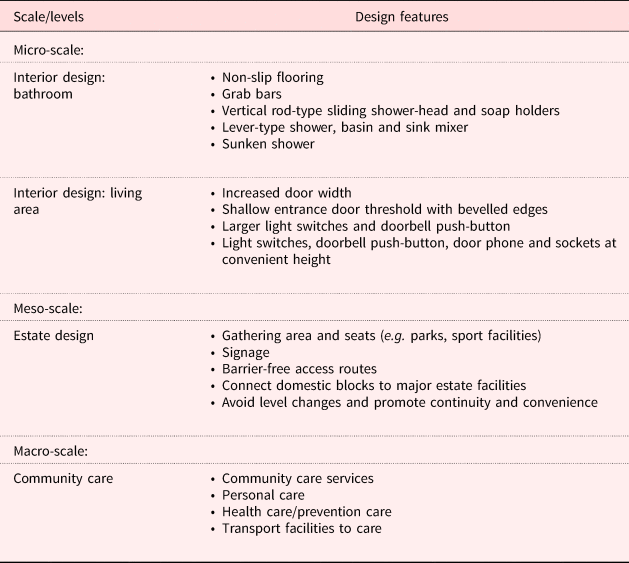
To investigate the effectiveness of the AIP design features and facilities, a single-method approach, a questionnaire survey, was adopted. The analysis is carried out at three built environment dimensions: (a) micro-scale dimension (internal/interior design features at home), (b) meso-scale dimension (estate design features and social networks), and (c) macro-scale dimension (community care support services). A semi-structured questionnaire survey was undertaken during August and September 2017. The questionnaire, which comprised six sections, was design to solicit the perceptions of elderly people on the effectiveness of AIP design elements and facilities. In the first two sections, respondents’ demographic and health information were sought. Sections 3, 4 and 5 solicit information about how effective the design elements and facilities incorporated in PRH estate are, at the micro-, meso- and macro-scales (Table 1), respectively. The respondents were asked to rate the degree of importance and satisfaction to the listed design features on a five-point Likert scale, where 1 = very unimportant/dissatisfied and 5 = strongly important/satisfied. The last section includes open-ended questions in order to collect more in-depth and insightful opinions from respondents (Reja et al., Reference Reja, Manfreda, Hlebec and Vehovar2003). A pilot study, using 20 questionnaires, was carried out to fine-tune the final questionnaire. The feedback received from the pilot study was consolidated into the final draft of the questionnaire.
Design features for micro-, meso- and macro-scales

Before conducting data analysis with the research findings, the authors adopted a Cronbach's alpha test to assess the internal consistency of the 45 items in the questionnaire in three scales, and identify the number of measurement errors (Tavakol and Dennick, Reference Tavakol and Dennick2011). The test was also recognised to be a measure of scale reliability. The standardised Cronbach's alpha test is represented by the following formula in which N is equivalent to the number of items,  $\bar{C}$ equals the average inter-item covariance between the items and
 $\bar{V}$ is the average variance (Institute for Digital Research and Education, 2017):
 ${\rm \alpha \;} = {\rm \;} \displaystyle{{N \times \bar{C}} \over {\bar{V} + \lpar {N-1} \rpar \times \bar{C}}}.$
The internal consistency of the items used to form the micro-, meso- and macro-scales was calculated: α = 0.754, α = 0.799 and α = 0.789, respectively. Cronbach's alpha values (reliability coefficients) exceeding 0.70 were considered as well-established (Tervo and Palmer, Reference Tervo and Palmer2004; Institute for Digital Research and Education, 2017), so that all measured scales were satisfactory for further analysis.
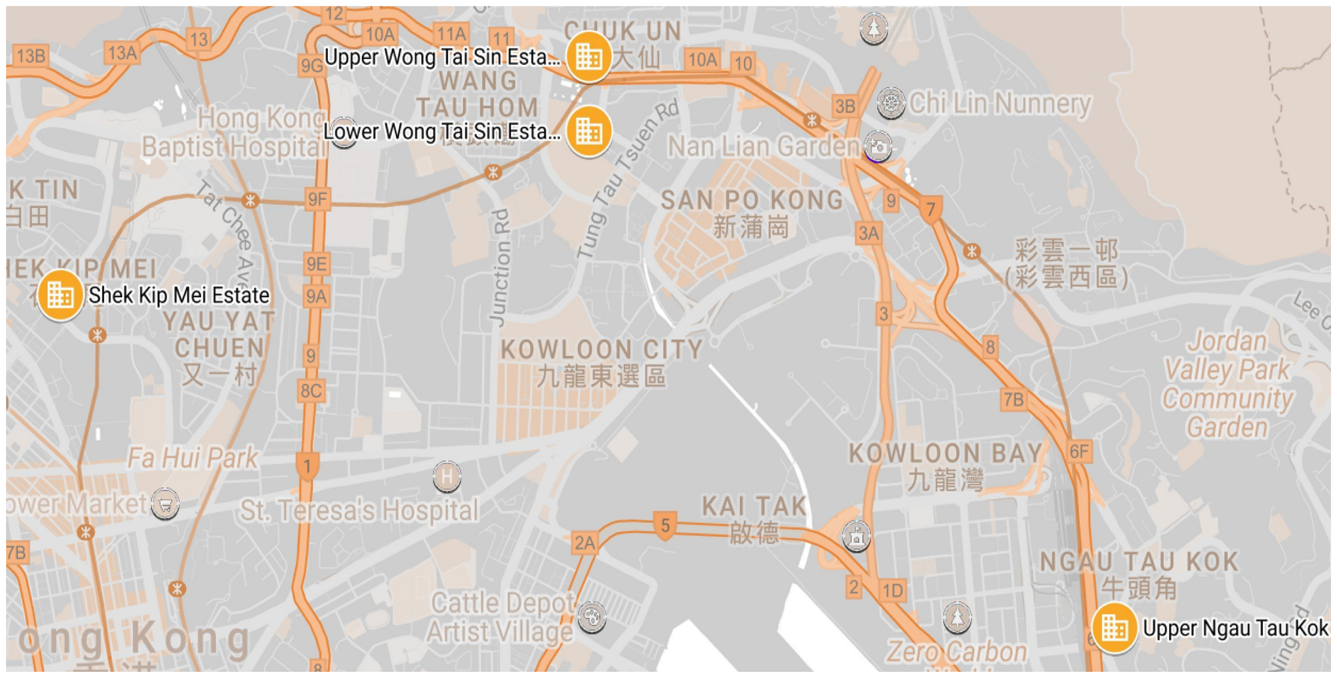
Four redeveloped PRH estates, where senior tenants represent more than 20 per cent of the total residential population, were selected for the study. These were (see Figure 1): Upper Ngau Tau Kok Estate, Shek Kip Mei Estate, Upper Wong Tai Sin Estate and Lower Wong Tai Sin (II) Estate (Census and Statistics Department, 2011). All these are early built public housing estates in Hong Kong, and they are known as the resettlement housing estates or the Government Low Cost Housing Scheme. These estates provide self-contained flats with kitchens, bathrooms and balcony facilities, and simple recreational facilities such as parks and playgrounds. In some aspects of the estates, accessibility was a huge issue to seniors who had difficulty walking or were in wheelchairs. For example, stairways were mainly used to connect between facilities in the estate, whereas wheelchair ramps were not available. According to a respondent in one of the sampled estates, many seniors with a walking disability would choose not to access the recreational areas, and stayed at home, especially on rainy days. This limited their ability to socialise with others. Given the dilapidated structural condition of these building blocks and lack of adequate facilities in these estate environments, these four estates were included in the Comprehensive Redevelopment Plan for redevelopment by the government. These four estates are not only the earliest estates to be redeveloped, but in the redevelopment process they are also the very first estates that were equipped with the UD concept in both residential units and estate environments in order to accommodate the needs of elderly people (for details of the measures of UD that are installed in the estates, see Table 1). Besides, seniors living in these four estates have lived there for many years and, in fact, they lived there before and after redevelopment. All these reasons resulted in a relatively higher proportion of senior residents in these estates in Hong Kong. Therefore, we believe that these four estates are ideal and representative to investigate the effectiveness of the AIP features for satisfying the needs of elderly people.
Locations of selected redeveloped public rental housing estates.

Based on a random sampling method, a total of 224 face-to-face-administered questionnaire responses were collected with a non-response rate of 25 per cent (27 per cent in Shek Kip Mei Estate; 23 per cent in Upper Wong Tai Sin Estate; 28 per cent in Lower Wong Tai Sin Estate (II); 32 per cent Upper Ngau Tau Kok Estate). Of these responses, 24.6 per cent were from Shek Kip Mei Estate, 25.9 per cent from Upper Wong Tai Sin Estate, 24.1 per cent from Lower Wong Tai Sin Estate (II) and 25.4 per cent from Upper Ngau Tau Kok Estate. Hence, the responses are evenly distributed. Among all respondents, female seniors represented 73 per cent and male seniors represented 27 per cent, whilst the largest group of respondents belonged to the age group 75–84, which was 49.5 per cent. Further, more than half of the respondents (53.6%) lived alone in their residences, and 32.1 per cent lived with their spouses. Of the 224 respondents, 62.9 per cent said they had long-term illnesses and diseases. The random sampling method used in the study helped to minimise the potential bias in the sample. It also ensured that the sample size in each group is well represented. This sampling approach is ideal for this type of study, as our research team did not aim for any specific group of the senior populations in the estates. We see that all senior tenants, as long as they lived in the estates, should have opinions towards the built environments of their homes, estates and community. Therefore, the random sampling method seemed appropriate in this study.
Data analytical methods
The descriptive statistics and Pearson correlation analysis were used to analyse the perceived satisfaction of seniors regarding the facilities and design features incorporated in their dwellings and estates. The basic patterns of the data-set were identified by using descriptive statistics in the form of mean score and standard deviation (SD) (Trochim, Reference Trochim2006a, Reference Trochim2006b). Mean score was used to rank the items to establish their relative significance. SD was introduced to show the degree of deviation and to place in ranked position two items with the same mean score. The Pearson correlation coefficient (r) was used to identify the strengths and relationships between dependent variables (overall satisfaction/importance levels) and independent variables (individual design features) on each scale. This would enable identification of design features that are significant for achieving successful AIP (Boston University School of Public Health, 2013). Further, correlation analysis and descriptive statistical analysis (frequency) were carried out to identify patterns caused by unusually high SD in the earlier descriptive statistics.
Empirical analysis
Micro-scale: opinion of satisfaction
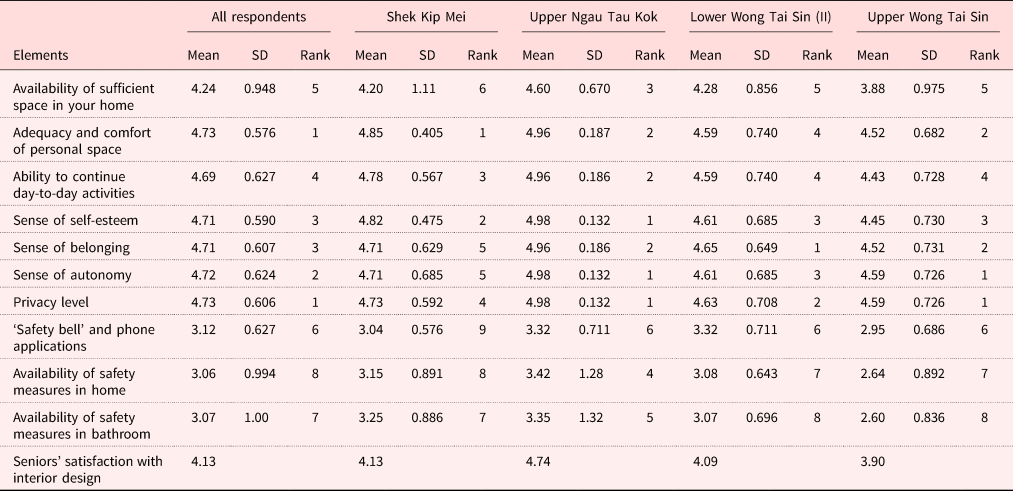
This section analyses the seniors’ perception on the satisfaction level about the existing design features (living and bathroom areas) as well as the physical space in their dwellings. As shown in Table 2, all the senior respondents are highly satisfied with the adequacy and comfort of the personal space provided, with the item ranked first (mean = 4.73), closely followed by satisfaction with their privacy level (mean = 4.73) and sense of autonomy (mean = 4.72), ranked second and third, respectively. However, they are not very satisfied with the available physical assistive measures or safety measures in their flats as the safety-related items ranked lowest. For example, they feel that the existing technological assistance or facilities are not adequate (mean = 3.12), nor are the safety measures in both the living space (mean = 3.06) and bathroom (mean = 3.07). Insufficient safety measures in the living area and bathrooms is also reflected through the high SD which are 0.994 and 1.002, respectively. For safety measures in the living space, among all the demographic aspects, the correlation analysis further revealed that the variable ‘estates’, where the seniors reside, has significantly impacted on their satisfaction (r = −1.43; p = 0.033). In other words, the senior population in different estates have very different satisfaction with the safety measures installed in living space. According to the descriptive statistics, we found that many seniors in Ngau Tau Kok Estate have chosen the options ‘satisfied’ (17.5% of the total sampling) and ‘very satisfied’ (28%), whereas a larger proportion of seniors in Upper Wong Tai Sin Estate were ‘dissatisfied’ (24.1% of the overall sampling in the estate) and ‘very dissatisfied’ (12.1%). However, no significant pattern/correlation is found between the safety measures (in the bathroom) and respondents’ demographic backgrounds.
Seniors’ satisfaction with internal design elements: mean scores, standard deviation (SD) and rank

Note: Seniors’ satisfaction is calculated based on the average of the total scores of all items, given all items are weighed the same.
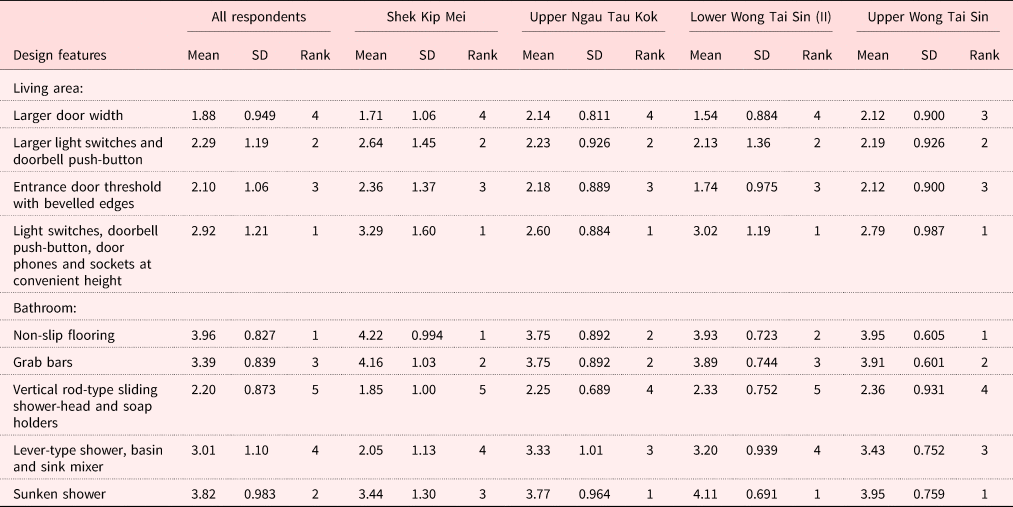
Seniors ranked non-slip flooring (mean = 3.96), safe shower stands/tabs (mean = 3.82) and safe pathways into the shower (mean = 3.39), first, second and third, respectively, as the most important safety enhancement measures (Table 3), indicating their concern about safety measures in the bathroom. For living areas, the mean scores range from 1.88 to 2.92, indicating that those features are less important to the seniors. The top two most important safety measures are ‘light switches, doorbell push-button, door phones and sockets at convenient height’ and ‘larger light switches and doorbell button’ (Table 3). However, these measures have been perceived to be important particularly by seniors with disabilities and who are confined to wheelchairs. Overall, results suggest that the seniors perceive safety measures in bathrooms are more important than in living areas.
Perceived importance on internal design features: mean score, standard deviation (SD) and rank

To examine the relationships between the satisfaction towards home design features (as a whole) and satisfaction towards individual design features, Pearson correlation was performed. As shown in Table 4, there exist statistically significant correlations between satisfaction towards overall home design features and all the individual (independent) variables. This suggests that the overall home design features were directly influenced by each individual design feature. Among all design features, satisfaction towards safety measures in the living area was found to be the most significant with r = 0.605 (p = 0.000). On the other hand, existing assistive technologies which enhance independent living has the weakest relationship (r = 0.293, p = 0.000).
Correlations between seniors’ satisfaction with interior design and micro-scale elements

Meso-scale: estate design features
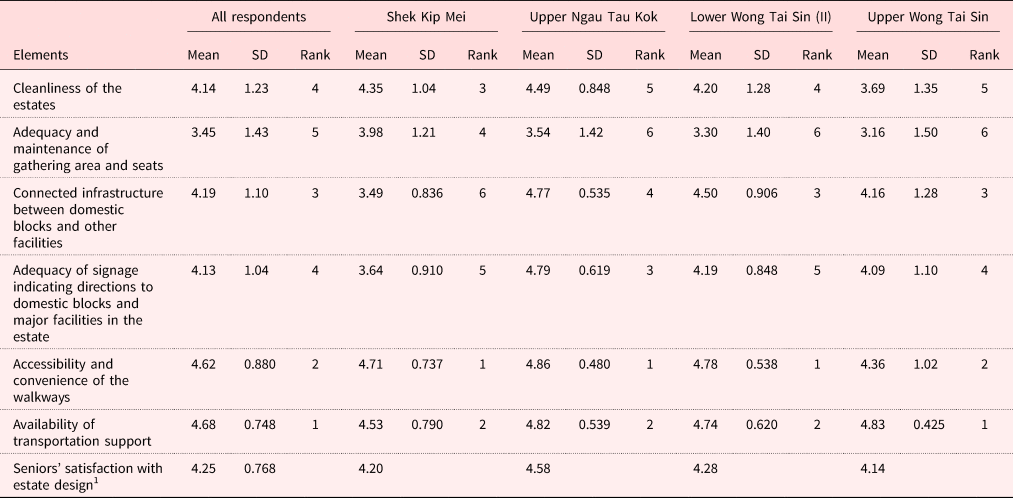
As shown in Table 5, senior respondents were generally satisfied with the estate outdoor environment and facilities. Five estate design features were found to have mean scores greater than 4.0. Seniors were particularly impressed with the accessibility facilities in the estates. For example, availability of transportation facilities (mean = 4.68, SD = 0.748) and convenient walkways within the estate (mean = 4.62, SD = 0.880) ranked first and second, respectively. They opined that convenient accessibility is particularly important for seniors confined to wheelchairs. Accessible routes with adequate ramps, handrails, and convenient steps and staircases are necessary for them to move freely and safely in and around the estates. Nevertheless, seniors were not very satisfied with the existing gathering areas and seating arrangements. This was clearly reflected through the lower mean score and the high SD for ‘adequacy and maintenance of gathering area and seats’. High SD can be interpreted that seniors’ opinion was not unanimous, or rather controversial between estates/respondents. However, no significant pattern was found when using correlation analysis between this feature and respondents’ demographics, including between estates.
Seniors’ satisfaction with estate design elements: mean score, standard deviation (SD) and rank

Note: 1.
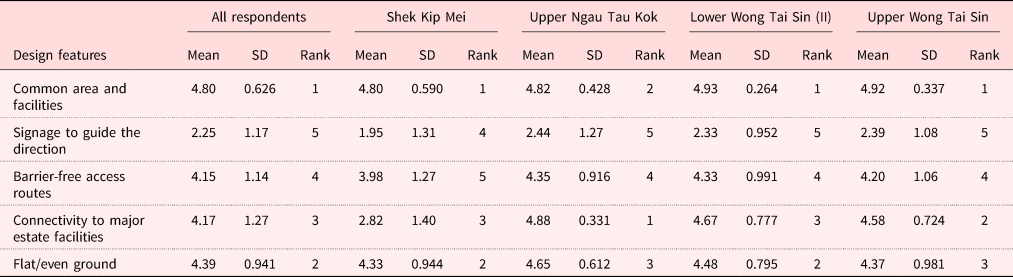
Further analysis of the seniors’ perceived importance level on various estate design features was carried out (Table 6). Results indicate that the most important estate design feature for the seniors is ‘common area and facilities’. This is understandable because most senior respondents (in all four estates) mentioned that they regularly visit one or more common areas/facilities. It was revealed that more than 76 per cent (171 out of 224) of the respondents visit at least one facility every day. Common areas and public facilities basically include facilities/features such as public spaces, sports facilities and public seating. Even though they perceived this design feature as the most important to have within an estate, they were not very satisfied with the current state of the facilities in their estates as the ‘adequacy and maintenance of gathering area and seats’ ranked least (mean = 3.45, SD = 1.432; Table 5).
Perceived importance of estate design features: mean score, standard deviation (SD) and rank

Table 6 shows that the important design features as perceived by seniors are ‘flat/even ground’ and availability of ‘connectivity to major estate facilities’. This might be due to the fact that all four estates are located in hilly areas, and thus having an even surface is an essential design feature in the estate for them to age in place safely. On the other hand, the feature ‘signage to guide the direction’ has been perceived as the least important. This is not surprising because all the seniors are very much familiar with the estate environment, as they have been living many years in their estates. Overall, the most important estate design features in redeveloped public rental estates are, ‘common area and facilities’, ‘barrier-free access routes’, ‘connectivity to major estate facilities’ and ‘flat/even ground’.
Positive and statistically significant correlations were found between overall satisfaction towards estate design and all other satisfactions on the meso-scale (Table 7). Results showed that the extent of overall satisfaction towards the estate design had direct linkage with satisfaction of all design elements, particularly accessible walkways and connected infrastructure, which exerted the strongest impact. On the other hand, ‘availability of transportation support’ had the weakest influence.
Correlations between seniors’ satisfaction with estate design and meso-scale elements

Macro-scale: community care support services
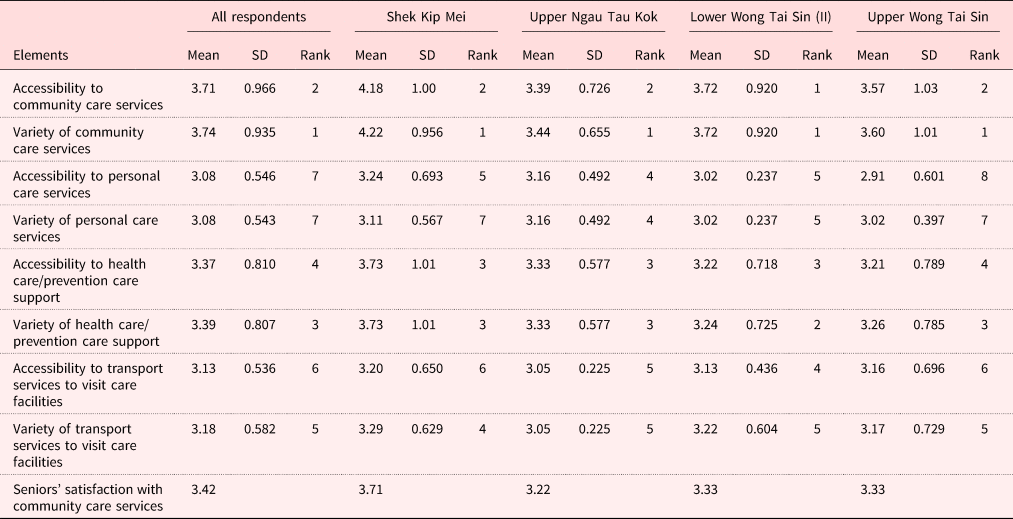
This section analyses the availability of community care support services in the four estates. As seen in Table 8, respondents generally were not satisfied with community care support services. However, community care services provided either by non-governmental organisations (NGOs) or estate authorities were somewhat acceptable to them, which is reflected through relatively high mean scores. However, large SD suggest that respondents (in the same/different estates) do not have consistent views on the community care service. The correlation analysis, conducted to examine the causes/patterns of such high deviations, revealed that both features (accessibility and variety) in community care services are closely related with two demographic features (estate and age). In terms of satisfaction for the accessibility of community care services, a strong relationship was found between the ‘estates’ and respondents’ ages. For instance, in Shek Kip Mei estate, 28 respondents were ‘very satisfied’ (50.9%) and 13 were ‘satisfied’ (23.6%); whereas, in Upper Wong Tai Sin Estate, 11 respondents (19%) said they were ‘dissatisfied’ with the feature. Furthermore, 13 respondents (41.9%) were ‘very satisfied’ and seven respondents (22.6% of the sampling in the estate) were ‘satisfied’ in the 85–94 age group. On the other hand, for those in the 75–84 age group, 17 respondents (14.3%) expressed that they were dissatisfied with the feature.
Seniors’ satisfaction with community care support services elements: mean score, standard deviation (SD) and rank

A similar trend was also found with regard to the variety of community care services, in which a strong correlation was found between the same two demographic aspects: estate and age. First, the variety of community care services has good correlation with the ‘estate’. For instance, in Shek Kip Mei estate, 28 respondents (50.9% of the total sampling in the estate) were ‘very satisfied’ and 14 respondents (25.5%) were ‘satisfied’ with the feature. In contrast, ten respondents in Upper Wong Tai Sin estate were ‘dissatisfied’. Moreover, in terms of age, it has a strong influence on the feature (r = 0.178, p = 0.008). For example, more respondents (39 persons; 17.4% of the total sampling) in the 65–74 age group were ‘dissatisfied’ or ‘neutral’; whereas, respondents who belonged to the 75–84 age group were mostly ‘very satisfied’ (25.2% of the total sampling) and ‘satisfied’ (28.9% of the total sampling) with the feature. Hence, these two patterns have contributed to the high SD on the satisfaction with both accessibility and variety of community care services.
In contrast, respondents were indifferently satisfied with personal care support services, such as ‘accessibility to personal care support services’ (mean = 3.08) and ‘variety of personal care support services’ (mean = 3.08). This indicates personal care services were not up to the expectation of the elderly people in these PRH estates.
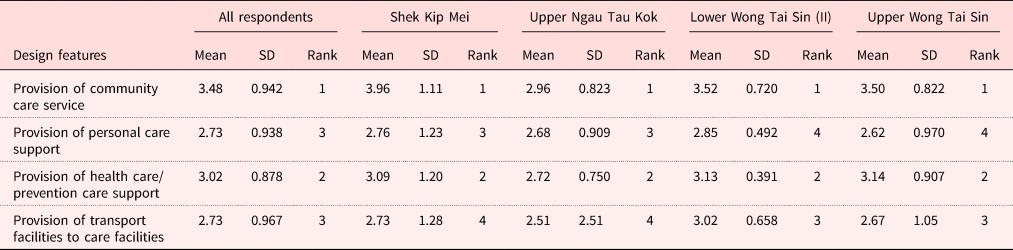
Table 9 presents the seniors’ perceived importance of community care services in the estates. Respondents expressed that provision of personal care support (mean = 2.73) and transport facilities (mean = 2.73) are not necessary for them unless their health condition deteriorates to a degree that they cannot take care of themselves. Thus, they opined that these services are less important. Nevertheless, provision of community care services was considered to be more inclusive and needed for every senior (Table 9). Thus, we can infer that two essential elements to respondents at macro-scale are ‘provision of community care services’ and ‘provision of health care/prevention care support.’
Perceived importance on community care support services: mean score, standard deviation (SD) and rank

Table 10 reveals that the satisfaction with ‘accessibility of community care services’ (r = 0.718, p = 0.000) and ‘variety of community care services’ (r = 0.743, p = 0.000) strongly correlate with the senior's overall satisfaction towards community care support services. It indicates that community care services were the primary drivers to the make-up of the overall satisfaction in this scale. Whereas, transport services that enable seniors to visit care facilities, including its accessibility and variety, yielded much less impact on the overall satisfaction, comparatively.
Correlations between seniors’ satisfaction with community care support services and macro-scale elements

Discussion and recommendations
Changes in the age structure of the population will continue to impose serious economic and social problems for Hong Kong, and one of the greatest challenges is the provision and conditions of senior housing. Senior citizens typically prefer to age in their dwellings for as long as they are physically capable of taking care of themselves. As more post-war PRH estates are expected to be redeveloped, the present study measures the effectiveness of special design elements and facilities incorporated under the Comprehensive Redevelopment Plan, to cater to the needs of senior tenants when ‘ageing in place’. This study evaluated the perceptions (satisfaction and perceived importance level) of senior citizens in four redeveloped PRH estates across Hong Kong.
Seniors’ opinion on AIP design features and facilities were explored at three different scales/perspectives: micro, meso and macro.
Micro-scale
Seniors were satisfied with the design features of their homes in general. They perceive that their present home environment provides them with some psychological comfort. In fact, they perceive that their present home design provides adequate privacy, sense of autonomy as well as personal space, which are crucial to achieve successful AIP.
The seniors, however, have serious concerns about safety. The technological and physical safety measures installed in their dwellings are inadequate to provide a safe living/home environment for them. The safety issue within the aged population in Hong Kong is serious (Cheung, Reference Cheung2016; Ng, Reference Ng2017). Furthermore, the seniors complained that they have no knowledge about where to seek help in getting government-sponsored safety measures. Thus, they mainly rely on themselves or seek help from their family members in getting safety measures installed. A respondent in Upper Wong Tai Sin Estate stated:
To me, safety is the most important concern when living alone at home. My home design is not changeable, and do not allow [us] to modify. Since I have no proper safety measures installed in my home [living area and bathroom], I just need to be more careful to avoid getting hurt.
It is therefore essential to enhance safety measures in their dwellings, particularly in living areas and bathrooms.
According to many senior respondents, slipping/falls in the bathroom have been a major concern, especially when walking into/out of showers. Thus, measures such as non-slip flooring and appropriate shower stand/tub for safe and easy entrance for showers are essential to ensure accident-free living for the seniors. Another important view was that more handrails/grab bars needed to be installed in the bathroom. Seniors also highlighted the importance of safety measures in living areas, especially for those confined to wheelchairs. In this respect, a larger size of light switches, push-button doorbells, door phones and sockets can be installed at a convenient height.
Meso-scale
Results revealed that the neighbourhood and public areas are equally important for the seniors to achieve successful AIP. This is in accordance with some previous studies (Carp and Carp, Reference Carp and Carp1982; Perez et al., Reference Perez, Fernandez, Rivera and Abuin2001). Most seniors mentioned that the surrounding estate environment adjacent to their dwellings is more important than their own home environment for their wellbeing. In fact, they were very enthusiastic about discussing and expressing their opinion on the estate environment rather than the home environment. Some seniors mentioned that a properly designed neighbourhood environment – public seating, space and facilities – could make them happier.
Overall results suggest that factors such as convenient transportation and accessibility, including convenient walkways, are most important. This coheres with previous finding by Perez et al. (Reference Perez, Fernandez, Rivera and Abuin2001) which found that better walkways with barrier-free access are highly appreciated by seniors. This indicates that the government and authorities should seriously consider designing senior-friendly walkways and transport connectivity/facilities when redeveloping PRH estates or in new housing schemes for the seniors. For instance, a respondent in Shek Yip Mei estate expressed:
I feel the estate is now convenient with improved accessibility. It does not need too much effort to walk from one place of the estate to another. Foot bridges and lifts are available everywhere.
Another critical aspect needing proper attention is the need for a repair and maintenance programme in common areas and seating in the estate. The seniors were not very satisfied with the prevailing condition of common areas, especially the design of common facilities including public seating. Generally, most seniors spend a considerable time in the common area. During the survey, many of them emphasised the present condition of recreational the parks, such as inadequacy of seats, lack of senior sport facilities and other public facilities (e.g. public washroom, wet (food) markets) in the neighbourhood and community. For example, respondents in Upper Wong Tai Shi estate repeatedly emphasised the inadequacy of seats and facilities in the public area of the estate. A respondent commented:
This is a ‘senior’ estate. Seniors normally spend most their time in the park, especially in the afternoon. However, there are always not enough seats in the park, elderly centres and shopping malls. It is quite frustrating.
In Lower Wong Tai Sin (II) Estate, the absence of public washrooms and inadequate indoor seating were emphasised greatly by many seniors. A respondent stated:
We [seniors] need more public washrooms. We like to sit and spend time in the park. However, without adequate washrooms, we often need to rush home if urgent … Also, it is important to have more seats with shelters and back rest/support. This is especially very important on rainy days.
It is therefore important to provide adequate and appropriate public seating, both indoors and outdoors. For outdoor seating, sunroofs and high seat backs are necessary to ensure the comfort and safety of seniors in common areas.
Macro-scale
Most senior respondents were satisfied with accessibility and the numerous community care services offered by the local charitable organisations in the estates. The numerous health care/prevention services were also adequate to cater to the needs of respondents. Especially, they considered the number of community service centres available in the estate as the most important community care service for them. For instance, relatively higher satisfaction was found in Shek Kip Mei estate, where at least five community care centres and residential care centres are already established. On the other hand, Upper Wong Tai Sin estate received the least satisfaction in this respect as it has only one senior community centre. A respondent in this estate stated:
You know, we [seniors] have nowhere to go, and we usually stay either in the park or the community centre to socialise with friends. Especially, in the summer, I love to go to the community centre for the air-conditioning and reading newspapers. However, the centre is always crowded every day. Because there is only one community centre in this estate, everyone who lives here goes to this one, and eventually it gets very crowded. So now, I cannot stay there anymore. I rather sit outside in the hot weather than ‘squeeze’ myself in the crowded space.
Moreover, seniors’ needs/expectations, in terms of accessibility and various community care services, differ across different age groups. For example, older seniors (aged 85–94) are satisfied with one senior centre. In contrast, seniors in the 75–84 age group prefer to have multiple senior centres. The same phenomenon was found with regard to the availability of a variety of community care services. The older seniors (aged 75–84) are generally satisfied with the existing number of community care services in the estates, but the majority of those in the 65–74 age group are quite dissatisfied. As the older seniors’ movements are restricted, they are satisfied with the existing service provision. On the other hand, younger and active seniors are willing to participate in as many community activities as they can in the neighbourhood. For example, a younger senior in Shek Kip Mei estate said:
After retirement, I feel I have lost my life's direction. It was difficult in the first few years for me to overcome this major change of life. A few years later, I started to follow my neighbours and participate in activities in my estate. Rather than sitting and facing ‘four walls’ at my home, I am an active member of my centre. I do not only actively participate in many activities/workshops in the centre, but also became a senior committee member who helps the social workers in the centre to contact other seniors to join the upcoming activities. Now I feel my life has a purpose.
Seniors perceived the provision of better community care services as the most important compared with other services. Hence, a significant improvement on community care services, both qualitatively and quantitatively, is necessary. In terms of quality, a local senior centre should be equipped with numerous community care services in order to cater to different needs of seniors. Seniors in different estates tend to have diverse needs given their unique experiences in the estate environment as well as design. Thus, more investigations are needed to seek senior participants’ opinion regarding their satisfaction on a regular basis. Furthermore, the supply of this service must also be increased for seniors, especially when accessibility remains an issue for some estates.
There is also a need to improve the diversity of personal care services. One of the biggest challenges for seniors was the lack of guidance on finding application channels. There was no way for them to apply for a service unless social workers approached them directly. It is therefore highly recommended to provide seniors with effective information on how to approach the service providers directly. Currently, most of the personal care services, such as meal delivery and home cleaning services, are exclusively available to those who are referred by social workers. Hence, the authorities may provide financial incentives to motivate NGOs or other organisations to include more seniors who may not previously have been eligible for the plans, especially those who require more attention than others, such as ‘old-old’, ‘deteriorated health’ and singleton seniors.
Participatory approach for seniors
Throughout the data collection period, there was a common concern among the senior respondents in all four estates. Their concern was the absence of public engagement activities/workshops for the residents, and not getting seniors engaged in discussions to understand their thoughts on designing built environment in estates. For example (micro-scale problem), a respondent in Shek Kip Mei estate mentioned:
I am a senior with disabilities and I rely on a wheelchair to move around. Rather than spending time in the park, I prefer to stay at home and watch television. However, my home is so small, which makes it difficult for me to move around with the wheelchair. I am very disappointed that no one has ever approached and consulted me about my needs. Also, there is no way for me to express my concerns to people who are in charge and can directly help me.
In addition, seniors in Lower Wong Tai Sin estate commonly highlighted and criticised the unavailability of a public washroom in the common area (meso-scale problem). They particularly expressed their frustration because they had no room/way to express their demands/concerns during the redevelopment phase, or even after the redevelopment work in their estates. For example, a respondent said:
We have been complaining about the inaccessibility to public washrooms in the public space. You know, we [seniors] don't like to stay at home all day and prefer to socialise in parks during the day time … We [seniors] have been telling the estate office over the years, but still no improvement. We really wish that there would be some types of public consultation workshops that allow us [seniors] to express ourselves and improve the estate environment.
Similarly, seniors in Upper Ngau Tau Kok estate also complained about the absence of an official communication channel with the government/estate office. They specifically emphasised poor and inaccessible design features in the estate, such as handrails and rain shelters, which is especially important on rainy days. For instance, a respondent said:
Because my estate is constructed on the top of the hill and it normally requires me to walk for some distance downhill to other facilities like the supermarket. But there are no handrails and rain shelters along the way. I know many of us [seniors] have slipped and fell down many times already. I tried to complain to the estate office and district councillors about this, but they did not respond to me. I feel very frustrated that although this is my estate, I feel like I have ‘no say’ about how I want my estate.
All these opinions and findings indicate the importance of getting seniors involved in the planning process if we are to improve and enhance the estate environment to support AIP. Their involvement in the process is significant to improve the estate environment as they possess a great deal of knowledge about the estate environment (Scharf et al., Reference Scharf, Phillipson, Smith and Kingston2002). It is also known that getting elderly people engaged in the planning process makes them happy and hence enhances their physiological and emotional feelings significantly (Wight et al., Reference Wight, Cummings, Karlamangla and Aneshensel2009). In future housing redevelopment/development projects, a participatory mechanism thus should be adopted in order to create an age-friendly living environment. To this end, the authors suggest three approaches:
• Policy makers can encourage seniors to form their own interest groups, especially those who have lived in the estate for many years. These senior interest groups can be invited to participate in all important policy-making meetings with other key stakeholders, such as urban planners, government officials and district councillors.
• Policy makers can organise public engagement workshops with residents (seniors particularly) on a regular basis. Workshops should not only be held during the early stages of the planning process, but throughout the development and after-development processes. This provides opportunities for the seniors to be informed constantly on the planning and decision-making processes in their estates.
• Policy makers can also provide alternative communication channels to the seniors to convey their special needs. As not all the seniors want to express their opinions in public workshops, policy makers may engage them through local NGOs and social workers in the planning process. This way, opinions of all can be accommodated.
Therefore, it is vital for the Comprehensive Redevelopment Plan to not only adopt a humanised design with the recommended design elements but, more importantly, also a participatory design. Throughout the redevelopment project, giving opportunities for seniors to participate in the planning and development stages in their estates will not only provide them with a sense of belonging to the estate, but also it will ensure their satisfaction and wellbeing.
Local and international implications – future redevelopment housing projects
To accommodate the special needs of the ever-increasing older population, various governments and authorities around the world have made efforts to redevelop older housing estates and construct new housing for the elderly. A recent example is the Hawaii Public Housing Authority, which introduced a master plan to redevelop 800 senior flats in the Honolulu region (Magin, Reference Magin2018). Another redevelopment project, which is located in Austin, Texas, plans to redevelop 504 affordable housing flats for seniors (Novak, Reference Novak2018). The findings of the present study will provide better insights for policy makers and planners in international redevelopment projects, such as above, to create aged-friendly housing in keeping with the AIP concept.
Acknowledgements
The authors express their gratitude to all seniors who participated in the study.
Author contributions
Both authors contributed significantly to the conceptualisation and design of the study, the collection and analysis of data presented in the paper, and writing. The final version of the manuscript was critically reviewed and approved by both authors prior to submission.
Conflict of interest
The authors would like to declare no conflicts of interest concerning the study, authorship and publication of this paper.
Ethical standards
The study follows the ethical standards with verbal consents obtained from all participants.