

Cognitive impairment following systemic chemotherapy treatment for breast cancer has received growing research and clinical attention (Janelsins, Kesler, Ahles, & Morrow, Reference Janelsins, Kesler, Ahles and Morrow2014; Meyers, Reference Meyers2013; Myers, Wick, & Klemp, Reference Myers, Wick and Klemp2015). The lay terms ‘chemobrain’ or ‘chemo fog’ are widely used to describe the cognitive dysfunction experienced by many breast cancer survivors (BCS) post-treatment (Collins, MacKenzie, Tasca, Scherling, & Smith, Reference Collins, MacKenzie, Tasca, Scherling and Smith2013). Researchers measuring pre- and post-treatment functioning have reported cognitive decline relative to normative data or healthy controls in between 12% and 82% of these women (Janelsins et al., Reference Janelsins, Kesler, Ahles and Morrow2014). The associated impairments have been assessed using both subjective self-report measures of cognitive functioning and objective neuropsychological tests. The cognitive domains of impairment commonly reported include attention, executive function, motor function, processing speed, and memory (Janelsins et al., Reference Janelsins, Kesler, Ahles and Morrow2014; Ono et al., Reference Ono, Ogilvie, Wilson, Green, Chambers, Ownsworth and Shum2015).
Correlations between self-reported cognitive dysfunction and performance on objective measures of cognitive functioning are inconsistent in this clinical population (Collins, Paquet, Dominelli, White, & MacKenzie, Reference Collins, Paquet, Dominelli, White and MacKenzie2015; Munir, Burrows, Yarker, Kalawsky, & Bains, Reference Munir, Burrows, Yarker, Kalawsky and Bains2010). A systematic review of studies that examined this relationship in cancer patients treated with chemotherapy found that only 8 of 24 studies found a significant association between objective and subjective cognition (Hutchinson, Hosking, Kichenadasse, Mattiske, & Wilson, Reference Hutchinson, Hosking, Kichenadasse, Mattiske and Wilson2012). The review authors suggested a need for more studies that assess objective measures of everyday cognitive problems, since this form of measurement may more closely correspond to self-report (Hutchinson et al., Reference Hutchinson, Hosking, Kichenadasse, Mattiske and Wilson2012).
One type of cognitive function that is more closely associated with everyday cognitive problems than many other cognitive domains assessed in objective tests, but which has only recently begun to be investigated in women treated for breast cancer, is prospective memory (PM). It is defined as the cognitive ability to remember to perform an intended action at a specified future moment whilst engaging in distracting ongoing tasks (Kliegel, Mackinlay, & Jager, Reference Kliegel, Mackinlay and Jager2008). PM assessments can be event-, time-, or activity-based (Kvavilashvili & Ellis, Reference Kvavilashvili, Ellis, Brandimonte, Einstein and McDaniel1996). Event-based PM involves responding to an external cue (e.g., buy bread when passing the supermarket); time-based PM involves responding at a specified time (e.g., phone your mother at 8 p.m.); and activity-based PM involves responding at the completion of a task (e.g., turn off the stove after cooking).
Many everyday activities involve PM and it is recognised that PM failures are relatively common in the general population. It has been suggested that individuals who speak of their ‘poor memory’ are referring to their prospective remembering (Fish, Wilson, & Manly, Reference Fish, Wilson and Manly2010). For the past three decades, researchers debated whether age-related declines in PM were evident because results in the literature were mixed; however, a recent meta-analysis on aging and PM supports the general claim that younger adults outperform older adults on PM tasks in the laboratory (Ihle, Hering, Mahy, Bisiacchi, & Kliegel, Reference Ihle, Hering, Mahy, Bisiacchi and Kliegel2013). Since PM is a complex cognitive task involving several executive processes, such as planning, task switching, working memory, and action initiation (Fish et al., Reference Fish, Evans, Nimmo, Martin, Kersel, Bateman and Manly2007; Marsh & Hicks, Reference Marsh and Hicks1998), there are several stages during which PM failures can occur. In clinical populations, failures of this type can have important health consequences, such as forgetting to take medications (McDonald-Miszczak, Neupert, & Gutman, Reference McDonald-Miszczak, Neupert and Gutman2009), or reducing independent living skills (Groot, Wilson, Evans, & Watson, Reference Groot, Wilson, Evans and Watson2002). Despite previous findings of problems with both memory and executive functions amongst a subset of women who have received chemotherapy for breast cancer, it is only in recent years that PM has been evaluated in this population. The two published studies that specifically examined this issue both found evidence of PM deficits in women who have been treated for breast cancer (Cheng et al., Reference Cheng, Yang, Dong, Chen, Zhang, Huang and Wang2013; Paquet et al., Reference Paquet, Collins, Song, Chinneck, Bedard and Verma2013). In contrast, continuous performance test (CPT) paradigms, which have some similarity to tests of PM, have not demonstrated sensitivity to effects of chemotherapy in women with breast cancer (Ahles et al., Reference Ahles, Saykin, Furstenberg, Cole, Mott, Skalla and Silberfarb2002; Mar Fan et al., Reference Mar Fan, Houédé-Tchen, Yi, Chemerynsky, Downie, Sabate and Tannock2005; Tchen et al., Reference Tchen, Juffs, Downie, Yi, Hu, Chemerynsky and Tannock2003).
Another method to assess objective performance in ways that more closely resemble everyday life is the use of virtual reality (VR) technology that is designed to simulate naturalistic environments whilst retaining a level of scientific control at laboratory standards (Brooks, Rose, Potter, Jayawardena, & Morling, Reference Brooks, Rose, Potter, Jayawardena and Morling2004). VR involves a computer-generated artificial environment that participants can interact with in real time, and thus allows for more naturalistic and complex tasks than conventional paper-and-pencil neuropsychological tests (Knight & Titov, Reference Knight and Titov2009). Researchers can manipulate the number, speed, order, and difficulty of stimulus presentation whilst gaining accurate and objective response measurements (Schultheis, Himelstein, & Rizzo, Reference Schultheis, Himelstein and Rizzo2002). In the present study, participants completed a VR shopping task on a computer as well as several other objective and subjective measures. The VR task involved an ongoing errand (shopping) as well as both time- and event-based PM components.
The aim of the present study was to evaluate whether PM performance and VR assessment were associated with self-reported everyday cognitive function in BCS. To facilitate cross-study comparisons, the study also used three objective neuropsychological measures recommended by the International Cognition and Cancer Task Force (Wefel, Vardy, Ahles, & Schagen, Reference Wefel, Vardy, Ahles and Schagen2011). It was hypothesised that a BCS group would perform more poorly on objective cognitive tasks than a matched healthy control group. It was further hypothesised that PM tests and VR measures would produce significant correlations between subjective and objective measures of cognitive functioning.
Method
Participants
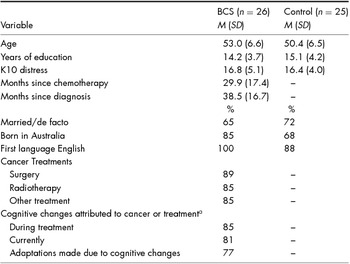
Twenty-six BCS aged 41 to 63 years (M = 53.0, SD = 6.6) participated. Inclusion criteria were: female; age 40 to 65 years; previous chemotherapy for breast cancer; chemotherapy completed 6 to 60 months before participation; and fluent in English. Inclusion criteria for a matched control group of 26 women were: female; age 40 to 65 years; no history of cancer, chemotherapy, or neurological problems; aged within 3 years of matched BCS; education level within 2 years of matched BCS; and fluent in English. One control group participant refused to undertake the computerised tasks and was subsequently excluded from analyses. After excluding this participant, the control group consisted of 25 healthy women aged 40 to 64 years (M = 50.4; SD = 6.5). Both groups were recruited via university emails and flyers. Sociodemographic and clinical characteristics of the women are presented in Table 1. The BCS group did not differ significantly from the control group in age, education, distress, marital status, language background, or country of origin.
Participant Sociodemographic and Clinical Characteristics

a The wording for these semi-structured interview items is available from the corresponding author. Examples of adaptations reported by participants: change work duties or delay return to work for cognitive reasons.
Objective Measures
VR shopping
Event- and time-based PM were measured using a VR Shopping computerised programme (Shum & Man, Reference Shum and Man2011). Participants’ ongoing task involved using the arrow keys on a keyboard to navigate through a virtual shopping centre and buy a list of 12 items from amongst 20 different shops. The time-based task required participants to use a mobile phone icon on the screen to check the time and send Short Message Service (SMS) messages at the fourth, eighth, and twelfth minutes. Messages sent within 15 seconds before or after the scheduled time were scored as correct. The event-based task required participants to press the ‘T’ key every time they heard an auditory announcement about a sale in the shopping centre. Three other non-sale announcements were used as distractors. These announcements appeared at the third, fifth, seventh, ninth, eleventh, and thirteenth minutes, with the sale announcements occurring at the third, ninth, and thirteenth minutes. Responses on the event-based task were scored as correct if the participant pressed the ‘T’ key within 15 seconds of the end of the sale announcement. This programme has shown sensitivity, ecological validity, and convergent validity for assessing PM impairments in people who have experienced traumatic brain injury (Canty et al., Reference Canty, Fleming, Patterson, Green, Man and Shum2014), so we were interested in whether similar impairments would be evident in a clinical population of BCS. Given that this is a new test with limited data available, other measures of PM were incorporated.
Event-based PM Quiz
A quiz task for measuring event-based PM was adapted from a previous study (Shum, Valentine, & Cutmore, Reference Shum, Valentine and Cutmore1999). Eighty multiple-choice questions were presented singly on the screen and participants selected one of three answers using the computer's mouse. These general knowledge questions on topics such as entertainment and geography were updated for this study. Participants were instructed to press the ‘SPACE’ bar on the keyboard whenever they saw an ‘animal word’ in the question. There were six questions with animal words, which appeared at or closest to the 30 s, 100 s, 150 s, 200 s, 250 s, and 300 s marks, giving participants a score ranging between 0 and 6.
Activity-based PM
Early during the testing sessions, participants were instructed to give the examiner a reminder at the end of the session: ‘At the end of the session today, I need to give you another questionnaire for you to complete at home. Could you please remind me when I tell you that the session has finished to give you that questionnaire? Great!’ Scoring was 2 (gave the reminder without a prompt), 1 (remembered with a prompt), or 0 (did not remember after prompting). After assessment, participants were instructed to return the questionnaire by reply-paid mail within one week. Scoring was 2 (questionnaire returned within 1 week), 1 (questionnaire returned within 2 weeks), or 0 (questionnaire not returned in 2 weeks; reminder email sent). The two scores associated with the questionnaire were summed to compute an activity-based PM score (0–4).
Verbal learning and memory
The Hopkins Verbal Learning Test-Revised (HVLT-R; Brandt, Reference Brandt1991) was administered to measure immediate and delayed verbal retrospective memory (RM).
Verbal fluency
The Controlled Oral Word Association Test (COWAT) was administered to assess verbal fluency (Benton & Hamsher, Reference Benton and Hamsher1978). Participants were asked to name as many words as they could in 1 minute beginning with the letter ‘F’ whilst the examiner recorded the responses. Participants were then asked to repeat the procedure using the letters ‘A’ and ‘S’.
Processing speed, attention, executive functioning, and visual-motor scanning
The brief, two-part Trail Making Test was administered (Reitan & Wolfson, Reference Reitan and Wolfson1985). Part A required participants to rapidly draw lines to connect consecutive numbers in sequence. In part B, participants had to alternate between connecting consecutive numbers and letters in sequence.
Subjective Measures
Subjective PM failures
The Brief Assessment of PM (BAPM) is a 16-item self-report questionnaire designed to evaluate the frequency of PM failures in individuals with brain injury (Man, Fleming, Hohaus, & Shum, Reference Man, Fleming, Hohaus and Shum2011). Participants respond between 1 and 6 indicating the frequency with which they experience each item (1 never, 2 rarely, 3 occasionally, 4 often, 5 very often, 6 not applicable). The items are categorised as either instrumental activities of daily life (IADL) or basic activities of daily life (BADL). For example, ‘Forgetting to buy an item at the grocery store’ is an IADL and ‘Not locking the door when leaving home’ is a BADL. Good internal consistency and validity have been demonstrated (Man et al., Reference Man, Fleming, Hohaus and Shum2011).
Subjective cognition
The Functional Assessment of Cancer Therapy Cognitive Scale (FACT-Cog-3) is a 37-item measure of subjective cognitive function for cancer patients (Wagner, Sweet, Butt, Lai, & Cella, Reference Wagner, Sweet, Butt, Lai and Cella2009). The four sub-domains are Perceived Cognitive Impairments (PCI), Comments from Others (CFO), Perceived Cognitive Abilities (PCA), and Impact on Quality of Life (IQL). Participants were instructed to indicate their responses as it applied to the past 7 days. Responses ranged from 0 (never or not at all) to 4 (several times a day or very much). In accordance with standard procedures for the FACT-Cog-3, responses were reverse scored when necessary so that higher scores on each subscale represented better self-reported cognitive function. Whilst reliability and validity data were not available for the FACT-Cog-3, the FACT-Cog-2 has shown internal consistency greater than .90 for its subscales (Lai et al., Reference Lai, Butt, Wagner, Sweet, Beaumont, Vardy and Cella2009).
Distress
The Kessler Psychological Distress Scale (K10) is a 10-item self-report questionnaire regarding depressive symptoms and anxiety levels over the last 4 weeks (Kessler et al., Reference Kessler, Andrews, Colpe, Hiripi, Mroczek, Normand and Zaslavsky2002). Participants responded with one of the following response options: 1 none of the time, 2 a little of the time, 3 some of the time, 4 most of the time, 5 all of the time. Internal consistency of this measure is high (α = .93; Kessler et al., Reference Kessler, Andrews, Colpe, Hiripi, Mroczek, Normand and Zaslavsky2002).
Procedure
The research was conducted in accordance with the Declaration of Helsinki (World Medical Association, 2008) and was approved by a university human research ethics committee. Assessments lasted approximately 60 minutes and took place at a university campus in a quiet room. After informed consent, a semi-structured interview was conducted to collect demographic and medical information. Tasks were administered in the following fixed order: VR Shopping, Quiz task, HVLT-R Immediate recall, Trail Making Test, COWAT, K10, FACT-Cog-3, and HVLT-R Delayed recall and recognition.
Data Analyses
Differences between groups were analysed using t-tests for continuous variables and chi-square for categorical variables. Effect size (viz., Cohen's d), was calculated from the pooled standard deviation and included a correction factor for sample size (Morris, Reference Morris2008). Effect sizes were computed such that a negative d indicates worse performance of the BCS group than the control group. Correlations were analysed using Spearman's rank-order correlation coefficients. An alpha level of .05 was used.
Results
Preliminary Analyses
Several variables were skewed. Because transformations made no difference to the pattern of statistical results, analyses used raw rather than transformed scores. One BCS participant had missing data on the computerised tests due to a power outage that disrupted assessment.
Objective Performance
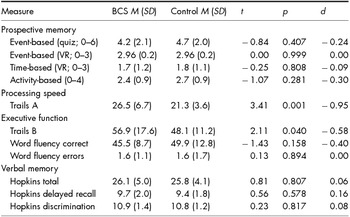
Table 2 shows performance on objective tests. The BCS and control groups did not differ significantly on the event-, time-, or activity-based PM tasks. There was a ceiling effect on the event-based ‘sales announcement’ VR shopping task: participants in both groups had near-perfect scores (mean correct responses 2.96 out of 3, in both groups). In both the event-based PM quiz task and activity-based PM, mean scores appeared to show somewhat worse performance in the BCS group (effect size d = −.24 and −.30, respectively), but the differences were not significant.
Group Performance on Objective Cognitive Tasks

Note. A negative d indicates worse performance of the BCS group than the control group.
As shown in Table 2, the BCS group took significantly longer than the control group to complete Trails A, t (49) = 3.41, p = .001, d = −.95. Similarly, Trails B was completed more slowly by the BCS group (M = 56.9, SD = 17.6) than the control group (M = 48.1, SD = 11.2), t (49) = 2.11, p = .040, d = −.58.
COWAT word fluency and the number of words recalled in the three learning trials of the HVLT did not differ significantly between the two groups. The COWAT tended towards worse performance by the BCS group (d = −.40) and HVLT towards slightly better performance by the BCS group (d = .06) but neither comparison reached statistical significance. COWAT errors, HVLT delayed recall and HVLT discrimination (correctly recognised words minus false positives for recognition) similarly showed no significant differences between the groups.
Subjective Measures
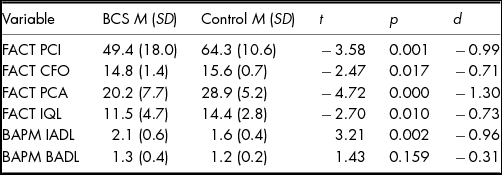
Table 3 shows self-report scores (except for K10 distress, reported in Table 1). The BCS group reported significantly more PCI (d = −.99), significantly more CFO regarding their cognitive functioning (d = −.71), significantly poorer PCA (d = −1.30), and a significantly higher impact of cognitive problems on their quality of life (d = −.73), than the control group. In addition to reporting significantly more problems with their cognition in general, the BCS group also reported significantly more PM failures on the IADL scale of the BAPM than the control group, d = −.96. The two groups, however, did not differ significantly on their reported PM failures on the BADL subscale, d = −.31.
Group Performance on Self-Report Measures

Note. FACT = Functional Assessment of Cancer Therapy; PCI = Perceived Cognitive Impairments; CFO = Comments from Others; PCA = Perceived Cognitive Abilities; IQL = Impact on Quality of Life; BAPM = Brief Assessment of Prospective Memory; IADL = Instrumental Activities of Daily Life; BADL = Basic Activities of Daily Life. A negative d indicates worse performance of the breast cancer survivor (BCS) group than the control group.
Relationships between Objective and Subjective Measures of Cognition
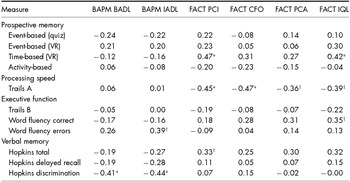
Spearman's correlations were used to test associations between objective and subjective cognitive measures in BCS. Correlations are reported in Table 4. Two of the objective measures correlated significantly with the FACT-Cog-3 self-report measure. Better performance on the time-based virtual reality PM task was significantly correlated with fewer self-reported cognitive problems and less IQL as measured by the FACT-Cog-3 subscales. Similarly, faster completion of Trails A was correlated with fewer self-reported cognitive problems and fewer CFO about cognitive problems. Similar trends were found for word fluency and the HVLT verbal learning score. In addition, worse self-reported PM on the BAPM correlated with poorer recognition performance on HVLT (discrimination score) and showed a trend towards correlating with more errors in the word fluency task. All correlations and trends were in the expected direction, that is, higher objective performance being associated with better subjective cognitive function.
Spearman Correlations between Objective and Subjective Cognitive Measures in Women Treated for Breast Cancer

† p < .10 * p < .05.
Note. BAPM = Brief Assessment of Prospective Memory; BADL = Basic Activities of Daily Life; IADL = Instrumental Activities of Daily Life; FACT = Functional Assessment of Cancer Therapy; PCI = Perceived Cognitive Impairments; CFO = Comments from Others; PCA = Perceived Cognitive Abilities; IQL = Impact on Quality of Life. Higher scores indicated worse performance on Trails A, Trails B, Word Fluency errors, BAPM IADL, and BAPM BADL. On all other measures, higher scores indicated better performance.
Discussion
The current study addressed discrepancies amongst previous findings regarding objective and subjective cognitive performance in BCS by using some objective measures that were hypothesised to correspond more closely to everyday cognition. Similar to previous research findings, the present study found evidence of subtle cognitive impairment in the BCS group with the largest group differences observed on measures of processing speed and executive functioning (Ahles et al., Reference Ahles, Saykin, McDonald, Li, Furstenberg, Hanscom and Kaufman2010; Phillips et al., Reference Phillips, Jim, Small, Laronga, Andrykowski and Jacobsen2012). Comparisons between groups on PM measures were not statistically significant. The BCS group reported significantly more PM failures on self-report measures than the control group and significantly poorer subjective cognitive functioning. There were some statistically significant correlations between objective and subjective measures, including for a VR measure of PM.
The first hypothesis, that the BCS group would perform significantly worse on objective cognitive measures than the control group, was partially supported. As expected, the BCS group took significantly longer to complete the Trails A (processing speed) and Trails B (attentional flexibility/executive functioning) tests than the control group, but the two groups did not differ significantly on word fluency or verbal learning tasks. Contrary to expectation, the differences between groups on objective PM measures (i.e., VR shopping, quiz, and questionnaire activity tasks) failed to reach statistical significance. The present study contrasted with previously published findings of poorer PM performance of BCS who had received chemotherapy than healthy controls (Cheng et al., Reference Cheng, Yang, Dong, Chen, Zhang, Huang and Wang2013; Paquet et al., Reference Paquet, Collins, Song, Chinneck, Bedard and Verma2013). Both sample size and effect sizes were smaller in the present study than in the previously published PM studies. Inspection of effect sizes suggests that, although group differences did not reach statistical significance, there was a tendency for the BCS group to underperform the control group on PM and other objective measures.
A further difference between the present study and the methods used by Cheng and colleagues (Reference Cheng, Yang, Dong, Chen, Zhang, Huang and Wang2013) was that their study utilised an event-based PM task that was arguably more challenging than those used in the current study. Their participants were given 30 question cards each containing 12 words and asked to identify which two words belonged in a different category from the other 10 words. Prior to beginning the task, they were instructed to tap the desk whenever there were two animal words printed on the card (target events), which occurred on every fifth card for a total of six possible points. They were also instructed at the beginning of testing to tell the administrator their phone number at the end of the assessment, for which they were scored two points (total of eight points). It is possible their event-based task and ongoing activity were more cognitively demanding than the event-based quiz and VR tasks, particularly given the observed ceiling effect in the present study. Their research found no difference between groups on the time-based PM task, similar to the current results.
Paquet et al. (Reference Paquet, Collins, Song, Chinneck, Bedard and Verma2013) used the 30-minute standardised Memory for Intentions Test (MIST), which incorporates multiple time- and event-based requests and allows for more fine-grained scoring of PM (0–48). Since most of the PM requirements for the MIST are introduced in the beginning, the task may again be more difficult than that used in the present study due to the RM load imposed by the MIST PM requirements.
As noted earlier, the VR shopping task and PM quiz have components similar to CPT paradigms. However, tasks such as the Conners’ CPT, which contains only visual stimuli and no distractors, have not shown differential performance between BCS treated with chemotherapy and control participants (Mar Fan et al., Reference Mar Fan, Houédé-Tchen, Yi, Chemerynsky, Downie, Sabate and Tannock2005; Tchen et al., Reference Tchen, Juffs, Downie, Yi, Hu, Chemerynsky and Tannock2003). This supports overall task difficulty as a potential explanation for the difference in PM findings between the present study and the two previous studies in BCS treated with chemotherapy.
Hypothesis 2, that there would be significant correlations between objective and subjective measures of cognitive functioning when objective assessment used PM and/or VR, was partially supported. Event- and activity-based PM tasks were not significantly correlated with self-report measures, but the time-based PM task in the VR environment (sending SMS messages at the correct times) was significantly correlated with both lower PCI and less impact of cognitive problems on quality of life as measured by the FACT-Cog-3. This correlation demonstrates a relationship between objective PM and subjective measures that has not previously been assessed in this clinical group. However, the Trails A task, involving neither VR nor PM, also correlated significantly with FACT-Cog-3 reports on both the PCI and CFO subscales. Similarly, the HVLT Discrimination score for recognition performance was associated with self-reported PM on the BAPM. Therefore, this study did not show a specific advantage of either VR or PM in corresponding more closely than conventional neuropsychological measures with self-reported cognition. In interpreting this lack of difference in the strength of correlations, it should be noted that the BCS group did not show a significant difference in performance from the healthy control group on the VR or other PM measures.
Findings regarding correlations between self-report and objective PM measures in the literature on other populations have been mixed (Potvin, Rouleau, Audy, Charbonneau, & Giguère, Reference Potvin, Rouleau, Audy, Charbonneau and Giguère2011; Uttl & Kibreab, Reference Uttl and Kibreab2011; Zeintl, Kliegel, Rast, & Zimprich, Reference Zeintl, Kliegel, Rast and Zimprich2006). Self-report measures typically enquire about daily performance in a variety of different situations whereas objective measures are generally conducted in laboratory settings and lack ecological validity, which may account for the discrepant findings in the literature (Zeintl et al., Reference Zeintl, Kliegel, Rast and Zimprich2006). Utilising objective measures that capture or simulate real-life prospective remembering events, like the VR task in this study, might increase correlations between self-reported cognition and performance on objective PM tests.
Another interpretation of the correlations found in this study, compared to the lack of associations between objective and subjective cognition in many of the previous studies in cancer survivors (Hutchinson et al., Reference Hutchinson, Hosking, Kichenadasse, Mattiske and Wilson2012) could be related to the selection of subjective measures. It is possible that the FACT-Cog-3, which was specifically developed to measure cognitive concerns reported by cancer survivors, may more often correspond with objective measures of cognition amongst this population than more general measures of subjective cognition. This remains to be tested, for example, only one study in the meta-analysis reported by Hutchinson and colleagues used the FACT-Cog (Version 1) and that study found no association between subjective and objective measures. In the present study, the BCS group reported significantly more problems related to cognition on all four scales of the FACT-Cog 3 as well as on instrumental activities that use PM. Self-report measures of cognition in cancer survivors have previously been related to negative affect (Green, Pakenham, & Gardiner, Reference Green, Pakenham and Gardiner2005; Shilling & Jenkins, Reference Shilling and Jenkins2007), suggesting that in some circumstances cognitive complaints may not actually reflect cognitive dysfunction, but rather the individual's ability to cope with the stressful event (Reid-Arndt & Cox, Reference Reid-Arndt and Cox2012). Post-hoc analysis of the present data showed that worse subjective cognition function on the FACT-Cog-3 was correlated significantly with K10 distress scores. However, the current results did not support an interpretation that differences in subjective cognition between cancer survivors and control participants could be explained by distress, because there was no difference in distress between the two participant groups, yet there were significant between-group differences on five of the six subjective cognitive measures. A previous study has found evidence that fatigue, but not distress, may mediate the relation between chemotherapy for BCS and poorer PM performance (Paquet et al., Reference Paquet, Collins, Song, Chinneck, Bedard and Verma2013).
Although group differences on the VR Shopping task were non-significant, the utility of the VR programme appears promising for future research, with potential refinements such as increasing the difficulty of some components. Comments from participants during testing suggest the programme shares more features related to real-world cognitive performance than more conventional neuropsychological measures. Comments about the order in which participants would have completed the shopping list in a real shopping centre and excitement about having a virtual coffee indicate engagement in the task and suggest the VR Shopping programme may have better ecological validity than some abstract laboratory tasks.
The VR Shopping programme was limited in this study by a ceiling effect on the event-based (announcement) task. Ceiling effects are a common methodological problem in PM research that can artificially reduce observable differences between groups (Uttl, Reference Uttl2008). Easy ongoing tasks have been shown to improve PM performance on event-based tasks (Marsh, Hancock, & Hicks, Reference Marsh, Hancock and Hicks2002), which can lead to ceiling effects. In this study, 45% of controls and 39% of BCS finished the ongoing shopping task list before the 14-minute time limit was reached. Since the third event-based cue occurred at the 13th minute, women who had finished the task were not engaged in an ongoing activity, theoretically making responses to the event cue easier.
In addition, evidence suggests auditory cues like those used in the VR shopping task are more likely to decrease omission errors and improve PM performance than visual cues (Vedhara et al., Reference Vedhara, Wadsworth, Norman, Searle, Mitchell, Macrae and Memel2004). Increasing the difficulty of the ongoing task or changing cue types in the VR shopping programme could help to avoid a ceiling effect in future research. Notably, there was no ceiling effect on the PM quiz task, which previous studies have found to be sensitive to the effects of brain injury (Shum et al., Reference Shum, Valentine and Cutmore1999).
Although participants were not specifically required to have cognitive complaints that they attributed to their cancer or cancer treatment, most BCS in this study did believe their cognition had worsened due to the cancer or treatment and more than 75% reported making behavioural changes to deal with perceived changes in cognition (such as changing their work patterns to accommodate cognitive difficulties). Although recovery over time might be expected, no differences were observed on subjective or objective measures between women who were within the first 2.5 years of finishing chemotherapy and those who had completed 2.5 to 5 years earlier. The present study did not compare different chemotherapy regimes, but it is noted that a wide range of cancers and cancer treatments, including treatments other than chemotherapy, have been associated with cognitive complaints and/or objective impairment (King & Green, Reference King and Green2015). The design and sample size of the present study did not allow age effects to be evaluated, but this should be considered in future studies given ongoing investigations of aging effects on PM. The complexity of potential age effects in PM is illustrated by the ‘age paradox’ in which older adults often show worse performance than younger adults in laboratory tests of PM yet often outperform younger adults on tests of PM conducted in naturalistic settings (Azzopardi, Juhel, & Auffray, Reference Azzopardi, Juhel and Auffray2015).
These results offer further insight into how objective and subjective measures of cognition may be associated in women who have been treated with chemotherapy for breast cancer. Limitations including a cross-sectional design, relatively small group sizes that precluded examination of age and subgroup effects, and ceiling effect on the VR shopping event-related PM task should be considered when interpreting these results. Subtle cognitive impairments may be difficult to detect with PM and neuropsychological assessment measures that are not sensitive and ecologically valid. The use of VR technology offers one approach to improving the realistic nature of cognitive testing measures and may be a useful direction for future research assessing cognitive performance in clinical and general populations. Choice of subjective measures of cognition should also be carefully considered.
Acknowledgements
This research was conducted as part of a Bachelor of Psychological Science (Honours) programme for Mary Mihuta. The assistance of John Zhong with programming and Danni Jones with data collection is gratefully acknowledged.
Financial Support
The project was partly supported by a grant awarded by the Griffith Health Institute to David H. K. Shum.
Conflict of Interest
None.
Ethical Standards
The authors assert that all procedures contributing to this work comply with the ethical standards of the relevant national and institutional committees on human experimentation and with the Helsinki Declaration of 1975, as revised in 2008.