Introduction
Moving in old age, relocation and housing transition have become significant issues in debates about ‘ageing in place’, as they relate not only to research but also to policies on health, social and residential care in an ageing society (Moore, Reference Moore2000; Golant, Reference Golant2003; Means, Reference Means2007; Jolanki and Vilkko, Reference Jolanki and Vilkko2015). People with intellectual disability (ID) live much longer than they did in the past, resulting in an expanding population of parents who are continuing to care for a son or daughter into old age (Emerson and Hatton, Reference Emerson and Hatton2004). Despite the policies that exist and the research that has been conducted to date, both health and social service providers typically lack an in-depth understanding of the needs of these older parents and their ageing offspring with ID (Hubert and Hollins, Reference Hubert and Hollins2000; Baumbusch et al., Reference Baumbusch, Mayer, Phinney and Baumbusch2017).
The choice between moving in old age and ageing in place can be more complex for older parents caring for an ageing son/daughter with ID than for older people who have no offspring with disability, because these older parents need to manage not just their own but also their offspring's ageing matters, such as transition plans for their offspring's housing and care needs. With regard to older parents who still live with their offspring with ID, previous studies have mostly focused on these parents’ future care plans of their disabled children (Jokinen and Brown, Reference Jokinen and Brown2005; Walker and Hutchinson, Reference Walker and Hutchinson2019). Care and housing transitions among these older parents and their ageing offspring with ID are rarely seen as parts of a whole, taking into account the needs of both generations, older parents and their disabled offspring.
In Taiwan, similar to many other countries, the percentage of individuals aged 65 years and over has risen dramatically in recent years, and ageing issues have become key health and social care concerns in society (Chou, Kröger and Pu, Reference Chou, Kröger and Pu2015). Since 2000, ‘ageing in place’ has been a central goal of the long-term care policy for older people in Taiwan (Wu and Chuang, Reference Wu and Chuang2001). However, similar to other countries, older people with ageing sons/daughters with ID are overlooked by Taiwan's long-term care policies, although, as in many countries (Braddock et al., Reference Braddock, Emerson, Felce and Stancliffe2001; Weeks et al., Reference Weeks, Nilsson, Bryanton and Kozma2009), the overwhelming majority (93%) of Taiwanese citizens with ID live with their family in the community (Ministry of Health and Welfare, Taiwan, 2018). Nevertheless, while national surveys of people aged 55+ years are conducted regularly in Taiwan, there are no empirical data available concerning ageing issues and living arrangements for ageing adults with ID and their older parents.
For the general population of older people, several Western and Taiwanese studies have discussed ageing in place and residential options. Based on Western studies (Robison and Moen, Reference Robison and Moen2000; Schmertmann et al., Reference Schmertmann, Boyd, Serow and White2000; Means and Evans, Reference Means and Evans2012), variables that are related to older people's choices in housing transitions (ageing in place, co-residence with children or relocating) include the following: age, gender, presence of a spouse in the household, education level, living environment (urban versus rural), ownership of housing, community participation, health and culture. In Taiwan, despite the ongoing decline in co-residence with children among older people, over half of older people still prefer living with their children later in life, which is a higher proportion than seen in Europe, Japan and South Korea (Directorate General of Budget, Accounting and Statistics of Executive Yuan, Taiwan, 2006). In addition to the variables identified in Western studies, financial condition is another strong predictor of housing transitions among older Taiwanese people (Tseng et al., Reference Tseng, Chang and Chen2006; Chang and Chang, Reference Chang and Chang2010; Chen and Lin, Reference Chen and Lin2010).
For people with ID in old age, the following moving alternatives exist: moving to a nursing home for older people (Thompson et al., Reference Thompson, Ryrie and Wright2004; Bowers et al., Reference Bowers, Webber and Bigby2014), moving to a residential setting for people with ID, moving to a sibling's home, moving to somewhere else, or ageing in place and staying with their parents. Care and housing transitions for ageing adults with ID and their older parents need to be considered as a whole, meaning as a transition for an ‘older two-generation family’, in order to meet the needs of both the older parents and their ageing offspring with ID.
Recently, the needs of older parents with ageing offspring with ID have received attention from parental groups concerned with limited housing options for both parents and their ageing offspring with ID in Taiwan. Terms such as ‘older two-generation apartments’ (Wang, Reference Wang2011) or ‘same institutions for people with ID and the elderly’ (Cheng et al., Reference Cheng, Chen and Yen2004) have been raised in this discussion. A qualitative study (Chou, Lee and Wang, Reference Chou, Lee and Wang2018), which interviewed older parents co-habiting with an ageing son/daughter with ID in Taiwan, found that these older parents’ preferences to either age in place or move were connected to the family and cultural contexts. However, quantitative data on these connections has been lacking in Taiwan, as in many other countries.
To analyse the decision-making process regarding moving or not moving, Clapham (Reference Clapham2005) developed the concept of ‘housing pathways’, which includes the following four domains: personal control, identity and self-esteem, social support and inequality. According to Clapham (Reference Clapham2002, Reference Clapham2010), personal control can be defined as ‘feeling in control of one's housing circumstances and the process of achieving one's goals’ (Clapham, Reference Clapham2010: 260). The meaning of home for people is linked to their individual experiences of security, positive identity and self-esteem, which are associated with a sense of the ability to cope and a sense of ownership; identity comprises both self-identity and social identity. Social support can be provided by family and close friends but also by health and social care professionals. In the framework, inequality is seen as social exclusion and a lack of resources, which have an effect on the chance of being in control of one's life and self-esteem.
In this study, the ‘housing pathways’ framework (Clapham, Reference Clapham2002, Reference Clapham2010) is employed to explore which older parents would choose ageing in place together with their ageing offspring with ID instead of other options and what factors are associated with this choice. We hypothesise that older parents’ choice of ageing in place together with their ageing offspring with ID is associated with the four domains of the housing pathways framework.
Methods
A survey was completed through a face-to-face interview in this study, and all potential participants were invited to take part.
Data collection and participants
The participants in this survey study were parents from older two-generation families that included parents aged 60 or more and their ageing offspring with ID aged 40 or more who were co-habiting in the same household. The families were recruited from two local authorities, H City and W County, which are located in the north-western and north-eastern parts of Taiwan, respectively. In general, H City is a wealthy city with a relatively younger population and better welfare system than the rest of Taiwan. In contrast, W County is a more remote area and has a higher proportion of ageing population than other local authorities in Taiwan.
In Taiwan, disability welfare benefits are available only to those who are assessed by the local government, determined to have a disability and provided with a disability certificate. From the two local governments, based on their disability assessments, we received a list of people with ID, including information on their age, sex, address, telephone number, level of ID, whether they used residential services and whether they had multiple disabilities (MD) in addition to their ID. However, we were not told which of them were co-habiting with older parents.
Because of this limitation, we screened all those citizens in the two local authorities who were listed as having ID or MD + ID, aged 40+ years and not using residential services. In order to attain the participants’ trust, first, the principal researcher's university and the city/county government posted a notification and invitation letter to all these families. The screening involved making a telephone call to each individual with ID (or MD + ID) aged 40+ years. Through the phone conversation, we confirmed whether the individual with ID (or MD + ID) was living with at least one parent aged 60+ years. If this was the case, the family fitted the criteria and was invited to join our study and asked whether they would allow us to interview them at home. In those families where both the father and the mother were aged 60+ years and co-habitating with their offspring with ID, only the mother was invited to participate in our survey as most often mothers were primary family carers in these families.
Structured interviews were then conducted at the participants’ home by one of the trained interviewers (15 working in H City and 13 working in W County) who read through the questionnaire and recorded the answer to each question. All of the interviewers had completed six hours of interviewer training prior to beginning the survey interviews. During the data collection, three senior social workers working with people with ID were employed to supervise the interviewers, review the data, check for missed questions or answers, and make corrections to the questionnaires that the interviewers completed.
Ethical approval for the study was obtained from the Research Ethics Board at National Yang-Ming University (IRB: YM103016F); all participants were informed of the study's details and signed an informed consent form.
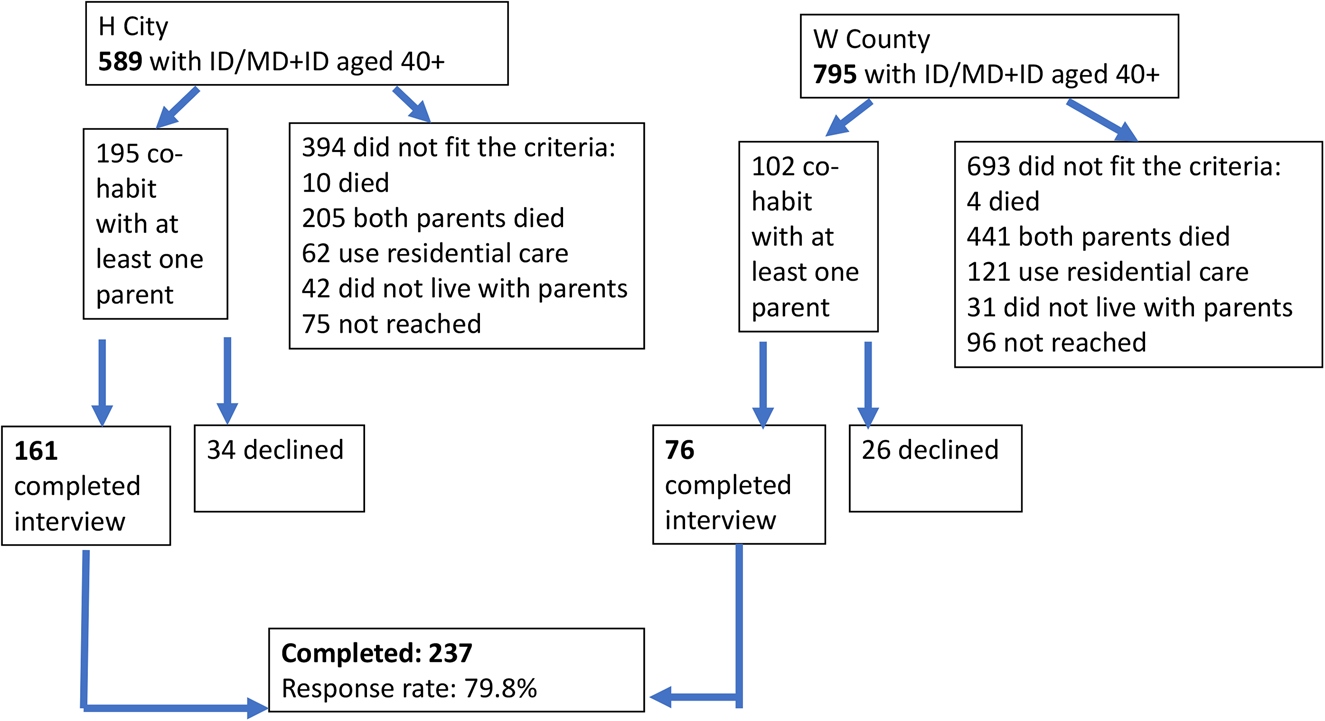
In H City, there were 589 individuals listed with ID (517 with ID and 72 with MD + ID) aged 40+, and of those, 195 fitted the criteria of our study; 161 (45 fathers and 116 mothers) of them completed the study (response rate 82.6%). In W County, 795 individuals were listed, and 102 met the sampling criteria; 76 (13 fathers and 63 mothers) completed our study (response rate 74.5%). Overall, 237 older parents of ageing people with ID took part in this survey between June and December 2015 (response rate 79.8%) (for details, see Figure 1).
Participant recruitment.

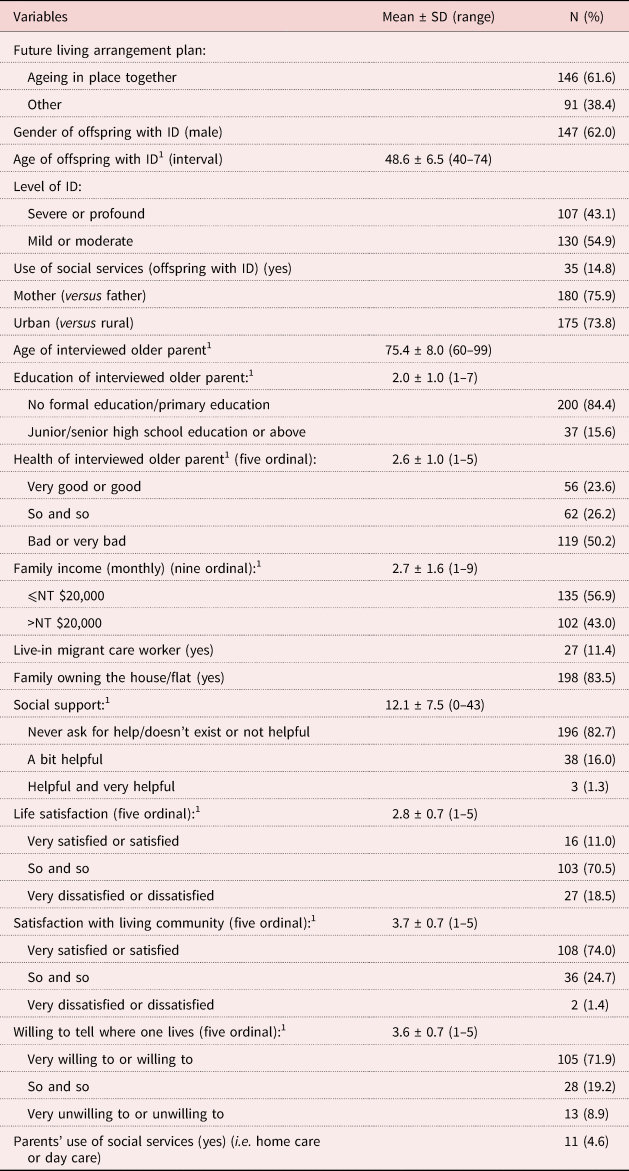
Among the participants, 45.6 per cent were married, the family having both the father and the mother alive; 75.9 per cent of the interviewees were mothers and 24.1 per cent were fathers. The mean age of their offspring with ID was 48.6 years (standard deviation (SD) = 6.5, range = 40–74) and 62.0 per cent were male. The mean age of the parents who were interviewed was 75.4 years (SD = 8.0, range = 60–99), and 84.4 per cent had received no formal education or attended only primary school. Among the families, 73.8 per cent lived in an urban area, 11.4 per cent hired a live-in migrant care worker and 83.5 per cent owned the house/flat where they lived. A very small proportion of the older parents (4.6%) and their ageing offspring with ID (14.8%) were using any social services (e.g. day care, home care). Most (82.7%) of these older parents reported that they did not have any formal or informal social support or that if they did, it was not helpful. Half of the older parents (50.2%) reported that they had a poor or very poor health condition. Over half (56.9%) of the families had a monthly income of less than US $700. In general, the participants were satisfied with their living community (74.0%) but not with their life (11.0%) (see Table 1).
Characteristics of older parents and of their ageing offspring

Notes: N = 237. SD: standard deviation. 1. Ordinal/interval variables: a higher score indicates higher level of satisfaction, willingness, support, health, income and older age.
Dependent variable
‘Ageing in place together’ was measured by two questions. The first question was: ‘What will be your future living arrangement when you are disabled?’ (1 = not moving, 2 = move in with a sibling (of the offspring with ID), 3 = move in with more than one sibling, 4 = move to a place close to siblings, 5 = move to residential setting, 6 = never thought about it, and 7 = have thought about it but have no idea). The participants who replied 1 (not moving) to the first question were then asked the following question: ‘You have replied that you will not move when you are disabled. What about your son/daughter with ID? Will she/he continue to stay with you here when she/he gets old?’ (1 = yes, 2 = no). If the parent replied ‘yes’, the answer was coded as ‘ageing in place together’. All the other answers to the above questions were coded as ‘other’.
Explanatory variables
The explanatory variables include the four domains of Clapham's (Reference Clapham2010) housing pathways framework as discussed above.
‘Personal control’ was defined by the following questionnaire item: ‘Does the house/apartment belong to your family (i.e. the participants or their children)?’, and the answer was coded as ‘yes’ and ‘no’ (the latter includes ‘It is rented’ and ‘It belongs to other relatives or an employer’).
‘Positive self-identity’ was measured by the following question: ‘Are you satisfied with your current living community, e.g. the area and the image of it?’ and was rated by five ordinal categories from very dissatisfied (1) to very satisfied (5). Positive social identity was defined by a question that asked ‘Are you willing to tell people where you live?’, and was rated by five ordinal categories from very unwilling (1) to very willing (5). The participants’ self-esteem was measured by the following question: ‘In general, are you satisfied with your current life?’, and was rated by five ordinal categories from very dissatisfied (1) to very satisfied (5).
‘Social support’, including formal and informal support, was measured using a translated local version of the Family Support Scale (Dunst et al., Reference Dunst, Jenkins and Trivette1984). A higher score indicates greater support (α = 0.71 in this study).
‘Inequality’ was defined based on the participants’ demographic and socio-economic variables including the level of disability of the offspring with ID (based on the assessment data shown in the disability certificate and categorised into four levels: mild, moderate, severe and profound), the participants’ age (coded as an interval variable), gender, level of education (determined by the question ‘What is your highest level of education?’), health (determined by the question ‘How is your health in general?’), family income (determined by the question ‘How much is your monthly family income, including wages, governmental subsidies and pensions?’) and housing geography (determined by the question, ‘What is your home address, including name of county and municipality?’, coded as urban or rural area based on the municipality). The participants’ level of education, health and family income were rated as ordinal categories, with a higher rank indicating higher education, better health and higher family income.
Statistical analysis
We analysed the results using the Statistical Package for Social Sciences (SPSS) version 20.0. A descriptive analysis was used for the characteristic data, and a cross-table analysis and F-test were used to determine if there were significant differences between the two groups ‘ageing in place together’ and ‘others’ in terms of the participants’ characteristics. Pearson's correlation coefficient was used to measure the associations between 12 independent variables. Logistic regression analyses were used to identify the factors associated with ageing in place together with ageing offspring with ID.
Results
Comparison between the two groups: ‘ageing in place together’ versus ‘others’
Most (61.6%) older parents who were interviewed replied that they would not move when they were disabled and that their ageing sons/daughters with ID would continue to live with them, so they would be ‘ageing in place together’ (G1). The rest of the older parents, that is, those who were not planning to age in place together with their ageing offspring with ID, were labelled as ‘others’ (G2).
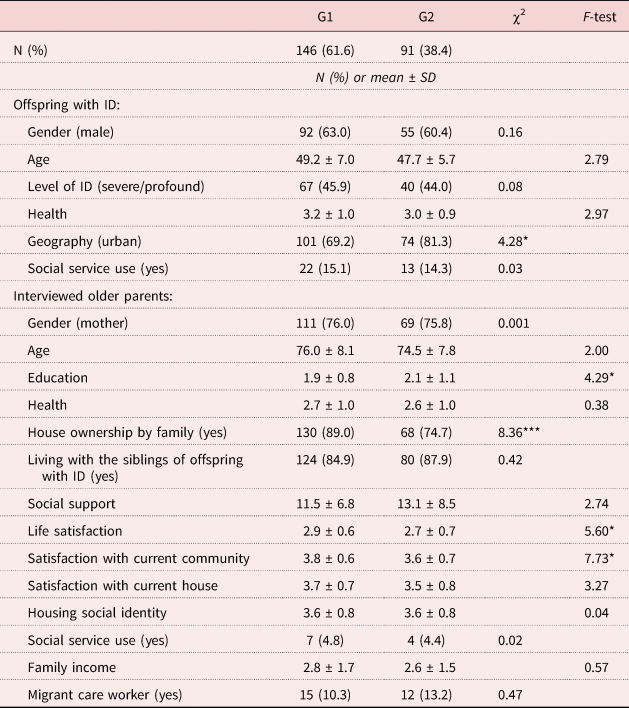
A comparison between these two groups (G1 and G2) found that there were significant differences between them in terms of housing geography (p < 0.05), parents’ education (p < 0.05), house ownership (p < 0.001), parents’ satisfaction with living community (p < 0.05) and life satisfaction (p < 0.05). The findings suggest that when compared with the parents from G2, the parents from G1 were more likely to live in a rural area, have a lower level of education, have a higher proportion of home ownership, and have a higher level of life satisfaction and satisfaction with the living community. However, a statistical comparison revealed no significant differences between the two groups concerning gender, age, level of disability or social service use among offspring with ID or in terms of parents’ age, gender, health, living with other children without disability, social support, social service use, family income or whether the family hired a live-in migrant care worker or not (Table 2).
Comparison between two groups: ageing in place together (G1) versus others (G2)

Notes: ID: intellectual disability. SD: standard deviation.
Significance levels: * p < 0.05, *** p < 0.001.
Correlations between the indicators of the four domains of housing pathways
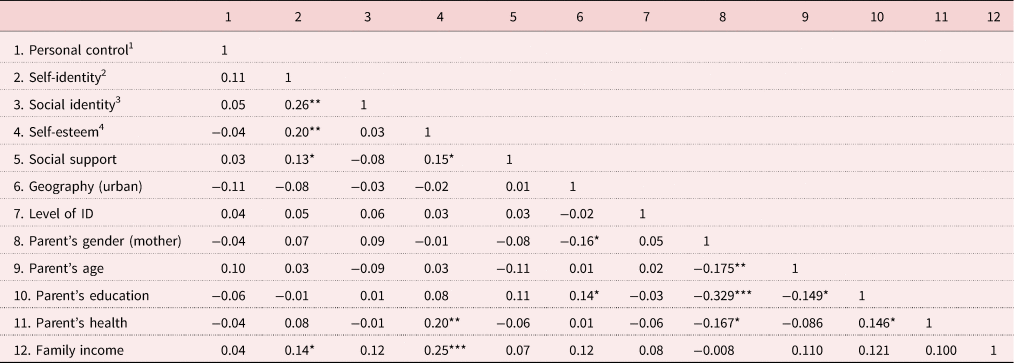
The correlations between the 12 variables that were defined based on the housing pathways framework in this study are shown in Table 3. The findings show that the indicators of parents’ personal housing identity (satisfaction with community), social housing identity (willingness to tell people where one lives) and self-esteem (life satisfaction) were strongly related with one another (p < 0.01); in addition, self-esteem was strongly associated with parents’ health (p < 0.01) and family income (p < 0.001).
Correlations among the variables of four domains (12 independent variables)

Notes: ID: intellectual disability. 1. Family housing ownership. 2. Satisfaction with living community. 3. Willing to tell where one lives. 4. Life satisfaction.
Significance levels: * p < 0.05, ** p < 0.01, *** p < 0.001.
Compared with fathers, mothers were more likely to be younger (p < 0.01), have a lower level of education (p < 0.001), have poorer health (p < 0.01) and live in a rural area (p < 0.05). Parents’ age was negatively correlated with education (p < 0.05), and parents’ education was positively related to their health (p < 0.05). Parents who had obtained a higher level of education were more likely to live in an urban area (p < 0.05) than parents with a lower level of education. Level of disability among offspring with ID was not significantly correlated with any of the other 12 variables.
The correlation results suggest that these older parents were mostly mothers and that they were more likely to be satisfied with their living community and have family ownership of their housing than other parents. However, these parents also had a lower level of education, health and family income than other parents.
Factors associated with ageing in place together with offspring with ID
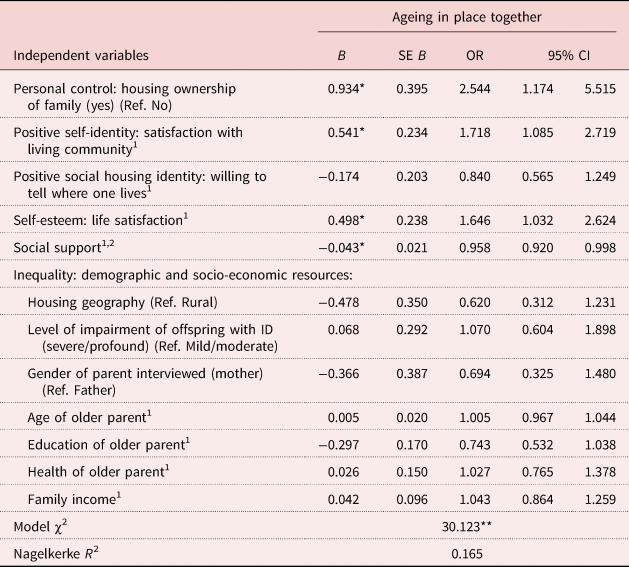
Table 4 shows that the logistic regression model on ‘ageing in place together’ was statistically significant (p < 0.01) based on chi-square tests. Based on the ‘housing pathways’ framework, the significant positive factors associated with ‘ageing in place together’ included ‘personal control’ (housing ownership) (p < 0.05), ‘positive housing self-identity’ (satisfaction with the living community) (p < 0.05) and ‘self-esteem’ (life satisfaction) (p < 0.05), as well as social support, which was negatively related (p < 0.05). All the variables reflecting ‘inequality’, such as the participants’ demographic and socio-economic variables, which included the participants’ resources, were not significantly related to ‘ageing in place together’ among the participants.
Logistic regression analysis on ageing in place together among older parents and ageing offspring with intellectual disability (ID)

Notes: N = 237. SE: standard error. OR: odds ratio. CI: confidence interval. 1. Ordinal/interval variables: a higher score indicates a higher level of satisfaction, willingness, support, health, income and older age. 2. Family Support Scale (Dunst et al., Reference Dunst, Jenkins and Trivette1984). Ref.: reference category.
Significance levels: * p < 0.05, ** p < 0.01.
The findings indicate that older parents’ ability to control their housing and whether or not they have a strong housing identity and self-esteem are important factors in decision making about relocation and ageing in place together with their ageing offspring with ID. Surprisingly, the findings show that those older parents who have a lower level of social support are more likely to be ‘ageing in place together’ than older parents with a higher level of social support. Overall, the results suggest that, on the one hand, older parents may choose ageing in place together with their offspring with ID because they live in owner-occupied housing and are happy with their life and living community. On the other hand, their choice may be due to the lack of social support for moving.
Discussion
In general, the older parents in this study were 75+ years old, and had cared for their offspring with ID for almost five decades. Most of them were mothers. This study confirmed what was found in previous Western as well as Taiwanese studies that have compared young and older parents (Aldwin et al., Reference Aldwin, Sutton, Chiara and Spiro1996; Hayden and Heller, Reference Hayden and Heller1997; Chou et al., Reference Chou, Lee, Lin, Kröger and Chang2009): that this generation and group of older parents, even those living in rural areas, have been doing care-giving work for a very long time. Consistent with previous studies conducted for older family care-givers (Chou et al., Reference Chou, Fu, Lee and Lin2011), these older parents generally had low levels of social support, health, family income and education, and only a very small proportion of them used social services.
Among these older parents, over 60 per cent did not want to move but wanted to age in place together with their ageing offspring with ID, regardless of whether the household had two parents (60.7%) or one parent present (62.3%). Echoing previous Western and Taiwanese studies (Litwak and Longino, Reference Litwak and Longino1987; Chen and Chang, Reference Chen and Chang2004; Carroll and Qualls, Reference Carroll and Qualls2014), these parents are not only similar to the majority of older people who do not have children with ID and do not want to move, but after several years, they have adjusted to their situation, including taking care of their offspring with ID regardless of their socio-demographic context (Chou et al., Reference Chou, Fu, Lee and Lin2011).
Compared with parents who had other options, older parents who would choose not to move but instead age in place with their ageing offspring with ID were more likely to have lower education, live in a rural area, own their house/flat, and have a higher level of life satisfaction and satisfaction with the living community (as shown in Table 2). This is consistent with a previous qualitative study (Chou et al., Reference Chou, Lee and Wang2018) that found that parents living in their own house had rarely thought about moving and appreciated the environment where they lived (e.g. good air quality in a rural area) and had grown accustomed to the neighbourhood that they had known for years.
Concerning the housing pathways framework (Clapham, Reference Clapham2002, Reference Clapham2010), based on the regression analyses in this study, we found that the domains of personal control (family owned the house/flat), self-identity (satisfied with the community) and self-esteem (life satisfaction) were positively significantly related to ‘ageing in place together’; in contrast, social support was negatively related. The demographic and socio-economic factors included in the domain of inequality were not related to the choice of whether the older parents planned to age in place with their ageing offspring with ID. These findings imply that the hypothesis of this study was only partly supported.
These results are inconsistent with those of other studies that focused on older people who do not have offspring with ID and whose housing pathways are strongly related to care needs and service use (Faulkner, Reference Faulkner2007; Bradley, Reference Bradley2011). This study found that older parents’ age, gender, education, living geography, family income, care needs of children with ID (e.g. level of disability) and personal health, namely all factors of the ‘inequality’ domain, were not determining factors in the parents’ decision regarding ageing in place together with their offspring with ID.
Previous Taiwanese studies (Chou et al., Reference Chou, Lee, Lin, Kröger and Chang2009, Reference Chou, Fu, Lee and Lin2011) have suggested that families that have a higher level of education and income are more likely to also have a higher level of formal and informal social support. Under the current familistic and market-oriented care policy regime in Taiwan, only older parents who have a higher level of social support and income would be likely to be able to afford a nursing home of good quality. In terms of social support, it can also be said that parents choose ageing in place together with their disabled children because they lack the support and resources to move. Additionally, this group of parents who have a lower level of individual capital (e.g. education and family income), mostly mothers, are more likely than other parents to follow traditional values, which stipulate that caring for family is a responsibility (Chou et al., Reference Chou, Lee and Wang2018).
Moving to a nursing home still carries a stigma in Taiwanese society. If parents move to a nursing home, they often feel that they have been abandoned by their children (Chen, Reference Chen2011; Wu and Chen, Reference Wu and Chen2014); parents also feel guilty if their children with ID move to an institution (Chou et al., Reference Chou, Lee and Wang2018). In addition, the family is responsible for paying the cost of residential care services; in particular, moving to a better quality care home costs more (Yang, Reference Yang2005). Hiring a live-in migrant care worker is a better economic choice for some families (Chou et al., Reference Chou, Kröger and Pu2015); the findings of this study indicated that 11 per cent of the participants hired a live-in migrant care worker.
In conclusion, the findings suggest that older parents choose ageing in place with their ageing offspring with ID because the family owns their house/flat (having ‘personal control’) and because they like the community (‘positive self-identity’) and are happy with their current life (‘self-esteem’); however, these parents have a low level of social support for moving.
Some limitations of this study should be noted. First, even though all of the parents who were co-habiting with their ageing offspring with ID were invited to participate from two local authorities, representing urban and rural areas in Taiwan, the population from only these two areas of Taiwan was included, so one needs to be cautious when making generalisations. Second, the number of parents who were investigated was rather small due to the small overall target group population. Therefore, there might not have been sufficient power to detect certain effects, e.g. correlations between the explanatory variables and ageing in place together with ageing offspring with ID. Third, this study was cross-sectional and is unable to reveal cause-and-effect relationships; therefore, the results cannot show the direction of the association between the explanatory variables and the dependent variable. A longitudinal study is desirable in the future. Last, the definitions of the four domains of housing pathways in this study could be discussed in future studies, in particular by studies conducted in other countries with different cultural contexts.
Despite the above limitations, the findings of this study contribute to knowledge related to moving or ageing in place among the group of older people who co-habit with their ageing offspring with ID. Furthermore, these findings extend beyond the housing pathways approach, which focuses on individual older persons’ decision making about moving or ageing in place and suggest that older parents co-habiting with their ageing offspring with ID should be viewed as a whole in terms of both policies and research on ageing. Consequently, long-term care policy should pay special attention to those older two-generation families that cannot afford formal care or the cost of a migrant care worker and who are now ageing in place together. For these families, ageing in place may not be the best choice but rather the only available choice.
Acknowledgements
The authors would like to thank all the parents who have generously given their time to our research.
Author contribution
Y-CC designed the study, collected and analysed the data and wrote the paper; TK assisted in desiging the study, and discussing, writing and revising the paper.
Financial support
This work was supported by the Ministry of Science and Technology, Taiwan (MOST 104-2410-H-010-008-SS2) and the Academy of Finland (CoE AgeCare 312303).
Conflict of interest
The authors declare no conflicts of interest.
Ethical standards
Ethical approval for the study was obtained from the Research Ethics Board at National Yang-Ming University (IRB: YM103016F).