Recent increases in the incidence of Clostridium difficile infection (CDI) have been observed in all age groups, but the elderly have been disproportionately affected and long-term care facilities (LTCFs) have borne a significant proportion of the increasing burden of CDI.Reference Lessa, Mu and Bamberg 1 – Reference Campbell, Giljahn and Machesky 5 In Ohio, mandatory statewide surveillance in 2006 demonstrated that the onsets of about half of initial CDI cases and three-fourths of recurrent cases occur in LTCFs.Reference Campbell, Giljahn and Machesky 5 A more recent national surveillance study estimated that the onset of 36% of healthcare-associated CDI cases in the United States occur in LTCFs.Reference Lessa, Mu and Bamberg 1 Asymptomatic carriage of toxigenic C. difficile is also common among LTCF residents.Reference Riggs, Sethi and Zabarsky 6 – Reference Sethi, Al-Nassir and Nerandzic 10
Although CDI is often diagnosed in LTCFs, the source of acquisition of C. difficile in these cases is not clear. Based on surveillance definitions proposed in 2007, cases of CDI with onset of symptoms >48 hours after admission to an LTCF were classified as healthcare facility (HCF)-onset, HCF-associated cases presumed to be acquired in the LTCF.Reference McDonald, Coignard, Dubberke, Song, Horan and Kutty 11 However, MylotteReference Mylotte 12 postulated that true LTCF-associated CDI is uncommon except in post-acute rehabilitation patients, with most cases being acquired in hospitals but having onset of symptoms in the LTCF. He proposed that LTCF-onset CDI cases diagnosed within 1 month of hospital discharge be classified as hospital-associated cases. Subsequently, several studies have reported that many LTCF-associated CDI cases occur within 1 month after hospital discharge.Reference Guerrero, Nerandzic, Jury, Chang, Jump and Donskey 2 – Reference Hunter, Mu and Dumyati 4 , Reference Jinno, Kundrapu and Guerrero 7 , Reference Kim, Toy and Muder 13 , Reference Mylotte, Russell, Sackett, Vallone and Antalek 14 For example, we reported that 85% of LTCF-onset CDI cases in a Department of Veterans Affairs’ LTCF occurred within 1 month after transfer from the hospital.Reference Guerrero, Nerandzic, Jury, Chang, Jump and Donskey 2 In more recent surveillance guidance, it has been noted that LTCF-onset CDI cases can be further subclassified as acute-care transfer– LTCF onset if the stool specimen is collected ≤4 weeks following transfer from an acute-care facility. 15
Although frequent development of LTCF-associated CDI within 1 month of hospitalization suggests hospital acquisition, previous studies have demonstrated that the time from acquisition of C. difficile colonization to onset of CDI is short (ie, 2–5 days). 16 Thus, we hypothesized that patients transferred from the hospital to an LTCF often acquire C. difficile colonization and infection in the LTCF. To test this hypothesis, we conducted a 5-month cohort study to determine the frequency of acquisition of C. difficile colonization and infection during the 6-week period after transfer from a Veterans Affairs hospital to an affiliated LTCF.
METHODS
Setting
The Louis Stokes Veterans Affairs Medical Center includes a 215-bed hospital and an affiliated 150-bed LTCF that provides care for a mix of residential and post-acute residents. Staff sharing between the hospital and the LTCF is minimal. During the study, the incidences of HCF-associated CDI for the hospital and the LTCF were 10 and 3 cases per 10,000 patient days, respectively.Reference McDonald, Coignard, Dubberke, Song, Horan and Kutty 11 CDI diagnostic testing was performed using a commercial enzyme immunoassay for glutamate dehydrogenase (Wampole C. diff Chek-60, Alere, Waltham, MA) as an initial screen and a polymerase chain reaction (PCR) assay for toxin B genes (Becton Dickinson, Franklin Lakes, NJ) for confirmation. Infection control measures for CDI included pre-emptive contact precautions for patients with orders for CDI testing, continuation of contact precautions until at least 2 days after completion of CDI treatment, and use of bleach for post-discharge CDI room disinfection.
Study Design
During a 5-month period in 2009, we conducted a cohort study of all consenting patients being transferred from the hospital to the affiliated LTCF. Patients with advanced dementia were excluded. Two members of the research team (SP and DMG) collected perirectal swab cultures from subjects within 24 hours of admission and then weekly for up to 6 weeks during their LTCF stays. Stool specimens were collected for LTCF residents diagnosed with CDI. LTCF-associated CDI was defined as diarrhea (≥3 unformed stools in 24 hours) beginning at least 48 hours after LTCF admission and a positive PCR assay for toxin B genes. For all CDI cases and asymptomatic carriers, medical record review was conducted to obtain information on demographics, medical conditions, medications, and prior CDI. The Louis Stokes Veterans Affairs Medical Center Institutional Review Board approved the research protocol.
Microbiology and Molecular Typing
Perirectal swabs and stool specimens were cultured as described previously.Reference Riggs, Sethi and Zabarsky 6 Fluorescent PCR ribotyping and PCR for the binary toxin gene cdtB were performed for the initial positive perirectal isolate for the asymptomatic carriers and for stool isolates from residents diagnosed with CDI using previously described methods.Reference Martinson, Broadaway and Lohman 17 – Reference Guerrero, Chou, Jury, Nerandzic, Cadnum and Donskey 19
Data Analysis
Data were analyzed using SPSS version 10.0 statistical software (SPSS, Chicago, IL). For residents with negative cultures on admission to the LTCF, bivariate analyses were performed to compare characteristics of those who did versus did not acquire colonization with toxigenic C. difficile. The Fisher exact test was used for categorical data and the Student paired t test was used for normally distributed data. LTCF residents diagnosed with CDI were classified as LTCF-acquired if they had a negative perirectal culture on admission and as hospital acquired if their perirectal culture on admission was positive for a strain with the same PCR ribotype as the isolate cultured from the CDI-positive stool specimen.
RESULTS
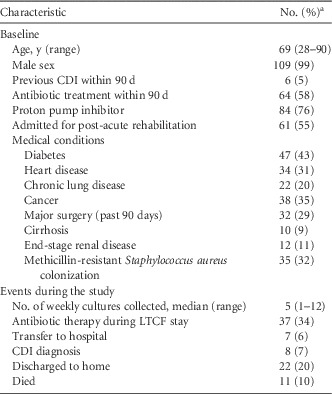
Of 124 patients transferred to the LTCF during the study period, 110 (89%) enrolled and were cultured on admission. Of the 14 patients who were not enrolled, 7 had active CDI, 2 had advanced dementia, and 5 were not willing to participate. Table 1 shows the baseline characteristics of the 110 LTCF residents studied and events that occurred during the study. The mean age of the patients was 69 (range, 28–90). Furthermore, 6 of the residents studied (5%) had a history of CDI within the past 90 days and had completed treatment with resolution of symptoms. Overall, 65 LTCF residents (59%) had received antibiotics during the 3 months prior to LTCF admission and 37 (34%) received antibiotics while in the LTCF. The median number of weekly perirectal cultures collected was 5 (range, 1–12).
Baseline Characteristics of the 110 Long-Term Care Facility (LTCF) Residents and Events During the Study

NOTE. CDI, Clostridium difficile infection; MRSA, methicillin-resistant Staphylococcus aureus.
a Unless otherwise specified.
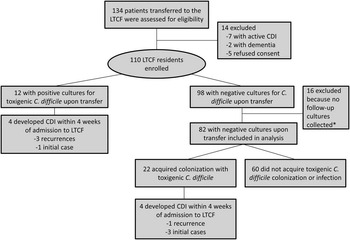
Figure 1 provides a flow diagram for the study participants, including an overview of the culture results and an indication of those patients who developed LTCF-onset CDI. Of the 110 patients, 12 (11%) were asymptomatically colonized with toxigenic C. difficile upon admission; 4 of the 12 (33%) colonized patients had a prior history of CDI within 90 days. Of the 12 patients colonized on admission, 4 (33%) developed CDI within 4 weeks, including 3 recurrent and 1 initial CDI episode.
Flow diagram for the study participants. Abbreviations: LTCF, long-term care facility; C. difficile, Clostridium difficile; CDI, C. difficile infection. *, 16 LTCF residents excluded because they had no follow-up cultures due to death (N=4), discharge (N=7), or hospitalization (N=5).

Of the 98 patients with negative cultures on admission to the LTCF, 82 (84%) had at least 1 follow-up culture; 16 patients had no follow-up cultures due to death (N=4), discharge (N=7), or hospitalization (N=5). Of the 82 patients with follow-up cultures, 22 (27%) acquired colonization with toxigenic C. difficile. Furthermore, 4 (18%) of the LTCF residents with new acquisition of colonization developed CDI, including 3 initial cases and 1 first recurrence. The patient with the first recurrence had completed CDI treatment and was asymptomatic and culture negative at the time of transfer to the LTCF. Of the 4 CDI cases, 2 occurred in residents admitted for post-acute rehabilitation. Overall, 3 of the 4 (75%) initial LTCF-onset CDI cases occurring within 4 weeks of admission occurred in residents who acquired colonization in the LTCF.
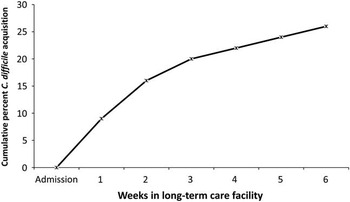
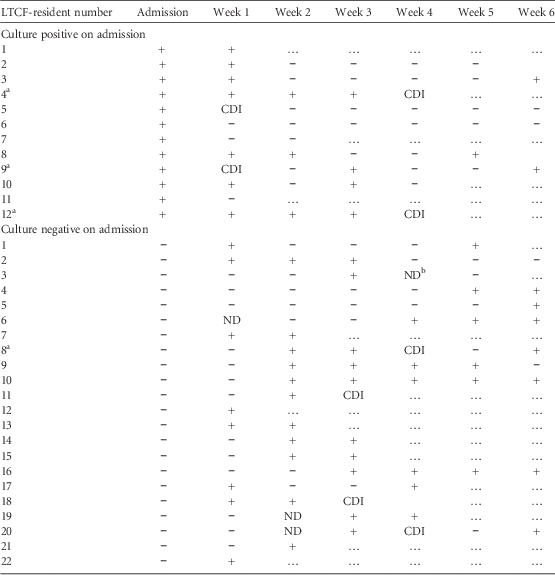
Table 2 provides a summary of the baseline and weekly culture results for the 34 LTCF residents with 1 or more perirectal cultures positive for toxigenic C. difficile, and it shows the timing of the diagnosis of CDI for the 8 CDI cases. For the 3 initial CDI cases with negative cultures on admission, the duration of colonization prior to infection was ~1 week for 2 cases and 2 weeks for 1 case. Figure 2 shows the cumulative percentage of new detection of colonization with toxigenic C. difficile for the 85 LTCF residents with negative cultures on admission and 1 or more follow-up cultures. Of the 22 LTCF residents with new detection of colonization, 14 (64%) acquired colonization within 2 weeks and 20 (91%) within 4 weeks.
Cumulative percentage of new detection of colonization with toxigenic Clostridium difficile for the 85 long-term care facility (LTCF) residents with negative cultures on admission and 1 or more follow-up cultures.

Perirectal Culture Results for the 34 Long-Term Care Facility (LTCF) Residents With Asymptomatic Carriage of Toxigenic Clostridium difficile, Stratified by Those With Positive (N=12) Versus Negative (N=22) Admission Cultures

NOTE. CDI, Clostridium difficile infection; ND, not done; +, positive perirectal culture; −, negative perirectal culture.
a Indicates that a LTCF resident had a prior history of CDI within 90 days;
b ND (not done) indicates that the perirectal swab culture was not collected despite the LTCF resident being in the facility during that week; cultures were not collected because the LTCF resident was not available at the time study staff were on site to collect cultures.
Of the 34 asymptomatic carriers identified during the study, 9 (26%) were carriers of binary toxin-positive ribotype 027 strains. Other ribotypes identified in more than 1 carrier included F053-163 (N=4), F106 (N=3), F014-020 (N=3), F017 (N=2), and F106 (N=3). Ribotypes identified in only 1 carrier included F078-126, FP 501, FP452, F255, F0120, F015, F002, F054, FP419, and F153. Of 8 CDI cases, 5 (63%) were infected with binary toxin-positive ribotype 027 strains. All 4 of the LTCF residents who were colonized on admission and subsequently developed CDI had matching PCR ribotypes for the admission and CDI isolates; 3 of 4 strains were identified as ribotype 027.
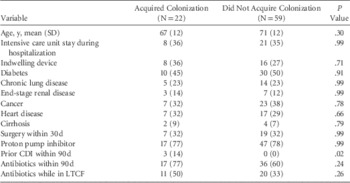
For residents with negative cultures on admission to the LTCF, Table 3 shows the results of bivariate analyses comparing the characteristics of those who did (N=22) versus did not (N=60) acquire colonization with toxigenic C. difficile. CDI in the previous 90 days was present significantly more often in the LTCF residents with new detection of colonization with toxigenic C. difficile (14% vs 0%; P<.01). We also observed a nonsignificant trend toward more frequent antibiotic exposure in the 90 days prior to transfer to the LTCF and during the LTCF stay for the residents who acquired colonization versus those who did not.
Comparison of Characteristics of Long-Term Care Facility (LTCF) Residents That Acquired Versus Did Not Acquire Colonization With Toxigenic Clostridium difficile

NOTE. Data are no. (%) unless otherwise specified. CDI, Clostridium difficile infection.
DISCUSSION
In our Veterans Affairs facility, we found that 11% of patients transferred from the hospital to the LTCF were asymptomatically colonized with toxigenic C. difficile at the time of LTCF admission. In addition, 27% of patients with negative cultures on transfer acquired colonization within 6 weeks after LTCF admission. Of 8 LTCF-onset CDI cases diagnosed within 1 month of transfer to the LTCF, 4 were recurrences and 4 were initial diagnoses. Of 4 initial LTCF-onset CDI cases, 3 (75%) occurred in residents with negative perirectal cultures on admission, suggesting that the infecting strains were not acquired in the hospital. These findings have important implications for control of C. difficile in long-term care settings.
Our results do not support the proposal of Mylotte that LTCF-onset CDI cases diagnosed within 1 month of hospital discharge be classified as hospital-associated cases.Reference Mylotte 12 Acquisition of toxigenic C. difficile colonization occurred frequently during the initial weeks after transfer to the LTCF, and most of the LTCF-onset cases diagnosed within 1 month of hospital discharge occurred in residents who acquired colonization in the LTCF. Antibiotic exposure in the hospital was a risk factor for acquisition of colonization in the LTCF, suggesting that hospital-based antimicrobial stewardship efforts may be useful as a strategy to reduce LTCF-onset CDI. The association between hospital antibiotic exposure and LTCF acquisition of C. difficile is supported by evidence that antibiotic-induced alteration of the microbiota that provide colonization resistance to C. difficile may persist for several weeks after completion of therapy.Reference Abujamel, Cadnum, Jury, Sunkesula, Kundrapu, Jump, Stintzi and Donskey 20 , Reference Hensgens, Goorhuis, Dekkers and Kuijper 21
Our findings are consistent with previous studies demonstrating that asymptomatic carriage of toxigenic C. difficile may be common in some LTCF populations.Reference Riggs, Sethi and Zabarsky 6 – Reference Marciniak, Chen and Stein 9 For example, in an outbreak setting in our LTCF, we reported that 51% of residents on 2 LTCF wards were colonized with toxigenic C. difficile, and 37% carried epidemic NAP1/027/BI strains.Reference Riggs, Sethi and Zabarsky 6 Asymptomatic carriers outnumbered CDI patients by a factor of 7 to 1.Reference Riggs, Sethi and Zabarsky 6 Kuijper et alReference Arvand, Moser, Schwehn, Bettge-Weller, Hensgens and Kuijper 22 found that the prevalence of asymptomatic carriage in several German LTCFs varied from 0% to 10%, with higher rates in facilities with actual or recent CDI cases.
One notable finding from our study was that half of the LTCF-onset CDI cases were recurrent episodes in patients who were asymptomatic at the time of LTCF admission. For 3 of the 4 patients with recurrences, the infecting C. difficile strain was recovered from a perirectal culture at the time of admission. As noted previously, others have demonstrated that many recurrences of CDI have their onset in LTCFs.Reference Hunter, Mu and Dumyati 4 , Reference Campbell, Giljahn and Machesky 5 Identifying LTCF residents with recent CDI as a high-risk population may be useful to facilitate timely diagnostic testing and treatment if symptoms recur.
Our study has several limitations. The Veterans Affairs LTCF population is predominantly male and may differ from other long-term care populations in age, underlying diseases, access to consultants, and antibiotic utilization.Reference Reeves, Evans, Simbartl, Kralovic, Kelly, Jain and Roselle 26 , Reference Brown, Jones, Daneman, Adler, Stevens, Nechodom, Goetz, Samore and Mayer 27 In addition, the epidemic 027 strain was the most common strain type and the number of LTCF-onset CDI cases was small. Therefore, larger studies are needed in other settings, including community LTCFs. Although our findings suggest that most LTCF-onset cases diagnosed within 1 month of admission were due to acquisition in the LTCF, we cannot exclude the possibility that low numbers of C. difficile were present that were below the limit of detection of our surveillance methods. However, we have previously demonstrated that recovery of C. difficile from perirectal swabs is equivalent to recovery from rectal swabs.Reference Rogers, Kundrapu, Sunkesula and Donskey 23 Because we did not perform typing for sequential isolates from individual residents, we cannot confirm that carriers were persistently colonized with the same strain. Finally, we cannot be certain that the individuals who were colonized with toxigenic C. difficile on admission to the LTCF acquired colonization during their hospital stay; it is possible that they carried C. difficile at the time of admission to the hospital. Future studies are needed in which patients are cultured at the time of hospital admission and discharge to the LTCF.
In summary, we found that LTCF residents in our facility frequently acquired colonization with toxigenic C. difficile after transfer from the hospital, and most initial CDI cases with onset within 1 month of transfer occurred in residents who acquired colonization in the LTCF. Previous studies have demonstrated that LTCF residents frequently acquire colonization with other healthcare-associated pathogens, including multidrug-resistant gram-negative bacilli, vancomycin-resistant enterococci, and methicillin-resistant Staphylococcus aureus.Reference Han, Maslow and Han 24 , Reference Fisch, Lansing, Wang, Symons, Cherian, McNamara and Mody 25 Thus, greater emphasis should be placed on infection control measures and antimicrobial stewardship in LTCFs as well as LTCF residents during hospital admissions.
ACKNOWLEDGMENTS
Financial support: This work was supported by a Merit Review grant from the Department of Veterans Affairs to C.J.D.
Potential conflicts of interest. C.J.D. has received research grants from Merck, GOJO, EcoLab, and Clorox and serves on an advisory board for 3M. All other authors report no conflicts of interest relevant to this article.