INTRODUCTION
To study the biodiversity of free-living marine nematodes in the Yellow Sea, China, sediment samples were collected in many sites from the intertidal to the sublittoral region of the Yellow Sea in the past few years. More than 260 species have been recorded from these habitats (Huang, Reference Huang and Ruiyu2008; Huang & Cheng, Reference Huang and Cheng2012; Huang & Xu, Reference Huang and Xu2013; Huang & Zhang, Reference Huang and Zhang2014). Two new Onyx species were found in the sediment samples from Rizhao coast. The present paper describes two new species and reviews the species of Onyx.
The genus Onyx was established by Cobb in 1891 with the type species Onyx perfectus. This genus differs from other related genera of Family Desmodoridae in the presence of fine cuticle striation, amphidial fovea not surrounded by cuticle striations, buccal cavity with a long-spear-like dorsal tooth, posterior pharyngeal bulb elongated and with a slight constriction in the middle, spicules short and arcuate, precloacal supplements normally S-shaped tubes (Platt & Warwick, Reference Platt and Warwick1988). Up to now, 18 species have been recorded in the world (Gerlach & Riemann, Reference Gerlach and Riemann1973; Blome & Riemann, Reference Blome and Riemann1994; Hourston & Warwick, Reference Higgins and Thiel2010; Nasira, Rehmat & Shahina, Reference Nasira, Rehmat and Shahina2011; Tu et al., Reference Tu, Smol, Vanreusel and Thanh2011). Out of them, Onyx ferox (Ditlevsen, 1921) Gerlach, 1951 had been described by a single female specimen. Males provide the main diagnostic features to differentiate species of Onyx. In the absence of males we consider Onyx ferox as invalid species. The list of 17 valid species of the genus Onyx Cobb, Reference Cobb1891 is as follows.
Onyx adenophorus Blome & Riemann, Reference Blome and Riemann1994
Onyx balochiensis Nasira et al., Reference Nasira, Rehmat and Shahina2011
Onyx blomei Tu et al., Reference Tu, Smol, Vanreusel and Thanh2011
Onyx cangionensis Tu et al., Reference Tu, Smol, Vanreusel and Thanh2011
Onyx cannoni Blome & Riemann, Reference Blome and Riemann1994
Onyx cephalispiculus Hourston & Warwick, 2010
Onyx cobbi Tu et al., Reference Tu, Smol, Vanreusel and Thanh2011
Onyx dimorphus Gerlach, 1963
Onyx macramphis Blome & Riemann, Reference Blome and Riemann1994
Onyx mangrovi Tu et al., Reference Tu, Smol, Vanreusel and Thanh2011
Onyx orientalis Tu et al., Reference Tu, Smol, Vanreusel and Thanh2011
Onyx paradimorphus Tu et al., Reference Tu, Smol, Vanreusel and Thanh2011
Onyx perfectus Cobb, Reference Cobb1891
Onyx potteri Hourston & Warwick, Reference Higgins and Thiel2010
Onyx rugatus Wieser, 1959
Onyx sagittarius Gerlach, 1950
Onyx septempapillatus Wieser, 1954
MATERIALS AND METHODS
Undisturbed sediment samples were collected using a syringe with a 2.6 cm inner diameter, pushed into the sediment down to 8 cm depth at Rizhao intertidal zone (119°34′E 35°26′N) of the Yellow Sea coast in July 2008. Samples were stratified by 0–2, 2–8 cm and fixed with 5% formalin in seawater respectively for long-term preservation. In the laboratory, samples were stained with 0.1% rose bengal for 24 h (Higgins & Thiel, Reference Hourston and Warwick1988). The samples were washed to remove the formalin and sieved over two mesh sizes (500 and 42 μm) in order to separate the macrofauna (500 μm) from the meiofauna (42 μm). Heavier sediment particles were removed using centrifugation in Ludox-™ with a specific gravity adjusted to 1.15 (Jonge & Bouwman, Reference Jonge and Bouwman1977). Each sample was washed into a lined Petri dish and the meiofauna was sorted under a stereoscopic microscope up to higher taxonomic levels. Nematodes were transferred into a 10 ml 9:1 (V:V) solution of 50% ethanol : pure glycerin in block cavity to slowly evaporate ethanol and then mounted in glycerin on permanent slides. The descriptions were made from glycerol mounts using interference contrast microscopy. Drawings were made with a camera lucida. Type specimens (slide number: RZ080422-4 and RZ080422-6, respectively) were deposited in the Qingdao Institute of Oceanology, Chinese Academy of Sciences.
Measurements are in μm. Abbreviations are as follows: a, body length/max. body diameter; a.b.d., corresponding body diameter of anus; b, body length/pharynx length; c, body length/tail length; c.b.d., corresponding body diameter; c′, tail length/a.b.d; M. maximum body diameter; Spic, spicule length along arc; V, corresponding body diameter of vulva; V%, position of vulva from anterior end expressed as a percentage of total body length.
SPECIES DESCRIPTION
Order CHROMADORIDA Chitwood, 1933
Family DESMODORIDAE Filipjev, 1922
Subfamily SPIRINIINAE Gerlach and Murphy, 1965
Genus Onyx Cobb, Reference Cobb1891
Onyx rizhaoensis sp. nov.
(Figures 1 & 2)
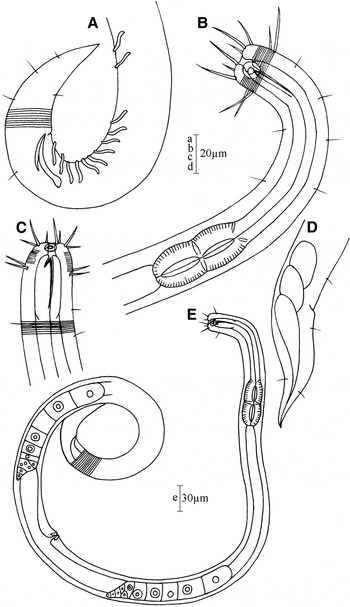
Onyx rizhaoensis sp. nov. (A) Lateral view of holotype posterior end, showing spicule, gubernaculum, precloacal supplememts and part detail of surface body cuticle; (B) lateral view of holotype anterior end, showing setiform anterior sensilla, amphidial fovea, buccal tooth and posterior pharyngeal bulb; (C) lateral view of female head end, showing amphidial fovea and buccal tooth; (D) lateral view of female tail region, showing caudal gland cells; (E) entire view of female body, showing reproductive system.

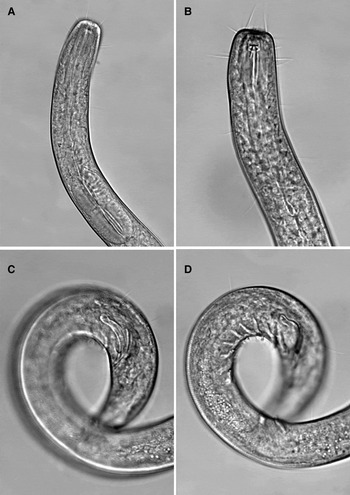
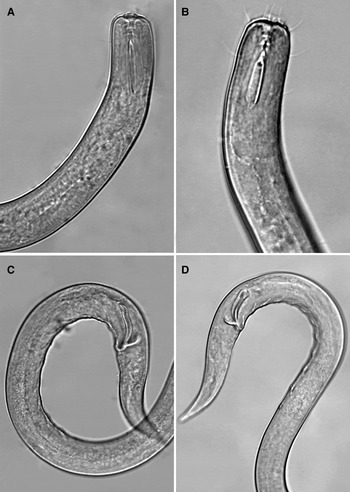
Onyx rizhaoensis sp. nov. (A) Lateral view of female cervical region, showing posterior pharyngeal bulb; (B) lateral view of holotype, showing setae and buccal tooth; (C) lateral view of male tail end, showing spicule and gubernaculum; (D) lateral view of male posterior part, showing precloacal supplememts.

TYPE MATERIAL
Two males and four females were collected from the sampling sites in July 2008. Holotype: ♂1 (slide number: RZ080422-4); paratypes: ♂2, ♀1, ♀2 in slide RZ080422-3, RZ080422-1 and RZ080422-4, respectively.
TYPE LOCALITY AND HABITAT
Intertidal sandy sediment at Rizhao coast of the Yellow Sea: 119°34′E 35°26′N.
ETYMOLOGY
This species is named after the sea area Rizhao of the type locality.
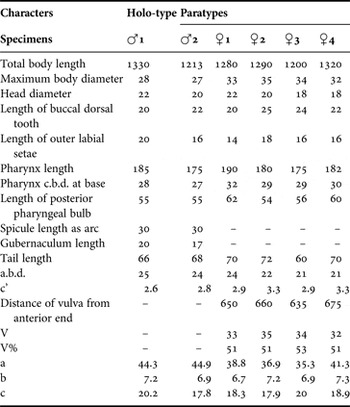
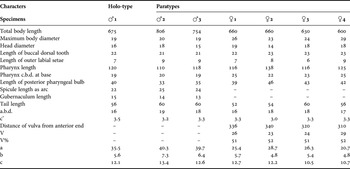
MEASUREMENTS (TABLE 1)


Individual measurements of Onyx rizhaoensis sp. nov. (in μm except for ratios).

DESCRIPTION
Male. Body cylindrical, tapered in tail to a pointed end. Cuticle with fine transverse striations extending from middle of amphidial fovea to tail tip. Head 22 μm wide, surrounded by one circle of sensilla setae, which consisted of six longer outer labial setae, 20 μm long and four shorter cephalic setae, 10 μm long. Inner labial sensilla not observed. Eight 18 μm subcephalic setae posterior to amphidial fovea edge. Cervicle setae irregularly distributed. Amphidial fovea with a single loop, 10 μm in diameter, located far anteriorly in head region. Buccal cavity cup-shaped with a large spear-shaped dorsal tooth, 20 μm long. Pharynx, anteriorly slightly widened, posteriorly with an elongated double bulb with a constriction in the middle. Cardia not discernible. Secretory-excretory system not observed. Tail short conical with three caudal glands. Two of which extend anteriorly beyond cloacal opening. Caudal setae scattered in tail region, about 15 μm long.
One anterior outstretched testis. Spicules regularly bent, proximal end cephalated and distal end tapered, 30 μm long along arc. Gubernaculum plate-like, 20 μm long in holotype, without apophysis. 12 S-shaped tubular precloacal supplements (11–14 μm) in 10 + 2 arrangement, posterior 10 closely spaced, anterior 2 set apart.
Female. Similar to males in most aspects. Amphidial fovea smaller and more anteriorly, i.e. almost at apical surface of the head. Ovaries paired, opposed, reflexed. Anterior ovary situated on the right side of the intestine, 160 μm long and posterior one 170 μm long. Vulva situated at about midbody.
Differential diagnosis
In addition to the genus characters Onyx rizhaoensis sp. nov. with relatively long cephalic setae; 12 S-shaped tubular precloacal supplements in 10 + 2 arrangement, posterior 10 closely spaced, anterior 2 set apart; vulva situated at about midbody. The new species most resembles Onyx perfectus Cobb, Reference Cobb1891 in most features but differs from it in dorsal buccal tooth length (20 vs 52 μm), spicules length (30 vs 52 μm), the number and arrangement of precloacal supplements (12 in 10 + 2 pattern vs 13 in evenly spaced), relatively posteriorly located vulva (51 vs 47%). In the arrangement of precloacal supplements, the new species is similar to Onyx potteri Hourston & Warwick, Reference Higgins and Thiel2010 but differs from it in the number of precloacal supplements (12 in 10 + 2 pattern vs. 10 in 8 + 2 pattern), amphidial fovea structure (single loop vs2.75 turns), spicules length (30 vs 50 μm) and gubernaculum shape (plate-like vs oval-like).
Onyx minor sp. nov.
(Figures 3 & 4)
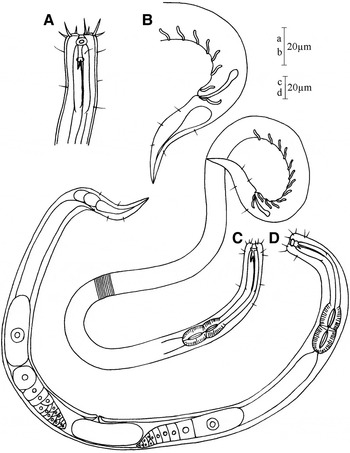
Onyx minor sp. nov. (A) Lateral view of male head end, showing setiform anterior sensilla, amphidial fovea and buccal dorsal tooth; (B) lateral view of male tail end, showing spicule, gubernaculum and precloacal supplements; (C) entire view of male body; (D) entire view of female body, showing reproductive system with eggs.

Onyx minor sp. nov. (A) Lateral view of female head end, showing buccal cavity and dorsal tooth; (B) lateral view of male anterior end, showing setiform anterior sensilla and dorsal tooth; (C) lateral view of male posterior body region showing spicule and gubernaculum; (D) lateral view of male tail region, showing gubernaculum and precloacal supplements.

TYPE MATERIAL
Three males and four females were collected from the sampling sites in July 2008. Holotype: ♂1 (slide number: RZ080422-6); paratypes: ♂2, ♀1, ♀2 in slide RZ080422-6, RZ080422-7 and RZ080422-8, respectively.
TYPE LOCALITY AND HABITAT
Intertidal sandy sediment at Rizhao coast of the Yellow Sea: 119°34′E 35°26′N.
ETYMOLOGY
Species name refers to small body.



DESCRIPTION
Male. Body cylindrical, tapered in tail to a pointed end. Cuticle with very fine transverse striations. Head 16 μm wide, surrounded by one circle of 10 almost equal sensilla setae, which consisted of 6 outer labial setae and 6 cephalic setae, 7 μm long. Inner labial sensilla not observed. Eight subcephalic setae in one circle, 7 μm long, posterior to amphidial fovea. Cervicle setae irregularly distributed. Amphidial fovea with a single loop, 5 μm in diameter, located anteriorly in head region. Buccal cavity cup-shaped with a large spear-shaped dorsal tooth, 22 μm long. Pharynx, anteriorly slightly widened, posteriorly with an elongated double bulb with a slight constriction in the middle, 40 μm long. Cardia not discernible. Secretory-excretory system not observed. Tail short conical with 3 caudal glands. Two of which extend anteriorly beyond cloacal opening. Several short caudal setae scattered in tail region.
Monorchic. Spicules regularly bent, cephalated proximally and tapered distally, 22 μm long along arc. Gubernaculum slender curving parallel to spicule tip and with a hooked dorsal apophysis. 12 S-shaped tubular precloacal supplements in even distance apart, each one about 10 μm long.
Female. Similar to males in most aspects. Amphidial fovea smaller and slightly more anteriorly on the head. Two opposed and reflexed ovaries. Anterior ovary situated on the right side of the intestine, 96 μm long and posterior ovary 135 μm long. Vulva situated at almost midpoint of the body.
DIFFERENTIAL DIAGNOSIS
Onyx minor sp. nov. is characterized by a relatively smaller body (600–806 μm long) for the genus, amphidial fovea with a single loop, forward in position, gubernaculum slender parallel to spicule and with a hooked dorsal apophysis, 12 S-shaped tubular precloacal supplements fairly evenly spaced. The new species most resembles Onyx macramphis Blome & Riemann, Reference Blome and Riemann1994 in the body length (their bodies shorter than 900 μm) but differs from it in amphidial fovea structure (single loop vs spiral with four turns), the number of precloacal supplements (12 vs 14), and anteriorly located vulva (51 vs 55%) in female.
KEY FOR ONYX MALES INCLUDING TWO NEW SPECIES
1 Male with atypical sigmoidal precloacal supplements 2
- Male with typical sigmoidal precloacal supplements 3
2 Male with 22 cup-shaped precloacal supplements O. rugatus Wieser
- Male with 7 tubular precloacal supplements O. septempapillatus Wieser
- Male with 10 conical precloacal supplements O. dimorphus Gerlach
3 All supplements in staggered row 4
- All supplements uniform and not in staggered row 6
4 Male with 18 equally sized supplements O. orientalis Tu et al.
- Male with different sized supplements 5
5 Male with 18 supplements in 4 different size groups O. adenophorus Blome & Riemann
- Male with 15 supplements in 3 different size groups O. cannoni Blome & Riemann
6 Amphidial fovea dimorphism in shape, male's elongated-oval, female's spiral with 2 turns O. cobbi Tu et al.
- Amphidial fovea no dimorphism in shape 7
7 Male amphidial fovea with multispiral 8
- Male amphidial fovea with a single loop 10
8 Male amphidial fovea broader than c.b.d., with 4–5 turns O. macramphis Blome & Riemann
- Male amphidial fovea narrower than c.b.d., with 2–3 turns 9
9 Amphidial fovea with 2.5 turns, 8 supplements O. blomei Tu et al.
- Amphidial fovea with 2.75 turns, 10 supplements O. potteri Hourston & Warwick
- Amphidial fovea with 3 turns, 15 supplements O. paradimorphus Tu et al.
10 Tail short, less than 1.5 a.b.d. O. mangrovi Tu et al.
- Tail longer than 2 a.b.d. 11
11 Outer labial setae longer than 15 μm (0.5–1 c.b.d.) 12
- Outer labial setae short than 15 μm (0.5 c.b.d.) 14
12 Male with 12 supplements in 10 + 2 arrangement O. rizhaoensis sp. nov.
- Male with 13–23 supplements in about evenly spaced 13
13 Presence of two groups of setae anterior to spicules, 15–23 supplements
O. balochiensis Nasira, Rehmat & Shahina
- Absence of groups of setae, 13–17 supplements O. perfectus Cobb
14 Male with 12 supplements Onyx minor sp. nov.
- Male with 14–16 supplements O. cangionensis Tu et al.
- Male with more than 22 supplements 15
15 Male with 24 supplements, presence of the cervical field of short setae
O. cephalispiculus Hourston & Warwick
- Male with 22–24 (23) supplements, absence of the cervical field of short setae O. sagittarius Gerlach
ACKNOWLEDGEMENTS
The authors would like to thank Ms Guilan Qi for her kind help in samples collection. We are also grateful to Dr Xiuqin Wu for providing the related references. Several anonymous referees provided valuable comments for the paper.
FINANCIAL SUPPORT
This work was supported by National Natural Science Foundation of China (Nos 30770250 and 41176107).